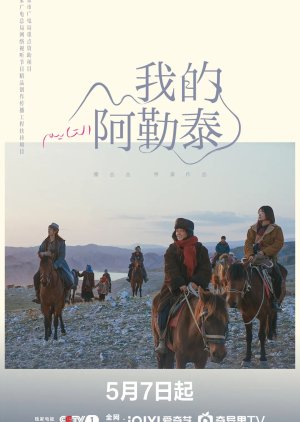
To the Wonder

我的阿勒泰 ‧ Drama ‧ 2024
Completed
tinydog
4 people found this review helpful
Feb 6, 2025
8 of 8 episodes seen
Completed 1
Overall 10
Story 10
Acting/Cast 10
Music 10
Rewatch Value 10

My Altay – A Lyrical Ode to the Altay Frontier

The miniseries To the Wonder (我的阿勒泰), adapted from Li Juan’s eponymous essay, captures the vast expanse of the Altay region and the solitude of pastoral life. It tells the story of a young woman who leaves behind the city for the open landscapes of Xinjiang, where she encounters a Kazakh herder. Their tentative relationship unfolds against the backdrop of changing seasons, shaped by unspoken emotions, fleeting moments, and the tension between tradition and modernity.

The series vividly portrays the lives of Kazakh herders, their bond with the land, and the challenges they face. Unlike many portrayals of pastoral life that exoticize or overly romanticize it, To the Wonder presents an authentic yet deeply emotional narrative. It does not merely depict life on the steppes but immerses the viewer in its rhythms, crafting a story rich with quiet intensity. The use of real locations and natural lighting enhances the immersion, making the shifting landscapes feel like characters of their own.

Beneath the beauty of this world lies an unspoken anxiety—the erosion of traditions, the pull of urbanization, and the question of what is left behind. The deeper message of the series is one of adaptation—minorities navigating the pressures of a changing world and reconciling the need to preserve identity with the inevitability of progress. Once deeply rooted customs, like the tradition of never selling live sheep as products—insisting instead on slaughtering them as a gesture of goodwill and hospitality—have gradually faded, mirroring the broader cultural shifts within these communities.

This theme of adaptation is most apparent in Sulitan’s arc. He is forced to relinquish symbols of his heritage—his guns are confiscated, he gives up falconry, and ultimately, he accepts his son’s relationship outside of their religion. These moments, though painful, reflect the broader struggle of holding onto the past while acknowledging the inevitability of change. His loss of falconry, once an integral part of Kazakh identity, is not just personal but emblematic of a wider reality where government regulations and modernization steadily erode long-standing ways of life.

The series stands out for its commitment to linguistic and cultural authenticity. Native Kazakh speakers play key roles, lending the dialogue a natural cadence and emotional weight rarely seen in mainstream Chinese dramas. The lead actor, Yu Shi’s decision to learn Kazakh for the role, rather than relying on dubbing, is a rare and commendable effort that adds to the depth of his performance. These details ground the story, making it feel lived-in rather than performed.

The romance at the heart of To the Wonder is one of restraint and longing. The connection between the protagonist and the herder unfolds through glances, shared silences, and the weight of unspoken words. There are no grand declarations, only the slow burn of emotions that mirror the vastness of the land itself. Their story is shaped by circumstances as much as personal choice, reinforcing the themes of transience and the fleeting nature of human connection.

The cinematography is breathtaking, capturing the Altay region in all its seasonal splendor. Wide-angle shots emphasize the isolation of the characters against the endless horizon, while golden hour lighting bathes scenes in a soft glow, enhancing their dreamlike quality. The interplay of light and shadow adds an almost hypnotic atmosphere, drawing viewers into the stillness of the landscape. Each frame feels intentional, as if preserving a moment before it vanishes.

Perhaps the most magical moment in the series is one that was never planned. It came not during filming, but at the airing of its finale. A geomagnetic storm swept over Xinjiang, bathing the region in a once-in-a-lifetime occurrence of the aurora borealis. The timing was uncanny—the crimson skies mirrored the most emotional scenes during the climax, making the experience feel almost supernatural. This coincidence only deepened the series’ themes of fate, wonder, and the unexplainable beauty of the world.

To the Wonder is not a conventional drama filled with high-stakes conflicts or fast-moving plots. Instead, it is a slow-burn—a deeply felt, exquisitely shot exploration of place, identity, and the tenuous connections we forge. It demands patience but rewards viewers with a deeply immersive and emotionally resonant experience. For those willing to surrender to its unhurried pace, the series offers something rare: a chance to truly feel a landscape, to inhabit the silences between words, and to find wonder in the everyday.

A masterpiece of mood and atmosphere, To the Wonder is a love letter to the Altay region, its people, and the quiet yearning that exists within us all.

Read More

Was this review helpful to you?
Completed
Ifa
3 people found this review helpful
Jun 16, 2026
8 of 8 episodes seen
Completed 4
Overall 10
Story 10
Acting/Cast 10
Music 10
Rewatch Value 10
This review may contain spoilers

A Beautiful Misunderstanding

To the Wonder feels less like a drama and more like a season of life that you happen to inhabit for a while. In an era where most stories are propelled by urgency, whether through career ambitions, romantic endgames, or carefully engineered conflicts, this series moves at the pace of wind crossing a grassland. It is interested not in what happens next, but in what it means to pay attention. Nothing dramatic appears to be happening, and yet everything is. Dreams, ambitions, loss, longing, belonging, and difficult choices unfold not through spectacle but through observation. The result is an immersive viewing experience that quietly settles into your emotions and stays there long after the credits roll.

Adapted from Li Juan's celebrated prose, the drama follows Li Wen Xiu, a young Han Chinese woman who returns to her hometown in Altay after professional setbacks derail her literary aspirations. On paper, the premise sounds deceptively simple. In practice, it unfolds with the depth and patience of a literary novel. Rather than rushing viewers from one plot point to another, the series invites us into a state of heightened perception. Faces, silences, weather, animals, and landscapes all become part of the storytelling. It asks us to linger, observe, and gradually learn to see the world as Wen Xiu herself begins to see it.

Wen Xiu is one of the most quietly compelling protagonists I have watched. At the beginning, she measures her worth through the unforgiving standards of urban success. She is awkward, insecure, and uncertain of where she belongs. Returning home initially feels like a retreat, but it slowly becomes an opportunity. Through her spirited mother, her growing connection with the Kazakh herder Batay, and her immersion in nomadic life, she transforms from someone desperately trying to write about life into someone learning how to live it. Her journey is not about becoming extraordinary. It is about becoming present.

The drama is also a subtle reflection on creativity itself. Wen Xiu dreams of becoming a writer, but the series never treats writing as a matter of talent alone. Instead, it suggests that writing begins with attention. Before one can tell stories, one must learn how to see. The grasslands become Wen Xiu's greatest teacher, and her artistic growth becomes inseparable from her personal growth. She becomes a writer not by escaping life, but by witnessing it more fully.

Many viewers approach To the Wonder expecting a romance, and certainly the relationship between Wen Xiu and Batay provides some of the drama's most luminous moments. Yet this is far more than a simple love story. The deeper romance is between Wen Xiu and existence itself. One line from the drama stayed with me: "Men seni zhaksy koremin, I see you clearly." The locals believe that love and friendship begin with being seen, and that idea quietly becomes the emotional foundation of the entire series. Batay is not merely a love interest. He is a doorway into another way of being. He moves through life with an ease that seems inseparable from the grasslands themselves. Wen Xiu's attraction to him is intertwined with her fascination with the world he represents. At times, he almost feels allegorical, as though the landscape itself had taken human form.

Some of my favorite moments come from their conversations. When Wen Xiu looks at a horse skull hanging from a tree and remarks that it resembles witchcraft, Batay gently corrects her: "There's no witchcraft, only nostalgia." He explains that horses are companions, and when one dies, its memory remains in places people frequently pass. It is such a simple explanation, yet it reveals an entire philosophy toward grief. Loss is not hidden away. It becomes part of the landscape. In another scene, Batay explains that Saykhan means "splendid" in Mongolian, while in Mandarin it sounds like "rainbow." He then smiles and calls it "a beautiful misunderstanding." That line perfectly captures their relationship. They come from different worlds, yet beauty often emerges through those differences.

Their romance is tender, playful, and refreshingly sincere. The teasing, the small nudges behind her grandmother's back, Batay's nervous hesitation before trying to kiss her, and the vulnerability hidden beneath his confidence make their connection feel achingly real. One moment that particularly stayed with me was when Batay, caught between family expectations and his own desires, quietly asks Wen Xiu, "Will you still like me?" The uncertainty in his voice could disarm even the most committed anti-romantic. Yet what makes To the Wonder remarkable is that it never reduces itself to whether these two people end up together. Instead, it consistently returns to a larger and more profound idea: the freedom of accepting our own smallness.

Contemporary culture constantly insists that we must become exceptional, visible, and unforgettable. To the Wonder proposes something quieter. When Wen Xiu asks her mother, "Although I'm clumsy, I'm still useful, right?" Her mother replies, "What do you mean by useful? Did I give birth to you so you can serve others? Look at the trees and grass on the grassland. They are useful if people eat and use them. But if no one uses them, it's perfectly fine for them to simply exist. They are free, aren't they?" There is something deeply comforting in that philosophy.

While Wen Xiu searches for meaning, her mother already possesses an intimate understanding of life's unpredictability. She knows that plans fail, money disappears, and people disappoint, yet she continues forward with humor, resilience, and grace. In many ways, she embodies the drama's central belief that life does not need to be perfect to be beautiful. Compared to city life, where achievement often becomes a measure of worth, Altay offers a radically different proposition. The mountains do not care about your résumé. Horses do not ask for credentials. The wind grants no awards. Nature's indifference becomes a source of comfort. Freed from the exhausting need to prove herself, Wen Xiu gradually discovers a more durable sense of belonging.

I know the ending has divided viewers, but I find myself among those who appreciate it. My initial reaction mirrored many others. The tonal shift felt abrupt. However, the more I sat with it, the more essential it became. Until that point, viewers can still lean into a somewhat romanticized vision of the grasslands. The landscape is beautiful. The people are resilient. Batay is charismatic. Even hardship arrives wrapped in poetry. Then Snowshoe's death shatters that illusion. Altay ceases to be a pastoral fantasy and becomes something more honest. Nature is beautiful, but it is also indifferent. Love exists, but so do consequences.

Batay's impossible split-second decision is not a choice between love and companionship. It is a choice to do what is right in a terrible circumstance. Snowshoe is not merely a horse. He is a companion, partner, and extension of Batay's life. The drama spends enough time establishing that bond that the tragedy lands with devastating force. What struck me most was not only the loss itself, but the immediacy of Batay's response as he ends Snowshoe's suffering in front of everyone, including Wen Xiu. From that moment onward, nothing can return to what it was before.

The hardest part is that nobody is truly at fault. Wen Xiu never intended harm. Batay never wanted to lose Snowshoe. Snowshoe did nothing wrong. Yet tragedy happens anyway. In a more conventional drama, there would be a villain to blame. To the Wonder is interested in something less comforting but more truthful: sometimes lives change because people are imperfect, distracted, inexperienced, or simply unlucky.

What makes the ending so impactful is the aftermath. Snowshoe's death is not merely an accident. It is a sacrifice. The question is not whether Wen Xiu is guilty, but whether she can live with the knowledge that her actions contributed to a loss she never intended. Whether Batay blames her or not becomes almost irrelevant. Grief settles between them like an unspoken presence. What remains is not resentment, but irreversibility. Some experiences cannot be undone. No apology can bring Snowshoe back. No explanation can restore the innocence that existed before. Their relationship now contains a ghost. Not a ghost of blame, but a ghost of memory. Every glance carries the knowledge of what happened. Every interaction carries the absence of what was lost.

For me, this becomes a catalyst for Wen Xiu's growth. She learns that you can love someone and still hurt them. You can mean well and still cause damage. One small mistake can alter another person's life forever. Snowshoe's death shatters her romantic idealization of the grasslands and transforms her from a visitor into someone emotionally entangled with this place and its people. The cost of loving something is that its suffering eventually becomes part of your own story. That is why the ending feels mature rather than tragic. It understands that some wounds do not heal cleanly. They become part of who we are, like scars. It also understands that the purpose of love is not always permanence.

While some viewers wanted more romance, more happiness, or a cleaner resolution, I think the ending beautifully dismantles the fantasy of closure. After everything that happens, the story focuses on what truly matters: Wen Xiu's ability to appreciate, witness, and be present. Batay is never reduced to a romantic reward waiting at the end of her journey. He remains fully himself, with a life that extends beyond the heroine's narrative. The tragedy is not that Wen Xiu loses him. The tragedy is realizing that some beautiful things cannot be kept without destroying the very qualities that made them beautiful in the first place. This is why I do not consider the ending sad, even though it carries melancholy. Sadness wants reality to be different. Melancholy accepts reality while grieving its beauty. The Portuguese word saudade comes to mind: a longing for something precious that is absent, accompanied by gratitude that it existed at all. The ending exists in that emotional space.

The visuals deserve special praise. The landscapes are breathtaking, but the cinematography never treats them as postcards. The camera understands that beauty is not something to admire from a distance but something to live within. You can almost feel the chill of the morning air, hear livestock moving across the plains, and sense the immense silence stretching beyond the horizon. Even the controversial sequence in the final episode impressed me. The shift in color, atmosphere, and expression creates an emotional weight that lingers long after it ends.

The casting is equally outstanding. Every actor feels completely at home in this world. Yu Shi, in particular, disappears into Batay. His dedication is visible in everything from his command of the local language and dialect to the physical demands of the role. The horseback riding, dancing, singing, and stunts never feel performative. They feel lived in. What I loved most, however, were the tiny details: the awkward laughs, the soft chuckles, the thoughtful hums. Those small moments make Batay feel like a real person rather than a character. The local actors are equally memorable, bringing a lived-in realism that grounds the entire drama.

In the end, To the Wonder is a poetic, introspective, and deeply immersive experience. It shifts one's perspective from the relentless pursuit of achievement toward gratitude for life, presence, and even smallness. It encourages us to see clearly, to pay attention, and to appreciate what is right in front of us. I came for the romance and the beautiful scenery, but I left with something much harder to articulate. After watching it, the world feels a little larger, a little quieter, and infinitely more worth noticing.

Read More

Was this review helpful to you?
Completed
DJL
4 people found this review helpful
May 11, 2024
8 of 8 episodes seen
Completed 0
Overall 10
Story 10
Acting/Cast 10
Music 10
Rewatch Value 10

Wonderful Reality Drama

I did not expect this series to be so good. So realistic and beautiful scenery. Love to see the captivating cultures.
Such a wonderful work of art. I’m glad I decided to watch it and it was a gems. I wondered how long for these actors & actresses to learned the language. I found this series is an eye opening how wonderful is the grassland and how free their life is.
Was this review helpful to you?
Completed
ysadulset
2 people found this review helpful
May 15, 2026
8 of 8 episodes seen
Completed 0
Overall 9.5
Story 9.5
Acting/Cast 10
Music 10
Rewatch Value 9.0

Oh, to be seen clearly beneath the wide skies.

The cinematography deserves all the praise it gets online. Almost every scene is breathtaking without looking overly composed for aesthetics alone. The camera pauses just long enough for us to take in the world around the characters, whether it is sheep moving across distant hills or the stillness of the grasslands.

What I loved most, though, was how unforced everything felt. The landscape is beautiful, yes, but the drama never treats the setting like a glossy travel brochure. Life simply unfolds there. People work, eat, argue, migrate, reconnect, and continue on with their routines. None of it feels empty because the series understands the rhythm of the place it is portraying. There is beauty in that life, alongside difficulty, isolation, and constant movement. Every moment carries texture because the world around them is lived in.

I have very little knowledge about Kazakh culture, so everything felt new. The drama presents the culture in such a raw and observant way that it almost sits somewhere between fiction and documentary, with both sides complementing each other naturally. Traditions, language barriers, and changing lifestyles are woven into daily conversations and routines. We can feel a way of life slowly shifting under modern pressures, alongside the uncertainty of whether to adapt or hold on more tightly to tradition. The series never pushes a clear judgment nor romanticizes anything either way.

I also did not expect that I'd end up liking the people, nor did I expect I'd find the journey romantic in more ways than one. Wenxiu’s experience of returning home and slowly immersing herself in a culture she once felt distant from carries its own romance. Her story could have easily turned into a familiar "city vs countryside" narrative, yet the drama wrote her journey with much more patience. We simply observe her drifting through uncertainty, writing, family, loneliness, and fleeting moments of happiness until she slowly begins seeing herself more clearly too.

The romance between Wenxiu and Batay fits just right into that journey. There are barely any scenes loudly announcing that romance is developing, yet it is always there beneath the surface. Most of their connection exists through small conversations, glances, and quiet understanding. By the time they confess, the feelings had already settled in long before either of them said it aloud.

I also liked how different yet warm her family dynamics were, especially with her mother. She carries humor, exhaustion, practicality, and affection all at once, and she steals scenes whenever she appears. Though, somehow, her mother ended up getting more scenes I would have wanted to see with the main couple, which was both hilarious and slightly criminal.

That, along with that one dramatic spin before the finale, is probably why this remained a 9.5 instead of becoming a perfect score for me. Eight episodes felt right for the story’s overall flow, and stretching it further may have weakened the atmosphere, though I still wanted more time with the main couple after they reunited.

I can also understand why this drama may not work with some. Anyone expecting a focus on romance, heavy twists or constant emotional highs might find it too understated. The drama is intentionally slow because it wants us to sit with these people and their way of life for a while. It captures that uncertain period where people are still figuring out where they belong, and how certain encounters quietly change them along the way.

Read More

Was this review helpful to you?
Completed
SanaRehmat
2 people found this review helpful
9 days ago
8 of 8 episodes seen
Completed 0
Overall 8.5
Story 8.5
Acting/Cast 8.5
Music 8.5
Rewatch Value 8.5
This review may contain spoilers

A Beautiful Glimpse into Kazakh Life

To the Wonder is one of those dramas that feels less like a story and more like a glimpse into someone else's life. More than anything, I watched it for its breathtaking scenery. The vast grasslands, mountains, forests, flower fields, and summer pastures are absolutely beautiful, but the real beauty lies in the simple lives of the people who call this place home.

What I loved most was getting a small window into Kazakh culture and traditions. From the language and festivals to the food and nomadic lifestyle, everything felt natural and authentic rather than something put on for the camera. It was refreshing to see a Chinese drama focus on an ethnic minority and show both the beauty of their traditions and the challenges of preserving them in a changing world.

The story itself is quiet and simple. There aren't huge plot twists or over-the-top conflicts. Instead, it follows ordinary people trying to live, love, chase their dreams, and make difficult choices. Every character feels believable because their struggles are so relatable. The romance is gentle and understated. It never tries to steal the spotlight, but grows naturally alongside the characters.

The cinematography deserves special praise. The natural lighting, wide landscapes, and warm colors make every scene feel like a painting. I also appreciated that the drama didn't rely on heavy beauty filters, allowing the scenery and the people to feel real. At times, I genuinely forgot I was watching a drama and felt like I was experiencing a documentary.

It was also nice hearing familiar references to Islamic traditions and festivals like Eid al-Adha. Even though some cultural differences surprised me at first, it was interesting to see how another Muslim community practices its traditions in its own way.

If I had one complaint, it's that the drama is simply too short. This easily could have been a full-length series. I wanted to spend more time with these characters, see more of their lives after the ending, and explore even more of this beautiful world.

To the Wonder isn't a drama you watch for suspense or fast-paced storytelling. You watch it to slow down, appreciate nature, experience another culture, and spend time with characters who feel wonderfully human. By the end, it genuinely made me think that living away from the city, despite its hardships and limited resources, might not be such a bad life after all. It is a quiet, heartfelt, and unforgettable journey.

Read More

Was this review helpful to you?
Completed
Magsie224
2 people found this review helpful
Jun 18, 2024
8 of 8 episodes seen
Completed 0
Overall 10
Story 9.5
Acting/Cast 10
Music 9.0
Rewatch Value 8.0

To the Wonder.

What a stunning drama. With ease i could have given this drama 10s across the board, However nothing in this world is perfect. But it was very close to. It felt like i was watching a slice of life from another culture filmed as it is. It never crossed my mind that they were actors in a drama, it all felt so real. The scenery is just beautiful, i wish i could go there, it felt like there was space to breathe. I really hope it stays that way. Protected.
I found it touching and could relate to the struggles to cope with the changes to life, the new rules and regulations, and restrictions. I am more than old enough.
Thank you so much to the whole team for producing such an interesting, and thoughtful drama for us all to enjoy.

Read More

Was this review helpful to you?
Completed
Ramnyli
2 people found this review helpful
Mar 4, 2026
8 of 8 episodes seen
Completed 0
Overall 9.5
Story 9.5
Acting/Cast 10
Music 9.5
Rewatch Value 10

To the Wonder is more than a drama; it's an experience

To the Wonder is a breathtakingly beautiful drama that quietly steals your heart. It unfolds as a deceptively simple story, yet its gentle pull is irresistible, drawing you into its world so completely that you cannot help but fall in love. The cinematography is stunning, capturing landscapes so vast and pure they feel like a character in themselves.

The drama's power lies in its profound authenticity. The performances are so natural and unforced that I often felt less like a viewer and more like a silent witness to a documentary. It offers a raw and intimate glimpse into a traditional existence, masterfully portraying the friction and poetry that arise when modernity gently brushes against ancient customs. The Kazakh way of life, with the village feeling like one extended, loving family, was a true privilege to experience.

At its heart, the drama beats with the extraordinary chemistry between Wen Xiu and Ba Tai. Their connection is so genuine and sweet that I found myself giggling along with them, completely charmed by their tenderness. My only, very slight, complaint is that I longed for just a few more moments with them at the end—but to say more would be to spoil the drama.

To the Wonder is more than a drama; it's an experience. An absolute must-watch.

Read More

Was this review helpful to you?
Completed
Kthln
1 people found this review helpful
Jan 6, 2025
8 of 8 episodes seen
Completed 0
Overall 10
Story 10
Acting/Cast 10
Music 10
Rewatch Value 10

A masterpiece

I'm so happy I'm a curious person because I don't think I would've found this if I wasn't .
This drama is quite literally one of the most beautifully made things ever. It's so beautifully written, the characters are so loveable and well crafted, it has the most beautiful cinematography. The leads have SUCH GOOD CHEMISTRY my heart fluttered every time they were on screen together. Please watch this underrated masterpiece!
Was this review helpful to you?
Completed
Hanyasmine
1 people found this review helpful
Apr 5, 2025
8 of 8 episodes seen
Completed 0
Overall 8.5
Story 8.5
Acting/Cast 10
Music 8.0
Rewatch Value 5.5

A cultural experience

As a Muslim woman living in a "Muslim" country, watching this show initially caught me off guard with the “Islamic” elements—it was a bit of a shock, honestly. They were praying, talking about Eid al-Adha... and then drinking alcohol?? That really threw me off at first!

But then I reminded myself: it's just cultural differences. Everyone lives and practices their faith in their own way, and that’s okay.

This show ended up being a really unique and moving experience for me. I felt like I was living those moments right alongside the characters. I truly loved it. (Also, the male lead? Super cute. The mother SO BEAUTIFUL!!!! )
I wish they were more c-dramas about ethnic minorities.

Read More

Was this review helpful to you?
Completed
art
1 people found this review helpful
Aug 24, 2025
8 of 8 episodes seen
Completed 0
Overall 10
Story 10
Acting/Cast 10
Music 10
Rewatch Value 10

a hidden gem!

this is so beautiful that i’m crying while writing this. i enjoyed it so much that i didn’t want it to end. i’m so happy i came across it. the cinematrogaohy, the aesthetics, the slice of life scenes, the realism, the innocent romance, EVERYTHING about this is chefs kiss. it’s a total breath of fresh air from other cdramas. i’m used to faster paced dramas but this was able to immerse me right from the start to the end. the acting is SUPERB. i’ve added this wonderful short drama to my list of comfort cdramas <3
Was this review helpful to you?
Completed
Drama Addict
1 people found this review helpful
Jan 15, 2026
8 of 8 episodes seen
Completed 0
Overall 10
Story 10
Acting/Cast 10
Music 10
Rewatch Value 9.0

Under the Vast Sky of Altai

I was utterly spellbound by the ending theme song. It is the kind of melody that seeps quietly into your heart and refuses to leave. Beautiful, lyrical, sentimental, romantic and richly ethnic, it carries the vastness of the land within its notes. As it plays, you can almost imagine yourself lying in the endless grasslands of Altai, gazing up at the open sky, breathing in freedom itself. For those curious, you can listen to it here: https://www.youtube.com/watch?v=LiUbJKGKiP4.

I first heard about this drama while travelling in Xinjiang, when our tour guide mentioned it almost in passing. At the time, it felt like one of those fleeting travel anecdotes you tuck away and forget. Yet it lingered somewhere in my mind, and over a year later, I finally tracked it down on iQIYI. Its Chinese title is My Altai. Set in the Altai region of Xinjiang, the drama is a rare linguistic tapestry, with much of the dialogue in Kazakh, interwoven with Mandarin spoken by Han Chinese characters, all supported by English subtitles. This alone gives the series an authenticity that immediately sets it apart.

Xinjiang is a multilingual, multicultural land, and Altai is among its most breathtaking regions, often described as the Switzerland of China. Watching this drama felt less like viewing a story and more like revisiting a place. The sweeping landscapes, roaming herds, and quiet rhythms of nomadic life stirred memories of the people and the raw beauty of the region.

At the heart of the story is Li Wenxiu, a Han Chinese girl with dreams of becoming a writer. Her life in Urumqi, however, proves deeply unsatisfying. Burdened by failure and grief, she travels to Altai to join her mother, who is mourning the loss of her husband and has retreated to this remote land to survive and heal. There, Wenxiu befriends the locals and helps her mother run a small shop to make ends meet. It is in this rugged yet gentle world that she meets Batay, a free-spirited nomadic young man who dreams of becoming a horse trainer. Their bond grows quietly but deeply, shaped by shared moments under wide skies. Love blossoms, only to be tested by a sudden accident and the pull of diverging ambitions. Fate drives them apart, leaving the lingering question: will their paths cross again?

In this short drama, you are confronted with a heart-rending moment when a man is forced to shoot the horse he loves and has nursed back to health in order to save the woman he loves. In that instant, the audience grieves alongside them both, sharing their unbearable loss and sacrifice.

The setting is raw and rugged, reflected in the landscape and the people who inhabit it. Most of the cast appear naturally sun-tanned, as though shaped by wind and weather. The male lead (Chinese name: Yu Shi), of Mongolian descent, embodies this environment perfectly, ruggedly handsome with a presence that feels both grounded and authentic. I hope to see more of him in future dramas.

Beyond romance, the drama paints a moving portrait of nomadic life and the cultural tensions beneath its surface. It explores cross-cultural relationships, generational conflict, and the painful choices faced by the young. Modern life beckons with promises of stability and opportunity, tempting them to abandon the wandering traditions of their ancestors. Meanwhile, the older generation clings fiercely to the old ways, holding on for as long as their bodies and spirits allow.

This is not the kind of drama I usually gravitate towards. I confess that I am easily drawn to glittering costumes, poetic dialogue, and visually polished casts. At first, this drama felt slow, understated, and even a little dull to me. Yet, almost without realizing it, I found myself completely absorbed. What began as mild curiosity turned into deep affection. By the end, it had quietly claimed a place in my heart.

For its sincerity, its cultural richness, and its haunting sense of place, I would highly recommend this drama. It does not shout for attention, but if you let it, it will stay with you long after the final note fades.

Read More

Was this review helpful to you?
Completed
emimai2910
1 people found this review helpful
Jun 19, 2025
8 of 8 episodes seen
Completed 0
Overall 10
Story 10
Acting/Cast 10
Music 10
Rewatch Value 10
This review may contain spoilers

Insanely breathtaking in more ways than one!

Just finished it all in one sitting and I have to leave a review immediately.

Many shows can be 10/10 but not many shows will leave me reeling from how beautifully perfect it was. This show gives me the same feeling I have after finishing My Liberation Notes but a thousand times more breathtaking.

I didn't know much about ethnic minorities in China before this but the show was extremely educational about the customs and traditions of the Kazakhs in Northeast China. But not in a "tribal" kind of ways that western shows sometimes portray minorities. Every characters had depths and are so relatable that we could see the parallel of their lives to ours even though their language, cultures and costumes are different. And this was an INSANE thing to achieve in just 8 episodes less than 40 minutes!!!

The acting is *chef kiss*, somehow everyone are so authentic and real. But I really have to give it to Ma Yili as Zhang Fengxia, she is a complicated, colourful, compassionate and everytime she is on screen i am completely speechless.

Don't even get me started on the landscape! OMG!!! Imagine falling in love, dancing, singing and just spend days with your love ones in such beautiful greenery🤯

Finally, the show is again reminding me of the connection native people have to their land. We see the impact of capitalism in expropriating the resources and also how these actions could damage the environment for the animals and natives.

The show is absolutely perfect for me, great cinematography, beautiful everything and all wrapped in respectful potrayals of their main subjects ❤️. A definitive must watch again and again

Read More

Was this review helpful to you?
To the Wonder poster

Details

Statistics

  • Score: 8.8 (scored by 2,851 users)
  • Ranked: #195
  • Popularity: #2786
  • Watchers: 8,557

Top Contributors

24 edits
21 edits
19 edits
18 edits

Popular Lists

Related lists from users

Recently Watched By