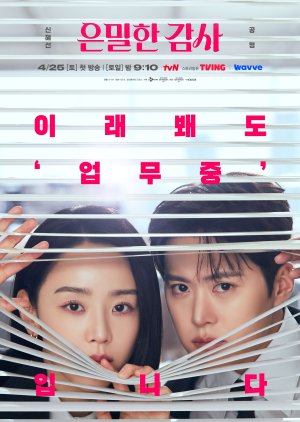
Shin Hye Sun and Gong Myoung: amazing!
From the first two episodes, I knew it would be a series worth watching until the end! The chemistry between the two leads is fantastic! I adore Shin Hye Sun first and foremost and am trying to catch up by watching all her work, but what about Gong Myoung? I didn't know him very well, but I recently finished watching "Mercy for None" and appreciated his ability to seamlessly transition from one role to the next.In short, I absolutely loved the series, both for its corporate dynamics and its writing. The subject matter is almost classic in the modern corporate world, but it didn't bore me.
Was this review helpful to you?

This review may contain spoilers
A Surprisingly Fun Mix of Romance, Business, and Office Politics
Filing for Love is one of those dramas that I went into without particularly high expectations and somehow ended up having a genuinely great time with. It isn't groundbreaking, and the overall plot isn't exactly something I haven't seen before, but the combination of great casting, strong performances, workplace investigations, business politics, comedy, character dynamics, and a surprisingly mature romance made it much more enjoyable than I expected.At its core, this is a workplace rom-com, but I think calling it just a rom-com undersells what made it fun for me. There is company politics, corporate power struggles, ethical investigations, suspense, romance, and plenty of comedy. The story follows Joo In-ah (Shin Hye-sun), the new head of Haemu Group's Audit Office, and Noh Ki-jun (Gong Myung), an ambitious auditor who finds himself demoted after In-ah arrives and restructures the department. Naturally, he isn't exactly thrilled about having the new boss responsible for his downfall.
One thing I particularly enjoyed was the business side of the drama. Honestly, I'm not sure why this isn't classified as a business drama because, in one way or another, the entire story revolves around the company. The characters' relationships, conflicts, investigations, career ambitions, internal power struggles, and even parts of the romance are all connected to the business environment.
The workplace isn't simply there as a backdrop for the love story. The auditing, corporate politics, executive power struggles, and workplace misconduct cases are all important parts of the narrative. Even when the story moves away from individual cases and into larger executive-level politics, it still feels connected to the same world.
I especially enjoyed the transition from the individual audit cases into the larger executive office politics. What could easily have felt like two completely different dramas was actually handled quite smoothly. The story gradually moved from smaller workplace investigations to bigger corporate conflicts involving the company's leadership, while simultaneously bringing in the characters' personal histories and unresolved feelings.
I liked how the business conflicts and personal relationships became increasingly intertwined. Past feelings, present relationships, career ambitions, corporate power, and company politics all started affecting one another, but the transition never felt particularly forced to me. It felt like a natural progression of the story rather than the writers suddenly throwing in a completely different plot halfway through.
And then there is the romance, which was easily my favourite part.
I absolutely loved the dynamic between In-ah and Ki-jun. The reverse power dynamic was such a refreshing change from the usual workplace romance. In-ah is the superior: intimidating, highly competent, incredibly driven, and very much in control. Ki-jun, meanwhile, is younger, more openly emotional, ambitious, and much more expressive. Instead of the usual cold, powerful male boss and timid female employee setup, we get a woman who is professionally dominant while the male lead is the one who is much more open about his feelings.
That dynamic was SO much fun to watch.
I especially loved that Ki-jun never needed to undermine In-ah's competence to make himself look better. He was understandably frustrated about being demoted, but he could still recognize how capable she was. Their relationship gradually moved from rivalry and frustration into genuine respect, partnership, and eventually love. It felt like they actually got to know each other, rather than suddenly falling in love because the script said they should.
And thank God there was no unnecessary noble idiocy or endless misunderstanding between them.
They were surprisingly honest with each other, especially once their feelings became clear. When they had problems, they actually talked about them. When Ki-jun wanted to pursue her, he pursued her. When In-ah struggled with her feelings, the conflict came from her personality and circumstances rather than some ridiculous misunderstanding that could have been solved with one conversation.
I also really appreciated that the drama treated them like adults in a relationship. Their conversations about marriage, work, career ambitions, living together, and what it actually means to build a life with someone were some of the most refreshing parts of the romance. It wasn't simply "we like each other, therefore everything is perfect." Their careers and workplace hierarchy genuinely affected their relationship, and the drama actually allowed them to think about what being together would mean.
Shin Hye-sun was, unsurprisingly, fantastic.
Joo In-ah could easily have become an unpleasant character because she's strict, intimidating, perfectionistic, and extremely demanding. But Shin Hye-sun gives her so much personality that I never saw her as simply a "cold female boss." She has this incredible ability to communicate things through the smallest expressions. You can tell when she's irritated, amused, embarrassed, sarcastic, hurt, or secretly softening toward someone without her needing to say much at all.
I particularly loved watching her gradually reveal the softer side of In-ah. She's not a character who constantly cries or needs someone to save her. She's strong, proud, incredibly competent, and willing to stand her ground. But she also has vulnerabilities and flaws, and watching her slowly acknowledge those flaws was one of the more satisfying aspects of her character.
Ki-jun's personality could have been irritating if played differently, but Gong Myung gives him so much charm. He's expressive, frustrated, competitive, affectionate, and occasionally chaotic, and his reactions made so many scenes funnier than they probably would have been on paper.
Most importantly, he matched Shin Hye-sun really well. Their chemistry was one of the biggest reasons I kept watching. Their scenes had this effortless energy where even their arguments were entertaining. Once they started becoming a proper team, I loved them even more.
The entire Audit Team 3 also deserves credit. I wasn't expecting to become attached to the supporting team, but their camaraderie was one of the things that made the workplace setting work. They felt like an actual team rather than random side characters who existed only to react to the leads.
The comedy was another pleasant surprise. I genuinely laughed quite a lot, especially during the earlier episodes. The combination of workplace investigations, In-ah's intense personality, Ki-jun's reactions, and the team dynamics created some really entertaining situations. The drama had a nice balance of comedy and corporate intrigue without becoming completely ridiculous.
I also wasn't particularly invested in Kim Jae-wook's character and his secretary's storyline. Kim Jae-wook is an actor I really like, and he performed well, but the characters themselves never had the same impact on me as In-ah, Ki-jun, or the audit team. Compared with the main couple's dynamic, that storyline often felt like the weakest part of the drama.
Still, I appreciated that the drama didn't turn the second male lead into a completely disposable obstacle. There was some development there, even if I didn't personally connect with the character. The same can't quite be said for every supporting character, though, and I do think some of those arcs could have been handled better.
Overall, Filing for Love isn't a drama I'd call revolutionary, but it doesn't need to be. Sometimes a drama is simply enjoyable because the casting works, the leads have chemistry, the characters are fun to spend time with, and the story gives you enough interesting things to keep you hooked.
For me, that was exactly what happened here.
I loved Joo In-ah and Ki-jun's relationship, the role reversal, their chemistry, the audit team's camaraderie, the workplace investigations, and especially the business aspect of the story. I enjoyed watching the drama grow from individual audit cases into larger executive-level corporate politics while simultaneously bringing the characters' personal histories and present relationships into the conflict. That progression was surprisingly smooth and never felt like the writers were forcing a new storyline just to create more drama.
It was fun, refreshing, easy to binge, and surprisingly addictive.
Nothing groundbreaking, but honestly? I had a great time watching it, and sometimes that's exactly what I want from a drama.
Was this review helpful to you?
Love this show so much
Love chemistry between them and funny stuffIt’s a very endearing story I’m praying it has wonderful romantic ending
I’ll be waiting to last episodes
One of few new shows where I’m bored in some part of it and continue to watch
Although I hate waiting for next week to come
I will continue to watch hoping I’m crying at end
Was this review helpful to you?
This review may contain spoilers
Ignore my review, it's for me to remember why I didn't like it
I review to keep track of what I've watched. I know that I'm the only person that felt this way about the show, so just scroll on.I couldn't even with this show. I skipped over massive quantities of this show just to finish it. I didn't like any of the characters, not even a little. There should be an infidelity tag, even though it doesn't apply to the leads. A department whose sole purpose is to out people having affairs in the office - what? So many people with wandering eyes. There were many times while watching this that I felt very uncomfortable.
And, this is a personal thing, but if I'm watching a romance, I don't want to get to the end just to hear that the FL doesn't want to get married.
Was this review helpful to you?

This review may contain spoilers
"I heard it through the grapevine (and I saw the photo too)."
Skillfully navigating the territory of workplace rom-coms, “Filing for Love” reveals its narrative maturity by gradually moving beyond the genre and its familiar simplifications to explore a far more complex reality: a working environment where surveillance, intrusion into private life, relentless competition, and the cult of productivity ultimately reshape even human relationships. Beneath its romantic dynamics and the inevitable conventions of the genre lies a surprisingly bitter reflection on contemporary loneliness, burnout, professional alienation, and the price many people are forced to pay when work ceases to be merely a part of life and becomes its absolute center.Through Team 3, seemingly relegated to the margins of the corporate hierarchy and tasked with handling the company's most uncomfortable and embarrassing issues, “Filing for Love” constructs a remarkably meaningful microcosm. The investigations that shape the first half of the story portray an environment in which work invades every aspect of existence, gradually transforming Haemu into a kind of city-state where people live, love, betray, and suffer almost exclusively within its boundaries.
While the first half of “Filing for Love” seems primarily concerned with the more intimate implications of work—surveillance, workplace relationships, burnout, loneliness, and the struggle to balance professional and personal life—the second half gradually broadens its scope, evolving into something close to a corporate political drama. Succession battles, reputation management, media pressure, and corporate restructuring become the natural extension of a theme that had been present from the very beginning: the company as a totalizing system, capable of extending its influence far beyond the workplace and permeating every aspect of individual existence.
Another interesting aspect of “Filing for Love” lies in its decision to subvert one of the most established dynamics of Korean workplace rom-coms. While the genre has accustomed viewers to the powerful CEO and the subordinate employee, the series instead places a woman in a position of authority, with the men around her forced to navigate that reality. The drama, however, carefully avoids reducing this choice to a simple reversal of roles. Its real interest seems to lie in the dynamics generated by power itself, regardless of the gender of the person who holds it.
When a relationship develops within a hierarchical structure in which one person has the authority to transfer, promote, or dismiss the other, the central issue is not whether that person is a man or a woman, but the imbalance of power that inevitably emerges. It is within this delicate equilibrium that Joo In-ah takes shape as one of the most compelling and well-realized characters in the entire series.
Joo In-ah (played with remarkable depth by the excellent Shin Hae-sun) is arguably the most fascinating character in the entire series. From her very first appearance, she is presented as a feared figure within the Haemu Group: an uncompromising executive, obsessed with rules and seemingly devoid of empathy. Yet, episode after episode, “Filing for Love” patiently dismantles this initial perception. In-ah is neither a moralist nor a cynic in the traditional sense of the term; rather, she is a radically pragmatic woman, accustomed to viewing the world through the lens of consequences and responsibilities.
Behind the feared executive, however, emerges a deeply lonely woman who lives an almost ascetic existence, accepts being misunderstood in order to carry out her work according to her own principles, and has turned isolation into a form of self-preservation. It is no coincidence that one of the most revealing aspects of her character emerges through her relationship with art. The woman who spends her days hidden behind regulations, disciplinary procedures, and an intimidating reputation chooses to expose herself in the most vulnerable way possible by posing as a model for an art class.
It is precisely this tension between strength and fragility, control and the need for understanding, that makes Joo In-ah one of the drama's most compelling characters. Her journey is not about learning to be strong—she has always been strong—but about gradually lowering her defenses and allowing herself the possibility of finally being seen for who she truly is.
No Ki-joon (portrayed with considerable charm by Gong Myoung) initially embodies the archetype of the perfect employee: capable, well-liked, efficient, and seemingly destined for a successful career. The series, however, quickly dismantles this surface image by exposing the vulnerabilities hidden behind the company's so-called "golden boy." His transfer to Team 3 marks the beginning of a profound identity crisis. Ki-joon has built much of his self-worth on professional achievement and the recognition he receives within the company, to the point where he can no longer distinguish between what he does and who he is. Through his character, “Filing for Love” explores one of the most insidious consequences of performance-driven culture: the risk of reducing one's identity to a professional role and gradually losing any sense of self beyond it.
Unlike many male protagonists in the genre, Ki-joon is not defined by his social status or his ability to wield power over others. His journey is instead that of a person who gradually learns to look beyond appearances, abandoning hasty judgments and preconceived notions. It is this willingness to constantly question his own assumptions that ultimately becomes his most defining quality throughout the story.
Jae-yeol (Kim Jae-young, delivering a measured performance perfectly suited to the role) is arguably the most tragic character in the entire series. In a more conventional drama, he would have been the classic second male lead destined to stand in the way of the main couple. Filing For Love, however, takes a far more interesting approach, turning him into a deeply human and melancholic figure. Every aspect of his life seems marked by a different form of deprivation: a strained relationship with a father who never considers him good enough, his mother's illness, a marriage shaped more by strategic interests than genuine affection, A-jeong's unrequited love, and, above all, his unresolved bond with In-ah.
More than an antagonist, Jae-yeol comes across as a man trapped within expectations that others have created for him. Heir, son, husband, executive: every role is imposed upon him before he has the chance to choose it for himself. Even his relationship with In-ah seems to belong more to the realm of regret and unresolved memories than to any genuine possibility in the present. In this sense, the character comes to embody one of the drama's most bittersweet ideas: success, power, and privilege do not necessarily guarantee freedom. On the contrary, they can become a cage just as suffocating as any other.
His character arc is particularly effective because the drama gradually abandons the idea of using him merely as a source of romantic tension. As the story progresses, Jae-yeol ceases to be an obstacle between the protagonists and instead becomes a symbol of everything In-ah and Ki-joon are trying to avoid: a life shaped by duty, compromise, and resignation. His personal journey ultimately takes on the contours of a quiet tragedy, one that inspires far more compassion than hostility.
A special mention should also go to A-jeong (Hong Hwa Yeon), a character the series uses to explore yet another form of loneliness and inadequacy. Ki-joon's former girlfriend and hopelessly in love with Jae-yeol, she lives constantly in the shadow of relationships that never achieve true reciprocity. Her desire to be seen and acknowledged is further complicated by a clear sense of inferiority toward In-ah, whom she perceives as unattainable both professionally and romantically. More than an antagonist, A-jeong remains the portrait of a person desperately searching for attention and belonging, enriching the broader mosaic of emotional fragility that runs throughout the series.
Through its protagonists, the series finds its most authentic voice. Beneath the romantic dynamics and the inevitable conventions of the genre, “Filing for Love” ultimately reveals itself as a story about individuals searching for a place to belong: Ki-joon seeks recognition and validation, In-ah a sense of peace that always seems just out of reach, Jae-yeol a form of legitimacy beyond the role imposed upon him by his family, and A-jeong a love that might finally be returned. Even its lightest and most entertaining moments rest upon a surprisingly bitter reality shaped by burnout, social pressure, isolation, and professional identities that gradually come to overshadow personal ones.
One of Filing for Love's greatest strengths lies in the way it develops the relationship between its two protagonists. Their romance is not born from immediate attraction or romantic destiny, but from a gradual process of mutual understanding and the slow abandonment of preconceived judgments. In the early episodes, Ki-joon sees In-ah much as everyone else at Haemu does: as a cold, uncompromising, and almost inhuman woman. His initial investigation into her affairs is driven by a desire to expose her, to find proof that something darker lies behind that carefully controlled façade. Yet the closer he gets to her, the more he discovers the exact opposite: a deeply lonely person, willing to endure the misunderstanding and resentment of others in order to do what she believes is right.
The drama charts this transformation through a series of subtle shifts in perspective. At first, Ki-joon watches In-ah in order to expose her; later, he watches her in order to understand her; eventually, he watches her because he is drawn to her.
Viewed in this light, the portrait Ki-joon creates carries far greater significance than the first kiss or any of the drama's more overtly romantic moments. If the paper clip symbolizes the birth of complicity, the portrait marks the birth of love.
For the first time, Ki-joon does not merely desire In-ah—he truly sees her, offering her a reflection of herself freed from the defenses behind which she has hidden for years. This is not a story of conquest, but one of mutual recognition: the story of a woman who has learned to live behind a suit of armor and a man who, little by little, stops looking at the armor and finally begins to see the person beneath it.
In this sense, “Filing for Love” is not truly a workplace rom-com, but a series about loneliness that uses the rom-com format as its narrative vehicle. Love is not presented as the culmination of one's existence or as a simple romantic reward, but rather as the possibility of escaping, if only for a moment, the structural loneliness generated by a system that measures a person's worth almost exclusively through productivity.
Just as the series seems to have fully embraced its most distinctive identity, some of its limitations begin to emerge. The ambition that expands the narrative from the microcosm of Team 3 to the internal power struggles of the Haemu Group enriches the story, but also accumulates a number of conflicts and subplots that the finale struggles to handle with the same care displayed earlier on. A certain repetitiveness in some of the investigative storylines, along with a few more conventional romantic detours, foreshadows a conclusion that resolves several of its most compelling tensions a little too quickly. More than the resolutions themselves, what leaves some room for reservation is the limited attention given to their aftermath.
Without reaching the excellence of the very best Korean workplace rom-coms, and despite a finale that simplifies and accelerates many of the tensions carefully built up along the way, “Filing for Love” remains a series that stands out for its thematic maturity, the quality of its character writing, and its ability to use romance as a vehicle for exploring something broader and more universal. It does not always fulfill every promise it makes throughout its journey, yet its reflection on contemporary loneliness, professional identity, and the need for belonging retains a sincerity that is rare within the genre. The journey does not always lead to the most satisfying destinations, but it remains far more interesting than most of the paths offered by traditional workplace rom-coms.
7½
Was this review helpful to you?

This review may contain spoilers
Seriously good!
I'm most likely getting ahead of myself but I think that even though the ratings so far have been fairly good, this drama is still underrated.Seriously even with the great casting I didn't have anything expectations for it but it just so good. It's not the first workplace romance drama, there's nothing really new to the plot, but it's still feels fresh.
Joo In-Ah is such a great leading lady, scary at first but slowly showing her soft side, I'm crushing on her hard! I really admire her strength and dedication, she's not the kind of female lead that would play the victim, cower and cry, she stands tall prideful and strong, love, love, looove her.
Episode 6 so far has been the best, and allthough their love triangle has peeked it's ugly head around the corner, I'm still hopeful that it won't ruin what has been so far a nearly perfect drama, with the only flaw so far being that there hasn't been enough scenes involving Kim Jaewook, but I'm sure that he will be featured more in the second half of the drama. I am excited and hopeful that it will continue to impress me, so let's see what happens next.
Why is this drama only 12 episodes!!?? I'll be so sad when it ends, I just can't get enough of it honestly. I got my wish and the second half features Kim Jaewook a lot more and I love it, so much that I'd watch even if every characters was played by him every single one from the male lead to the rats rummaging tjrough the garbage, it'd be confusing, nonsensical, absurd and stupid but it'd be beautiful and enjoyable for me. With such a strong bias towards the actor playing him Jeon Jaeyeol hasn't triggered my second male lead syndrome. Hes seems to be a pretty nice guy but he doesn't come close to No Gijun, the guy is just perfect in every single way. I love this drama beyond words and simply cannot wait for more episodes!
I just finished this one and I'm so satisfied with how it ended, I'm adding it to my favorite damas list. The only reason not rating it a 10/10 is because Park Ajeong was so bland, I never liked her, I didn't hate her, I didn't pity her and frankly I didn't understand her, I kept waiting for her to make me feel something and it never happened, never understood why she was so broke and alone, maybe because I wasn't interested in her from the beginning and didn't pay close enough attention or maybe it wasn't explained, I truly don't know and don't care, but I'm sure that'll be cleared up for me when I watch this again, because I am for sure going to.
Was this review helpful to you?
Muy linda comedia romantica!
Seguime en @tuguiakdrmas en ig!Terminé *Amor bajo auditoría* y me encontré exactamente con lo que esperaba: una serie ligera, entretenida y con muchísimo encanto.
Aunque tiene romance, algo de misterio y bastante suspenso empresarial, para mí la comedia es claramente el corazón de la serie. Gran parte de su atractivo está en las interacciones entre los personajes y en una protagonista que rompe constantemente con las primeras impresiones.
La auditora interpretada por Shin Hye Sun llega a la empresa como un verdadero huracán. Parece dispuesta a llevarse a todo el mundo por delante, pero rápidamente descubrimos que detrás de esa fachada hay una persona profundamente respetuosa, leal y protectora con su equipo y con quienes quiere.
También me gustó el contraste entre los protagonistas. Mientras ella carga con una historia personal dura y una vida bastante solitaria, sin un entorno afectivo que la sostenga, el personaje de Gong Myung proviene de una familia cálida y amorosa, rodeado de hermanas y de vínculos que lo contienen. Esa diferencia les da una dinámica muy linda y divertida.
Otro detalle curioso es que la serie va desarrollando uno o dos casos de auditorías internas por episodio. En cierto sentido me recordó a *Seguro contra divorcios*: en ambas series vemos sentimientos y relaciones humanas analizados casi como si fueran casos de una empresa. Es una premisa rara, pero funciona sorprendentemente bien.
Y después está el suspenso corporativo, que mantiene el interés durante toda la historia, acompañado por un elenco muy sólido. Además, tenemos a nuestro amado Kim Jae Wook en un papel bastante más oscuro de lo habitual. Lo admito: extraño verlo en roles románticos, Kim Jae Wook.
¿Es una obra maestra? No.
¿Es una serie que cumple perfectamente con su objetivo de entretener? Absolutamente.
Tiene buen ritmo, personajes queribles, actores y actrices con muchísimo carisma, una banda sonora agradable y suficientes giros para que nunca se vuelva aburrida.
Y además nos regaló lo que probablemente sea uno de los mejores besos del año.
Was this review helpful to you?
This review may contain spoilers
I started watching this drama ongoing because I found it funny. And I laughed a lot while watching it. At the beginning of the drama, the story was simple and funny. Comedy parts were the drama's main strong point.
The casting was really great. I just got crush on Jeon Jae Yeol (Kim Jae Uck) at the first glance. He just had a strong main character aura. Not just him, Park A Jeong also made me doubt how important her character might be. The chemistry between Jeon Jae Yeol and Park A Jeong was really intense. While watching their acting, sometimes I felt that the main couple is the second leads and only there for comedy. Of course, they didn't actually disappoint as main character at all. Shin Hae Sun is such a great actress! She never disappoints me through her acting. Even if the story is a trash, I still could watch her acting. And Gong Myoung is such a cutie pie. The couple looked so cute and soothing.
The drama had such a good writing in the comedy parts. But for some reason I felt that it lacked a strong plot. There wasn't much of character development. The drama showed some of the rash decisions and actions of the characters and realizing it later. But I didn't feel that they actually portrayed the characters' emotion flows properly. I mean I could get why they acted that way but could not empathize them properly. So, in last few episode something felt off to me. I mean even office politics could do better.
Was this review helpful to you?
This review may contain spoilers
Mature, unique and fun to watch
Filing for LoveI really enjoyed this drama/ rom com. It is a much more mature drama than the sickly sweet overdone romances , first love and teen bulling , angst ridden child hood cliches that seem to constantly bombard the k drama scene in the last 12 months. For me the story was unique and refreshing.
The world of corporate politics never looked so sexy and scandalous. I don’t know if Korean companies actually audit ‘Public Morality’ or not but it is an interesting concept from a westerner’s perspective. While people having affairs at work is not acceptable, people are more often or not given their privacy unless the affair has secondary misdemeanours directly affecting others (discrimination) or financial loss to the company. The idea of a hot line to audit to report affairs or the release of ambiguous photos to staff / management generally seems more like invasion of privacy and defamation. Drama Touched upon this but not followed up this issue unfortunately.
I sometimes cringed at how intrusive Audit and colleagues pried into people’s lives especially when no wrongdoing was evident or found. I also was disgusted by how quickly the team and others condemned and gossiped about their colleagues without knowing the truth. Is emotional cheating a thing if not acted upon? Lots of morally questionable behaviour to think about.
The Acting by all characters were brilliant. The characters were intelligent, real and generally likeable. Even Secretary xx was more pitiful rather than a malicious horrible despised character. The chemistry between Gong Myoung and Shin Hae Sun was believable and their first kiss is just how I imagine and remember attraction and desire to be. Their relationship developed in a modern way based on partnership and shared goals. They were both experienced in previous relationships and this showed. As a result it felt balanced rather than an immature one of pushing and pulling and demanding perfection but not giving it.
The pace and stories underpinning each episode were all intriguing and kept me watching without hitting a fast forward button.
Episode 11 jump 3 months annoyed me at first but led to a new case after the fallout from previous case.
Episode 12 wrapped up loose ends nicely. For me it was not rushed but a satisfying conclusion.
Congratulations to all the crew and cast for a great drama.
Was this review helpful to you?
This review may contain spoilers
Nice drama to watch
This is a nice drama to watch, especially for the FL, who always delivers a great performance.Even with the license of exaggeration about the corporate world, showing several secondary leads that are impossible to exist in the corporate world, closer to a comic book than to reality, the episodes were easy to watch.
For me, the most important part is the reflection on having a relationship in the company (no serious organization would allow your subordinate to be your partner), the difficulties of living together with a partner with the demands of the competitive corporate world, and the evolution of the female leader as she seeks to find and overcome her flaws to build a relationship.
Overall, I had a good time.
Was this review helpful to you?

This review may contain spoilers
well written characters and plot? they gave it to me.shin haesun knows her dramas damn like the conflict is so good like u dont know if she can survive that. the similarities with welcome to samdalri and this is so jksdjkf. down bad love interest and extreme conflicts. yongpil and kijun sit in the same table.
i like the secretary's character. u dont really know which side shes on. she bold not becos she is but its for survival. she's messy. she's not a girls girl but not a pick me. shes her own authentic self.
let me talk about hye young i thought they were going to abandon her cus her temper, alcohol addiction and infidelity but her character development is so good. unhappily married and was arranged to a man to get him a strong background. her character knows her purpose of the marriage & is not naive about it. she can be irritable at times but once it was for jae yeol she's willing to be his used cus she knows how weak jaeyeols status is.
also in-ah's back story was not seen much.
Was this review helpful to you?

This review may contain spoilers
A Well-Made Office Romance That Brings Nothing New
After 12 episodes, it became clear that Love Under Audit was never really about auditing, corporate politics, or business ethics.It's an office romance wrapped in the familiar K-drama formula: love triangles, jealous rivals, workplace rumors, secret relationships, corporate power struggles, noble sacrifices, misunderstandings, and conveniently timed emotional crises.
The biggest strength of the series is its cast. Shin Hye-sun and Gong Myung carry much of the show's emotional weight, making even the most predictable situations watchable. Their chemistry is solid enough to keep the story moving even when the writing falls back on well-worn clichés.
The problem is that the drama rarely takes risks. Almost every major development feels recycled from dozens of previous office romances. The story constantly chooses the safest possible route, making it easy to predict where everything is heading long before it gets there.
Even the corporate storyline eventually becomes secondary to relationship drama, rumors, and personal conflicts. At times, the company seems less interested in making money than in managing everyone's love life.
That doesn't make the drama bad. It simply makes it familiar.
In fact, that's probably why many viewers will enjoy it. It delivers exactly what it promises: romance, attractive leads, emotional tension, and a satisfying ending.
My biggest disappointment was that some of the supporting characters—especially the protagonist's sisters—were more entertaining than several of the main subplots and deserved much more screen time.
In the end, Love Under Audit is comfort food television. Easy to watch, easy to enjoy, and just as easy to forget a few months later.
Was this review helpful to you?