

 1
1 1
1


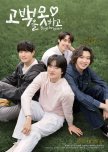
This first kiss is both wonderful and hilarious
Thank you to Director Lim Hyun Hee and to Writer Lee Shin Won for this lovely, funny show. !Fighting!A cute little kdrama BL. My reactions: (E1-2) I am so happy! Laughing like a nutcase. This looks like it is going to be good. (E3-4) Great, great first kiss. Completely bananas long-haired lover! Nam Shi An bias. Main romance gets sunny cool house scenes, heart-wrenching-already second romance gets yellow streetlight in darkened backstreets. (E5-6) (holding myself back from spoilers) A lesbian bestie, smiles, tears, a seriously heart-fluttering hug and a heartbreaking embrace. Oh that ominous fitbit. (E7-8) Ouch, very very PG. Sweet as honey.
This is standard kdrama sequence in mini-mini form (8 eps at 30 mins ea.), all the best bits condensed. Several annoying loose ends/teasers for poss. sequel. Confession as the main issue, and its relation to personal growth. Some commentators seem puzzled -- I think because the show at the very last minute loses its surreal edge and comes down to earth (a very nice earth) with a tiny thud. I still go with 10stars for quality, cinematic intelligence, art, and for Nam Si An ripping up any official documents within reach (adorably).
If immature behavior is a topic I will grab the chance to say that I think the young guy/young girl/cute kid/charley-chaplin comedy characters work in Jungian terms, igniting psychological needs or functions in us, the spectators. In this comedy the childish terrors of our doll-like protagonist Jin Woo make us laugh as he ineffectually tries to stop the no-boundaries Id-representing Gi Seop from entering his house. [As Jade hinted] in BL these men will blossom quickly into true lovers, like flowers in a desert spring. They enable us to remember/compare/hope for our own spring and gain emotional strength.
Maybe that R rating is because there is a lesbian character. Ooh so scary.
first posted on viki april 30th 2024
Was this review helpful to you?
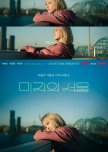
classic heart-wrenching healing drama
Kdrama at its best. 2025, 12 eps at 1hr10mins ea = 14 hrs watchtime. The plot, deceptively simple and predictable to begin with, is a joyful surprise by the finale. An elegant, streamlined version of the classics within the boundaries of the new double audience for binge-watching and on-air experience. Kudos to the writer, Lee Gang.The director, the composer and the two leads in themselves are all fabulous and very famous. In particular check out Nam Hye Seung's track record in producing the soundtrack for so many hits . The director Park Shin Woo is also an experienced romance-hit director, who I imagine kept this drama soundly on track. This review is a little long , apologies. The show deserves a little more praise than usual.
A pair of twins, Mi Ji and Mi Rae, secretly exchange their lives temporarily. Mi Ji , a chaotic and loving part-timer who takes care of her grandmother in a nursing home in Dusan-ri, puts on heels and skirts and bluffs her way through Mi Rae's corporate office job (which financially supports the family In addition to their mom's work).
The English title alludes to the roles of a poet and her poetry in the show and to the ways in which the twins finally learn to write their own stories. The Korean title, Miji's/ Yet Unknown Seoul, on the other hand, helps clarify that there is a steady dramatic focus on Mi JI and her first love, Ho Su.
The doubling of practically all the characters. is fun, but the arc of Miji's and Hosu's love is central to the plot. She is the narrator. Her story continues with unabated power until the final episodes where, in tune with new patterns, several storylines wrap up together at once (in older more desultory patterns, storylines begin and finish in sequence) .
Two settings, two moms, two lover-to-be. Both sisters, distinct in character, have a chance to stretch themselves within their new situations. Each puts her own distinct spin on the other's problems and each goes through a the temporary re-assortment of personality which accompanies psychological change and transformation.
Park Bo-Young, a profoundly good actress, playing both twin roles, accomplishes something even more difficult than playing only two separate parts consistently. The sisters become more like each other while suffering their psychological crises through the central portion of the show, and when they pull themselves together, are even more distinct people. PBY portrays psychological change in double.
Mi Rae's tightly-wound, organized and reserved character does not change as much as her goals do; they change to better fit her real interests and her hidden independence.
Mi Ji and Ho Su have long-term psychological wounds that they have to face. Hosu in particular, who is more physically limited than he looks (from the serious car accident which took his dad), must face his own profound fear of rejection and his desperate hope for a normal life.
Park Jin Young is a magnetic and amazing talent. In his role as Ho Su he is both beautifully clumsy and gracefully tactful. How does such a graceful dancer balance the fully buttoned-up, disabled, and overcoated lawyer with his own exuberance? Mainly he uses his eyes and a sort of hopeful stillness which his training enables him to precisely calibrate. Watch it happen. The absence of wider gestures (the character actually has to avoid losing his balance) gives the way he catches Mi Ji's hands when she sputters off track and his little goodbye waves, wordless eloquence.
Mi Ji's personal changes and her triumph over depression and lack of self-confidence are key to unlocking the estrangement of others, even characters as close as twins are. Ho Su's damaged health and painful memories estrange him from his stepmom, Mi Ji's failure in high school estranges her from her mom, secrets divide both the moms from each other, and divide the twins mom from their grandmother. As Mi Ji changes, the whole web of relationships shifts and others cease to be stuck in previous patterns too. The two sisters find improvement in relationship with their own mother, as does Ho Su with his stepmom.
My favourite supporting characters, the wonderful Jang Young Nam as the twin's Mom, and Won Mi Kyung as the companion of the poet Rosa, also change alongside Mi Ji as she starts her journey. Mom and grandmother finally share their stories at almost the last minute. The elderly restaurant owner learns to read the poet's poems.
Ho Su's first boss, one of Im Chul Soo's fabulous characters, also disabled, is an excessively competitive and unfeeling lawyer zipping around in a wheel chair when not leaning on his silver-headed cane. Even he eventually even becomes helpful when Ho Su's disabilities worsen.
And so, of course, as expected in a rom-com, the leads find love as they straighten out their misunderstandings. What a great watch!
a spoiler ---
ps. Friendship between the poet and Sang-Wol, my foot. True hearts and flowers full blown love in full sight. Miji and HHosu listen to her story and the openness in their hearts shows on PJY and PBY's faces. This is as healing as anything else in the story, Very daring for South Korea and very nice for Pride month.
Was this review helpful to you?
This review may contain spoilers
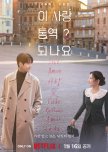
A classic by the Hong Sisters
This is a solid classic. I loved it and stayed up way too late to binge it last Friday night.Listen to no one, not even me. Proceed with caution, and try this out for yourself. The summaries given out publically before the show aired may have been somewhat misleading.
The frame is that of a crew and actors shooting a romantic dating-reality show. The two stars of this show-within-the-show, the Korean actress, suddenly made famous by a role as an axe-wielding zombie, and the princely Japanese romance lead, have to summon romantic feelings as part of their jobs. The basic genre which develops inside of that frame is that of a psychological thriller, because it turns out that the actress has crazy difficulty with romance. The issue of sincerity -- how do you know if someone means what they say? -- is thus handled very cleverly at both levels.
The misunderstandings of the OTP turn out not to be linguistic, since both the interpreter and the lead actress speak Korean. The ML, played by the legendary Kim Seon Ho, struggles wryly, as will you, to understand the FL. The SML, Hiro, the Japanese co-star of the dating show, also struggles; he doesnt know Korean, she understands neither Japanese nor English, so he ends up learning Korean.
Go Yoon Jung really shines. The actress she plays, MuHui, constantly hallucinates an intensely funny, mischievous and irresponsible alter. She suffers from a classic case of dissociative personality disorder due to a very traumatic childhood. Do-Ra-Mi, the alter, takes over MuHui's personality in her off-hours and meddles with MuHui's love life..
Zombie love. Most of MuHui's energy and joy is captured in her alternate self. She slept in a coma through the growth of her fame. The ML, a classic taciturn lead, is still enraptured by a love he could never achieve. He has a richly difficult family life, swiftly introduced but not given as much visual time as his amazing house full of books tottering on every surface. The house itself is allusive, literary. It is inhabited by a wild-haired author, a family friend; also by the love rival from the frozen past, a bohemian brother. Many more secondary characters are clearly drawn and reflect issues brought up by the OTP. without their own entire arc made visible.
The script and dialogue of Can This Love Be Translated are classic Hong Sisters: heavy on metaphor, difficult to translate into English, thick and rich with all sorts of plot textures. THE HS ARE NEVER EVER PREDICTABLE. HS shows often involve some incredibly creative twists on currently popular genres which put them at the top of the class. Some love the HS, some hate them. Find out who you are.
My favorite visual trick amongst many lovely scenes, shots and sequences, is that the show starts out in the open light of day, in Italy, Japan and most notably in the wide open spaces of the Canadian West. At the end of the Canada episodes the crew chases the spectacle of the Northern Lights, the Aurora Borealis, only to fall asleep exhausted and miss the show. The lovers, up late by chance, do see it. The show, then moving to Italy, dives into darkness psychologically and frequently visually, as the two begin to heal her illness. The show finishes in Korea at a dark sky reserve where the lovers stargaze under the brilliant night sky. Nice, huh?
But before we get there there is a lot of translation to be done by the viewer. Does Hiro fall for MuHui, will MuHui and the interpreter ever wake up and fall in love, why ever does MuHui appear at one point to try to seduce poor Hiro? Why are certain conversations between the ML and FL completely opaque; how do they suddenly turn into fights? (tbh, this is a RL experience for many of us, right?) At some points at the ends of one or two scenes the actors' dialogues are left unsubtitled -- horrifyingly, this may have been deliberate?
The romance is a bit old-school, for my taste. The structures of the 12ep plot may seem old-school too, since the HS wrote that book on 16 episode romcom that you are reading from. The halfway mark is hit at ep6 -- the lovers commit. Troubles and travails begin in episode 7 right on cue. Instant resolutions and sudden wrap-ups are held in the final episodes 11-12, as a vestigial representation of the old scramble of non pre-produced shows. I was actually happy that this took up two episodes instead of the often crazy old-style one episode wrap.
The Hong Sisters have written 14 shows, each distinct, in many genres, It is a mystery how they manage to hit the public sweet spot every time. If you want your favourite romantic recipe, this isnt for you. But this is the real warning: they mostly write smash hits, so you may miss out.
ps. I normally strive for short, somewhat condensed reviews. Apologies for this one. It confuses me that my own view of the show was so different than most others', so I tried to lay out why. Probably not very well, but whatever.
pps. here is another way to look at it. People always contrast the Hong sisters' top shows to those of Kim EunSook, the writer for Goblin and most recently, for Genie Make a Wish. For me the imperfections of even the best of the HS still have more heart and sincerity than the slicker and often more entertaining KES. Both brilliant. Both classic.
Was this review helpful to you?
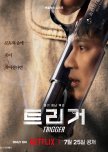
Social commentary and Kim Young Kwang
A really great watch, although quite violent. 2025, 10eps x 50mins ea = abt 9 hrs watchtime. A police procedural becomes a kdrama with the addition of a fantastical villain, scads of social commentary and traumatic pasts all around.Excellent vignettes of individuals encouraged to pick up a gun to address their crushing grievances. The legendary action star Kim Nam Gil wearily struggles against the seductive desire for violent vengeance. Kim Young Kwang, all tattoos, swagger and excellent tailoring, takes revenge upon the society which abandoned him as a child. His performance is what makes this small kdrama so enjoyable.
The merciless bullying and barely suppressed anger of daily life in SK is the context, guns are the 'triggers' and the grand climax of this 10 episode series is a large cleansing violent setpiece. The use of smoke renders it dreamlike and poetic. The shadowy mostly American gangs of armsdealers who back Young Kwang's character seem determined to see SK as a market opportunity for gun sales.
Gun violence is not as common in kdrama since guns are banned in RL Korea -- villains in drama usually use an imaginative array of other weapons. The discussion of the use of guns and their potential effect on SK society is therefore uniquely interesting. Always interesting to consider, given the fact that in a society with universal male conscription, exactly half the population is already trained to handle guns.
An excellent Netflix production. The soundtrack is great, by the experienced composer Hwang Sang Jun. Director, Kwon Oh Seung.
Was this review helpful to you?


