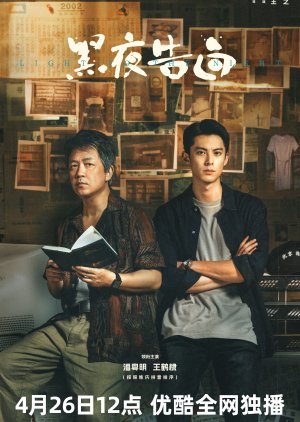
Every event has a center. Beyond it, ripples spread.
When I first saw the trailer, it immediately caught my attention, but the drama turned out to be very different from what I had expected — in the best possible way.One thing I absolutely did not expect was for this drama to become such a tear-jerker. While the first 9 episodes contain many natural and genuinely funny moments, starting from episode 10 — and especially during the last 5 episodes — I cried my eyes out 😭
This is a 100% worth-watching investigation drama and definitely one of Wang Hedi’s best performances so far. His portrayal of Ran Fangxu was unforgettable.
The story revolves around the mysterious disappearance of a father and daughter at the elevator entrance of the Yuanlongli building in July 1997. The case deeply affects the lives of detectives He Yuanhang and Ran Fangxu, and it takes 18 years for the truth to finally come to light.
The drama switches between three timelines:
• 1997 — when the father and daughter disappeared
• 2002 — when the father’s skull was discovered
• 2015 — when the case was finally solved
The transitions between the timelines were done brilliantly and never felt confusing.
Even though the drama focuses on only one case, the plot is incredibly complex, filled with twists and turns that constantly keep you on the edge of your seat — and in the end, everything ties together perfectly.
I especially loved the 师父–徒弟 relationship development between He Yuanhang and Ran Fangxu. They truly became each other’s family. The actress Ren Min, who played Xiao He (He Yuanhang's daughter), even mentioned in an interview that for Xiao He, Ran Fangxu was like a mother 😂
After episode 10, seeing how much Ran Fangxu meant to both He Yuanhang and Xiao He was absolutely heartbreaking 😭
The drama also did an amazing job portraying grief, guilt, obsession, and the way one unresolved tragedy can leave deep scars on people’s entire lives.
“所有事件,必有中心。中心之外,必有涟漪。”
“Every event has a center. Beyond it, ripples spread.”
Was this review helpful to you?
hHard to let go
The acting performances are over the top, especially Dylan Wang as RanFangXu... absolutely brilliant, playing 3 life stages of the character.. rookie police officer Xiao Ran, captain Ran and uncle Ran...LightToTheNight is a realistic drama ... miracles don't happen in real life, so in this drama... no matter how much we hope for a happy ending, to keep it real, that miracle won't happen...
Dylan Wang's LightToTheNight is a must see drama ... and then, you will want to rewatch it!!!
Was this review helpful to you?

When the truth waits eighteen years — Spoiler Free
━━━━━━━━━━━━━━━━━━Between the Lines
igiam’s reflections on drama, character and hidden meaning
━━━━━━━━━━━━━━━━━━
When the truth waits eighteen years
At first glance, Light to the Night feels like a slow-burning crime thriller. Its constant shifts between 1997 and 2015 may seem demanding, but they are far from unnecessary. Every return to the past quietly plants another piece of a puzzle that only becomes clear much later.
Rather than focusing on action or shocking twists, the series patiently explores how lies, guilt, fear, and silence can shape people’s lives for decades. Every witness remembers differently. Every version of the truth is incomplete. The investigation becomes less about finding a culprit and more about understanding why so many people chose to hide what they knew.
What impressed me the most was the relationship between He Yuan Hang and Ran Fang Xu. Their partnership is built on trust, respect, and the belief that every forgotten victim deserves to be heard. Even when time separates them, that bond continues to guide the investigation in unexpected ways.
The drama also deserves praise for avoiding easy answers. It asks the audience to observe carefully, connect details, and remain patient. Many seemingly insignificant scenes later become essential pieces of the story.
If you’re looking for a fast-paced thriller full of constant action, this may not be the right choice. But if you enjoy layered mysteries, character-driven storytelling, and investigations that reward attention to detail, Light to the Night offers a satisfying and emotional journey.
In the end, I didn’t remember the case first.
I remembered the people who refused to stop searching for the truth.
— igiam | Observing Stories Between the Lines
Was this review helpful to you?

Light to the Night — A Story About Obsession, Choices, and the Weight of the Past
Light to the Night stands out because of the way it tells its story through three different timelines, slowly revealing how one event changed everyone’s lives forever. What starts as a missing persons case, then a crime mystery case becomes something much deeper: a story about obsession, guilt, choices, and the consequences people carry for years.The three main leads are the heart of the drama. Dylan Wang delivers one of his most mature and outstanding performances so far. His character starts off charismatic, funny, and full of energy, but across the timelines you slowly watch the obsession consume him, replacing that warmth with sadness and emotional exhaustion. He balances humor and pain incredibly well, making the character feel very human. The other two leads are just as strong, especially during the emotional confrontations where nobody feels completely innocent or completely guilty.
What makes the drama memorable is that the mystery itself eventually becomes less important than the emotional damage it leaves behind. Every character is trapped by decisions they made in the past, and the series constantly shows how one choice can quietly destroy lives over time. The atmosphere stays heavy, melancholic, and emotionally tense until the very last episode, which makes the ending hit even harder.
Was this review helpful to you?
I recommend watching it
This is a detective thriller in which Dylan Wang departs from his usual "prince charming" image. He plays a young police officer named Ran Fang Xu. The story spans nearly 20 years and follows the investigation into the mysterious disappearance of a father and daughter. My expectations for this project were high. Dylan Wang explores a completely new, realistic, and dark genre. Watching his transformation over 18 years, from a rookie to a seasoned cop, will be incredibly captivating. And the presence of master detective Pang Yueming guarantees that this will be a quality story, not just another project. The beginning of the drama was impressive! A strange story, strange police officers who don't understand each other. Masterfully filmed, the imagery is constantly engaging. A high-quality, interesting detective with a twisting plot. Perhaps one of the best detective series I've ever watched. For detective fans who enjoyed "Above Ashes," "Under the Skin," "Signal," and "Tunnel," this is the place for you! I'm still thrilled with Wang He Di—he's a brilliant, versatile actor who plays his role superbly, especially considering he was originally a model. Compared to many actors, he's truly outstanding. Although I have to give them credit, everyone gave it their all. The plot is very engaging, with several major twists. Honestly, I cried! There's a really heartbreaking moment at the end of episode 9 and the beginning of episode 10, and then there's episode 22. So, I'll tell you right now, the plot isn't easy. Another thing I liked was that the script didn't sag; everything unfolded at a decent pace. You won't get bored, and you won't let it slide into the background, otherwise you might miss something. What I didn't like, and was really irritating at first, was the plot jumps from the past to the future, but overall, everything fell into place later. Another gripping detective story with Pan Yue Ming! And Wang He Di, too! Simply fantastic! An intriguingly twisted plot that keeps the viewer on the edge of their seats until the very last minute! I recommend watching it.Was this review helpful to you?

A masterpiece
Incredible!Most crime series have the detectives solve a new case with each new episode but this one manages to focus on one case for 28 episodes and it never gets boring.
It always keeps you on tenterhooks.
A little glimpse here, a snippet of information there, just enough that it keeps you wondering what the heck is going on.
I was just as puzzled as the detectives were. And everytime I thought: "This person! This one has to be the culprit!", I was taught otherwise, time and again.
It's amazing storytelling!
Was this review helpful to you?

So realistic Dylan Wang was glammed down to portray a cop
This drama impresses in every aspect - the direction, writing and cinematography create an ambiance of mystery, sometimes bordering on horror, that draws the viewer into the investigation of a father and daughter who took an elevator to the 18th floor of a building and went missing for 18 years.But what impressed me most was the acting, especially of Dylan Wang, PanYue Ming, Ren Min and the young He Xiao He. Dylan once again proves he can tackle any role with aplomb, able to portray each stage of a policeman's life believably, from an idealistic and bookwormish rookie to a passionate deputy captain police officer bent on solving a 5-year-old case, and finally, a Beijing lecturer. To portray a rookie cop, minimum makeup was used on Dylan. For his deputy officer look, some freckles were applied on his face that made him look darker. For his lecturer look, some wrinkles were added. Yet, in all these looks, his handsomeness still peeped through.
This is my first time watching Pan Yue Ming, Ren Min and the young He Xiao He and they are all good!
The story switches among three timeframes, 1997 when the father and daughter went missing, 2002 when the remains of a person connected to the case were found and 2015 when the case was solved. I think switching between timeframes is brilliant as associated scenes of the case in different timeframes are shown closely together. For example, the different and telling scenes when the same door that is opened in 2002 is opened in 2015. This technique of switching among timeframes requires viewers to focus on the drama to avoid confusion.
If you don't have the ability to focus, I suggest you drop the drama instead of giving it a low score when you get confused.
One unexpected element about this drama is that it is such a tear-jerker. I probably used up a whole box of tissues. This proves how effective the depiction of the story is and how well the characters are able to draw viewers in.
I also love the OST. It reminds me of Hollywood or BBC productions. It provides the appropriate background music to the visual elements.
Was this review helpful to you?

Painful, haunting, and beautifully done
Underrated drama.From beginning to end, "Light to the Night" is exceptionally well executed, with a tight and purposeful plot that never feels dragged out or unnecessarily complicated. Every episode builds naturally on the last, slowly revealing the heavy emotions behind the story while keeping the tension and mystery compelling throughout.
What impressed me most, however, was the acting. Dylan Wang delivers one of his strongest performances yet and once again proves how versatile he is as an actor. He convincingly carries every stage of his character’s life. Pan Yue Ming and Ren Min shine as well , and the performances across the cast feel authentic. The production also deserves credit for how naturally these transitions were handled. The styling and makeup changes are subtle rather than overdone, helping each version of the character feel believable, which makes the emotional moments hit even harder.
One of the drama’s biggest strengths is its storytelling structure. The narrative moves between three different timelines — the original disappearance in 1997, new discoveries connected to the case in 2002, and the eventual resolution years later in 2015. The transitions between these periods are handled incredibly well and often placed side by side in ways that deepen the emotional and investigative impact of a scene. Small details become meaningful when mirrored across timelines, such as revisiting the same location years apart and seeing how differently a moment unfolds with new context. It is a smart and immersive way of telling the story, though it definitely requires viewers to pay close attention in order to fully appreciate how all the pieces connect together.
Despite the heaviness of the plot, the drama also does a good job weaving humor naturally into the story. The lighter moments never feel forced or out of place. Instead, they provide small moments of warmth and relief. The humor helps balance the emotional intensity of the series without ever undermining the seriousness of the story.
The music is also used effectively. The soundtrack and instrumental pieces never overwhelm the scenes, but instead quietly deepen the emotions, especially during the reflective and heartbreaking moments. Some scenes linger long after they end because the combination of acting, directing, and music is done so well.
What makes the drama especially powerful is that the emotional conflicts are not driven by simple villains or forced misunderstandings, but by people genuinely trying to protect the ones they care for - only to end up hurting them in the process. The show captures that tragic side of humanity so well: how love, fear, guilt, and good intentions can become destructive when people make choices for others .
By the end, the tragic outcome feels inevitable yet still absolutely devastating. This is a mature, emotionally layered story with strong performances, thoughtful directing, and real emotional impact. Painful, haunting, and beautifully done.
Was this review helpful to you?

poignant and awesome storytelling
With so many Chinese dramas flooding streaming platforms today, too many fall into the same traps: fractured storylines, bloated casts, painfully stretched episodes, rushed endings, excessive CGI, and those gravity-defying wire-fu fight scenes that often feel more cartoonish than cinematic. Somewhere along the way, spectacle replaced storytelling.But Light to the Night avoids nearly all of those pitfalls. What makes this series work is its restraint. Instead of constantly introducing new characters and subplots just to extend runtime, the drama stays grounded around a core group of people and a relatively confined setting. That focus gives the audience time to actually invest emotionally in the characters rather than merely trying to remember who everyone is.
And this is precisely why the show succeeds across 28 episodes without feeling unnecessarily padded. It proves that a drama does not need 40 or 50 episodes to create depth. Every episode here feels purposeful. Chinese dramas could learn from this approach: quality storytelling is not measured by duration, but by narrative discipline.
What impressed me most was how the tension continuously evolved. Just when you think you’ve figured out the mystery, the story quietly pulls the rug from under you. The twists are not cheap gimmicks inserted for shock value; they are carefully planted, making the audience question their own assumptions over and over again. That is intelligent writing. In an era where many dramas rely on visual excess, this series relies on suspense, atmosphere, and character psychology.
I also believe Pan Yue Ming absolutely stole the show as Detective He. His performance carried weight, subtlety, and realism. There was a quiet intensity in the way he portrayed the character that made every scene feel grounded. Yet credit must also go to Dylan Wang for understanding exactly what Captain Ran needed to be. Rather than overacting, he played the role with restraint, calmness, and composure, which balanced the series beautifully. Sometimes the strongest performances are the ones that know when not to be loud.
What ultimately separates this drama from many others is that it respects the intelligence of its audience. It trusts viewers to pay attention, to connect emotional nuances, and to sit with ambiguity instead of spoon-feeding every answer. That confidence is rare today.
In the end, Light to the Night reminds us that compelling television does not need endless episodes, flashy effects, or exaggerated action scenes. Strong characters, disciplined storytelling, and well-earned suspense are more than enough.
Tha final wave on the train in the end is how you end one of the best Chinese series.
Was this review helpful to you?

 1
1This review may contain spoilers
Notoriously Reputed Yuanlongli Building
The old and long-standing building of Yuanlongli is surrounded by many urban legends. Some say it is a ghost building that eats people, others say people vanish in black cloak with no bones left. Things go awry when a pair of father and daughter disappear on the 18th floor of the building in broad daylight, in front of numerous residents of the building. A rumor or an accident, an accident or a well-planned murder? A case spanning throughout three timelines at the cost of numerous innocent lives, what seemed like unconnected accidents were in fact a web of crimes leading into something even bigger and far darker.The story starts off really well in terms of build-up. Starting it all with the disappearance of two living people right in front of people, slowly changing the superstitious belief into reasonable man made activities. I really enjoyed those little introductions and doubts they kept throwing at the beginning and unveiling the story slowly in each coming episodes. And then the chills down the spine when they started throwing clues at the end of episodes starting from ep 8 and 9!
Tho, I wish they could do a better job with the build up of main characters in primary episodes, I was starting to take them really unserious considering how casually they were predicting the entire incident writing a whole script of events based on few clues, and how malleably they kept on changing their predictions on the crime and criminal and labelling all that with fancy high-end terms. I really couldn't take the theory of investigating after predicting, cause that is what lead to constant closing and opening of this case. I really couldn't excuse all of it to lack of gadgets and technology. So in the beginning Ran Fangxu's collection of theories really did not impress me a single bit.
The story started to get hold of the characters after the second timeline, when they actually started concluding the case based on actual evidence and did not presume things unilaterally. I think that was when I finally started getting even more interested in the story.
The parallel storytelling of the second and third timeline kept me invested. Ran Fangxu slowly discovering issues after a co-incidental discovery and then the unveiling and consequences that followed. But the third timeline again lost its spark, while I was indeed into the unveiling of the mysteries, the way those mysteries were conveniently solved in the third timeline made the entire investigation humanly unrealistic. Everything was just conveniently there, there was a child in the building of yuanlongli who was conveniently a hacker and hence could solve every problem, people conveniently remembered the questions asked and investigations made 15 years ago by Ran Fangxu and were able to solve the case. Ran Fangxu's theories conveniently dropped the right clues at the right time, which solved the case easily in hours. I would have preferred if they put the same efforts in the third timeline that Ran put during his investigations while unveiling the story and discoveries made by Ran, so this part made the entire police team's job in the third timeline feel like plot supporters rather than actual job workers with crucial role.
Anyways, coming to the end, it still does not change the fact that the story had me hooked from the beginning and engaged until the end except a few episodes. Starting from the build-up to the suspense, the emotional engagement, the attachment to the characters' emotions everything was so beautiful and well done. Each character played their little role in the drama in bringing the story together. The plot twists were fun, tho I did manage to reach those predictions but seeing them actually happen was fun.
The one that surprised me the most was definitely Wang Hedi, while I would say he has a big room for improvement, this genre switch was indeed well handled by him.
Was this review helpful to you?
This review may contain spoilers
A Proustian Drama with a Searing and Complicated Message
Introduction:This is an expansive drama that encompasses so much that it is hard to know where to begin. Right from the beginning, China itself is one of its main characters. This remains in a way the distinguishing feature of all C-dramas. Although they may appear superficially similar to K -dramas and J – dramas and T – dramas, they have a unique feature in that China and its fate always features in these dramas but not in any obtrusive way.
The Main Protagonists:
The building Yuanlongli International Garden in Weiyang, Sichuan is the site of this drama. It is a labyrinthine housing complex meant to embody a possible China, a capitalist China? Or is it an illustration of Hong Kong which is being formally integrated back into the mainland on 30th June 1997 (which is when the drama begins as it spans two more years, 2002 and 2015, shuttling shuttles between these three years which mirror each other)? One is not quite clear. This building complex is, however, a world unto itself housing a brothel, apartments for people to live, and myriad small businesses. The extremely wealthy and the not-so-wealthy all seem to be housed in this space. Although it is meant to be a community, it is in fact anything but. It is a scary urban jungle and the principle underlying it is the survival of the fittest. One has to kill here or be killed. The lives of the two main female protagonists, Qiao Suqing and Xu Meng are concrete manifestations of this principle. Qiao Suqing who is suffering at the hands of an extremely abusive employer and bearing with all this misery just because she is getting paid handsomely (Is this again the drama’s reminder of what capitalist relations ultimately are?). The other protagonist, Xu Meng, is suffering at the hands of an extremely abusive father who is forcing her into prostitution and loan sharks to pay for his medical bills. Xu Meng and Qiao Suqing become very close and the ordeals they are facing bring them into an intimate relationship with each other. Xu Meng decides to take the law into her own hands by engineering the murder of Qiao Suqing’s employer. In a scuffle with her sick father, who is forcing her to flee from Weiyang, she pushes him back in self-defence and he ends up hitting the edge of a wall and succumbs to the ensuing head injury. Xu Meng watches him die, calls her friend for help, who pitying her plight decides to help her get rid of the body. It is not quite clear as to why they have to do this. It was not that Xu Meng deliberately killed him. She could call the police and resolved the matter in a civil manner. But she does not. Is it because of the world in which she has lived, where one has to either kill or be killed, where one cannot trust anyone other than themselves, be it even the state authorities? Her profound inability to trust anyone is confirmed later in her own confession to the police. She is as much a victim of this world as she is a protagonist who intentionally murders. Together, Xu Meng and Qiao Suqing dismember the father’s body and decide to stage a disappearance. Xu Meng is supposed to have disappeared with her father as they were being chased by loan sharks. It is this disappearance, which becomes the central case around which the drama revolves. It is “solved” twice, once in 1997, and once again 2002 when the head of the father is found, both times unsuccessfully before being finally solved in 2015.
The other main protagonists of this tale are the young police officer, Captain Ran Fang Xu and his mentor He Yuanhang and the mentor’s daughter, He Xiaohe. Captain Ran is an orphan, who is brought up by his grandmother. He is a bright and extremely honest young man. He is a product of another possible China. A China that does not abandon its orphans, that educates them. Captain Ran is a topper in the State Police Exams and this disappearance of Xu Meng and her father is his first case. He cares about everyone around him, is painfully conscientious and whoever comes to know him cannot but help liking him. He and Qiao Suqing fall in love and the drama contemplates the tantalizing possibility of the two getting married before snuffing it out in a gut-wrenching manner with the death of Captain Ran in a car accident engineered by a jealous Xu Meng, who does not want to let go of Qiao Suqing. Ran is particularly fond of his mentor’s daughter and substitutes as her father when her real father is away on business paying very close attention to her studies, making sure she never goes astray, but without suffocating her rebellious nature. Before he was killed, Ran had almost solved the disappearance having zeroed in on Qiao Suqing but does not know of the role of Xu Meng, until just before his death when she stands before the dying Ran. It is He Yuanhang and his daughter, who carry his work forward and bring the case to its true conclusion. In this process, the role of memory, especially of the Proustian memoire involuntaire, is beautifully illustrated in this drama. Be sure to catch those scenes for their cinematographic prowess and their literary texture.
The fate of the protagonists and the that of building complex somehow takes its stroll alongside the fate of China itself, from the return of Hong Kong in 1997 to the entry of the Chinese men’s football team into the 2002 World Cup and more confident, socially developed, infrastructurally sound China of 2015, where even small town police stations, through the initiative of their officers and state budgets are able to have state of art evidentiary archives to facilitate the tracking down of criminals. Indeed, the memory of the protagonists is contrasted to that of the memory of institutions and that of the state. The moral seems to be: without memory no civilization is possible.
In addition to the main protagonists the minor characters are painted equally well and with great sensitivity. The cement factory owner, a former gangster who is imbued with a great sense of responsibility to this workers, who flees the country, returns for personal revenge and for discharging that responsibility, before committing suicide, the photographer from Guangdong who spies on his girlfriend Xu Meng because he is deeply disturbed by her work as a prostitute, a quack healer who devises remedies which he administers on himself and his patients and in the process is poisoning both himself and his patients, all of these are beautiful painted pictures, whose poignancy forces one to stop and reflect.
The Dramatic Structure:
Although the dramatic structure is that of an edge of seat whodunit with detectives trying to uncover traces of wrongdoing in a struggle with murderers who try ingeniously and meticulously to erase every trace of their crimes and with time itself which is the biggest eraser of traces, there is another struggle at the play throughout the drama. This is the struggle between two ideas: the idea of a corrosive Darwinian individualism, where everyone for themselves, where the fittest survive and one kills or one is killed, represented by the building and its main female protagonists, Xu Meng and Qiao Suqing, against the idea of a wholesome socialism where the law serves the people and individual initiative is supported by society and society is in turn strengthened by individual initiative represented by Captain Ran and his mentor. Captain Ran’s initiatives are supported by society, like his becoming a police officer despite being an orphan with not much means and he in turn strengthens society, like his convincing the authorities to finance a state-of-the-art archive in the criminal division of Weiyang. In this struggle between these two ideas, there is no guarantee that socialism will win as evidenced by the murder of Captain Ran by Xu Meng. The drama does not fall for the idea that only individualism can produce geniuses and socialism only rewards mediocrity. Both socialism and individualism can produce genius, Captain Ran and Xu Meng respectively. But only socialism fosters its geniuses towards the good while individualism simply abandons its geniuses to their own devices, which can in many instances turn them into monsters, as shown by Xu Meng’s life.
The Message:
The drama goes to great lengths to show that the circumstances in which we find ourselves determine the way we act to a great extent. But at the same time, it forces us to ask whether those wretched, difficult circumstances should absolve individuals of blame, especially when they resort to crimes like murder. The moralizing that the drama resorts to in the end, when pronouncing judgement of the two female protagonists will sound very vapid to the viewer. And I think the vapidity is the very point. The force of circumstances can be so overwhelming that the law does appear like an ass. Are these two women really deserving of the death penalty and life imprisonment, is something every viewer will ask. The drama complicates its seemingly simplistic answer with the demolition of the building complex in the last episode, which has been announced in a middle episode, and which is a reality against with the father and the daughter are racing in order to find the truth of the disappearance. The demolition seems to suggest that although individuals do have a responsibility towards living a good life, circumstances dictated in large by social structures inevitably shape the actions of individuals. So, without radical social transformation, which the demolition symbolizes, no good is possible.
Was this review helpful to you?

Buckle-Up, Many Twists in the Night!
This was a very intriguing series. Although the script had some weak aspects, I still really enjoyed it. The production team did a great job grabbing my attention from the very beginning. There was a point when I felt the storyline was dragging a bit by the 9th episode in which they introduce the first plot twist. Although it’s a very heartbreaking twist, it revised my interest in the series. The script was very well laid out and did a great job connecting multiple aspects together. It also did a great job integrating many of the supporting characters into the various stories during the different timelines. This also did an incredible job switching between the various timelines. This series had some very complex characters. Just when you think you understand their actions, the script flips it around. However, the main weak aspect in the script was the 2002 storyline involving He Xiao He. A very minor weak aspect was the questionable police work done throughout the series. The styling and costume department did an incredible job creating different looks with each character for the various time lines. They also did an amazing job with the props and set/location designs to create the lapse of time. The entire cast was incredible throughout this. This also had amazing cinematography, CGI, and special effects. However, there was some odd background music choices at times.Random Note:
Yuanlongli International Gardens should also be listed as a main lead.
This has a lot of plot twists. Two were a big surprise for me and one I guessed from the beginning.
This had some of the most heartbreaking moments I’ve ever seen in a drama. This included the very last scene which was also slightly bizarre.
The series synopsis on MDL does not give an accurate description and is a little off. My favorite miss information is “use a yellow-painted jeep and a makeshift excavator for investigation”. This part is hilarious and nether one is in the series. The synopsis on Viki is more accurate.
Was this review helpful to you?