1
1 1
1This review may contain spoilers
All That for This?
The Husband started off on a surprisingly strong note. A marriage already hanging by a thread suddenly takes a dark turn when Ko Se Yun disappears, leaving her husband Kang Tae Ju caught between a murder accusation, a kidnapping, and a growing conspiracy. The early episodes had just the right amount of suspense. Nothing felt excessively dramatic, but there was enough mystery to keep me hooked. The identity of the kidnapper was kept under wraps, and that uncertainty made the whole situation creepier. I found myself making theories in my head, trying to figure out who was behind it and, more importantly, why Se Yun had been kidnapped. Unfortunately, that initial thrill did not last.The drama revealed No Man Hui as the mysterious kidnapper fairly quickly. During the kidnapping, Man Hui was framed as an almost psychopathic, manic figure who could raise the stakes whenever Tae Ju made the slightest mistake. At first, it worked. His gaze was creepy, his smile was creepy, and there was something genuinely unsettling about him. But the same cycle kept repeating. Tae Ju makes a mistake, Man Hui threatens him, the tension rises, Se Yun survives, and then we do it all over again. Eventually, I became numb to it. When your supposed thriller starts making you think, "Oh, here we go again," the suspense has officially clocked out. Still, I tolerated the repetitive kidnapping arc because I assumed there had to be a bigger payoff waiting. The kidnapping itself was only the surface, after all. Tae Ju's search for Se Yun was filled with obstacles, from Se Yun's parents to the police, and practically everyone seemed determined to make his life harder.
The police were especially frustrating. There are incompetent police officers in dramas, and then there is this. At some point, it stopped feeling like intentional characterization and started feeling like careless writing. They barely seemed interested in conducting a meaningful investigation, not even the kind of investigation that exists purely for show. The fact that nobody seemed particularly interested in checking computers and desktops for potentially crucial evidence was baffling to me. Is IT not part of the basic vocabulary of modern investigations? I thought that was basic protocol. By the end, I genuinely wondered what purpose the police served other than becoming another roadblock for Tae Ju.
To the drama's credit, Tae Ju's search did eventually lead somewhere. I had expected the kidnapping storyline to drag almost until the finale, so I was actually surprised when it wrapped up during the first half. The escape itself was one of those scenes where I had to temporarily suspend not just disbelief, but common sense. Tae Ju and Se Yun barely managed to hit Man Hui hard enough to keep him down, yet they immediately ran away. They even left a loaded gun right beside him. Naturally, Man Hui got back up and chased them. At this point, they were begging to be chased and captured.
This kind of thing happened too often. I can forgive characters making bad decisions when those decisions fit their circumstances or happen occasionally. But when the same kind of questionable decision-making keeps appearing, it stops creating tension and starts creating comedy. Some of the directing choices did not help either. There was even a moment when Tae Ju tried opening the car door with his right hand while his left hand was the one pushing the door. It was such a small thing, but after everything else, it became another accidental comedy moment.
Once the kidnapping arc was over, the drama shifted gears. The story focused on why Man Hui kidnapped Se Yun in the first place. This was where things became increasingly messy. The drama kept peeling back layers of conspiracy, introducing one revelation after another, as though it were determined to convince us that there was an enormous, intricate puzzle hiding underneath everything. The problem is that once all the layers were removed, the core of the story felt surprisingly simple. The complicated route did not lead to a complicated destination.
I can give the drama the benefit of the doubt and accept that some of the motivations may technically make sense. The problem is the buildup and storytelling. The reasons behind the kidnapping never felt strong enough to justify the elaborate chain of events surrounding it. The same goes for the explanation behind Tae Ju and Se Yun's broken marriage. There may be an emotional explanation for it, especially when grief and blame are involved, but the drama did not make me feel enough of that emotion for it to land naturally. As a matter of fact, I honestly don’t see the point of their divorce arc and how it’s important to the plot. There were simply too many variables in this drama. Too many people, motives, connections, secrets, and twists were piled on top of what should have been a relatively straightforward core story. The more the drama explained, the more loose ends seemed to appear.
The cast was another mixed bag for me. I have always enjoyed Nam Goong Min's acting, and I could see what he was trying to do with Tae Ju. His character is supposed to be a quiet, introverted, nerdy doctor who keeps most of his emotions buried, and Nam Goong Min's restrained expression works for that aspect of the character. He also tried to communicate through his eyes, which suited Tae Ju's personality. However, that restraint also made the character feel rather bland at times. Despite everything Tae Ju went through, I rarely felt emotionally connected to him. I could understand that he was under immense pressure, but I did not necessarily feel that pressure with him. The funniest part was probably his brief burst of panic when he saw his wife being drowned upside down. I am simply not used to seeing that kind of loud Nam Goong Min, and somehow it felt more comedic than terrifying.
Lee Seol was even more difficult for me to connect with as Se Yun. I am not sure whether the problem lies more with the character writing, the delivery, or both, but I found her character frustrating and emotionally distant. Whatever emotion she was trying to convey rarely landed for me. There were moments when I could understand what she was supposed to be feeling because the script, dialogue, and situation told me so, rather than because the performance made me feel it. That also affected the central marriage. I was never fully convinced by Tae Ju and Se Yun as a married couple. Their interactions often felt awkward in a way that did not seem intentional. Between the character writing, Nam Goong Min's occasionally awkward delivery, and Lee Seol's performance, their relationship never developed the emotional weight that the story seemed to expect me to accept.
The one actor who left the strongest impression on me was Kim Dae Myung as No Man Hui. After seeing him play such a warm and lovable character in Hospital Playlist, watching him become this creepy, mysterious figure was quite the transformation. His stare and smile alone were enough to make him unsettling. Unfortunately, that effect was strongest while Man Hui remained a mystery. Once his character and motivations became clearer, the creepiness faded and he felt more like a manic, desperate human being than the terrifying figure the drama initially presented.
The supporting cast also consisted of plenty of familiar faces, but that came with an unfortunate side effect. Some characters were cast or written in a way that made them suspicious almost immediately. Instead of making the eventual revelations feel like a shocking "Aha!" moment, it sometimes felt more like the drama was confirming what I had already suspected. When the audience can see the suspicious character standing under a giant neon sign saying "I AM IMPORTANT," the twist loses some of its magic.
Visually, the drama did not leave much of an impression either. Some scenes looked noticeably low effort, and there were moments where the use of generative AI stood out rather than enhancing the production. Whatever the reasoning behind those choices, the result made the drama feel cheaper than it should have. The OSTs were similarly forgettable. Nothing really stayed with me after an episode ended.
In the end, The Husband left me with the strange feeling that the drama was trying very hard to make me feel stupid. It wrapped a relatively simple story in layers of conspiracy, twists, and complications, only for the underlying motivations to feel much simpler than the journey suggested. The first few episodes gave me hope that I was in for a tense mystery thriller, but the good parts ended too soon. The suspense gradually gave way to repetition, then absurdity, and eventually accidental comedy.
There is nothing wrong with a complicated story, but complexity should serve the story rather than become the story. Here, I felt like I was constantly being handed another piece of a puzzle, only to realize that half the pieces belonged to a different box. Unfortunately, I cannot recommend this one. The beginning had potential, but the drama went downhill much earlier than I expected.
Was this review helpful to you?

Namkoong Min, the Best Part of the Drama
“The Husband" had an interesting premise and a cast that could have made it really compelling, but unfortunately, the final result left me feeling quite mixed. The drama had potential, but I felt that the writing and especially the pacing didn’t always allow it to reach that potential.
The biggest positive for me was definitely “Namkoong Min". As always, he brings a lot to his character through his acting. He manages to convey emotions very naturally, even in scenes where the writing lacks depth. I particularly enjoyed the way he handled the more intense moments and gave his character a strong presence.
Namkoong Min has this ability to make a character captivating simply through his expressions, his eyes, and the way he conveys emotions without overacting. You can tell that he fully understands his character and tries to give him more complexity, even when the script doesn’t necessarily give him enough material to work with. For me, he was easily one of the strongest aspects of the drama.
The rest of the cast also did a decent job overall. The performances were generally convincing, and some scenes worked mainly because of the actors’ performances. However, I sometimes felt that the supporting characters weren’t developed enough and lacked depth. This made some of the relationships and conflicts feel less impactful than they could have been.
That was ultimately my main disappointment: “the performances were better than the writing". There were good ideas, talented actors, and especially Namkoong Min carrying a large part of the drama, but the script didn’t always live up to them. Some slow parts and certain writing choices made it difficult for me to stay fully invested in the story.
I wouldn’t say “The Husband" was a bad drama, but rather a drama that could have been much better. With stronger writing, more developed characters, and better pacing, it could have been far more memorable.
Was this review helpful to you?

watch for the romance, pretend the mystery isn't there bc that's exactly what the writers did
as a character drama focused on their marriage, it's an okay show. the biggest standout to me, (unlike everyone else who watched this show apparently), was lee seol as ko seyun. her portrayal of a mother who lost her daughter, and who (to her knowledge) was basically abandoned by her husband at that time, is incredibly realistic and emotional. i think her actions are very easy to understand in the context of her trauma (if you don't hate women. hah.) i also like namkoong min and seeing him onscreen is generally enjoyable. however, nkm was playing a more generic thriller male lead imo, and if you've seen one, you've seen all of them. he's of course amazing in his role, there just wasn't much to work with, and i only connected to him in the context of how much he loved his wife.while the romance arc was beautiful, the mystery part, as in the main part of this show, is riddled with plot holes the size of jupiter. we are introduced to no manhui as a serial killer who has been active for five years. this is a fact, not a red herring, and yet, by the end, apparently he was just manipulated into this because he wanted his wife to get surgery?? no manhui and kim gyeongae get married after he kills her abusive boyfriend (landlord?), which fine. but we don't get a timeline of whether this occurred before or after he started killing people. why did he kill the cop's wife? was his wife involved? if he killed the cop's wife before he met kga, why is he suddenly against femicide now? we'll call the mastermind CH to avoid spoilers, but how did CH know that nmh would be up to just kill people? because that's not a normal conversation that you have at a doctor's appointment. and how did nmh end up recording that conversation? there's no way he knew what was up before he sat down, you can tell they were genuinely surprised by how the convo was going.
there's also just general stupidity that goes around to extend the runtime (if we start talking about the cops mishandling the case we'll be here all day).
basically, if you want a romance with a realistic fl with a suspenseful background for aesthetics and nothing else, this is your show. if you want a romantic thriller that actually thrills, just go watch flower of evil.
Was this review helpful to you?

This review may contain spoilers
Suspense, Grief, and Edge-of-Your-Seat Twists
The Husband delivers a gripping, edge-of-your-seat thriller that turns a falling-apart marriage into a captivating mystery. Rather than forcing conventional romantic chemistry between Tae-ju and Se-yun, the drama wisely leans into their realistic emotional distance; as a couple on the brink of divorce who are worn out by grief and the painful weight of their daughter’s death, the lack of warmth between them felt entirely intentional and beautifully acted. Namkoong Min and Lee Seol deliver stellar performances, authentically capturing the heavy exhaustion and resentment of two people whose connection has frayed over time. What initially seemed like a plot that might run out of steam after four episodes surprisingly maintains a sharp, relentless momentum across all twelve. The narrative is packed with unexpected twists, high-stakes plot developments, and a strong ensemble of well-written supporting characters that keep you hooked at every turn. While it requires a slight suspension of disbelief to accept how seamlessly a high-profile hospital director like Kang Tae-ju transforms into a fugitive on the run overnight, that remains a minor quibble in an otherwise tight script. Ultimately, The Husband executes a satisfying, well-rounded conclusion, making it a thoroughly entertaining ride for anyone who loves an intense, character-driven mystery.Was this review helpful to you?

One of My Favorite Suspense Thrillers Ever! ❤️
As a 24-year-old guy who has been watching K-dramas for a long time, *The Husband* was exactly the kind of suspense thriller I love. From the very first episode, I was completely hooked by the storyline, tension, mystery, and the feeling that there was always something more happening beneath the surface. I genuinely loved every episode, and the way the story kept building its suspense while maintaining its emotional side made this such an addictive watch. This has easily become **ONE OF MY MOST FAVORITE SUSPENSE THRILLERS THAT I HAVE EVER SEEN.**Namgoong Min once again proves why he is one of my most favorite Korean actors. He was absolutely fantastic in this role, and his performance made every scene feel convincing and engaging. And yes, he is seriously handsome! Lee Seol was also absolutely beautiful and delivered such a wonderful performance. Their chemistry was one of my favorite parts of the drama, and I loved watching their relationship develop throughout the story. Both of them played their parts so well, and their acting was one of the biggest reasons I stayed so invested.
I also have to give credit to the entire cast because everyone did such a great job. I loved the storyline and especially the chemistry between the couples. The suspense kept me constantly interested, and I was always curious about what would happen next. There wasn't a single episode that I felt bored watching, and I really enjoyed how the drama balanced its thriller elements with the characters and their relationships.
And that ending was honestly one of the best endings I've seen in a K-drama. Without spoiling anything, I thought it was incredibly satisfying and a great way to finish the story. *The Husband* is definitely going on my list of favorite K-dramas and suspense thrillers. Namgoong Min, Lee Seol, the rest of the cast, the storyline, the chemistry, the suspense, and especially the ending all came together so well. ❤️
Was this review helpful to you?

This review may contain spoilers
the kidnapper
I have a strong feeling that Ko Seyun’s kidnapping has something to do with Dr. Kim Gyeong Ae. From the moment she was introduced, something about her has felt suspicious. While she appears calm, professional, and trustworthy on the surface, I can’t shake the feeling that she’s hiding something much bigger. There have been several moments where her behavior seemed a little too calculated, making me wonder if she’s secretly connected to everything happening behind the scenes.One of the biggest reasons I suspect her is because of her feelings for Kang Tae Ju. It’s pretty obvious that she likes him, and jealousy has been a major motivation for characters in dramas before. If she sees Ko Seyun as someone standing in the way of the future she wants with Tae Ju, it wouldn’t be surprising if she decided to remove that obstacle. Whether she planned the kidnapping herself or simply helped make it happen, I think her emotions could have influenced her actions.
I also don’t believe she’s acting alone. If my theory is correct, then No Man Hui is probably involved as well. He’s powerful, manipulative, and always seems to have people doing his dirty work. Dr. Kim Gyeong Ae could easily be working with him, either because she’s being manipulated, threatened, or because they’ve made some sort of agreement that benefits both of them. Together, they would have the resources and intelligence to pull off something as complicated as Ko Seyun’s kidnapping without immediately drawing suspicion.
Another thing that makes me question Dr. Kim is how perfectly she seems to fit into the investigation without ever becoming a suspect. Sometimes in mystery dramas, the character who appears the most helpful ends up being the one hiding the biggest secret. She has access to medical information, knows more than she lets on, and could potentially manipulate evidence or people without anyone realizing it. That kind of position gives her opportunities that most other characters don’t have.
I also think the writers may be intentionally making viewers overlook her by focusing attention on more obvious suspects. It’s a classic misdirection. Everyone is busy pointing fingers at the characters who seem openly suspicious, while someone like Dr. Kim quietly stays in the background. That makes me even more convinced that she’s connected to the kidnapping in some way.
Of course, this is just my personal theory, and I could be completely wrong. The drama might reveal an entirely different mastermind, or Dr. Kim could turn out to be innocent after all. But based on everything we’ve seen so far, I can’t ignore how suspicious she feels. Her interest in Kang Tae Ju, her mysterious behavior, and the possibility that she’s secretly working with No Man Hui all make too much sense to me.
If this theory ends up being true, it would be one of the biggest plot twists in the story. It would explain why certain events have unfolded the way they have and would completely change how we view Dr. Kim Gyeong Ae’s character. Until the truth is revealed, I’ll definitely be keeping a close eye on her because I have a feeling she’s hiding far more than she’s letting everyone see.
Was this review helpful to you?

This review may contain spoilers
Went in blind very good watch great suspense
This was a good watch i will say that i went in blind for this show as in the only thing i knew was the language of the show and that it had something to do with the husband. I saw the front page and watched it from that alone no research whatsoever. That and that it said thrilling watch on my Disney.Plot:
What initially drew me in the story at the start was that it appears to be a story about a troubled marriage and hiow they would deal with it as they went along. I was very quickly blindsided and quickly develops into a tense and unpredictable thriller, and the show does an excellent job of keeping you questioning what is really happening at most points, and when you finally thought you got it it changed. I had initially thought that he had just regretted getting her kidnapped but suddenly hidden spy cams are found. It blew my mind honestly. It might have blown me because its been a while since i last watched a thriller but it was such a good reveal. Also, the whole wife being kidnapped for ransom and you figure out that there might be something more hidden underneath, first the husband and then later the father to the culprit
The suspense:
For me, the show was very suspenseful it kept me going and guessing as i mentioned so the suspense is another major highlight. The drama constantly gives you pieces of information without revealing the whole picture too quickly. I feel like some dramas does that sometimes. It really makes it difficult to predict where the story is going at points. Just when you think you've figured something out, another detail changes the way you see the situation. That sense of uncertainty makes the episodes very easy to binge. If you are a type of watcher to binge shows rather than watch as they air. I binged the show when i found it.
The action scenes:
The action deserves credit as well. It feels relatively grounded and desperate rather than overly glamorous. The shows action scenes are well choreographed to the point where it feels real and that this could actually be how that situation would play out. You can feel that the characters also have their quirks like how SeYuns life of rock climbing does that her character knows how to get around a rope and can climb to places, is strong mentally etc . The characters aren't invincible, and the danger actually feels dangerous. That makes the more intense moments much more effective.
The acting:
One cant make a review without also mentioning the acting. It really does have its strengths here. Min Namkoong's performance is immaculate . He brings a lot of depth to his character his micro expressions are on point and the way that he embodies his character is just great, particularly i'd say that as the situation around him becomes increasingly desperate, his acting becomes better and better. He plays a man who is forced FAR outside his comfort zone. Watching him gradually become more desperate, determined, and actually just very emotionally unstable makes the character feel much more human and believable for a man in that state.
Overall, id say that the show is a good watch for a thriller. The acting is good, the story keeps moving, the twists are fun, and it gets more interesting as it goes.
Was this review helpful to you?

A Good Husband
First of all, I wanted to pay tribute to KBS2, South Korea's historic public broadcaster, specialized in drama broadcasting. For years, it has been losing ground, struggling to compete with other public and private networks, and more recently with OTT platforms. Bound by a public-service mandate, it now has the image of "Dad TV", a bit old-fashioned, with an aging audience. It also took too long to adapt to the new rules of the audiovisual market. But with The Husband, KBS2 gives us a thriller that uses all the codes of a private network drama, even going as far as using AI to enhance certain scenes. So, let's say it: KBS2 broke open the piggy bank! And for that alone, I have to give them credit. But was the effort worth it? Namkoong Min is popular, he works the old-fashioned way (he doesn't do OTT productions, which are more lucrative) and he has plenty of experience. I think it was a great choice to bring him in and see him in a different kind of role, allowing him to bring all that experience to a drama where I wasn't necessarily expecting him. Let's see what it delivers.Kang Tae-Ju (Namkoong Min) is a talented neurosurgeon who works at his father-in-law's private hospital. His wife, Ko Se-Yun (Lee Seol), is the hospital's administrator. Their marriage has been falling apart for months following a tragedy that devastated them. After one last attempt to save their relationship, Tae-Ju gives up and asks for a divorce. After spending the night drinking, he realizes the next morning that Se-Yun is nowhere to be found. Not particularly worried at first, he goes to work, where a mysterious stranger calls him demanding money over a deal they supposedly made the previous night. Since he remembers nothing, he assumes it's a scam. Except his wife really has been kidnapped, and the ransom has to be paid. As the hours go by, Se-Yun's parents, followed by the police, begin to suspect Tae-Ju. Everything falls apart when a video sent by the kidnapper leads to Tae-Ju being taken into custody, as everything seems to point to him having organized the whole thing himself. Determined to uncover the truth on his own, he escapes with the help of the mysterious Lee Su-Hyeong (Park Byung-Eun), who seems to know the kidnapper, who also happens to be a killer. Tae-Ju is now a fugitive, hunted by both the police and this psychopath.
The drama gets off to a flying start, and there is plenty to like: the thriller is effective, with a constant sense of tension and danger. Tae-Ju finds himself caught up in a kidnapping case and has to figure out what is happening, protect his wife who is being held captive, and escape the authorities at the same time. The drama doesn't simply tell its story: it plays with the viewer's perception. I absolutely loved being made to look like an idiot; that's exactly what I want from a thriller: misdirection and doubt about the protagonist's actions. We are shown a scene, we hear a conversation, we are given a piece of information… but one element is deliberately missing. So we reach a conclusion that seems perfectly logical, only to discover later that we had actually interpreted the information correctly… just not what it really meant. That mechanism works extremely well. We spend a lot of time outdoors, Tae-Ju is the one being hunted, and it is genuinely thrilling. Thanks to AI and relatively inexpensive production techniques, the drama even allows itself car chases through dense urban areas and pedestrian zones; I have rarely seen anything like that in a drama. I'm not particularly fond of Namkoong Min, but I think he's very good in this new register: usually, he is locked into that very distinctive British-style stoicism of his; here, given the role, I'm discovering a completely different actor. Opposite him, Kim Dae-Myung, as the antagonist, gives him an excellent performance to play against in the role of Noh Man-Hui. He is a versatile actor who can play just about anything. As this cold-blooded psychopath, he is extremely convincing. It's a duel between two top-level players, but at a distance. My verdict halfway through was very positive, because the information was being revealed little by little.
But that's where the break comes, abrupt and far too predictable: the drama changes tone and the writing, which had been very good, starts to lose its way. We enter a much more conventional and predictable phase. Once Tae-Ju is no longer the hunted but becomes the hunter, the pace slows down considerably and the atmosphere changes. The police procedural side gradually takes over from the thriller, and I'm much less convinced by the whole conspiracy surrounding medical research. The masterminds and the real people behind the kidnapping, which turns out to be just the tip of the iceberg, gradually reveal themselves and show their cards. The second half relies heavily on flashbacks to explain what was happening behind the scenes. Occasionally that can be a plus, but here it becomes excessive. Instead of moving the story forward, some scenes simply explain something the viewer has already watched. At times, it feels as if the drama is taking its own story apart instead of moving it forward. Episode 11 pushes this principle particularly far: I felt like I was watching the making-of of the story, with the behind-the-scenes version of events we had already seen. It's interesting if you want to understand the whole puzzle, but much less effective when it comes to maintaining tension. The worst part is that more and more inconsistencies start appearing, along with painfully obvious plot conveniences: Noh Man-Hui casually uses his own car as if everything were perfectly fine, while there are several opportunities to capture, neutralize or kill certain characters, but the story prevents it because the writing needs them to survive until the next scene. The script simply does whatever it needs to do to get to the next scene, and that's a real shame. To be honest, I was already starting to lose interest around episode 9. And the biggest problem for me is that the drama doesn't even properly close the storyline involving the key character Lee Su-Hyeong
Overall, The Husband is still a quality production, with excellent direction and cinematography, especially during the first five episodes. The director himself clearly stepped outside his comfort zone if you look at his filmography. The sets and photography are genuinely impressive, and there is no reason for this production to feel inferior to similar dramas. The overall atmosphere is also pleasant. The supporting cast does the job without standing out, but the drama is worth watching for the performances of Namkoong Min and Kim Dae-Myung. Lee Seol is a talented actress, but she is unfortunately underused in the second half. Special mention also goes to the veteran Lee Sang-Hee, who plays Gyeong-Ae, Man-Hui's completely unhinged wife, bringing an extra layer of scheming and menace to the story. As for the ending, it is predictable, admittedly, but it is coherent and avoids yet another standard happy ending.
In the end, The Husband leaves me with rather mixed feelings. I have much more desire to remember what it got right than what it got wrong. There is that first half where I genuinely felt like I was getting exactly what I love about Korean thrillers: a story that catches me off guard, doesn't give me all the answers, and constantly leaves me wondering what is really going on. That's rare enough that I can't simply dismiss the drama because of its weaknesses later on. The second half definitely brought me back down to earth, to the point where I occasionally found myself checking the time, but it doesn't erase the enjoyment I got from the first half. And ultimately, that's probably what I'll remember about The Husband: an imperfect series that could have been much better, but at least tried something. In a landscape where so many dramas end up following well-established formulas, I much prefer one that takes a gamble and partly fails than one that never takes any risks at all. So yes, KBS2, do it again. But next time, just try to keep the same level for all twelve episodes. That's why I'm giving it a score of encouragement.
Was this review helpful to you?

This review may contain spoilers
If I had a hammer, I'd hammer in the morning, I'd hammer in the evening, all over this land
Drawing inspiration from a Hollywood-style premise that flirts with decidedly captivating classic genre archetypes — the marriage thriller, the suspect husband, the kidnapped wife and an invisible killer — “The Husband” builds tension through a gradual accumulation of elements, in what appears to all intents and purposes to be a descent into the gothic-crime genre that is sure to captivate, laying excellent groundwork and fuelling ever-higher expectations.However, just when the viewer seems to have grasped the parameters within which the story intends to unfold, the series takes a sharp turn, transforming what appeared to be a gradual evolution of the thriller into a substantial replacement of it.
What might have taken the form of a narrative metamorphosis — A becoming B without ceasing to be A — instead gradually takes on the contours of a rupture: the marriage and crime thriller of the first part gives way to a medical-scientific conspiracy that does not seem to fit organically within the initial premise, nor does it succeed in retrospectively lending it a deeper meaning.
A rupture that appears all the more pronounced precisely because the first part of the drama perfectly illustrates the narrative framework that the series had outlined with equal rigour;
Through a cohesiveness that is more than mere appearance, “The Husband” exploits and expands upon – whilst redefining them within the conventions of television – the three unities of classical drama, beginning with the action in which the protagonist, Tae-ju, is determined to find and rescue Se-yun whilst, at the same time, proving that he is not responsible for her abduction; inevitably linked to time, through the ransom countdown and the constant threat of Se-yun’s death – elements that imbue the narrative with a frenetically gripping pace; finally arriving at the unity of place, where the house, Se-yun’s prison, even the hospital and the car delineate the microcosm within which the desperate hunt unfolds.
Within this narrative puzzle, the portrayals of the characters — Tae-ju, Se-yun, Man-hui, the police, the parents, Su-hyeong — all serve this conflict, alongside all the narrative elements that help the viewer immerse themselves in the whirlwind of hypotheses that the story inevitably provokes.
It is therefore within such precise narrative parameters that the viewer is gradually led to formulate their own questions, building expectations consistent with what the series has shown them up to that point.
And this is the point at which “The Husband” makes its most problematic choice: rather than developing those premises organically, it begins to shift the narrative’s focus towards a completely different subject matter...
The first sign of the plot’s fragility emerges as early as when the series introduces characters and situations that appear destined to deepen the mystery, but which ultimately turn out to be mere plot devices.
Su-hyeong, a former police officer and a sort of maverick driven by revenge, embodies a whole series of elements that could potentially be crucial to the story’s progression: he has a previous case, he has lost his wife, he has studied the kidnapper’s modus operandi, he possesses information the police do not have, and he knows another victim; yet his role is exhausted almost immediately, without him being accorded the narrative weight that his introduction seemed to promise, effectively reducing him to a plot device serving the protagonist’s sensational escape.
The same mechanism is repeated, on a smaller scale, in the subplot involving the nurse’s grandmother, who is kidnapped and used by Man-hui as leverage to extract information from the hospital – a subplot introduced with sufficient emphasis but quickly absorbed and abandoned by the narrative.
It is, however, particularly as the story progresses that this mechanism takes on more pronounced proportions, because it is not merely that certain plot threads are abandoned: the very nature of the narrative gradually changes.
The action and survival thriller gives way to a hospital-based conspiracy linked to stem cell research, with the focus shifting from the kidnapping and the hunt for the killer towards a web of vested interests, blackmail, murders and repressed emotions involving doctors, patients and their families. The problem is not, once again, the ambition to broaden the scope, but the lack of a transition capable of making this new scenario feel like the natural consequence of what had gone before.
This same shift gradually extends to the characterisation. From the very first episodes, Man-hui demonstrates that he employs technology, surveillance and planning with such systematic rigour that he is constantly one step ahead of anyone attempting to stop him; what changes, therefore, is not so much his nature as the increasingly evident disparity between his ability to anticipate every move and that of a clumsy investigative apparatus that seems perpetually to be chasing him after the fact.
His characterisation thus ends up oscillating between that of a brutal serial killer – who resorts to mallets, hammers and stones with often impulsive violence – and that of an almost infallible criminal capable of devising extremely sophisticated plans, a combination that the screenplay does not always manage to render fully coherent. Crosses, rituals, an hourglass and Little Red Riding Hood seem to belong to a killer with his own ritualistic conception of violence; at the same time, however, the second half asks us to view him as a highly sophisticated strategist of intrigue.
Man-hui and Gyeong-ae are gradually absorbed by the demands of the plot, whilst the complexity of their relationship remains only partially explored.
From that moment on, everything seems to operate according to different rules: the police – running like headless chickens – continue to chase without ever getting ahead of the game, whilst a surgeon almost incidentally takes on investigative duties, the hospital is transformed into a microcosm of rivalries, secrets, crimes and repressed emotions, whilst Se-yun herself, after being kidnapped, tortured, recaptured and finally freed, is left exposed to further dangers with protection that, paradoxically, appears far more fragile than that afforded to the wife of her own tormentor.
It is at this point that the viewer’s sense of disorientation becomes more than just a simple shift in tone: the series seems to have reversed its trajectory without laying the groundwork necessary to make that turn.
It is not, therefore, a question of expecting every detail to be explained or of insisting that a thriller must adhere slavishly to the conventions of the genre; it is a matter of recognising a narrative progression and verifying its internal consistency. In “The Husband”, however, intentions, premises and developments often seem to proceed on different levels, to the extent that certain plot twists are not merely implausible, but difficult to reconcile with the logic previously established.
In many series, the problem arises in the final episodes: a rushed conclusion, an unconvincing resolution, an ending that fails to live up to its promise. Here, the issue is more radically: the fracture occurs at the very heart of the narrative, retroactively altering our perception of what comes next and, to some extent, of what has come before.
‘The Husband’ thus ends up feeling like a drama that is progressively split into two narrative identities that are difficult to reconcile.
This is perhaps the main reason for my disappointment: not that I am faced with a story devoid of ideas, but with one that contains far too many and which, instead of organising them into a coherent whole, ends up simplifying and trivialising them.
And yet, amidst the muddled plot development, there was a story. Perhaps even a far more interesting one than the one the series chose to overload with conspiracies: the one suggested by the title itself, through the possible parallels between the two families – Tae-ju and Se-yun on the one hand, Man-hui and Gyeong-ae on the other...
Two profoundly different couples, even irreconcilable on a moral level, yet united by the same notion of marital devotion, taken to the point of self-sacrifice. Tae-ju goes so far as to put his own identity, and ultimately his marriage, on the line in order to protect Se-yun; Man-hui, having shared with Gyeong-ae a guilt that will become the very foundation of their relationship, in turn chooses to take full responsibility to save her.
One attempts to protect his wife without losing himself entirely; the other, having already crossed that threshold, transforms his sacrifice into a final act of protection. An imperfect symmetry – morally irreconcilable yet narratively evocative – which could have elevated “The Husband” to something far deeper than a mere crime thriller.
The drama could have been a real gem: it has the premise, the atmosphere, the characters and even thematic parallels capable of sustaining it. But the writing ends up squandering exactly what had made the opening so promising, gradually replacing structure with a mere accumulation of events and causality with the need to drive the plot forward. This is perhaps its most bitter contradiction: having enough material to build a memorable story, yet ending up simplifying it, trivialising it and fragmenting it.
A story may deliberately leave something unresolved; what it cannot do without paying a price is to invest time, information, motivations and relationships in building up its premises, only to transform them – once their immediate function has been fulfilled – into mere tools for advancing the plot. For every narrative element to which significance is attached inevitably ends up creating an expectation, and that promise, sooner or later, demands to be fulfilled.
5/10
Was this review helpful to you?
An entertaining thriller that keeps me guessing and invested in the fate of the marriage
An intense thriller that keeps me guessing. This drama’s strategy seems to deliberately withholds the true motive behind the crime, gradually revealing it as the story unfolds. This makes every episode engaging and keeps the suspense alive.The car chases, manhunts, narrow escapes, psychological mind games, and fight scenes are all exceptionally well executed, constantly keeping viewers on the edge of their seats. In my opinion, the drama achieves a high level of cinematic quality while remaining thoroughly entertaining from start to finish in every episode.
To add a few more thoughts now that I’ve finished watching Episode 8, it delivers some of the most crucial revelations of the entire series. Several flashbacks reveal Tae-ju’s earlier life, his willingness to endure humiliation from his father-in-law out of love for Seyun, and the hard work that led him to become a renowned neurosurgeon. The happiness he longs to share with Seyun and their daughter is shattered by the unlawful medical practices and conspiracy within the hospital, orchestrated by his father-in-law. The story grows increasingly emotionally layered, exploring how love, conflicting perspectives, and difficult choices shape each character’s actions. Meanwhile, the cold-blooded kidnapper remains at large.
Takeaways after finishing watching:
I enjoyed this drama so much that I rewatched all 12 episodes nonstop. It’s refreshing to see how the acting and the way the story unfolds kept me engaged from beginning to end. There are many moments that made me pause, ponder, and reflect. The story is deeper than it initially appears, with meaningful messages woven throughout. Compared with many recent K-dramas—whether rom-coms built around familiar tropes or action/thrillers adapted from webtoons—I really appreciate the unique worldview and perspective this drama brings to the screen.
Was this review helpful to you?

This review may contain spoilers
Why did I bother?
To be quite honest, I probably should have looked at the reviews and dropped this around like episode 4. What starts off as a pretty interesting idea for a thriller quickly peters out - and the worst part of it all is that the only reason why I stuck around is that admittedly, the leads (Min Namkoong specifically) put in 10 to 15 dollar acting performances that the overall story simply cannot keep up to. Even then, it feels like Namkoong specifically is trying to cover as much ground as possible - specifically that in the early going, he is portrayed as a husband that is more focused on work then trying even a little to patch up a quickly crumbling marriage.I will admit that there are some story beats I like - the idea that the main bad guy's wife is indeed in on the plot, and the overall ending being presented as a happy ending of sorts - and certainly, the first four episodes do a great job of doing the things a thriller needs to do to keep audiences interested, but once the wheels fall out, hooo boy do things start getting frustrating.
Apropos of nothing, but can we just appreciate the lead detective's mane of hair? That's the clearest example of hockey hair I've seen in a long while, and from a Korean drama no less.
Was this review helpful to you?

This review may contain spoilers
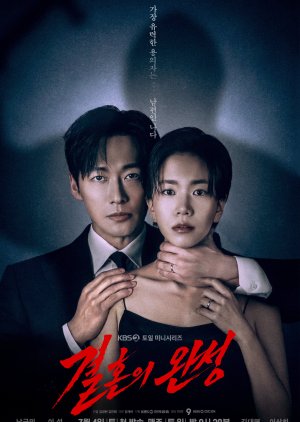
Contrary to what the poster suggests, it's not about domestic violence, and none of that is actually depicted. I don't understand why they chose this illustration. (which makes me uncomfortable, I admit)A series about the insidious power dynamics in South Korea. This surgeon should be at the top of the social ladder, yet finds himself crushed by his stepfather, the police (yet another bunch of useless idiots, as is so often the case in K-dramas), and a kidnapper. He is brought back down to his social origins : his fatherless childhood and his education on a scholarship.
In the end, who were the real villains of the story ? Those doctors who were so full of themselves. I'd say: realistic.
The plot unfolds smoothly throughout the first two-thirds of the series. There’s a twist in every episode. We can overlook the somewhat inconsistent acting. However, the ending drags on unnecessarily; we already know all the details, yet they keep rehashing them.
In this kind of story, you need a great antagonist. And at first, he certainly is one, odious and incredibly annoying. It works really well because we know nothing about him, and his motivations seem absurd. His wife, who's involved in the scheme (and whom we'd figured out long in advance), is just as despicable. And the series should have stuck with that instead of turning everything upside down the way it does. What a huge waste ! and it creates a major plot hole. In the end, they just abandon their entire backstory ; it doesn't make sense for even a second. Which brings me to my final point : "Some scenes were generated by AI."
No way. Isn't this nonsense going to end soon ? I don't want to see this. This year, it's a party at AIgen. Don't you know how to film anymore ? Don't you have a production crew anymore ? No actors left ? Where's your damn dignity ? This has to stop. Don't spit in our faces like that. Stop ruining everything with your death machines.
I suspect that at least part of the script was generated by these chatbots. Between the inconsistencies that ruin the series towards the end, and episode 8 throwing in flashbacks of scenes we've just seen… Strange. Very strange. Or is it just that awful opening sequence ? We're not sure anymore, but we're fed up with it, that's for sure !
Lee Seol delivers a particularly intense performance. And this AIgen nonsense insults her involvement as a performer.
Was this review helpful to you?