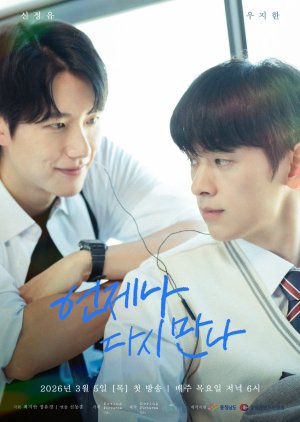
Everyone has imagined it at least once. What if you could go back to the past? Jang Hye Seong, a well-known painter, visits his alma mater, Seongjin High School, to give a special lecture at the request of his friend Tae Jun. During a break, he stops by the art room and discovers his old sketchbook. Inside it, he finds a drawing of his first love, Lee U Jin, half torn. On impulse, Hye Seong redraws U Jin right there. The moment he finishes the painting and puts the brush down, he is suddenly transported back to 2008, his high school days, where he reunites with U Jin. Even after returning, Hye Seong doesn’t want to repeat the mistakes he made back then, so he tries to keep his distance from U Jin. But with U Jin boldly and persistently coming closer, Hye Seong is left completely defenseless. Their eighteen begins again. Can they change their fate and finally reach each other? (Source: Korean = idol_romance X || Translation = MyDramaList) Edit Translation
- English
- Русский
- Français
- Português (Brasil)
- Native Title: 언제나 다시 만나
- Also Known As: Eonjena Dasi Manna , We'll Always Meet Again
- Director: Sin Dong Hun
- Genres: Romance, Youth, Fantasy
Where to Watch Always Meet Again

Cast & Credits
-
") Woo Ji Han Main Role
Woo Ji Han Main Role -
") Shin Jeong Yu Main Role
Shin Jeong Yu Main Role -
") Seo Seung HyunTae Jun [U Jin & Hye Seong's friend]Support Role
Seo Seung HyunTae Jun [U Jin & Hye Seong's friend]Support Role -
") Min Do HeeJang Eun Ha [Hye Seong's older sister / nurse at Seongjin High School]Support Role
Min Do HeeJang Eun Ha [Hye Seong's older sister / nurse at Seongjin High School]Support Role -
") Kim Hyung Min[Physical education teacher]Support Role
Kim Hyung Min[Physical education teacher]Support Role -
") Kim Tae Hyeong[Art teacher]Support Role
Kim Tae Hyeong[Art teacher]Support Role










Reviews

Weak start, getting better with every episode...
While we are flooded with short KBL mini-series, this is a serious TV production. And it shows. The main actors are already established and even the best friend is a character we have seen in other series as supporting role.I like scifi and time travel always but I would lie if I would say the script does not have it's flaws. Sadly it has. Especially the color-blindness was not explained at all. Especially WHEN does he have it, is it just an after-effect due to his time travelling or did he had it all the time or did it develop gradually. It has such a prominent role in the story that I don't know WHY it was there. So it irks me still, why it wasn't explained at all. Also the fight between Woojin and his best friend was overly fast resolved without the proper appology. Teajun had the vibe of jealousy which was not done right. It gave me first the impression he is also interested in Woojin in a romantic way but that was just a fleeting moment and imho not necessary.
The cinematography was top notch giving the past and the "now" a different vibe - which it should. Also they did an amazing OST. The only gripe is the overly blurness of their first kiss in the beginning, this was a bit over the top. I disagree with some reviews here saying the did not have chemistry, I think they did. The glances and micro expressions did it for me, without the face to face aural confessions we are so used to. They don't need words to convey their feelings. In the finale Woojin said his smile had a sadness to it and yes, that's what was intended. This was a much more mature storyline compared to most school/university BLs we get to see nowadays which I appreciated.
Regardless of the flaws of the script, I enjoyed the series. It took almost a year after "Ball Boy Tactics" to get a proper KBL on the screen and I appreciated it. So while not perfect, it's worth the watch.

Warms the heart while playing with the possibilities of fate
In a year where short-format K-BLs continue to dominate the scene, Always Meet Again arrives with the ambition of feeling like something more complete, more polished, more emotionally grounded, and at times more daring than its peers. Reuniting Jeong Shin and Myung Kim after A Breeze of Love, the series leans heavily into what made that pairing work in the first place: an effortless chemistry that doesn’t need grand declarations to resonate. There’s a quiet intimacy in the way they share the screen, where glances linger just long enough and emotions surface in restrained, almost delicate ways. It’s the kind of dynamic that feels lived-in, and it ends up carrying much of the series on its shoulders.What initially presents itself as a familiar time-travel romance gradually reveals a more introspective core. Rather than focusing purely on mechanics or spectacle, the narrative is more interested in grief, regret, and the desperate human urge to rewrite what was lost. The direction supports this approach beautifully, contrasting the muted tones of the present with the softer, almost glowing warmth of the past. There’s a consistent sense of longing woven into the visuals, reinforced by a carefully chosen soundtrack that elevates even the quieter moments. As the story progresses, it finds a stronger emotional rhythm, with later episodes delivering a more cohesive and impactful payoff than the somewhat tentative beginning might suggest.
That said, not everything on this canvas is painted in vibrant colors (tsk). For all its emotional strengths, the writing often struggles to keep up with its own ambition. The time-travel logic is, at best, loosely defined, and at worst, frustratingly inconsistent, leaving key plot points feeling underexplained or even contradictory. The subplot involving color blindness is perhaps the clearest example of this: introduced as something significant, it never quite finds a meaningful resolution or clear purpose within the narrative. Similarly, certain conflicts, especially those built around the idea of “pushing someone away for their own good”, feel more like familiar genre obligations than fully justified character choices, occasionally breaking the story’s emotional immersion.
There are also moments where the series hints at deeper layers, whether through supporting characters or secondary tensions, only to resolve them too quickly or abandon them altogether. This creates a sense of narrative imbalance, as if the story is constantly choosing between being intimate and being complex, without fully committing to either. The short episode format doesn’t help in this regard, often making developments feel rushed or undercooked when they needed just a bit more space to breathe.
And yet, despite these flaws, Always Meet Again remains an undeniably engaging watch. There’s a sincerity at its core that makes it easy to forgive its rough edges. When the series leans into its emotional beats, when it allows its characters to simply exist together without the weight of convoluted plotting, it becomes genuinely affecting. The performances, especially from the central duo, bring a level of nuance that elevates even the weaker scenes, grounding the story in something that feels real even when the logic falters.
By the time it reaches its conclusion, the series feels less like a tightly constructed narrative and more like an emotional journey, one that doesn’t always make perfect sense, but still manages to leave a lasting impression. It’s not flawless, and it doesn’t fully realize all the ideas it introduces, but there’s enough heart, atmosphere, and chemistry here to make it worthwhile. In the end, Always Meet Again may not be the best one out there, but it reminds us why stories about love, loss, and second chances continue to resonate: not because they are perfect, but because, at their best, they feel honest.






Recent Discussions
| Title | Replies | Views | Latest Post | |
|---|---|---|---|---|
 | [SPOILERS!] Plot holes by JMLovesBL | 0 | 0 | No discussions yet |