


Director - Screenwriter Lan Hong Chun's Notes from Douban
I am a native of Shantou. "Love Letter to Grandma" (Chinese Title of 'Dear You') is my 3rd film. It still features ordinary people as the main characters, still tells the story of this place, and is still based on close relatives. However, there are also many different changes, and I would like to share some with you.
It's been almost ten years since we made our first film in the Chaoshan dialect in 2017. We've finally put together three films, forming what everyone calls the "Chaoshan Family Trilogy." Actually, we didn't initially plan to make a trilogy. When we were making "Dad, I Can Do It," (Chinese title of 2018 film 'Proud of Me') we didn't have any professional background; we just went with a "let's give it a try" attitude. Unexpectedly, some audiences liked it, and some were even waiting for the next installment, which led to what we have now.
The second film was "Take You to Meet My Mom" (Chinese title of 2022 film 'Back to Love') which is about mothers. Because I'm not a professional in this field and lack the necessary knowledge, I was afraid of messing it up. So, I've always insisted on writing from the heart, prioritizing stories I've personally experienced. If I truly read and feel it, I'm less likely to botch it, this has always been my principle for choosing subjects. Now that I've talked about my closest parents, who should I make the third book about?
1. The story has many similar real-life prototypes.
After the release of "Take You to Meet My Mom," which took place in 2022 and 2023, I spent a long time working on the script. I wrote a bunch of family relationship stories about sisters, brothers, siblings... and revised them again and again. But I always felt that I didn't have that "must-make" urge in my heart, and I always felt that something was missing.
The story of "Love Letters to Grandma" came about in April 2023. It has been exactly three years since the first draft of the story was written, and it is now being presented to the audience. Why is there a story about Grandma? Unlike the previous two stories, which were based on personal experiences, much of this story was "heard" from others.
In 2019, I started filming a documentary called "The Flavors of Chaoshan Around the World," which tells the stories of overseas Chaoshan people. We traveled to many countries and listened to the stories of hundreds of overseas Chinese families. Later, due to the pandemic, we couldn't travel abroad. In 2023, we went out again and went to Malaysia, Thailand, Vietnam, Indonesia... and met many elderly overseas Chinese. Their stories about family and their homeland really touched my heart.
Some people ask if there are real-life prototypes in the movie. To say they are 100% identical is not the case, but similar people and events are extremely common in the stories we've heard. After meeting enough people and hearing enough stories, the story of this film naturally began to take shape.
2. Characters : Mu Sheng,Nan Zhi, Ye Shu Rou
Many viewers who have seen the movie ask, Are there any hidden meanings in the names of Musheng, Nanzhi, and Shurou? Actually, I didn't plan anything when I first chose the names. I first decided on the name Musheng, and then, following my intuition, I chose Nanzhi and Shurou. When I looked back after everything was settled, I realized that it perfectly reflected the relationship between the three of them. It seemed like these three names were meant to be.
However, on the surface, it seems that Musheng and Nanzhi are always protecting Shurou. But conversely, it is Shurou's personal charm that has always given Musheng and Nanzhi their support and strength.
The character of Shurou is designed to be clear-headed, self-consistent, resilient, and decisive from beginning to end. She is not bound by worldly conventions or constrained by tradition; she dares to love and hate, and dares to make choices for her own life, living with integrity throughout. We actually cut many scenes from the film. For example, there's a scene where Nanzhi tells Shurou in a letter that a Teochew opera called "Yu Jiaolong" is very popular in Southeast Asia recently, and the heroine in the play who dares to elope for love and travel the world with a sword is exactly like you. Later, Shurou replies proudly, saying that she's not embarrassed to be called Yu Jiaolong.
To this end, we specially filmed a very important "play within a play." The true historical context is that in the 1950s in Singapore, Malaysia, and Thailand, the Teochew opera "Yu Jiaolong" became a nationwide sensation, the story of Yu Jiaolong, Confined to her family home, yet yearning for the world, she dared to break free from constraints, pursue love, and live like a chivalrous woman. We filmed the play within a play intending to portray Yu Jiaolong as a reflection of the personalities of Shurou and Nanzhi—both women, at their core, possess chivalry, integrity, and an unyielding spirit.
Unfortunately, the movie was too long, and the edited version was over two and a half hours long. This part of the Teochew opera movie had to be cut, but it can be released later for everyone to see.
As for whether the characters Shurou and Nanzhi are realistic or have any prototypes, there are no exact prototypes in their stories. However, in terms of personality traits, they are just like the people I know well, the people I'm closest to. The underlying personality traits of Shurou and Nanzhi can be said to be drawn from my grandmother, my mother, and my sister—the female relatives I've known since childhood.
When I write about Nanzhi making a choice in a certain situation, and I'm unsure of her choice, I think that if my grandmother or other people were in the same situation as Nanzhi and Shurou in the movie, they would make the same choice.
3. The most authentic emotional expressions of actors and amateurs
In all 3 films, I used non-professional actors as the leads. The first two films were about fathers and mothers, and the actors' ages and life experiences closely matched the characters. The actor who played the father was in his 60s, and his own experiences with his children were almost identical to those in the film; the actress who played the mother also raised three children herself, and the struggles, concerns, and tenderness in the film were all from her own life experience, which she didn't need to act out.
But with "Love Letters to Grandma," the difficulty was completely different. Especially the lead actress, Xie Nanzhi, Li Sitong, was only 20 years old when filming this drama, still a sophomore in college. Mu Sheng was also only in his early 20s, but they had to portray a life spanning two or three decades, full of ups and downs. They didn't have the experience of being parents and wandering through half a lifetime like in the drama, so I couldn't directly draw on the actors' existing life experiences as I did with the previous two dramas.
Therefore, the most difficult part of casting for this drama was the casting process. I even became a bit obsessive-compulsive during the casting process, determined to find people whose personalities and underlying character traits were 100% compatible with the characters. Surprisingly, the three young leads who were ultimately cast had MBTI traits that perfectly matched the characters in the script. Meeting them was truly a stroke of luck.
Casting for the role of Nan Zhi took us over 6 months. We interviewed thousands of girls throughout the Chaoshan region. Besides door-to-door referrals from relatives and friends, the casting team spent countless hours on Douyin & short video platforms, searching one by one, like looking for a needle in a haystack. Finally, we found Si Tong online. She was a sophomore studying finance at the time, with no acting experience whatsoever. She took leave from school and immediately joined the production. Even more challenging was that the first scene we filmed was one of the most emotionally charged in the entire film—the scene where the bank sends out obituaries.
Normally, new actors should start with simple scenes and gradually work their way up. But we were a small crew, and we couldn't control the location or shooting time. We rented the location from the Bank of Communications, so we could only shoot at that time. It meant that a 20-year-old girl with zero experience had to film such a complex emotional scene in her very first scene. I was quite unsure of myself at the time.
Finally, I used the most primitive, and documentary-like, method. Before filming that scene, I didn't let Sitong enter the set. I spent almost two days rehearsing every extra in the entire bank, every detail, until we knew it by heart. Who would send money to redeem their daughter, who would write love letters to their fiancée, who would bring money back home to save their mother—every character, every dialogue, was rehearsed until everyone knew it by heart, like a completely real, immersive space. Only after everything was ready did I let Sitong enter. And she herself is a girl with extremely strong empathy; as soon as she stepped into that space, she was completely pulled back to that era, falling into the role of Nanzhi. What made us very gratified was that, although she had just taken leave from school and went straight into that scene, all her emotions and all her reactions achieved a real and moving effect. Later in the entire film, we mostly used this method to let her immerse herself in the scene, truly feel it, and express her emotions from the inside out.
The entire cast, from the elderly grandmother to the main actors Musheng, Nanzhi, and Shurou, were all making their film debuts. To find the perfect people, we spent over 70% of the pre-production period casting. It took almost 9 months of open auditions, interviews, and screen tests before we finally assembled the group.
They lacked professional acting skills, yet they brought these characters to life with the most genuine and heartfelt emotions. I am truly grateful to them for their willingness to completely dedicate themselves to this story and this film.
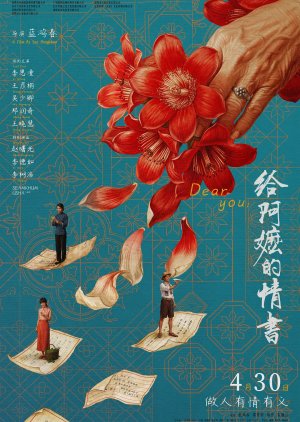
Details
- Title: Dear You
- Type: Movie
- Format: Feature Film
- Country: China
- Release Date: Apr 17, 2026
- Duration: 1 hr. 58 min.
- Genres: Drama, Family
- Tags: Landlady Female Lead, Foreigner Male Lead, Ethnic Minority, Set In A Foreign Country, Family Reunion, Family Relationship, Multi-Generational, Social Issues, Family Secret
- Content Rating: Not Yet Rated
Statistics
- Score: 8.3 (scored by 134 users)
- Ranked: #41616
- Popularity: #15951
- Watchers: 488
- Favorites: 0
Top Contributors


Popular Lists
Related lists from users


Recently Watched By


