


 1
1


This review may contain spoilers
A Royal Curse, a Cursed Story
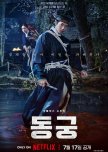
When I started The Palace of the East, I knew exactly what I was getting into: a fantasy horror thriller set during the Joseon era, but also a drama written by the co-writers of The Guest (a good one) and Bulgasal (not a good one), and directed by Choi Jung Gyu, the man who gave us, among other things, the magnificent The Devil Judge in 2021. Aesthetically speaking, it is truly beautiful, putting forward an oppressive atmosphere reminiscent of the movie Silent Hill, or even the series Stranger Things in some visual aspects, through its lighting choices and its blockbuster fantasy feel. The series starts off at full speed during the first three episodes, which establish the setting. Unfortunately, the short format imposed by Netflix and the storytelling shift that occurs in the second half left me with a bitter aftertaste. I felt that the narrative was losing some of its ambition. Do not expect a revolutionary story, as this is something we have seen many times before. But it is everything else that makes the difference, and given the budget allocated to it, it really could not afford to fail. Let’s take a closer look.At the heart of the royal palace, a mysterious curse seems to have fallen upon the King’s family. After several unexplained deaths and the sudden collapse of the last Crown Prince, the King (Cho Seung Woo) calls upon Gu-cheon (Nam Joo Hyuk), a man capable of crossing the boundary between the world of the living and the world of spirits in order to hunt supernatural creatures and ghosts. He acquired this cursed ability as a child during a tragic event and has carried it as a burden ever since. To accompany and watch over him, he orders Saeng-gang (Roh Yoon Seo), a court lady who is actually his only daughter, to join him. He exiled her as a child because she possesses the ability to hear the dead. Together, they must uncover the secrets of the Eastern Palace, the residence of the heirs to the throne, a place consumed as much by political conspiracies as by supernatural forces, where every discovery brings them closer to a truth that some people are willing to kill to preserve. The Dowager Queen (Jang Young Nam) and the King’s brother, Prince Ik-Sang (Tae In Ho), are also lurking in the shadows, each serving their own interests.
From the very first minutes, The Palace of the East makes a strong impression. The cinematography is exceptional, the production design is incredibly rich, the music is magnificent, and the visual effects reach a level rarely seen in a Korean drama. The result is genuinely cinematic. The CGI is perfectly integrated, and the whole production has a very strong visual identity. On these aspects, I even find the drama superior to Alchemy of Souls or Kingdom, for example, which are fairly recent. The direction is remarkably elegant, fluid, and impressively effective. The universe sometimes evokes FromSoftware games, especially Demon’s Souls, with its majestic palaces, atmosphere of decay, and disturbing creatures. Let’s be very clear about this: it looks incredible. The story, without being innovative, uses its unsettling atmosphere to take us on an adventure close to a fantasy horror thriller. I really enjoyed the first three episodes because the protagonists are quickly identified, there are not too many of them, and our main duo is likeable. In short, from the beginning, you can feel that we are dealing with people who know their craft and know how to put their expertise into practice. The story, which seems simple at first glance, will gradually multiply false leads, encouraging us to question the true intentions of certain characters.
Unfortunately, this excellent first impression gradually fades away. I found the second half more intense and certainly more fast-paced, but while the action side takes over, the storytelling gradually falls apart as we get closer to the ending. The story seemed promising, but ultimately lacks development. Aside from Saeng-gang, Gu-cheon, and the King, most of the other characters are without depth, especially the Dowager Queen, Prince Ik-Sang, and the shaman. They mainly exist to lead us toward false leads. As for the antagonist, he is introduced in a clumsy way, used as a tool, and poorly exploited. The viewer discovers his importance very late, even though he could have become a much more memorable antagonist.
The true threat hidden from the beginning turns out to be the Crown Prince (Kwak Dong Yeon), who was poisoned by his father at the time, when the latter discovered that he was practicing occult sciences.
In reality, it is the entire cast of characters, despite being quite small, that suffers from a lack of writing and, for some of them, a lack of substance. The conclusion easily falls into over-the-top territory. Some scenes lack coherence, such as the notable absence of the royal guards (they must have had a swimming pool day). We are still inside the King’s palace. The lack of extras is also quite puzzling for a place that is supposed to be alive. The thriller aspect is gradually abandoned in favor of action, leading to a finale worthy of Mortal Kombat but without a Fatality... Although, maybe. In the end, we leave the drama with more questions than answers:
Why did the King decide to kill his own son, knowing that this act would trigger a terrible curse? Why are the Prince and the Shaman presented as threats to the Crown if their roles are ultimately so limited? What is the role of the Dowager Queen and what are her true intentions? Why make the prince played by Kwak Dong Yeon such a central character in the revelations when he is barely developed?
For me, the real missed opportunity of the script lies there: the drama never truly settles the Crown Prince’s guilt. And that is a shame, because it would have given much more depth to both the King and the Crown Prince.
The writers know how to create an atmosphere, establish mystery, and bring fantasy to life. However, they struggle to give their characters enough depth and to transform their many plot threads into a fully satisfying conclusion. To end on a positive note, I would say that the duo formed by Nam Joo Hyuk and Roh Yoon Seo works extremely well, and that we thankfully avoided the easy and unnecessary mistake of adding a fake romance that would have served no purpose.
In the end, The Palace of the East impresses more with what it shows than with what it tells. The writers know how to create an atmosphere, build mystery, and stage fantasy with real mastery. Visually and musically, it is a true success, with stunning cinematography, ambitious production design, and direction that sometimes gives it the feel of a cinematic production. I also really liked the presence of Ggeomeoksali, this small creature with an almost innocent appearance that brings a lighter touch to an otherwise very dark universe. Like a Mogwai from Gremlins, it could easily have become just a cute element designed to appeal to viewers, but it ultimately finds its place within the drama’s fantasy mythology. Unfortunately, this visual ambition is not always matched by the writing. The many threads introduced throughout the episodes do not all receive satisfying conclusions. It is a shame, because the whole story is missing a tragic depth that could have elevated it. Nevertheless, The Palace of the East remains a largely positive experience thanks to its unique atmosphere, carefully crafted fantasy universe, and above all, a duo that works remarkably well. This drama is not revolutionary, but it remains entertaining and enjoyable. It nevertheless leaves me with a feeling of incompleteness, with a script that ultimately failed to live up to its ambitions.
Was this review helpful to you?
A Good Husband
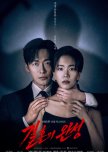
First of all, I wanted to pay tribute to KBS2, South Korea's historic public broadcaster, specialized in drama broadcasting. For years, it has been losing ground, struggling to compete with other public and private networks, and more recently with OTT platforms. Bound by a public-service mandate, it now has the image of "Dad TV", a bit old-fashioned, with an aging audience. It also took too long to adapt to the new rules of the audiovisual market. But with The Husband, KBS2 gives us a thriller that uses all the codes of a private network drama, even going as far as using AI to enhance certain scenes. So, let's say it: KBS2 broke open the piggy bank! And for that alone, I have to give them credit. But was the effort worth it? Namkoong Min is popular, he works the old-fashioned way (he doesn't do OTT productions, which are more lucrative) and he has plenty of experience. I think it was a great choice to bring him in and see him in a different kind of role, allowing him to bring all that experience to a drama where I wasn't necessarily expecting him. Let's see what it delivers.Kang Tae-Ju (Namkoong Min) is a talented neurosurgeon who works at his father-in-law's private hospital. His wife, Ko Se-Yun (Lee Seol), is the hospital's administrator. Their marriage has been falling apart for months following a tragedy that devastated them. After one last attempt to save their relationship, Tae-Ju gives up and asks for a divorce. After spending the night drinking, he realizes the next morning that Se-Yun is nowhere to be found. Not particularly worried at first, he goes to work, where a mysterious stranger calls him demanding money over a deal they supposedly made the previous night. Since he remembers nothing, he assumes it's a scam. Except his wife really has been kidnapped, and the ransom has to be paid. As the hours go by, Se-Yun's parents, followed by the police, begin to suspect Tae-Ju. Everything falls apart when a video sent by the kidnapper leads to Tae-Ju being taken into custody, as everything seems to point to him having organized the whole thing himself. Determined to uncover the truth on his own, he escapes with the help of the mysterious Lee Su-Hyeong (Park Byung-Eun), who seems to know the kidnapper, who also happens to be a killer. Tae-Ju is now a fugitive, hunted by both the police and this psychopath.
The drama gets off to a flying start, and there is plenty to like: the thriller is effective, with a constant sense of tension and danger. Tae-Ju finds himself caught up in a kidnapping case and has to figure out what is happening, protect his wife who is being held captive, and escape the authorities at the same time. The drama doesn't simply tell its story: it plays with the viewer's perception. I absolutely loved being made to look like an idiot; that's exactly what I want from a thriller: misdirection and doubt about the protagonist's actions. We are shown a scene, we hear a conversation, we are given a piece of information… but one element is deliberately missing. So we reach a conclusion that seems perfectly logical, only to discover later that we had actually interpreted the information correctly… just not what it really meant. That mechanism works extremely well. We spend a lot of time outdoors, Tae-Ju is the one being hunted, and it is genuinely thrilling. Thanks to AI and relatively inexpensive production techniques, the drama even allows itself car chases through dense urban areas and pedestrian zones; I have rarely seen anything like that in a drama. I'm not particularly fond of Namkoong Min, but I think he's very good in this new register: usually, he is locked into that very distinctive British-style stoicism of his; here, given the role, I'm discovering a completely different actor. Opposite him, Kim Dae-Myung, as the antagonist, gives him an excellent performance to play against in the role of Noh Man-Hui. He is a versatile actor who can play just about anything. As this cold-blooded psychopath, he is extremely convincing. It's a duel between two top-level players, but at a distance. My verdict halfway through was very positive, because the information was being revealed little by little.
But that's where the break comes, abrupt and far too predictable: the drama changes tone and the writing, which had been very good, starts to lose its way. We enter a much more conventional and predictable phase. Once Tae-Ju is no longer the hunted but becomes the hunter, the pace slows down considerably and the atmosphere changes. The police procedural side gradually takes over from the thriller, and I'm much less convinced by the whole conspiracy surrounding medical research. The masterminds and the real people behind the kidnapping, which turns out to be just the tip of the iceberg, gradually reveal themselves and show their cards. The second half relies heavily on flashbacks to explain what was happening behind the scenes. Occasionally that can be a plus, but here it becomes excessive. Instead of moving the story forward, some scenes simply explain something the viewer has already watched. At times, it feels as if the drama is taking its own story apart instead of moving it forward. Episode 11 pushes this principle particularly far: I felt like I was watching the making-of of the story, with the behind-the-scenes version of events we had already seen. It's interesting if you want to understand the whole puzzle, but much less effective when it comes to maintaining tension. The worst part is that more and more inconsistencies start appearing, along with painfully obvious plot conveniences: Noh Man-Hui casually uses his own car as if everything were perfectly fine, while there are several opportunities to capture, neutralize or kill certain characters, but the story prevents it because the writing needs them to survive until the next scene. The script simply does whatever it needs to do to get to the next scene, and that's a real shame. To be honest, I was already starting to lose interest around episode 9. And the biggest problem for me is that the drama doesn't even properly close the storyline involving the key character Lee Su-Hyeong
Overall, The Husband is still a quality production, with excellent direction and cinematography, especially during the first five episodes. The director himself clearly stepped outside his comfort zone if you look at his filmography. The sets and photography are genuinely impressive, and there is no reason for this production to feel inferior to similar dramas. The overall atmosphere is also pleasant. The supporting cast does the job without standing out, but the drama is worth watching for the performances of Namkoong Min and Kim Dae-Myung. Lee Seol is a talented actress, but she is unfortunately underused in the second half. Special mention also goes to the veteran Lee Sang-Hee, who plays Gyeong-Ae, Man-Hui's completely unhinged wife, bringing an extra layer of scheming and menace to the story. As for the ending, it is predictable, admittedly, but it is coherent and avoids yet another standard happy ending.
In the end, The Husband leaves me with rather mixed feelings. I have much more desire to remember what it got right than what it got wrong. There is that first half where I genuinely felt like I was getting exactly what I love about Korean thrillers: a story that catches me off guard, doesn't give me all the answers, and constantly leaves me wondering what is really going on. That's rare enough that I can't simply dismiss the drama because of its weaknesses later on. The second half definitely brought me back down to earth, to the point where I occasionally found myself checking the time, but it doesn't erase the enjoyment I got from the first half. And ultimately, that's probably what I'll remember about The Husband: an imperfect series that could have been much better, but at least tried something. In a landscape where so many dramas end up following well-established formulas, I much prefer one that takes a gamble and partly fails than one that never takes any risks at all. So yes, KBS2, do it again. But next time, just try to keep the same level for all twelve episodes. That's why I'm giving it a score of encouragement.
Was this review helpful to you?
Soft Hearts, Iron Fists
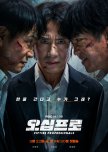
Sometimes there are series I don’t even try to analyze or break down. I immediately immerse myself in them, and that’s usually a good sign. Fifties Professionals instantly hooked me—not because of its story, which is fairly classic in essence, but because of its atmosphere. A well-balanced mix of genres: action, crime, comedy, romance, and above all this almost theatrical troupe feeling, carried by an ensemble cast that works like a solid collective. In this kind of setup, everything depends on balance. And here, the series generally avoids excess, which is never easy when you need to maintain constant emotional tension. Yes, the usual genre tropes are there, but they pass smoothly, almost naturally. For viewers not very familiar with K-dramas, the cast may not mean much. For others, these faces speak for themselves: seasoned actors who have nothing left to prove and who are here to showcase their craft, almost in a controlled playground.2016. To recover a USB drive containing compromising files involving North and South Korean agents, including a high-ranking NIS official, three of the best in their field end up in direct confrontation. A bag containing dozens of cut diamonds worth a fortune is also part of the loot. On one side, ghost agent Jung Ho-Myung (Shin Ha-Kyun), on the other, North Korea’s “weapon” Bulgae (Oh Jung-Se), and finally the right-hand man of a powerful gang, Kang Beom-Ryong (Heo Sung-Tae), nicknamed “Doksa” (the viper). But during a confrontation, the trio ends up stranded on the small island of Yeongseon. Bulgae, who has taken the loot, becomes amnesiac and forgets everything about his past. The other two lose his trail. 2026. Ho-Myung, now a wanted man, continues his mission in secret, despite being married and a father. Beom-Ryong watches him from a distance, while his boss is in prison. Expelled from the gang, he has become a convenience store manager. As for Bulgae (fire dog), renamed Bong Je-Soon, he now lives an ordinary life.
The most interesting part of the drama is therefore not the plot, but the evolution of these three heroes ten years later. If Je-Soon is not aware of his change due to his amnesia, the other two have evolved in surprising ways. This is where the psychological aspect becomes interesting and surprising: Ho-Myung must deal with family responsibilities, while Beom-Ryong, who brought Gong-Bok (Lee Hak-Joo), his right-hand man, along with him, has by chance become a convenience store manager and a fundamentally good man. Now, I’m not trying to sell this as a psychological drama, but what I want to highlight is that alongside their original mission, we have three men in reconstruction whose common point is not their past, but their attempt to live differently, in a form of unconscious redemption. Because behind the spy storyline, the series raises a simple but effective question: can one truly start over after a life of violence and secrets? These characters are not manichean and do not follow binary logic. They are not war machines, but human beings with strengths and weaknesses. Even love, directly or indirectly, gets involved. The three women around them are not decorative props either.
Indeed, these are strong, grounded and humane women who embody the present, stability, but also a moral and institutional gaze on these men returning from their former lives. Don’t expect a rom-com style romance here—it is more a stylistic device used to express the idea of existing or emerging romantic partnerships. One of the series’ greatest strengths is its ability to shift registers: it smoothly moves from action to comedy, from drama to “romance.” There are intense moments, but also lighter ones. The director, who can rely on works such as Squad 38 and Bad Guys: Vile City, handles this with fluid transitions, never abrupt. The famous “switch” in tone is well mastered, thanks to acting, editing, and music. Even the dialogues may seem simple or even absurd, but they often work through situational contrast, reinforcing the slightly surreal tone of the whole. What caught my attention is this very diverse gallery of characters, which creates an immediate and almost fusion-like chemistry. There is above all no downtime, which does not mean there are no calmer moments allowing us to connect with their lives.
The series subtly alternates between fights and conviviality, against a backdrop of political conspiracy, influence trafficking, and drugs. The action is clear and spectacular when needed. But as you already understood, the main strength of the drama lies in its cast, and in the way they are highlighted through solid and effective directing. I mentioned the trio of actors, but it would be unfair not to mention Kim Shin-Rok, Shin Dong-Mi, and Han Ji-Eun, who all bring something complementary. They also have long careers behind them. The atmosphere of the series is truly excellent; there is a strong feel-good spirit behind very serious stakes. The plot is simple and easy to follow, but the most important thing lies elsewhere, in relationships, group dynamics, and the reconstruction of broken lives. There are few notable twists, and the heroes are rarely in real danger, but honestly, that is not a problem. The director Han Dong-Hwa’s approach is to remain sober: action scenes have scale when needed, but there is no overuse of gratuitous violence or gore. Violence exists, but it is contained. I would never have expected such a drama to deliver so much emotion, because it is deeply human.
Fifties Professionals does not reinvent the wheel. But what makes the series stand out is its strong ensemble chemistry, its theme of redemption, and the right to happiness in a second life. This is easily accepted, because although the two agents had to kill as part of their institutional roles, the gangster, while he did “break faces,” never actually killed anyone. This is a drama about people trying to rebuild their lives without completely denying their past. The chosen format helps densify the narrative and avoids artificial filler. The only drawback—and truly the only criticism I can make—is that the ending feels rushed. It is a real shame. It is frustrating, because after taking such care in building its characters over twelve episodes, they deserved a proper moment of emotional breathing space before the credits. Five or ten extra minutes would have been enough to give more emotional weight to their farewells. They were truly endearing, and I would really love to see them again in other adventures because I thoroughly enjoyed them.
Was this review helpful to you?
Law Through the Walls of the Invisible
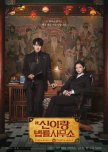
If I mention Move to Heaven or May I Help You?, does that ring a bell? Phantom Lawyer clearly draws inspiration from these two dramas to build its narrative, as it leans on the syncretic religious fabric specific to Korean culture: shamanism is often associated with Christianity here, without hostility or major conflict. In this special law firm, our protagonist is tasked with solving cold or corrupted criminal cases involving ghosts, usually people who died violent deaths. The goal is simple: to deliver justice on their behalf. So you already know what you’re getting into (and not getting kicked in the teeth like Chuck Norris would say), so no point in “getting mad”: this is firmly in the realm of feel-good storytelling, emotional release, repentance, and redemption. You’re here to have a good time, laugh or cry (yes, keep the tissues handy), and enjoy a 100% family-friendly feel-good series—even if everything is very neatly tied up and highly predictable.Shin I-Rang (Yoo Yeon-seok) is a kind, timid man, a lawyer struggling to find his place. He is the son of a prosecutor who died 20 years ago, later revealed to have been involved in corruption. His family remains close-knit and supportive. After failing to land a job in a law firm, he eventually decides to open his own practice in an old building. What he doesn’t know is that this place used to be a shamanic temple. By lighting a special incense burner, he discovers he can see spirits attached to talismans. Han Na-Hyun (Esom) is a brilliant lawyer who has never lost a case. One day, she faces I-Rang in court while he is defending a ghost—and unexpectedly loses. Initially wary of him and thinking he might be unstable, she gradually gets to know him, especially as they discover shared links from the past. She also carries psychological wounds of her own, and together they begin to help each other while solving cases involving strangers, as well as family-related secrets tied to their own histories.
Phantom Lawyer blends legal thriller and supernatural fantasy. It’s not the drama of the year, and honestly it doesn’t try to be—and that’s fine, because it delivers what it promises: dopamine and comfort viewing. The series doesn’t reinvent the genre; it simply continues it. Some cases are more engaging than others, but in this kind of format, the goal is to satisfy the widest audience. One thing to keep in mind is that Phantom Lawyer is ultimately about forgiveness, whether religious or emotional. The structure is somewhat unusual: between five ghost-related legal cases, the story also explores Na-Hyun’s personal trauma and the burden she has carried since childhood, while gradually uncovering the mystery surrounding I-Rang’s father’s death. This mainly serves to strengthen the bond between the two leads. Each case delivers its share of genuine emotion, because the ghosts I-Rang encounters are fundamentally good people—but not simplistic ones. The episode involving the elderly woman, for example, clearly shows that the drama is more nuanced than it first appears.
The series openly explores grief and how it is processed after losing someone, especially when unresolved truths can finally surface thanks to I-Rang’s ability. It becomes a story about resilience in its many forms. Yes, there are shortcuts and narrative conveniences used to heighten emotion, but again, you know what you signed up for: comfort viewing. The main strength of the show is not its plot (which doesn’t need to be groundbreaking), but the duo Yoo Yeon-seok – Esom. Their chemistry is so natural it doesn’t feel forced at all. Both are versatile, skilled actors: when I-Rang is possessed by spirits, he fully embodies them, often leading to comedic moments—especially with the rookie K-pop idol spirit. Na-Hyun starts as pure rationality, someone who doesn’t believe in the supernatural. Their dynamic really carries the series. Esom has a natural elegance and charm that few actresses possess, while Yoo Yeon-seok displays an impressive range. There is also a fair amount of dark humor, which contrasts interestingly with the tragic and emotional moments. The tone is well handled overall. The drama also raises the question of whether justice is still possible when evidence has vanished with the victims.
Supporting characters (many familiar faces for K-drama viewers) add warmth and depth. The atmosphere is solid, occasionally reminiscent of Hotel Del Luna. Of course, there is an antagonist tied to I-Rang’s past, revealed later on. The music consistently enhances emotional beats, and the CGI is decent enough not to break immersion. While pacing is strong for the first ten episodes, the second half does dip at times. Still, for a 16-episode drama (increasingly rare in 2026), there are no truly useless filler episodes. That said, episode 11 deserves a warning for heavy product placement. Toward the end, the quality becomes uneven, but it remains watchable. You don’t watch Phantom Lawyer expecting twists—you watch it to see lawyers deliver justice to ghosts who never received it in life. It’s a story of repair and reconciliation, often touching and emotional. It brings relief to both the living and the dead. Yes, it’s formulaic and structured, but sometimes a little humanity like this does no harm, does it?
This drama doesn’t try to overwhelm you with complexity; it offers therapeutic simplicity—a kind of medicine you actually enjoy taking. I found myself genuinely invested in their doubts, pain, and small victories.It’s not a thriller or a hard-hitting procedural, so there’s no point overanalyzing logic gaps or inconsistencies. I genuinely enjoyed it for what it was. And without spoiling anything, if I hadn’t gotten the ending 99% of viewers probably wanted, I would’ve deducted a point. Because yes—some things matter that much. And don’t miss the final epilogue; it’s worth staying for the lighter note.
Was this review helpful to you?
The Four Fantasists
Although the script is 100% Korean, its genesis traces back to the “The B-Team” concept developed by Stan Lee’s studio in 2018. Directed by Yoo In-sik (Dr. Romantic, Vagabond, Extraordinary Attorney Woo), this K-drama takes us to 1999, at the dawn of the Y2K bug, in the small town of Haeseong—marked by a dark incident dating back over twenty years. The WONDERfools naturally evokes Marvel or DC-style heroes, but it leans more toward a mix of works like Cashero, Hi-Five, and even The Boys, in the sense that these characters are not born as heroes but are the result of laboratory experiments or accidental contamination. In terms of atmosphere, they also carry a touch of Guardians of the Galaxy. So between satire and superhero deconstruction, do these late-20th-century “wonder kids” (in truth, broken misfits) succeed in delivering both spectacle and escapism?At the end of 1999, Eun Chae-ni (Park Eun-bin), in fragile health, is expected not to survive into the new century due to a weak heart. She is a 27-year-old woman with a childish streak—likable but stagnant. Her only family is her grandmother, who runs a large restaurant. Her high school friend Kang Ro-bin (Im Sung-jae), somewhat intellectually limited, and her neighbor Son Gyeong-hun (Choi Dae-hoon), a lazy, compulsive liar of sorts, are her only companions. A new civil servant arrives at the town hall and surprises them with his rigidity: Lee Un-jeong (Cha Eun-woo) is a mysterious figure who takes a particular interest in Chae-ni. One night, after a tragedy, the trio accidentally acquire superpowers through an unfortunate chain of events. In reality, this awakens Chae-ni’s latent abilities while also granting her new ones. Elsewhere in the city, a diabolical figure returns: Professor Ha Won-do (Son Hyun-joo), released on parole after 20 years in prison. He is the source of the misfortunes awaiting the group and is directly tied to parts of their past.
From the very first minutes, the tone is set. The series opens with Radiohead’s iconic Creep, immediately immersing us in the melancholy and existential gloom of the late century. This temporal and musical contrast perfectly establishes an atmosphere that constantly oscillates between nostalgia and modernity. The retro aesthetic brings a carefully crafted vintage feel. It offers a fresh take on the superhero genre—far from standard blockbusters—focusing instead on humor and the clumsy, deeply human side of these “Wonderfools.” At its core, they stem from the “Wunderkinder Project” (yes, the German reference is deliberate), echoing the idea of scientific experiments reminiscent of World War II-era experimentation narratives. In keeping with the Y2K setting, the series leans heavily into nostalgia, portraying flawed heroes with limited lifespans whose already broken lives are further shaped by physical or psychological damage. The core idea is to show how ordinary, slightly dysfunctional people deal with overwhelming responsibility. They gradually discover strengths they never knew they had, especially courage and self-sacrifice.
In this kind of drama, the appeal is not in an unpredictable plot. The main strength of The WONDERfools comes down to one name: Park Eun-bin. Once again, she delivers an outstanding and compelling performance—an absolute showcase without ever overdoing it. She practically owns the screen. Credit is also due to Choi Dae-hoon and Im Sung-jae, both highly respected actors in Korean cinema and television. As for Cha Eun-woo, while I’m not particularly a fan, he delivers a surprisingly solid performance alongside his Clark Kent-like physique. The chemistry between the team members works well: they support each other, motivate one another, and grow together. Another smart choice is that their powers are unstable—they must learn to trigger and control them, often leading to comedic or chaotic action scenes. Their energy is contagious; it’s pure dopamine entertainment. You’re not here to think—you’re here to have fun. The direction is polished, the CGI solid, and the production design effective. The soundtrack also elevates key moments; the ending of episode 6, for instance, evokes a Guardians of the Galaxy-style sequence with a long tracking shot centered on Park Eun-bin.
The downside is that while the heroes are well-developed and the series entertaining, it somewhat misses the depth of its central conflict. Even though the danger is present, it never feels truly threatening. The antagonists are often too soft, lacking real menace despite having interesting abilities on paper. They are not cruel enough, and somewhat improbably, some even display empathy. The use of a cult as a cover for their actions feels like an overly familiar narrative shortcut. Moreover, Son Hyun-joo, a major figure in the industry, is underused and drifts through the story like a ghost. It’s a shame, as there was real potential to intensify the threat and raise the stakes in certain action sequences. That said, I understand Yoo In-sik’s intention to keep the focus on the “Fantastic Four” of misfits and their emotional journey. The entire moral arc revolves around what they choose to do with their flawed abilities—their decision to turn defect into altruistic sacrifice.
One final note: I’ll leave the discovery of the protagonists’ superpowers to the viewer, some of which, despite being seemingly “useless,” turn out to be crucial at key moments. It’s also worth noting the director’s clever handling of historical context, avoiding lazy flashbacks. While not particularly groundbreaking, the series delivers an enjoyable, feel-good yet occasionally darker story—a blend of burlesque comedy, human drama, and thriller elements. With solid production values, it is clearly a Netflix export-oriented project. The overall package is strong, even if sometimes chaotic, though viewers should be careful of occasional emotional overindulgence. The redemption arc of a certain character also feels somewhat too easy by the end. Ultimately, what remains is a high-energy series with a clean tone and highly likable, relatable heroes. Yes, it lacks consistency and rigor at times, but it never feels frustrating because the entertainment is clear and effective. As with many shows of this kind, the ending remains open. I initially planned to give it a 7, but Park Eun-bin alone earns it an extra point—she absolutely dominates the game.
Was this review helpful to you?
Murthehelp VS Babylon
Season 1 of A Shop for Killers worked thanks to a subtle balance between a gripping, claustrophobic thriller and inventive action that managed to surprise at every turn. We followed Ji-An through a believable progression, we worried about her, and we anxiously watched her make one risky choice after another. The tension was constant, with twists in every episode. It was pretty difficult to figure out where the story was going because information was revealed little by little. Season 2 completely changes direction, and yet the first episode really whetted my appetite because it was clever and offered another great idea to bring both returning viewers and newcomers into the story. Unfortunately, I was immediately less convinced by what followed. Sure, the drama is as addictive as a good pack of Kopiko candies, but it completely abandons the novel in order to exploit the 100% action angle.The first episode starts with a rather original idea: it takes place during the final episode of Season 1, but from Jin-Man's point of view. We get to see what was happening behind the scenes, while also discovering his connection to Babylon's Japanese branch more than fifteen years earlier, before he founded Murthehelp. If Season 1 was a faithful adaptation of the first chapter of Kang Ji-Young's book, this sequel is a very loose adaptation that no longer follows the original trilogy's storyline at all. I'll be honest: I could have stopped right there at the end of this introductory episode. Why? Because what follows completely abandons the intelligent thriller side of the story and dives headfirst into much more generic action spectacle. I felt like I was watching a mix of Counter-Strike and Splinter Cell (the video games), with a bit of The Expendables thrown in. Now, that's not necessarily a bad thing, but it still needs to live up to the stakes. Unfortunately, this feels more like fan service than anything else. Overall, it's enjoyable, but nothing more. I'm a little disappointed because the narrative downgrade compared with Season 1 isn't merely a matter of degree.
After Season 1, we were expecting the return of Bale (Jo Han-Sun), the iconic antagonist, the psychopath, the unstoppable killing machine. He is indeed here, but unfortunately, he's little more than a guest appearance before giving way to the Sino-Korean Jin Kusanagi (Jung Yun-Ha), the head of Babylon's Japanese branch. She has about as much charisma as an oyster, and her best agent, Agent Q (Hyunri), is barely any better. I'm not against women being used as badass characters—quite the opposite—but seriously, was there really nothing better available? They simply lack presence, and more importantly, they never feel dangerous in any way. The Murthehelp team is still around, but many of them no longer have the same impact. They mostly seem to be there to make an appearance, before several of them are eventually taken out toward the end. We could have hoped for stronger bonds between Jin-Man and Ji-An. Nope. Everything feels artificial and predictable. I don't get the same hype as before, especially that wonderfully chaotic feeling that things were almost being improvised on the spot. The plot is so basic that Episode 2 is almost the complete opposite of the first. I genuinely thought it was some kind of elaborate joke. The rest isn't exactly brilliant either, and by the final episode, you can pretty much read the whole thing like an open book.
The story creates a stylistic clash between two rival organizations fighting for the parallel-market arms trade, supplying Third World governments, rebels, and private militias. Whereas Murthehelp was originally presented almost like a local business catering to the "killers in the neighborhood," it has now received a massive upgrade and is suddenly capable of almost going toe-to-toe with Babylon. The arrival of a whole army of "clowns" makes the series more spectacular and bloodier, with sound design that can sometimes be excessive (the knife impacts sound downright cartoonish). The violence is therefore turned up a notch, and the visual spectacle improves, while realism and atmosphere take a hit. Some characters we had grown attached to in the past aren't treated with much respect. A minimum amount of empathy, please—is that really too much to ask? Meaningful relationships disappear in favor of predictable and pointless behavior. Thankfully, the fight sequences are well choreographed, because it would have been something if they'd messed those up too. Special mention to Ji-An, who apparently read How to Become G.I. Joe in 10 Easy Lessons to make up for her previous combat deficiencies.
Technically, it's solid, no complaints there: the direction lives up to its ambitions. And if you're looking for fights, massacres, explosions, and mass dismemberment, you're going to be well served. It's a shame we don't get to see the uncle and niece together more often; they seem to spend most of their time avoiding each other. I wasn't convinced by the supposed-but-not-really passing of the torch: Kim Hye-Jun was better and more convincing in Season 1 than she is here. Apparently, somewhere between a stray bullet and a punch to the face, she somehow found time to get her hair done and her makeup touched up... Yeah, between a full-blown brawl and a beauty salon, priorities matter. Lee Dong-Wook does the job; it's clean and solid without being outstanding. As for Jin-Man's team, it's nice to see the old faces returning, but since I don't want to spoil anything, prepare to be disappointed and disgusted. The drama is short, just like Season 1, but the density is noticeably lower. That's undeniable. It feels like they spend several episodes circling each other before finally making an appointment for the big final fight. What a surprise!
In the end, Season 2 isn't bad, far from it, but it has lost what made the first season so appealing. Where Season 1 was constantly trying to surprise us, this one is mostly trying to blow us away. It works fairly well if you approach it as pure, unapologetically over-the-top entertainment, but much less so if you were hoping for the tense and clever thriller that made the first season such an addictive watch. We still have the characters, the weapons, the fights, and gallons of blood, but we've lost a large part of what made the first season so compelling: the tension, the uncertainty, and that feeling that everything could go completely off the rails at any moment. It's spectacular and occasionally exhilarating, but considerably more predictable. The entertainment factor is still there, but if the steak is bloodier, it doesn't taste as good. The conclusion is bafflingly predictable, but the good news is that the ending seems fairly definitive... Which, in my opinion, won't stop them from making one final installment anyway.
Was this review helpful to you?

Analysis of the Theory of Emptiness, or a Failed Parody
This review was conducted without any trickery, though it contains minor spoilers that have no real consequences. Well, the time has come to perform an autopsy on the beast, which—after a slow 12-episode agony—finally collapsed, torn between mediocrity and embarrassment. Sometimes one can be mistaken, but for a major public broadcaster in a prime-time slot, the conclusion is unmistakable: this is not merely a failure, it is a full-blown industrial accident. The 2026 audience has spoken. Viewers refuse to be treated like fools, and this disaster proves that the era of glossy, algorithm-driven rom-coms is coming to an end. Lightness is fine; stupidity and mindless nonsense are not—never again, thank you. As a viewer, I’m tired of being taken for an idiot. I’m willing to be indulgent, to swallow a few absurdities for the sake of a “cute” romantic comedy, but my patience has limits. I made it to episode 6 and then bailed. Yes, even my intrinsic masochism told me to stop the carnage. That, in essence, explains my 2/10 rating. I got off the bus, and as Denis Brogniart would say: the verdict is final.Matthew Lee / Lee Hae-seok (Ahn Hyo-Seop) is a young farmer (well… sort of) with a rough-around-the-edges personality but a heart of gold (like Elvis). He passionately cultivates white-flowered nuri mushrooms. One day, Dam Ye-Jin (Chae Won-Bin) disrupts his peaceful routine. A star host on a home-shopping channel, she has made it her mission to get Matthew to sign with Eric Seo (Kim Beom), co-CEO of the international cosmetics brand L’Étoile. (Naturally, despite having spent half his life in France, he doesn’t speak a word of French.) She comes to renew their contract. Despite his repeated refusals, she persists. Their relationship begins to evolve. Long story short: love triangle, romance, childhood psychological baggage, and all the usual tropes—except without nuance or depth, because apparently we had better things to do, right? It’s the “seen it 100 times before” syndrome… and even on a good day, it still doesn’t work.
Sold Out on You (the French title is frankly awful) suffers from lazy, mechanical writing that confuses humor with hysteria. Between flat, unfunny characters, misunderstandings staged like advertising sketches, and editing that feels like a poorly assembled scaffolding just to exaggerate effects, the series generates a constant sense of discomfort. The childish reactions of thirty-year-old adults and the “cute” scenes devoid of any real emotion instantly break the viewer’s engagement. The unsettling part is that the drama believes itself to be adorable, while it actually sinks into pathetic overacting. There is no emotional connection possible because everything is pre-calculated to the millimeter. It reminded me of Mozinor’s parody generator: take the same ingredients, reshuffle them, change the setting and job titles, but keep the same mechanical structure. The characters are no longer coherent individuals, but bundles of recycled tropes: the clumsy yet “modern working girl” heroine, the taciturn but perfect male lead, the chic but empty rival, and eccentric villagers used as joke machines. Everything becomes predictable ten minutes in advance. It could almost be turned into TikTok Shorts.
As mentioned, it all feels like déjà vu: a clone of Brewing Love, with hints of Hometown Cha-Cha-Cha and Business Proposal. There is absolutely no originality or new creative direction. It shamelessly recycles past dramas in bulk, scene by scene. The same tired formula is everywhere: a fake “artisan, rural, bucolic” aesthetic used purely as decorative background, and the same artificial clash of opposites (the hyperactive city girl versus the overly sensitive country man). There is a complete absence of social realism, as physically demanding jobs are stripped of substance to become aesthetic wallpaper. Sold Out on You clumsily attempts to replicate a formula that was already showing cracks, confirming the creative drought of its writers. In truth, it feels like a collapse of social coherence disguised as luxury advertising. The drama descends into involuntary absurdity by disconnecting its characters from any sense of reality. A 25-year-old home-shopping host driving a Porsche convertible, living in a Gangnam showroom-style apartment, and owning a wardrobe worthy of Céline Dion instantly destroys credibility. Many recent rom-coms seem afraid of reality: everything must be Instagrammable, and sincerity—romantic or otherwise—is killed before it can even emerge.
If the writing no longer even smells remotely fresh, the waste is equally evident in the casting and technical execution. The directing is a disaster, the editing even worse, with constant continuity errors and scenes that make no sense in real life (yes, it’s a rom-com, fine—but still). The most frustrating part is how the actors are handled. Ahn Hyo-Seop is drowned in hollow dialogue lines worthy of a teenage sitcom, while poor Kim Beom is reduced to a ghost-like presence or a glorified food courier, disappearing from entire sequences without explanation, a collateral victim of a broken script. And worst of all is Chae Won-Bin: unconvincing, poor performance, completely unfit for the role. To top it off, the technical side is a mess. The pacing is artificially chopped up in a desperate attempt to revive a drama already brain-dead from the start, while advertising constraints are visibly dictating choices. The production team seems to have given up, resulting in sheer chaos. It’s a parade of clichés and worn-out tropes; everything is black and white, and the series proudly embraces it. Supporting characters are stuck in the same repetitive roles to the point of exhaustion (family ties, friendship clichés, etc.). In short… it’s boring.
In conclusion, Sold Out on You is the very definition of the “theory of emptiness”: visually, we are saturated with an aesthetic that feels entirely out of place, fake luxury, and clinical filters—everything reeks of artificiality. This historically low 2.9% audience share is a much-needed wake-up call from a viewership that has matured and now demands texture, sincerity, and respect. Subjecting myself to six more episodes of this marketing parade would amount to pure televisual masochism. The series never actually tells a story; it merely recycles a catalogue. It is often childish and saccharine. For newcomers to K-dramas, it might still pass (I might have stuck with it last year, perhaps). But for those who are tired of being treated like fools, it’s better to move on—you’ll save your time. I’m not asking for a perfect romance in a perfect world, only for credible characters capable of conveying emotion, even within an imperfect script. Beneath the filters, the Porsche, and the romantic slow-motion shots, there was ultimately… nothing. The “stop” button has been pressed. Definitively.
Was this review helpful to you?
The Manuscript of Faust
The Boy in the Last Row is a psychological thriller that plunges us into an ambiguous relationship between a teacher and his student. But the real question from the very beginning is not so much who the teacher is, but rather who truly is the teacher, and who is the student. Very quickly, the series goes beyond this initial framework to become a thriller focused not on the events themselves, but on how they are told and interpreted. You are handed an invitation, and it is up to the viewer to determine the share of truth and lies being delivered. Directed by Kim Kyu-Tae, who is far from a novice and offers a strong résumé with dramas such as The Trunk, Our Blues, Live, and Moon Lovers: Scarlet Heart Ryeo, works that have all left their mark, we already know we are in for effective direction and full immersion from the very first minutes. Without spoiling anything, and unless you are completely unfamiliar with the genre, a high-level duel awaits between these two men.Heo Mun-Oh (Choi Min-Sik) is a professor of Korean literature at university. A failed writer (he has only published one novel), over time he has become a very harsh, stubborn, and irritable man with those around him, especially his wife, Jo Hyeon-Suk (Jin Kyung), a talented psychologist/therapist. They look more like roommates than a real couple. In his youth, when he was still a student, his rival was Kim Su-Hun (Heo Jun-Ho), who has since become a wealthy and famous writer. The worst for Mun-Oh is that this man married his crush, Ahn Eun-Joo (Kim Yunjin). During one of his classes, he becomes drawn to an unusual student sitting in the last row, the young Lee Kang (Choi Hyun-Wook). Very quickly, Mun-Oh detects talent in him and pushes him further. His interest in Kang’s essays keeps growing, but when Kang admits that he does not invent anything and simply recounts what he experiences in real life, Mun-Oh’s shock turns into obsessive curiosity as he becomes emotionally involved.
The main interest of the drama does not lie in the multiplication of secondary plotlines, but in the focus on a small number of characters. This choice immediately strengthens immersion and gives the impression of being trapped in a closed system where every interaction matters. This makes sense given the limited number of episodes. Without giving too many specific indications, there is one essential, even crucial element to pay attention to as time goes on. It is not just about spotting false appearances, but above all about paying attention to what is said, and who says it. The thriller is built precisely on this confusion, constantly misleading and sustaining doubt at all times. Its strength lies in the power of its narrative and the way it is delivered. What sets the series apart is its use of storytelling itself as a dramatic tool. The story feels filtered, constructed, sometimes fragmented, creating a constant tension between what is shown and what is understood. The viewer is never certain of having access to an objective truth, only to a possible version of events. Hum...Have I said too much? :)
The plot revolves around the Mun-Oh / Kang duo (duel), which initially appears straightforward. But the relationship between the two men gradually becomes ambiguous, making us doubt everything. Trust turns into dependency and evolves into a form of role confusion. One of them seems to control the narrative, while the other gradually loses critical distance. The series thus explores a dynamic in which obsession with a story can alter the perception of reality itself. The Boy in the Last Row is a cerebral thriller where everything relies on perception and interpretation. Rather than multiplying spectacular twists, the series builds its strength on constantly questioning what we think we understand. Reality, imagination, and illusion constantly overlap, forcing us to reconsider each piece of information as it appears. To put it simply, do not believe everything you see or hear. Confusion becomes the key word of the story, and each new piece of information forces us to reconsider the previous ones, reinforcing the addictive aspect of the whole. We are constantly building theories, to the point where it becomes almost playful. And the fast pacing sometimes prevents us from thinking too clearly.
But the series also relies on a very controlled execution. Indeed, it could not work without its essential core, which rests on the two main protagonists. And here I’ll just say it: bravo, gentlemen! On one hand, there is one of the giants of Korean cinema, not for the quantity of works he has participated in, but for their quality: Choi Min-Sik. This actor does not need to speak; his charisma allows him to fully embody the character like no one else. Opposite him, the rising star of K-dramas, Choi Hyun-Wook, who already has an impressive résumé despite his young age, delivers a convincing and powerful performance. The chemistry between these two generations of actors is sublime and elevates the entire story. To complete the cast, the presence of two other “monuments,” Heo Jun-Ho and Jin Kyung, makes this an exceptional quartet of talent. Kim Kyu-Tae knows how to highlight his actors in a convincing and immersive way through carefully crafted direction. The atmosphere is unsettling, heavy, mysterious, and increasingly suffocating. All of this is enhanced by visuals that serve the drama and emphasize the contrast between reality and perception.
If for me it is almost a flawless narrative, I cannot deny being slightly disappointed by the ending, or at least by certain aspects of it. Not because, like in Very Bad Trip, everything is revealed as the “behind the scenes”, but because of the motive and the triggering element of this masterfully orchestrated trap. Like the spinning top in Inception, the ending does not simply aim to provide answers. It invites the viewer to reinterpret the entire story from a different angle and leaves enough subtle doubt to extend the experience beyond the credits. Yes, many times I found myself wondering whether I had fully understood it, or even whether multiple interpretations were possible during the final sequences. The soundtrack appropriately accompanies all these moments of tension and constant doubt, in a dark tone and perfectly integrated into the narrative. For some, a degree of skepticism may dominate, but the strength of the writing cannot be ignored. Before closing the manuscript, one essential point must be retained: it is the viewer themselves who is invited to write the final chapter and decide who is the winner and who is the loser.
Was this review helpful to you?
Between Deceptive Appearances and Narrative Entanglement
Reverse is a drama that lives up to its name. It is an adaptation of the audio movie (a format primarily intended for blind or visually impaired audiences) titled Reverse: Memory and Truth, created by Lim Gun-joong. Wavve therefore gave him free rein to adapt his own project for the screen. This psychological thriller also received support from the KOCCA (Korea Creative Content Agency) in 2024, marking the first time a production has transitioned from an audio format to a visual one. But can it deliver the same impact? That was the central challenge. Building on its original narrative foundation, Lim Gun-joong does not do too badly, even if episodes 4 and 5 are open to debate due to certain issues we will examine. A decoder might be required. I must admit that at times I had to rewatch scenes because they were too confusing or simply unreadable. The core idea of Reverse is original: past and future seem to influence each other in real time.Let’s lay out the story. After fleeing a villa that eventually explodes, Ham Myo-jin (Seo Ji-hye) loses control of her car and is violently hit by a truck, sending her to hospital. She survives miraculously but appears to suffer partial amnesia. She no longer remembers those around her, including her fiancé Ryu Jun-ho (Ko Soo), a brilliant internationally renowned architect. He takes care of her during her recovery. Meanwhile, the police investigate the villa explosion that killed two people, including Choi Hee-su (Kim Jae-kyung), a close friend of Myo-jin, and her father, a powerful businessman. Other figures soon emerge: a blackmailer linked to Jun-ho, a Chinese gang, and a mysterious individual named Ki-cheol (Yoon Je-moon). The case proves far more complex than it first appears, with one deception hiding another. It is truly Machiavellian.
Reverse demands a very specific cognitive effort from the viewer, requiring constant intellectual attention. Even though color grading is used to distinguish timelines, it would have been more effective at times to display on-screen timestamps (which is occasionally done). The intention is obvious: to disorient the viewer. The downside, in my view, is that this becomes counterproductive, particularly in episodes 4 and 5 where I found myself lost more than once. This is partly due to editing and direction that are not always up to the task. Moreover, the overload of contradictory information and lack of clear markers make it difficult to distinguish between memory, hallucination, and reality. It becomes frustrating to analyze the information rather than simply immerse oneself in the story. The pacing is solid, but interruptions in flow are felt due to a somewhat haphazard structure in the middle of the series. The addition of seemingly unnecessary characters—present only to confuse matters—also feels like a questionable choice. At times, there is a lack of grounding, especially around Ki-cheol, despite him being a key pivot in Myo-jin’s quest for truth and revenge.
If we set aside the confusing direction, Reverse remains a strong drama, held together by an excellent cast, refined visual direction, polished aesthetics, and a solid plot full of twists, culminating in an ending whose outcome is difficult to predict. The story constantly misleads the viewer by presenting seemingly good characters who turn out to be bad, and vice versa. It is difficult to know who is lying or telling the truth until the explanations begin to surface around episode 7. We understand that the central stake revolves around Myo-jin’s revenge, but without spoiling anything: is she herself truly innocent? Reverse is a cerebral work of deconstruction that may put off many viewers, which is understandable. In its attempt to create total mystery, it sometimes struggles to connect the dots between characters. The involvement of the Chinese gang, for instance, remains unclear and ultimately feels like a red herring (I even had to ask an AI, which says something). To make sense of it, one must never forget that the story revolves around a sordid and deeply disturbing family tragedy.
I started reconnecting with the drama around episode 6, and especially during the final two episodes, which truly deliver. Everything finally becomes fluid, gripping, and clear. The frustration of suppressed or misunderstood emotions finally dissipates. Why? Because the masks fall, and the true nature of the characters is revealed. Reverse is, above all, a story about manipulation: one must never take scenes or dialogue at face value. The title is no coincidence—total inversion is always at play. The psychological, dramatic, and tragic layers are the drama’s core strengths. Distinguishing heroes from villains becomes a real ordeal, as you quickly realize. The only truly “good” character is Lee Sang-ho (Lim Won-hee), who assists Myo-jin in her search for truth. Reverse aims to stimulate the viewer’s perception, but adapting a powerful audio narrative into a visual format is no easy feat. The result is unsettling.
The drama is a mental puzzle. It is a bold adaptation that constantly oscillates between confusion and brilliance. The viewer must show unwavering patience not to get lost. But the experience is ultimately rewarding, as it forces reflection. If complexity is not your thing, this is not the show for you. In terms of immersion, the sight of a Chinese gang speaking Korean is somewhat jarring, and one or two narrative points remain unresolved at the end. Nevertheless, Reverse is a gripping, dark thriller with disturbing truths that are difficult to accept. It ultimately reflects both the good and evil within us all. This is where the series finds its strength: it rejects manichaeism entirely, offering instead a twisted mental labyrinth. The performances by Seo Ji-hye and Ko Soo, who carry this fragile narrative structure with remarkable intensity, deserve special mention. And the finale is chilling and explosive, as one might (or might not) expect. This is therefore an imperfect but fascinating work on the malleability of memory and the darkness of the human soul.
Was this review helpful to you?
Laboratory Rats
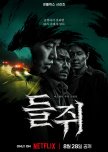
In Korean folklore, the rat is not merely a pest, and it is no coincidence that it occupies the first place in the zodiac. But the rat is also associated with the legend of the Impostor (The Cut Fingernail). According to this myth, if a person throws their nail or hair clippings on the ground instead of burning them or disposing of them properly, a rat may eat them. By ingesting these pieces of human body, the rat absorbs the person's vital essence and takes on their exact appearance. It then takes the victim's place within their own family, driving the real human being away and making them appear insane. This tale served as a warning to children, teaching them cleanliness, respect for the body (which, according to Confucian tradition, is inherited from one's parents), and caution about what they leave behind. But while the white rat is a symbol of divine blessing, our rat here is black, a symbol of malice. Like a Rat is a thriller adapted from Ludovico's webcomic, which draws inspiration from this legend and attempts to put it into practice. Like Song Kang-ho and Choi Min-sik, Sul Kyung-gu seems eager to have a little "fun," taking on ambitious projects that only Netflix and Disney can afford to offer him, and here he does so with Field Mouse. So, does this adaptation succeed or not?Je Mun-Jae (Ryu Jun-Yeol) is a novelist who has been living as a recluse for the past three years. He communicates with the outside world only through his friend, who takes care of everything for him. But one day, his life suddenly falls apart: he can no longer unlock his phone or access his bank accounts… and his friend becomes unreachable overnight. He cannot even prove his own identity because nobody knows who he is. He no longer exists as Je Mun-Jae, because a "rat" has stolen everything from him. Worse still, the police are convinced that he has committed several crimes and offenses, so he has no choice but to go on the run. His only hope lies with No-Ja (Sul Kyung-Gu), a former crime boss who has reinvented himself as a loan shark. The problem is that No-Ja has been looking for Mun-Jae for more than three years because Mun-Jae owes him a large sum of money. Mun-Jae convinces him not to kill him and promises to repay everything he owes if No-Ja helps him find the man who has stolen his identity, much like a doppelgänger. Paranoid and schizophrenic, Mun-Jae must piece together fragments of his past in order to separate fact from fiction. Meanwhile, Lieutenant Park Sun-Yong (Lee Kyoo-Hyung), who has been after No-Ja for a long time, quickly connects the two cases and sets off in pursuit of them. But who is the cat and who is the mouse, or rather… the rat?**
Like a Rat is exactly the kind of thriller that immediately grabbed my attention, only to gradually leave me wanting more. From the very first minutes, the drama establishes a particularly dark and unsettling atmosphere. The story places us inside the mind of a character whom we can never be sure is the victim of a conspiracy or simply being deceived by his own paranoia. Mun-Jae takes medication for anxiety, seems to be losing his grip, and no longer knows what he can trust. For a while, every possibility seems plausible: impostor, twin, hallucination, manipulation… And for a large part of the series, the drama plays remarkably well with this ambiguity. The story becomes a genuine game of deception revolving around identities. We think we have figured out who the victim is, who the impostor is, who the Rat is… before the story regularly comes along and reshuffles the cards. The revelations about Mun-Jae's past, the different identities, and especially Seo Yu-min gradually turn the story into one gigantic game of "who is who?" The most successful aspect is that some clues were there from the very beginning. The habit of biting one's nails, in particular, takes on an entirely different meaning once the revelations are known. The drama had therefore properly laid the groundwork for some of its surprises and does not rely solely on twists pulled out of nowhere. The first six episodes are particularly well constructed, gripping and dense, both narratively and in terms of the action scenes.**
But the screenplay deteriorates during the final stretch. I really enjoyed the beginning and middle of the series, but the final two episodes cooled me down considerably. The twists become increasingly numerous, sometimes at the expense of credibility. Miraculous escapes, ambiguous flashbacks that reveal either too much or not enough, and characters suddenly switching sides sometimes give the impression that the screenplay is primarily looking for ways to move the plot forward. The problem is all the more noticeable because the series had established such a realistic, dark and particularly believable tone up to that point. These shortcuts therefore clash strongly with what had made it so effective. The same goes for some of the action scenes, including one of the final confrontations between No-Ja and Park Seung-Gyu… Yeah, no, actually. I'm deliberately exaggerating, but that's the idea: the series becomes less rigorous precisely when it should be reaching its climax. A thriller of this quality should normally go out with a bang. Here, the tension accumulated over several episodes gradually deflates just when it should have reached its peak. It is genuinely unfortunate that the momentum fizzles out toward the end, which is sadly the series' biggest weakness. But that should not overshadow everything that works, because the suspense remains omnipresent from beginning to end.**
Like a Rat is directed by Kim Hong-Sun, who is a genre specialist, so we're in for something substantial. The direction is probably one of the series' greatest strengths. The cinematography is superb, the atmosphere is particularly well crafted, and the whole production has a genuine cinematic quality. The action scenes are also very successful. The chase sequences are particularly convincing and genuinely feel like watching a movie sequence, while the fights do not shy away from violence. The score perfectly complements the dark atmosphere and contributes greatly to the series' identity. Finally, the cast is clearly up to the task. Ryu Jun-Yeol carries a large part of the series on his shoulders with a particularly demanding role, especially in the scenes where his character's identity becomes the very heart of the story. But Sul Kyung-Gu is impressive. At 58, he has a presence that immediately commands respect and gives No-Ja enormous credibility. Alongside Lee Kyoo-Hyung, they form a particularly convincing trio. Their dynamic as gangster and police officer works because all three actors play their characters with such naturalism that they feel completely believable. The almost exclusively male cast also fits the series' criminal world perfectly.**
In the end, Like a Rat leaves me with fairly mixed feelings. I genuinely enjoyed being led down the garden path by this story and trying, episode after episode, to understand what was hiding behind this succession of identities and manipulations. It is rare enough for a thriller to maintain so much mystery without making me give up along the way. But precisely because of that, after such a build-up, I expected much more from the resolution. The series had created a fascinating game of deception and an atmosphere that gave it everything it needed to deliver a knockout blow, but it gets a little lost along the way by trying to make its story increasingly complicated. What bothers me most in the end is that some questions seem to have been deliberately left unanswered, even though answering them would have given the whole thing considerably more coherence. As for the open ending, I find it rather pointless: leaving something ambiguous only works when that ambiguity adds something to the story or allows us to look back at it differently. Here, I mostly felt as though I was being asked to keep thinking about a story that, above all, needed a better conclusion. So we are left with a gripping and often highly successful thriller, but also one whose potential has been somewhat wasted. The Rat certainly led me on a wild chase, but what it really needed was to know where its own burrow was.
Was this review helpful to you?
The Recipe for Happiness Under Military Regime
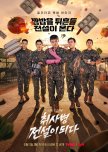
To begin, I’ll borrow inspiration from my old review of Mr. Queen. To create a truly tasty dish, here is the recipe:“Take a young, popular and likeable actor. Make him play a hero built around the universally comforting theme of cooking. Add an unexpectedly peaceful military setting, a generous dose of humor, passion, and human values. Sprinkle in absurd comedic situations and strong bromance. Finally, season it with RPG-like video game sequences where you gain EXP to level up, and a light touch of romance.” Based on the webcomic of the same name, kitchen utensils replace weapons, because the real danger is… on the plate. Here, there isn’t a trace of physical violence: no bullying, only a few squabbles, and above all challenges that are more digestible than dangerous. Why did this drama work so well in Korea? Probably because it brings together almost all the ingredients the local audience loves. But the real question is elsewhere: will this perfectly calibrated mix manage to appeal to our own taste as well?
Two months after losing his father, a highly respected chef, young conscript Kang Seong-Jae (Park Ji-Hoon) is assigned to the Ganglim forward base, near the North Korean border. This small garrison of 29 men is commanded by Captain Hwang Seok-Ho (Lee Sang-Yi), assisted by Lieutenant Cho Ye-Rin (Han Dong-Hee) and Staff Sergeant Park Jae-Young (Yoon Kyung-Ho). They are all very humane officers. Because of his parents’ profession, Seong-Jae is assigned to the mess hall to assist Sergeant Yoon Dong-Hyun (Lee Hong-Nae) in the kitchen. Not only is he loud-mouthed, but he is also utterly useless at cooking. The verdict is clear: every meal is a disaster, and the entire base is at breaking point. That’s when Seong-Jae is suddenly presented with a hologram that, like in a video game, assigns him missions to earn EXP, level up his skills, and ultimately reach the final goal: becoming the “ultimate chef.” Thus begins the epic journey of the Kitchen Soldier, whose mission is to rebuild cohesion through good food.
What immediately stands out is how quickly the series pulls you in—even if you consider cooking an abstract art. Indeed, food culture is something that unites everyone, across all generations. The concept is also introduced very quickly: we are not simply following a soldier in a remote outpost, but a character evolving like in a video game. EXP, levels, skill unlocks, quests, “resets”… everything is there. This RPG system is treated as a mental reality experienced by the hero—a way for him to cope and reassure himself. The presence of his father figure is also essential in the evolution of his “character sheet.” The outpost is not really an army base; it feels more like a friendly village where everyone depends on one another. Cohesion comes first. The drama deliberately highlights the positive side of military conscription—we are not in D.P. here. The war is not on the battlefield; it takes place in the kitchen. Cohesion around food strengthens camaraderie, and the show fully delivers on its feel-good promise. And to reinforce this concept, food becomes the catalyst for absurd moments: once the palate sends taste information to the brain, an explosion of flavors triggers hallucinations. A rice ball, for example, can spark a full boyband fantasy sequence featuring the Migak Boys’ entire music video.
Why do all these ingredients work so well and feel so appetizing? It mainly comes down to perfect synergy. This is a simple but enjoyable story, with a strong cast, sharp dialogue, and immediately lovable characters you can relate to. Above all, it highlights universally appealing themes: teamwork, camaraderie, motivation, selflessness, naïve optimism, and over-the-top absurd humor. Of course, this is not realism—we are dealing with a live-action adaptation of a webtoon. But does enjoying tasty dishes and sincere characters make us fools? I sincerely hope not. Cooking is a universal language, just like laughter, and both are appreciated in their own way. To spice things up, a subplot involving corruption in the supply chain adds a slightly darker note, showing the zealous behavior of certain higher-ranking officers. But overall, everyone remains well-meaning, with a paternal figure watching over the younger soldiers. Seong-Jae even gets his own awkward romantic moment with Jung Min-A (Jeon So-Young), a girl who has been in love with him since high school—without any manual on how to handle teasing from his comrades.
Of course, everything isn’t perfect: there is a slight dip in energy in one or two episodes. Some moments may feel repetitive, but the spirit remains intact and the simple lifestyle is respected. The pacing is generally solid, even if it slows slightly before the culinary competition finale. Everything is fairly predictable, but that is intentional within this “feel-good utopia”: this is not a harsh world, but one where taste and skill resolve problems instead of fists. This drama is aimed at a family audience, but not only them—everyone can enjoy it, feel emotions, and recharge their dopamine levels. Director Jo Nam-Hyung also shows growth here, serving up a satisfying dish after the excellent The Tale of the Nine-Tailed 1938, which I also recommend. The adaptation of the webcomic—spanning nearly 200 chapters—is quite successful in tone and atmosphere. To be honest, without the “spicy” contributions of Yoon Kyung-Ho, Lee Sang-Yi, and Lee Hong-Nae (who is genuinely excellent), surrounding the very solid Park Ji-Hoon, the drama wouldn’t have had the same flavor. Without their punchlines, the recipe might have left a bitter aftertaste. Thanks to them, the emotional cooking ladle digs out the very best from the bottom of the pot.
Let’s move on to the bill—and rest assured, it won’t be too salty. If you accept the “set menu” formula and don’t try to over-analyze it, you’re in for a treat. Like a good ice cream, The Legend of Kitchen Soldier is a tasty, crunchy dessert—Cyril Lignac would approve. No need for Philippe Etchebest to restore order in the kitchen: Seong-Jae handles the mess hall like a true chef. The series whets your appetite from the very start, even throwing in a small twist in the penultimate episode to whip everything up right before the finale. It’s intense, joyful, and should be taken for what it is: excellent entertainment to enjoy with others. This accumulation of unlikely concepts works surprisingly well, mostly perfectly cooked with a touch of controlled madness. However, I did miss a bit more craziness, and the arc introduced around Captain Im Seung-Bin strangely fizzled out. But as someone not exactly skilled in cooking myself, I still enjoyed this gargantuan meal. (Private joke—this is for you Aude.)
The holographic interface still works, the ending is open… so, “Ready Player One”? And as they say: bon appétit, of course! (Joël Robuchon).
The references to the chefs are French of course :)
Was this review helpful to you?
APT, Apateu... Uh, uh-huh, uh-huh
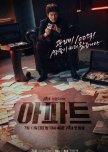
Well no, Rosé from Blackpink did not make a cameo in the drama, but I think the title of her song with Bruno Mars is quite fitting here, since the story takes place in a huge apartment complex with nearly 9,850 households (yes, that's a lot of people). And the premise is rather original, since dramas set in these large residential complexes, popular with the middle and upper classes, are relatively rare. Because while in Europe our goal is to avoid ending up in these giant "rabbit hutches", in South Korea it is quite the opposite. Indeed, most residents are homeowners, with only around 10% being tenants, along with a similar proportion of social housing integrated into the complex. In addition to the main story, I thought we were going to explore the everyday problems faced by this population. This world is vast, but it represents a microcosm in which several themes unfortunately weren't explored in enough depth. The Apartment Job is a mix of comedy-drama, crime and thriller. This balance works reasonably well, except at times when it starts to wobble.Park Hae-Kang**(Ji Sung)** is a former gang boss who has gone into managing an illegal gambling den and debt collection. But one day he gets caught up in a scheme and has to find 10 billion won to get his seriously ill spiritual father out of prison. Thanks to Hwang In-Sik, aka "The Lizard" (*Kim Won-Hae), a con man who owes him money, he learns that a huge reserve fund intended for repairs to a massive residential complex, amounting to around 18 billion won, could be recovered. Using In-Sik's apartment as their HQ, he hopes to first get elected as the representative of his district, and then as chairman of the residents' council. This is the perfect opportunity to empty the complex's bank accounts. To carry out his plan, in addition to his four accomplices, he calls on a broke legal assistant he had already crossed paths with, Kang Ha-Ri(Ha Yoon-Kyung). But Lee Chung-Won**(Park Byung-Eun)**, the CEO who built the complex, stands in their way, as he is also part of a gangsters' club. The local "concierge", Jang Suk-Jin(Moon So-Ri), who knows everything as the neighborhood gossip, could prove to be a valuable ally.
What I liked about the series is the concept of infiltrating this complex: the residential setting allows for a fairly original blend of comedy, social drama, thriller, crime and a sprinkling of action. Overall, it works quite well, even if it becomes a little shaky in the second half. We get a basic but also entertaining look at how a Korean apartment complex is organized and managed. So, contrary to what the French title suggests, there is no property manager in the usual sense, and the complex is represented by a chairman who represents all the residents and sets the budget to be administered. The little gang gives it their all and sometimes manages to make up for the script's shortcomings. The little boy is genuinely convincing and adorable. This "family" is the most likeable part of the series. There are also some funny twists, even if they are often predictable, good character dynamics, small action scenes, and memorable moments thanks to the inimitable Kim Won-Hae. Especially at the beginning, the atmosphere and pacing are quite good. The potential is definitely there, with concrete examples of recurring problems affecting neighborly relations.
Unfortunately, this enormous social potential is underused, quite simply because the drama doesn't have the budget to match its ambitions, nor the well-developed script to go with them. Everything is only skimmed over: homeowners versus tenants, social housing, construction defects, dilapidation, neighborhood disputes, real-estate interests, etc. The Apartment Job could have been an extremely original social comedy. But most of these elements remain in the background. We are shown the problem, and then the story quickly moves on to something else. It's a real shame. The complex is enormous (several thousand apartments), but visually it feels small: whenever there are protests or meetings, it feels like we're in a small neighborhood. This is a major problem because the complex is supposed to be at the heart of the drama. In short, it desperately lacks life; the streets are almost deserted, so the impact of this supposed anthill completely falls flat. The discussions always revolve around the same people, who represent the archetypes and stereotypes we see in K-dramas: everyone has their neatly defined role and sticks to it. The only character who actually evolves and brings some life to this stagnant environment is Jang Suk-Jin; that's not enough.
The writing is too simplistic: the story moves forward through little nudges and elements that always happen to arrive at exactly the right moment. Don't expect any major surprises; everything is predictable and formulaic once the thriller aspect takes over. The residents' reactions are also problematic and stupid: when Hae-Gang and his team are involved, everything is either completely black or completely white. It's like the "Sheep Club Association." It's funny at first, but by the end, it becomes tiresome. But the real false good idea (FBI) was introducing an overly caricatured main antagonist: Lee Chung-Won starts out as a potentially interesting character, a powerful construction chaebol with interests of his own. But as time goes on, he just seems like a spoiled child suffering from paranoia: "I'm evil because I'm evil." The further the series progresses, the more inconsistent his behavior becomes. Park Byung-Eun is a great actor, but they really make him look like a clown because he constantly overacts. In short, everything often lacks credibility because the story gets lost in pointless convoluted schemes. The direction keeps trying to tease us with a future relationship between Hae-Gang and Ha-Ri, but another romance eventually develops at the end.
Like an old gimmick, we get the usual PPL for Subway and pain-relief patches, followed by the inevitable "X years later" 15 minutes before the end. This could have suggested that we were going to get something more authentic and unconventional... And nope. This series leaves me with a strange and paradoxical feeling: the actors give a lot and know how to entertain us when necessary, and we grow fond of them; the atmosphere is good, the few secondary characters are likeable, and the basic idea is nice, because we are sold the concept of a thug who gradually gets caught up in the game and starts investing himself in the well-being of the residential complex. Some scenes are genuinely funny and others touching, but... the script doesn't always keep up, and inconsistencies and writing shortcuts rain down, especially after the halfway point. The drop in pace is obvious toward the end, with far too many scenes that feel completely disconnected from the story, as if they were only there to fill time. And that's usually not a good sign. In conclusion, I am left with an unfinished feeling, because with an idea like this, a quality cast, and a setting that could have been teeming with life and sincerity, we could have had a great drama instead of a very average one.
Was this review helpful to you?


