




One of the most genuinely relevant things I've watched in this genre — and OffGun deliver
This series opens with a conversation that stopped me immediately. A man in burnout being told by his "girl"friend to take a break, go to therapy — and him answering that he can barely afford rent, so how exactly is he supposed to afford therapy. That exchange alone signals what kind of show this is going to be: one that's actually paying attention to the world it exists in.The burnout bar as a concept is inspired — a place where customers therapeutise each other because professional help is out of reach for most of them. It's absurd and completely believable at the same time, and it sets up a story about art, AI, labour, and the very specific exhaustion of trying to be creative in a system that doesn't support it. These are not themes I expected to find handled this thoughtfully in a BL series, and I found it genuinely exciting.
OffGun carry it fully. The chemistry is there, the performances are strong, and the three-way dynamic at the center of the story is genuinely compelling — chaotic and messy in the way real human entanglements are. What I found most interesting is that the main character isn't positioned as a victim of circumstance but as someone who is himself flawed, himself capable of toxicity. That honesty gives the series a texture that most shows in this genre don't attempt.
In terms of story and acting, one of the strongest series I've seen. The kind of show that makes me wish more BL trusted its audience this much.

When I say I want a toxic BL, this is exactly what I mean.
Not because I want abuse romanticised. Not because I think love should hurt. But because I'm interested in stories where damaged people collide, where morality isn't clean, and where everyone is forced to confront the consequences of who they've become.Payback begins with exactly that promise.
Sun isn't an innocent protagonist caught in someone else's game. Before tragedy ever enters his life, he works as a debt collector for a loan shark, threatening desperate families for money. He already belongs to a brutal world where survival comes at someone else's expense. Then everything collapses. A debtor, pushed beyond his breaking point, kills Sun's younger brother in front of him. His mother dies soon afterwards. His boyfriend Bank disappears with all of his money.
For five years, he simply survives out of habit.
What makes him such a compelling protagonist is that he genuinely believes this is his punishment. If he hadn't chosen that life, his brother would still be alive. His guilt becomes the thing that keeps him moving, and Min Thanakorn plays that emotional numbness beautifully. Sun rarely allows himself to grieve because, deep down, he doesn't think he deserves to.
Years later, while working as a delivery driver, Sun accidentally overhears Bank — now living under the name Sunny as one of Thailand's biggest stars — casually admitting his own involvement in the events that led to Sky's death. Until then, Sun believed Bank had betrayed him and stolen his money. Suddenly he realises something far worse: Sunny didn't simply abandon him. He played a direct role in destroying his family.
That's the moment revenge is born.
Sun's revenge is deeply personal. He wants Sunny to lose everything the same way he did. Jay's revenge, however, is something entirely different. He wants to expose and destroy the corrupt system behind Dream Entertainment, a system built on exploitation, coercion and the abuse of power.
And unfortunately, this is where I think the series slowly loses the thread it had woven so carefully.
I kept waiting for the moment where Sun's personal revenge would naturally evolve into Jay's larger fight. Not because Sun suddenly stops caring about Sunny, but because he slowly begins to understand that Sunny isn't the beginning of this story. He's another product of the same machine.
Ironically, the ending already hints at exactly that version of the story.
I just wish the journey had taken us there more deliberately.
Personally, I would've loved to watch Sun dismantle Sunny's life piece by piece throughout the series. Not through violence, but through carefully calculated moves. Destroying his reputation. His public image. His career. Slowly forcing Sunny into a position where he'd finally have to confront the consequences of his own choices.
And then... give Sunny one episode. One chance to tell his side of the story.
Not because he deserves redemption.
Because he deserves perspective.
Payback begins by asking us to empathise with someone who carries enormous responsibility for the tragedy that destroyed his own life. I wanted that same complexity extended to Sunny. Not to forgive him, but to understand him.
Because I think that's where Sun's character arc truly wanted to go.
Not towards revenge.
Towards self-forgiveness.
The most powerful version of this story isn't one where Sun wins. It's one where he realises that revenge was never really about Sunny. It was a tool that kept him going, a reason to stay alive when he otherwise had no idea what he was still living for.
And perhaps that's why I wanted one more confrontation between Sun and Sunny. Something that forces Sun to hear the other side of what happened. Because Sunny did something terrible. But Sun also has to confront the fact that his own choices helped create the chain of events that led to his brother's death. None of that absolves Sunny. But it could have forced Sun to understand that he can't spend the rest of his life looking for one person to carry all of his guilt.
The series gestures toward this idea, particularly during Sun's psychological collapse and the devastating scene where he performs a suicide attempt for the camera, only to realise that despite everything, he doesn't actually want to die.
It's one of the strongest scenes in the entire show.
The same can be said for the corruption storyline.
The entertainment industry isn't simply used as a dramatic backdrop. The "Backer" system — powerful executives exploiting actors in exchange for career advancement — is presented as something deeply rotten, and the series deserves credit for refusing to make that corruption feel incidental. Payback deserves credit for refusing to sanitise that reality.
Jay is perhaps the character I'm most conflicted about.
His chemistry with Sun is undeniable. I genuinely enjoyed watching two people who both understand they're using each other while slowly becoming unable to pretend that's all they're doing. But I also found Jay frustrating. The rabbit reveal — discovering that Sun was the mysterious man from five years earlier — should have fundamentally transformed Jay's motivations. Instead, it mostly plays like another layer of romantic destiny. I wanted that revelation to matter more.
Because Jay doesn't just discover that he once slept with Sun.
He discovers that he has finally found the person he's been looking for all this time.
And that should change something.
I wanted to see Jay protect Sun without a deal attached. Without Sun owing him anything. Not because Sun is useful to him, but because, for once, Jay has found something he doesn't want to lose.
That would have made their relationship feel so much more significant to me.
In the end, Payback isn't a failed revenge story.
It's a revenge story that already contains the emotional journey I wanted to watch — it just never fully connects all the threads.

Warm and authentic
This one reminded me of Given — not in plot but in feeling. Music as emotional language, a pairing that feels genuine rather than performed, and a warmth that doesn't need to manufacture drama to hold your attention. If you know Given, you'll understand why that's a compliment.The couple feels authentic in a way that's harder to achieve than it looks. Baram's quiet, consistent support of Han Tae never tips into something saccharine — it just feels like someone who actually sees another person and chooses to stay. And Han Tae's journey of learning to believe in himself and let someone in is handled without overplaying it. The music running through all of it earns its place rather than just being backdrop.
A genuine comfort series — the kind you put on when you want to feel something warm without being put through the wringer. Those are rarer than they should be, and this one does it well.
The series was too short to do anything with it
I actually appreciate being dropped into a relationship that already exists but that only works when the series gives you enough in the first few minutes to feel why these two people belong together. The current between them has to be strong enough to pull you in immediately. Here it wasn't, and that's the root of almost every problem that follows.The emotional logic of Yu Jun's position is genuinely interesting. Fifteen years of friendship turned love, a partner who is attentive and seemingly perfect, who anticipates every need without asking for anything in return — and slowly that devotion starts to feel less like love and more like pity. The fear of being someone's charity case rather than their equal is a painful and completely understandable place to arrive at after that long. I could follow that thread.
The problem is that the series barely had time to lay it out before it needed to move on. The breakup arrived before I was emotionally invested enough for it to land, which made it feel less like an inevitable tragedy and more like an overreaction to a situation the series hadn't fully built. Baek Hyeon Seo stepping into that gap didn't help — his presence read more as convenient plot mechanism than genuine threat, and I spent most of his screentime wondering what exactly he thought he was doing and why he had so much energy for someone else's relationship.
The resolution follows a pattern I find frustrating: misunderstanding arises, partner apologises without fully understanding what went wrong, they reunite, nothing has actually changed. The underlying dynamic that created the problem in the first place is still there.

More flirt than substance — but the flirt was pretty good
The setup has charm: a former idol starting over as a corporate intern, unexpectedly reunited with his childhood friend who is now his boss and apparently has had feelings for him this entire time. Choi Jun wasting absolutely no time making his interest known is the kind of confident energy that carries a series — and Ki Hyun Woo has the kind of screen presence that makes you forgive a lot.The heart-fluttering moments deliver. The flirting and innuendo-laced conversations between the two Juns are genuinely fun, and the kissing and intimacy in the final episode are among the better executed scenes in the series. When the show commits to what it actually is — a charming, slightly forward workplace romance — it works.
The problems are structural and persistent. The plot is paper thin, stretched across too many business meetings I had zero investment in and too many side characters who don't earn their screentime. The childhood connection, which should be the emotional core of the whole series, is never properly explained — why they lost touch, what it meant to each of them, why Choi Jun waited until now. A single text message could have resolved the episode five misunderstanding, which tells you everything about the communication logic at work here. The flashbacks are confusingly edited and add little.
Episodes one through three, seven, and eight. The rest is filler with occasional highlights. There's a better version of this series somewhere in the premise — it just didn't quite make it to the screen.

A parallel world that pulls you in — but doesn't quite make you feel the weight of leaving it
The concept genuinely works for me. A man who wanders into a shrine under a full moon, makes a wish, and wakes up in a version of his life where things came easier — warmer colleagues, a closer dynamic with the person he's been measuring himself against. It reminded me a little of Fringe in the best way: not science fiction exactly, but that particular uncanny feeling of a world that looks like yours and isn't quite. I found that premise more compelling than I expected.The tension between the two leads translated for me too. I believed the pull between Akihito and Ookami, the admiration layered over something more complicated, the way proximity in the parallel world shifts what can't be said in the original one. Akihito's reluctance to return made complete sense to me — I think I would have struggled to leave too.
Where the series loses me a little is in the clarity of what exactly Akihito loves about Ookami specifically. I didn't get enough of that — the particular reason this person, this dynamic. What I would have wanted is exactly what you're describing: small but meaningful differences between the two worlds, things that exist in one and not the other, that quietly reveal what the real world actually cost him and what the parallel world quietly took away. That kind of detail would have made the eventual choice — to go back, to rebuild something real rather than inhabit something already finished — land with much more weight.
The idea was there. The execution just didn't go quite far enough with it.

Charming enough to enjoy, inconsistent enough to notice
A gentle, undemanding first-love romance that works best when it stops trying to be more than that. The campus atmosphere is pleasant, the central relationship develops with a sweetness that doesn't need to manufacture conflict to hold your attention, and Yu Lei and Chen Ke have a dynamic that I found easy to spend time with — the jealousy, the small gestures, the gradual shift from uncertainty to something more settled. For what it is, it mostly delivers.The cracks show in the details. A snow scene that aimed for romantic and landed somewhere closer to unintentionally comic — genuinely too many snowballs in too many hair. And the recurring use of "friends can hug" and "friends can kiss" as cover for feelings that are obviously already well past friendship wore thin fairly quickly. I understand the intent, but when the subtext is that legible, the text starts to feel constructed rather than natural.
The secondary characters are where the series loses the most ground. Underdeveloped subplots, a second lead whose shift arrives without sufficient buildup, and a character whose emotional breakdown lands disconnected from everything that preceded it because the series never properly laid the groundwork. These are structural issues that affect the overall flow even when the central romance is working.
The core of the series — Yu Lei and Chen Ke finding their way to each other — is warm enough to make the rest forgivable. Just don't come in expecting consistency.
The chemistry does what words don't have to — I just wanted more time with them at the end
I came to this one having just watched A Shoulder to Cry On, and the parallels are obvious — an emotionally closed-off character, someone loyal enough to keep showing up anyway, a connection built on shared history and unspoken feeling. But where that series spent much of its energy on trauma and the space between the characters, this one closes that distance more convincingly. Ho Tae and Dong Hee actually feel like two people who have been circling each other for years and both know it.The chemistry is the reason this series works as well as it does. So much of what passes between them happens in glances and proximity rather than dialogue, and it reads as completely authentic. I believed the pull between them from early on and stayed invested throughout because of it. The melancholic, unhurried atmosphere suits that dynamic perfectly — this isn't a series that reaches for dramatic peaks, it lives in the quieter spaces, and that restraint pays off.
My frustration is with the ending, or more precisely with the ratio. The series takes its time building toward honesty between these two — carefully, patiently, earning every step — and then when they finally get there, the time we actually spend with them as something more than almost is over almost immediately. Not tragic, just not enough. After that much buildup the emotional payoff felt shorter than it deserved.

Tae-hyun's trauma stays with you — the ending less so
The enemies-to-friends-to-something-more arc is handled with real care here, and that's the core of why this series works. Da-yeol and Tae-hyun earn every step of their dynamic shift — from deliberate provocation to grudging proximity to genuine trust — and Tae-hyun's backstory is drawn with enough specificity to land as something more than a plot device. The loneliness, the walls, the pushing people away before they can leave first — I believed all of it.What stayed with me most, and I'll be honest that this comes from a professional place as much as a personal one, is the question of where the adults are in Tae-hyun's life. A teenager with that history, those behavioural patterns, living in those circumstances — in a functioning system there would be intervention. Youth protection services, mandatory reporting, someone looking at this situation and asking harder questions. The series doesn't engage with that absence, which is its right, but I found myself thinking about it in a way that slightly complicated my ability to simply feel the romance.
Da-yeol's decision to draw a boundary and step away is one of the strongest moments in the series — genuinely mature writing, and his parting words to Tae-hyun are quietly devastating. I don't fault him for it. But knowing that Tae-hyun's only real anchor then disappears for two years, and imagining what that period looked like for someone with his history — the series skips over exactly the part I would have most wanted to see.
The reunion and reconciliation felt rushed to me. The time jump is supposed to signal growth, but we don't witness that growth — we're asked to accept it, which is a different thing. I'm always skeptical of time jumps that do the character work off screen and then present the result as earned resolution.
I didn't manage to see the special episodes — if they fill in some of that two-year gap, I'd genuinely be curious to know.

Two people pulling each other out — quietly, messily, and believably
This feels less like a BL series and more like a small, intimate stage play with two characters and one apartment. Almost everything happens in the same cramped space, which forces the story to live entirely in the dynamic between Haoyu and Chenxi — and that turns out to be exactly the right call.The setup has a certain toxicity to it on paper: a debt collector effectively trapped with the person he's supposed to be pressuring. But the series earns its way past that by taking both characters seriously. Chenxi's sarcasm and provocation are a surface over something much heavier — grief, guilt, the particular exhaustion of someone still living in the aftermath of loss. And Haoyu, for all that his arrival is coercive by circumstance, actually listens. Two damaged people finding each other in a situation that shouldn't work — and it does.
The melancholic tone is consistent and handled with care. This isn't a series that rushes toward warmth; it lets the darkness sit and earns the connection slowly. Not a light watch, but a genuinely affecting one.
Subtly toxic is probably the most accurate summary — and you'd only fully understand why once you know the circumstances. Sometimes that's exactly where the most interesting stories live.
Quietly devastating — and it earns every tear
This series does what the time-travel-romance concept promises and rarely delivers: it made me feel the weight of an impossible love without softening it into something comfortable. A man who ends up in 1920s Chiang Mai, a connection that forms across a distance that can never fully close, and an ending that doesn't offer the easy resolution the genre usually reaches for. Even the special episode holds that line. They don't really end up together, not in the way we want them to, and the series is honest enough to sit with that.What makes it work where similar concepts don't is the specificity of the world it builds and the genuine tenderness between the leads. The historic setting feels considered rather than decorative, and the emotional stakes are real from early on. I cried, and I don't say that lightly.
It also manages something I find genuinely difficult to pull off — a story about same-sex love in a historical context that doesn't use the era purely as an obstacle but as part of the texture of who these people are and what they can and can't have. That's a more honest approach than most.
One of the more quietly affecting series I've watched in this genre.

Muay Thai, a fake relationship, and exactly the kind of fun it promises
A heartbroken doctor, a Muay Thai fighter, a drunken one-night stand that somehow turns into a fake relationship with actual feelings underneath — this is a series that knows its lane and stays in it comfortably. Similar energy to Knock Out in the best way: not trying to be more than it is, delivering on what it promises, and making good use of the Muay Thai setting as more than just backdrop.The fake relationship dynamic works here because the chemistry between the leads earns it — you can see the feelings creeping in before either character will admit it, which is exactly how that trope is supposed to function. Nothing here will surprise you, but sometimes that's not the point. Sometimes you just want a series that's warm and fun and doesn't overstay its welcome.
A solid watch for when you're in the mood for something uncomplicated that still delivers.

Here for PondPhuwin — and only for PondPhuwin
I watched this for the Never Let Me Go spinoff and stopped once that part was done. The anthology format means the other couples weren't a reason to stay, and I didn't pretend otherwise.
The past life concept is a sweet idea and PondPhuwin carry it well — the chemistry is still there, the emotional beats land. But I kept asking myself whether this was really necessary. Never Let Me Go stands completely on its own, and a journey into a past life felt more like a charming detour than something the story actually needed.
What I would have wanted instead is simpler and probably harder to write: Palm and Nuengdiao in the present, after everything. Everyday life, a relationship without trauma as the backdrop, small moments that show how two people who went through all of that actually build something together. That's what I find genuinely interesting about established couples — not the grand gestures or the fate-testing scenarios, but the quiet proof that they work. That version of a spinoff I would have watched twice.
As it stands — sweet, enjoyable, and exactly as necessary as a spinoff tends to be, which is to say not very. But PondPhuwin made it worth the detour.
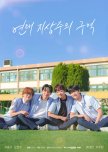
Sweet premise, complicated by an age gap I couldn't fully set aside
The concept is genuinely inventive — a 29-year-old transported into a virtual game as a 19-year-old character, tasked with bringing happiness to someone who doesn't know any of this is happening. There's something quietly interesting about the ethics of that setup, and the series handles the sweetness of it well enough.My personal sticking point is the age gap, which the virtual framing doesn't really resolve for me. Tae is emotionally and experientially a decade older than how he's presenting, and that asymmetry sat with me throughout in a way I couldn't fully set aside. I'm aware the series isn't asking me to think about it that hard — it's a gentle, warm story and it mostly succeeds at being that. But I notice these things and they affect how fully I can invest.
The couple landed somewhere in the middle for me, the intimate scenes didn't quite work, and by the end my engagement had drifted. Sweet while it lasted, but not something I'd return to.

Everything built toward something — and then the final kiss didn't deliver it
This series was recommended to me as one of the most emotionally affecting BL series out there, and it earns that reputation for most of its runtime. The slow build of suppressed feelings between two people who've been each other's entire world since childhood, the jealousy that surfaces when a girl enters the picture and forces something unspoken into the light — it's handled with real patience and emotional intelligence. I thought of Let Free the Curse of Taekwondo more than once, which is a high bar. That series reached me a little deeper personally, but this one absolutely belongs in the same conversation.Which is why the final kiss matters so much, and why I have to be honest about it.
I wish I were less affected by this kind of thing. I'm aware it might sound shallow. But when a series spends its entire runtime building toward a moment — layers of pain, longing, restraint, everything held back for so long — and then that moment arrives and reads as tense in the wrong way, not shy or overwhelmed but genuinely uncomfortable, it undermines something. A crescendo that doesn't land doesn't just disappoint, it retroactively dims what came before it. That's not a small thing when the whole series has been building emotional pressure toward exactly that release.
Everything else here is strong. The story, the performances, the pacing — all of it works. I just wish the ending had matched what the series deserved.


