



This review may contain spoilers
Hometown Cha-Cha-Cha: If Comfort Had a Hometown, It Would Be Gongjin
Hometown Cha-Cha-Cha is one of my favourite dramas of all time. It is the show I return to whenever I need comfort—something warm enough to quiet the mind and make an ordinary day feel a little lighter. I have watched it several times, yet Gongjin still welcomes me as though I never left. If I had to describe this drama in one word, it would be home.The story follows Yoon Hye-jin, a successful Seoul dentist whose life takes an unexpected turn. After visiting the idyllic seaside village of Gongjin on her late mother’s birthday, she impulsively decides to open a dental clinic there. That decision brings her into the orbit of Hong Du-sik, better known as Chief Hong—a charming jack-of-all-trades who appears whenever someone in the village needs help. They seem like complete opposites, but their repeated encounters slowly develop into affection.
The premise is simple, and that simplicity is one of the drama’s greatest strengths. Instead of relying on constant twists, the screenplay finds meaning in daily life: meals shared with neighbours, arguments that disappear as quickly as they begin, village gossip, unexpected kindness and the memories people leave behind. It explores family, financial hardship, grief, honesty in relationships and the difficult question of what it truly means to be happy.
Most importantly, the supporting characters are never treated as background decoration. Every resident of Gongjin has a distinct personality, personal struggle and emotional arc. Their stories are meaningful, funny and sometimes heartbreaking, while their gradual development gives the community a genuine sense of life. Gongjin does not feel like a set built around the leading couple—it feels like a place that existed before they arrived and will continue after the final episode.
That sense of community was especially relatable to me. Everyone knows everyone else’s business. Rumours travel quickly, quarrels happen over the smallest matters, and privacy is almost impossible. Yet when someone is struggling, the entire village quietly appears. The elders are treated with affection and respect, the children are allowed to have their own personalities, and even minor characters are given moments that matter. Anyone who has lived in a small community will recognise this strange combination of irritation, intimacy and unconditional care.
Kim Seon-ho, one of my favourite Korean actors, gives Chief Hong a wonderfully natural presence. He never needs exaggerated styling or dramatic gestures to command attention. His relaxed body language, expressive eyes and excellent comic timing make Du-sik effortlessly charming. At the same time, he allows small cracks to appear beneath the character’s cheerful exterior, gradually revealing the guilt and unresolved trauma that Du-sik has been carrying. His smile draws people towards him, but it is the sadness behind it that gives the performance its emotional depth.
Shin Min-a is equally well cast as Yoon Hye-jin. She makes Hye-jin’s pride, awkwardness and occasional childishness feel endearing rather than irritating. Her cute expressions rarely feel forced because they grow naturally from the character. More importantly, she convincingly portrays Hye-jin’s transformation from a guarded outsider into someone who learns to understand—and eventually belong to—the community around her.
The chemistry between Shin Min-a and Kim Seon-ho is one of the drama’s greatest pleasures. Hye-jin and Du-sik have contrasting personalities, but their differences create warmth rather than constant hostility. Their romance is built through small gestures, teasing conversations, quiet concern and moments in which they learn to be emotionally honest with one another. They match each other’s energy beautifully, making even their ordinary meetings memorable.
There is a second-lead romantic thread involving Ji Seong-hyeon, but the drama avoids turning it into a toxic or manipulative rivalry. Instead, the characters largely behave like adults. Misunderstandings are not dragged out simply to manufacture conflict, and the romance remains rooted in communication, patience and mutual respect.
The drama also knows how to become deeply emotional without abandoning its warmth. Gam-ri’s death is particularly difficult to watch. Her final moments and the handwritten letter she leaves behind are handled with tenderness and restraint. The sequence is painful, but it never feels emotionally exploitative. It becomes a reflection on grief, memory and the quiet ways in which a person continues to live through those who loved them.
Yu Je-won’s direction maintains an admirable balance between romance, comedy and heavier emotional material. The screenplay has a large ensemble to manage, yet the central relationship rarely disappears beneath the supporting stories. A few stretches do meander, particularly when the narrative pauses to spend more time with the villagers, but those moments also deepen our connection with Gongjin. Even when the plot slows down, the atmosphere remains inviting.
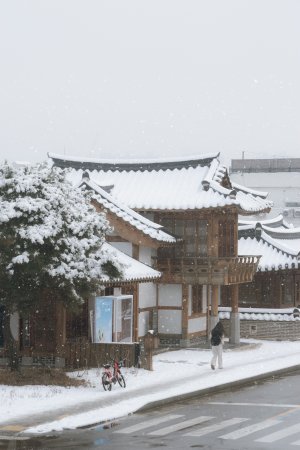
The cinematography strengthens that atmosphere beautifully. The fishing harbour, market, boats, beaches, restaurants and narrow village streets create a convincing visual identity. The camera does not present the seaside merely as a picturesque tourist destination; it shows it as a working community. Scenes such as Hye-jin and Du-sik running through the rain, the electricity returning to her home, and the characters gathering by the beach remain especially memorable.
The visual design is equally thoughtful. The costumes and makeup feel natural and appropriate for the setting. Chief Hong never needs flashy clothing to appear attractive—his simplicity is part of the character’s appeal. Hye-jin’s expensive heels, contrasted with Du-sik’s practical bathroom slippers, cleverly establish their different worlds before the dialogue needs to explain them. As the characters grow closer, their visual differences also begin to feel less like barriers and more like complementary parts of the relationship.
The music carries the same gentle quality as the rest of the drama. Its soft, comforting soundtrack brings calm to the quieter scenes, while the background score supports the comedy and emotion without overpowering the performances. The music does not demand attention; it settles naturally into the world of Gongjin and becomes part of its rhythm.
Although Hometown Cha-Cha-Cha is primarily a romantic comedy, it contains a remarkably broad emotional palette. It is funny, romantic, respectful and occasionally devastating. It explores sacrifice, loneliness, friendship, family and forgiveness without losing its essential warmth. Managing so many characters and emotional threads could easily have made the main narrative feel messy, but the drama largely keeps them in harmony.
The final episodes reveal that Du-sik’s trauma is connected not to stock fraud, but to a disastrous investment, financial loss, an investor’s suicide attempt and the death of Du-sik’s friend. The storyline is ultimately about guilt, responsibility and learning to forgive oneself. It is one of the drama’s darkest elements, but it explains why Du-sik has spent so much of his life helping everyone except himself.
The ending provides emotional closure for Du-sik, Hye-jin and most of the residents. Hye-jin and Du-sik announce their plans to marry and take their wedding photographs, although an actual wedding ceremony is not shown. Gam-ri’s letter offers Du-sik permission to grieve, while the final moments allow the rest of Gongjin to remain part of the story rather than reducing the finale to the leading couple alone.
My only criticism is that a few scenes occasionally felt unnecessary and could have been shortened without affecting the main narrative. However, these moments may have been included to develop the supporting characters and give the ensemble room to breathe. They also prevent the drama from focusing too heavily on the leading couple, which can sometimes make even a good romance feel repetitive. Although the pacing slows in places, it never seriously weakens my enjoyment of the drama.
Some dramas entertain us for sixteen episodes and disappear as soon as the screen goes dark. Hometown Cha-Cha-Cha stays. It reminds us that happiness can be found in ordinary moments, that healing rarely happens alone, and that home is not always the place where we began—it can also be the place where people finally learn to understand us.
Was this review helpful to you?

This review may contain spoilers
Lovely Runner? More Like an Overhyped, Overrated and Boring Run in Circles
If I had to describe my experience of watching Lovely Runner in one word, it would be frustrated. Several people recommended it to me, but I started it quite late because heavily hyped dramas often struggle to fulfil the enormous expectations surrounding them. Unfortunately, my hesitation proved justified. Despite its popularity and remarkably high ratings, Lovely Runner became one of my most disappointing K-drama experiences.On paper, the premise is genuinely promising. Lovely Runner combines fantasy, romance and time travel in a story about a devoted fan attempting to change the fate of the celebrity who once gave her hope. It is an emotionally appealing concept with all the ingredients required for an engaging romantic drama. The initial episodes establish that premise reasonably well, and it is easy to understand why the story attracted so many viewers.
However, an interesting premise cannot carry an entire series by itself. After the opening episodes, the narrative becomes increasingly predictable. The repeated changes to the timeline create the appearance of movement, but the central conflicts and emotional patterns remain largely unchanged. Instead of developing naturally, the drama repeatedly manufactures danger, separation and emotional distress to keep the story moving. Several scenes feel prolonged beyond their dramatic value, while others appear to exist primarily to provoke another emotional response from the audience.
This repetition gradually weakened my investment in the characters. Rather than wondering what would happen next, I often felt that I already understood the pattern: hope would appear, another complication would separate the leads, someone would cry, and the timeline would once again rearrange the circumstances without meaningfully changing the emotional substance of the story. The nonlinear structure could have created suspense and complexity, but the screenplay handles its movement between timelines without enough clarity or discipline. As a result, the drama frequently loses momentum and, eventually, my attention.
This was my first time watching both Kim Hye-yoon and Byeon Woo-seok in leading roles, and unfortunately, neither performance connected with me as strongly as I expected. Kim Hye-yoon brings considerable energy to Im Sol, but her performance often felt excessively expressive for my taste. The exaggerated reactions, forced cuteness and frequent shifts into heightened emotion made the character more irritating than endearing to me. Some viewers clearly found this style charming, but I struggled to see a natural person beneath the performance.
Byeon Woo-seok delivers a more restrained performance as Ryu Sun-jae and handles several emotional scenes reasonably well. Nevertheless, I did not find the performance compelling enough to justify the extraordinary level of praise surrounding it. The character is likeable and devoted, but much of his appeal comes from how idealistically he is written rather than from particularly layered characterisation.
More importantly, I did not feel convincing romantic chemistry between the leads. Chemistry is subjective, and many viewers clearly experienced their relationship very differently. For me, however, their interactions often seemed carefully performed rather than naturally lived. Both actors appeared to be working extremely hard to create sweetness, comedy or heartbreak, and that visible effort prevented many scenes from feeling spontaneous. The supporting cast performs adequately, but when the central relationship fails to create an emotional connection, the surrounding story inevitably loses much of its impact.
The direction also contributes to this problem. Almost every important scene is treated as though it must become the emotional centrepiece of the entire drama. The actors are frequently asked to express everything at maximum intensity, while lingering shots, tears and music repeatedly emphasise what the audience is expected to feel. Emotional storytelling is most effective when intensity is balanced with restraint. Here, the constant insistence that every moment is special eventually makes very few moments feel genuinely special.
I always look for one or two exceptional scenes that remain in my memory after a drama ends. Great dramas usually contain moments in which the writing, performance, direction and emotional context come together so naturally that the scene stays with the viewer. Lovely Runner appears determined to manufacture that effect repeatedly. Instead of allowing a few significant scenes to stand apart, it frames numerous interactions as iconic romantic moments. For me, this overemphasis diminished their impact and left me without a single scene that felt truly extraordinary.
Visually, however, the drama is considerably more successful. The cinematography is polished, with attractive framing, warm colour grading and carefully selected locations. Recurring visual elements—including the yellow umbrella and seasonal imagery—give the series a recognisable aesthetic identity. The costumes and makeup are also excellent. The colour combinations complement both the characters and the environments, while the styling convincingly supports the movement between different periods. This department deserves genuine praise.
The soundtrack is another major strength. The songs are memorable, and the background score generally matches the intended atmosphere of each scene. Even when the narrative failed to move me, the music frequently did its best to provide the emotional weight that I found missing from the performances and screenplay.
The finale provides the happy romantic resolution that most fans would want, but by that point, I was no longer emotionally invested in the outcome. Rather than feeling satisfied, I mainly felt relieved that I had reached the end. The combination of repetitive plotting, heightened performances and excessive emotional manipulation made the series surprisingly difficult for me to complete.
I understand why Lovely Runner became popular. It offers an attractive cast, polished visuals, memorable music, an appealing fantasy-romance premise and an idealised love story built for passionate fandom. Nevertheless, popularity and personal quality are not always the same thing. For me, the execution never fulfilled the potential of the premise, and the content did not justify its exceptionally high reputation. Lovely Runner may be deeply meaningful to many viewers, but for me, it was an overextended and emotionally exhausting drama whose hype greatly exceeded its substance.
Was this review helpful to you?


