

 3
3 3
3 3
3


Caffeine Jelly, Hurt Feelings, and the Cost of Being a Hero
There is a beautiful pattern I have noticed with superhuman kdrama narratives recently, and I keep turning it over in my head the more titles I add to the list. The pattern is this: Korean drama writers are exceptionally good at asking one question regardless of how wild the premise gets. What is the human angle here? I call it the Nolan Effect, borrowing from Christopher Nolan’s approach to the superhero genre. Not because every superhero story suddenly needs to become dark, gritty, and emotionally traumatizing like The Dark Knight trilogy. No, the real Nolan Effect, at least to me, is the understanding that the humanity behind the power matters more than the power itself. Superhuman abilities are not merely spectacle. They are emotional amplifiers. They expose grief, loneliness, sacrifice, fear, love, and identity in ways normal dramas sometimes cannot. The powers are the fireworks, but the human beneath the “mask” is the actual story.
Moving built its entire emotional architecture on generational trauma and parental sacrifice as the true cost of extraordinary ability. Cashero, which I reviewed on this site, took the beautifully absurd premise of a man whose strength scales with how much cash he carries and turned it into a portrait of a reluctant hero burning his own future one rescue at a time. Both reviews are waiting for you here if you want the full picture.
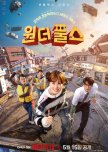
And now enter The Wonderfools, an eight-episode Netflix original set in 1999, where a terminally ill woman accidentally falls into experimental chemical waste, gains the power to teleport via caffeine-spiked heart rate, and somehow ends up responsible for saving an entire city from apocalyptic ruin. Yes, I walked into this one on the strength of my barely-concealed bias for Park Eun-bin. I am not apologising for it. but The Wonderfools once again proved that Korean drama narrative has mastered the Nolan Effect and injected its own brand of warm, chaotic, deeply human storytelling into it.
So let’s chat about The Wonderfools, the latest superhuman Kdrama that reminded me there is always a human heart beating underneath the spectacle.
Let’s start with the obvious elephant in the room and the sole reason I pressed play in the first place: Park Eun-bin. She plays Eun Chae-ni, a woman born with congestive heart failure who never expected to live past thirty. Somehow, despite her tiny frame and constant goblin energy, Chae-ni becomes the chaos nucleus of the entire drama. Her friends literally dub her “The Trainwreck of Haeseong,” and honestly? Accurate.
One of the things I admire most about Park Eun-bin as an actor is how completely she erases the fingerprints of her previous characters. Chae-ni does not resemble Woo Young-woo, Seo Mok-ha, or Jung Se-ok even remotely. She feels like a completely different creature. One second she is making me slightly emotional with quiet vulnerability, the next second she is stuffing caffeine jelly into her mouth preparing for battle like a sleep deprived raccoon who accidentally became an Avenger. I am ridiculously impressed by how easily she shifts between moments of tragedy and moments of pure laughter as if both are a second skin. If you watch this drama even just for Park Eun-bin’s acting sorcery, that’s a completely valid excuse, and you will be well-fed.
Opposite her is Cha Eun-woo as Lee Un-jeong. Full honesty here, I had never watched a Cha Eun-woo drama before this. He is good here. He plays one of the surviving experimented children from Project Wunderkind, carrying decades of trauma behind his polite face. I have no complaints about his performance at all. His emotional scenes work, his chemistry with the cast is solid, and his character being an aggressively honest straight shooter becomes the perfect comedic contrast against the rest of the chaotic goblins surrounding him.
That said, I never fully vibed with him the way I did with the rest of the cast. Through no fault of his own, I genuinely think he might be too pretty sometimes to the point of distraction. It is like placing a flawless sculpture inside a room full of exhausted raccoons fighting over emotional support ramen. Still, he anchors the ensemble well enough, and the drama would not function without his calm presence balancing everyone else’s nonsense.
The real comedic gold, however, comes from Choi Dae-hoon and Im Sung-jae as Son Gyeong-hun and Kang Ro-bin respectively. These two complete the trio and round out Chae-ni’s closest friends. I am actually laughing while writing this part right now as I imagine the scenes these two are in. Im Sung-jae plays Kang Ro-bin, Chae-ni’s friend since high school who now works in her grandmother’s restaurant. His super strength only activates when his feelings are hurt, which drives the entire comedic engine of the drama. The rest of the characters purposefully make fun of him just to trigger his power. Im Sung-jae is so great at physical comedy that any drama he’s in guarantees actual laugh-out-loud moments from me, not just the nose-exhale kind.
Choi Dae-hoon, oh Choi Dae-hoon. I already loved him from Seoul Busters, and here he plays a similar character archetype. Son Gyeong-hun is a husband and father who constantly struggles to get respect from his family. What surprised me most is that I recently watched him play a ruthless, cold character in Climax, and now he’s back to the warm, bumbling archetype I recognize. He rounds up the trio’s chaotic energy perfectly, and their group interactions are genuinely some of the best laugh-out-loud comedy I have seen this year.
Meanwhile, Choi Yoon-ji as Seok Ho-ran brought the exact emotional balance needed for the villain side of the story. I am not familiar with her work at all before this, but Ho-ran plays a perfect tragic villain whose character starts to waver toward the end. Together, both sisters inject humanity into characters who could have easily become cartoon antagonists. By the end, I genuinely wanted happiness for them more than revenge, which honestly says everything. Both names are now on my watchlist without hesitation. Love, Take Two just shoots up in my watch list.
Plot wise, The Wonderfools is not trying to reinvent the superhero genre. Experimental children. Secret projects. Immortality powers. A morally compromised scientist. Former allies turning against each other. None of this is new territory. But the drama succeeds because it understands something many superhero stories forget. Familiarity does not matter if the emotional execution works. The drama wears its genre influences without embarrassment and does not concern itself with subverting expectations. What it concerns itself with, relentlessly, is the human angle. The wunderkinds pay a visible cost for every use of their abilities, because that is what this brand of Korean superhero storytelling insists on examining. One character’s body hardens slowly into stone with each use. Seok Ju-ran’s hair whitens episode by episode, her skin pales, she begins coughing blood. The powers are not free, and watching that toll accumulate across eight episodes gives the final confrontation its genuine weight.
For most of its runtime, The Wonderfools is a full-throated comedy. I watched seven episodes without triggering a single analytical instinct, carried entirely by momentum, laughter, and the occasional human moment that landed like a quiet punch. One of those moments: Chae-ni strapped to an operating table, told by the lead antagonist that she is “nothing,” then getting back up after her rescue, loading herself with caffeine jelly, and declaring with shaking fury, “I’m not nothing, I’m my grandmother’s whole world. I just haven’t done anything yet.” Clichéd? Perhaps a little. Did I love it unreservedly? Absolutely. That is the secret sauce of The Wonderfools. The drama never tries to sound smarter than it is. It simply delivers emotional sincerity inside absurd superhero chaos.
And honestly, I think this is where South Korean superhero storytelling currently shines the brightest. Moving, Cashero, and The Wonderfools all exist on completely different tonal spectrum. Moving occupies the darker, heavier end. Cashero sits in the grounded, bittersweet middle. The Wonderfools plants its flag at the lighter, more absurd end. All three prove the same thesis: the Nolan Effect is not tied to tone or narrative weight. It is tied to the insistence on asking “what is the human angle here?” and refusing to let go of the answer. Balancing that humanity with full comedic identity is a harder achievement than it looks, because Moving had the luxury of darkness as its foundation. The Wonderfools had to hold comedy and genuine emotional stakes in the same hand without one killing the other. That it succeeds is mastery, not accident.
The OST leans into 90s rock throughout, fitting the era without demanding attention. Nothing was particularly memorable to me, though every track served its scene well. My favourite use was a single continuous shot near the finale: Park Eun-bin on a gurney, still groggy from a kidnapping, the chaos of the trio’s battle blurred and unfocused in the background, the music carrying the full weight of the scene. The kind of shot that made me laugh and feel something simultaneously. The final episode delivers genuinely impressive cinematography during the climactic battle, near Avengers-level in its scale and kineticism, while never losing sight of the fact that these are regular people improvising their way through heroism.
The drama also knows, crucially, when to stop being funny. The final thirty minutes shed the comedy cleanly, and the emotional stakes land because the characters have earned them. A post-credit scene hinting at a possible second season also made me laugh with genuine delight and I loved every second of it. The one notable flaw is the romance between the leads, which feels grafted on rather than organically grown. The story does not need it, and it occasionally pulls focus from more interesting dynamics at play. It is not obnoxious enough to damage the experience, but it earns the mention. The clearest proof that the Nolan Effect is fully operational in a superhero story is when you find yourself wishing for a happy ending for the people standing against the protagonist. I sat with The Wonderfools hoping, fully and helplessly, that Seok Ju-ran and Seok Ho-ran would make it through. They are not villains. They are victims of the same experiment that made them extraordinary, now paying for it with their lives. That grief is completely legible, and I felt every bit of it.
The Wonderfools is not trying to become the next emotionally devastating masterpiece. It is not a drama begging for symbolic dissection or philosophical essays. Instead, it understands the value of warmth, chaos, friendship, absurd comedy, and small emotional truths hidden underneath giant superhuman battles. Before I realized it, I was already on the final episode. That alone says a lot.
This is not a drama I will dissect. It is not asking me to. It is asking me to laugh, to care, and to notice how quickly eight episodes disappear when a show is doing its job well. It is asking me to confirm, once again, that Park Eun-bin is without argument one of the finest actors working in Korean drama today. Her range here, from chaos goblin to quiet heartbreak and back again within the same episode, is precisely why she holds SSS tier on my list next to Shin Hae-sun. It is asking me to add Jung Yi-seo to my watchlist immediately, because anyone who delivers restrained fury at that level deserves every leading role she gets next.
Most of all, The Wonderfools is asking me to recognise that Moving, Cashero, and this drama now occupy three distinct and deliberate points on the same tonal spectrum, from devastating to grounded to gleefully absurd, all three proving an identical thesis. South Korean superhero storytelling levels up by proving you do not need darkness to have depth. The Nolan Effect is not a formula reserved for serious dramas. It is a commitment to the human angle at any volume, in any tone, with any premise, caffeinated teleportation triggers and feelings-powered super strength very much included. The Wonderfools understood that from its first frame and never let go, and for that, and for Park Eun-bin, I am genuinely glad my bias dragged me through the door.
Kdrama superhero storytelling has mastered The Nolan Effect, and The Wonderfools might be the clearest proof yet. If you want a superhero story that doesn’t take itself seriously but still respects its own humanity, curl up with The Wonderfools. It won’t change your life, but it will make your weekend better. And sometimes, that is the truest superpower of all.
Moving built its entire emotional architecture on generational trauma and parental sacrifice as the true cost of extraordinary ability. Cashero, which I reviewed on this site, took the beautifully absurd premise of a man whose strength scales with how much cash he carries and turned it into a portrait of a reluctant hero burning his own future one rescue at a time. Both reviews are waiting for you here if you want the full picture.
And now enter The Wonderfools, an eight-episode Netflix original set in 1999, where a terminally ill woman accidentally falls into experimental chemical waste, gains the power to teleport via caffeine-spiked heart rate, and somehow ends up responsible for saving an entire city from apocalyptic ruin. Yes, I walked into this one on the strength of my barely-concealed bias for Park Eun-bin. I am not apologising for it. but The Wonderfools once again proved that Korean drama narrative has mastered the Nolan Effect and injected its own brand of warm, chaotic, deeply human storytelling into it.
So let’s chat about The Wonderfools, the latest superhuman Kdrama that reminded me there is always a human heart beating underneath the spectacle.
Let’s start with the obvious elephant in the room and the sole reason I pressed play in the first place: Park Eun-bin. She plays Eun Chae-ni, a woman born with congestive heart failure who never expected to live past thirty. Somehow, despite her tiny frame and constant goblin energy, Chae-ni becomes the chaos nucleus of the entire drama. Her friends literally dub her “The Trainwreck of Haeseong,” and honestly? Accurate.
One of the things I admire most about Park Eun-bin as an actor is how completely she erases the fingerprints of her previous characters. Chae-ni does not resemble Woo Young-woo, Seo Mok-ha, or Jung Se-ok even remotely. She feels like a completely different creature. One second she is making me slightly emotional with quiet vulnerability, the next second she is stuffing caffeine jelly into her mouth preparing for battle like a sleep deprived raccoon who accidentally became an Avenger. I am ridiculously impressed by how easily she shifts between moments of tragedy and moments of pure laughter as if both are a second skin. If you watch this drama even just for Park Eun-bin’s acting sorcery, that’s a completely valid excuse, and you will be well-fed.
Opposite her is Cha Eun-woo as Lee Un-jeong. Full honesty here, I had never watched a Cha Eun-woo drama before this. He is good here. He plays one of the surviving experimented children from Project Wunderkind, carrying decades of trauma behind his polite face. I have no complaints about his performance at all. His emotional scenes work, his chemistry with the cast is solid, and his character being an aggressively honest straight shooter becomes the perfect comedic contrast against the rest of the chaotic goblins surrounding him.
That said, I never fully vibed with him the way I did with the rest of the cast. Through no fault of his own, I genuinely think he might be too pretty sometimes to the point of distraction. It is like placing a flawless sculpture inside a room full of exhausted raccoons fighting over emotional support ramen. Still, he anchors the ensemble well enough, and the drama would not function without his calm presence balancing everyone else’s nonsense.
The real comedic gold, however, comes from Choi Dae-hoon and Im Sung-jae as Son Gyeong-hun and Kang Ro-bin respectively. These two complete the trio and round out Chae-ni’s closest friends. I am actually laughing while writing this part right now as I imagine the scenes these two are in. Im Sung-jae plays Kang Ro-bin, Chae-ni’s friend since high school who now works in her grandmother’s restaurant. His super strength only activates when his feelings are hurt, which drives the entire comedic engine of the drama. The rest of the characters purposefully make fun of him just to trigger his power. Im Sung-jae is so great at physical comedy that any drama he’s in guarantees actual laugh-out-loud moments from me, not just the nose-exhale kind.
Choi Dae-hoon, oh Choi Dae-hoon. I already loved him from Seoul Busters, and here he plays a similar character archetype. Son Gyeong-hun is a husband and father who constantly struggles to get respect from his family. What surprised me most is that I recently watched him play a ruthless, cold character in Climax, and now he’s back to the warm, bumbling archetype I recognize. He rounds up the trio’s chaotic energy perfectly, and their group interactions are genuinely some of the best laugh-out-loud comedy I have seen this year.
Meanwhile, Choi Yoon-ji as Seok Ho-ran brought the exact emotional balance needed for the villain side of the story. I am not familiar with her work at all before this, but Ho-ran plays a perfect tragic villain whose character starts to waver toward the end. Together, both sisters inject humanity into characters who could have easily become cartoon antagonists. By the end, I genuinely wanted happiness for them more than revenge, which honestly says everything. Both names are now on my watchlist without hesitation. Love, Take Two just shoots up in my watch list.
Plot wise, The Wonderfools is not trying to reinvent the superhero genre. Experimental children. Secret projects. Immortality powers. A morally compromised scientist. Former allies turning against each other. None of this is new territory. But the drama succeeds because it understands something many superhero stories forget. Familiarity does not matter if the emotional execution works. The drama wears its genre influences without embarrassment and does not concern itself with subverting expectations. What it concerns itself with, relentlessly, is the human angle. The wunderkinds pay a visible cost for every use of their abilities, because that is what this brand of Korean superhero storytelling insists on examining. One character’s body hardens slowly into stone with each use. Seok Ju-ran’s hair whitens episode by episode, her skin pales, she begins coughing blood. The powers are not free, and watching that toll accumulate across eight episodes gives the final confrontation its genuine weight.
For most of its runtime, The Wonderfools is a full-throated comedy. I watched seven episodes without triggering a single analytical instinct, carried entirely by momentum, laughter, and the occasional human moment that landed like a quiet punch. One of those moments: Chae-ni strapped to an operating table, told by the lead antagonist that she is “nothing,” then getting back up after her rescue, loading herself with caffeine jelly, and declaring with shaking fury, “I’m not nothing, I’m my grandmother’s whole world. I just haven’t done anything yet.” Clichéd? Perhaps a little. Did I love it unreservedly? Absolutely. That is the secret sauce of The Wonderfools. The drama never tries to sound smarter than it is. It simply delivers emotional sincerity inside absurd superhero chaos.
And honestly, I think this is where South Korean superhero storytelling currently shines the brightest. Moving, Cashero, and The Wonderfools all exist on completely different tonal spectrum. Moving occupies the darker, heavier end. Cashero sits in the grounded, bittersweet middle. The Wonderfools plants its flag at the lighter, more absurd end. All three prove the same thesis: the Nolan Effect is not tied to tone or narrative weight. It is tied to the insistence on asking “what is the human angle here?” and refusing to let go of the answer. Balancing that humanity with full comedic identity is a harder achievement than it looks, because Moving had the luxury of darkness as its foundation. The Wonderfools had to hold comedy and genuine emotional stakes in the same hand without one killing the other. That it succeeds is mastery, not accident.
The OST leans into 90s rock throughout, fitting the era without demanding attention. Nothing was particularly memorable to me, though every track served its scene well. My favourite use was a single continuous shot near the finale: Park Eun-bin on a gurney, still groggy from a kidnapping, the chaos of the trio’s battle blurred and unfocused in the background, the music carrying the full weight of the scene. The kind of shot that made me laugh and feel something simultaneously. The final episode delivers genuinely impressive cinematography during the climactic battle, near Avengers-level in its scale and kineticism, while never losing sight of the fact that these are regular people improvising their way through heroism.
The drama also knows, crucially, when to stop being funny. The final thirty minutes shed the comedy cleanly, and the emotional stakes land because the characters have earned them. A post-credit scene hinting at a possible second season also made me laugh with genuine delight and I loved every second of it. The one notable flaw is the romance between the leads, which feels grafted on rather than organically grown. The story does not need it, and it occasionally pulls focus from more interesting dynamics at play. It is not obnoxious enough to damage the experience, but it earns the mention. The clearest proof that the Nolan Effect is fully operational in a superhero story is when you find yourself wishing for a happy ending for the people standing against the protagonist. I sat with The Wonderfools hoping, fully and helplessly, that Seok Ju-ran and Seok Ho-ran would make it through. They are not villains. They are victims of the same experiment that made them extraordinary, now paying for it with their lives. That grief is completely legible, and I felt every bit of it.
The Wonderfools is not trying to become the next emotionally devastating masterpiece. It is not a drama begging for symbolic dissection or philosophical essays. Instead, it understands the value of warmth, chaos, friendship, absurd comedy, and small emotional truths hidden underneath giant superhuman battles. Before I realized it, I was already on the final episode. That alone says a lot.
This is not a drama I will dissect. It is not asking me to. It is asking me to laugh, to care, and to notice how quickly eight episodes disappear when a show is doing its job well. It is asking me to confirm, once again, that Park Eun-bin is without argument one of the finest actors working in Korean drama today. Her range here, from chaos goblin to quiet heartbreak and back again within the same episode, is precisely why she holds SSS tier on my list next to Shin Hae-sun. It is asking me to add Jung Yi-seo to my watchlist immediately, because anyone who delivers restrained fury at that level deserves every leading role she gets next.
Most of all, The Wonderfools is asking me to recognise that Moving, Cashero, and this drama now occupy three distinct and deliberate points on the same tonal spectrum, from devastating to grounded to gleefully absurd, all three proving an identical thesis. South Korean superhero storytelling levels up by proving you do not need darkness to have depth. The Nolan Effect is not a formula reserved for serious dramas. It is a commitment to the human angle at any volume, in any tone, with any premise, caffeinated teleportation triggers and feelings-powered super strength very much included. The Wonderfools understood that from its first frame and never let go, and for that, and for Park Eun-bin, I am genuinely glad my bias dragged me through the door.
Kdrama superhero storytelling has mastered The Nolan Effect, and The Wonderfools might be the clearest proof yet. If you want a superhero story that doesn’t take itself seriously but still respects its own humanity, curl up with The Wonderfools. It won’t change your life, but it will make your weekend better. And sometimes, that is the truest superpower of all.
Was this review helpful to you?


