
 Editorials


 3
3 3
3 3
3


Brutally Beautiful and Surprisingly Gentle
There is a particular kind of fantasy that almost everyone has entertained at least once. Not the fantasy of becoming rich. Not the fantasy of saving the world. The fantasy of watching someone who has spent years making other people’s lives miserable finally meet someone who simply refuses to tolerate it anymore.
Teach You a Lesson understands that fantasy almost immediately. It knows exactly why audiences are showing up. It knows why teachers are talking about it in staff rooms. It knows why parents are arguing about it over dinner. It knows why it exploded onto Netflix the moment it arrived. This is a drama built around catharsis, the kind that makes you grin, pump your fist, and then quietly wonder whether enjoying it says something uncomfortable about yourself.
And that is exactly why I could not stop watching.
But here is the thing about a show this popular, this gloriously violent, and this unapologetically provocative: it is never just about the punches. Beneath the bone-crunching action and the vigilante fantasy sits a mirror held up to a very real, very uncomfortable crisis in modern education. So grab a cup of tea and settle in, because this drama has me, and probably half the planet, completely hooked.
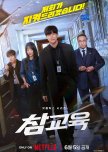
Let us start with the people who make this chaotic world worth watching, because Teach You a Lesson has an ensemble that feels less like a cast and more like a squad you would genuinely want on your side in a fight. At the center is Kim Mu‑yeol as Na Hwa‑jin, a former special forces captain turned field inspector for the fictional Educational Rights Protection Bureau. This is my first proper exposure to Kim Mu‑yeol’s work, and I have to say, I am utterly captivated by his acting (it helps that he has such a great smile too). He shifts effortlessly between drama, comedy, action, and tragedy within a single scene, and that versatility is exactly what makes his Na Hwa‑jin so magnetic. Here, he is all coiled intensity and quiet menace, a man who speaks with his fists because words have failed the system entirely. He is not a hero in the traditional sense, and that is precisely what makes him so attractive.
Then there is Lee Sung-min as Minister of Education Choi Gang-seok, the weary architect of this unconventional bureau, bringing a gravitas that makes you believe a man could lose his daughter to school violence and decide to burn the whole broken system down in response. He and Kim Mu-yeol apparently previously worked together on Juvenile Justice under the same director, and that reunion feels less like casting and more like fate.
The real scene-stealers, though, are Jin Ki-joo as Im Han-rim, a fellow inspector whose fighting skills could make action heroes weep with envy, and Pyo Ji-hoon as Bong Geun-dae, the KAIST genius who handles intelligence and tech support. Jin Ki-joo’s Han-rim is a perfect storm of ferocity and vulnerability; she gets one of the most terrific introduction scenes I have seen in recent memory. Pyo Ji-hoon, who many might know as P.O from Block B, brings an endearing geekiness that balances out all the testosterone and rage. Fans have lovingly dubbed this quartet the “Anti-Bully Avengers,” and I cannot think of a better description. They are flawed, messy, and often operating in moral grey areas, but by the end of the first episode I was completely invested in their mission.
Now, let’s chat about the story itself, because Teach You a Lesson is not your typical high school drama. There are no love triangles here, no agonizing over college entrance exams, no sweet friendship montages set to acoustic ballads. This is a show that opens with a student leaping from a school roof because the bullying has become unbearable. It is grim, and it is meant to be. The show is adapted from the popular Naver webtoon Get Schooled, which has generated over 2.3 billion won in revenue since its 2020 debut.
But director Hong Jong-chan, who also directed Juvenile Justice, made a conscious decision to approach the source material “through a more refined lens” and create something meaningful rather than just reproducing the webtoon’s more controversial elements. The result is a 10-episode procedural that feels like a superhero origin story set in the bleakest possible world. Each episode tackles a different school, a different case: a kindergarten teacher harassed by overbearing parents, an aspiring engineer caught between rival gangs, a social media influencer whose false accusations drive an innocent teacher to suicide. The format keeps things fresh, but the underlying message remains consistent, the system is broken, and someone has to fix it, even if that means breaking a few rules, and a few faces, along the way.
What I find most entertaining about Teach You a Lesson is how it refuses to offer easy answers. On one hand, it is pure catharsis. Watching Na Hwa-jin dismantle a bully’s entire world, exposing the corruption of a powerful politician father, and forcing the son to experience the same social ostracization he once inflicted on others, feels like justice served hot. It is the kind of revenge fantasy that makes you cheer out loud and immediately feel a little guilty for doing so. But the show is smarter than that. It constantly asks uncomfortable questions: Is this really justice, or just revenge dressed up in a nicer suit? When you fight violence with violence, do you become the very thing you are trying to destroy?
These are not new questions, but the show presents them with such visceral intensity that you cannot ignore them. The bullying scenes are in-your-face, deliberately uncomfortable, designed to make you squirm. And the show’s refusal to divide people into simple heroes and villains is one of its most refreshing qualities. Some teachers genuinely care, others are exhausted and defeated. Some students are irredeemable monsters, others are victims who have been pushed too far. It is messy, because real life is messy.
And speaking of messiness, what truly astounds me about Teach You a Lesson is how it threads the needles of action-comedy and tragedy with surgical precision, never letting one lane bleed into the other in ways that feel jarring or disrespectful. This is a show that will have you laughing at the ERPB team’s bickering antics one moment, particularly when Hwa-jin repeatedly reminds Han-rim to “please not kill anyone” during their field ops, as if she is a hyperactive child who needs constant supervision. Then, in the very next scene, you are confronted with the unbearable weight of a teacher who saw no way out other than ending their life, or a student who believed the world would be better off without them.
The tonal shifts are sharp, but never clumsy. It reminds me so much of Seoul Busters, another drama that excelled at maintaining separate, disciplined lanes for its comedy and tragedy. In both shows, the humor is never used to undercut the pain, and the pain is never so heavy that it smothers the moments of levity. They exist side by side, like two rivers flowing in parallel, sometimes close enough to touch but never contaminating each other. That discipline is a testament to the writing and directing. It takes a confident creative team to trust that audiences can handle the whiplash, and an even more confident one to pull it off without either tone feeling forced or out of place.
Visually and aurally, Teach You a Lesson is a masterclass in controlled chaos. Director Hong Jong-chan, working with cinematographers Yoon Joo-hwan and Lee Choon-hwi, creates this dystopian atmosphere that feels both heightened and painfully familiar. The schools are sterile, oppressive spaces, all fluorescent lighting and cold hallways, but the violence that erupts within them is raw and kinetic. The fight choreography is brutal and balletic; you can tell Kim Mu-yeol brings authentic action skills to the table, he is a real-life recipient of the honorary title “West Sea Guardian” from the Defense Ministry after all.
But the show is not just about fists and feet. There is a quiet, almost tender moment when the camera lingers on a quote from Albert Camus inscribed on a school wall: “Nothing is more despicable than respect based on fear”. It is a fleeting image, but it says everything. And then there is episode nine, which completely broke me. Na Hwa-jin and Choi Gang-seok are processing their grief separately, each in a different room, yet the show refuses to let them be truly alone. Gang-seok is drunk, laid down in Hwa-jin’s private quarters, while Hwa-jin sits in the living room, bent over a couch with his eyes fixed on the floor, lost in his own sorrow.
The director could have easily used a back-to-back shot, cutting between the two actors to emphasize their isolation. Instead, they chose a wide shot that captures both men in the same frame, separated only by the thin wall between their rooms. In that single, devastating composition, I saw two people carrying the weight of the entire broken system on their shoulders, unable to comfort each other even when they are just inches apart. It is powerfully sad, the kind of visual storytelling that does not need dialogue to break your heart. Oh yeah, that was some of several moments that I truly wept.
The music, composed by Kim Tae-seong, knows exactly when to swell with heroic triumph and when to pull back into mournful silence. The show understands that the most powerful moments are not always the loudest ones.
And yet, for all its polish and punch, Teach You a Lesson has not been without its controversies. The show has sparked fierce debates, particularly around an episode involving a female student who falsely accuses a male teacher of sexual harassment. Critics have argued that the show leans into a troubling male perspective, suggesting that such narratives are harmful in a world where real cases of harassment are often dismissed. Others have pointed out that the show’s reliance on “might makes right” is ultimately an escapist fantasy that offers no real solutions for the systemic issues it highlights.
Even Korean teachers have been split. Some have found the show deeply cathartic, a validation of their daily frustrations with unruly students and overbearing parents. Others have found it horrifying, worrying that viewers might come away believing that violence against students is somehow a necessary part of education. The Korean Federation of Teachers’ Associations issued a statement acknowledging that the show lays bare the harsh realities of modern classrooms, but stressed that “what this drama misses at its core is that what teachers need is not a fist, but legal protections”. It is a fair point, and one that the show itself does not fully address.
So, do I recommend Teach You a Lesson? Absolutely, with one caveat: this is not a show for everyone. If you want something light and fluffy, look elsewhere. This will make you angry, sad, and gleeful within the same episode, then make you question why you were cheering at all. It is one of the smartest, most addictive feel-good dramas of the year, and I say “feel-good” with every bit of irony that implies. It understands the pull of fantasy while never losing sight of how dangerous it is to indulge that fantasy too far.
And here is the thing I keep coming back to: I truly enjoyed every single minute of this drama, and I do not say that lightly. Teach You a Lesson has this rare, almost magical ability to close its stories in the most cathartic way possible. Every single plot point, every thread the writers carefully laid out, gets tied up with such satisfying precision that I found myself smiling, genuinely smiling, at the end of every episode. I cannot remember the last time a kdrama made me feel that way so consistently.
There is a rhythm to the storytelling that feels almost musical; each episode builds its own complete arc, delivers its emotional punch, and then resolves with a sense of closure that is both earned and deeply comforting. The karma always arrives, sometimes with a fist, sometimes with a quiet revelation, but it always arrives. And that consistency, that refusal to leave any character’s fate dangling in uncertainty, is what makes the binge-watching experience so addictive.
In fact, I so rarely wish for sequels. I’m usually content to let a good story stand on its own. But for Teach You a Lesson, I will make an exception. The procedural format is perfectly suited for more seasons, new schools, new cases, new bullies who desperately need a lesson, and new victims who deserve their moment of justice. The cast is strong enough to carry it, the premise is flexible enough to sustain it, and the world they have built feels like it has so much more to say. So yes, I am putting it out into the universe: I really do hope we get a season two.
The show knows that sometimes teaching a lesson means throwing a punch, and it also knows a punch is never the final answer. In the end, Teach You a Lesson is not really about teaching bullies a lesson at all. It is about holding a mirror up to a society that failed its most vulnerable, and asking, with all the subtlety of a fist to the face, what we plan to do about it.
That question, I think, is worth sitting with, even when the answer is not pretty.
Teach You a Lesson understands that fantasy almost immediately. It knows exactly why audiences are showing up. It knows why teachers are talking about it in staff rooms. It knows why parents are arguing about it over dinner. It knows why it exploded onto Netflix the moment it arrived. This is a drama built around catharsis, the kind that makes you grin, pump your fist, and then quietly wonder whether enjoying it says something uncomfortable about yourself.
And that is exactly why I could not stop watching.
But here is the thing about a show this popular, this gloriously violent, and this unapologetically provocative: it is never just about the punches. Beneath the bone-crunching action and the vigilante fantasy sits a mirror held up to a very real, very uncomfortable crisis in modern education. So grab a cup of tea and settle in, because this drama has me, and probably half the planet, completely hooked.
Let us start with the people who make this chaotic world worth watching, because Teach You a Lesson has an ensemble that feels less like a cast and more like a squad you would genuinely want on your side in a fight. At the center is Kim Mu‑yeol as Na Hwa‑jin, a former special forces captain turned field inspector for the fictional Educational Rights Protection Bureau. This is my first proper exposure to Kim Mu‑yeol’s work, and I have to say, I am utterly captivated by his acting (it helps that he has such a great smile too). He shifts effortlessly between drama, comedy, action, and tragedy within a single scene, and that versatility is exactly what makes his Na Hwa‑jin so magnetic. Here, he is all coiled intensity and quiet menace, a man who speaks with his fists because words have failed the system entirely. He is not a hero in the traditional sense, and that is precisely what makes him so attractive.
Then there is Lee Sung-min as Minister of Education Choi Gang-seok, the weary architect of this unconventional bureau, bringing a gravitas that makes you believe a man could lose his daughter to school violence and decide to burn the whole broken system down in response. He and Kim Mu-yeol apparently previously worked together on Juvenile Justice under the same director, and that reunion feels less like casting and more like fate.
The real scene-stealers, though, are Jin Ki-joo as Im Han-rim, a fellow inspector whose fighting skills could make action heroes weep with envy, and Pyo Ji-hoon as Bong Geun-dae, the KAIST genius who handles intelligence and tech support. Jin Ki-joo’s Han-rim is a perfect storm of ferocity and vulnerability; she gets one of the most terrific introduction scenes I have seen in recent memory. Pyo Ji-hoon, who many might know as P.O from Block B, brings an endearing geekiness that balances out all the testosterone and rage. Fans have lovingly dubbed this quartet the “Anti-Bully Avengers,” and I cannot think of a better description. They are flawed, messy, and often operating in moral grey areas, but by the end of the first episode I was completely invested in their mission.
Now, let’s chat about the story itself, because Teach You a Lesson is not your typical high school drama. There are no love triangles here, no agonizing over college entrance exams, no sweet friendship montages set to acoustic ballads. This is a show that opens with a student leaping from a school roof because the bullying has become unbearable. It is grim, and it is meant to be. The show is adapted from the popular Naver webtoon Get Schooled, which has generated over 2.3 billion won in revenue since its 2020 debut.
But director Hong Jong-chan, who also directed Juvenile Justice, made a conscious decision to approach the source material “through a more refined lens” and create something meaningful rather than just reproducing the webtoon’s more controversial elements. The result is a 10-episode procedural that feels like a superhero origin story set in the bleakest possible world. Each episode tackles a different school, a different case: a kindergarten teacher harassed by overbearing parents, an aspiring engineer caught between rival gangs, a social media influencer whose false accusations drive an innocent teacher to suicide. The format keeps things fresh, but the underlying message remains consistent, the system is broken, and someone has to fix it, even if that means breaking a few rules, and a few faces, along the way.
What I find most entertaining about Teach You a Lesson is how it refuses to offer easy answers. On one hand, it is pure catharsis. Watching Na Hwa-jin dismantle a bully’s entire world, exposing the corruption of a powerful politician father, and forcing the son to experience the same social ostracization he once inflicted on others, feels like justice served hot. It is the kind of revenge fantasy that makes you cheer out loud and immediately feel a little guilty for doing so. But the show is smarter than that. It constantly asks uncomfortable questions: Is this really justice, or just revenge dressed up in a nicer suit? When you fight violence with violence, do you become the very thing you are trying to destroy?
These are not new questions, but the show presents them with such visceral intensity that you cannot ignore them. The bullying scenes are in-your-face, deliberately uncomfortable, designed to make you squirm. And the show’s refusal to divide people into simple heroes and villains is one of its most refreshing qualities. Some teachers genuinely care, others are exhausted and defeated. Some students are irredeemable monsters, others are victims who have been pushed too far. It is messy, because real life is messy.
And speaking of messiness, what truly astounds me about Teach You a Lesson is how it threads the needles of action-comedy and tragedy with surgical precision, never letting one lane bleed into the other in ways that feel jarring or disrespectful. This is a show that will have you laughing at the ERPB team’s bickering antics one moment, particularly when Hwa-jin repeatedly reminds Han-rim to “please not kill anyone” during their field ops, as if she is a hyperactive child who needs constant supervision. Then, in the very next scene, you are confronted with the unbearable weight of a teacher who saw no way out other than ending their life, or a student who believed the world would be better off without them.
The tonal shifts are sharp, but never clumsy. It reminds me so much of Seoul Busters, another drama that excelled at maintaining separate, disciplined lanes for its comedy and tragedy. In both shows, the humor is never used to undercut the pain, and the pain is never so heavy that it smothers the moments of levity. They exist side by side, like two rivers flowing in parallel, sometimes close enough to touch but never contaminating each other. That discipline is a testament to the writing and directing. It takes a confident creative team to trust that audiences can handle the whiplash, and an even more confident one to pull it off without either tone feeling forced or out of place.
Visually and aurally, Teach You a Lesson is a masterclass in controlled chaos. Director Hong Jong-chan, working with cinematographers Yoon Joo-hwan and Lee Choon-hwi, creates this dystopian atmosphere that feels both heightened and painfully familiar. The schools are sterile, oppressive spaces, all fluorescent lighting and cold hallways, but the violence that erupts within them is raw and kinetic. The fight choreography is brutal and balletic; you can tell Kim Mu-yeol brings authentic action skills to the table, he is a real-life recipient of the honorary title “West Sea Guardian” from the Defense Ministry after all.
But the show is not just about fists and feet. There is a quiet, almost tender moment when the camera lingers on a quote from Albert Camus inscribed on a school wall: “Nothing is more despicable than respect based on fear”. It is a fleeting image, but it says everything. And then there is episode nine, which completely broke me. Na Hwa-jin and Choi Gang-seok are processing their grief separately, each in a different room, yet the show refuses to let them be truly alone. Gang-seok is drunk, laid down in Hwa-jin’s private quarters, while Hwa-jin sits in the living room, bent over a couch with his eyes fixed on the floor, lost in his own sorrow.
The director could have easily used a back-to-back shot, cutting between the two actors to emphasize their isolation. Instead, they chose a wide shot that captures both men in the same frame, separated only by the thin wall between their rooms. In that single, devastating composition, I saw two people carrying the weight of the entire broken system on their shoulders, unable to comfort each other even when they are just inches apart. It is powerfully sad, the kind of visual storytelling that does not need dialogue to break your heart. Oh yeah, that was some of several moments that I truly wept.
The music, composed by Kim Tae-seong, knows exactly when to swell with heroic triumph and when to pull back into mournful silence. The show understands that the most powerful moments are not always the loudest ones.
And yet, for all its polish and punch, Teach You a Lesson has not been without its controversies. The show has sparked fierce debates, particularly around an episode involving a female student who falsely accuses a male teacher of sexual harassment. Critics have argued that the show leans into a troubling male perspective, suggesting that such narratives are harmful in a world where real cases of harassment are often dismissed. Others have pointed out that the show’s reliance on “might makes right” is ultimately an escapist fantasy that offers no real solutions for the systemic issues it highlights.
Even Korean teachers have been split. Some have found the show deeply cathartic, a validation of their daily frustrations with unruly students and overbearing parents. Others have found it horrifying, worrying that viewers might come away believing that violence against students is somehow a necessary part of education. The Korean Federation of Teachers’ Associations issued a statement acknowledging that the show lays bare the harsh realities of modern classrooms, but stressed that “what this drama misses at its core is that what teachers need is not a fist, but legal protections”. It is a fair point, and one that the show itself does not fully address.
So, do I recommend Teach You a Lesson? Absolutely, with one caveat: this is not a show for everyone. If you want something light and fluffy, look elsewhere. This will make you angry, sad, and gleeful within the same episode, then make you question why you were cheering at all. It is one of the smartest, most addictive feel-good dramas of the year, and I say “feel-good” with every bit of irony that implies. It understands the pull of fantasy while never losing sight of how dangerous it is to indulge that fantasy too far.
And here is the thing I keep coming back to: I truly enjoyed every single minute of this drama, and I do not say that lightly. Teach You a Lesson has this rare, almost magical ability to close its stories in the most cathartic way possible. Every single plot point, every thread the writers carefully laid out, gets tied up with such satisfying precision that I found myself smiling, genuinely smiling, at the end of every episode. I cannot remember the last time a kdrama made me feel that way so consistently.
There is a rhythm to the storytelling that feels almost musical; each episode builds its own complete arc, delivers its emotional punch, and then resolves with a sense of closure that is both earned and deeply comforting. The karma always arrives, sometimes with a fist, sometimes with a quiet revelation, but it always arrives. And that consistency, that refusal to leave any character’s fate dangling in uncertainty, is what makes the binge-watching experience so addictive.
In fact, I so rarely wish for sequels. I’m usually content to let a good story stand on its own. But for Teach You a Lesson, I will make an exception. The procedural format is perfectly suited for more seasons, new schools, new cases, new bullies who desperately need a lesson, and new victims who deserve their moment of justice. The cast is strong enough to carry it, the premise is flexible enough to sustain it, and the world they have built feels like it has so much more to say. So yes, I am putting it out into the universe: I really do hope we get a season two.
The show knows that sometimes teaching a lesson means throwing a punch, and it also knows a punch is never the final answer. In the end, Teach You a Lesson is not really about teaching bullies a lesson at all. It is about holding a mirror up to a society that failed its most vulnerable, and asking, with all the subtlety of a fist to the face, what we plan to do about it.
That question, I think, is worth sitting with, even when the answer is not pretty.
Was this review helpful to you?


