

 3
3 3
3 3
3


Generational Sin, Hidden Tragedy, and a Palace Full of Wounds
I finished The East Palace last week, and after the screen went dark, my mind kept circling back to one stubborn thought: that cursed palace felt more like a living, breathing monster than any royal residence I had ever seen.
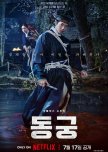
The Korean title simply calls it Donggung, the traditional residence of the crown prince during the Joseon dynasty. But the Chinese translation adds two extra characters that mean "ghost" and "mystery," and honestly, they nailed it. Because in this drama, the East Palace is not some hopeful cradle for a future king. It is a nest of vengeful spirits and a breeding ground for a curse that has festered for decades. Successive crown princes have died in bizarre ways, and the palace whispers that a vengeful spirit in the pond has sworn to wipe out the royal bloodline. The king secretly summons a ghost hunter named Gu Cheon, a man who can cross between the living and the dead, and assigns him a court lady named Saeng-gang, who can hear the voices of ghosts, to keep watch. The two distrust each other from the start, but they are forced to work together, peeling back layer after layer of a thirty-year-old court conspiracy.
To be perfectly honest, that premise alone had me hooked. Historical drama, ghosts, and sageuk court intrigue, three elements I cannot resist, all tossed into one bowl like a ramyun with double toppings. As someone who always enjoys layered storytelling and cerebral chess narratives, sageuk is my kryptonite. The East Palace promised a puzzle box wrapped in period clothing, with supernatural chills as the seasoning on top. I knew before I even pressed play that I was in for a treat.
Let us talk about the cast first. Nam Joo-hyuk returns in his first post-military role, playing Gu Cheon, an exorcist who can freely move between the human world and the spirit realm. The Nam Joo-hyuk I knew was Baek Yi-jin from Twenty-Five Twenty-One, sunny and bright, the kind of smile that could light up an entire screen. But here, he has packed away all that radiance and replaced it with a face that says, "I have seen too much life and death, and I do not have the energy to explain myself to this world." I could not help but notice how naturally Nam Joo-hyuk wears loneliness like a second skin. He is exceptionally good at hiding his pain behind that quiet, solitary exterior, letting just enough of the ache flicker through his eyes without ever spilling it outright. There is a difference between performing sadness and embodying it, and Nam Joo-hyuk clearly belongs to the latter camp.
Then there is Roh Yoon-seo as court lady Saeng-gang, and she is another revelation. To be honest, she was one of the core reasons I picked up The East Palace in the first place. I first encountered her in Our Blues, where her masterful acting gave me one of the most compelling teen pregnancy stories I had seen in a while. Then I saw her again in Crash Course in Romance, and once more, I fell in love with her acting as a student handling senior high-school pressure. There is something about Roh Yoon-seo that feels remarkably grounded; she never overacts, never reaches for cheap tears or dramatic flourishes. Instead, she lets her characters breathe.
In The East Palace, she sheds her good-girl high school image completely. Saeng-gang is no sweet, helpless heroine waiting to be rescued. She is a woman with her own schemes, her own stubborn obsession with uncovering the truth about her mother's death, and her own quiet determination to navigate a world that has never been kind to her. Born with the ability to hear the voices of the dead, she carries that curse not with melodrama but with a weary acceptance that feels deeply lived-in. The king plants her beside Gu Cheon as a spy, but she has her own agenda. Roh Yoon-seo brings a layered performance that balances vulnerability with steel; you can see the grief simmering beneath her composed surface, but you also see the sharp intelligence calculating every move. She is not just a love interest or a sidekick; she is a fully realized character.
The relationship between Gu Cheon and Saeng-gang starts with mutual suspicion, then slowly builds into trust and shared purpose, but it never rushes toward romance. Their connection is built through actions, a shared glance, a fight fought back-to-back, a sentence left unfinished. Their bond is subtle, emotional, and unspoken. And I really appreciate that The East Palace never reduces Saeng-gang to a mere sidekick female lead. There are moments where she takes point on the investigations, piecing together clues while Gu Cheon follows her lead. She is not there to simply support his journey; she has her own arc, her own ghosts to face, and her own battles to win.
And I cannot skip over Cho Seung-woo. I first encountered him in Stranger, where he played the emotionless but brilliantly perceptive prosecutor Hwang Si-mok. There is something about Cho Seung-woo that I have always found magnetic; he brings this effortless raw magnetism to every role, a kind of quiet intensity that makes it impossible to look away. That same quality is on full display in The East Palace. He plays the king, and his character carries the densest emotional weight in the entire show. His screen time is not the longest, but every scene he is in crackles with authority. This king swings between mercy and ruthlessness so deftly that you can never tell whether he is a victim or a perpetrator. Cho does not need to raise his voice to terrify you; he sits perfectly still, and a single look from him offers ten different possible interpretations. By the end, you realize that this king is both the maker and the sufferer of the curse. A character this morally complex could easily become a caricature, but Cho handles it with just the right touch.
Now, let us dive into the plot itself. The East Palace opens with a classic sageuk mystery: crown princes have been dying, one after another, over the last thirty years. What follows is a truly fascinating web of lies, tragedies, deceptions, betrayals, and redemptions that only a well-crafted sageuk can achieve. The show weaves together multiple timelines, hidden identities, and long-buried grudges with intricate care. Every character has a secret, every kind gesture hides a knife, and every whispered conversation feels like it could tip the entire kingdom off balance. I found myself constantly second-guessing my own theories, only to have the drama neatly upend them with a new revelation. It is the kind of storytelling that trusts its audience to keep up.
The conspiracy at the heart of the show stretches back generations, tying together the fates of court officials, royal concubines, and even the lowliest servants. Gu Cheon and Saeng-gang are not merely solving a supernatural mystery; they are untangling a knot of human wrongdoing so tightly wound that it has taken on a life of its own in the form of vengeful spirits. The drama balances its human drama with its ghostly elements beautifully, never letting one overshadow the other. The ghosts are always a consequence of human sin, never the cause of it.
On the audio-visual craft, is where The East Palace truly elevates itself. Director Choi Jeong-gyu makes a bold visual choice: the real world is rendered in cold, blue tones, while the spirit realm blazes in a barren red. One is cold, the other hot; one is life, the other death. The colour palette alone tells half the story. The blue of the real world feels suffocating, full of rules and pretense. The red of the ghost world is chaotic, primal, and free from the need to maintain dignity. The red, in particular, is used to denote the realm of gwi, the spirits, and it creates an unsettling contrast that makes every transition between worlds feel jarring and dangerous.
And the production team clearly did not cheapen out on the effects. The CGI is surprisingly robust, bringing the various ghostly entities to life with impressive detail. But beyond the visual effects, the sword fight choreography deserves special mention. The action sequences are truly breathtaking; they are fast, visceral, and beautifully staged, with none of that shaky-cam nonsense. Every clash of blades feels weighty and consequential. It is rare to find a drama that balances supernatural chills with such grounded, physical action, and The East Palace manages that balancing act with surprising grace.
But what truly moved me about The East Palace was not the flashy special effects. It was the core theme hidden beneath the ghost story. On the surface, this drama is about catching spirits, but underneath, it is about the human heart. The very name "East Palace" becomes a grand irony: it should be a place that nurtures a future monarch, but instead it is occupied by curses and vengeful souls. The real corruption never comes from ghosts; it comes from people. The real contamination is in the entire system of power. The most vicious characters in this show are never the snarling spectres; they are the living. The ghosts may haunt the halls, but their fury is always a reflection of something far more human. The real question the drama keeps asking is not who the ghosts are, but who made them that way.
This idea, that a curse is merely an extension of human wickedness, is not entirely new, but The East Palace wraps it in a court-mystery package and executes it with satisfying coherence. The whole story is about karma and retribution, about the sins of one generation being paid for by the next. And when the drama finally offers its resolution, it does so not with a grand exorcism, but with something far more unexpected: the king finally embracing humility, acknowledging his own humanity. That ending made me pause and think. I realised that true exorcism does not require a sword; it requires confession. Some curses persist only because no one is willing to admit they did something wrong.
Of course, the drama is not flawless. With only eight episodes, some plot points feel rushed. A few rules of the ghost world are not explained clearly enough, and I occasionally found myself confused about the logic of certain supernatural mechanics. Also, the heavy use of dark, shadowy scenes does get a bit tiring on the eyes after a while. Beyond that, The East Palace relies heavily on concepts from Korean shamanism, Buddhism, and Taoism that might not be familiar to Western audiences. The concept of Samsara is mentioned but never explained, and terms like Ak-gwi, Gwi-mae, and Won-gwi are used without translation. For those familiar with this lore, these are excellent Easter eggs; for others, it can be confusing. If you want to dig deeper, I posted a brief educational thread on my BlueSky account that you can use as a cheat sheet.
But these issues never overshadow the show's strengths. The East Palace is a work I would gladly recommend; its greatest assets are the performances, the story, and the atmospheric tension.
Lying in bed after that final episode, I thought: if the East Palace were a real place, it would not be a beautiful royal building. It would be a massive, silent wound. Those ghosts were not there for revenge, not really; they were there to remind us that every person who steps into the heart of power is walking on bricks that may be soaked in someone else's blood. Gu Cheon and Saeng-gang were just two people who wandered into that wound and tried to help it heal.
So, would I recommend The East Palace? Strongly yes, but with an asterisk. It boasts some of the best cinematography and fight scenes I have seen this year. For anyone missing a good sageuk, this is absolutely worth your time. That said, it suffers from the same tight runtime that pulled down The Art of Sarah from greatness, and unlike that show, this was clearly designed with multiple seasons in mind. That may frustrate viewers who prefer neatly wrapped endings. But even with those frustrations, I do not regret a single minute. The journey was thrilling, the characters stayed with me, and the themes of guilt and redemption resonated far deeper than I expected. If you go in knowing that not every mystery will be solved, I think you will have a wonderful time. It is not perfect, but it is ambitious, visually stunning, and emotionally rich.
And that, I think, is enough.
The Korean title simply calls it Donggung, the traditional residence of the crown prince during the Joseon dynasty. But the Chinese translation adds two extra characters that mean "ghost" and "mystery," and honestly, they nailed it. Because in this drama, the East Palace is not some hopeful cradle for a future king. It is a nest of vengeful spirits and a breeding ground for a curse that has festered for decades. Successive crown princes have died in bizarre ways, and the palace whispers that a vengeful spirit in the pond has sworn to wipe out the royal bloodline. The king secretly summons a ghost hunter named Gu Cheon, a man who can cross between the living and the dead, and assigns him a court lady named Saeng-gang, who can hear the voices of ghosts, to keep watch. The two distrust each other from the start, but they are forced to work together, peeling back layer after layer of a thirty-year-old court conspiracy.
To be perfectly honest, that premise alone had me hooked. Historical drama, ghosts, and sageuk court intrigue, three elements I cannot resist, all tossed into one bowl like a ramyun with double toppings. As someone who always enjoys layered storytelling and cerebral chess narratives, sageuk is my kryptonite. The East Palace promised a puzzle box wrapped in period clothing, with supernatural chills as the seasoning on top. I knew before I even pressed play that I was in for a treat.
Let us talk about the cast first. Nam Joo-hyuk returns in his first post-military role, playing Gu Cheon, an exorcist who can freely move between the human world and the spirit realm. The Nam Joo-hyuk I knew was Baek Yi-jin from Twenty-Five Twenty-One, sunny and bright, the kind of smile that could light up an entire screen. But here, he has packed away all that radiance and replaced it with a face that says, "I have seen too much life and death, and I do not have the energy to explain myself to this world." I could not help but notice how naturally Nam Joo-hyuk wears loneliness like a second skin. He is exceptionally good at hiding his pain behind that quiet, solitary exterior, letting just enough of the ache flicker through his eyes without ever spilling it outright. There is a difference between performing sadness and embodying it, and Nam Joo-hyuk clearly belongs to the latter camp.
Then there is Roh Yoon-seo as court lady Saeng-gang, and she is another revelation. To be honest, she was one of the core reasons I picked up The East Palace in the first place. I first encountered her in Our Blues, where her masterful acting gave me one of the most compelling teen pregnancy stories I had seen in a while. Then I saw her again in Crash Course in Romance, and once more, I fell in love with her acting as a student handling senior high-school pressure. There is something about Roh Yoon-seo that feels remarkably grounded; she never overacts, never reaches for cheap tears or dramatic flourishes. Instead, she lets her characters breathe.
In The East Palace, she sheds her good-girl high school image completely. Saeng-gang is no sweet, helpless heroine waiting to be rescued. She is a woman with her own schemes, her own stubborn obsession with uncovering the truth about her mother's death, and her own quiet determination to navigate a world that has never been kind to her. Born with the ability to hear the voices of the dead, she carries that curse not with melodrama but with a weary acceptance that feels deeply lived-in. The king plants her beside Gu Cheon as a spy, but she has her own agenda. Roh Yoon-seo brings a layered performance that balances vulnerability with steel; you can see the grief simmering beneath her composed surface, but you also see the sharp intelligence calculating every move. She is not just a love interest or a sidekick; she is a fully realized character.
The relationship between Gu Cheon and Saeng-gang starts with mutual suspicion, then slowly builds into trust and shared purpose, but it never rushes toward romance. Their connection is built through actions, a shared glance, a fight fought back-to-back, a sentence left unfinished. Their bond is subtle, emotional, and unspoken. And I really appreciate that The East Palace never reduces Saeng-gang to a mere sidekick female lead. There are moments where she takes point on the investigations, piecing together clues while Gu Cheon follows her lead. She is not there to simply support his journey; she has her own arc, her own ghosts to face, and her own battles to win.
And I cannot skip over Cho Seung-woo. I first encountered him in Stranger, where he played the emotionless but brilliantly perceptive prosecutor Hwang Si-mok. There is something about Cho Seung-woo that I have always found magnetic; he brings this effortless raw magnetism to every role, a kind of quiet intensity that makes it impossible to look away. That same quality is on full display in The East Palace. He plays the king, and his character carries the densest emotional weight in the entire show. His screen time is not the longest, but every scene he is in crackles with authority. This king swings between mercy and ruthlessness so deftly that you can never tell whether he is a victim or a perpetrator. Cho does not need to raise his voice to terrify you; he sits perfectly still, and a single look from him offers ten different possible interpretations. By the end, you realize that this king is both the maker and the sufferer of the curse. A character this morally complex could easily become a caricature, but Cho handles it with just the right touch.
Now, let us dive into the plot itself. The East Palace opens with a classic sageuk mystery: crown princes have been dying, one after another, over the last thirty years. What follows is a truly fascinating web of lies, tragedies, deceptions, betrayals, and redemptions that only a well-crafted sageuk can achieve. The show weaves together multiple timelines, hidden identities, and long-buried grudges with intricate care. Every character has a secret, every kind gesture hides a knife, and every whispered conversation feels like it could tip the entire kingdom off balance. I found myself constantly second-guessing my own theories, only to have the drama neatly upend them with a new revelation. It is the kind of storytelling that trusts its audience to keep up.
The conspiracy at the heart of the show stretches back generations, tying together the fates of court officials, royal concubines, and even the lowliest servants. Gu Cheon and Saeng-gang are not merely solving a supernatural mystery; they are untangling a knot of human wrongdoing so tightly wound that it has taken on a life of its own in the form of vengeful spirits. The drama balances its human drama with its ghostly elements beautifully, never letting one overshadow the other. The ghosts are always a consequence of human sin, never the cause of it.
On the audio-visual craft, is where The East Palace truly elevates itself. Director Choi Jeong-gyu makes a bold visual choice: the real world is rendered in cold, blue tones, while the spirit realm blazes in a barren red. One is cold, the other hot; one is life, the other death. The colour palette alone tells half the story. The blue of the real world feels suffocating, full of rules and pretense. The red of the ghost world is chaotic, primal, and free from the need to maintain dignity. The red, in particular, is used to denote the realm of gwi, the spirits, and it creates an unsettling contrast that makes every transition between worlds feel jarring and dangerous.
And the production team clearly did not cheapen out on the effects. The CGI is surprisingly robust, bringing the various ghostly entities to life with impressive detail. But beyond the visual effects, the sword fight choreography deserves special mention. The action sequences are truly breathtaking; they are fast, visceral, and beautifully staged, with none of that shaky-cam nonsense. Every clash of blades feels weighty and consequential. It is rare to find a drama that balances supernatural chills with such grounded, physical action, and The East Palace manages that balancing act with surprising grace.
But what truly moved me about The East Palace was not the flashy special effects. It was the core theme hidden beneath the ghost story. On the surface, this drama is about catching spirits, but underneath, it is about the human heart. The very name "East Palace" becomes a grand irony: it should be a place that nurtures a future monarch, but instead it is occupied by curses and vengeful souls. The real corruption never comes from ghosts; it comes from people. The real contamination is in the entire system of power. The most vicious characters in this show are never the snarling spectres; they are the living. The ghosts may haunt the halls, but their fury is always a reflection of something far more human. The real question the drama keeps asking is not who the ghosts are, but who made them that way.
This idea, that a curse is merely an extension of human wickedness, is not entirely new, but The East Palace wraps it in a court-mystery package and executes it with satisfying coherence. The whole story is about karma and retribution, about the sins of one generation being paid for by the next. And when the drama finally offers its resolution, it does so not with a grand exorcism, but with something far more unexpected: the king finally embracing humility, acknowledging his own humanity. That ending made me pause and think. I realised that true exorcism does not require a sword; it requires confession. Some curses persist only because no one is willing to admit they did something wrong.
Of course, the drama is not flawless. With only eight episodes, some plot points feel rushed. A few rules of the ghost world are not explained clearly enough, and I occasionally found myself confused about the logic of certain supernatural mechanics. Also, the heavy use of dark, shadowy scenes does get a bit tiring on the eyes after a while. Beyond that, The East Palace relies heavily on concepts from Korean shamanism, Buddhism, and Taoism that might not be familiar to Western audiences. The concept of Samsara is mentioned but never explained, and terms like Ak-gwi, Gwi-mae, and Won-gwi are used without translation. For those familiar with this lore, these are excellent Easter eggs; for others, it can be confusing. If you want to dig deeper, I posted a brief educational thread on my BlueSky account that you can use as a cheat sheet.
But these issues never overshadow the show's strengths. The East Palace is a work I would gladly recommend; its greatest assets are the performances, the story, and the atmospheric tension.
Lying in bed after that final episode, I thought: if the East Palace were a real place, it would not be a beautiful royal building. It would be a massive, silent wound. Those ghosts were not there for revenge, not really; they were there to remind us that every person who steps into the heart of power is walking on bricks that may be soaked in someone else's blood. Gu Cheon and Saeng-gang were just two people who wandered into that wound and tried to help it heal.
So, would I recommend The East Palace? Strongly yes, but with an asterisk. It boasts some of the best cinematography and fight scenes I have seen this year. For anyone missing a good sageuk, this is absolutely worth your time. That said, it suffers from the same tight runtime that pulled down The Art of Sarah from greatness, and unlike that show, this was clearly designed with multiple seasons in mind. That may frustrate viewers who prefer neatly wrapped endings. But even with those frustrations, I do not regret a single minute. The journey was thrilling, the characters stayed with me, and the themes of guilt and redemption resonated far deeper than I expected. If you go in knowing that not every mystery will be solved, I think you will have a wonderful time. It is not perfect, but it is ambitious, visually stunning, and emotionally rich.
And that, I think, is enough.
Was this review helpful to you?


