

 3
3 1
1


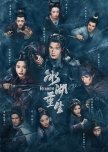
A precious pearl within a hard shell.
First and foremost, this drama is a risk worth taking to give Princess Agents (2017) the closure it deserves. This is a gift for fans who have been left on the edge of that cliff in the Frozen Lake incident for years. The frustration of endless waiting for the official end is finally over, no matter what controversies it creates.
1# What is in the past
Princess Agents is among the first C-dramas that brought me into the world of Chinese dramas. As I recall, the production quality isn't great, but the story itself is a gem. For me, it is not the romance or wuxia that keeps this story engraved in my memory: it is the tragedy finally revealed in the last three episodes. Chu Qiao recognizes Yuwen/Zhuge Yue’s love and sacrifice when it is too late. The selfless Zhuge Yue meets his death. And Yan Xun, once so free-spirited, eventually becomes consumed by vengeance. And, Princess Chun’er fails in her revenge and is cast down as a commoner.
My afterthought is that it is actually easy for the director to give a happy ending rather than a tragic cliffhanger. Just need to add one more episode! Chu Qiao leaped out of the frozen lake with her hidden martial technique activated. It may feel like a deus ex machina, but she managed to pull Zhuge Yue out of the lake and single-handedly defeated Yan Xun. She then transferred her inner energy to save Zhuge Yue and so on. They got married and lived together in seclusion in cold Ximeng. The badass story would end happily like a typical wuxia story, even though this trajectory won't solve the political problem.
#2 What has changed now in a good way
In Rebirth (2026), they chose to follow the novel to some extent to give more room to address the political problem. This drama thus experienced a tremendous change. The most striking aspects are the shift in genre and level of conflict, evolving from romance-wuxia into a more political and military-driven story, and from interpersonal conflict into conflict between nations. The story expands in scope and deepens in theme. What was once centered mainly on personal freedom becomes a broader commentary on societal issues, power relations, and peacemaking.
For me, this shift is worth appreciating because not many C-dramas are willing to venture into a territory less favored by mainstream audiences. This is precisely what makes Rebirth feel like such a precious pearl. While watching it, I found it deeply satisfying and would even consider it on a par with dramas like Swords into Plowshares (2026), which has a similar theme. And, for a "female general drama", it is so much better than "that overnight female general" in Pursuit of Jade (2026).
This shift also reflects the director's and screenwriter's ambition. To support the premise they set out to deliver, even if the drama does not fully reach an epic scale, it is still produced with strong cinematography, a soundtrack that effectively supports the atmosphere, and clear line delivery. Its worldbuilding is also carefully constructed, with fairly distinct cultural differences established among the states of Yan, Biantang, Ximeng, and Yong. Even, they added a cult of a faceless god! The storyline, plot, and events are fast-paced and efficient, advancing with clear discipline. Because it is set in a dystopian world, the director also does not hesitate to present brutal and bloody scenes. The story does become dark and intensely serious, with relatively little comic relief. The atmosphere is intense and high-stakes in almost every moment. They let you see the beast among men with power, those who treat human beings like dust.
3# What are the problems
Even so, it must be acknowledged that this precious pearl is not easily obtained. Viewers must struggle to crack open its hard shell. And many viewers, it seems, fail to open it, and therefore cannot appreciate what lies within. This drama’s "failure" is largely shaped by the circumstances surrounding it, rather than its story and production quality.
The main problem is premature disappointment driven by: (1) nostalgia for the original main cast of Princess Agents (Zhao Liying, Lin Gengxin, Shan Dou, and Liqin). Getting the original leads to come back is practically not possible, (2) the new actress cast as Chu Qiao, who is considered too young to portray such a mature character, even though she is actually quite capable, and (3) the accusation that Rebirth is a newly invented story that departs from "the true Princess Agents".
People may think differently. For me, there is no such thing as a true Princess Agents (since it is an adaptation, too). The changes made to Rebirth were the director’s and screenwriter’s creative efforts to restore the promise in the face of an impossible circumstance. The cool wuxia elements in Princess Agents—martial techniques and inner energy—as well as Chu Qiao’s personal backstory, particularly her mother's role as the leader of an underground spy group, were largely omitted, as they are invented additions that did not come from the original novel. If those elements were kept, they would be forced to write a completely new story, with zero grounding in the source material.
The next problem is the different opinions among fans and (new) viewers over whether Rebirth is a standalone or a continuation. Each perspective carries significant consequences for the viewing experience. Those who deeply loved Princess Agents and its original cast are unwilling to accept this continuation, burdened as it is by disappointment. They watch unwillingly, may not really watch at all, and skip or jump right to the ending. They take pleasure in mocking this project, ignoring its strengths and denying it the appreciation it deserves, and use this moment to praise the former drama as if it were perfect.
Meanwhile, new viewers who do not have the time to watch Princess Agents as a prequel tend to treat Rebirth as a separate, standalone story. Skipping the prequel and jumping right into Rebirth is indeed more practical. But the downside is, important context is lost—the background that explains the present events, the reasons behind each character's relationships, and the emotional weight behind "the more serious and dark" Rebirth. Without proper contextual knowledge, they are bound to feel confused. Another thing: their first expectations are often “how is the romance and chemistry in this drama—is there kissing, is there a love triangle, is it a happy ending?” or “when will Li Yunrui from Blossom (2024) appear?” They easily become disappointed with the several early episodes, which show little of what they expect and serve more as a buildup before Rebirth reaches its momentum again.
So, if you see the low rating, it is not the drama itself that is a failure; it is these two camps of people who deliberately make it fail. It almost becomes a movement where one voice follows another in unison, without adding anything new to the discussion. So unfair and ridiculous, but that is how the viewers' "politics" are at play. Seemingly, they won't stop until this drama hits a new low.
4# Why still love it and what could've been better
In the end, only a small number of viewers seem willing to embrace it as a re-adapted continuation. I am part of this small group. If asked why, my answer is: The value of Rebirth lies not in its perfection or its ability to please everyone, but in its courage to continue a story that was once left unfinished. Even though, in the end, some of my hopes were left unfulfilled, I feel enriched after enjoying it. Having this drama is still better than having nothing at all.
Also, this drama feels like an interesting experiment: how a director continues a story from a post-climax point after almost a decade, while facing the reality that audiences and trends have already changed. In the era of easy and fast access to information and communication, we no longer have patient audiences. Bad-mouthed spread faster, fan wars are everywhere, and people have more power to make demands or to destroy figures they hate. Also, romance is almost everything. Even if the overall story is crap, people would praise any drama with a heavy dose of romance.
Even so, I am not a viewer who watches with blind love while closing my eyes to its flaws. As a matter of reflection, I also wish there were certain things in Rebirth that had been executed differently. For examples:
(1) They shouldn’t have started right from the Frozen Lake incident. They should have gone a bit further back to show why Chu Qiao and Zhuge Yue ended up in such a desperate situation. What made the final episodes of Princess Agents so devastating wasn’t just the bloodshed or Zhuge Yue’s fall into the lake, but his one-sided confession of love before—after Chu Qiao said that they would meet again on the battlefield as enemies, and she reminded him: if you didn’t want to be hurt, it would be better not to make a move (to love). Zhuge Yue replied solemnly: he actually had already been hurt for a long time (ever since Chu Qiao chose to follow Yan Xun and become a rebel, leaving him behind).
That scene was the true emotional bomb, the real reason Chu Qiao is shattered, knowing Zhuge Yue falls into Yan Xun's trap. It should have been preserved and carried forward as the foundation of Rebirth. So, when Chu Qiao awakens after sinking into the Frozen Lake, what should have happened to her was not amnesia but hysteria. Whether she later became amnesiac or blind as a result of emotional repression, the story would have been far more compelling. In that way, her reunion with Zhuge Yue would have become a deeply meaningful release and resolution of their previous conflict, rather than merely a simple recognition of someone once lost and finally returned.
(2) Rebirth should also not test Chu Qiao and Zhuge Yue with a merely “typical breakup” like that of newly formed lovers in a romance drama. They are not just a couple who have recently fallen in love, but a husband and wife who have perfected their marriage. Two people who love each other deeply, even when faced with differences in belief and ideology, do not easily cut their bonds. Trust and commitment should become the foundation of their actions. Even if tragedy repeats itself, and they end up hurting each other, everything must lead to their unshakable reunion, not another separation, and a solid cooperation to face the final war. This positive dynamic is a bit missing. Actually, many C-dramas fall short in their portrayal of married main couples. Here is not an exception.
(3) Although Rebirth focuses more on political and military, the dynamics it builds are often no more than moving troops here and there. There is no real discussion of geopolitics, military strategy, tactics, diplomacy, or efforts toward peace beyond force-on-force combat. The heads of state (three in Biantang, one in Ximeng, and two in Yong) are also easily toppled by a single person's hit behind the curtain. And later, a new entity (the Quanrong people) is introduced without proper foreshadowing and serves only as a device to unite the fragmented existing political entities. This makes Rebirth fall into the trope of a military story that is more about brawn than brains.
There are several wars throughout the story, but they are handled through telling rather than showing. Even when the wars are depicted, the action sequences are simple, involving only a few extras. Moreover, there is no clear sense of distance between locations or the cost of time. Armies move from place A to place B with ease, without logistical constraints or other practical difficulties. The peace itself feels somewhat cheapened, as it is achieved too easily—through the destruction (killing) of the old structure to build a new one. In reality, things do not work that way. Peace is achieved through justice and negotiation, where the old and the new reach a compromise or middle ground. Because of this, Chu Qiao and Zhuge Yue’s ambition to end oppression and slavery feels more like a dream or rhetoric.
Once again, this drama was not designed to be epic in a political or philosophical sense. Maybe the director didn’t really invest in this area (as they did in The Double (2024). They focused more on plot progression than on believability. But I wish whoever tries to create political-military drama would first learn about psychology, politics, war, and peacebuilding, etc., to avoid oversimplification. That will be the new statement of professionalism that improves the story's realism.
5# What should be more balanced
Lastly, the drama is too heavily focused on developing its villains/ antagonists rather than the virtues of the protagonists. On the one hand, this is a strength, as it allows us to understand the origins of evil and serves as a mirror, reflecting just how corrupt the world is. However, goodness and virtue should also be explored in a balanced way—at the very least by giving each character a meaningful redemption. In fact, there are many moments when characters could have been steered toward a more hopeful path rather than continuing down a darker alley. All it would take is a brief scene.
Li Ce, the womanizer who once cared nothing for the state, now learns statecraft, governs wisely, and holds his son with Ziming (before his death). Li Yan, who loves Chun’er wholeheartedly, spares her further violence and becomes king in order to restore her dignity and elevate her status (before his death). General Huan Huan does not die easily, but instead engages in a true sword duel with Zhao Che and proves her worth as a badass military general (the side of her that reminds Zhao Che why he falls in love with her). Instead of suicide, Chun’er realizes the full consequences of her actions and is killed while trying to protect her baby (in her delusional state, or in an alternate reality?) and the people of Yong, who are torn by another great war. Chu Qiao learns to temper her steel-hard idealism and steady her emotions so she can look at Zhuge Yue with eyes shimmering with love. And Zhuge Yue learns to love himself and to stop letting his body and his heart get wounded over and over again.
The strongest character transformation is only found in: Queen of Lingyue, who solves her conflict by eventually choosing the righteous path; General Chen, who remains steadfast in his loyalty while being true to himself; Helian Ling, who learns pure love and moves on by embracing her new role as the Queen of Yanbei; and Yan Xun, who lets go of his ego, accepts Helian as his reality, and ultimately achieves the unification of Yanbei.
This redemption, which leads to the character's transformation, should be the true meaning of "Rebirth": not only physical rebirth but also existential one. The transformations on a personal level are truly the ingredients of the freedom and peace they are all seeking so badly. It should be found inside themselves, not from the battlefield.
(I wrote this after ep. 39. I am so happy, in ep. 40, they show us alternate reality of every beloved character if they decided things differently)
6# The key to opening the shell and enjoying Rebirth is an open mind.
Despite its relatively low rating, this drama remains phenomenal and is able to maintains quality. It may not be a viewing experience that satisfies the masses, but for those willing to go beyond surface expectations, it offers something that lingers long after the story ends. Its flaws are there, and its execution is not without weaknesses, yet its core still carries weight for viewers who choose patience over haste, substance over appearance. Breaking through its outer layers is not easy, but what lies within offers a value that makes the effort worthwhile.
1# What is in the past
Princess Agents is among the first C-dramas that brought me into the world of Chinese dramas. As I recall, the production quality isn't great, but the story itself is a gem. For me, it is not the romance or wuxia that keeps this story engraved in my memory: it is the tragedy finally revealed in the last three episodes. Chu Qiao recognizes Yuwen/Zhuge Yue’s love and sacrifice when it is too late. The selfless Zhuge Yue meets his death. And Yan Xun, once so free-spirited, eventually becomes consumed by vengeance. And, Princess Chun’er fails in her revenge and is cast down as a commoner.
My afterthought is that it is actually easy for the director to give a happy ending rather than a tragic cliffhanger. Just need to add one more episode! Chu Qiao leaped out of the frozen lake with her hidden martial technique activated. It may feel like a deus ex machina, but she managed to pull Zhuge Yue out of the lake and single-handedly defeated Yan Xun. She then transferred her inner energy to save Zhuge Yue and so on. They got married and lived together in seclusion in cold Ximeng. The badass story would end happily like a typical wuxia story, even though this trajectory won't solve the political problem.
#2 What has changed now in a good way
In Rebirth (2026), they chose to follow the novel to some extent to give more room to address the political problem. This drama thus experienced a tremendous change. The most striking aspects are the shift in genre and level of conflict, evolving from romance-wuxia into a more political and military-driven story, and from interpersonal conflict into conflict between nations. The story expands in scope and deepens in theme. What was once centered mainly on personal freedom becomes a broader commentary on societal issues, power relations, and peacemaking.
For me, this shift is worth appreciating because not many C-dramas are willing to venture into a territory less favored by mainstream audiences. This is precisely what makes Rebirth feel like such a precious pearl. While watching it, I found it deeply satisfying and would even consider it on a par with dramas like Swords into Plowshares (2026), which has a similar theme. And, for a "female general drama", it is so much better than "that overnight female general" in Pursuit of Jade (2026).
This shift also reflects the director's and screenwriter's ambition. To support the premise they set out to deliver, even if the drama does not fully reach an epic scale, it is still produced with strong cinematography, a soundtrack that effectively supports the atmosphere, and clear line delivery. Its worldbuilding is also carefully constructed, with fairly distinct cultural differences established among the states of Yan, Biantang, Ximeng, and Yong. Even, they added a cult of a faceless god! The storyline, plot, and events are fast-paced and efficient, advancing with clear discipline. Because it is set in a dystopian world, the director also does not hesitate to present brutal and bloody scenes. The story does become dark and intensely serious, with relatively little comic relief. The atmosphere is intense and high-stakes in almost every moment. They let you see the beast among men with power, those who treat human beings like dust.
3# What are the problems
Even so, it must be acknowledged that this precious pearl is not easily obtained. Viewers must struggle to crack open its hard shell. And many viewers, it seems, fail to open it, and therefore cannot appreciate what lies within. This drama’s "failure" is largely shaped by the circumstances surrounding it, rather than its story and production quality.
The main problem is premature disappointment driven by: (1) nostalgia for the original main cast of Princess Agents (Zhao Liying, Lin Gengxin, Shan Dou, and Liqin). Getting the original leads to come back is practically not possible, (2) the new actress cast as Chu Qiao, who is considered too young to portray such a mature character, even though she is actually quite capable, and (3) the accusation that Rebirth is a newly invented story that departs from "the true Princess Agents".
People may think differently. For me, there is no such thing as a true Princess Agents (since it is an adaptation, too). The changes made to Rebirth were the director’s and screenwriter’s creative efforts to restore the promise in the face of an impossible circumstance. The cool wuxia elements in Princess Agents—martial techniques and inner energy—as well as Chu Qiao’s personal backstory, particularly her mother's role as the leader of an underground spy group, were largely omitted, as they are invented additions that did not come from the original novel. If those elements were kept, they would be forced to write a completely new story, with zero grounding in the source material.
The next problem is the different opinions among fans and (new) viewers over whether Rebirth is a standalone or a continuation. Each perspective carries significant consequences for the viewing experience. Those who deeply loved Princess Agents and its original cast are unwilling to accept this continuation, burdened as it is by disappointment. They watch unwillingly, may not really watch at all, and skip or jump right to the ending. They take pleasure in mocking this project, ignoring its strengths and denying it the appreciation it deserves, and use this moment to praise the former drama as if it were perfect.
Meanwhile, new viewers who do not have the time to watch Princess Agents as a prequel tend to treat Rebirth as a separate, standalone story. Skipping the prequel and jumping right into Rebirth is indeed more practical. But the downside is, important context is lost—the background that explains the present events, the reasons behind each character's relationships, and the emotional weight behind "the more serious and dark" Rebirth. Without proper contextual knowledge, they are bound to feel confused. Another thing: their first expectations are often “how is the romance and chemistry in this drama—is there kissing, is there a love triangle, is it a happy ending?” or “when will Li Yunrui from Blossom (2024) appear?” They easily become disappointed with the several early episodes, which show little of what they expect and serve more as a buildup before Rebirth reaches its momentum again.
So, if you see the low rating, it is not the drama itself that is a failure; it is these two camps of people who deliberately make it fail. It almost becomes a movement where one voice follows another in unison, without adding anything new to the discussion. So unfair and ridiculous, but that is how the viewers' "politics" are at play. Seemingly, they won't stop until this drama hits a new low.
4# Why still love it and what could've been better
In the end, only a small number of viewers seem willing to embrace it as a re-adapted continuation. I am part of this small group. If asked why, my answer is: The value of Rebirth lies not in its perfection or its ability to please everyone, but in its courage to continue a story that was once left unfinished. Even though, in the end, some of my hopes were left unfulfilled, I feel enriched after enjoying it. Having this drama is still better than having nothing at all.
Also, this drama feels like an interesting experiment: how a director continues a story from a post-climax point after almost a decade, while facing the reality that audiences and trends have already changed. In the era of easy and fast access to information and communication, we no longer have patient audiences. Bad-mouthed spread faster, fan wars are everywhere, and people have more power to make demands or to destroy figures they hate. Also, romance is almost everything. Even if the overall story is crap, people would praise any drama with a heavy dose of romance.
Even so, I am not a viewer who watches with blind love while closing my eyes to its flaws. As a matter of reflection, I also wish there were certain things in Rebirth that had been executed differently. For examples:
(1) They shouldn’t have started right from the Frozen Lake incident. They should have gone a bit further back to show why Chu Qiao and Zhuge Yue ended up in such a desperate situation. What made the final episodes of Princess Agents so devastating wasn’t just the bloodshed or Zhuge Yue’s fall into the lake, but his one-sided confession of love before—after Chu Qiao said that they would meet again on the battlefield as enemies, and she reminded him: if you didn’t want to be hurt, it would be better not to make a move (to love). Zhuge Yue replied solemnly: he actually had already been hurt for a long time (ever since Chu Qiao chose to follow Yan Xun and become a rebel, leaving him behind).
That scene was the true emotional bomb, the real reason Chu Qiao is shattered, knowing Zhuge Yue falls into Yan Xun's trap. It should have been preserved and carried forward as the foundation of Rebirth. So, when Chu Qiao awakens after sinking into the Frozen Lake, what should have happened to her was not amnesia but hysteria. Whether she later became amnesiac or blind as a result of emotional repression, the story would have been far more compelling. In that way, her reunion with Zhuge Yue would have become a deeply meaningful release and resolution of their previous conflict, rather than merely a simple recognition of someone once lost and finally returned.
(2) Rebirth should also not test Chu Qiao and Zhuge Yue with a merely “typical breakup” like that of newly formed lovers in a romance drama. They are not just a couple who have recently fallen in love, but a husband and wife who have perfected their marriage. Two people who love each other deeply, even when faced with differences in belief and ideology, do not easily cut their bonds. Trust and commitment should become the foundation of their actions. Even if tragedy repeats itself, and they end up hurting each other, everything must lead to their unshakable reunion, not another separation, and a solid cooperation to face the final war. This positive dynamic is a bit missing. Actually, many C-dramas fall short in their portrayal of married main couples. Here is not an exception.
(3) Although Rebirth focuses more on political and military, the dynamics it builds are often no more than moving troops here and there. There is no real discussion of geopolitics, military strategy, tactics, diplomacy, or efforts toward peace beyond force-on-force combat. The heads of state (three in Biantang, one in Ximeng, and two in Yong) are also easily toppled by a single person's hit behind the curtain. And later, a new entity (the Quanrong people) is introduced without proper foreshadowing and serves only as a device to unite the fragmented existing political entities. This makes Rebirth fall into the trope of a military story that is more about brawn than brains.
There are several wars throughout the story, but they are handled through telling rather than showing. Even when the wars are depicted, the action sequences are simple, involving only a few extras. Moreover, there is no clear sense of distance between locations or the cost of time. Armies move from place A to place B with ease, without logistical constraints or other practical difficulties. The peace itself feels somewhat cheapened, as it is achieved too easily—through the destruction (killing) of the old structure to build a new one. In reality, things do not work that way. Peace is achieved through justice and negotiation, where the old and the new reach a compromise or middle ground. Because of this, Chu Qiao and Zhuge Yue’s ambition to end oppression and slavery feels more like a dream or rhetoric.
Once again, this drama was not designed to be epic in a political or philosophical sense. Maybe the director didn’t really invest in this area (as they did in The Double (2024). They focused more on plot progression than on believability. But I wish whoever tries to create political-military drama would first learn about psychology, politics, war, and peacebuilding, etc., to avoid oversimplification. That will be the new statement of professionalism that improves the story's realism.
5# What should be more balanced
Lastly, the drama is too heavily focused on developing its villains/ antagonists rather than the virtues of the protagonists. On the one hand, this is a strength, as it allows us to understand the origins of evil and serves as a mirror, reflecting just how corrupt the world is. However, goodness and virtue should also be explored in a balanced way—at the very least by giving each character a meaningful redemption. In fact, there are many moments when characters could have been steered toward a more hopeful path rather than continuing down a darker alley. All it would take is a brief scene.
Li Ce, the womanizer who once cared nothing for the state, now learns statecraft, governs wisely, and holds his son with Ziming (before his death). Li Yan, who loves Chun’er wholeheartedly, spares her further violence and becomes king in order to restore her dignity and elevate her status (before his death). General Huan Huan does not die easily, but instead engages in a true sword duel with Zhao Che and proves her worth as a badass military general (the side of her that reminds Zhao Che why he falls in love with her). Instead of suicide, Chun’er realizes the full consequences of her actions and is killed while trying to protect her baby (in her delusional state, or in an alternate reality?) and the people of Yong, who are torn by another great war. Chu Qiao learns to temper her steel-hard idealism and steady her emotions so she can look at Zhuge Yue with eyes shimmering with love. And Zhuge Yue learns to love himself and to stop letting his body and his heart get wounded over and over again.
The strongest character transformation is only found in: Queen of Lingyue, who solves her conflict by eventually choosing the righteous path; General Chen, who remains steadfast in his loyalty while being true to himself; Helian Ling, who learns pure love and moves on by embracing her new role as the Queen of Yanbei; and Yan Xun, who lets go of his ego, accepts Helian as his reality, and ultimately achieves the unification of Yanbei.
This redemption, which leads to the character's transformation, should be the true meaning of "Rebirth": not only physical rebirth but also existential one. The transformations on a personal level are truly the ingredients of the freedom and peace they are all seeking so badly. It should be found inside themselves, not from the battlefield.
(I wrote this after ep. 39. I am so happy, in ep. 40, they show us alternate reality of every beloved character if they decided things differently)
6# The key to opening the shell and enjoying Rebirth is an open mind.
Despite its relatively low rating, this drama remains phenomenal and is able to maintains quality. It may not be a viewing experience that satisfies the masses, but for those willing to go beyond surface expectations, it offers something that lingers long after the story ends. Its flaws are there, and its execution is not without weaknesses, yet its core still carries weight for viewers who choose patience over haste, substance over appearance. Breaking through its outer layers is not easy, but what lies within offers a value that makes the effort worthwhile.
Was this review helpful to you?


