



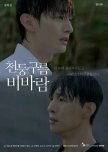
Thundercloud Rainstorm: Against My Better Judgment
Korean BLs have such a reputation for favoring darker storylines that the fandom has given them a name, “Korean Noir.” “Thundercloud Rainstorm” continues that aesthetic, but it comes with a visceral, hypnotic force that mesmerized me despite periods of discomfort and even, at times, a sense of horror at what the series forced me to witness.
Seo Jeong Han (played by Jeong Ri U) is a wealthy, withdrawn, socially isolated loner who has suppressed any emotional connection with others. Into his life comes Lee Il Jo (played by the luminous Yoon Ji Sung), a poor relation being brutally bullied by his half-brother who demands the land their father left to Il Jo. For reasons he doesn’t understand, Jeong Han helps Il Jo and Il Jo comes to live with and rely on him. As the show progresses, Jeong Han becomes more drawn to, even infatuated with, Il Jo.
The gradual melting of Jeong Han into someone who can love is the defining story arc of the series, and while it might at times seem abrupt, it works because you as the viewer are falling in love along with him. The character of Il Jo is engineered to make you love him, constructed for maximum audience protectiveness — beautiful, innocent, suffering, self-sacrificing, pure of heart. If I were writing this for a freshman lit class, I might even use the term “Christ figure.”
What keeps them apart? South Korea is one of the most class-conscious societies in the world — a fact Koreans discuss openly and with complete self-awareness. The series implies that Jeong Han is the son of the leader of one of the giant family-run conglomerates - the chaebol - that dominate entire sectors of the Korean economy and have an outsized influence on Korean society and culture generally. That places Jeong Han at an almost unreachable height, while Il Jo is just a poor boy from the sticks. Not only does Jeong Han have to struggle with opening his heart to someone he might not otherwise have considered, his father strongly, violently, opposes his son falling in love with anyone from such a different background, much less a man.
To protect Jeong Han, Il Jo therefore pulls away. Jeong Han brings him back. Il Jo pulls away. Jeong Han brings him back. Il Jo pulls away. Jeong Han brings him back. The pattern is repeated with the stepbrother’s bullying, who brutally beats Il Jo more than once. Is this drama for drama’s sake? Is it padding to fill out a script? Certainly, Il Jo’s desire to protect Jeong Han is fully consistent with his self-sacrificing character, but what begins as selflessness begins to look like a contrived dramatic device and the violence, especially against someone who refuses to fight back (turns the other cheek?) is egregiously overdone.
And yet, none of it mattered. Despite the repetition, despite the padding, despite the cruelty, I couldn’t stop watching. I was completely captivated. It is a testament to the show’s visceral, hypnotic power that even as my brain registered contrived plot devices and structural flaws, my defenses completely collapsed, because just as Jeong Han fell in love with Il Jo, so did I, slowly, helplessly, and against my better judgment, and when you’re in love, you accept the flaws.
Seo Jeong Han (played by Jeong Ri U) is a wealthy, withdrawn, socially isolated loner who has suppressed any emotional connection with others. Into his life comes Lee Il Jo (played by the luminous Yoon Ji Sung), a poor relation being brutally bullied by his half-brother who demands the land their father left to Il Jo. For reasons he doesn’t understand, Jeong Han helps Il Jo and Il Jo comes to live with and rely on him. As the show progresses, Jeong Han becomes more drawn to, even infatuated with, Il Jo.
The gradual melting of Jeong Han into someone who can love is the defining story arc of the series, and while it might at times seem abrupt, it works because you as the viewer are falling in love along with him. The character of Il Jo is engineered to make you love him, constructed for maximum audience protectiveness — beautiful, innocent, suffering, self-sacrificing, pure of heart. If I were writing this for a freshman lit class, I might even use the term “Christ figure.”
What keeps them apart? South Korea is one of the most class-conscious societies in the world — a fact Koreans discuss openly and with complete self-awareness. The series implies that Jeong Han is the son of the leader of one of the giant family-run conglomerates - the chaebol - that dominate entire sectors of the Korean economy and have an outsized influence on Korean society and culture generally. That places Jeong Han at an almost unreachable height, while Il Jo is just a poor boy from the sticks. Not only does Jeong Han have to struggle with opening his heart to someone he might not otherwise have considered, his father strongly, violently, opposes his son falling in love with anyone from such a different background, much less a man.
To protect Jeong Han, Il Jo therefore pulls away. Jeong Han brings him back. Il Jo pulls away. Jeong Han brings him back. Il Jo pulls away. Jeong Han brings him back. The pattern is repeated with the stepbrother’s bullying, who brutally beats Il Jo more than once. Is this drama for drama’s sake? Is it padding to fill out a script? Certainly, Il Jo’s desire to protect Jeong Han is fully consistent with his self-sacrificing character, but what begins as selflessness begins to look like a contrived dramatic device and the violence, especially against someone who refuses to fight back (turns the other cheek?) is egregiously overdone.
And yet, none of it mattered. Despite the repetition, despite the padding, despite the cruelty, I couldn’t stop watching. I was completely captivated. It is a testament to the show’s visceral, hypnotic power that even as my brain registered contrived plot devices and structural flaws, my defenses completely collapsed, because just as Jeong Han fell in love with Il Jo, so did I, slowly, helplessly, and against my better judgment, and when you’re in love, you accept the flaws.
Was this review helpful to you?


