

 10
10 42
42 15
15


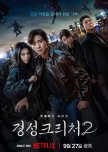
The back-up story would have been there, but the willingness to actually tell it was limited
So here it is, the second season. The historical coat is stripped away and the story transforms into a modern thriller, the theme of which revolves around a horror that only humans are capable of.Pleasing and pithy: Some script scenes from the first season were hinted at and entertainingly mirrored in the present day mise-en-scene. That´s fun to watch. The confrontation with the longing for power and immortality also has its moments and insights. Additionally: the leads give their all, again.
On the other hand, someone in production probably didn't really feel like it anymore... There is only minimalist suggestion of what may have happened during the past 80 years. This could actually be a substantial story, yet they are not going to tell us. This serves merely for shaping a coarse (albeit promising) framework, unfortunately remaining pretty lean. Thus it is raising more questions than it feels like answering, its only mission being turning the two leads though the mill of horror once more. Accordingly, the story almost constantly takes place in gloomy night, dark rooms or sinister underground.
For season 1, the dramaturgical technique of hinting at historically shaped, individual fates may have had an effect, enhancing identification with characters. For the second season, continuing with this method only works to a limited extent, because by now we are already closely identified with them.
All in all, the second season comes across somewhat indecisive. The back-up story would have been there, but the willingness to actually tell it was limited. On the other hand, it is still fast-paced and emotionally dense. Nevertheless (at least for me) it is somehow unsatisfying, almost unnecessary. Second seasons for Netflix-KDramas haven´t really convinced me yet. Neither does this one.
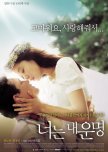
Magnificent balancing act of intense emotions. Old school production without high-gloss polish.
"You are my Sunshine" is the international title of this KMovie from 2005 - named after the US country song of the same name from the 1930s. However, the original title is "You are my destiny". Regardless, both are working. The Plot is based on a true story that happened in Yeosu around 2001.It's about prejudice. About the socially doubtful binding norm and where it is actually coming from. And it's about a man who, fortunately, cares less about what others say and trusts more in what he feels and believes is right. So this is about a positive role model of a man - a man who noticeably sets himself apart from the crowd who dominate the image of men here: Men who buy women, men who buy women abroad as wives, men who beat women without hesitation, men who infect women with AIDS (and don't tell them), men who won't let go of women, see them as possessions and unrestrainedly abuse them... There are the many completely 'normal', 'socially valued' men , husbands, fathers, whose behavior is simply outrageous. As if it were a matter of course, they set the standard of what is right, they set the tone... and yet deny any responsibility.
It's also about love. The sunny, courageous, positive message is embodied by a man who loves sincerely and unconditionally. However, he is generally considered naive. The cattle farmer is considered a hillbilly and a bit peculiar. Not just because he talks to his cow, but because he keeps the word he gave to the woman he loves and stands by what he feels. He is different. (Although, his attitude towards life, women, animals and nature could be considered quite progressive, too...)
And the woman? The female Protagonist could see herself as a victim. On top of that, she might be ashamed of her life. But despite everything that made her tainted and even 'leper' in her life as a prostitute, she was able to keep her soul pure inside. She is straight and clear, she doesn't deceive herself and above all she doesn't get her hopes up, because she knows life as it is - for women like her.
Life in the country is plain, ordinary, vulgar, simple. Also sensually grounded in the changing seasons. Although the ideal of pure, white skin is held high, the story instead focuses on the stigma of the tainted and tanned skin. The everyday scenario of bruises and violets from beating men as well as the darker Filipino and Vietnamese (versus light, pure South Korean) skin of purchased wives thematically dominate here. Finally, it´s about fear of AIDS (spots). That's the rural reality.
Nevertheless, there is this down-to-earth man who puts love above everything else – in good times and in bad... he´s honest, sincere, reliable, devoted, lovable. And there is this woman who can and wants to get involved... until her past catches up with her...
Two wonderful leading actors. Pure KMovie. Intense. Feels lifelike with a deep impact. A magnificent balancing act of conflicting emotions.
Old school production, though. Without high-gloss polish.
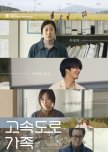
Thought-provoking KMovie, sailing close to the wind when it comes to duty of care and child welfare
The KMovie "Highway Family" is set at the bottom of the social pyramid in South Korea in the year 2022. It portrays a homeless family who seems to have found their own lifestyle at the country's highway rest stops. A happy family sleeping in a tent, living on scrounged money and having lots of fun together.That's one side of the medal. As audience, however, one cannot help but see the other side of the coin despite all the family idyll. The heavily pregnant wife has no medical support during what is now her third pregnancy. Her two children, being five and nine years old by now, miss out on any schooling. The parents claim that they do the teaching themselves, but reading, writing and maths are obviously not on their curriculum. A playground on the highway rest stops, which are heavily frequented by cars and heavy trucks, is dangerous, and the parents' duty of supervision is by no means guaranteed. The father is (as so often) the head of the family and objectively speaking, his decisions about the self-chosen outlaw family life sometimes border on violating his duty of care. Supposed (motorway rest stop) idyll and freedom may correspond to the father and his outlook on life. Wife and children, on the other hand, are now stuck in this boat. They love each other as a family and especially the children know no different. They rely on their father.
The KMovie sails close to the wind when it comes to moral issues concerning work, economy and society as well as duty of care and child welfare. Camps may form in the audience. And that is intentional.
The second protagonist, alongside the Highway family, is a married couple who lost their own child and who run a second-hand furniture store. Solid. Prosocial. Responsible. However, emotionally deeply wounded and unhappy.
Worlds clash. Two families meet. One is shattered deep inside, the other formally. Together they build something new - an alternative family patchwork, grounded in a rather simple normal life, which obviously doesn't have to be the worst, at least when kids are involved. Yet, can it be as simple as that? And at the disturbing end there is the question about the end of the story... which remains in the eyes of the beholder...
A thought-provoking KMovie.
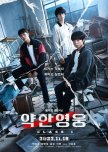
Intense. Brutal. Yes, I recommend it. And with a heavy heart I am also considering it valuable
"Weak Hero Class 1" leaves me with mixed emotions. It is an intense KDrama, in which the young people are remarkably slow-paced, sort of numb, at times bordering on apathy. On the other hand, there are violent outbursts. Extreme. Brutal. A cruel parallel world that actually should have no place whatsoever in the everyday life of high school students!What kind of society do we live in? It is simply too much, what young people have to go through and deal with. KDrama didn't invent it. Neither does the webtoon, the story is based on. It is a sad and scandalous reality in many schools, in many classes, in South Korea and elsewhere.
"Weak Hero Class 1" doesn't sugarcoat anything.
And it ends just the way it is... no end in sight...
I admit, I was about to drop it. Too much frustration and violence - it actually goes on and on. (Even if the 'weak hero' develops cunning, inspiring recipes to fight back... it still remains a world of violence.)
But then the relationship dynamics between the boys (and girls) are quite intense and what they go through inside and out is touching. Ultimately, it doesn't help to look away - even if it's painful to look at. In fact, "Weak Hero Class 1" is a great, impressive production. It is a disturbing inventory - disturbing because the story leaves no perspective, no silver lining, no substantial room for hope. (At most marginal sparks of light here and there.)
The largely indifferent attitude towards life that prevails in posture and movement of the young people is one thing, the massive outbreaks of violence another. Each soul seems to have long since fled its young body, so that there are only roughly apathetic youths on the move who occasionally act as numb thugs who kick helpless bodies on the ground, or vice versa. It's actually unbearable. It's traumatizing on both sides. And yet it is everyday life. This creates a very unique flow in the world of the students. In this world, one may search in vain for serious, responsible, courageous adults. They are lacking. The kids are alone in this world and have to find their way to live in it, or rather: to survive. Which side will you be on? Perpetrator? Victim? Rescuer? Spectator?
What agitates me the most in connection with "Weak Hero Class 1" is the enormous enthusiasm among der age-group of 13-17, who with this story obviously feel seen right on. This may be 'only' a fictional story, but it obviously tells the story of the youth, we (adults) usually dont´t get. Many are thrilled. In fact, I'm NOT thrilled. I'm impressed by the intensity of the production, yes. But primarily appalled by the dominance of bullying and the severity of violence among peers in everyday school life today. I am also shocked by the documented, self-evident aimlessness and helplessness of the adults. Ultimately, I am frustrated by the lack of a positive outlook and affected by such a disillusioning world of experience of the young, growing up generation.
"Weak Hero Class 1" is based on the template of a web toon and has (via KDrama) by now reached an even wider audience, especially among the 'adults', regarding bullying among schoolchildren. I appreciate that. The KDrama was released on the young streaming platform Wavve and was thus able to give plenty of dramaturgical space to the violent excesses. Maybe more than necessary? Or just right? The KDrama has a simple mission: to show what 'we' tend not to see because 'we' (adults) have no place in this parallel world of schoolchildren. And as a matter of principle, the story does not provide any answers in terms of a way out. No.
In the contrary: 'we' adults are in the pillory... What have we done (and also missed) that it could have gotten this far! Where is this going to end? What can we do about it?
Anyway, bottom line: I recommend the series. And with a heavy heart I am also considering it valuable especially for all those who call themselves adults, parents, teachers, social workers, officials in youth welfare offices, police officers, etc....
Hello, wake up!
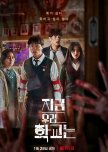
In spite of all the horror and struggle for survival, there is still room for the heart note
"All of Us Are Dead" isn't specific to South Korean culture, but it's not surprising that the story was born on South Korean soil... The story picks up on the sheer horror that South Korean youth are exposed to in the face of their brutal educational system. There, the enormous pressure to perform is higher than almost anywhere else in the world. For some, bullying is one way to reduce stress. The bullied, in turn, are doubly stressed. Other options include withdrawal, drugs, or suicide. South Korean society is largely blind and/or helpless in the face of this. The pressure to perform and, in this context, the psychological suffering of young people seems to be without alternative in view of the nationwide (and worldwide, economic) competition - a price that society has to pay in view of the greater good. And with that, the youngsters are left alone to somehow survive in this merciless world. However, this applies (perhaps not so blatantly) in a similar way to young people in many countries around the world.This is where "All of Us Are Dead" comes in its impressive and striking way.
The original title is something like "Currently at our school", so the focus is actually on the school and their students. In fact, the horror of everyday school life, which is more existential for some and less existential for others, mutates into a horror for everyone. A troubled father wants to create a way for his suicidal son to finally stand up to his bullies. The experiment goes astray. The vicious, zombie-like virus is sweeping the entire city and beyond. Disaster control, state of emergency, martial law - the whole program is needed to get the situation under control. And here, again, the young people are left alone in their existential need.
The story telling and expression of various group and relationship dynamics between the young people represent high-end KDrama quality - intense, powerful, sensitive, excellent. Almost everything is on the table. For me, this is the strength of this KDrama and the reason why worth watching.
Besides the problems, dynamics and approaches of trying to 'master' the threatening epidemic somehow sums up what we have had to go through worldwide in the past 2 years marked by Covid. When the rules are overridden, individuals (those who happen to have something to say) rule against the backdrop of their (helpless) personalities - arbitrary or scientifically based, rational or irrational, mostly driven by fear and from a safe distance and/or on the (argumentatively) safe side. Then real quick nobody takes side of individuals anymore, the big picture being more important...
Seen in this way, "All of Us Are Dead" is a qualitatively demanding KDrama in several respects. In spite of all the horror and struggle for survival, there is still room for the heart note.
However, I would like to emphasize that the virus is turning people into flesh-eating zombies. So the abundance of screaming, rattling, biting, blood-smeared zombie scenes, which simply lack any aesthetics for the eye and ear, is part of the story, too. In general this drama is brutal. This is obviously very popular in the international zeitgeist and thus (being published on the international netflix platform) stagily staged. I would say, brutal details and zombie-screentime could definitely have been less prevailing (in order to still tell the story).
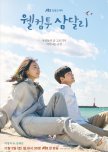
Pleasantly warming and inspiring, like a cup of tea that you may enjoy sip by sip
Once again a wonderfully authentic KDrama with amiable characters, who are living a live just like any South Korean life could be. The KDrama is neither captivatingly suspenseful nor does it urge to be devoured in one go. Instead, it's rather pleasantly warming and inspiring, like a cup of tea that you may enjoy sip by sip. The story could always go on as everyday life is - in Jejudo and elsewhere (in the province).At first glance, “Welcome to Samdal-ri” is a sweet Rom+Com and, in passing, it is also a declaration of love for Jejudo, the largest South Korean island. At second glance, however, the KDrama also delivers a lovingly drawn and yet time-critical image of society, in particular of a generation that is struggling to balance between archaic roots and home on the one hand as well as global, urban & digital lifestyle values on the other.
In general, lifelong friendship can be considered the overarching theme. The peer group as a family of choice in the sense of a community of fate, whose commitment has been growing from the inevitable spatial proximity of a village community - here: Samdal-ri.
Specifically, the story is about such a lifelong friendship between two friends, who at some point naturally became a love for life, yet without automatically being able to be lived as such.
As so often, it´s about family with its particular momentum, mingling as centrifugal and as pulling force, too.
Refreshing, soft and tangible: Shin Hye-sun and Ji Chang-wook. But overall, "Welcome to Samdal-ri" offers great casting in all positions.
Enjoy your tea time...
---------------------------------------------------------
SIDE NOTE...
...on "Welcome to Samdal-ri" offering a felicitous, good-humoured and optimistic time-critical image of society
On the one hand, the monotonous everyday life in the provinces just glides along. In “Welcome to Samdal-ri” the social tightness of the village structure is intensified by the island situation on Jeju-do. Binding village life in its everyday occurrences may be boring for some, while reliably familiar and pleasantly manageable for others. Rhythm, rules, community - everything is well-arranged. You can count on being safely caught by a social net that is protecting, warming. However, it comes with a price: a naturally intrusive social environment that would like to have a say everywhere...
On the other hand, the shimmering metropolis of distant Seoul is attracting the young with its wide world full of fashion, culture and lifestyle, promising individual fulfillment in a varied, anonymous, fast-paced, entertaining, colorfully inspiring, glittering city life that bears the stamp "successful". But this has its price, too, as the KDrama clearly shows with various examples. Fast-paced, cool big city life is mostly superficial, curt, nonbinding, aloof and mercilessly leaving you out in the cold.
Gossip apparently seems to be for us humans naturally coming with our anthropological cradle… Whether city or countryside, whether Seoul oder Samdal-ri, it is everywhere - the KDrama is cleverly using this as a dramaturgical bridge between the two worlds...
In a village with an intrusively curious neighborhood like Samdal-ri, where almost nothing can be kept secret, gossip adds spice to an otherwise uniform everyday life. However, it turns out, globalization and digitalization have by now raised village gossip to an unimagined, even more threatening (since anonymous) level. Rumors multiply virally in the form of social media posts shared at lightning speed, thus turning Seoul into just another (digital) village, yet on a global scale - with the effect that the brutal force of the impact far dwarfs that of a rural, analogue village. Once a rumor like this has started, it's hard to stop it and it's practically impossible to undo it. The anonymity of a viral rumor mill also invites hateful comments, the existential consequences of which no one seems to have to take responsibility for. Never mind whether there really is something to it or not… no one is interested anyway.
In the worst case, self-imposed exile from the analogue village offers an opportunity to escape social pressure at least. The digital village of the globalized new world, however, no longer shows any mercy. It's everywhere... there's no escape...
The uncontrollable social media with its enormous power as well as the largely non-binding, superficial encounters of an anonymous urbanity are juxtaposed with the archaic themes that continue to shape life on Jeju-do today - and thus the roots and grounding of its people. Eventually, "Welcome to Samdal-ri" tells of the dominance of tides and weather shaping everyday life; of the power of the sea, which continually takes its toll; of the lives of the Haenyeos diving for abalone and more - day after day, year after year; of the Haenyeo families, following the mother as the strong head of the family; and even of bloodguilt that turns friends into enemies, urging to pass this feud on from generation to generation.
Although life in the provinces may seem archaic, tight and boring, not everything automatically has to be wrong or bad. Nevertheless, young people increasingly and understandably prefer to go to Seoul. They want to leave the dusty roots and rigid structures behind. They prefer to live at the center of the vibrant new South Korean world instead.
But even if they leave their village home for individual fulfilment, psychologically they are still far from finding their way back to themselves. And even if Seoul has such a promising, almost magnetic, electrifying, cosmopolitan charisma, the capital, along with the temptations of big city life, also harbors a fatal seed, that many have not expected: Betrayal! Betrayal of oneself (and/or eventually betrayal of others...) For most people sooner or later this seed will be sprouting, if they lose their grounding along the way - if they simply radically cut off their roots instead of finding ways to continue to nourish them...
As such I appreciate "Welcome to Samdal-ri" offering way more than a Rom+Com - e.g. a felicitous, good-humoured and optimistic time-critical outlook on contemporary issues within modern society.
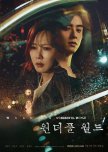
What´s life if our heart threatens to tear? Emotionally intense KDrama. About crime&politics, too
“Wonderful World” is painting a wonderful psychological picture of people desperately trying to come to terms with their inner suffering. The focus is on feelings that we would rather not experience. Accordingly, the KDrama is anything but funny. This is once again a KDrama that isn't afraid of drama.What is life like when our heart threatens to tear? If someone is losing their child, for example... There is no stent nor bypass for that. Guilt and loss of control, the desolation of existence and sheer agony are shaping the terrain through which one has to survive every day. At best there is grieving. But to get there even, that is a long way... “Wonderful World” takes on these emotional dimensions – carefully, sensitively, seriously and urgently.
At the same time, this KDrama vividly documents how the selfish decision of individuals, who see themselves as elite or want to be seen as such, unscrupulously, ruthlessly and brutally throw the lives of 'insignificantly normal' people completely out of balance. It is thus a political drama about a world that is not as 'wonderful' as it claims to be, too.
“Wonderful World” is also a crime thriller because there is a murder to be solved. This brings tension and additional dynamism to the story. “Wonderful World” could also be understood as a story about one or two revenge missions. In my opinion, however, these are more stencils in the background. In the foreground unfolds the emotional world of those who feel left alone in their pain and their helpless anger - but still, they carry on, somehow. Two humans see and understand each other in their suffering and are/feel/come close to each other because of this ...and ultimately try to regain a sense of control over their lives. Therein lies the power and beauty of “Wonderful World” (I think anyways).
As I said, this KDrama is not afraid of drama. It's right in the middle of it and even better. The increase in entanglements, and the music, too, remind me in places of the early KDramas - and gladly so. A great script. Yes, bitter life experiences, admittedly. Nevertheless. Intense acting. Serious. Authentic.
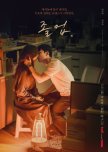
A refreshingly sassy KDrama, critically reckoning with the South Korean education system (and love)
“The Midnight Romance in Hagwon” promises a love story with its international title - and that's what we get. Jung Ryeo-won and Wi Ha-joon are creating the relatively adult, authentic aura of a tender but complicated love relationship between a former graduate and his former tutor. Yet, the two are more than a couple. Today, as teachers, they inspire each other to teach didactically creative. And in doing so, they also inspire their students.Thus, the KDrama, which in the original means something like “The Graduate”, basically offers more than a romance. It is rather a quite critical reckoning with the South Korean education system. The criticism: It's less about education than about grades -and a lot of money is involved in getting good grades. The students learn the correct answers to their questions. They therefore receive any effective support outside of school, mainly in the tutoring academies, provided their parents can afford it. However, there is one thing, the students don't learn: how to ask the right questions. They don't learn to question or get to the bottom of something. They know their material they have to memorize and what formulas they should be able to apply. Everything else is not part of the entrance exam or a prerequisite for qualifying for admission to one of the three large SKY universities. It has to be Seoul National University, Korea University or Yonsei University (S, K and Y), if anyone in South Korea is to become something...
"The Midnight Romance in Hagwon" aka "The Graduate" takes stock of the prevailing, dubious, even misleading values of a society, still trying to convince the people that they have to obsessively achieve something in order to be valuable of some sort.
When it comes to the academy teaching staff, it is about tailor-made exam preparation, courting parents an acquiring new students. Looking to the right or left, seeing a student as an individual human being with dreams and needs, let alone respond to them? Oh my! Whether it's students or scandals, it's never about the people. It's always about the money. A lot of money. The competition is enormous. The South Korean education market is a lucrative economic engine that is humming along happily.
This KDrama offers a wonderfully staged, emotionally sensitive and vivid approach to these issues, using the fate of various ambitious, highly motivated teachers who would like to try something different, but are not allowed to. They are surrounded by elitist parents who are ready to do anything for the glorious future of their beloved, dearest offspring. They are also surrounded by fiercely competitive academies that are just waiting for someone to make a mistake, because then those protégés can easily be poached and their own coffers start ringing instead...
What a refreshingly sassy KDrama, dealing with all those issues...
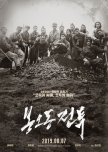
A Monument to Collective Resistance
For me, "The Battle: Roar to Victory" refuses simple hero worship and shuns comparison with typical Hollywood blockbusters. Instead, it stands as a monument to the collective – to an identity forged from the resistance of ordinary people who were never meant to be soldiers.To truly "feel" this film, I guess, one must understand the world these characters inhabited. Following the official annexation in 1910, Korea lived under iron-fisted Japanese military rule. The turning point came just one year before the film’s events: On March 1, 1919, activists in Seoul read a Declaration of Independence, sparking the nationwide Samil Movement. Up to two million people protested peacefully for months. The colonial power’s response was sheer terror: mass arrests, torture, and brutal massacres, leaving thousands dead.
This KMovie picks up in 1920, where this trauma transitioned into a new phase. Despair over failed peaceful appeals to the international community gave way to the conviction that freedom could only be won by force. The film captures the moment when farmers, hunters, and traders transformed into a desperate but determined Independence Army. Women, too, are shown as an integral part of this – not just as couriers in the background, but as fighters on the front lines, shattering the strict social roles of the era.
The cinematography is grand, but never for its own sake. The jagged canyons of Bongo-dong become a character in themselves. To grasp this, one should know the significance of the tiger in Korea: it is the national symbol, and the shape of the Korean peninsula is often likened to a pouncing tiger. The film introduces this symbolism brutally through a scene with a Japanese commander and a slain tiger – a deliberate metaphor for the attempt to physically and culturally annihilate the Korean spirit.
But in the decisive battle, the tide turns. The "Valley of the Tiger’s Mouth" is more than a name; it is a tactical trap. Utilizing their superior knowledge of the terrain, the resistance lures the technologically advanced Japanese army into narrow, impassable gorges. Here, the modern military machine loses its power. It is as if the land itself – the Korean Tiger – closes its jaws and swallows the invaders. The mountains are not just a backdrop; they are the deadliest weapon of the resistance.
Technically, the film is a modern powerhouse. The action is brilliantly choreographed, yet the violence is drastic and unvarnished, making the brutality of the occupation almost physically palpable. While director Won Shin-yeon, occasionally breaks this tension with slapstick humor – which may feel jarring to Western viewers – this abrupt shift is a known stylistic device in Korean cinema to make the unbearable endurable.
Even the portrayal of the Japanese antagonists, which may seem one-dimensional at first, serves a deeper purpose. These figures represent a deep-seated collective wound in Korea’s cultural memory known as "Han" – a feeling of accumulated grief, resentment, and a burning desire for justice that was never fully resolved. Since the liberation was immediately followed by the Korean War and the division of the country, the trauma of colonization remained unhealed. The almost caricatured villainy is less a narrative weakness and more a stylized mirror of this multi-generational pain.
The film’s massive success in South Korea (over 4.7 million viewers) was no accident. Released near Liberation Day in 2019 during a period of renewed trade tensions with Japan, it struck a deep patriotic nerve.
My Verdict
Is there patriotism? Yes. Pathos? Plenty. But those who look beyond these genre conventions will find a powerful tribute to an unyielding collective identity – to the human identity in resistance. I´d say, the film reminds us that history is not just written by generals. It is written by the countless individuals willing to stand up for their freedom.
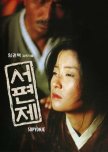
It subtly wrapped me in its delicate web of pansori & quietly etched itself into my heart
I never imagined, at the beginning of the KMovie Seopyeonje, that this film would take such hold of me — that it would subtly wrap me in its delicate web of pansori sounds and, by the end, leave me deeply moved and emotionally full in a way that defies comparison. On the contrary, I was even tempted to stop watching early on… and yet, quietly, Seopyeonje etched itself into my heart.It is a silent masterpiece. Poetry in images. Minimalism that omits nothing, but says only what must be said.
And then: that moment when the spark of Han — that deeply rooted feeling of loss, pain, and longing — is passed on. Not with pathos. But with a quiet glance. A melody. An unfinished sentence.
Obviously, I give it my highest praise. And I’m far from the first. Seopyeonje was initially shown only in Seoul in 1993, but audiences were so moved that it expanded nationwide — against all expectations. Soon, over a million people had seen this quiet film, which offers no spectacle, yet unfolds an overwhelming inner force. Many critics still speak of it as a turning point in Korean cinema — the first serious attempt to explore cultural roots on screen, with pride, depth, and quiet beauty.
------------------- Pansori, Han, and the School of Sorrow -------------------------------------
The title Seopyeonje refers to one of the three main styles of pansori: the western style, particularly solemn and perhaps the most technically demanding. But Seopyeonje is more than music — it is narrative, sound, breath. A life theme for the protagonists, a central motif of the film, a spiritual core. And a mirror of suffering that is not confined to the Korean peninsula.
Han — in Korean — does not describe individual pain, but a collective, deep-seated wound. Initially shaped by colonization, division, and bondage. Yet Han is not just sorrow — it is also strength. Grief that does not fade, but perhaps can be transformed. Into music. Into movement. Into memory.
Seopyeonje lives from this. The film does not force us to feel — it invites us. Into quiet images. Into pauses. Into the invisible between the notes.
-----------------------------------------------------------------------------------------------------------
This KMovie is a staging like a song cast in light. What director Im Kwon-taek achieves here is more than cinema. It is like a sung poem. The camera is almost motionless, as if not to disturb the sound. Landscapes do not pass by — they linger. Colors — especially white, brown, deep red — seem to come from memory, not the present. Every scene is composed like a measure in a long song.
The film speaks a quiet cinematic language: where others insert dialogue, Seopyeonje remains silent — or lets a pansori piece speak. When Song-hwa sings, time stands still. And perhaps that is the film’s greatest magic: that by the end, you forget you’re watching — and begin to listen.
The film’s deepest rupture is not loud — it happens almost in passing. Song-hwa, the adopted daughter, loses her sight. What first appears as tragedy becomes a disturbing act of devotion: her father Yu-bong takes her sight so she must rely solely on hearing — to fully merge with pansori. It is both sacrifice and violation, unsettling and ambiguous. Yet Seopyeonje does not judge — it lets us feel for ourselves whether there is beauty or destruction in it.
Song-hwa’s singing after her blindness is purer, clearer, more piercing. But at what cost? That remains open — like so much in this film. And perhaps that is its greatest truth: that no answer needs to be loud to be valid.
------------------------------------ SIDE NOTE: Pansori – Sound as Cultural Memory -------------------------------------------
Pansori is not just an art form — it is a cultural memory. For centuries, this epic singing tradition has been performed in Korea by a solo singer accompanied by a drummer — with voice, gesture, breath. The stories, often hours long, blend folk tales with literary depth, improvisation with ritual.
Originally developed in Korea’s southwest, pansori was long a folk art passed down orally. Only in the 19th century did it gain recognition among the urban elite. But with modernization, the knowledge began to fade — until 1964, when the Korean government designated it a National Intangible Cultural Heritage. In 2003, UNESCO added it to its list of Masterpieces of the Oral and Intangible Heritage of Humanity.
This recognition was more than a title — it was a lifeline. Since then, pansori has been actively supported, taught, and passed on. And yet: the original spontaneity, the free improvisation that once gave it magic, has become rarer. Many performances now follow fixed texts, and audiences are less familiar with the old codes. But the sound remains. And with it, what Seopyeonje so powerfully shows: that a single voice can carry an entire world.
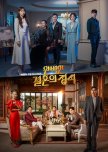
Another Cinderella, all-out, taking her sudden chance for revenge
"Perfect Marriage Revenge" is based on a webtoon and tells the story of a second chance in life, set in the top percentile of society. Another Cinderella story. And as is the case with fairy tales, you can hear them over and over again...This version is particularly enjoyable, being peppered with gratifying moments of retribution. Cinderella wants to get one over on the mean stepmother and her nasty daughter! She doesn't want to be nice and well behaved anymore. Splendid! Of course the others obviously attempt to push back on her new self. This ultimately leads to a lively exchange of blows between two of the country's rich business families.
"Perfect Marriage Revenge" delivers intrigue and makjang, cleverly mixed with emotional complications and well-placed retaliation, which is, however, repeatedly and tirelessly parried. It´s like ping-pong - reckoning here, malice there, self-respect here, nefariousness there. What a delight, if you´re in the mood for just that.
A campaign of revenge with an open visor. With an explicit protagonist who allows herself to act impulsively, intuitively and cleverly at the same time. In her authenticity, she is able to win the hearts of allies as she is fighting her battle not out of greed, but out of self-love for her self-respect.
As I said, with plenty of gratifying moments...
And as a fairy tale it surely delivers...
No more, no less.
Terrifying.
And captivating at the same time.
Most peculiar.
First I wanted to quickly get out of it.
But then, somehow, I couldn't leave the girls and boys behind in their misery...
A nasty, cruel game with anguish and desperation.
And at the same time bitterly serious.
When bullying turns into a relentless, painful fight for survival...
An original but also creepy reckoning with the issue and impact of psychological and/or physical violence among teenagers.
Nurtured and inspired by what for some (far too many!) is real hell on earth.
In that sense: quite upsetting.
Therefore: ambitious and well done.
However: still scary.
Watching the Machine Run
To me, The Manipulated feels like a KDrama approximation of a classic Tom Cruise production: glossy, efficient, and carefully tailored for international appeal. Disney clearly wants this to sell – and on an entertainment level, the series does many things right. The pacing is tight, the action relentless, the staging polished, and the performances well integrated. It is professional, routine, and undeniably effective.And yet, this is precisely where my problem begins. The series devotes an enormous amount of screen time to violence, cruelty, and the grotesque fantasies of a completely detached super‑rich elite – and at times, it seems almost to revel in them. Dehumanized games that have lost any connection to reality are not merely shown, but aestheticized, intensified, and actively hyped.
Of course, the protagonist is a victim. And of course, in genre‑typical fashion, he manages to navigate his way through this scenario. The suffering is real, but never existentially threatening to the narrative itself. In the end, what remains is exactly what it is: pure entertainment. Efficient, calculated, and easily consumable.
This kind of entertainment primarily caters to a Western‑oriented, largely male audience. Female fans, however, are also well served – not least because they get to experience Ji Chang‑wook as closely as possible. Once again, his performance is impressive: soft and hard, vulnerable and controlled, with a convincing transformation and undeniable presence.
Anyone looking for this kind of high‑gloss thrill ride will be thoroughly satisfied. For me personally, it goes too far. Or rather: too far in the way this particular form of “sickness” is placed on a pedestal – not out of narrative necessity, but for ratings.
A message beyond sheer impact?
For me: none.
The Manipulated delivers exactly what the global market demands: frictionless, high‑gloss action. Those seeking flawless entertainment will be served. Those looking for the emotional depth and cultural specificity that once defined K‑drama will find little more than a smoothly polished surface.
This is not a drama meant to be felt, but a machine designed to be watched – professionally choreographed, yet morally as hollow as the world of the super‑rich it portrays.
------------------------------------------------
Epilogue – Tracing the Cracks
Still, it may be worth taking a closer look at the motives of the detached super‑rich, the antagonist, and the actual perpetrators. Especially within the context of KDrama – a format that often subverts even seemingly stereotypical structures with irony or emotional depth – one might ask whether these figures are merely projection surfaces for escalation, or whether they unintentionally reveal more about power, alienation, and responsibility than the series explicitly articulates.
The elites’ violence games are so exaggerated, so completely severed from any sense of humanity, that they verge on caricature. They can be read as a mirror of a fully commodified society, in which even cruelty becomes a product – consumable, aestheticized, and emptied of meaning. In this reading, the emptiness of the antagonists is not accidental, but symptomatic: power without accountability, wealth without responsibility, play without consequence.
Perhaps whatever social critique the series may contain – if any – lies less in its plot than in the contrast between its glossy surface and the inner devastation of its characters. Between immaculate presentation and moral void, a space opens in which Western thriller clichés are adopted yet inadvertently exposed. The tongue‑in‑cheek notion that “KDrama simply can’t help itself, even when it wants to be Western” could be read as a quiet comment: the form may be imported, but the emotional emptiness remains visible.
Whether these fractures are intentional or merely byproducts of a production optimized for maximum impact remains unclear. The Manipulated does not actively invite reflection – but it allows it in retrospect. The final question is therefore less about the series itself than about its context: is this pure consumer product, or does it – perhaps unintentionally – reflect the social emptiness from which it emerged?
Entertaining, yet rather lightweight. Visually stunning scenes. Emotionally intense at times, too
Frankly, I'm not a fan of shallow, adolescent love stories. (Not necessarily because they are not good, but I guess I am too old by now. The topics are not mine anymore.) I'm interested in somewhat more complex, mature characters and differentiated relationship studies - preferably in an distinctive (Korean) context with additional historical, cultural or subcultural insight."Moon Lovers - Scarlet Heart Ryeo" originally goes back to a Chinese story. The movie adaptation was a great success and so here comes a Korean remake - the plot is unceremoniously moved to the Goryeo of the 12th century and a controversial historical ruler is portrayed on that occasion: the 4th son of the founder of the Wang dynasty (who ruled the Goryeo Empire for over 400 years) King Gwangjong, born under the name Wang So (925-975).
----------------------- SIDE NOTE --- King Gwangjong
Some historical sources have led to the interpretation that he was a right-wing tyrant, but more recent evidence suggests that he implemented the major reforms that laid the foundation for a solid kingdom for more than 4 centuries. This character has also appeared several times in KDrama, for example in "Taejo Wanggun" (2000), "The Dawn of the Empire" (2002), "Empress Chunchu" (2009), "Shine or Go Crazy" (2015) or here: "Moon Lovers - Scarlet Heart Ryeo" (2016).
Wang So had three older brothers (Wang Mu, Wang Tae, Wang Yo), 20 half brothers and 7 half sisters. From this, one can firstly see that he was not actually considered for the line of succession, and secondly suspect that King Taejo kept several wives at court. As life goes, all three older brothers died for different reasons and in the end the crown accidentally fell at Wang So's feet.
After a turbulent period of 3 kings in quick succession, King Gwangjong re-established a stable, centralized government with a strong, loyal army and 7 peaceful years before the aristocracy rebelled against his reforms (which came at their expense). One of his innovative reforms concerned slave ownership, which he had officially checked for legality. When in doubt, the slaves became free people and taxpayers (while their former masters began to lose influence...) However, putting down this rebellion of aristocracy earned him the reputation of a bloody tyrant.
Another reform was the introduction of a national civil service examination, which lasted for almost 950 years. This replaced the pure nepotism previously practiced in filling political offices with performance and ability. At the same time he laid the basis for Confucianism as a principle of social order. He also introduced a dress code at court, from which the respective rank could be read from the colors.
King Gwangjong married his half-sister and two nieces. This is unique in Goryeo's history, as it was more common at court to marry outside of the bloodline in order to gain allied lordships. Gwangjong, on the other hand, relied on a strong, purely royal bloodline. After all, he ruled for 26 years and set the course for the next 400 or so.
-----------------------------------------------------
Back to the KDrama. Unfortunately, the plot that was spun around this dazzling historical king and his family is a bit shallow and predictable at times. Sometimes it reminded me of a harmless, colorful teenage boarding school flirtation. (I obviously don't quite correspond to the target age group there...) But then, furthermore, the story offers unexpected depth and emotionally touching scenes, too. After all, it also comes along with some exciting and visually stunning sequences and an atmospheric soundtrack. I initially ended up there for ´actress´ IU in the first place. In fact, I discovered Lee Joon-gi (as Wang So) in this KDrama. In my eyes it is his down-to-earth charisma (and maturity?) that helps to overcome some weaknesses in the script.
An attractive dramaturgically dynamic component is the leap in time, through which the approximately 20-year-old Go Ha-jin (IU) suddenly ends up at the court of the royal Wang family - in the midst of the numerous sons and half-sons of King Teajo... As a woman from the future, she brings fresh air and a cheeky spirit into everyday palace life, which is characterized by distrust and intrigues. The various mothers are prepared to do almost anything in order to secure a royal career for their precious princes. At the same time, the modern Ha-jin in her idiosyncratic way brings the blue blood of the king's sons (some of whom are still quite pubescent) to a boil, thus providing additional competition among the boys on top of the already existing succession rivals ....
A nice, charming, entertaining, but rather lightweight KDrama-tour into Korean history.

A blockbuster among Disney+ Series. Action driven, yet luckily with subtle character portraits, too
"Moving" is about people with superpowers. “Moving” tells the stories of a variety of people with such superpowers. These superpowers definitely belong to the realm of fantasy. However, it´s nothing like the 'Marvel' universe, because despite all the action spectacle that "Moving" has to offer, this Disney+ production (based on a successful South Korean webtoon) remains true to the KDrama habitus, that life takes place in the area BETWEEN black and white. It's about shades of gray. Nobody is exclusively good or evil. Well, almost nobody...“Moving” takes aim at South Korea’s intelligence policy. The KCIA, which became the ANSP and was eventually called the NIS. The connections with the USA and the difficult relationship with North Korea come into play. Difficult, because even within the framework of an official sunshine policy, distrust and hostility are always maintained in the background.
The South Korean secret service has been part of the international elite since the KCIA was founded. The superpowers of the protagonists may be symbolic of this. The name of the secret service has changed several times, as has its official focus. However, this does not mean that the entire workforce can be replaced...
“Moving” finds its balance between political thriller, action thriller and emotionally differentiated Korean habitus. The trick: the tough agents become humanly tangible because they are also parents, worried about their children. And then another trick: the children have inherited their parents' super-powers, but have not (yet) undergone any agent programming. They are children, still relatively naive, pubescent, too...
Worlds collide. The worlds of those, who behind the curtain want to move the world in their favor (for the sake of so called bigger picture and a safer world), the worlds of those executives, more or less blindly obedient (Black Ops) agents who are needed to succeed with their missions, and the world of those, who actually make this world worth living - people with their ordinary families and social relationships.
“Moving” has 20 episodes. Numerous character and relationship portraits are drawn, all of which are somehow intertwined - the old and the young, yesterday and today. And finally altogether now for a tomorrow free from deadly intelligence agency demands.
“Moving” is, first and foremost, a KDrama with a top-class casting that aims to offer streaming delight at the highest international level. “Moving” is explicitly seen as a kind of blockbuster among Disney+ series productions - with a correspondingly hefty budget. As such, the series has entered the streaming market in a self-assured manner and immediately achieved remarkable success worldwide...
However, for my personal taste, this KDrama comes across as a bit too action driven and brutal - with those superpowerful men and women, who (despite their deadly wounds) keep bouncing back again and again and again... I might have dropped it, if not for this variety of subtle and affectionate character portraits, that make a great part of the story, too.


