The acting is very good, and it doesn't seems fake, very great acting skill that touches your heart. Each character make you sympathize with them and they feel very human and not like one of those unbelievable character. Though it does seems a bit like a romance dream but the relationship and feeling seems pretty real and you can sympathize with the character. The actors and actress suit the role very well, and not to mention they are all very good looking too.
I really like the ending music because it seems to tell of each couple not forgetting their first love and the pain and feeling they have toward each other. though they didn't really play music much throughout the drama so far, but the ending song really match the drama really well.
The rewatch value for me is pretty high because the drama have kept me laughing for the whole time. and it is like a romantic comedy drama that make s you laugh, cry and sympathize as you watch the drama.
Was this review helpful to you?

This review may contain spoilers
And No More Shall We Part
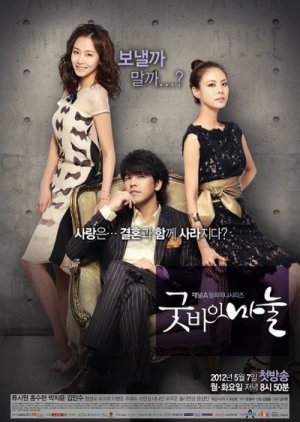
What makes “Goodbye Dear Wife” excellent overall lies in the intricate web of narrative strings that forms its framework, and in its ability to gradually bring them into focus in a surprisingly coherent manner, despite the fact that these threads unravel on the very edge of contradiction or, indeed, the most extreme paradox.A man discovers he has only a few months to live and decides to divorce the woman he loves. Not because he has stopped loving her, but because he loves her so much that he wants to ensure she can build a life for herself without him.
Behind this paradoxical, central and inescapable turning point, themes such as marital love, the spectre of first love, the rekindling of unrequited or impossible desires, and even death as a means of shaping the future all converge; almost a love story as voluntary self-destruction, filtered, moreover, through a Catholic subtext capable of defining an act of absolute sacrifice: namely, renouncing the right to be loved by one’s wife in order to guarantee her a life after he is gone…
The drama’s initial comedic tone introduces a number of thematic variations which are gradually developed and ultimately subverted; temptation and possession, the desire to possess and the impossibility of truly possessing another person – or even oneself.
Seung Hyuk, the protagonist (Ryu Shi Won, who is excellent and strikes a perfect balance between the drama’s various stylistic registers), believes he is in control of his own life; he has given up his career as a martial arts champion for the sake of Sun Ah (Hong Soo Hyun, visceral and lovely, deeply moving in her devotion, as dictated by her role, yet also delightfully self-deprecating in playing on her undeniable beauty) by building a marriage and a high social and financial standing, but remains fundamentally unresolved because of Hyang Ki (Park Ji Yoon, icy and inscrutable, but above all deeply tormented), his ‘first love’, who appears almost like a lost object to be recovered.
The temptation is not merely physical and emotional, but rather an almost desperate desire to turn back the clock…
But in a (paradoxically) symmetrical way, Sun Ah, too, experiences exactly the same feeling, with the return of Hyun Chul (Kim Min Soo, perhaps a little too stiff and lacking in any real spark), who is, moreover, extremely keen on the possibility of reclaiming the life they might have had. She had almost embraced the novitiate following Hyun Chul’s disappearance, but had been ‘saved’ by that rediscovered love offered to her by Seung Hyuk himself.
A couple, two past loves, the chance to open that door again, to find out whether what they have lost is really what they still want.
It is the diagnosis that completely alters the nature of things. Not only Seung Hyuk’s life, but his very notion of control; whereas before his mindset was: ‘I can decide who to love, who to leave, who to take back, and how to organise my life’, now, in a tragic reversal, it becomes: ‘I cannot even imagine how long I will live’. Before, there was almost a sense of omnipotence – amplified, moreover, by the entertaining microcosm surrounding the protagonist, his gym and his devoted athletes – but now this has given way to utter helplessness. The former champion can only manage what remains to him in a desperate attempt to bring some order to his life.
Yet another paradox – or rather, the resulting contradiction – concerns his behaviour towards Sun Ah, who is brutally reduced to the status of someone incapable of making her own choices; he decides that she must leave him, that she must forget him, that Hyun Chul might even be her future, and, above all, that the pain he will inflict on her now is preferable to the pain she will feel later.
It is an ‘extreme’ form of possession: the attempt to control his wife’s future. This makes his behaviour both loving and, at the same time, deeply violent. Not violent in the physical sense: violent because it robs her of the chance to choose. He does this through psychological blackmail, which is devastating even from the viewer’s perspective; he wounds her with the harshest arguments directed at Sun Ah – a devoted wife, a Christian believer and an obedient woman – deliberately seeking the point at which he can sever the bond. He must make her believe she is no longer loved.
The analysis of a marital crisis raises some universal questions: How well do we really know the person we love? Where does love for the other person end, and to what extent is it instead a desire to possess their image, their future, their fidelity and their presence?
The illness undermines all logical reasoning, eroding not only the body but also one’s certainties; the secret and the fear that Seung Hyuk experiences in solitude, ironically, also provide the comic framework that runs through the entire drama – yet another paradox: the protagonist knows something the others do not; he knows his own fate.
His wife does not, nor do his friends and family – his mother is even preoccupied with her own rediscovery of love, unaware of anything – whilst the other characters continue to interpret Seung Hyuk’s behaviour according to the usual rom-com tropes: love, betrayal, jealousy, first love, rivalry, gossip, etc.
Only Hyang Ki knows (and here one might raise objections regarding the principle of medical confidentiality); comedy and melodrama coexist perfectly, as we, the audience, see two different interpretations of the same behaviour at the same time. This asymmetry proves to be the mechanism that makes a situation bearable which, from the protagonist’s point of view, is simply tragic.
No longer being able to control one’s own destiny takes the paradox of possession to its extreme: the attempt to manage what will be left behind; yet the more Seung Hyuk tries to control everything, the more the drama shows him that nothing truly belongs to him; whilst the final match seems to represent the best possible metaphor, he, once again, chooses to change course.
In the end, his desperate attempt to become the architect of other people’s futures comes up against the reality that time cannot be managed and hearts cannot be planned. Seung Hyuk had believed he could foresee everything, even the pain of those left behind; yet his journey comes to a close when he gives up fighting against what he cannot change and chooses, once again, Sun Ah. There is no longer a future to plan, nor a life to entrust to someone else: all that remains is the time – brief and precious – to be spent together.
It is a resignation that bears no resemblance to defeat. Accepting one’s own fate also means granting the other person the freedom to choose their own, without any longer claiming to protect them even from what is bound to happen. Inevitably, the nature of sacrifice changes: it is no longer a matter of deciding on behalf of the one you love, but of accepting that you cannot save them from whatever the future may hold.
Time passes, and with it, life. The pain does not disappear, but finds a way to exist within the days, in everyday actions, in memories, in what continues to grow even though someone is no longer here. The loss is not erased, nor can the past be rewritten: quite simply, both end up finding a place within the present.
Perhaps this is the most authentic form of acceptance that the drama offers the viewer: not only that of the person who must die, but above all that of the person forced to remain behind. For death may cut short a life, but not necessarily a love; and what remains is neither possession of the other, nor the impossible promise of a future together, but the possibility of carrying on with life whilst carrying their memory with one.
‘Goodbye Dear Wife’ does not grant the miracle we have continued to await alongside its characters. It offers something more subdued: the realisation that not all stories can have a happy ending, but that a story can still find its own meaning without betraying what it has told. You can lose someone and, despite this, carry on living. You can carry on loving without ever being able to have them again. And what if, in the end, the price of love was exactly that? Learning to let go of what, more than anything else, we would have wanted to hold on to.
8/10
Was this review helpful to you?

Was this review helpful to you?
This review may contain spoilers
Tear Jerker, Comic Tragedy
This is an apparent comedy for most of the 20 episodes but slides into a tragedy so rapidly in the last, you cannot help but become a part of the story and be touched by the pathos of it all. No one can forget Sun-ah's eyes in the closing scene, as she talks to her husband she loves so much, and tells him all about their son.Some really good scenes. The church was excellent. I found the story line inconsistent, and thought it was a farcical comedy, and the light way they dealt with such a serious theme keeps one hoping that the farce would all work out in the end. But as with Korean dramas, they just like to keep it all too tragic, all too real in the end. You have to respect the makers to have created such an ending.
Was this review helpful to you?

This review may contain spoilers
Same shit because man is dying and making a sad face
So because this man is dying and can make a pitiful faceevery woman should kneel and take his Cookie in there mouth and then enjoy it
because he is dying he should be loved by everyone and you can donate your girlfriend, lover even your wife to Dying man
so he can dying after he enjoy every woman he has around him
JUST because he know he is dying he is entitled to do anything he want and everything is right as long as he die
he can kick his wife sleep around and then come back and ask his wife to give him a good BJ because he is DYING
EVERYTHING IS JUSTIFIED because this MAN is DYING, how man drama showing this same shit again and again that this person is dying so he will F$$K everyone before he DIE
$ex is most important before dying and should be with as many partner as many you can make them pity you
being inhuman is justified as long as you DIE
fact every human die but they do not get Luxury to know when they DIE but as long as you get this Luxury to know when you will Die you can do anything now because there is no Conqueses of your action
You can murder people, you can rape people, you can cheat people you can scam people, you can play with there feeling, you can be hit anyone as much as you want
xxxxxxxxxxxxxxxxxxxxxxxxxxxxxxxxxxxxxxxxxxxxxxxxxxxxxxxxxxxxxxxxxxxxxxxxxxxxxxxxxxxxxxxxxxxxxxxxxxxxxxxxxxxx
what a luxury benefit of dying this Drama shows
Was this review helpful to you?

Was this review helpful to you?