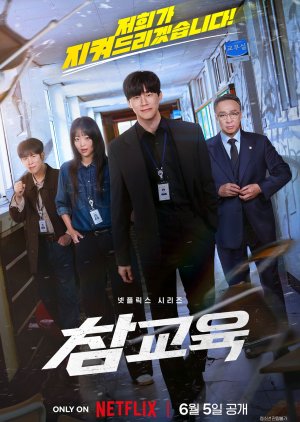
Taxi Driver: School Bully Version
Teach You A Lesson was one of my most anticipated dramas this year and it didn't disappoint!Ep 1 was a great start after which the momentum stabilizes to a case by case format of troublesome school after troublesome school. Through 10 episodes, the drama covers all the major bullying crimes including physical violence, substance use, cyber crimes, stalking, defamation and scamming.
Kim Mu Yeol and his slaps keep delivering until Jin Ki Joo, P.O and Lee Sung Min join the action. The main cast comprising these four Anti-Bully Avengers definitely carried the show with their friendly camaraderie. Kim Mu Yeol has charisma for days and the swagger of a believable action hero protagonist, while Jin Ki Joo and the rest of the cast are equally engaging in their roles.
Having said that, I do want to mention that this show seems to have a lot of fourth wall breaking, preach-heavy moments. Satire usually hits when the message is more subtle and indirect so I do wonder if the ones who truly need these lessons both among students and the adults around them will get the message.
At the same time, it's very evident that the makers put a lot of effort into shaping the script in such a way that they'd cover all the possible domains of potential criticism from viewers beforehand. From public outrage from hypocritical human rights warriors to making sure they mention that they're only after the bad apples among both teachers and students and acknowledging the good ones that do exist and reassuring that their mission is for their protection, they've done a good job presenting a neutral unbiased view that keeps educational rights at the forefront.
While this helps theme-wise, this creative choice may have tipped slightly into becoming an overcorrection with constant repetition of similar thoughts across multiple episodes which has then also compromised the overall pacing of the show. This can put off some viewers who are more used to the steady build up of anticipation and dread in more conventional action/thrillers, especially high school themed thrillers set around a single school and one common enemy.
Regardless, this was a fun watch overall with a solid theme. Lots of entertaining action choreography and a healthy balance of humor and emotion.
Teach You A Lesson is a really fun addition to high school themed revenge dramas, this time with adults delivering the slaps-err-justice!
Was this review helpful to you?
This review may contain spoilers
Tries to make a point but has its own flaws
Show tells us how not only the students but also the teachers get bullied by student bullies and how a newly formed Govt org deals with those bullies. Each episode deals with different bullies in different schools.Starting scenes of most eps were very traumatising to watch for me with all the graphic bullying of helpless students by their school bullies and few suicide scenes too, so I mostly ended up skipping all such scenes.
Then the ML arrives and kicks their asses - literally! 😁 And it was very satisfying to watch! And I think that satisfaction was the reason I continued to watch it till the end. Fl does great action too! Also special mention to all the actors who acted as bullies in each episode, they all did really good acting. 👏👏
But the show has few major issues. (Minor spoilers)
1) Firstly romance b/w fl and 2nd ml (Deputy Director Bong) was totally unnecessary because they didn't have an ounce of chemistry whatsoever! I understand they were trying to make an age appropriate pairing but then they should have checked the pair for chemistry before casting.
I have watched many of FL's work and I have always liked her pairings with her costars but this time they should have casted someone else to be her pair or should have skipped romance altogether because it wasn't necessary at all! The last few scenes b/w them look so forced and bad.
2) Secondly, the theme of the show itself is an issue in some episodes, especially where they showed that girl student make false SA accusation. They somehow indirectly made it seem as if all such cases are false and all teachers are innocent in the concluding scene of that ep when in reality so many teachers actually SA their students. And so many children are afraid to speak out fearing no one will believe them.
So I wish they had showed that the other foreign language school teacher had actually SAed her and because no one helped her, she became what she became instead of showing that just being denied admission in that school as the reason she became a bully, which didn't make any sense.
3) Also there was no need for that lady teacher to suddenly start using cane beating punishment on that student all of a sudden. It seemed so silly. She could have simply thrown her out of the class, cancelled her marks or put her name on the notice board for misbehaving in the class or done something else instead of just beating her which has only a temporary effect on such people.
Also couldn't the school or org just ban phones in classrooms? That would have saved so much bullying. They could have asked them to keep their phones in their lockers and not use it on the school premises.
4) Fourth being how they dealt with that psychological evaluation episode. Like it was so stupid the way they revealed that teacher's evaluation in front of her colleague and even revealing she was trying to kill herself indirectly.
I mean they should have called her separately and informed her about such sensitive matters especially for a person who was attempting suicide just mins before that evaluation scene and fl actually almost saw it herself!
Overall an interesting drama with a different perspective. 7.8/10
Was this review helpful to you?

A Bitter-Tasting " Bouillabaisse "
Adapted from the webcomic Chamkyoyook, No. Lesson for Everyone! (or Get Schooled!) sets out with a clear ambition: exposing school violence, bullying, abuse of power, educational pressure, and the failures of a system that is supposed to protect the most vulnerable. On paper, it's hard not to support such a project. Yet as the episodes progress, a growing sense of frustration begins to emerge. Not because the subjects themselves are uninteresting, but because the series constantly seems to favor spectacle over reflection, instant emotional gratification over analysis, and punishment over understanding. The show relies on radical and highly efficient methods that are undeniably satisfying in the moment. But then what? What are the long-term results? What perspective does it offer? In many ways, it's a lot like politics: plenty of smoke and mirrors. The series focuses almost exclusively on the consequences while rarely addressing the root causes. That's the central paradox: I completely agree with the diagnosis, but less and less with the way it is presented. From the very beginning, it reminded me of Gordon Ramsay-style rescue shows: the hero arrives, cleans up the mess, and leaves. Fine—but what happens afterward?The premise itself is strong. Following the alarming observation that teachers' authority has significantly eroded and that school violence continues to rise, South Korea's National Assembly passes a new law. Supported by the President and the Minister of Education, Choi Gang-Seok (Lee Sung-Min)—whose own daughter, a teacher, was murdered by a high school student two years earlier—a Bureau for the Protection of Educational Rights is created. On the ground, it is led by Na Hwa-Jin (Kim Moo-Yul), a former elite soldier who was also the deceased teacher's husband. He is assisted by Im Han-Rim (Jin Ki-Joo), who once served under him in the military, and Bong Geun-Dae (Pyo Ji-Hoon), a computer genius. Their mission is simple: intervene directly in schools and deal with problems at their source, using force when necessary. Like a procedural crime drama, the series tackles bullying, parental pressure, corruption, physical violence, social inequality, juvenile delinquency, and institutional failures. All relevant topics, certainly—but far too many to be handled thoroughly within the show's limited runtime.
To give you an idea, it's as if someone threw a little bit of The Glory, Extracurricular, Weak Hero, Study Group, ONE, and even GTO into a giant wok and stirred everything together. Unfortunately, the "one case per episode" structure weakens the overall narrative, especially in a series consisting of only ten episodes. Sixteen would probably have been necessary to properly explore everything. The formula rarely changes: a problem appears, the Bureau intervenes, the guilty parties are punished, and the story moves on to the next case. As a result, everything feels somewhat superficial because the show almost never takes the time to examine the origins of the conflicts, with only a few exceptions. Yes, it is satisfying to watch bullies and incompetent adults finally get what they deserve. But to what end? The consequences quickly disappear, the situations lack depth, and most importantly, everything becomes predictable. The story simply moves from one school environment to another, checking boxes along the way. It often feels less like a coherent narrative and more like a catalogue of social issues. The repetitive structure quickly becomes tiresome: a victim, a bully, a forceful intervention, punishment, and then on to the next case. At first glance, that sounds entertaining. In reality, not so much. The series never seriously examines the deeper causes of these problems. How did such violence emerge? How did the system allow it to flourish? Why did institutions fail, and more importantly, did they ever genuinely attempt to solve these issues before they reached crisis point? The protagonists act like firefighters: they put out the fire, but the show rarely cares about why the house is burning in the first place. There are simply too many cases and not enough episodes to properly develop the ideas being presented.
Another issue is the complete absence of tension. Na Hwa-Jin, much like prime Steven Seagal, is never truly challenged. He functions more as an archetype than a realistic character—a cross between Superman and Zorro. Somewhere between vigilante fantasy and rough justice, he bulldozes through every obstacle, solving situations either through cleverness or physical force. Twenty opponents at once? No problem. He's essentially an unarmed version of So Ji-Sub, with a smug smile added for good measure. Physical confrontation frequently replaces actual conflict resolution. To keep the story moving, the series constantly escalates situations, but this escalation destroys much of its credibility. Seventeen-year-old students look thirty. Thirteen-year-old middle schoolers look twenty. Adults are passive, absent, or incompetent. Institutions barely seem to function. Where is the police? What are the prosecutors doing? There are never any meaningful investigations beforehand. Everything is exaggerated for dramatic effect. The series embraces pure black-and-white morality: the untouchable hero, the irredeemably evil villain, the fragile victim, the complete absence of accountability, and bystanders who never react. Another weakness is the lack of a true antagonist. It's difficult to determine whether the corrupt politician or the murderer of Na Hwa-Jin's wife is supposed to be the show's central adversary.
That being said, there are some genuinely strong moments. I particularly enjoyed Episode 5, which follows a teacher being relentlessly harassed by a deeply troubled parent, and Episode 8, which echoes the themes explored in SKY Castle, portraying parents willing to sacrifice anything for their children's success. These episodes are more nuanced, more human, and encourage reflection about parenting in a society where children are either treated like royalty or thrown into the arena of relentless competition. Ultimately, the series is more interesting for the questions it raises than for the answers it provides: school violence, juvenile justice, and the limitations of educational and institutional systems. At times, it also reminded me of Taxi Driver. Whenever all hope is lost, the Bureau arrives as a miracle solution capable of fixing everything within days. Another aspect that bothered me is the complete lack of scale. Although the issues presented are supposedly systemic and nationwide, everything feels strangely localized on screen, as if these problems only exist within the boundaries of a single mid-sized city. The broader national dimension is never convincingly portrayed.
And then there's the Bureau itself. A four-person team reporting directly to a government minister simply makes no sense. Everything is simplified to maximize the appearance of efficiency, but it often feels more like a narrative shortcut than a genuine attempt to engage with reality. As a result, much of the show's impact and authenticity is lost. Nearly every development feels telegraphed, leaving little room for surprise. As for the cast, while the direction is effective enough, I wasn't entirely convinced by the performances. Kim Moo-Yul gets the job done but brings little nuance to his character. Lee Sung-Min, on the other hand, fits his role perfectly. However, I'm still struggling to understand the narrative purpose of Jin Ki-Joo and Pyo Ji-Hoon's characters. Were there really no better options available?
The series relies heavily on implausible situations and exaggerated set pieces to keep the audience entertained and move the plot forward. In the end, it doesn't reveal anything particularly new about the issues it discusses. The final episode falls completely into convenience and narrative shortcuts in order to justify the Bureau's existence. This feels very much like a low-budget Netflix production that deserved a far more sophisticated treatment. Adapting a webtoon should have allowed the writers greater freedom, yet the result remains surprisingly constrained. While the original webtoon generated controversy—particularly in the United States, which I find somewhat amusing—the drama adaptation will likely spark debates of its own.
In the end, I fully agree with the show's core premise. The issues it addresses are important, timely, and universal. However, the execution is often counterproductive. By constantly prioritizing spectacle, escalation, and quick resolutions, the series ultimately weakens its own message. The problem isn't the subject matter—it's the way it's handled. A worthy intention. A relevant diagnosis. But an oversimplified demonstration. Despite occasional flashes of insight, the final result remains unsatisfying because there were simply too many ingredients, and none of them were ever given enough time to fully develop their flavor.
Was this review helpful to you?

 2
2 1
1 1
1 1
1 1
1This review may contain spoilers
THE SCHOOL SYSTEM IS BROKEN AND THESE PEOPLE SAID HOLD MY CLIPBOARD
OVERVIEW:Imagine a Korean school system where students rule through fear, teachers are afraid to intervene, principals answer to angry wealthy parents, and even police investigations vanish under political pressure. Enter Na Hwa Jin, an inspector for the Educational Rights Protection Bureau, a government agency created to tackle the chaos. Backed by Minister Choi Gang Seok and aided by deputy director Bong Geun Dae, who frequently goes undercover as a student, Hwa Jin takes on the worst cases of school corruption and abuse. Later joined by former soldier Im Han Rim, the team brings a mix of investigation, intimidation, and brutal justice to every mission. Each episode sees the ERPB storm a different school, expose systemic wrongdoing, punish the guilty, and restore order. It’s *Taxi Driver* set in Korean schools, and it’s ridiculously satisfying.
⸻⸻
COMMENTARY:
• Overall Impressions
The reason it never becomes repetitive or preachy is that it fundamentally understands that the problem is never just the bully. Not in a single episode. Every case peels back a different layer of the same systemic rot and what you find underneath is always something more complicated and more disturbing than a mean kid who needs to be taught a lesson.
E1 is about a politician's son who bullies with complete impunity because every adult in that building is financially terrified of his father. E2 is about a school that has essentially become a gang recruitment pipeline because nobody in authority cared enough to intervene before it got that far. E3 is about a teacher being systematically destroyed by her own student through social media manipulation while the principal negotiates a private peace deal with the perpetrator instead of protecting the victim. E4 is about a corrupt teacher quietly steering wealthy students toward exam advantages for years. E5 is about a parent who weaponized the complaint system, the very system designed to protect children, in order to torment a teacher. E6 is about teenagers who understand exactly how untouchable their minor status makes them and exploit that legal protection like it is a VIP membership card. E7 is a gambling addiction pipeline deliberately marketed to vulnerable high schoolers by loan sharks who knew exactly what they were doing. E8 is about academic pressure so suffocating that a mother was feeding her son illegal stimulants just to stay competitive. E9 is about passive exploitation dressed up as friendship. And E10 brings the entire season full circle to the murder that started everything.
TEN EPISODES, not one repeated problem. I genuinely sat back after finishing the finale and just thought about how much discipline that took and how rarely dramas actually pull that off.
⸻
• Na Hwa-jin
Na Hwa Jin shows up to a school on his very first day, immediately hears a student make a joke about a classmate who just died, and beats him. Not a disappointed look or a firm talking-to or a carefully worded warning about appropriate behavior. He beats the student and then puts the entire class in a plank position. ON HIS FIRST DAY. I watched that scene with my mouth literally open because you are simultaneously horrified and cheering and both of those feelings are completely valid and the show knows it.
What I love about Hwa-jin is that the drama never pretends that what he does is strictly legal or straightforwardly ethical. It leans into that tension deliberately. He operates with government authority but the way he uses that authority is so creative that even his allies sometimes need a moment to process what just happened. There is a scene in E2 where he drives two students around a parking lot in a car missing a door at genuinely unreasonable speeds while they scream and beg for mercy and he looks completely unbothered. Like he is running a routine errand. That is the energy this whole show runs on.
Kim Mu-yeol is doing exactly what this role needs. Hwa-jin is not warm. He is not funny on purpose. He does not give inspirational speeches over background piano music while a student cries and realizes bullying is wrong. What he is, is terrifyingly certain of himself and absolutely relentless in a way that makes him magnetic to watch even when you are slightly concerned about his methods. Welcome to wish fulfillment drama done right.
⸻
• Im Han-rim
Han-rim shows up in episode three. She is a former soldier. She has the scars to prove it. She introduces herself by grabbing a knife blade with her bare hand and staring a teenager off a balcony. And she operates with this cheerful, almost casual efficiency when it comes to physical confrontation that is so specific and so perfectly calibrated that I immediately sat up straighter and went "okay WHO is this woman and why is she not in everything."
The thing about Han-rim that elevates her beyond just being cool (and she is very cool, devastatingly cool, the coolest person in a drama full of people doing impressive things) is that she has a full emotional interior. She is not just competent action sequences and intimidating stares. She has a backstory with real pain in it. Her dynamic with Geun-de is warm and protective in ways that feel genuinely earned rather than manufactured. The moment in E7 where she thinks she has put him in real danger and you can see the weight of that on her face... that is not a one-dimensional character. That is someone with genuine emotional stakes and Jin Ki-joo plays every single layer of her beautifully.
If you watched this drama and somehow slept on Jin Ki-joo's performance I genuinely need you to go back and rewatch every one of her scenes because she is doing something special in this role and she deserves every bit of recognition she gets for it. I said what I said and I will not be taking questions.
⸻
• Bong Geun-dae
P.O plays Bong Geun-dae with this very specific earnest energy that makes you feel genuinely protective of the man even though he is a government official with a full salary and a tactical team behind him. He has an important title. He is the Deputy Director of the ERPB. He is a grown adult professional with institutional authority.
And YET, every single episode this man ends up going undercover in a school and getting beaten up, or kidnapped by loan sharks, or developing a functional gambling addiction for the purposes of an investigation, or getting his cover blown in a cybercafe while Han-rim is distracted by snacks. He is perpetually in some form of danger and he handles it with such specific, hapless dignity that I was rooting for him from episode one and never stopped. The moment in episode seven where he sends a distress signal in Morse code through a criminal gang's server from inside their hideout is simultaneously the most ridiculous and most satisfying thing this drama does and I will cherish it forever.
⸻
• Lee Gang-seok
Gang-seok is the political brain of the operation. He is the one who turns what Hwa-jin does in schools into policy and press conferences and actual systemic change. He is the reason the ERPB has real institutional teeth beyond the personal and extremely creative damage Hwa-jin inflicts. For most of the season he operates with this calm, controlled precision that makes him feel almost separate from the emotional stakes.
And then E10 happens. And Gang-seok completely loses his composure and tries to go after Gyu-cheol himself after seeing Hwa-jin's injuries and I felt it in my whole chest. Because Lee Sung-min has been quietly laying the groundwork for that moment all season. He has been calling Hwa-jin his son in the background the whole time in small subtle ways you might not even consciously register while you are watching. And then that moment arrives and suddenly the full weight of everything he has been carrying just comes through and it lands exactly right. That is what veteran actors do. They make it look effortless and it is not effortless at all.
⸻
• Choi Ga-yun
The entire ERPB exists because Ga-yun was murdered by a student she was trying to help. And the justice system gave that student two to four years and called it sufficient. Hwa-jin lost his partner. Gang-seok lost his daughter. And the show never lets you forget either of those things but it also never hammers you over the head with grief every episode in a manipulative way. It works as an undercurrent instead, quietly explaining why these two men are as relentless as they are. Why they take cases that would exhaust anyone else. Why Hwa-jin has absolutely zero interest in meeting bullies halfway or giving anyone a comfortable exit.
And then episode ten reveals the full truth of why Gyu-cheol killed Ga-yun. And the answer is so banal and so ugly and so small that it hit me hard.
He killed her because she threw away his drugs. She was trying to save him and he murdered her because she got in the way of his business. That is it. That is the whole reason. No grand motive. No complicated backstory that recontextualizes everything. Just the most devastating kind of senselessness; a good person who was trying to help someone who did not want to be helped and paid for it with her life.
⸻
• Standout Cases
E3 with Ye-ri is the one I keep thinking about the most. Because Ye-ri is not a traditional villain with a coherent evil plan. She is a teenager who discovered that social media gives her power and that power is addictive and she used it in increasingly destructive ways because every adult around her either enabled her or refused to confront her until the damage was already irreversible. Two teachers are destroyed. One dies. And by the end Ye-ri is not triumphant; she is cornered and desperate and holding a knife she does not actually know how to use. The show does not ask you to feel sorry for her. But it does ask you to understand how she got there and that is such a morally complicated and brave thing for a drama like this to do.
E5 made me genuinely stressed in a way I was not prepared for. The sound design choice of making U-jin's mother's constant phone messages audible to us is either genius or deliberate cruelty and I think it might be both. Ji-seon's story is devastating because it is so recognizable. A person doing a genuinely good job being slowly dismantled by one parent's relentless campaign of harassment while every system around her fails to intervene. The principal asking her to just ignore the messages because upsetting parents creates problems for the school is such a specific and believable institutional failure that I felt genuinely angry watching it.
And E8. This one is going to make parents deeply uncomfortable and honestly it should. Hyeon-min's mother is not a cartoon villain. She is not motivated by cruelty or hatred. She is motivated by the very real and crushing pressure of the South Korean academic system and the genuine belief that her son's entire future depends on his CSAT results. The show does not let that be an excuse but it also does not pretend it is not a real pressure that real parents feel. Hwa-jin making her follow the exact same sleep-deprived controlled-meal no-rest schedule she imposed on her son is the most elegant punishment in the entire season. Not a fine. Not prison. The direct lived experience of what she built for her child. And the scene where Hyeon-min finally tells her he does not want to go to medical school and she just goes completely blank, processing something she never once considered possible, is some of the best acting in the whole drama. I felt so many things watching that scene. All of them complicated.
⸻
• Romance
The show handles this Han-rim and Geun-de romance thread with exactly the right lightness. It never becomes a main event. It never sacrifices plot for romantic moments or turns the whole drama into a will-they-won't-they exercise. But it does earn the warmth between them through consistent small details across all ten episodes that accumulate into something genuinely sweet and real.
Han-rim worrying about Geun-de's safety during undercover operations in ways she tries to disguise as professional concern. Geun-de being the one person who manages to reach her during the drug-induced fugue state in the finale. Hwa-jin clocking the whole situation from episode four and doing that very specific knowing older-brother energy about it for the rest of the season: saying nothing, just existing in the background of their interactions being aware and mildly amused. Gang-seok at Ga-yun's grave watching both of them pointedly try to ignore each other and clearly finding it somewhat hilarious.
These are good people becoming genuinely attached to each other in believable ways over time and the show respects the audience enough to let that happen organically. I appreciate that so much more than I would have appreciated manufactured tension and dramatic confessions and misunderstandings that exist only to delay the inevitable. Sometimes the best romance is the one the drama trusts you to notice without pointing at it every five minutes.
⸻
• What Makes the ERPB Different
This show never frames the ERPB's mission as students-are-the-problem.
Ji-seon in E5 is being tormented by a parent. Hyeon-min in E8 is being harmed by his own mother. The gambling students in E7 are being deliberately targeted and addicted by loan sharks who identified vulnerable teenagers as a business opportunity and pursued them accordingly. Seong-gu in E9 is being exploited by someone he thinks is his closest friend. The ERPB protects teachers and students and parents depending entirely on who is being victimized in any given situation and that flexibility keeps the show from becoming a simple morality tale about bad kids who need discipline.
⸻⸻
OVERALL:
Teach You A Lesson is exactly the kind of drama that reminds you what Korean television does better than almost anyone else when everything is working the way it should. It is bold and stylish and packed with performances that make you genuinely care about what is happening on screen. It takes real social problems seriously and approaches them with actual intelligence rather than just using them as backdrop for action sequences. It delivers catharsis and satisfaction in ways that feel consistently earned. And it surprised me emotionally in ways I was completely not prepared for with an underlying story about grief and loss and what people build in the aftermath of devastating and senseless tragedy.
Is it morally complicated? Absolutely. Will it make you think? Yes. Will it also have you cheering and gasping and completely unable to stop watching? Also yes. All of those things live comfortably together in this drama and that is genuinely difficult to pull off.
The cast is phenomenal across the board. Kim Mu-yeol and Jin Ki-joo and Lee Sung-min and P.O are all doing some of the best work of their careers here and every single one of them deserves recognition for it. The writing is disciplined and smart. The pacing is excellent across all ten episodes. And the emotional core underneath all the action reveals itself slowly and hits with full force when it finally arrives.
Do not sleep on this one. The people who get it will GET IT and I genuinely think more people need to be watching and talking about this drama because it deserves so much more attention than it is getting.
I am giving this an 8.5/10.
THE SYSTEM WAS BROKEN AND THESE PEOPLE SAID NOT ON MY WATCH AND I FELT THAT DEEPLY AND PERSONALLY!!
Tysm for reading ❤️
Was this review helpful to you?
absolutely amazing
i am a sucker for bullying kdramas and ohmygosh this drama is so satisfying. I havent even finished episode 1 and it has got me hooked. How they portray bullying and bullies power so far is so amazing. I love it and I highly reccomend! When the actors are all new, im normally hesitant to continue a show but these actors are amazing! The bullied and the bully themselves are so impeccable and you can tell they really grasp the characters personality and raw emotions. I can't wait to see more of themWas this review helpful to you?

A Different Take on the School Violence Trope
Along the lines of Weak Hero Class and Study Group, this drama is all about violence, bullying, and corruption in the school system. The "different take" comes from the government establishing the Educational Rights Protection Bureau to protect students, rather than students having to fight their own battles without any support from adults. At first the Bureau consists of one government official and the only inspector he's hired, a former military-trained, special units badass who can easily take down a group with one hand tied behind his back. As the story progresses, we find out why these two have teamed up and the catalyst to the formation of the Bureau. As they work to remove perpetrators of violence in schools, they hire two more Inspectors, each with their own unique skills, talents, along with assorted personality quirks. This motley crew goes into schools that have been reported as having issues to clear the environment so students and teachers can exist without fear.Most of the episodes have new storylines in new schools. However, toward the end of the series , we begin to see the connections between some of the storylines. It is nicely wrapped up in a full circle ending that also hints to a possible second season.
Although I have watched both Weak Hero Class series and Study Group, I'm really not a fan of dramas with so much fighting. This was a tad different in that the fighting and blood was kept to a minimum. The Inspectors battled much of the corruption by going undercover, and hacking into phones and computers in order to go after the perpetrators. I enjoyed this much more that with other series I've seen. The acting was good, the separate storylines were good and kept me tuning in for all 10 episodes. All in all it was an entertaining series worth watching.
Was this review helpful to you?

This review may contain spoilers
Is it realistic? No. Is it cathartic? Absolutely
This is one of those stories that will start unravelling and likely, eventually collapse in on itself if you decide to delve deeper into the premise. Throughout the 10 episodes, I found myself revisiting the same questions1. How would 4 people, 3 in the field, handle ALL the schools in Korea?
2. Based on the fact (again) that there are only 3 inspectors in the field, how do they vet which cases need immediate attention and which don't? What happens to the ones that are pushed back? Do the people just keep suffering?
3. How do you keep such an organization incorruptible? To make better and faster changes, they'd need more agents. But humans are greedy. How would they, down the line, keep the ERPB 'pure'? What steps do they need to vet the new inspectors? How thorough would they need to be?
4. What happens after they leave an institution? We never go back to the schools to see if the changes stuck, so... How do we know that the bullies fully stop and none others crop up to fill the gap?
5. Because the ERPB is often shown to work alone, with no collaboration during or after with the teachers or the parents, how will the organization ensure that the steps they've taken to better the place stick?
The more I asked the questions, the more I sat there like... Hmm😕🤔🤔🫤
However, rather than dwell on that, I choose to appreciate what the story is trying to say, highlight, and the lessons it may hopefully teach one or two people out there. Some things I appreciated were how the show
🥊Exposes the dysfunction not only in the classrooms, but also in the education system as a whole, in homes, and within the legal system. While the children can be insane and do some horrible things, the adults more often than not play a role in how and why these children turn out the way they do. By hiding them behind money, power, a billion excuses, as well as weak and poorly executed laws.
🥊Highlights how bullying is not only wrong, but also absolutely inhumane. Whether it's between students themselves, teachers and students, parents and teachers, parents and their children, etc. It's all wrong, and hella fucked. Bullying also doesn't always occur in the form of physical violence
🥊Constantly emphasizes the need to speak up. Closed mouths don't get fed. And suffering in silence saves no one. Not yourself, not the people you are trying to alleviate the burden from by keeping quiet, no one. Ask for help. Yes, some people may turn away from you, but if you keep asking, maybe, just maybe, someone will hear you and actually do something about it
🥊That stricter punishments are needed regardless of age. The punishment needs to fit the crime, and an apology should not be seen as punishment - *angrily thinks back to that juvenile gang case and the case regarding the elementary school mother*
🥊Showed up the bullies getting slapped back. I think slapping is one of the most disrespectful ways to hit another human being. So anytime a bully was straight-up open-palm slapped, I clapped. Them being punched, kicked, tripped, scared within an inch of their lives was fantastic, but the slaps... I swear I heard an angel singing in my ear when each one landed
The bullying plot line aside,
💐I loved the underlying plot about the murder that set it all in motion. Watching the fiancé and the dad fight to protect other innocents as they were hounded by the grief, guilt, and sadness that they couldn't protect the one person they cared about the most was heartbreaking. Not to mention they were also being insulted in public with people bringing up her death at every chance they got, like she was a pawn on some political chess board... Uff!
🌸The comedy was also great. I laughed out loud a bunch of times. Of all the characters, I think Deputy Bong made me laugh the most. That poor, long-suffering employee. The ERPB did not have an HR department, but if it did, bro would've been in there every week with a long ass list of very valid complaints.
🌹The romance - It was unexpected and doesn't quite add much to the plot, but it was funny. Deputy Bong decided that his life wasn't hard enough and decided to fall in love with a deranged baddie. I am both happy and sorry for that man.
Final Thoughts
While the drama isn't really realistic, it poses some important questions and highlights important social issues. If you enjoy watching bullies and bad guys get punched, slapped, and served a dose of their own medicine, you'll have a fun time with this one.
Note that, depending on how much violence you can handle (physical, emotional, and psychological), you may need to skip quite a number of scenes
Was this review helpful to you?

This review may contain spoilers
What lesson are they trying to teach?
I caved and watched Teach You A Lesson. Let me tell you: a student getting slapped around should be the least of your concerns about this kdrama.There are some serious WTF moments and the way some issues are dealt with are definitely laced with korean right wing ideology.
Spoilers ahead.
As usual, when talking about social issues from other countries, disclaimer: I am not Korean. Just an art curator studying asian cultures and histories to better understand the creative processes. I am not here to put my western POV into this story, just to point out some things I found interesting.
Yes, Teach You A Lesson is a fantasy-action kdrama about confronting severe school bullying and protecting victims when institutions fail. I will also say it puts in the table school violence and educational issues that are rarely dealt with in a proper way in South Korea.
First, you should approach it as part of the kdrama family of Weak Hero Class 1 and Study Group. Except here, it’s a government agency doing the dirty work and not students beating the lights out of each other. The power dynamics are not the same.
Second, some episodes are really well done. I liked the one about a primary teacher being harassed by an overly critical parent telling them how to treat their “precious” children. There’s been several reports primary teachers taking extreme desicions because of it and government remains inactive.
I also liked the episode dealing with a mother pressuring her son to get into one of SKY med schools. It shows how children are pushed to extremes (mentally, emotionally and physically) to the point of pill dependency and burn out before they are even in university.
There are other issues such as online game gambling, something that has become a problem for high school student and parents around the world. Also, wealthy parents paying teachers to get exams ahead of time to the detriment of middle class/poor families whose children work and excel on their own.
BTW, the kdrama treats all kind of addictions as a crime and uses prison as “rehabilitation” but never questions if there should be new legislation to deal with this crisis, nor offers any message about access to psychological treatment.
And sure, a few episodes are pure fantasy.
With that said, let’s move on to the episodes that made me rise by eyebrows: A teen influencer accuses her male teacher of sexual harassment that leads to his death. Spoiler, she lied. This my first red flag.
Teach You A Lesson ot once takes this girl’s accusation seriously and offhandedly writes it off as a bully acting out. Using THIS particular issue to make a point about “teachers right to protect themselves against kids” is wild.
This episode could have been a good opportunity to explore the complicated relationship between teachers and students in a hyper-mediated environment. How both are left to become victims due to lack of government legislation or the naturalisation of a culture of online shaming, doxxing and harassment. Some reports published lately could have been enough for a solid episode if Teach You A Lesson really wanted to lean into a more realist approach. But this is not that kind of kdrama and you should be aware of that when watching it.
There’s also a direct or underhanded commentary, depending on the story, about kids hierarchy according to social status and economic circumstances. As well as “broken families” being an excuse to dwell into crime, even when we see some of these rich kids are probably the worst of all.
There’s a lot of talking about violence when it comes to this kdrama but I don’t see anyone saying anything about corporal punishment becoming an issue in South Korea only in the 2000s. And it was only by 2021 that all corporal punishment of children was banned under South Korean law. This means that, until 5 years ago, physical punishment was widely accepted in families, schools, the military and the justice system. And it’s likely still very much a thing today (when people are not looking… or not). Just giving context for those following the discourse of Teach You A Lesson.
Now, the most WTF moment of them all (for me): a governmental office illegally holding in prison four juvenile delinquents (shaved heads and all), refusing their parents habeas corpus, and exposing them to hardened criminals for bullying and dealing drugs is perhaps a right winger’s wet dream.
The fact this comes in the coattails of Shinsegae Group’s Starbucks Tank Day campaign leaves me speechless. This episode is truly tone deaf or outright propaganda.
Teach You A Lesson’s production team had no way to know this “controversy” would happen weeks before the release of the kdrama. But it does give pause, to say the least, they everyone involved in this kdrama thought that practices usually seen during dictatorships or extreme right wing regimes was a proper resolution to the issue of juvenile delinquency. Characters are criminals or victims. There’s no middle ground.
I said at the beginning this kdrama belongs to a particular genre of kdrama but, unlike those, Teach You A Lesson seems to want to deliver a message about the education system. That’s why I think it’s a missed opportunity to point out the need for legislation and educational reforms.
You can read more about the very real social issues the kdrama and original webtoon are based on here:
https://www.bbc.com/news/world-asia-66655572
https://thediplomat.com/2025/06/south-koreas-education-obsession-is-a-national-emergency/
https://www.scmp.com/news/asia/east-asia/article/2187691/how-south-koreas-metoo-generation-fights-sexual-abuse-schools
https://world.kbs.co.kr/service/news_view.htm?lang=e&Seq_Code=192623
https://en.wikipedia.org/wiki/Gwangju_Inhwa_School
https://www.koreatimes.co.kr/southkorea/society/20260515/80-of-teachers-fear-child-abuse-accusations-for-routine-classroom-guidance
https://www.koreaherald.com/article/10576776
https://www.theguardian.com/world/2026/jun/06/starbucks-south-korea-tank-day-promotion-blunder
Was this review helpful to you?

What goes around, comes around.
I liked this drama very much , it shows how the one with powers tries to control the weak ones, I wish that central organizations like this existed because I saw when a boy from my class harassed (by words) one of our female teachersit's showed that not only the students get bullied but the teachers also sometimes faces the same thing and it also showed that karma comes instantly
I also liked the character of Im han Rim , I think she's the another reasons that I loved this drama so much.
overall I like this drama very much , I highly recommend, and the 2nd episode was on another level OMG and when I saw the students of Guun Hi-tech school it remind me of the Section E from Ang mutya.
this drama is the perfect combo of bully and comedy..
everything I said is based on my personal opinion ...
Was this review helpful to you?

I Get the Hype Now This Shit Is Actually So Satisfying
Honestly, I intended to save this series for later since it's one of my favorite webtoons. However, the massive hype on social media made me worried about spoilers, so I decided to watch it now. As a big fan of the original, I think the adaptation is quite solid overall.It opens incredibly strong the villains in every episode are insanely infuriating, and seeing them get their comeuppance is deeply satisfying. Unfortunately, the intensity dips a little in the later episodes, and the finale feels somewhat underwhelming. There are some changes from the webtoon (understandable, as certain scenes might be too brutal for broadcast). My biggest complaint is the forced romance subplot for Im Han-rim it felt really unnatural and unnecessary. Still, the cast delivered strong performances, especially Kim Mu-yeol who nailed Na Hwa-jin's cool, charismatic vibe.
Overall, the cast performed well, especially Kim Mu-yeol who portrayed Na Hwa-jin with excellent cool charisma. Despite some flaws in pacing and added elements, it's still a solid and entertaining adaptation.
Was this review helpful to you?

This review may contain spoilers
Giving them a taste of their own medicine ...
this wasn't just another school drama about bullying , this had some depth in victims' stories and the main storyline , yet it was rushed and made no sense sometimes .what was different and great about this that they didn't just punish the bullies , they made them go through what they put their victims through which was very satisfying to watch.
this had a great potential yet it was rushed in some stories and what didn't make sense for me is how they got all that authority like ML got away with beating a lot of guys even students although they deserved it but it didn't make sense and the only time he went to jail was when he stood against that teacher who sold exams to students , it didn't make sense .
the final episodes where his fiancee's killer stabbed him like he stabbed him 4 times and he walked after that like nothing had happened this drama lacked logic sometimes .
this wasn't perfect yet it was very entertaining to watch.
Was this review helpful to you?
Fight back, we’re here to know why and solved the root cause.
I felt bored and fed up from the beginning. I'm honestly tired of bullying-centered stories, especially when they keep reinforcing the idea that this is simply how the whole world works. In reality, isn’t like that. These narratives often normalize and perpetuate hierarchical mentality rather than challenge it.What I find most disturbing is how these dramas can indirectly influence young viewers who are still developing their sense of self-worth and identity.
Constantly portraying cruelty, power imbalances, and social dominance as unavoidable realities can leave a harmful impression, especially on those who are vulnerable to internalizing those messages, hah.
I don’t want a savior, I want to learn why I should save myself and that’s why I think I like this drama because the lead actor is implying that he’s ain’t here to be the savior but yourself and he’s here to guide you how you can.
About the females lead who’s a teacher. I am utterly disgusted who’s saying she’s too much involved, she’s ain’t. She’s being her, she’s being a teacher. Just like the kindergarten/elementary teacher. It’s part of Asia culture to care for their students deeply just like ‘bullying culture’ it is in the culture. They just showed the focused on the boy because they want you to sympathize with him. But, no. I will only said it twice. No, she literally does that to her all students, that moment is just highlighted. In Asia, teachers are literally the second parents, in their off time they visit students that didn’t attended the class and even provide for them. In my country Philippines currently it’s a part of job.
Was this review helpful to you?