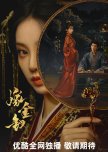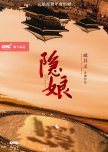
My Therapist Says I’m Not Allowed to Talk About the Gold Anymore
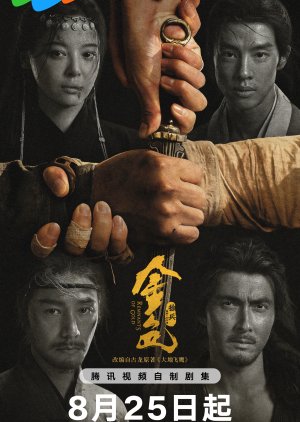
Let me start with a confession: I went into Remnants of Gold expecting a stylish sand-and-swords romp. What I got was a three-day existential crisis, a sudden urge to distrust all dunes, and a profound fear of loose change.Director Xu Bing doesn’t just adapt Gu Long—he dissects him. The 300,000 taels of gold aren’t treasure; they’re a Rorschach test. Everyone who chases them doesn’t go mad—they go true. And that’s the horror. The desert isn’t a setting; it’s a character, and it hates you personally. The cinematography is so achingly beautiful that you’ll forget people are screaming until you realize you’re the one screaming.
The Serious Part (because I have to):
This is a Wuxia drama about the death of idealism. Pu Ying (Yin Fang) is the law’s last gasp, and watching him wrestle with duty while the sand eats his morals is like watching a candle burn in a hurricane—heroic, futile, and hypnotic. Xin Zhilei’s Zhang Luyao is a revelation: a vengeance engine wrapped in poison-proof skin, yet somehow more fragile than glass. She doesn’t want the gold; she wants the lie that gold represents. Chen Kun’s Yu Hou is the political animal we all fear becoming—calculating, charismatic, and utterly hollow. And Vengo Gao’s Ban Zha? The chaotic neutral trickster who made me laugh, cry, and question if freedom is just another cage.
The Funny Part (because I’ll cry otherwise):
· The gold has a higher body count than the plague. At this point, I’d trust a timeshare salesman more than a treasure map.
· Ban Zha walks into every scene like he’s at a desert rave, and I respect that energy.
· If I had a coin for every time someone whispered “the gold” with dramatic gravitas, I’d have 300,000 taels and promptly lose my mind.
The Thought-Provoking Part (because I can’t stop):
Is the gold a metaphor for ambition? Greed? Hope? Or is it just a MacGuffin that exposes how we’re all willing to become ghosts for something that doesn’t exist? The show asks: What do you chase when you know the chase will destroy you? And then it gives no answers—just more sand, more masks, and more broken oaths. The finale doesn’t resolve; it echoes. I sat through the credits in silence, feeling like I’d just watched a funeral for every character I loved, including the parts of myself that believed in happy endings.
Final Verdict:
It’s a masterpiece. It’s also emotional vandalism. I’d rewatch it endlessly—not because I enjoy the pain, but because each viewing reveals a new lie, a new truth, or a new shadow on the dune. Bring water, bring patience, and bring a therapist. You’ll need all three.
10/10. Would lose my sanity again. Next time, I’m chasing the gold with Ban Zha. At least he’ll make me laugh before we both die.
Was this review helpful to you?
This review may contain spoilers
What is worth preserving in yourself when everything around you has a price?
Introspective and transcendental, with a subtle supernatural touch. A story that looks for something far more valuable than the gold at its centre: what remains of us when desire, survival, and circumstance put our values to the test.“In this life, is it better to die with wealth enough to rival a nation, or to die respected by others?” At the end of your life, what has greater value: what you possessed, or what kind of human being you were?
10/10 for the dialogue, directing, and performances.
The dialogue can be strangely dry and almost absurd at times. Conversations have a very mundane, human rhythm. The characters sound like a collection of peculiar individuals who happen to have ended up in the same desert rather than generic wuxia archetypes. I loved the conversational quality: exchanges feel like two people reacting to one another rather than actors waiting to deliver polished lines. You are expected to catch the tone, pause, facial expression or contradiction yourself. The dialogue and behaviour feel like real everyday life rather than something written for a drama. People hesitate, ramble a little, make ordinary comments or leave things unsaid. Small gestures and people not explaining themselves make the drama feel lived rather than performed. You get the impression that the camera has happened upon these people rather than that they’ve positioned themselves for a scene. Each one appears suspicious, and by the end of the drama, you finally understand who they truly are.
The location, voices, yellowish grading and even the very dark, naturally lit night scenes make the production feel very tangible. The real desert reinforces all of it. The wind, sand, sun and emptiness feel almost like another character rather than merely a picturesque background. The gold itself feels almost metaphorically like a seductive trap, while the endless desert becomes the grave of those consumed by greed.
The ending is beautifully open to interpretation. Whether the gold is literally there almost becomes secondary. Zhang Lu Yao sees it and can still ride away, unlike so many who were destroyed by their desire for it. Even more striking is Pu Ying. One of the purest characters, he has consistently refused the gold. In the final scene, he rolls down the dune and accidentally uncovers the ingots without even noticing them. The irony is beautiful: the man who never wanted the gold is the one who finally reveals it. He doesn't even need to reject it anymore; it has simply ceased to hold value in his inner world.
Throughout the story, people desperately search for gold and destroy themselves trying to find it. In the end, when nobody is searching, it quietly reveals itself to the person who wants it least.
Those who desperately sought the gold could not possess it. The man who never wanted it finds it without even knowing he has.
Was this review helpful to you?
What Do You Carry Across a Desert?
Three hundred thousand taels of missing gold, a massacred family and far too many people who seem to know something about both.That is more or less where Remnants of Gold begins. Zhang Luyao is looking for the truth about what happened to her family, Pu Ying is following an investigation of his own, and somewhere between them sits a much older story involving soldiers, old loyalties and a fortune nobody seems to have actually enjoyed.
It sounds like a mystery about missing gold. For a while, it is.
But the further the story goes, the less interesting the gold becomes.
Part of that is because of the people gathering around it. Zhang Luyao is intelligent, guarded and formidable, but thankfully not written as someone whose intelligence prevents her from making bad decisions. Xin Zhilei gives her a wonderful stillness; she can look exhausted by the world and still be the most dangerous person in the room.
Yu Hou is much messier. Chen Kun makes him selfish, charming, cowardly, lost and loyal without making any of it feel contradictory. He wants money because money means freedom, or at least he thinks it does. The problem is that he keeps forming attachments that make walking away considerably harder than he planned.
Pu Ying is quieter. Yin Fang gives him an appealing steadiness, although the writing never opens him up quite as much. And then there is Ban Cha, who appears with his wine and salt and the general air of a man who has wandered into everyone else's emergency by accident.
By then, the gold has collected an increasingly strange jianghu around it. Ha Bingzhong, Tie Futu, Xiaofang, Pingping, Seventeen, Tang Zheng, the Qin Demons... almost everyone arrives with an old debt, a private motive or some piece of history nobody thought worth mentioning earlier.
I liked that. A strange habit, an old grievance, a few lines of dialogue, and someone who appeared ten minutes ago can feel as though they have been wandering around this world for years.
Sometimes, though, there really isn't much more than the suggestion.
Thirteen episodes keep the story lean, but they also leave several characters somewhere between memorable minor figure and plot mechanism. Xiaofang and Pingping matter, yet their fates very conveniently push other characters where the story needs them to go. Tang Zheng arrives carrying enough history for another drama, while the Qin Demons are wonderfully strange and also suspiciously useful when needed.
Despite finding these people interesting, I never became deeply attached to most of them. The drama keeps us at a certain distance, letting people reveal themselves through what they do, what they remember and what they refuse to explain. I suspect some of that is intentional. Sometimes it works. At other times, especially when characters start dying, I understood why something mattered before I necessarily felt that it mattered.
Xu Bing's direction can be similarly uneven. He likes taking his time, and often I liked taking it with him. People sit and drink, conversations circle around what nobody wants to say, and silences are allowed to last.
But sometimes a scene continues after it has already made its point, while something much more important is treated so elliptically that I wondered whether I had missed a scene somewhere. This becomes particularly noticeable toward the end, when thirty years of grudges, loyalties and unfinished business suddenly have to come together in very little time. Some deaths feel inevitable. Others feel rather more like somebody needed to die so somebody else could finally make a decision.
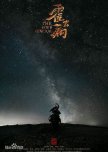
The desert location work is one of the drama's strengths. It looks dry, empty and unpleasant to cross. The fights have weight, people get dirty and exhausted, and there is a roughness to the whole thing that suits this world. Some of the sets are much less convincing, especially beside those landscapes.
I liked the sense that these people had lives before we met them. They are selfish, loyal, petty, stubborn, occasionally foolish and not always easy to place neatly on one side of anything. Even when the writing didn't give me quite enough of them, it usually left me wanting to know more.
And somewhere along the way, I stopped wondering who would end up with the 300,000 taels of gold, or whether there was ever any gold to find. After enough time in this desert, even the gold begins to feel like a story someone once told.
I wanted to know what would happen to the people still looking for it.
There is quite a bit here that bothered me, but I can already see myself watching it again someday. So despite all my complaints, I'm giving it an 8.5.
Was this review helpful to you?
1
1
1