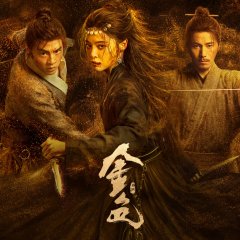
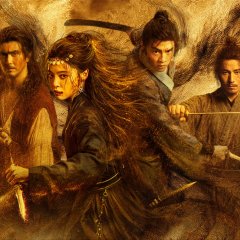
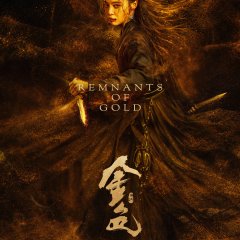
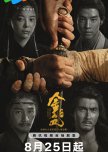
Three hundred thousand taels of gold appear without warning in the vast desert, stirring the winds of fate. Rumor has it that all who seek the treasure are doomed to become vengeful spirits, consumed by greed and madness. On the very first day of his investigation, a Jinyiwei officer falls into insanity. His faithful deputy, lost in the shifting dunes, spirals ever deeper into a struggle between desire and loyalty. Meanwhile, a woman once marked for death—her entire family slaughtered, her body now immune to all poisons—returns to the desert. She willingly places herself at the heart of a brewing storm, making herself the prize in a deadly contest fueled by revenge. Behind the ceaseless, swirling sands lie insidious traps and the insatiable greed of those who covet the gold. (Source: Chinese = Tencent, Weibo, Baidu || Translation = MyDramaList) ~~ Adapted from the novel "Da Di Fei Ying" (大地飞鹰) by Gu Long (古龙). Edit Translation
- English
- Русский
- Deutsch
- Français
- Native Title: 金色
- Also Known As: Da Di Fei Ying , Jin Se , 大地飛鷹 , 大地飞鹰
- Screenwriter & Director: Xu Bing
- Director: Zhang Sheng Fu
- Genres: Mystery, Wuxia
Where to Watch Remnants of Gold
Cast & Credits
- Xin Zhi LeiZhang Lu YaoMain Role
- Yin FangPu YingMain Role
- Gao Wei GuangBan ChaSupport Role
- Ken WuXiao Fang [Liang Zhou Guard soldier]Support Role
- Bu Guan JinPing Ping [Lu Yao's sworn sister]Support Role
- Chen KunYu Hou [Deputy envoy of Liang Zhou]Support Role

Reviews
My Therapist Says I’m Not Allowed to Talk About the Gold Anymore
Let me start with a confession: I went into Remnants of Gold expecting a stylish sand-and-swords romp. What I got was a three-day existential crisis, a sudden urge to distrust all dunes, and a profound fear of loose change.Director Xu Bing doesn’t just adapt Gu Long—he dissects him. The 300,000 taels of gold aren’t treasure; they’re a Rorschach test. Everyone who chases them doesn’t go mad—they go true. And that’s the horror. The desert isn’t a setting; it’s a character, and it hates you personally. The cinematography is so achingly beautiful that you’ll forget people are screaming until you realize you’re the one screaming.
The Serious Part (because I have to):
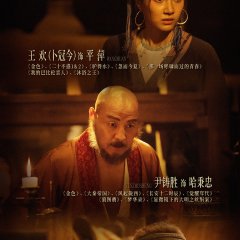
This is a Wuxia drama about the death of idealism. Pu Ying (Yin Fang) is the law’s last gasp, and watching him wrestle with duty while the sand eats his morals is like watching a candle burn in a hurricane—heroic, futile, and hypnotic. Xin Zhilei’s Zhang Luyao is a revelation: a vengeance engine wrapped in poison-proof skin, yet somehow more fragile than glass. She doesn’t want the gold; she wants the lie that gold represents. Chen Kun’s Yu Hou is the political animal we all fear becoming—calculating, charismatic, and utterly hollow. And Vengo Gao’s Ban Zha? The chaotic neutral trickster who made me laugh, cry, and question if freedom is just another cage.
The Funny Part (because I’ll cry otherwise):
· The gold has a higher body count than the plague. At this point, I’d trust a timeshare salesman more than a treasure map.
· Ban Zha walks into every scene like he’s at a desert rave, and I respect that energy.
· If I had a coin for every time someone whispered “the gold” with dramatic gravitas, I’d have 300,000 taels and promptly lose my mind.
The Thought-Provoking Part (because I can’t stop):
Is the gold a metaphor for ambition? Greed? Hope? Or is it just a MacGuffin that exposes how we’re all willing to become ghosts for something that doesn’t exist? The show asks: What do you chase when you know the chase will destroy you? And then it gives no answers—just more sand, more masks, and more broken oaths. The finale doesn’t resolve; it echoes. I sat through the credits in silence, feeling like I’d just watched a funeral for every character I loved, including the parts of myself that believed in happy endings.
Final Verdict:
It’s a masterpiece. It’s also emotional vandalism. I’d rewatch it endlessly—not because I enjoy the pain, but because each viewing reveals a new lie, a new truth, or a new shadow on the dune. Bring water, bring patience, and bring a therapist. You’ll need all three.
10/10. Would lose my sanity again. Next time, I’m chasing the gold with Ban Zha. At least he’ll make me laugh before we both die.
What is worth preserving in yourself when everything around you has a price?
Introspective and transcendental, with a subtle supernatural touch. A story that looks for something far more valuable than the gold at its centre: what remains of us when desire, survival, and circumstance put our values to the test.“In this life, is it better to die with wealth enough to rival a nation, or to die respected by others?” At the end of your life, what has greater value: what you possessed, or what kind of human being you were?
10/10 for the dialogue, directing, and performances.
The dialogue can be strangely dry and almost absurd at times. Conversations have a very mundane, human rhythm. The characters sound like a collection of peculiar individuals who happen to have ended up in the same desert rather than generic wuxia archetypes. I loved the conversational quality: exchanges feel like two people reacting to one another rather than actors waiting to deliver polished lines. You are expected to catch the tone, pause, facial expression or contradiction yourself. The dialogue and behaviour feel like real everyday life rather than something written for a drama. People hesitate, ramble a little, make ordinary comments or leave things unsaid. Small gestures and people not explaining themselves make the drama feel lived rather than performed. You get the impression that the camera has happened upon these people rather than that they’ve positioned themselves for a scene. Each one appears suspicious, and by the end of the drama, you finally understand who they truly are.
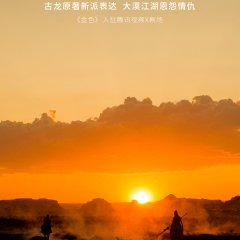
The location, voices, yellowish grading and even the very dark, naturally lit night scenes make the production feel very tangible. The real desert reinforces all of it. The wind, sand, sun and emptiness feel almost like another character rather than merely a picturesque background. The gold itself feels almost metaphorically like a seductive trap, while the endless desert becomes the grave of those consumed by greed.
The ending is beautifully open to interpretation. Whether the gold is literally there almost becomes secondary. Zhang Lu Yao sees it and can still ride away, unlike so many who were destroyed by their desire for it. Even more striking is Pu Ying. One of the purest characters, he has consistently refused the gold. In the final scene, he rolls down the dune and accidentally uncovers the ingots without even noticing them. The irony is beautiful: the man who never wanted the gold is the one who finally reveals it. He doesn't even need to reject it anymore; it has simply ceased to hold value in his inner world.
Throughout the story, people desperately search for gold and destroy themselves trying to find it. In the end, when nobody is searching, it quietly reveals itself to the person who wants it least.
Those who desperately sought the gold could not possess it. The man who never wanted it finds it without even knowing he has.
Recent Discussions
| Title | Replies | Views | Latest Post | |
|---|---|---|---|---|
| Character Relationship Chart by BaekhyunoonaID | 0 | 0 | earwhipper 13 days ago | |


1
1