Beethoven but Japanese; Not flawless but a VERY good time
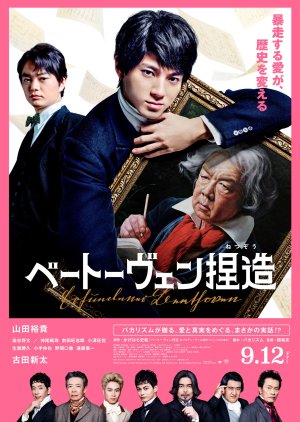
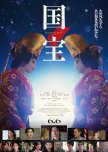
Okay, this is a very blown up/exaggerated rating, but I fear I cannot stay neutral here since I’m a huge Yamada Yuki fan. #yukicultIt was amazing being able to catch the international premiere of this movie, especially in the city it’s mostly set in. The film follows Schindler, Beethoven’s extremely devoted secretary, who works tirelessly to preserve Beethoven's image while idolizing him to the extreme.
The premise itself is quite fascinating: an entirely Japanese cast playing Europeans in a "fake 19th century Europe" built on LED screens which were definitely noticeable at times, sometimes more than others. Of course, I constantly found myself wondering which parts of Vienna they were trying to capture in those bird's-eye shots.
The actors really gave it their all despite the strange setup and story. Yamada Yuki carried for sure! I love him in slightly unhinged roles and this was no exception. I even caught myself rooting for his (delusional?) character, though maybe that’s just my bias.
It’s also interesting how about 90% of the film is told through voiceover rather than dialogue. With its 115-minute runtime it’s certainly not particularly long but I feel it could’ve been tighter and more engaging if cut down to around 90 minutes. Some of the monologues felt like they went on for a bit too long and kept going in circles.
My friend pointed out some historical inaccuracies in the costumes, apparently mixing styles from different eras. I can’t really comment on that but I feel like if I knew anything about it, it wouldn’t bother me that much. The film isn’t concerned with strict historical accuracy — on the contrary, it’s exactly focused on the tension between myth and reality. How much truth are we willing to ignore to keep enjoying the fantasy?
Overall, I had a really good time. The audience was laughing a lot, the atmosphere was great and it just felt special to experience this film on the big screen. I hope I will be able to rewatch it as soon as possible.
Was this review helpful to you?

It's Not As Boring As It Sounds, But ....
Faking Beethoven is a rather straight-forward biopic of Anton Schindler who served as Ludwig Van Beethoven's secretary for a few years towards the end of Beethoven's career and life. Schindler was one of the earliest biographers of Beethoven and was competing with a few other of Beethoven's associates to leverage the composer's name, frame his legacy and make some money via publication. Schindler had been suspected of strongly controlling the narrative of Beethoven's life (or at least his later years) from the first edition of his biography in 1840, but it was not until 1977 that it was proven the lengths to which he had done so. After Beethoven died he acquired the conversation books that people had used to speak to Beethoven after he had gone fully deaf and then severely edited them and added new lines and content. He then tossed away most of them, and sold the remainder to a major Prussian university. It was a only mild scandal in the academic world (since there are many other sources for documenting Beethoven's life), and I will note that the whole thing was not even considered worth bringing up when I took a course on Beethoven's symphonies as a student at UC Berkeley in the mid 80s for which a later biography was required reading. People at the time were much more interested in whether an unsent love letter by Beethoven to his "Immortal Beloved" was, in fact, meant for a guy (which it might have been but no one knows for sure).And so this film details the history of Schindler's time with Beethoven, and the subsequent publication history of the various editions of Schindler's biography of the man. The film is written by Bakarhythm, and so it leans comedic but less so than many of his works. However, the script is entirely too reliant on voice-over throughout the film. Yamada Yuki manages a journeyman's effort conveying a weirdly obsessed fan of the composer who got to be part of his daily life for a few years and wanted to shape the world's understanding of the man to conform to his vision of his erstwhile employer. Furuta Arata has fun as "the great man" who is well documented by many other sources as being volatile, gruff, complex and interesting.
The film is not Amadeus nor does it aspire to be. But one has to wonder if there are not many more interesting stories about Beethoven's life that would serve to make a better film. Heck, we get tangentially get a bunch of Beethoven's relationship to his nephew Karl in this film which is a far more dramatic story than what this film centers. This film is probably a must watch if you are a fan of Yamada. For everyone else, the film is a bit more vibrant than you might expect given that it's really about one guy's efforts to assert his narrative about a famous public figure over a handful of rival narratives in ways that are of little consequence even for the academics who do care about accurately documenting Beethoven's life and legacy. And so I'd say if you're interested in the period in general or the later life of Beethoven, then you likely would enjoy the film.
Was this review helpful to you?