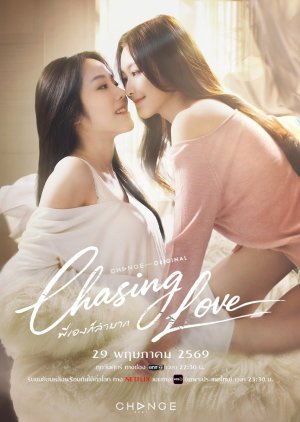
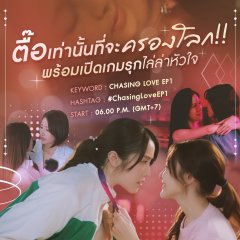
After what was meant to be a one-night stand, guarded scientist Song melts into a romance with her hookup — who turns out to be her boss's daughter. Three women running away from love cross paths with three others who refuse to give up chasing their hearts — proving that love is what keeps the human spirit alive. No matter how hard we try to escape, in the end, everyone still wants to love and be loved. (Source: Netflix; thai.film) ~~ Adapted from the novel "Chasing Love" (พี่เองก็ลำบา)" by Peony (พีโอนี). Edit Translation
- English
- Français
- Português (Brasil)
- Español
- Native Title: พี่เองก็ลำบาก
- Also Known As: I'm Struggling Too , Phi Eng Ko Lambak
- Director: Bo Pantip Vibultham
- Screenwriter: Ticha
- Genres: Romance, Drama
Where to Watch Chasing Love

Subscription (sub)
Cast & Credits
-
") Nile Chanidapa Sommitthanakul"Song" Sadanan WorakitMain Role
Nile Chanidapa Sommitthanakul"Song" Sadanan WorakitMain Role -
") Namwan Natchaya Vongbut"Piang" Piangrawin ChatphimukMain Role
Namwan Natchaya Vongbut"Piang" Piangrawin ChatphimukMain Role -
") Fay Apisara LertwisettheerakulPloySupport Role
Fay Apisara LertwisettheerakulPloySupport Role -
") Gene Ornalin LeelaburanathanakulPleSupport Role
Gene Ornalin LeelaburanathanakulPleSupport Role -
") Gift Sirinart Sugandharat"Matmi" Matika ChatphimukSupport Role
Gift Sirinart Sugandharat"Matmi" Matika ChatphimukSupport Role -
") Aomsin Nuttharat Papirom"Rin" KhwanrinSupport Role
Aomsin Nuttharat Papirom"Rin" KhwanrinSupport Role









Reviews

Stockholm Syndrome, but Make It a Family Drama
This series begins with an unusual premise, attractive production values and several potentially engaging relationships. The first episodes contain enough chemistry, comedy and mystery to suggest that the story could become a compelling mixture of romance and emotional drama.Unfortunately, the writing quickly collapses underepetitiver forced conflicts, irrational character decisions and clichés.
Rather than developing its characters, the series repeatedly changes their personalities to serve individual scenes. Song pushes Piang away whenever the plot needs separation, then becomes affectionate whenever the story needs romance. Piang moves between independence and emotional dependence without a convincing internal journey. The side couples fall in love, separate and reunite with almost no meaningful development.
The central family conflict is even more frustrating. Piang’s grandmother is depicted as controlling, manipulative and abusive, yet the story repeatedly excuses her behaviour as love. Her sudden transformation in the finale is not supported by any genuine reflection, accountability or consequences.
The series also introduces serious themes—including suicide, guilt, emotional abuse, class discrimination and abusive family relationships—but rarely explores them with the necessary depth. These issues function mainly as plot devices designed to create temporary drama.
Some of the supposedly sensual moments feel so immature and awkwardly staged that they seem less like intimacy between two adult women and more like the fantasy of a puberty-driven twelve-year-old boy. Instead of strengthening the romance, these scenes often make it feel artificial emotionally empty.
There are still occasional enjoyable moments. Piang can be charming, and the production is visually appealing. However, these strengths cannot compensate for storytelling in which almost every major emotional development feels rushed, manipulated or undeserved.
In the end, the series does not fail because it uses familiar tropes. It fails because it uses them without believable character logic, emotional consequences or proper development. The result is a polished production built around deeply incompetent writing.
Was this review helpful to you?

Be honest about how you feel and act accordingly, or you will hurt yourself and others.
I liked the "Dreaming of the future" theme; it's a shame it never comes up again in the plot at any point. The secondary characters are interesting. The production is good (except for the audio glitches that occur a few times), but I found the series' opening quite generic and lacking in any unique elements.However, as the episodes progressed, Song's behavior unfortunately made me start rooting for Piang to end up with another doctor. She kept "playing games" with Piang: she would say, "Go away, leave me alone," while her actions actually said, "Stay by my side." Furthermore, I couldn't find a single solid reason for Piang to love Song, and I found the idea of becoming "friends with benefits" in hopes of making Song fall in love to be completely wrong. If you start a casual relationship and tell the other person, "I don't want anything serious," but you're actually lying—with the real intention of making them fall for you because you love them—that is wrong. The right thing to do is to be sincere and speak your mind; after all, if the roles were reversed, NO ONE would forgive someone for saying they loved the other person and wanted a serious relationship when, in reality, they didn't love them and just wanted to play games. Sincerity is the foundation of everything.
PS.: Couldn't believe Song's crying at the beginning of the episode. One moment Song is crying for someone, and the next she's not. Did she forget she was crying? Hahahaha. At several points the audio is very low, disrupting the experience and disconnecting the viewer.
Was this review helpful to you?
Recent Discussions
| Title | Replies | Views | Latest Post | |
|---|---|---|---|---|
| A deus ex machina blanket resolution for all? by Ivylina Jolie | -1 | 0 | Ivylina Jolie Jul 11, 2026 | |
| Not Homophobic, But Is Seriously Matapobric?? by Ivylina Jolie | -1 | 0 | Ivylina Jolie Jul 4, 2026 | |
| CHASING MASH-UPS LIKE NO OTHER by Ivylina Jolie | -1 | 0 | Ivylina Jolie Jun 19, 2026 | |