1
1 1
1This review may contain spoilers
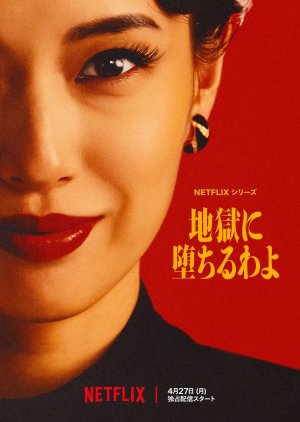
Erika Toda Eats Worms and Builds an Empire in Straight to Hell
This show is unwell, and I mean that as a compliment. This show looked at stability, peace, emotional balance, and said no thanks, we’re going to follow one woman who eats worms and then builds a media empire out of pure spite.And at the center of this chaos tornado is Erika Toda, who is out here playing Kazuko Hosoki from 17 to 66 like she signed a contract with God and refused to lose. Five decades, five personalities, zero weakness. It is honestly offensive how good she is. I felt judged watching her. Like girl, relax, some of us are barely playing one version of ourselves correctly.
We start in 2005. Kazuko is rich, famous, dripping in power, and surrounded by rumors like flies on expensive fruit. Fraud, yakuza, sketchy vibes. The kind of success where people smile at you and then immediately Google “is she a criminal.” So she decides to tell her life story to this struggling writer Minori, played by Sairi Ito. And you think oh, nice, healing moment. No. This is not healing. This is PR with trauma seasoning.
Then the show punches you in the throat with her childhood. Post-war Japan said “good luck” and left her to starve. This woman ate an earthworm to survive. An earthworm! I complain when my food delivery is ten minutes late, and she is out here doing Fear Factor just to stay alive. That kind of origin story does not give you soft eyes and a gentle heart, that gives you laser focus and trust issues so deep they need their own postal code.
By 17 she is lying about her age and working as a hostess, climbing fast because she can read men like cheap subtitles. Of course some trash boss tries to ruin her. Of course. Men stay predictable. But instead of collapsing, she goes full villain origin. She learns one rule and carves it into her soul. Never depend on anyone. Not your boss. Not your man. Not your horoscope. Nobody.
So what does she do? Opens her own nightclub in Ginza. Like a psychopath. Brings her younger brother along. Builds it into a success because apparently survival was just her warm-up round. Meanwhile her love life is a flaming garbage fire. Rich men proposing, promises flying, stability nowhere to be found. And then she gets involved with the underworld because why not add organized crime to the emotional damage cocktail.| Toma Ikuta shows up as a yakuza boss boyfriend and you just sit there thinking yes, this tracks, nothing about this woman screams “safe choices.”
Every time life hits her, she does not break. She upgrades. Betrayal? New skill unlocked. Failure? Character expansion pack. So when she becomes a fortune teller, it feels obvious. Of course she can predict people. She has been reverse-engineering human behavior since she was eating worms in a ditch.
And the show looks amazing while all this insanity is happening. The wardrobe evolves like a glow-up montage on steroids. The makeup ages her so well it is almost disrespectful. And somehow Erika Toda is still dominating scenes she is not even in. That is witchcraft. I am convinced.
The supporting cast is great but they know they are living in her world. Toko Miura brings emotional depth as Chiyoko Shimakura, but nobody is hijacking this train. This is Kazuko’s rollercoaster and everyone else is just strapped in, screaming.
The timeline keeps flipping between past and present, and you start realizing something important. Kazuko’s version of events are suspiciously polished. Meanwhile Minori is digging around like “hmm, this smells like selective memory.” So now it is not just a life story. It is a psychological chess match about who controls the narrative.
Kazuko is not a good person in the clean, Instagram-quote way. She is ruthless, messy, morally chaotic. A walking red flag with perfect lipstick. And yet you cannot look away. Because Erika Toda does not ask you to like her, but dares you to understand her.
Take her out and this show collapses instantly. Leave her in and it feels like you are watching someone set fire to the world and then sell tickets to the show.
Was this review helpful to you?

This review may contain spoilers
Truly one of the most complex female characters I've seen a while.
Hosoki's life story and character development was indeed a roller-coaster for me. I usually don't even leave reviews on shows or movies that I watch, but she truly captivated me. She was by no means... a good person? But you somehow could sort of understand the miserable background she came from. Extreme poverty and hunger, to then being deceived and abused by men over and over again. Seeing her relationship with Hotta was beautiful, in my opinion he was truly the only person she ever loved aside from her mother.Was this review helpful to you?

Erika Toda's magnum opus
Just finished the new biopic J-drama on Kazuko Hosoki (Japan’s most famous fortune teller) on Netflix.In a nutshell, it’s about how a girl rising from the poverty and ruins of post-WW2 Japan develops the hunger, ambition, and eventually the greed to become one of the richest and most influential figures in modern Japan.
I’ve been a long-time fan of Erika Toda ever since her Liar Game days (despite her maybe not being the strongest actress technically — I’ve just always had a soft spot for her lol), so I was honestly in awe when I saw that this biopic would have her portraying the same character all the way into old age.
I’d first like to say this might genuinely be her magnum opus, because the acting she delivers here is easily career-defining. Every stage of Hosoki’s life was portrayed in an absolutely stellar way, filled with deep emotional weight and the complex nuances her character faces throughout each phase of her life.
The story and writing are excellent as well, and the pacing made me binge the entire series in 2 days. (I consume media from everywhere — Western, Japanese, Korean, Chinese, Thai etc. — and nowadays it’s honestly rare for a drama to captivate my attention span enough for me to finish it.) The writers weave together a lot of multi-faceted characters alongside very ambiguous and morally complex dilemmas.
The cinematography is excellent too. I remember within the first 20 minutes or so, there’s a scene where Erika Toda lights a cigarette in her limo and lowers the window just enough for the smoke to drift out as she gazes into the city lights and reminisces about her origins. That was the moment I knew this drama was going to be something special.
Overall, an 11/10 for me, and I’d absolutely recommend any J-drama fan to give this a watch.
Was this review helpful to you?

Erika Toda (Kazuko Hosoki): Delivers a chameleon-like performance. She seamlessly transitions from the vulnerability of a starving youth in the post-war era to the icy arrogance of the "Queen of Ginza," and finally to the loneliness of a mogul in her glass mansion. Sairi Ito (Minori): Serves as the series' moral compass, questioning whether redemption is possible for someone who built a career by exploiting the fears of others.
Under the direction of Tomoyuki Takimoto, the series utilizes a color palette that evolves with the decades: sepia and gray tones for the 40s and 50s, vibrant and saturated colors for the 80s bubble economy, and a cold, clinical aesthetic for the "present" (2006). The soundtrack by Hibiki Inamoto is a standout, mixing classics from the portrayed eras with tense themes that heighten the psychological suspense during the confrontations between the biographer and the psychic.
Erika Toda’s performance is award-worthy; the historical reconstruction of Japan is impeccable; the series tackles complex themes like media ethics and the isolation caused by power. Especially for those who enjoy biopics that don't try to "sanctify" their protagonists. The pacing might be slow for those expecting an action thriller; some episodes focused on Ginza’s nightlife drag on longer than necessary.
Was this review helpful to you?

This review may contain spoilers
Clawing your way out of hell is something only a woman can do: dpmtfo
A cautionary tale that most women in this current generation, of those that live in the west and aren't under the constraints of poverty, don't have to learn the hard way.Women, anyone really, who have come to age in post war arenas have a grit that is admirable and something you don't often see unless you go to the outskirts of society or in rare cases where every circumstance has aligned to create a living hell. I see myself sitting here in my room, because I can't bring myself out to connect with the world, and am reminded of how lucky I am. But sometimes I find myself wishing for that struggle, would that make me stronger like her? Do you get the greater vivid 'human experience' if you go through such trials? If I grew up under such circumstances how would I have ended up? Like her i'm hungry to live, both in different meanings of the word.
In her is a desperateness and hunger that is insatiable and always will be. You will always be that child like she is always a hungry little girl. In the end that shadow follows you wherever you go. It doesn't have to trail behind you or outpace you ,like her's does, but maybe you can walk with it hand in hand.
I wanted to write about those that grew up in post war Europe and e&se Asia but I don't have the right knowledge for the topic. All I know is that this show depicts the desperateness, grit, and emotional trauma that a child of war experiences pretty well.
I must say that I got so pissed off about her husband cheating that I felt it for hours physically and had to write this in order to calm down... I'm not gonna go into that here because it's gonna make me so mad and I don't even know how I would dispel that anger. It felt like a orange giving off slight pressure inside my ribcage, it doesn't help that I found the actor handsome...lol.
While watching I steeled myself over thinking that her one true love would probably die tragically but instead their love suffered a worse fate I didn't foresee. Their relationship and how it ended? Did he die repenting? After seeing her strong everywhere else is she still a fool in love? (yes) Some questions don't need answers because the lack of makes it.
An acquaintance of my grandmother's did the same thing, she took her husband back to nurse him on his deathbed a decade or so after he cheated on her and left with his mistress. This is something women before us had to do similar things to in order to survive, keep a man in your life because you had no agency, but she did it out of 'love'. Now you don't need to stay with a man who disregards all of your experiences and efforts together, dump him... please.. Although it might not be a handsome yakuza who paid off your debts and swindled the man that abused you & it's probably some boy slouching in his gamer chair texting other women, if you need the push you should dump him... Your being, dignity, and agency matters more than that of a man...
To live as a woman is to suffer for no reason in order for men to live... Is that the case? Are you insatiable and hungry if you desire more?
I wanted to watch it again fully instead of skimming somewhat (i'm a massive 10x sec and then rewinder) and write something less surface level and deeper on feminism, the messages you get from the show, & clawing yourself out of hell but i'm still genuinely so pissed off that I can't bring myself to go through it completely. Maybe i'll comment..... I will...
Iv'e heard that to love your appearance as a woman you should think of it as the amalgamation of features that came from those in love before you, but sometimes 'love' is forced. I choose to instead believe that they come from the women that crawled out of hell to survive, like her, and those that never could...
extra:
-Really loved the detail of the shrine and it's state as she and her greediness grew and the reflection it shows to us. Is the deity hungry too? Does it desire more?
-'When one desire disappears it will be replaced with another, that's human nature' (or was the word greed?)
-Got curious and upset over the possible inaccuracies in dresses. Some looked a little too modern, 70s in the 50s etc. ,in certain parts.
Was this review helpful to you?

This review may contain spoilers
Straight to Hell: A Guide to Building the Castles You Can’t Escape
Straight to Hell is a Japanese biopic that burns with stunning energy through its high‑end retelling of a story that observes the price of chasing insatiable ambitions. A ride that punches you in the gut, wrenches your heart, and drops you at the doors of a hostess bar, daring you to survive without selling your body and stay pure-hearted in a world where the blame falls on the gullible, not the liar. Most notably, it challenges you to understand the becoming of a rich, tight-strung seeming woman and see the struggle behind her life of luxury. Through its strong lead, it takes character building beyond its literal sense, revisiting every fragment of time and memory that creates a person, every experience that makes them alive. The drama is not just the memoir of the individual it follows, but a reminder that every coin is two-sided, with a dark underside waiting to be told.The story starts on a bold note and holds the momentum all the way through. Ruthless, record-breaking and cultural phenomenon Hosoki Kazuko—the name that holds the title of Japan’s most famous fortune-teller—is notorious for the blunt quality of her predictions. With grace, she stands poised, every step flaunting heels that serve as weapons in disguise. Just like herself, designed to look pretty while fierce fire burns on the inside, the gunpowder of past wars a rumbling that never stills. If eyes are a window to the soul, her sharp gaze is testimony to the rugged paths she survived with nothing but pride and a head held high. An editor and author follow her extensively, determined to unearth the truth behind daggers of rumours tainting her reputation as a fraud with ties to the Yakuza. Together, they document both the spark of her polished persona under the spotlight of being one of the country’s most domineering mediatic presences and the part of her life spent in the shadows. Finally ready to tell her story, she revives the past six decades. All six numbers of her seemingly lottery ticket of a life slowly reveal themselves—yet perhaps not so honestly.
From post-WWII Japan to the empire of mediatic attention Hosoki led in 2006, the story unravels her life as the world's most celebrity yet controversial fortune‑teller. The reconstruction of different eras reveals how she grittily builds herself a winning name, becoming gold from the earth and dust she once fought her way through. Erika Toda stuns as the central piece to this shifting story, playing ages 17 to 66 with remarkable nuance and precision, embodying this tale of empowerment and rags-to-riches as though Hosoki’s story were truly engraved under her skin. As an underage teenager pretending to be 20, she first begins her lifelong journey to success working in a hostess club in a bustling district reigned by desire and greed after a long postwar period. What represents a night-retreat for the rich, women-famished men in the area is grounds for survival for the hostess ladies trained to compete for their pay. Luckily, Hosoki possesses an actress's talent for crying on the spot, which she uses in her favour to turn a literal one-man show into a puppet theater where she is the master of their strings.
Although her effortless charm makes her the gravitational pole of everyone's heart, it also makes her the victim of betrayal from the hostess's boss himself. Furious at being tricked into selling her body, his leading her down the road “straight to hell” marks the next chapter of her story. But unlike this bad faith suggests, her fiery sense of determination drives her to turn the tables and become the one creating that hell, leading her own uprising and setting those she passes ablaze. The support of an investor grants her monetary freedom, allowing her to juggle her sprouting businesses and school, marking the start of her journey to becoming an accomplished and educated woman—then crowned the “queen” of Ginza, the most sought-after and high‑end Japanese nightlife district. She reigns the streets like a feline claiming its territory until a member of the Yakuza Japanese mafia enters her life, leaving her with heartbreak and insurmountable debt.
However, some stones still remain unturned, and more stories are yet to be discovered. Driven by her growing curiosity and an adept sense of journalism, Uozomi Minori manages to meet Hosoki’s estranged brother and longtime business partner, Hosoki Hisao. His retelling of his celebrity sister’s past places the author in a dilemma, torn between continuing as planned and writing Hosoki’s story in a favourable, white washed lens, or revealing the darker truth behind her fame and risking trouble. The shocking discoveries she makes seem endless in their cruelty as she continues to meet Hosoki’s past acquaintances, each encounter revealing a sinister underside to her otherwise acclaimed reputation.
Back in the nineteen-seventies, Hosoki continued to plummet like a wingless bird. Her empire becomes a cage instrumenting her own demise, transforming her castle into a prison that steals from her in more ways than one. After being pulled into the world of assault, authority and crime, another member of the Yakuza slips into her heart. This time, a saviour who has always led his life by the standards of tradition and integrity. But even when he leaves her palace, fumes of cigarettes and moral decay still linger, swarming around no other than herself, revealing her as the final shadow…and perhaps the ultimate villain of the story. The crown of notoriety she once wore becomes a symbol of corruption, a stolen jewel reflecting all the shining beauty she took away from those around her. First hungry for food, then for success, and finally power. While chasing the satiation of her greed, all of her inhumane experiences left their everlasting trace on her, leaving her unable to erase their rot and shaping her into a villain herself.
With nothing but her own two hands, her exquisite manipulation skills, her familiarity with the cruel workings of life, and her immeasurable wealth, she builds a reputation not even she can escape—not even in the name of survival. Seeking to seal her faith as an untouchable figure, she pursues a career in fortune-telling, becoming the power orchestrating others’ misfortune, perhaps even for her own gain. Her sincere spiritual awakening that had once anchored her among the instability of her life transforms into a vessel through which she can feed off of other people’s most sacred hopes and dreams. Yet in the end, Hosoki falls victim to her own slogan, the very predictions she sold lifting her onto a cursed throne that was bound to fall to pieces. All along, the series title didn't just allude to the hell she was put to due to others or the hell she put others through. Rather, it signified her own descent, every step she ever took ultimately leading her down the path straight to hell.
Ironically, the fortune teller’s own future in the series remains an unresolved enigma rather than a clear answer. The audience becomes the true predictor, weighing the array of possible answers to the endless questions Hosoki Kazuko left behind with her legacy. As Uozomi writes in her book, “What will happen to Kazuko in the future? Even her own six‑star astrology has no answer for that.”
This slice of hell is plated fashionably, satisfying the hungry audience's craving for pure, untamed chaos. From its production quality, to its orchestral music and luscious visual appeal, Straight To Hell is one of the rare gems that aims high yet still successfully scores without missing a single beat.
Was this review helpful to you?

This review may contain spoilers
Fortune telling works. In fact, it works all too well. Simply because we choose to believe in it. A bit like merit.Right from the first episode, we hear a line that, as a true Balzac fan, I simply couldn't help but notice : "But I refuse to be poor. I want to make a lot of money." Trapped first by this necessity, and then by the social pressure to become rich. She will stop at nothing, and where it becomes incredible is seeing her in action : she struggles, she loses all her illusions and only becomes more ruthless, going from one debt to another. Even more interesting is the perspective of the author tasked with transcribing the memories of this seemingly cruel old lady. The whole narrative aims to provide an insight into the Japanese mindset regarding "success" and to allow us to reflect on it in turn.
"Better to deceive than to be deceived", a statement that Vautrin would certainly not disavow. In a world where money is king, we are all its slaves ; we are left with no other choice. We choose to believe that if we want to, we can. And it has always been the other way round. By taking the example of a woman who gets rich through her hard work and the sacrifice of her soul on the altar of the golden calf, it only makes this truth all the more glaring.
We find ourselves in the company of a rich and powerful celebrity who fantasizes about her memories of poverty and a penniless author forced to work a side job. It might be tempting to dislike a character like Hosoki Kazuko (Erika Toda), but she embodies the values of her time. This isn't about passing judgment. She chases after money, she spends ostentatiously, she brags about her successful bets, she recounts her petty acts of revenge. And the figure of the Buddha reappears in nearly every episode... everything remains an illusion except for the suffering of this life. We're already straight in hell. This character endures abominable things. (the grip of the yakuza… those leeches as violent as they are arrogant and always detestable) But we are confronted with a terrible thing : it is she who tells the story… a little too well to be honest.
The series doesn't depict the real life of this person who actually existed at all : "Hosoki began managing Tokyo clubs and coffee shops while still a teenager, eventually running up debts to members of Japanese organized crime" says Wikipedia. And that's not a problem, because the form matches the content. That is the series' focus, its vocabulary, purpose and reason for being.
"Self-Portrait of a Trompe-l'œil"
The cinematography is simply magnificent. A visual delight. The nightlife, the illusory wealth, the facades, the contrast between extreme poverty and luxury, the dirt-floored rooms and the beautiful apartments. Behind the scenes lies a ruthless exploitation of oneself and others.
Everyone gives a wonderful performance. That's essential when there are so many long takes and short single-take sequences. The director gives plenty of creative freedom to his lead actress, Erika Toda, who delivers a phenomenal performance in this role spanning 60 years of life. Her style, demeanor, and personality traits evolve with the character's supposed age and depending on who tells the story.
"I don't believe in fortune telling."
At the end of Les Illusions Perdues, Vautrin launches into a long monologue in which Balzac has him say the following :
"Success is the ultimate motive behind all actions, whatever they may be. The act itself is therefore nothing in and of itself ; it exists entirely in the idea that others form of it. [...] When, after having legally amassed a fortune, you are rich and a marquis, you will allow yourself the luxury of honor. You will then profess such refinement that no one will dare accuse you of ever having lacked it."
Isn't the parallel with Straight to Hell striking ?
Was this review helpful to you?

This review may contain spoilers
My God... What a Woman!
Often in a show, you know who to hate and who to love. Who to proverbially spit on and who to empathize with. Who to have good thoughts about and whose neck you want to ring. It's often clear-cut, with maybe a few grey characters here and there.But what if one character was an embodiment of all the above? You hate to love her and live to hate her. You empathize with her one minute, and the next, you start thinking that hell really should have separate sections. We truly can't all go to the same place and suffer the same punishments..., right?
As Kazuko said in the finale, her life is entertaining. She is an enigma. A confusing, puzzling woman whom I don't even know if I like, hate, respect her or am wholly afraid of. Her ambition and desire to be richer than probably God himself is insane, in the best of ways. However, the things that she does to get to where she eventually ended up... Yikes.
I love how complex she was. She was never good. Morally grey at best when she was a child, but life turned her into something else entirely. I am envious of how she never let life beat her down. How she always got up, survived, and pivoted. Was it all due to luck? The men in her life? Her brilliance and conniving nature? Or a combination of everything?
Personally, I think it's the latter. She had insane luck on her side, was as brilliant as she was conniving, and was strong despite all the misfortune and setbacks that hounded her. And above all, she was a damn good con artist. But despite the evil that she was at the end, there was still some good in her. A tiny sliver of it, but it was there. I understand her, and she scares me
PS: I know the plot was about Kazuko herself, but I wish we had seen more of her family. Her sisters, especially. The sisters, especially the oldest, never liked her (and Kazuko looked down on her, too). I wonder how they felt over the years. Her brother's story would have been interesting too. Of all the family members, he was with her the most till she dumped him for her image. I wonder what his life had been like walking behind Kazuko all those years
Was this review helpful to you?

A Summary, Not a Story (Actual Rating: 0.5)
Watching this drama was like watching a very long recap - a surface-level overview that prioritizes conceptual ideas over meaningful execution. If you are expecting a compelling psychological study of a complex villain, set against the rich backdrop of a post-war Japan rebuilding itself, you will find yourself disappointed.The show tried to do too much, and decided to solve their problem by heavily relying on us having prior knowledge of the public figure. Instead of, oh I don't know, focusing on active storytelling. The script spends barely minutes on the titular character’s actual formative years, immediately thrusting us into Hosoki Kazuko's adulthood when her persona is already fully established. From there, the plot settles into a repetitive, superficial cycle:
A business is established -> The audience is abruptly told the venture was a success in the next scene -> A hardship occurs that barely lasts and has our Hosoki still looking as impeccable as ever, then is followed immediately by another pivot to a new enterprise -> Rinse and repeat
Because we are not permitted to witness the labor behind her success or properly see the emotional fallout of her failures, Hosoki's supposed moral descent carries no dramatic weight. Not that there even IS a semblance of a moral descent to explore in the first place. By the time the drama reaches its crude conclusion, we are once again simply told that she is the villain, rather than being allowed to witness her evolution into one. Heck, we don't even get into fortune telling, her actual big business, until the last couple of episodes. And even then, it is just breezed through like it is a mere footnote.
Speaking of, the show starts off with Hosoki fiercely criticizing a woman for relying on men, advocating instead for female independence (ironically, in real life, Hosoki propagated that it was women's duty to serve men). Yet, despite this opening stance, the narrative anchors all of Hosoki's struggles to her romantic entanglements. While romantic conflict can be a valid vehicle for character exploration, the relationships in this drama lack emotional resonance onscreen. Because Hosoki is written as a mere image rather than a fleshed-out human being, the emotional weight that these conflicts carry are as light as a feather.
As for the acting, Erika Toda herself delivers a great performance, but she is visibly constrained by the material. I don't think Erika herself knew just who she was portraying or wanted to portray. The direction and script leave her characterization fragmented; rather than portraying a cohesive, evolving individual, Erika is left navigating a series of disjointed emotional states dictated by the plot's immediate needs.
Historical context? Despite the immense potential of the post-war setting, the historical backdrop functions as mere window dressing. Aside from well-crafted period sets and sporadic news snippets, the socio-political climate has zero impact on the actual story.
I only stuck around until the end because a non-MDL reviewer said that the last few episodes were juicy enough. But I was ultimately left sorely disappointed there as well.
Was this review helpful to you?

Une route pas si droite...
C’est toujours un plaisir de revoir Toda Erika dans un premier rôle. Si son récent Reboot ne m’avait pas convaincu, tant il était dénué de réalisme, Straight to Hell se veut l’antichrist du « what the fuck » déballé dans cette histoire de chirurgie parfaite complètement improbable. Et c’est justement le physique de Toda-san qui va être mis à l’épreuve dans ce biopic historique dépeignant la vie de l’une des figures les plus controversées des médias japonais, la voyante télévisuelle Hosoki Kazuko, disparue en 2021 à l’âge de 83 ans.Après avoir fait partie de la grande famille des Femmes ayant fait le Japon dans les fameux asadora de la NHK, incarnant durant le XXe siècle la sympathique Kawahara Kimiko, génie de la céramique, elle ne semble pas effrayée de rempiler dans une nouvelle fresque historique dépeignant la même période. Mon sentiment était que, depuis Scarlet, elle n’avait plus vraiment rayonné dans un drama, ses premiers rôles étant éclipsés par ses partenaires, souvent bien plus marquants, comme dans Story of My Family, Police in a Pod ou justement le récent Reboot, qui n’en était vraiment pas un pour sa carrière, ne convainquant pas avec son côté faussement mystérieux.
Mais avec Netflix à la manœuvre et en incarnant quasiment chaque minute d’écran disponible la sulfureuse Hosoki Kazuko, elle risque bien de relancer sa carrière, en particulier à l’international. Car cette série s’offre le luxe de sortir dans tous les pays en même temps, avec doublage régional, monsieur ! Évidemment, c’est un crime de lèse-majesté d’entendre autre chose que la voix originale d’Erika, surtout que l’effort de mimétisme ne s’est pas porté uniquement sur le maquillage ou les gestes, mais aussi sur la voix, qui doit être cohérente avec l’âge du personnage, 66 ans lors de l’intrigue en 2004.
Bien sûr, les habitués de l’actrice seront gênés par sa prestation durant cette période, le maquillage révélant tout de même son âge réel. Elle adopte en plus des manières à la Sharon Stone dans Basic Instinct, assez gênantes à mon gout, accentuant encore le côté « cosplay » de son personnage. En face, son intervieweuse prend bien plus d’ampleur, incarnée par la toujours sympathique mais trop peu présente à l’écran Ito Sairi. Un film et un drama par an en général, comme si ses personnages de gentilles coincées se reflétaient dans les propositions de rôles. Pourtant, avec sa voix cassée, on peut lui imaginer tellement de propositions cinématographiques. Ici encore, elle découvre un mentor qui va lui apprendre comment une femme doit prendre en main sa vie plutôt que de la subir.
Les hommes vont donc en prendre pour leur grade nous promet on, même si la réalité historique et sociétale rattrape régulièrement le personnage incarné par Erika. Netflix a mis tous les moyens possibles pour faire de ce drama une référence dans la description des ères Shōwa et Heisei. Les costumes, la mise en scène et surtout les décors sont magnifiques et, même s’ils sont parfois trahis par les effets numériques et les plateaux de studio, la reconstitution des ruines de l’après-guerre est bluffante. Les cabarets sont fastueux, tout comme les demeures, et la bande originale, bien à sa place, accompagne la tension, que l’on aurait toutefois souhaitée plus intense.
Car l’histoire et la prestation d’Erika m’ont laissé un peu sur ma faim. Comme si j’étais son personnage, jamais rassasié par l’assouvissement de mes désirs. Ceux-ci étant de la voir réellement sombrer dans le mal jusqu’à en devenir ivre. Mais, sans trop spoiler, il est clair que la série insiste davantage sur les romances avec de beaux yakuza à la classe à la Delon dans Borsalino, avec pour seul sang sur les mains… le leur. Ils font à peine plus peur que des yankees de lycée. Un peu comme si Erika était Cendrillon et que les différents héritiers crapuleux étaient des princes charmants. Il y a bien de la violence faite aux femmes, souvent suggérée d’ailleurs, comme s’il fallait lisser le propos pour une production internationale Netflix.
La descente aux enfers tarde donc à venir, du moins visuellement. Il faudra passer bien des épisodes remplis de romantisme et de succès dans le business avant de voir le côté sombre du personnage. Sa déchéance ou sa réelle personnalité, c'est au choix, n’arrivent qu’après avoir joué cinquante fois les bons samaritains. Le déroulement insiste finalement peu sur le côté escroc et la terreur qu’elle a imposée à la télévision pendant ses dernières années. Ainsi, elle sauve une grande célébrité du suicide et se montre particulièrement délicate avec sa biographe. Elle prêche sans cesse qu’elle se venge des hommes, mais oublie que le métier d’host est particulièrement rémunérateur pour les hommes qu'elle paye.
Si, comme moi, vous vous attendiez à une véritable pourriture, à une diablesse qui s'habille en Prada profitant de la misère issue de l'explosion de la bulle économique, vous devez passer votre chemin, car l’ennui vous guette malheureusement. La TV poubelle et les années de voyantisme n’arrivent que dans l’avant-dernier épisode, alors que ce sont les trois décennies 80, 90 et 2000 de la Trash TV qui m’intéressaient. Toda Erika et Ito Sairi ne prennent alors de la consistance qu'à ce moment-là, nous interrogeant sur l'intérêt des 8 heures précédentes, alors qu'il ne reste qu'une heure trente pour conclure 80 années de vie. Reste la reconstitution de la guerre et des Trente Glorieuses, rarement aussi bien filmée. Cette série reste finalement une belle ambassadrice des ères Shōwa et Heisei. Dommage que le chemin pour arriver à ces années de « paradis » soit si sinueux.
Was this review helpful to you?

10/10 A underrated masterpiece
I've watched a great deal of cinema recently, yet very little has held my attention as completely as the tv_show Straight to Hell did. What makes the series so compelling is not simply its narrative unpredictability, but the precision of its rhythm. Scenes unfold with a kind of restless fluidity, constantly shifting between tension, irony, and emotional unease without ever losing momentum. There is a confidence in the pacing that feels almost musical, allowing moments to breathe just long enough before destabilising them again.The performances are equally striking. Rather than relying on overt dramatics, the acting feels deeply embodied and instinctive, as though each character exists slightly beyond the frame of the script itself. Much of the series' intensity comes from this subtle control. The way silence, hesitation, or a fleeting expression often communicate more than dialogue creates an atmosphere where even ordinary interactions feel charged with something unpredictable beneath the surface.
What surprised me most about Straight to Hell is how carefully constructed it feels emotionally and aesthetically.
In an era where many productions appear manufactured for immediacy, this series carries the texture of something genuinely crafted, a work shaped by patience, artistic clarity, and evident affection for the medium itself. You can feel the presence of people who were not simply producing content, but building a world with intention, passion, and trust in the audience's attention.
Was this review helpful to you?

This review may contain spoilers
Going straight to hell means dating a man
Gran historia, me gusta como los primeros 7 episodios son contados como ella queria que fuera el libro dejandonos que nos manipule para que poco a poco despertemos como Minori y veamos la complejidad de su pasado y sus acciones asi como sus manipulaciones.Grandisiima actuacion por parte de Toda Erika, se come la pantalla.
Me ha encantado la musica tengo tanto la original como las canciones que han puesto en el spotify y no paro de escucharlas.
Me ha gustado ver tambien la evolución , industrialización y modernizacion de japon a traves de los años gracias a la historia de Kazuko
ep.1 yo supporting a esta señora que manipule a todos los hombres sinceramente. Va a ser interesante ver su ascenso como la mejor adivinadora de todo japon. No te deja indiferente a serie , me gusta el inicio
ep.2 esta señora ya siendo bussiness woman a los 23 años me hace preguntarme , ¿que he hecho yo en mi vida con 26? . Esta señora la menos codiciosa, que veia al Mita san como un pelele y despues de descubrir quien es va directamente tras él. Flipando, pero mira si va a manipular a hombres me vale, ya mujeres me toca mas las narices
ep.3 Ya el Mitasan se veia como un lobo con piel de cordero , tan rapido Kazuko entra a la casa lo unico que buscan es que continue el legado familiar y la suegra podemos hablar el mal rollo que daba. Me encanta la venganza que hace.
Sudosan me da mala espina , Kazuko sinceramente usa a los hombres como quieras manipulales pero no te vuelvas a dejar manipular. Y lo digo por Sudosan, como le dejas 500000 yenes?
ep.4 que puto asco. Kazuko tienes permiso para matar a todos los hombres que se te acerquen y que te molesten ya sabia yo que el sudosan no era trigo limpio y encima que este detrás del jefe de la madia, ya estaban tardando, una mujer que tuviera tres negocios prosperos en Ginza era presa demasiado facil.
Espero la venganza porque se que se vengara del sudosan y del mafioso.
Triste porque se haya muerto la madre y encima que vinieran los cobradores de deudas
ep.5 me encanta que haya llevado a la novelista a donde estaban los pavos, super random la escena . Y que diga que los hombres los puedas utilizar.
Luego la venganza llevada por Hotta san me ha gustado, tenia al principio miedo de que fuera otro hombre que fuera a utilizarla. Eso si no he entendido nada del juego, pero oye que le haya desplumado me encanta
ep.6 los hombres van a ser hombres vale guay que Hotta y ella esten juntos y sea una relación basada en el respeto pero un hombre va a ser un hombre y va a ser superorgulloso.
Por fin ya se comienza a meter en el mundo de la adivinación. Flipando yo no conocía lo de la adivinación basada en estadistica, pero tiene sentido coger patrones de lo que hace la gente y meterlo en la adivinación.
Menudo cambio el Enka de club internacional a discoteca. Hotta por poco se muere triste.
Ha aparecido Chiyoko Shimakura, personaje interesante que si bien nos hace parece a Kazuko como salvadora de mujeres del infierno que han metido sus novios o ex maridos no hay que olvidar lo siguiente: Aunque Hosoki construyó un mito mediático diciendo que había "salvado" a la cantante de la muerte, la realidad fue mucho más oscura. Hosoki infló la cifra real de las deudas y la aisló del mundo. Obligó a Shimakura a realizar unos 160 conciertos al año mientras se quedaba con casi todas las ganancias, dándole solo una pequeña mensualidad. Se estima que le extrajo cerca de 1,000 millones de yenes.
Pero mira me gusta aun asi que Kazuko sea como una especie dentro de unos limites muy difuminados de salvadora de mujeres de hombres inutiles. Esta serie cada capitulo que veo me hace mas misandrica
ep.7 que guarra que es lo que le daba de pension mensual 30.000 JPY equivale a 164,61 EUR.
Uf que ha aparecido el hermano y ahora le esta contando la verdad de Chiyoko Shimakura y no lo que le esta mintiendo Kazuko.
Muy feo que Hotta haya participado en la extorsión pero tiene pinta que al ser de la antigua escuela de la yakuza sera el que cese la extorsión y manipulación y lo deje con Kazuko.
Que la Chiyoko le pida tener sexo a Hotta como favor me parece muy fuerte. Ya sabemos porque lo dejaron.
Ese final yendo la novelista a confirmar con Chiyoko si es cierto que Kazuko la salvo y la manipulo y dice que si. Que a veces es mejor vivir manipulados. Es muy fuerte. Porque es como se ha sentido ella todo el rato con las conversaciones de Kazuko
ep.8 que guarra la tia tiene una nueva presa Masahiro Yasuoka. Cuando se ve como comienza con la adivinación y como manipula a un hombre casado muy fuierte. Minori ya creo que ha despertado y se ha dado cuenta de lo guarra que es y espero y deseo que escriba un libro escribiendo lo guarra y manipuladora que era
ep.9 fantasia. Kazuko arrinconando a Minori para que se arrepienta y no publique el libro que la difame o que lo escriba como ella quiere.
Que al finaal la señora pudiera salir ilesa de todos los escandalos y juntase una fortuna tan grande es simplemente sorprendente.
Me hubiera gustado leer la historia e interpretación de minori, porque al final es la historia de una mujer que ha sido en la primera parte de su vida utilizada por los hombres y aprendio que si quieres tener poder tienes que utilizar a la peña y manipularla. Adoro que sea personajes complejos.
Was this review helpful to you?