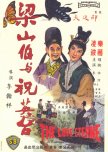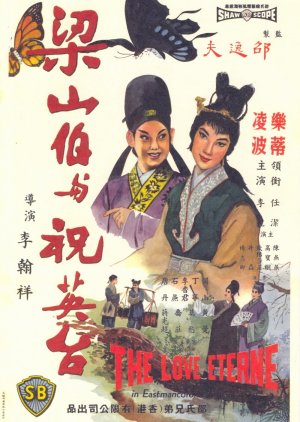
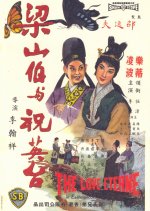
In the late Eastern Jin dynasty, Juk Ying Toi, the daughter of a wealthy family, longs to travel to Hangzhou to study. However, her father refuses to allow it, leaving Ying Toi with no appetite for food or drink and so depressed that she falls ill. Before long, Ying Toi comes up with a clever plan. Disguising herself as a physician, she explains the cause of the young lady’s illness and finally persuades her father to give his consent. On her journey to study, Ying Toi, disguised as a man, happens to meet the handsome and charming Leung Saan Baak. The two find that they get along well and travel together. During their three years as classmates, Ying Toi and Saan Baak become close friends and develop a deep bond. As they spend every day together, Ying Toi gradually begins to fall in love with Saan Baak. However, constrained by her assumed identity, she cannot bring herself to reveal the truth. One day, after her father repeatedly urges her to return, Ying Toi has no choice but to take leave and go home, leading to the classic “Eighteen-Mile Farewell” scene. Despite all her attempts to test him and hint at her feelings, her slow-witted beloved fails to understand what she means, and their parting becomes forever… (Source: Chinese = Douban || Translation = MyDramaList) ~~ Based on the Chinese legend "Butterfly Lovers" (梁山伯与祝英台). Edit Translation
- English
- magyar / magyar nyelv
- dansk
- Norsk
- Native Title: 梁山伯與祝英台
- Also Known As: Liang Shan Bo yu Zhu Ying Tai , The Eternal Love
- Screenwriter & Director: Li Han Hsiang
- Genres: Music, Romance, Drama
Cast & Credits
-
 Ivy Ling Po Main Role
 -
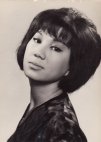
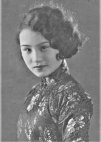
 Betty Loh TiZhu Ying TaiMain Role
 -
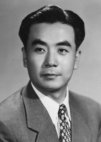
 Yang Chi Ching[Teacher]Support Role
 -
 Chen Yan Yan[Ying Tai's mother]Support Role
 -
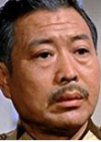
 Ching Miao[Ying Tai's father]Support Role
 -
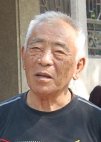
 Ku Feng[Wedding orchestra musician]Support Role

Photos
Reviews

The most subversive element of the film is that both leads are played by women, Betty Loh Ti (with poignant vocals dubbed by Tsin Ting) as the girl disguised as a boy and Ivy Ling Po as the boy she falls in love with. Both are magnificent, so convincing as the yearning heterosexual couple that the casting of two women seems an inextricable part of the story’s message about the role of women in society despite the fact that this is based on a truly heterosexual ancient legend (from roughly 266–420 AD). I have to imagine, or at least hope, that Chinese queer cultural critics have written some fascinating studies of this film, particularly because it seems to be widely considered a populist Chinese classic.
The story continues on irrespective of deeper implications, building to its inevitable, operatic climax bursting with raw emotion (here is where Loh truly shines). The ending is poignant and wistful, and I understood why this story had lasted all these years.

Poetic
As a musical adaptation of The Butterfly Lovers, The Love Eterne really surprised me, especially given my viewing of Tsui Hark's adaptation at the start of this month. While part of me still prefers that version of the story, it's hard to fault an infectiously cheerful and kaleidoscopic musical, loaded with gorgeous sets and charming sentiments. Shot on the Shaw Brothers backlot, writer/director Han Hsiang Li and cinematographer Tadashi Nishimoto soar with a vast vision that covers the film in shimmering colour that dazzles in the elegant melodic numbers. Displaying an impressive sensitivity towards the courtship, Li uses graceful wide shots to gaze at the blossoming romance. Adapting a well-known traditional story, the screenplay by Han Hsiang Li beautifully employs the operetta numbers to create an epic operatic atmosphere that pulls at the heartstrings. Dipping the tale into Melodrama, Li hits a poetic note with the thoughtful dialogue capturing Bo's and Ti's eternal love, turning them into beautiful butterflies. Topped by some utterly spellbinding performances, The Love Eterne is essential viewing for any aspiring fan of Chinese Opera.