


 1
1


The Manuscript of Faust
The Boy in the Last Row is a psychological thriller that plunges us into an ambiguous relationship between a teacher and his student. But the real question from the very beginning is not so much who the teacher is, but rather who truly is the teacher, and who is the student. Very quickly, the series goes beyond this initial framework to become a thriller focused not on the events themselves, but on how they are told and interpreted. You are handed an invitation, and it is up to the viewer to determine the share of truth and lies being delivered. Directed by Kim Kyu-Tae, who is far from a novice and offers a strong résumé with dramas such as The Trunk, Our Blues, Live, and Moon Lovers: Scarlet Heart Ryeo, works that have all left their mark, we already know we are in for effective direction and full immersion from the very first minutes. Without spoiling anything, and unless you are completely unfamiliar with the genre, a high-level duel awaits between these two men.
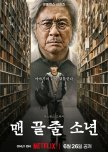
Heo Mun-Oh (Choi Min-Sik) is a professor of Korean literature at university. A failed writer (he has only published one novel), over time he has become a very harsh, stubborn, and irritable man with those around him, especially his wife, Jo Hyeon-Suk (Jin Kyung), a talented psychologist/therapist. They look more like roommates than a real couple. In his youth, when he was still a student, his rival was Kim Su-Hun (Heo Jun-Ho), who has since become a wealthy and famous writer. The worst for Mun-Oh is that this man married his crush, Ahn Eun-Joo (Kim Yunjin). During one of his classes, he becomes drawn to an unusual student sitting in the last row, the young Lee Kang (Choi Hyun-Wook). Very quickly, Mun-Oh detects talent in him and pushes him further. His interest in Kang’s essays keeps growing, but when Kang admits that he does not invent anything and simply recounts what he experiences in real life, Mun-Oh’s shock turns into obsessive curiosity as he becomes emotionally involved.
The main interest of the drama does not lie in the multiplication of secondary plotlines, but in the focus on a small number of characters. This choice immediately strengthens immersion and gives the impression of being trapped in a closed system where every interaction matters. This makes sense given the limited number of episodes. Without giving too many specific indications, there is one essential, even crucial element to pay attention to as time goes on. It is not just about spotting false appearances, but above all about paying attention to what is said, and who says it. The thriller is built precisely on this confusion, constantly misleading and sustaining doubt at all times. Its strength lies in the power of its narrative and the way it is delivered. What sets the series apart is its use of storytelling itself as a dramatic tool. The story feels filtered, constructed, sometimes fragmented, creating a constant tension between what is shown and what is understood. The viewer is never certain of having access to an objective truth, only to a possible version of events. Hum...Have I said too much? :)
The plot revolves around the Mun-Oh / Kang duo (duel), which initially appears straightforward. But the relationship between the two men gradually becomes ambiguous, making us doubt everything. Trust turns into dependency and evolves into a form of role confusion. One of them seems to control the narrative, while the other gradually loses critical distance. The series thus explores a dynamic in which obsession with a story can alter the perception of reality itself. The Boy in the Last Row is a cerebral thriller where everything relies on perception and interpretation. Rather than multiplying spectacular twists, the series builds its strength on constantly questioning what we think we understand. Reality, imagination, and illusion constantly overlap, forcing us to reconsider each piece of information as it appears. To put it simply, do not believe everything you see or hear. Confusion becomes the key word of the story, and each new piece of information forces us to reconsider the previous ones, reinforcing the addictive aspect of the whole. We are constantly building theories, to the point where it becomes almost playful. And the fast pacing sometimes prevents us from thinking too clearly.
But the series also relies on a very controlled execution. Indeed, it could not work without its essential core, which rests on the two main protagonists. And here I’ll just say it: bravo, gentlemen! On one hand, there is one of the giants of Korean cinema, not for the quantity of works he has participated in, but for their quality: Choi Min-Sik. This actor does not need to speak; his charisma allows him to fully embody the character like no one else. Opposite him, the rising star of K-dramas, Choi Hyun-Wook, who already has an impressive résumé despite his young age, delivers a convincing and powerful performance. The chemistry between these two generations of actors is sublime and elevates the entire story. To complete the cast, the presence of two other “monuments,” Heo Jun-Ho and Jin Kyung, makes this an exceptional quartet of talent. Kim Kyu-Tae knows how to highlight his actors in a convincing and immersive way through carefully crafted direction. The atmosphere is unsettling, heavy, mysterious, and increasingly suffocating. All of this is enhanced by visuals that serve the drama and emphasize the contrast between reality and perception.
If for me it is almost a flawless narrative, I cannot deny being slightly disappointed by the ending, or at least by certain aspects of it. Not because, like in Very Bad Trip, everything is revealed as the “behind the scenes”, but because of the motive and the triggering element of this masterfully orchestrated trap. Like the spinning top in Inception, the ending does not simply aim to provide answers. It invites the viewer to reinterpret the entire story from a different angle and leaves enough subtle doubt to extend the experience beyond the credits. Yes, many times I found myself wondering whether I had fully understood it, or even whether multiple interpretations were possible during the final sequences. The soundtrack appropriately accompanies all these moments of tension and constant doubt, in a dark tone and perfectly integrated into the narrative. For some, a degree of skepticism may dominate, but the strength of the writing cannot be ignored. Before closing the manuscript, one essential point must be retained: it is the viewer themselves who is invited to write the final chapter and decide who is the winner and who is the loser.
Heo Mun-Oh (Choi Min-Sik) is a professor of Korean literature at university. A failed writer (he has only published one novel), over time he has become a very harsh, stubborn, and irritable man with those around him, especially his wife, Jo Hyeon-Suk (Jin Kyung), a talented psychologist/therapist. They look more like roommates than a real couple. In his youth, when he was still a student, his rival was Kim Su-Hun (Heo Jun-Ho), who has since become a wealthy and famous writer. The worst for Mun-Oh is that this man married his crush, Ahn Eun-Joo (Kim Yunjin). During one of his classes, he becomes drawn to an unusual student sitting in the last row, the young Lee Kang (Choi Hyun-Wook). Very quickly, Mun-Oh detects talent in him and pushes him further. His interest in Kang’s essays keeps growing, but when Kang admits that he does not invent anything and simply recounts what he experiences in real life, Mun-Oh’s shock turns into obsessive curiosity as he becomes emotionally involved.
The main interest of the drama does not lie in the multiplication of secondary plotlines, but in the focus on a small number of characters. This choice immediately strengthens immersion and gives the impression of being trapped in a closed system where every interaction matters. This makes sense given the limited number of episodes. Without giving too many specific indications, there is one essential, even crucial element to pay attention to as time goes on. It is not just about spotting false appearances, but above all about paying attention to what is said, and who says it. The thriller is built precisely on this confusion, constantly misleading and sustaining doubt at all times. Its strength lies in the power of its narrative and the way it is delivered. What sets the series apart is its use of storytelling itself as a dramatic tool. The story feels filtered, constructed, sometimes fragmented, creating a constant tension between what is shown and what is understood. The viewer is never certain of having access to an objective truth, only to a possible version of events. Hum...Have I said too much? :)
The plot revolves around the Mun-Oh / Kang duo (duel), which initially appears straightforward. But the relationship between the two men gradually becomes ambiguous, making us doubt everything. Trust turns into dependency and evolves into a form of role confusion. One of them seems to control the narrative, while the other gradually loses critical distance. The series thus explores a dynamic in which obsession with a story can alter the perception of reality itself. The Boy in the Last Row is a cerebral thriller where everything relies on perception and interpretation. Rather than multiplying spectacular twists, the series builds its strength on constantly questioning what we think we understand. Reality, imagination, and illusion constantly overlap, forcing us to reconsider each piece of information as it appears. To put it simply, do not believe everything you see or hear. Confusion becomes the key word of the story, and each new piece of information forces us to reconsider the previous ones, reinforcing the addictive aspect of the whole. We are constantly building theories, to the point where it becomes almost playful. And the fast pacing sometimes prevents us from thinking too clearly.
But the series also relies on a very controlled execution. Indeed, it could not work without its essential core, which rests on the two main protagonists. And here I’ll just say it: bravo, gentlemen! On one hand, there is one of the giants of Korean cinema, not for the quantity of works he has participated in, but for their quality: Choi Min-Sik. This actor does not need to speak; his charisma allows him to fully embody the character like no one else. Opposite him, the rising star of K-dramas, Choi Hyun-Wook, who already has an impressive résumé despite his young age, delivers a convincing and powerful performance. The chemistry between these two generations of actors is sublime and elevates the entire story. To complete the cast, the presence of two other “monuments,” Heo Jun-Ho and Jin Kyung, makes this an exceptional quartet of talent. Kim Kyu-Tae knows how to highlight his actors in a convincing and immersive way through carefully crafted direction. The atmosphere is unsettling, heavy, mysterious, and increasingly suffocating. All of this is enhanced by visuals that serve the drama and emphasize the contrast between reality and perception.
If for me it is almost a flawless narrative, I cannot deny being slightly disappointed by the ending, or at least by certain aspects of it. Not because, like in Very Bad Trip, everything is revealed as the “behind the scenes”, but because of the motive and the triggering element of this masterfully orchestrated trap. Like the spinning top in Inception, the ending does not simply aim to provide answers. It invites the viewer to reinterpret the entire story from a different angle and leaves enough subtle doubt to extend the experience beyond the credits. Yes, many times I found myself wondering whether I had fully understood it, or even whether multiple interpretations were possible during the final sequences. The soundtrack appropriately accompanies all these moments of tension and constant doubt, in a dark tone and perfectly integrated into the narrative. For some, a degree of skepticism may dominate, but the strength of the writing cannot be ignored. Before closing the manuscript, one essential point must be retained: it is the viewer themselves who is invited to write the final chapter and decide who is the winner and who is the loser.
Was this review helpful to you?


