


 1
1


This review may contain spoilers
A Royal Curse, a Cursed Story
When I started The Palace of the East, I knew exactly what I was getting into: a fantasy horror thriller set during the Joseon era, but also a drama written by the co-writers of The Guest (a good one) and Bulgasal (not a good one), and directed by Choi Jung Gyu, the man who gave us, among other things, the magnificent The Devil Judge in 2021. Aesthetically speaking, it is truly beautiful, putting forward an oppressive atmosphere reminiscent of the movie Silent Hill, or even the series Stranger Things in some visual aspects, through its lighting choices and its blockbuster fantasy feel. The series starts off at full speed during the first three episodes, which establish the setting. Unfortunately, the short format imposed by Netflix and the storytelling shift that occurs in the second half left me with a bitter aftertaste. I felt that the narrative was losing some of its ambition. Do not expect a revolutionary story, as this is something we have seen many times before. But it is everything else that makes the difference, and given the budget allocated to it, it really could not afford to fail. Let’s take a closer look.
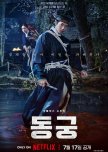
At the heart of the royal palace, a mysterious curse seems to have fallen upon the King’s family. After several unexplained deaths and the sudden collapse of the last Crown Prince, the King (Cho Seung Woo) calls upon Gu-cheon (Nam Joo Hyuk), a man capable of crossing the boundary between the world of the living and the world of spirits in order to hunt supernatural creatures and ghosts. He acquired this cursed ability as a child during a tragic event and has carried it as a burden ever since. To accompany and watch over him, he orders Saeng-gang (Roh Yoon Seo), a court lady who is actually his only daughter, to join him. He exiled her as a child because she possesses the ability to hear the dead. Together, they must uncover the secrets of the Eastern Palace, the residence of the heirs to the throne, a place consumed as much by political conspiracies as by supernatural forces, where every discovery brings them closer to a truth that some people are willing to kill to preserve. The Dowager Queen (Jang Young Nam) and the King’s brother, Prince Ik-Sang (Tae In Ho), are also lurking in the shadows, each serving their own interests.
From the very first minutes, The Palace of the East makes a strong impression. The cinematography is exceptional, the production design is incredibly rich, the music is magnificent, and the visual effects reach a level rarely seen in a Korean drama. The result is genuinely cinematic. The CGI is perfectly integrated, and the whole production has a very strong visual identity. On these aspects, I even find the drama superior to Alchemy of Souls or Kingdom, for example, which are fairly recent. The direction is remarkably elegant, fluid, and impressively effective. The universe sometimes evokes FromSoftware games, especially Demon’s Souls, with its majestic palaces, atmosphere of decay, and disturbing creatures. Let’s be very clear about this: it looks incredible. The story, without being innovative, uses its unsettling atmosphere to take us on an adventure close to a fantasy horror thriller. I really enjoyed the first three episodes because the protagonists are quickly identified, there are not too many of them, and our main duo is likeable. In short, from the beginning, you can feel that we are dealing with people who know their craft and know how to put their expertise into practice. The story, which seems simple at first glance, will gradually multiply false leads, encouraging us to question the true intentions of certain characters.
Unfortunately, this excellent first impression gradually fades away. I found the second half more intense and certainly more fast-paced, but while the action side takes over, the storytelling gradually falls apart as we get closer to the ending. The story seemed promising, but ultimately lacks development. Aside from Saeng-gang, Gu-cheon, and the King, most of the other characters are without depth, especially the Dowager Queen, Prince Ik-Sang, and the shaman. They mainly exist to lead us toward false leads. As for the antagonist, he is introduced in a clumsy way, used as a tool, and poorly exploited. The viewer discovers his importance very late, even though he could have become a much more memorable antagonist.
The true threat hidden from the beginning turns out to be the Crown Prince (Kwak Dong Yeon), who was poisoned by his father at the time, when the latter discovered that he was practicing occult sciences.
In reality, it is the entire cast of characters, despite being quite small, that suffers from a lack of writing and, for some of them, a lack of substance. The conclusion easily falls into over-the-top territory. Some scenes lack coherence, such as the notable absence of the royal guards (they must have had a swimming pool day). We are still inside the King’s palace. The lack of extras is also quite puzzling for a place that is supposed to be alive. The thriller aspect is gradually abandoned in favor of action, leading to a finale worthy of Mortal Kombat but without a Fatality... Although, maybe. In the end, we leave the drama with more questions than answers:
Why did the King decide to kill his own son, knowing that this act would trigger a terrible curse? Why are the Prince and the Shaman presented as threats to the Crown if their roles are ultimately so limited? What is the role of the Dowager Queen and what are her true intentions? Why make the prince played by Kwak Dong Yeon such a central character in the revelations when he is barely developed?
For me, the real missed opportunity of the script lies there: the drama never truly settles the Crown Prince’s guilt. And that is a shame, because it would have given much more depth to both the King and the Crown Prince.
The writers know how to create an atmosphere, establish mystery, and bring fantasy to life. However, they struggle to give their characters enough depth and to transform their many plot threads into a fully satisfying conclusion. To end on a positive note, I would say that the duo formed by Nam Joo Hyuk and Roh Yoon Seo works extremely well, and that we thankfully avoided the easy and unnecessary mistake of adding a fake romance that would have served no purpose.
In the end, The Palace of the East impresses more with what it shows than with what it tells. The writers know how to create an atmosphere, build mystery, and stage fantasy with real mastery. Visually and musically, it is a true success, with stunning cinematography, ambitious production design, and direction that sometimes gives it the feel of a cinematic production. I also really liked the presence of Ggeomeoksali, this small creature with an almost innocent appearance that brings a lighter touch to an otherwise very dark universe. Like a Mogwai from Gremlins, it could easily have become just a cute element designed to appeal to viewers, but it ultimately finds its place within the drama’s fantasy mythology. Unfortunately, this visual ambition is not always matched by the writing. The many threads introduced throughout the episodes do not all receive satisfying conclusions. It is a shame, because the whole story is missing a tragic depth that could have elevated it. Nevertheless, The Palace of the East remains a largely positive experience thanks to its unique atmosphere, carefully crafted fantasy universe, and above all, a duo that works remarkably well. This drama is not revolutionary, but it remains entertaining and enjoyable. It nevertheless leaves me with a feeling of incompleteness, with a script that ultimately failed to live up to its ambitions.
At the heart of the royal palace, a mysterious curse seems to have fallen upon the King’s family. After several unexplained deaths and the sudden collapse of the last Crown Prince, the King (Cho Seung Woo) calls upon Gu-cheon (Nam Joo Hyuk), a man capable of crossing the boundary between the world of the living and the world of spirits in order to hunt supernatural creatures and ghosts. He acquired this cursed ability as a child during a tragic event and has carried it as a burden ever since. To accompany and watch over him, he orders Saeng-gang (Roh Yoon Seo), a court lady who is actually his only daughter, to join him. He exiled her as a child because she possesses the ability to hear the dead. Together, they must uncover the secrets of the Eastern Palace, the residence of the heirs to the throne, a place consumed as much by political conspiracies as by supernatural forces, where every discovery brings them closer to a truth that some people are willing to kill to preserve. The Dowager Queen (Jang Young Nam) and the King’s brother, Prince Ik-Sang (Tae In Ho), are also lurking in the shadows, each serving their own interests.
From the very first minutes, The Palace of the East makes a strong impression. The cinematography is exceptional, the production design is incredibly rich, the music is magnificent, and the visual effects reach a level rarely seen in a Korean drama. The result is genuinely cinematic. The CGI is perfectly integrated, and the whole production has a very strong visual identity. On these aspects, I even find the drama superior to Alchemy of Souls or Kingdom, for example, which are fairly recent. The direction is remarkably elegant, fluid, and impressively effective. The universe sometimes evokes FromSoftware games, especially Demon’s Souls, with its majestic palaces, atmosphere of decay, and disturbing creatures. Let’s be very clear about this: it looks incredible. The story, without being innovative, uses its unsettling atmosphere to take us on an adventure close to a fantasy horror thriller. I really enjoyed the first three episodes because the protagonists are quickly identified, there are not too many of them, and our main duo is likeable. In short, from the beginning, you can feel that we are dealing with people who know their craft and know how to put their expertise into practice. The story, which seems simple at first glance, will gradually multiply false leads, encouraging us to question the true intentions of certain characters.
Unfortunately, this excellent first impression gradually fades away. I found the second half more intense and certainly more fast-paced, but while the action side takes over, the storytelling gradually falls apart as we get closer to the ending. The story seemed promising, but ultimately lacks development. Aside from Saeng-gang, Gu-cheon, and the King, most of the other characters are without depth, especially the Dowager Queen, Prince Ik-Sang, and the shaman. They mainly exist to lead us toward false leads. As for the antagonist, he is introduced in a clumsy way, used as a tool, and poorly exploited. The viewer discovers his importance very late, even though he could have become a much more memorable antagonist.
The true threat hidden from the beginning turns out to be the Crown Prince (Kwak Dong Yeon), who was poisoned by his father at the time, when the latter discovered that he was practicing occult sciences.
In reality, it is the entire cast of characters, despite being quite small, that suffers from a lack of writing and, for some of them, a lack of substance. The conclusion easily falls into over-the-top territory. Some scenes lack coherence, such as the notable absence of the royal guards (they must have had a swimming pool day). We are still inside the King’s palace. The lack of extras is also quite puzzling for a place that is supposed to be alive. The thriller aspect is gradually abandoned in favor of action, leading to a finale worthy of Mortal Kombat but without a Fatality... Although, maybe. In the end, we leave the drama with more questions than answers:
Why did the King decide to kill his own son, knowing that this act would trigger a terrible curse? Why are the Prince and the Shaman presented as threats to the Crown if their roles are ultimately so limited? What is the role of the Dowager Queen and what are her true intentions? Why make the prince played by Kwak Dong Yeon such a central character in the revelations when he is barely developed?
For me, the real missed opportunity of the script lies there: the drama never truly settles the Crown Prince’s guilt. And that is a shame, because it would have given much more depth to both the King and the Crown Prince.
The writers know how to create an atmosphere, establish mystery, and bring fantasy to life. However, they struggle to give their characters enough depth and to transform their many plot threads into a fully satisfying conclusion. To end on a positive note, I would say that the duo formed by Nam Joo Hyuk and Roh Yoon Seo works extremely well, and that we thankfully avoided the easy and unnecessary mistake of adding a fake romance that would have served no purpose.
In the end, The Palace of the East impresses more with what it shows than with what it tells. The writers know how to create an atmosphere, build mystery, and stage fantasy with real mastery. Visually and musically, it is a true success, with stunning cinematography, ambitious production design, and direction that sometimes gives it the feel of a cinematic production. I also really liked the presence of Ggeomeoksali, this small creature with an almost innocent appearance that brings a lighter touch to an otherwise very dark universe. Like a Mogwai from Gremlins, it could easily have become just a cute element designed to appeal to viewers, but it ultimately finds its place within the drama’s fantasy mythology. Unfortunately, this visual ambition is not always matched by the writing. The many threads introduced throughout the episodes do not all receive satisfying conclusions. It is a shame, because the whole story is missing a tragic depth that could have elevated it. Nevertheless, The Palace of the East remains a largely positive experience thanks to its unique atmosphere, carefully crafted fantasy universe, and above all, a duo that works remarkably well. This drama is not revolutionary, but it remains entertaining and enjoyable. It nevertheless leaves me with a feeling of incompleteness, with a script that ultimately failed to live up to its ambitions.
Was this review helpful to you?


