

 1
1


This review may contain spoilers
Loving the uniqueness!
Update: I’m just finished episode 6, and I am finding it more difficult to get through each episode. I’ve adjusted my overall rating accordingly. But it is still very early in the show, and things could pick up again!I wasn’t planning to start Overdo until more episodes had dropped, but I saw so many negative reviews that I became too curious to wait. I’ve only watched the first three episodes, but so far, I absolutely love it.
I love that it doesn’t look, feel, or unfold like many other C-dramas. This is my first Republican-era drama, and I’m fascinated by the costumes, the visual style, and the presence of the characters.
It also doesn’t drag or feel slow to me. Things are moving, and we’re constantly receiving new information. The story begins in the present day, then moves back to three years earlier for a few minutes before returning to the present. Nuggets of backstory are woven throughout each episode, gradually revealing more about the characters and what happened between them. I keep wanting to uncover the next piece.
I’m still very early in the drama, and even if I had finished all five currently available episodes, I would consider it too soon to make any final judgment. But at episode three, I’m completely sold.
People naturally react to dramas very differently, and that’s part of what makes discussing them so enjoyable. I’m used to seeing disagreement over whether a drama was wonderful, disappointing, or somewhere in between. What surprises me here is just how extreme the divide seems to be. Right now, people appear to either love Overdo or hate it, with very little middle ground.
As for me, three episodes in: I love it.
Was this review helpful to you?
This review may contain spoilers
Generation to Generation – A Rare Example of Narrative Integrity Done Right
I went into Generation to Generation with no expectations—and ended up ranking it as one of the best dramas I’ve seen.What sets this drama apart is not just how engaging it is, but how consistently it delivers on what it promises from beginning to end.
Narrative & Structure
This is a dense, layered story; not heavy in the sense of being exhausting, but rich in moving parts. There are multiple sects, histories, relationships, and power dynamics to track, and the show expects you to pay attention. But in return, it rewards you with a story where:
Every episode moves the narrative forward
Every reveal connects cleanly to what came before
Nothing feels like filler
Most importantly: it never loses control of its own story. There are no sudden character shifts, no late-stage shortcuts, and no “we ran out of time so here’s a rushed ending” problem.
Themes & Moral Core
At its heart, this drama challenges the idea of inherited morality.
“Righteous” sects commit cruelty in the name of justice
The so-called “demon” sect contains both corruption and compassion
Characters are defined not by where they come from, but by what they choose
The show consistently reinforces that:
Hatred can become all-consuming and destructive
It’s easy to gather people by appealing to their desires (power, revenge, fear), but that doesn’t create true alignment
Standing up for what’s right is difficult, and often punished, but necessary
And crucially: it never contradicts these ideas for the sake of convenience.
Characters
The two leads anchor the story, but they don’t exist in isolation.
The female lead is strong, capable, and principled without being reduced to a trope
The male lead carries both emotional depth and moral clarity, and his arc is one of responsibility, not just romance
The supporting cast is equally important. Their arcs don’t disappear; they resolve in ways that reflect the larger themes of the story.
Romance
The romance is not the point—but it is the catalyst.
It drives the conflict without overtaking the narrative, and it feels:
believable
earned
integrated into the larger story
This is not a “watch it for the romance alone” drama, but the relationship matters because of what it represents.
Ending
The ending is where this drama proves itself.
After maintaining a high level of consistency throughout, it sticks the landing:
No character regression
No thematic betrayal
No rushed resolution
Every major arc—personal, political, and relational—reaches a natural conclusion.
Whether you prefer tragic or happy endings, this is an ending that feels earned.
Final Thoughts
Generation to Generation is the kind of drama that reminds you what good storytelling looks like:
It respects its own rules
It respects its characters
And it respects the viewer’s attention
It may have an “idol drama” cast, but it operates far beyond the limitations people associate with that label.
This is not just a good drama.
It is a structurally sound, thematically coherent, and emotionally satisfying one, and those are far rarer than they should be.
Was this review helpful to you?
This review may contain spoilers
He Waited
I went into The Forbidden Flower expecting a romance famous for its kissing scenes.That is not the drama I got.
What I got instead was one of the most emotionally affecting romances I have watched in years.
The story follows He Ran, a young woman carrying a devastating secret, and Xiao Han, a quiet horticulturist who seems disconnected from the world around him. On paper, the premise sounds simple. In execution, it becomes a story about loneliness, grief, choice, agency, devotion, and the courage to love someone when there are no guarantees about the future.
One of the things I value most in a drama is momentum. I can forgive a lot if a story keeps moving. The Forbidden Flower never stalled. Every episode revealed something new, deepened a relationship, or changed the stakes. The plot continually moved forward, and several times it genuinely surprised me. That is rare. I am usually very good at spotting narrative patterns and predicting where a story is headed, but this drama fooled me more than once.
The biggest strength of the show is Xiao Han.
I absolutely fell in love with this character.
Not because he is flashy. Not because he is powerful. Not because he delivers grand speeches.
Because he listens.
Because he notices.
Because he waits.
Again and again, he learns things about He Ran and gives her the space to tell him when she is ready. He doesn’t manipulate her. He doesn’t pressure her. He doesn’t force confessions. He simply remains present. There are many romantic heroes who are exciting. There are far fewer who feel trustworthy.
What struck me most is that Xiao Han consistently respects He Ran’s ability to make her own choices. Given how often dramas use secrets, misunderstandings, and “I know what’s best for you” behavior as shortcuts to conflict, this stood out enormously.
That does not mean I agreed with all of He Ran’s choices.
In fact, I spent much of the drama frustrated with her decision to hide the truth about her illness. While I understood her motivations, I never believed she had the right to make that choice for Xiao Han. One of the central tensions of the drama becomes the difference between protecting someone and respecting their right to choose. The show ultimately explores that conflict in a way I found thoughtful and emotionally satisfying.
The chemistry between the leads is excellent, but perhaps not in the way the drama’s reputation suggests.
I had heard repeatedly that this was a drama known for its “hot kisses.” After watching all 24 episodes, I think that description is misleading.
Are there a lot of kisses? Yes.
Are they good? Absolutely.
Are they the primary source of the drama’s emotional impact? Not even close.
Most of the kisses are gentle, tender, and consistent with who these characters are. The emotional intimacy is far more powerful than the physical intimacy. The moments that stayed with me were not the kisses themselves, but the conversations, the waiting, the flowers, the promises, and the quiet acts of devotion.
The secondary romance between Chou Jia Rong and Zhang Yuanqi deserves special mention.
I expected it to be a side story.
Instead, it became one of my favorite parts of the drama.
Chou Jia Rong is a woman who has spent years defining herself entirely through responsibility and sacrifice. Her heartbreaking belief that she does not deserve happiness becomes one of the most moving themes in the series. Zhang Yuanqi brings a completely different energy than Xiao Han. Where Xiao Han waits, Zhang Yuanqi acts. Their scenes together are filled with tension, humor, vulnerability, and some of the strongest chemistry in the drama.
The cinematography is beautiful throughout. Flowers become a recurring visual language. The triangular structure by the sea, the greenhouse, the paintings, and the changing seasons all reinforce the emotional themes without feeling heavy-handed. The soundtrack was generally strong as well.
The ending was exactly what it needed to be.
By the time the final episode arrived, the question was no longer whether these two loved each other. The question was whether love would be enough to survive uncertainty, illness, distance, and time.
The answer was contained in a simple promise that became the emotional heart of the entire drama:
He waited.
Was this review helpful to you?
This review may contain spoilers
This Is Not a Romance (And That’s Why It Works)
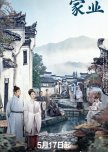
I have spent the last several weeks completely immersed in this drama, and after finishing all 42 episodes, I think the biggest mistake viewers can make is watching it as a romance.There is romance in it. There is longing, heartbreak, separation, devotion, and eventually love. But romance is not the story.
The story is Li Zhen.
More specifically, it is the story of a woman rebuilding a family, preserving a craft, and carrying an entire legacy on her shoulders.
One of the things I appreciated most is that the drama never turns Li Zhen into an instant genius. She fails repeatedly. Ink batches are ruined. Experiments go wrong. Business plans collapse. Trusted people betray her. Every success is earned through persistence, intelligence, and an almost stubborn refusal to quit.
That commitment to process is what makes the drama feel so authentic.
The same applies to the relationships.
Unlike many idol dramas, this series does not rely on endless misunderstandings, accidental falls, forced jealousy, or artificial romantic obstacles. The relationship between Li Zhen and Luo Wen Qian develops slowly through partnership, trust, and shared hardship. Some viewers may find the romance too restrained, but for me it fit the story perfectly. These are two people carrying enormous responsibilities. Their feelings grow naturally through working side-by-side rather than through dramatic declarations every few episodes.
Yang Zi is outstanding as Li Zhen. She never seems concerned with looking beautiful at every moment. Whether covered in soot, exhausted from failed experiments, grieving, frustrated, or triumphant, she feels completely believable. Li Zhen is intelligent without being perfect, determined without being invincible, and compassionate without becoming naive.
This was my first drama with Elvis Han, and he made a tremendous impression. He has one of the most distinctive voices I’ve heard in a C-drama, and his performance carries a quiet emotional weight that works especially well alongside Yang Zi. Much of his character’s journey depends on restraint rather than grand gestures, and he handles it beautifully.
I also want to specifically praise Wang Zi Hao as Tian Ben Chang.
For much of the drama, Ben Chang could have become a one-dimensional villain. Instead, Wang Zi Hao creates someone far more interesting: a young man whose ambition gradually corrodes every decent part of him. Watching his descent from an attentive and seemingly sincere young man into someone willing to sacrifice family, morality, and eventually even his own brother was one of the strongest character arcs in the series. I was constantly impressed by how much screen presence he brought whenever he appeared.
Another major strength is the supporting cast.
Seventh Grandmother became one of my favorite characters. Li Jin Shu (Eighth Grandfather) became one of my favorite characters. Rong Hua’s journey surprised me repeatedly. Even secondary branches of the family receive enough development that their victories and losses matter.
The drama also does something increasingly rare: it allows older characters to be important. Wisdom, experience, craftsmanship, and mentorship are treated as valuable rather than obstacles to younger characters taking center stage.
As for the ending, I suspect viewers will debate it.
Personally, I found it fitting.
The final episodes reinforce what the drama has been telling us from the beginning: this is ultimately the story of Li Zhen’s legacy. The romance matters, but it is not the sole measure of her life. The preservation of knowledge, the restoration of the Li family, and the continuation of the craft matter just as much.
By the end, what stayed with me most wasn’t a kiss scene or a confession.
It was the image of knowledge being preserved and passed forward.
For a drama centered on ink-making, that feels exactly right.
Rating: 10/10
A rare drama that trusts its audience, respects its characters, and understands that craftsmanship, family, and legacy can be just as compelling as romance.
Was this review helpful to you?


