



This review may contain spoilers
In the shadowplay, acting out your own death, knowing no more
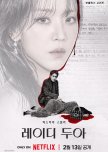
‘The Art of Sarah’ builds its structure around a theme that is, first and foremost, a question about identity. Perhaps it is precisely by starting from the end that we can find the most honest key to understanding this drama: a world dominated by brands, super-luxury, appearances and perceived value, where even a name can become a choice, an invention, a strategy.In this scenario dominated by appearances, Sarah is introduced as an almost mythological figure. Not so much for what she does, but for the way the series observes her: always slightly above the others, more aware, more lucid, as if the system surrounding her were not only a cage, but also a language to be mastered.
This is where the drama builds its most fascinating ambiguity. Is Sarah a victim? Is she a strategist? Is she both? The narrative seems to suggest that, in a world where value is perception, even morality can become a form of representation.
The metaphor of luxury handbags, perfect but exposed because they are “too accurate”, is not a decorative detail: it is the conceptual heart of the drama. Like those seemingly authentic objects, Sarah also oscillates between originality and performance, between authenticity and construction. The audience perceives the tension between what is and what appears to be, and it is here that the moral suspension that accompanies the entire series takes shape.
However, as the story delves deeper into the heart of the matter, that suspension slowly tends to resolve itself, not abruptly, but almost imperceptibly. It is as if, after flirting with the idea of an identity that cannot be reduced to a definition, the series finally chooses to bring it back within a more readable perimeter, without betraying the initial ambiguity and without losing the charm of doubt that Sarah has been able to generate at every step of her journey.
The unveiling, then, seems to take a more cautious trajectory: some elements, perhaps introduced belatedly, give the impression of a functional rather than inevitable relaunch, and the whole tends to come together in a more orderly fashion than might have been expected. This is not inconsistency, but more prosaically a form of narrative caution; after suggesting moral vertigo, the series opts for a controlled landing, which does not cancel out the initial suspension but recomposes it with lightness.
Overall, however, it remains a solid, elegant and coherent production. And above all, she stands out. Shin Hye-sun is magnetic: she combines fragility and calculation with rare naturalness, without ever overdoing it with unnecessary mannerisms. Even when the writing becomes more cautious, her performance continues to suggest something unresolved. She alone makes it drama worth watching.
Lee Joon-hyuk, on the other hand, remains prudently more conventional — perhaps deliberately — and this contrast brings out an interesting element: ambiguity is more fascinating than moral correctness. The morally “dark” character is narratively more vivid than the “righteous” one, and Shin Hye-sun's presence amplifies this tension, making it clear that the true energy of the drama stems from its ability to embody doubt without resolving it.
In the end, ‘The Art of Sarah’ avoids — courageously!? cautiously!? — giving us clear answers, instead creating an open space for reflection, where identity, appearance and morality intertwine without being completely resolved. A drama that knows how to play with doubt, challenging the viewer to question rather than passively observe, and does so with elegance and consistency, without ever betraying its conceptual construction.
For those who love stories that leave a trail of questions rather than certainties — and the inevitable need for a second viewing! — this can be considered a successful narrative experiment: provocative, sophisticated and, above all, capable of making you talk and think, even after the credits roll, and especially after THAT final question...
7/10
Was this review helpful to you?
This review may contain spoilers
For lovers of genre
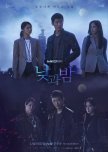
I watched "Awaken" based on VIKI's introduction, expecting a crime thriller maybe in the style of "Flower of Evil" or "The Devil", two series I really adoredAt the beginning, I followed with good expectations, thanks to a rather impressive incipit and with intriguing subsequent suggestions, even though the typifications of the main characters were not particularly original (the usual typecasting of the variegated team at work always reminds me of certain Japanese robot cartoons of childhood with the leader, the beauty, the clumsy and the nerd, those things, in short...).
However, as the episodes went on, I began to have more than one doubt about the direction of the series with a growing sense of annoyance, a red alert for a scenario completely different from the initial perspective; getting to the point, the expansion to Sci-Fi and things of this nature I had not really planned for and at that point the interest really dropped exponentially...
I mean, it's not that the story is particularly boring, it's reasonably elaborate and repeatedly tries to revive the attention with impactful cliffhangers, but the problem is that 'Awaken' really does come at a very late stage and smashes open doors from so many previous ones...
With everything we ‘ve had, from 'The X-Files' to 'Stranger Things', via 'Dark Angel' and their many epigones with 'special kids', it's a moment's notice to find yourself in such trite situations that you're able to understand much of the unfolding almost immediately.
The usual secret labs, the usual child-guinea-pigs, the usual mad doctors, between Dr. Frankenstein and the many crazed demiurges in a delirium of omnipotence, perhaps even parents of the aforementioned lab subjects
In overall terms, for fans of the same genre, it is certainly something that can intrigue and involve, but at the same time, for the aficionado with a little knowledge of the material, it is impossible not to notice the incredible accumulation of references, clichés and tired stereotypes that make the nose twitch, as well as the usual holes in the logic that often screw up the elaboration and development of many situations...
And it's a pity, because in my opinion the moral dimension of the story should have been highlighted more, thanks to the excellent performance of the main character Namkoong Min, capable of casting for several episodes the classic shadow of doubt on his true nature; it's also a shame for the little in-depth analysis between our super-child and the really disturbing mad scientist-mother, limited to the last episodes; the same goes for the police-daughter/father-scientist relationship, with an always excellent Kim Chang Wan in a role that would have deserved a better deepening, but then the police daughter (who we are told is also of great merit) really knows practically nothing about her father's work, for all those years! ?
The lead character in the guise of a wanted possible multiple homicide who calmly drives around the city, in defiance of roadblocks, checkpoints, camera recordings or phone interceptions (as seen in so many dramas or movies) is inexcusable, as is the Terminator-turn with the relative moving of trucks with his hands (but why?), with sudden and opportune super-powers...
A comic anthology is the three days wasted by Jamie (by the way, she, Lee Chung Ah, really beautiful -nda) and the nosey reporter waiting for the rain to cease so they can go by boat to the island-laboratory, and then the two 'super-boys' who come and go in a flash, at night, and how do they do it, maybe flying!?
It gets to the end rather tiredly due to the too many twists and turns of the drama with a pretty predictable and practically inevitable ending that leaves that inevitable sense of déjà-vu and general discontent quite marked...
Personally my rating is 7/10, fairly generous, more for the first part of the story and for some of the acting performances:
Of course Namkoong Min who certainly doesn't need me to tell him that (he's a class actor!) and something in the minor characterisations but at the end of the whole affair there are no particular desires left for second viewings...
Was this review helpful to you?
This review may contain spoilers
If I were a bramble and you were a rose
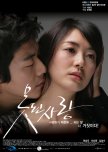
“Cruel Love” (or “Bad Love”) is a typical example of a genre product that falls victim to the very nature of Korean dramas, which are capable of changing direction midway through: a powerful premise, built upon a chain of tragic events and tangible consequences, which at a certain point is gradually replaced by a more conventional and convoluted melodrama, full of artificial obstacles capable of inducing a state of utter frustration. No one is claiming to want a happy ending at all costs, but rather demanding – for the sake of dramatic and intellectual integrity – that the story’s development remains consistent with what it initially promised.The first part of the drama works extremely well because, through melodramatic coincidence, in every episode each tragedy brings about a consequence and every event perfectly alters the course of the story, through a whole series of external and irreversible obstacles (scandal, a ruined career, abortion, the breakdown of a family, bereavements, the rekindling of love, etc.) which create a rupture with the characters’ previous lives.
The romantic drama arises naturally from the situation that has been created. The psychological consequences depicted in the first part of the story are an extremely powerful driving force for the narrative’s progression: characters who suffer the consequences of their own decisions, or are forced to confront events that have now irrevocably altered their lives.
It is exactly this aspect that makes the first half particularly successful: however exaggerated the events may be, the pain does not seem gratuitous, because it leaves its mark and forces the protagonists to rebuild their identities from the ruins. In-jung, in particular, is not simply subjected to a series of misfortunes: she is transformed by them, and her newfound love for Yong-gi takes on meaning simply because it comes after a life that is completely different from the one she had imagined.
But then, as the action shifts from the provinces to Seoul, a melodrama of misunderstandings seems to unfold, a victim of its own need to carry on. Although the obstacles are gradually removed, the script seems compelled to create new ones, including through the introduction of utterly laughable and redundant characters, resulting in decidedly weaker situations that end up influencing the fate of the protagonists – who love one another and should therefore be together, but for some reason cannot…
The problem is that, at this stage, the complications no longer seem to arise naturally from the accumulated wounds, but become, in themselves, the fuel needed to prolong the story. What in the first part was a drama built on consequences gradually becomes a drama built on obstacles: when one obstacle is removed, another must be found immediately. And so the narrative ends up losing the very force that had made it interesting, because the viewer begins to see the mechanism at work rather than being drawn into the events.
The introduction of Park Shin Young, the lookalike of the protagonist’s first love, is a twist that ends up creating a narrative dynamic different from the premise, whilst also missing a great opportunity; whereas previously the focus was on the psychological consequences of what had happened, the story now attempts to play the classic melodrama card with ‘the past returning’ in an almost physical form.
This, in itself, could have been interesting, but instead it ends up shifting the narrative tone, being used explicitly to further complicate the relationship, when it could have carried greater psychological weight – perhaps to truly explore the relationship between memory, guilt, grief and desire, with all that this entails within the relationship between the two protagonists.
The very nature of this subsequent agreement (“let’s stay together until spring”) presupposes that the characters no longer act according to their own inclinations, but rather in the interests of the script. Two adults are in love, the main obstacles are gradually being overcome (by the way: is there a ranking of the most absurd terminal illnesses in the Dramaverse?) and neither of them has a concrete reason to give up on the other: the viewer’s question inevitably becomes: “But why!?” Even the suspension of disbelief breaks down; everything seems to boil down to justifying the 20-episode run.
These two different forms of melodrama ultimately distort the romantic dynamics of the story as well: the first part told the story of people who suffer the consequences of their own decisions; the second seems to focus on people who make decisions with the aim of bringing about new consequences. And this is a substantial difference, because in the first case the tragedy is part of the story, whilst in the second it becomes almost a plot device within it.
The paradox really comes to the fore in the final episode. After the inevitable time ellipsis, both have rebuilt their lives; almost all the obstacles that had prevented the two protagonists from living out their love for much of the story have simply vanished. And so the inevitable ‘Is that it!?’ arises, because the ending demonstrates, almost retrospectively, just how contrived much of the previous, tormented journey had been. The meeting, the glances, the embraces and the promise of eternal love… The end.
The bench built by Yong-gi, the return to Samcheok, the walk hand in hand: it’s all symbolically very beautiful and brings the story full circle with elegance, but it lacks what would have been most interesting to see – namely, a genuine confrontation between the two.
There is no real conversation capable of making sense of what has happened, no shared analysis of the wounds, the blame, the fears and the sacrifices that have kept them apart. The traumas of the past seem simply to have been absorbed and dissolved by the passage of time and the disappearance of external obstacles. With these removed, the two can finally love one another. But the most interesting drama would have been to understand how two people so deeply scarred by what they had been through could find one another again and consciously choose each other.
For this reason, the ending – whilst consistent with the series’ romantic tone and undoubtedly evocative both visually and emotionally – leaves one with a sense of incompleteness. The story has spent an enormous amount of time setting up the obstacles, but surprisingly little on actually showing how the protagonists overcame them.
There is, however, still much to be commended about the overall production of “Bad Love”: the excellent performances, the beautiful soundtrack, the atmosphere, the cinematography, the provincial landscapes, the melancholic charm of Samcheok and, above all, that initial ability to craft a mature, painful and compelling romantic story. It is a series that manages to be elegant, evocative and even poignant, and which, in its first half, achieves moments of remarkable intensity.
It’s a shame that, as the story unfolds, that very elegance ends up being little more than packaging – like a beautifully wrapped present: fine wrapping paper, a perfect bow, every detail meticulously attended to, all of which whets your curiosity about what might be inside. Only to open it and find the cheap little ring that comes with an Easter egg.
After a truly excellent first half – with convincing performances, a great atmosphere and a remarkably captivating audiovisual production – “Bad Love” culpably ends up gradually losing the narrative focus of its story (ironically, with the metaphor of the bench and swing clearly evident!), replacing the power of the consequences with a succession of increasingly contrived complications needed solely to drag the whole thing out.
The emotional turmoil and depth that had led one to expect the very best fade away in a conclusion that is far too hasty and complacent, culpably made up of haphazard narrative choices and missed opportunities. What remains is the memory of something that could have been far greater than what it ultimately managed to be.
6 ½
Was this review helpful to you?
This review may contain spoilers
And No More Shall We Part
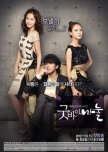
What makes “Goodbye Dear Wife” excellent overall lies in the intricate web of narrative strings that forms its framework, and in its ability to gradually bring them into focus in a surprisingly coherent manner, despite the fact that these threads unravel on the very edge of contradiction or, indeed, the most extreme paradox.A man discovers he has only a few months to live and decides to divorce the woman he loves. Not because he has stopped loving her, but because he loves her so much that he wants to ensure she can build a life for herself without him.
Behind this paradoxical, central and inescapable turning point, themes such as marital love, the spectre of first love, the rekindling of unrequited or impossible desires, and even death as a means of shaping the future all converge; almost a love story as voluntary self-destruction, filtered, moreover, through a Catholic subtext capable of defining an act of absolute sacrifice: namely, renouncing the right to be loved by one’s wife in order to guarantee her a life after he is gone…
The drama’s initial comedic tone introduces a number of thematic variations which are gradually developed and ultimately subverted; temptation and possession, the desire to possess and the impossibility of truly possessing another person – or even oneself.
Seung Hyuk, the protagonist (Ryu Shi Won, who is excellent and strikes a perfect balance between the drama’s various stylistic registers), believes he is in control of his own life; he has given up his career as a martial arts champion for the sake of Sun Ah (Hong Soo Hyun, visceral and lovely, deeply moving in her devotion, as dictated by her role, yet also delightfully self-deprecating in playing on her undeniable beauty) by building a marriage and a high social and financial standing, but remains fundamentally unresolved because of Hyang Ki (Park Ji Yoon, icy and inscrutable, but above all deeply tormented), his ‘first love’, who appears almost like a lost object to be recovered.
The temptation is not merely physical and emotional, but rather an almost desperate desire to turn back the clock…
But in a (paradoxically) symmetrical way, Sun Ah, too, experiences exactly the same feeling, with the return of Hyun Chul (Kim Min Soo, perhaps a little too stiff and lacking in any real spark), who is, moreover, extremely keen on the possibility of reclaiming the life they might have had. She had almost embraced the novitiate following Hyun Chul’s disappearance, but had been ‘saved’ by that rediscovered love offered to her by Seung Hyuk himself.
A couple, two past loves, the chance to open that door again, to find out whether what they have lost is really what they still want.
It is the diagnosis that completely alters the nature of things. Not only Seung Hyuk’s life, but his very notion of control; whereas before his mindset was: ‘I can decide who to love, who to leave, who to take back, and how to organise my life’, now, in a tragic reversal, it becomes: ‘I cannot even imagine how long I will live’. Before, there was almost a sense of omnipotence – amplified, moreover, by the entertaining microcosm surrounding the protagonist, his gym and his devoted athletes – but now this has given way to utter helplessness. The former champion can only manage what remains to him in a desperate attempt to bring some order to his life.
Yet another paradox – or rather, the resulting contradiction – concerns his behaviour towards Sun Ah, who is brutally reduced to the status of someone incapable of making her own choices; he decides that she must leave him, that she must forget him, that Hyun Chul might even be her future, and, above all, that the pain he will inflict on her now is preferable to the pain she will feel later.
It is an ‘extreme’ form of possession: the attempt to control his wife’s future. This makes his behaviour both loving and, at the same time, deeply violent. Not violent in the physical sense: violent because it robs her of the chance to choose. He does this through psychological blackmail, which is devastating even from the viewer’s perspective; he wounds her with the harshest arguments directed at Sun Ah – a devoted wife, a Christian believer and an obedient woman – deliberately seeking the point at which he can sever the bond. He must make her believe she is no longer loved.
The analysis of a marital crisis raises some universal questions: How well do we really know the person we love? Where does love for the other person end, and to what extent is it instead a desire to possess their image, their future, their fidelity and their presence?
The illness undermines all logical reasoning, eroding not only the body but also one’s certainties; the secret and the fear that Seung Hyuk experiences in solitude, ironically, also provide the comic framework that runs through the entire drama – yet another paradox: the protagonist knows something the others do not; he knows his own fate.
His wife does not, nor do his friends and family – his mother is even preoccupied with her own rediscovery of love, unaware of anything – whilst the other characters continue to interpret Seung Hyuk’s behaviour according to the usual rom-com tropes: love, betrayal, jealousy, first love, rivalry, gossip, etc.
Only Hyang Ki knows (and here one might raise objections regarding the principle of medical confidentiality); comedy and melodrama coexist perfectly, as we, the audience, see two different interpretations of the same behaviour at the same time. This asymmetry proves to be the mechanism that makes a situation bearable which, from the protagonist’s point of view, is simply tragic.
No longer being able to control one’s own destiny takes the paradox of possession to its extreme: the attempt to manage what will be left behind; yet the more Seung Hyuk tries to control everything, the more the drama shows him that nothing truly belongs to him; whilst the final match seems to represent the best possible metaphor, he, once again, chooses to change course.
In the end, his desperate attempt to become the architect of other people’s futures comes up against the reality that time cannot be managed and hearts cannot be planned. Seung Hyuk had believed he could foresee everything, even the pain of those left behind; yet his journey comes to a close when he gives up fighting against what he cannot change and chooses, once again, Sun Ah. There is no longer a future to plan, nor a life to entrust to someone else: all that remains is the time – brief and precious – to be spent together.
It is a resignation that bears no resemblance to defeat. Accepting one’s own fate also means granting the other person the freedom to choose their own, without any longer claiming to protect them even from what is bound to happen. Inevitably, the nature of sacrifice changes: it is no longer a matter of deciding on behalf of the one you love, but of accepting that you cannot save them from whatever the future may hold.
Time passes, and with it, life. The pain does not disappear, but finds a way to exist within the days, in everyday actions, in memories, in what continues to grow even though someone is no longer here. The loss is not erased, nor can the past be rewritten: quite simply, both end up finding a place within the present.
Perhaps this is the most authentic form of acceptance that the drama offers the viewer: not only that of the person who must die, but above all that of the person forced to remain behind. For death may cut short a life, but not necessarily a love; and what remains is neither possession of the other, nor the impossible promise of a future together, but the possibility of carrying on with life whilst carrying their memory with one.
‘Goodbye Dear Wife’ does not grant the miracle we have continued to await alongside its characters. It offers something more subdued: the realisation that not all stories can have a happy ending, but that a story can still find its own meaning without betraying what it has told. You can lose someone and, despite this, carry on living. You can carry on loving without ever being able to have them again. And what if, in the end, the price of love was exactly that? Learning to let go of what, more than anything else, we would have wanted to hold on to.
8/10
Was this review helpful to you?
This review may contain spoilers
Eros + Thanatos = taxidermy
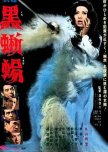
The enigmatic and alluring Black Lizard, a highly wanted criminal and thief who collects jewels, orders the kidnapping of Sanaye, the daughter of the jeweler who owns the precious diamond called “Star of Egypt”; Private investigator Kogorō Akechi sets out on her trail, engaging in a thrilling duel full of twists and turns with the cunning and brilliant collector, who, in addition to her passion for jewelry, also reveals an unusual penchant for human taxidermy…In 1968, in addition to directing avant-garde films for Toei, director Kinji Fukasaku accepted an offer from Shochiku to adapt—with great success—one of Edogawa Ranpo’s most famous novels, “Black Lizard”. The film was, however, based on the theatrical adaptation staged by Yukio Mishima. Isao Kimura was cast in the lead role as Detective Akechi, while the famous drag queen Akihiro Maruyama (Akihiro Miwa) was chosen to play the female lead.
Nearly 60 years after its release, “Black Lizard” continues to be regarded as a film that defies categorization, one that eludes any single definition. At first glance, it might be dismissed as an elegant crime thriller set against a “cops and robbers” backdrop, but it immediately becomes clear that the film is, in reality, a decidedly elusive cinematic work: decadent melodrama, psychological noir, pop spectacle, filmed theater, and a spy story coexist in a balance as improbable as it is fascinating.
It is likely that its hybrid nature is the reason it has been difficult to place this film within Fukasaku’s filmography; he is best remembered for his revolutionary yakuza eiga films of the 1970s, which are often cited by Hollywood masters of genre cinema—Martin Scorsese above all.
And yet, rather than a mere, perhaps impromptu episode, “Black Lizard” now stands as a cult classic capable of engaging with an international cultural landscape in the midst of transformation: within it, we can find the spectacular elegance of James Bond films, the colourful explosion of Pop Art, camp aesthetics, Japanese theatre, a certain colour palette typical of European cinema, literary decadence and even hints of classic Gothic horror; everything seems to merge into a visual universe where every costume, every set and every gesture combine to transform the narrative into an experience that is, above all, aesthetic.
Fukasaku’s – successful – challenge lies in going beyond the police investigation, instead staging a sort of war of aesthetics, in which every character, every setting and every object seems to be asking the same question: namely, whether beauty can survive the passage of time by transforming itself into an image, a simulacrum or a work of art.
At the heart of this aesthetic universe is, inevitably, its leading lady. Rather than simply portraying Black Lizard, Akihiro Miwa transforms her into a true pop icon ahead of her time, making her own body the film’s primary narrative tool. Each new appearance coincides with a metamorphosis: wigs, flamboyant outfits, jewellery, hairstyles and theatrical poses do not merely serve a decorative purpose, but continually redefine the character’s identity.
She does not merely wear the costumes; rather, she seems almost to inhabit them, transforming every entrance onto the stage into a performance in its own right. In this sense, Miwa’s acting transcends the very concept of performance, merging with the profoundly artificial nature of the film, where the boundary between human being, work of art and spectacle becomes increasingly blurred.
It is indeed this centrality of the image that makes “Black Lizard” much more than a sophisticated crime thriller. The protagonist’s obsession with jewellery and absolute beauty does not merely conform to the conventions of the crime story, but introduces a theme that runs through the entire work: the desire to shield what is perfect from the passage of time. In this universe dominated by artifice, every body, every object and every set seem to aspire to a form of eternity, transforming the film into a surprisingly complex reflection on the relationship between aesthetics, possession and death.
The more one looks at it, the less “Black Lizard” appears to be a mere 1968 pop thriller. Fukasaku crafts a work that traverses the detective novel, decadent melodrama, theatre, Gothic horror, camp aesthetics and pop art, without definitively belonging to any of these genres. Through the magnetic figure of Akihiro Miwa, the film draws on the legacy of Poe, reinvents it through Ranpo, elevates it with Mishima, and imbues it with the morbid elegance of Wilde and Beardsley. The result is a work in which beauty is not to be regarded as a prize to be won, but rather as a curse to be preserved.
For the Black Lizard, love does not consist in possessing a living human being, but rather in snatching them from the grip of time, transforming them into an eternal simulacrum. It is in this tension between eros and death, between desire and artifice, that the film finds its core identity, its deepest essence, establishing itself not only as one of the most eccentric cult classics of 1960s Japanese cinema, but also as one of its most surprising points of convergence with the great Western decadent imagination.
Thanks to this inspired insight, the film definitively transcends the boundaries of a mere adaptation of Edogawa Ranpo’s work. A dense web of cultural references spanning East and West takes shape around the obsession with the Black Lizard. The Japanese writer’s ero-guro imagery engages in a dialogue with the decadence of Oscar Wilde (thanks to the trait d’union provided by Mishima), with the sinuous elegance of Aubrey Beardsley’s revealing illustrations, and with the long shadow of Edgar Allan Poe, an author to whom Ranpo himself paid homage through his very pseudonym.
Even certain echoes of classical Gothic cinema – from Michael Curtiz’s “Mystery of the Wax Museum” to Edgar G. Ulmer’s “The Black Cat” – seem to resurface in the Black Lizard’s lair, where beauty is wrested from life to be transformed into an object of contemplation. More than just a crime thriller, “Black Lizard” thus becomes a surprising crossroads of different artistic traditions, capable of blending Western decadent melodrama with Japanese psychological noir into a work of extraordinary iconographic richness.
Seen in this light, the Black Lizard transcends the role of a mere thief or collector, or that of the classic femme fatale, to take on the almost priestess-like role of an aesthetic guardian. Every gem she steals, every body she preserves, every work of art gathered in her home is driven by the same obsession: to halt the passage of time, to rescue beauty from its inevitable decay and transform it into an eternal image. Her collection is not made up of objects, but of crystallised moments, of lives suspended at the moment of their absolute perfection.
It is only in his encounter with Detective Kogorō Akechi that this value system reveals its fragility. What unfolds between the two is not merely a detective duel, but a subtle game of seduction, intelligence and mutual recognition, in which the boundary between hunter and prey gradually dissolves. Akechi represents the only form of beauty that the Black Lizard cannot transform into an object of contemplation, because he continues to elude her through his indomitable vitality. For this reason, the protagonist’s final act does not feel like a surrender, but rather an extreme affirmation of her own worldview: in a universe where love is synonymous with the absolute possession of the desired object, to survive would mean accepting the failure of her own obsession.
If “Black Lizard” continues to exert a unique fascination even today, it is largely because it defies any definitive classification. Its most enduring strength seems to lie just in its ability to transform popular cinema into a spectacle of the image, where literature and theatre, East and West, eros and death come together in a celebration of beauty that is as refined as it is unsettling.
It is no coincidence that the film’s journey gradually leads the viewer away from everyday reality: from the bright lights and streets of Japan’s major cities to the confined spaces of the train, from the sea to the isolated refuge of the Black Lizard, a dwelling suspended outside of time where the protagonist keeps her collection of bodies and dreams. The geographical journey thus becomes an inner journey, a gradual entry into the mental universe of a woman who refuses to accept the transience of existence.
Fukasaku seems to suggest that beauty, the very moment it attempts to become eternal, inevitably risks ceasing to belong to life. In the Black Lizard’s lair, time seems to have stood still: everything that is perfect is preserved, but nothing truly continues to live. This is the ultimate price of the illusion of eternity, the paradox of an aesthetic which, in its attempt to defeat death, ends up embracing it.
8 ½
--------------------------
Dedicated to Akihiro (Miwa) Maruyama: 15 May 1935 – 20 June 2026
Was this review helpful to you?
This review may contain spoilers
My Wife and My Dead Wife (Coffee for three?)
Even before it became part of Korean fantasy television, the forty-nine-day limit has its roots in Buddhist tradition, where it represents the transitional period between death and rebirth – a liminal time in which unfinished business can still be brought to a conclusion.Asian cinema and television have repeatedly reworked this imagery, interpreting it through different sensibilities: sometimes through a precise chronological framework, as in “Hi, Bye, Mama!”; at other times by aligning, it with the rhythm of the seasons, as in “Be with You”; or through an intangible presence that continues to accompany those left behind, as in “Windstruck”.
In some of these works, however, the return is never the story’s conclusion, but rather its premise. It is the narrative gesture from which questions take shape, questions that concern memory, grief, affection and the very way in which time changes people.
What happens when it is not just a person who returns, but a past that everyone, in different ways, had learnt to transform into a memory?
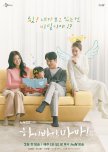
This question marks the beginning of “Hi, Bye, Mama!”. Having died suddenly five years earlier, just as she was about to give birth, Cha Yu-ri is given the inexplicable chance to return to the world of the living for forty-nine days. The miracle, however, does not return her to the past, but to a present that has already learnt to live with her absence. A husband who has rebuilt his life, a daughter who has grown up associating the word ‘mum’ with another woman, a family that has transformed grief into memory: it is within this microcosm that the series chooses to set its characters.
Such a premise almost inevitably leads the viewer to imagine a story of a second chance. It is an almost natural expectation, fuelled by the narrative premise itself. Yet, episode after episode, the series slowly begins to shift its focus in a very different direction...
Yu-ri’s journey progressively takes her through a series of psychological stages that ultimately redefine the very meaning of her return. Whilst she initially faces reality with the bewilderment of someone who finds herself in a world that has suddenly become alien to her, she soon realises that the true miracle lies not in having returned, but in coming to terms with a time that has never stopped to wait for her.
Although she had observed Gang-hwa and Seo-woo’s lives for years, as an invisible presence, direct contact with that present reality brings about a very different sense of disorientation: her husband has built a new family, her daughter has learnt to call another woman ‘Mum’, and she herself gradually realises she is merely a guest in a life that no longer belongs to her. The reunion thus gives way to an unexpected feeling: that of being a stranger in the place she once called home.
This state of paralysis is only broken when her maternal instinct once again takes precedence over every other emotion. Realising that her ghostly presence risks having a negative influence on Seo-woo, Yu-ri gradually abandons the idea of a simple reunion and chooses a far more painful path: entering her daughter’s life without being able to identify herself as her mother. She thus accepts a marginal, almost invisible role, working as an assistant at the nursery the little girl attends and observing her daily growth at close quarters.
It is within this microcosm that “Hi, Bye, Mama!” finds one of its most successful insights. The series, in fact, rejects one of the most overused tropes of family melodrama — the contrast between the ‘real’ mother and the antagonistic stepmother — opting instead for a far more complex and humanly credible approach.
Min-jung is not an obstacle to be removed, but a woman who has built, day by day, a genuine emotional bond with Seo-woo, taking on responsibilities that no one would have wished to inherit.
From this point on, the conflict ceases to be external and becomes entirely moral. The more Yu-ri comes to understand the sincerity of Min-jung’s love, the more the miracle of her return loses the appearance of a gift and takes on the form of a trial. To remain alive would mean reclaiming a place that time has inevitably entrusted to someone else, shattering a balance built through hard work and sacrifice.
The forty-nine-day countdown thus ceases to be a mere narrative deadline and becomes a slow realisation: the problem is no longer figuring out how to return to her own life, but accepting that, in the meantime, that life has continued to exist without her.
At this stage, however, one of the script’s main weaknesses becomes apparent. The series establishes from the outset that Yu-ri has spent five years alongside her family as an invisible presence, observing their daily lives. Because of this, it is difficult to reconcile this premise with the gradual ‘discovery’ of Min-jung’s character.
Many of Min-jung’s qualities – such as her dedication, patience and the bond she has built with Seo-woo – which Yu-ri seems to grasp only during her time at the nursery, should already have been part of her emotional makeup. Instead, the screenplay chooses to sacrifice this continuity of perspective in order to gradually guide the viewer towards the same realisation, achieving an effective emotional progression, but at the cost of internal consistency that is not always convincing.
Even the gradual revelation of Yu-ri’s return seems to obey the demands of the episodic structure rather than the natural consequences of such an extraordinary event. The news remains confined to ever-narrowing circles, as if the screenplay preferred to preserve the narrative balance rather than allow its inevitable repercussions to spread throughout the entire family and social microcosm.
At the same time, the series assigns the numerous ghosts in the columbarium an almost choral role, transforming each individual regret into a variation on the same theme. The intention is clear: to gradually prepare the viewer for Yu-ri’s fate through a series of small farewells. It is a choice that makes sense on a symbolic level, but one that often ends up diluting the narrative tension, taking away from the very human relationships that represent the series’ truest heart, and even verging on the redundant through the introduction of the – frankly unnecessary – figure of the exorcist.
Three different choices that ultimately produce the same effect: distancing the narrative from the human core that its very premise had made so powerful
When “Hi, Bye, Mama!” moves away from fantasy tropes and simply relies on its cast, it immediately regains its authenticity. It is particularly in the more contemplative scenes – even more so than in the dialogue – that the series reaches its finest moments: a mother who confesses to having forgotten the sound of her daughter’s voice; a father who continues to cherish every one of her belongings as if time had never passed; a sister who still enters her room; Gang-hwa realising he has never truly been alone; Yu-ri watching Seo-woo asleep beside Min-jung; the everyday conversations between Yu-ri and Eun-sook, built more on silences than on words.
And it is through these very fragments that Min-jung, too, completes her transformation, finally ceasing to be ‘the second wife’ and assuming, with full dignity, the role of mother.
Fantasy never disappears entirely; it simply becomes transparent. It remains the necessary condition for these characters to meet once more, but finally steps back from the centre of the narrative, making way for what the series does best: portraying the fragility of human bonds.
“Hi, Bye, Mama!” seems to suggest that the past survives not so much in moving images as in objects and small daily rituals. It is a memory that does not flow: it remains. Like a photograph.
It is significant that the theme of memory, too, is explored through a deeply material imagery. Photographs, letters, rooms left untouched, small everyday objects: memory almost always passes through what can be touched and cherished.
What is striking, however, is the almost total absence of audiovisual memories. In an age when home videos, voice recordings and short clips are perhaps the most immediate way to preserve the presence of a loved one, “Hi, Bye, Mama!” deliberately chooses not to go down this route. It is hard not to imagine that those fragments of voice and movement could have taken on enormous emotional significance within the narrative.
Whilst the drama retains its emotional power intact in the decisive moments, much of the credit goes to an impeccable cast that consistently avoids any melodramatic excesses. Kim Tae-hee crafts an extraordinarily restrained Yu-ri, conveying her pain through hesitations, uncertainties, silences and glances rather than words. It is a minimalist performance that naturally accompanies the character’s journey of self-discovery right through to her catharsis.
Particularly effective is the way the various emotional stages are handled. In the early episodes, Yu-ri rediscovers the world with a clumsy, almost childlike physicality, whilst learning once more to inhabit her body and navigate everyday life. This initial lightness makes the subsequent transformation all the more striking: as the forty-nine-day deadline approaches, Kim Tae-hee gradually strips the character of that vitality, making her movements slower and her body heavier, as if the inevitability of the separation were also reflected in her physical presence.
In the most intense scenes, the actress once again works with an almost understated skill: a restrained gesture, a held breath, a gaze that seeks to etch into her memory what she is about to lose, and tears held back. In this very composure—which eschews emphasis in favour of a silent and dignified grief—the actress conveys Yu-ri’s most authentic essence, transforming her into the portrait of a love capable of stepping aside.
Even more striking is the performance by Kim Mi-kyung, who brings the magnificent Eun-sook to life through a grief that is almost entirely internalised. Her journey only finds its full realisation in the finale, when the wish she expressed years earlier is revealed as the true reason behind Yu-ri’s return, gently overturning the narrative’s perspective: alongside the grief of a daughter deprived of motherhood, the pain of a mother forced to outlive her own daughter emerges with equal intensity.
For much of the series, Eun-sook suppresses her grief behind a façade of severity. She forbids anyone from mentioning Yu-ri, avoids her grave and imposes a sense of normality that is, above all, a survival mechanism. Kim Mi-kyung conveys this tension through understated acting, characterised by measured gestures, an ever-composed demeanour and glances that shy away from anything that might reopen the wound, transforming her steadfastness into a veritable emotional armour.
When Yu-ri returns, the actress allows that armour to crack without ever resorting to exaggeration. In the scenes shared between mother and daughter — a caress, a lullaby, a bowl of soup prepared just as it used to be — the pain emerges through small, everyday gestures, gaining even greater intensity through their very simplicity. It is then that we realise how Eun-sook’s harshness was never a sign of distance, but rather the fragile dam built up over the years to prevent grief from overwhelming what remained of the family.
Go Bo-gyeol carefully avoids any antagonistic portrayal. Her Min-jung constantly walks a fine line between gratitude, guilt and a sense of inadequacy, without ever turning her pain into a demand. Even in moments of greatest fragility — often brought on by confessions made over a glass too many — the actress maintains surprising control, allowing her emotions to emerge very gradually. Tears never represent a melodramatic climax, but rather the natural surfacing of pain that has been held back for far too long.
Lee Kyu-hyung portrays, with great restraint, a character constantly torn between two mirror-image feelings of guilt: that of having failed to protect Yu-ri, and that of having granted himself the right to start living again. His performance almost always eschews emphasis, save for the inevitably tragic moments, shaping Gang-hwa through hesitations, silences and sudden stiffening of the body, as if every gesture were the result of a precarious balance that is constantly at risk of breaking.
Without ever upstaging one another, the lead actors all seem to employ the same approach, almost achieving an ensemble performance, whilst remaining consistently true to the emotional core of the story, despite the script’s distractions, the excesses and redundancies of the fantasy elements, and the questionable nature of certain moments.
By the end of the series, “Hi, Bye, Mama!” leaves the viewer with a curiously ambivalent feeling. On the one hand, there is the realisation that this is a work capable of tackling universal themes with rare sensitivity and of relying on a cast of extraordinarily restrained performers; on the other, there remains the impression that the series has often faltered in the face of the power of its own concept.
The story of a mother who returns not to reclaim her life, but to learn how to truly let go, would probably have possessed, on its own, all the strength needed to sustain the narrative. Instead, the screenplay chooses, on several occasions, to dilute that tension within a broader narrative structure, alternating moments of genuine intensity with others that seem to pander to a more conventional fantasy aesthetic.
And yet, whenever the series finds the courage to push the supernatural into the background, something very simple happens: we stop questioning its rules and start taking an interest solely in the characters. These are the moments when “Hi, Bye, Mama!” reaches its highest level, reminding us that the real miracle lies not in Yu-ri’s return, but in the chance given to all the characters to finally say to one another what time had left unsaid.
This repeated oscillation between profound insights and a more cautious narrative structure makes “Hi, Bye, Mama!” a series that continues to challenge the viewer even after the credits have rolled. Not so much for what it tells, but for what, at times, it hints it might be. An almost unresolved state; a work that genuinely moves the viewer, whilst continuing to suggest, between one scene and the next, the outline of an even bolder drama.
“Hi, Bye, Mama!” seems to find its ultimate meaning not in the illusion that pain can be erased, but in the possibility of transforming a farewell that has remained unresolved into a farewell that is finally spoken. Rather than simply telling the story of a return, the series ultimately explores the way in which we learn to let go of those we have loved. At that point, to paraphrase Serge Gainsbourg, one of his famous lines seems to come almost naturally:
‘Je suis venu te dire que je m’en vais.’
7/10
Was this review helpful to you?
This review may contain spoilers
“The body may be gone. The weight never leaves.”
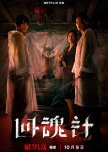
Two mothers, Wang Hui Chun and Chao Ching, bring their daughters’ killer back to life for seven days. It might sound like the start of a fantasy story. But it isn’t.What emerges is not the supernatural, but a system built on abuse, money and bodies held captive. A bold premise, almost a narrative gamble, capable of drawing the viewer right into the thick of the action before throwing them off balance.
At first, to mislead him with elements that seem to belong to the realm of fantasy, only to gradually reveal a more down-to-earth, contemporary dimension, where exploitation and money reshape every balance.
That's where the story draws its strength: in the constant deception—not just as a theme, but as a structural device—which leads the viewer to doubt, time and again, not only the nature of the story, but also that of its characters.
This suspended space is inhabited by two figures who share the same trauma, yet are separated by a circumstance that radically reshapes their perspective.
On the one hand, a definitive, irreversible loss—a daughter who cannot be brought back, not even symbolically. On the other, a suspended presence, a body that still breathes, and which keeps alive a possibility, however fragile.
It is in this asymmetry that the story finds one of its deepest tensions: for whilst the pain is shared, its direction is not. One moves within absence, the other within a state of waiting.
And this difference – subtle yet decisive – ends up gradually undermining not only their alliance, but also the very meaning of what they are trying to achieve.
In this context, revenge does not hold the same meaning for both of them. For someone who has lost everything, it may well become the only possible form of redress—or of survival. For the person who still clings to a glimmer of hope, however faint, it risks becoming a choice that calls into question what remains to be protected.
And when the target of this revenge is a man who is already dead, the matter becomes even more complicated: for what remains is no longer justice, but an extension of it—prolonged, organised, and increasingly difficult to distinguish from the very thing it was meant to fight.
This delicate balance is further destabilised by the portrayal of the daughters, Jin Jin and Hsin-yi, which operates by way of reflection and, progressively, through reversal.
Whilst the two mothers follow divergent paths—one rooted in absence, the other held back by a possibility—their respective daughters initially seem to confirm this dichotomy, presenting the viewer with an apparently orderly, almost reassuring interpretation.
It is a perception that the narrative carefully cultivates, leaving it to the viewer to construct a system of correspondences: innocence and guilt, protection and betrayal, victim and complicity. But it is here that the deepest deception takes root.
As the narrative unfolds, what seemed set in stone begins to crumble, and identities start to defy any fixed categorisation.
The daughters do not merely mirror their mothers: they challenge their mothers’ assumptions and complicate their choices, to the point where the distinction between victim and active participant in the system becomes increasingly difficult to draw.
The figure of the torturer, brought back to life, also forms part of this ongoing shift: no longer merely the source of evil, but an element that reveals, by contrast, the extent to which that evil is already widespread, internalised, and ready to resurface elsewhere.
The ending does not introduce a sudden revelation, but brings to a conclusion a process already underway: that of a gaze that is guided, directed, and ultimately disillusioned. Not so much because the truth is hidden, but because it is gradually rendered unrecognisable.
If the narrative tension unfolds naturally, culminating in an inevitable emotional breakdown, it is also thanks to the perfect and complementary performances of the two leading ladies.
Shu Qi’s presence is, at least in my view, the main draw of the story: a measured performance, often achieved through understatement, restrained yet deeply empathetic.
In contrast, Lee Sinje defines the measure, the stylistic signature, through a modulation of pain that unfolds in the absence of any prospect of hope, allowing choices to emerge that, almost inevitably, become increasingly irrational.
Around these characters, a context unfolds that does more than simply serve as a backdrop; it actively contributes to the construction of meaning.
A world in which money circulates without any apparent source, fuelling a culture of get-rich-quick schemes, identities that are constantly being constructed and renegotiated, and life paths defined more by opportunity than by choice.
In this network, deception is not an exception, but an organisational principle. It takes various forms, adapts and transforms: from the violent and direct structure orchestrated by Zhang Shih-kai, to the more subtle and seemingly legitimate version reflected in his mother’s activities, where the promise of redemption is intertwined with strategies of control and profit.
Two distinct yet perfectly interconnected models, which paint a picture of a system capable of replicating itself without interruption.
Even where the possibility of detachment seems to emerge, it ultimately gets swallowed up by the same pattern: relationships built on self-interest, performed identities, and dynamics that reverse roles to the point of turning the observer into an integral part of the mechanism.
Alongside this dimension lies a contrasting and complementary realm: that of opulence, of impersonal spaces, of hotel rooms and boutiques, of an aesthetic that suggests possibilities whilst concealing structural fragility.
And, in contrast, marginal realities, peripheral environments, places that bear the tangible traces of a system that consumes and redistributes without ever truly making up for what it takes away.
It is in this constant shifting—between visibility and invisibility, between construction and loss—that the drama establishes its identity, creating a dialogue between a seemingly ‘fantastical’ framework and a reality that, by contrast, seems all too familiar.
At this point, one cannot help but question the very nature of the framework underpinning the narrative: the resurrection, the seven days granted, the final return.
These elements, when viewed through a strictly realistic lens, would seem to call for a precise, almost demonstrative explanation.
But the story never seeks such coherence. From the very beginning, it establishes its own balance, in which death ceases to be a definitive limit and becomes a state of limbo, serving the purpose of what is yet to emerge.
And it is exactly in this suspended space that the reversal takes on meaning: not as an exception, but as the logical outcome of a perspective that is already biased, already susceptible to deception.
What concerns daughters—their nature, their role—does not require explanation, but rather recognition of what it becomes the moment certainties begin to crumble.
It is not, then, a question of whether or not to believe in the process, but of accepting the ground on which it operates: a system in which identity, responsibility and truth are constantly being redefined, to the point where every distinction becomes unstable.
The final return does not open up a new perspective, but brings to completion a dynamic already in motion: that of a world in which nothing truly comes to an end, but everything is absorbed, reorganised, and put back into circulation.
It is also in this choice—risky, exposed, at times imperfect—that the drama finds its own identity: an unstable equilibrium which, precisely in its imperfections, defines its strength.
Nothing truly ends. It simply changes hands.
7 ½
Was this review helpful to you?
This review may contain spoilers
“More than expressing myself, I destroy—in my own way.”
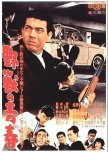
Within the highly prolific period of the so-called Nikkatsu Action—particularly between 1960 and 1962—"Youth of the Beast" (1963) stands as one of the most significant turning points in the trajectory of Seijun Suzuki.Some critical readings—often shaped by a rather rigid, auteur-driven perspective—tend to interpret Suzuki’s cinema as inherently pessimistic rather than programmatic, drawing on the ideas of another “outsider,” only seemingly distant, such as Jacques Rivette, who believed that cinema should strip the viewer of clichés and project them into a destabilizing, even unsettling dimension.
A strong idea, one that aligns surprisingly well with Suzuki’s aesthetic: a cinema that does not build, but dismantles, that does not reassure, but exposes. And yet, it is interesting to observe how the so-called B-movies of the late 1950s—apparently indebted to American hard-boiled aesthetics—would, in retrospect, prove to be among the most transformative moments of his career.
From an initially and inevitably imitative model, a gradual stylistic and cultural hybridization emerges, allowing Suzuki to introduce increasingly bold formal shifts: jump cuts not far removed from the lessons of the Nouvelle Vague (particularly Jean-Luc Godard), often eccentric widescreen compositions, sudden visual allegories, and an expressive use of color—elements that break away from the linearity of contemporary productions, which were generally more aligned with international trends (unsurprisingly, these were also the years in which Japan entered the aesthetic orbit of the James Bond phenomenon).
Within this framework, "Youth of the Beast" emerges as a work in which the hard-boiled matrix is not merely referenced, but fully absorbed and reworked. From its very first scenes, Suzuki introduces a key element through the play of reflections inside the nightclub.
Mizuno acts in front of a mirror that is far more than a simple visual device: it becomes a threshold. On one side, the gesture, on the other, the gaze. On one side, the action, on the other, its observation—as if it were already cinema within cinema.
And while all this unfolds, elsewhere—just a few meters away—the cabaret continues as if nothing were happening: music, bodies, lightness. Two planes coexist without ever truly touching, as if the picture itself refused to reconcile them. It is precisely within this disjunction that the first sign of a gaze already out of alignment begins to emerge, ready to fracture what initially appears perfectly readable.
Much of the film’s impact also lies in the magnetic presence of Jō Shishido, whose performance shapes a protagonist that seems to step directly out of the world of Raymond Chandler or Dashiell Hammett—filtered, however, through a distinctly Japanese sensibility.
Mizuno is, in every sense, an outsider private eye: a former policeman expelled for unorthodox methods, who inserts himself between two rival gangs in a structure reminiscent of a “servant of two masters,” only to reveal a far more personal objective—uncovering the truth behind his mentor’s death, too hastily dismissed as suicide. It is here that the picture fully descends into the territory of the bleakest noir.
The truth, far from restoring order, ends up eroding everything: it exposes, contaminates, destroys. And when the full picture finally comes into focus, what emerges is not justice, but a form of awareness that is irreparably compromised.
Suzuki builds this trajectory through a mise-en-scène that is violent, stripped down, almost brutal, yet constantly interrupted by visual insertions that resist any single interpretation: elements that seem to drift out of context, such as the yellow dust that invades the assault scene (and then the wind, an indispensable feature in the director's cinematic language), the sudden fall of the addicted woman, or abrupt eruptions of violence and sadism that oscillate between realism and abstraction.
These are images that do not explain—they suggest, unsettle, remain open. In this sense, the work does not simply tell a story; rather, it fractures it, distorts it, placing it under constant tension between narrative surface and something more elusive beneath it.
What emerges is a deeply corrupted world, permeated by a violence that spares no one. Within this universe, the portrayal of female characters takes on extreme contours, often tied to dynamics of manipulation, exploitation, and betrayal.
Seen through a contemporary lens, this aspect may appear problematic—but it can also be repositioned within the grammar of hard-boiled noir, where female figures often function less as causes of degeneration than as reflections of a world already compromised.
In this context, the protagonist’s so-called 'misogyny' appears less as a moral stance and more as the byproduct of an environment in which every relationship is contaminated.
Mizuno himself is neither a traditional hero nor a straightforward anti-hero. He operates according to a personal code—seemingly more stable than that of the other characters, yet far from irreproachable. In a world where everything is tainted, his position inevitably begins to crack: he is not detached from the violence that surrounds him, nor from its most ruthless logic.
The ending, in this sense, is revealing. Mizuno does not simply expose the truth—he actively shapes its outcome, deliberately closing a cycle of violence that leaves no room for redemption.
It is precisely in this gesture—lucid, fully conscious—that the character’s ambiguity comes into focus: not a judge, not a savior, but someone who, while holding onto a personal moral line, ultimately shares in the same dark substance of the world he moves through.
What remains is a sense of emptiness, almost exhaustion—as if, once the mechanism has been revealed, there were nothing left to preserve.
In this regard, "Youth of the Beast" is not only a remarkably effective noir, but one of the most accomplished expressions of the internal tension that defines Suzuki’s cinema: an unstable balance between form and sabotage, between adherence to genre and its gradual dissolution.
An image that offers no foothold, seeks no redemption—and because of this, retains an extraordinary power even today.
9/10
Was this review helpful to you?

This review may contain spoilers
Sunglasses After Dark
Whilst “Branded to Kill” can be seen as the most obvious breaking point in the relationship between Seijun Suzuki and the Nikkatsu production system, “Trapped in Lust” appears to sit within an even deeper, almost subterranean continuum, where that same rift resurfaces in other forms, adapting to a production context that has since changed.It is no coincidence, after all, that behind the project we once again find Atsushi Yamatoya, who was already one of the writers of “Branded to Kill”, and who here - as well as playing the role of Takagawa- is involved in a reworking that feels more like a detour than a real remake.
In his compelling analysis, ‘Il Fiore e Il Serpente’ (2022), Beniamino Biondi devotes a section to Yamatoya, also mentioning three different screenplays that formed the basis for “Branded to Kill”, although, curiously, he merely touches upon “Trapped in Lust”.
We are in the midst of the pinku eiga and roman porno season – that cinematic realm where the body becomes the central element, both an exposed surface and a narrative device. Yet precisely where one might expect greater freedom of expression, the film immediately introduces a more ambiguous tension.
Sex, in fact, is never truly liberating. It is obviously ever-present, pervasive, almost obsessive — yet progressively stripped of meaning, as if, by inertia, it continued to exist even after having lost its purpose.
Hoshi, the main character played to perfection by Genjiro Arata, navigates this system as a figure already broken. A rising killer, driven by a desire for recognition that coincides with his climb to the top of the organisation, he soon finds himself caught up in a decidedly complex dynamic that ultimately overwhelms him.
The character of Mayuko (the voluptuous and alluring Moeko Ezawa) — an apparently faithful wife, but in reality a pawn of the organisation — introduces an element of structural ambiguity right from the start: there is no relationship that is not, to some extent, constructed, manipulated or prearranged.
His (apparent) elimination, however, does not result in what might be seen as a strengthening of the protagonist, but rather marks a rupture. It is as though, just at the moment when the body should (and could) re-establish itself as the centre of the action, something ends up breaking irrevocably.
The resulting impotence — made all the more evident in his encounter with Yumeko (Nozomi Yasuda), the young prostitute at the hotel — is not merely a narrative element, but a genuine deviation from the system: desire, stripped of his ‘object’ and, at the same time, of its mystery, is transformed into an automatic gesture, a function incapable of producing any meaning whatsoever.
It is no coincidence that Hoshi spends almost the entire film behind a pair of sunglasses, worn regardless of whether he is indoors or outdoors, or whether it is day or night: it is as though his gaze, filtered and obscured, ends up conveying an inevitably distorted view, a reflection of a cinema in which reality is no longer simply shown, but is constantly obscured, distorted and re-enacted.
As was already the case in "Branded to Kill", a recognisable structure is present here too: there is always an organisation, rules are followed, and a hierarchy is in place. But it is precisely in the relationship with these rules that the film finds one of its most significant turning points.
Hoshi’s fault lies not so much in the mistake itself, but in the return. In returning to the scene of the crime, in reopening what ought to remain closed. It is an act that disrupts the system’s internal balance — and lays it bare. From that moment on, the climb is no longer merely ambition, but a form of attraction towards the point where the mechanism seizes up, becomes visible, and turns inevitable.
It is in this context that some of the film’s most unsettling characters emerge.
The ruthless and sadistic killers Mario and Saigo form a dual, almost unreal, certainly hallucinatory presence: a seemingly fragile female doll juxtaposed with a rigid, armed, silent body. Only later does the apparatus reveal itself for what it is: a simulated identity and mechanical bodily artificiality, a sort of Cronenberg-esque hybridisation.
Even once revealed, the effect does not fade. A sense of unsettling continuity remains, as if the body could now be broken down, reassembled and manipulated without any stable point of reference. It is precisely through these figures that violence takes on a further dimension: no longer a source of tension, as is typical of noir, but a repeated, almost abstract function.
The deaths follow a pattern that borders on the grotesque — bodies frozen in baffling, ambiguous poses, even the act of defecation abruptly interrupted (a pure homage to Suzuki, worthy of the finest Abel Ferrara) — whilst the narrative seems to constantly veer away from a linear progression. Curious musical and choreographic interludes, featuring Crazy Horse-style dancers who are stripped down and seemingly out of context, do not interrupt the narrative, but rather throw it off balance.
In Hoshi’s journey, this gradual loss of coherence results in an ambiguous transformation. Having eliminated his opponents, though physically scarred — blind in one eye — the protagonist seems to regain a form of ‘vigor’, but this recovery does not amount to a genuine restoration. Rather, it is the final stage of a process: the body returning to function just as everything else has ceased to make sense.
The final confrontation takes place in a stunning, almost Stanley Kubrick-esque setting that is both a fortress and a stage: a concrete building, isolated and surrounded by vegetation, which gradually reveals itself for what it is.: A theatre. The boss offers no resistance. He sits, observes, waits. The gesture that concludes the confrontation is simple, direct, inevitable. And immediately afterwards, something cracks.
Hoshi bows. Not to anyone in particular — perhaps, hypothetically, to an invisible audience; is this, ideally, a breaking of the fourth wall!?
It is at this point that the film ends with a meta-cinematic short circuit: power reduced to the role of spectator, the killer to that of performer, violence to mere representation. There is no victory left. Here too, there is no conclusion, but only the realisation that what we have witnessed was nothing more than a visionary performance taken to the extreme.
Whilst “Branded to Kill” depicted a system that had ceased to function, “Trapped in Lust” portrays what happens when, in place of rules, only the body remains. And even that, inevitably, ends up breaking down.
8/10
Was this review helpful to you?
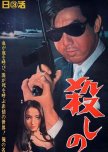
This review may contain spoilers
Il n'est en art qu'une chose qui vaille, celle qu'on ne peut expliquer...
There comes a point in Seijun Suzuki’s career when one begins to suspect that something has simply broken. Not in a dramatic sense, nor in any ‘artistic’ way that we are accustomed to describing it.More simply — and perhaps for that very reason more radically — it is as if, after years spent making three or four films a year within the Nikkatsu production machine, Suzuki had looked at the mechanism for what it was: a perfectly functioning structure… and one that was completely exhausted.
At that point, instead of resisting or walking away (at least of his own accord), he seems to do something much simpler. The mechanism… He picks it up. He opens it… And stops putting it back together.
“Branded to Kill” (for the record, the only Suzuki film regularly distributed in Italy at the time) stems precisely from that: not as a dramatic break with convention, but as an internal short circuit, a moment when the genre movie — specifically the yakuza noir — carries on by inertia, even though something, in the meantime, has stopped working.
It’s not that there’s a specific scene or a passage you can pinpoint; it’s just that, as you watch it, at a certain moment you seem to sense it. The film is still there. The story… not quite in the same way.
Suzuki breaks the structure down into fragments, allowing them to coexist without forcing a return to wholeness. A gesture reminiscent of Cubism: not an alternative reality, but the same reality viewed from incompatible, simultaneous angles that cannot be pieced back together. Not a narrative that unfolds but a surface that shatters.
The protagonist, the hitman Hanada, is not a character in the traditional sense; he is a top-tier professional, ranked number 3 in a hierarchy that seems more like a mental obsession than a real system. It is unclear whether he is merely a victim of events, tries to navigate them, or simply reflects them.
It’s almost like a loop. He has these incredible obsessions – the smell of rice in particular, and relationships with the opposite sex – and moves through a world – real!? Imaginary!? Inevitable!? – which, really, resembles a noir film, at least on the surface, perhaps from a distance. Up close, however, it is as if everything had been taken apart and put back together badly, as if a deliberate decision had been made to sabotage the very concept of continuity (logical!? Narrative!?)
It is therefore pointless to try to piece the picture back together: the fragments were never meant to fit together. It is from this acceptance — rather than from any interpretation — that “Branded to Kill” reveals its most elusive nature. It functions like a trance: actions repeat themselves, distorted; situations slip into one another without ever truly meshing. Hanada moves within this flow as if following an automatism he does not control.
It is a kind of strange, almost ‘flawed’ hypnosis that always seems to leave a crack, a tiny gap that prevents one from letting go – and, evidently, from understanding (?). Yet rather than being a dream to be deciphered, it is a reality that has ceased to function.
Despite everything, beneath this unstable surface, the structure is still (more or less) recognisable.
There’s a killer. There are assignments, organisations, hierarchies. There are enigmatic women, betrayals, shoot-outs. Everything needed to build a good noir. Except that here, every element seems to arrive after its own meaning. The tension doesn’t seem to build so much as to dissipate.
Vague dialogue that distracts rather than clarifies, and violence that borders on abstraction in its slavish and, in some respects, illogical repetition. The incredible soundtrack, a blend of jazz and avant-garde (the pink vinyl edition is beautiful!) The noir genre hollowed out from within, leaving only the shell—though far from inert… But this is no parody or cinephile’s mockery playing with arthouse cinema; it is something stranger: a noir that hasn’t realised it’s finished.
And in this friction — between what we recognise and what no longer works — Suzuki finds his greatest freedom. He does not destroy the genre but lets it go. The director takes the noir/yakuza film as his starting point, distorting it until it becomes unrecognisable yet not abstract, moving away from pure avant-garde to arrive at a form of pop (art?) under extreme stress…
If we were to imagine the Nikkatsu executives sitting in the projection room watching "Branded to Kill", we would probably be faced with a scene reminiscent of Jean-Luc Godard’s "Le Mépris", where Jerry Prokosch, the producer played by Jack Palance, literally flings – like a frisbee or discus throw – the film cans of Fritz Lang’s film, for an adaptation of Homer’s “Odyssey” that isn’t exactly “commercial”, in his view…
But Suzuki is not a ‘rebel’, rather, he is an insider saboteur. The romantic narrative of ‘the director versus Nikkatsu’ is true but limiting. Suzuki is more interesting – and complex – if we read him as a craftsman who realised that the system had run out of substance, and that it was better to ‘stuff’ the form until it burst.
If, in "Branded to Kill", sex becomes almost a “fetishistic compulsion inextricably linked to death and violence” (quoted) and if Suzuki “deconstructs genres and conventions”, drawing on a non-conformist spirit and a taste for social satire (already quite evident in his first “personal” works), then, rather than associating him with the American Samuel Fuller, as is often suggested, one is inclined to link him more closely to a director seemingly worlds apart, such as the Italian Marco Ferreri, whose iconoclastic vision is almost identical.
At this point, seeking a conclusion in the traditional sense seems almost out of place.
“Branded to Kill” doesn’t really come to a closure. It doesn’t tie up loose ends or restore order. It simply… fizzles out.
As if, having pushed the mechanism to its limits, Suzuki had decided it was no longer worth fixing. That the meaning, if there was any, had already been exhausted along the way.
And that all that remained was this collection of fragments, images, gestures — still in motion, but now disconnected from any notion of wholeness.
And the viewer, at that point, is not asked to understand, but rather to simply stand before those fragments. To lose himself, if necessary. Or even just to accept that the pieces will never come back together. Because perhaps this is precisely the film’s most radical act: not breaking the rules, not rewriting them, but letting them go — and observing what remains when we stop holding them together.
“Branded To Kill” is unlike anything else, even today when we’re used to everything. It’s short, fast-paced and full of images that stick in your mind. Ultimately, if you like, it’s even entertaining — but in that slightly strange way that leaves you feeling as though you’ve understood something… without knowing exactly what.
And in that moment, between a shot that slips away and a cut that doesn’t quite land, you almost find yourself picturing him once more:
Suzuki. A step back. A quick glance. A half-smile.
As if he were saying to you: “It used to work great, you know?
But in this way it’s much more interesting.”
9 ½ / 10
Was this review helpful to you?
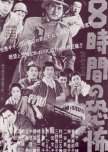
This review may contain spoilers
“I’m not John Ford. And whatever this is… it’s not a western.”
A landslide blocks the railway line, forcing an assorted group of passengers to continue their journey toward an alternative station aboard an aging bus, along a treacherous and unforgiving mountain road. A situation already precarious in itself, which takes on far more ominous overtones when word spreads that two dangerous criminals may be traveling the very same route.It takes little more than this premise to recognize how, in the hands of Seijun Suzuki, what unfolds is a reinterpretation — only seemingly faithful — of the archetypal model established by “Stagecoach” (John Ford, 1939): a moving microcosm of humanity, compelled to confront an external threat that inevitably brings to the surface latent tensions, contradictions, and hierarchies.
It is no coincidence that one of the characters — the woman working at an American base — explicitly evokes that very imagery, enthusiastically likening the situation to a “western movie.” A fleeting moment, perhaps, but one that functions almost as a statement of intent, subtly offering the viewer a key through which to interpret what follows.
Because while the starting point appears to adhere to a well-established narrative framework, it is precisely in the development — in the details, tonal shifts, and the characters’ reactions — that Suzuki’s gaze begins to gently destabilize the structure, allowing a sense of underlying instability to emerge, one that would soon become a defining trait of his cinema.
From this seemingly codified foundation, it is in the definition of its characters that the work most clearly reveals its true nature.
The passengers are not merely individuals, but rather recognizable social archetypes, arranged with almost schematic precision: figures that initially seem to comply perfectly with genre conventions, only to be gradually tested — and often subverted — over the course of the journey.
We encounter the “fallen” woman tied to the American base, yet endowed with a moral integrity far stronger than her role would suggest; the convicted murderer — a former military doctor — who will unexpectedly reveal a capacity for sacrifice; the irreproachable policeman; and the aging driver, a figure not unlike those found in westerns, suspended between irony and quiet responsibility.
Alongside them unfolds a gallery of equally emblematic presences: the opportunistic salesman, dysfunctional couples, restless bourgeois figures, young people chasing uncertain futures — culminating in perhaps the most fragile and emotionally resonant character, the abandoned mother traveling with her child, who becomes one of the narrative’s emotional centers.
At first, these figures seem to move within predictable and almost reassuring boundaries. But with the violent intrusion of the two criminals, that fragile balance begins to fracture.
At this precise moment that the masks fall.
What initially appeared as simple typification gradually transforms into a far more exposed and unforgiving terrain, where each individual’s true nature emerges: the cowardice of those concerned only with survival, the opportunism of those seeking advantage, but also the unexpected courage of those who, having nothing left to lose, choose to act.
In this regard, the trajectory of the condemned man is particularly telling — a figure initially relegated to the margins, yet ultimately embodying a form of redemption through action, in stark contrast to others who, despite their social respectability, prove incapable of withstanding the pressure.
What emerges, then, is not so much a distinction between good and evil, but between those who can endure the strain… and those who are crushed by it.
And it is from this tension — more human than moral — that a fragile sense of solidarity begins to take shape: intermittent, unstable, yet ultimately the only viable means of survival for a group that, until then, shared nothing but a common destination.
From this reluctant convergence arises a collective response — not heroic in the traditional sense, but instinctive, almost inevitable — as individuals, pushed to their limits, are forced to recognize themselves as part of a shared fate.
The resolution of the conflict, sudden and violent, brings the tension to an end, but offers no true sense of liberation.
Because while the group ultimately reaches the long-awaited station, what awaits each of them is a return to reality that feels, in many cases, far more disillusioned than the expectations that accompanied their departure. Dreams fade, illusions dissolve, and what remains is the quiet weight of an experience that cannot simply be left behind.
It is worth noting that, despite its apparent structural rigor, “Eight Hours of Terror” was subject to studio interference during the editing phase — a clear indication of the uneasy relationship between Suzuki and the production system within which he operated.
And yet, even within such constraints, his authorial presence unmistakably surfaces.
One can already sense a subtle inclination toward disruption: moments of irony, sudden tonal shifts, small acts of irreverence that both relieve and destabilize the tension. Certain characters, deliberately accentuated, verge on caricature, contributing to an unstable balance between realism and stylization.
Likewise, the management of space — largely confined to the interior of the bus — becomes a genuine exercise in form, where rhythm and suspense rely heavily on precise editing and carefully controlled shifts in perspective, avoiding any sense of stagnation despite the limited setting.
It is within these details, rather than in the broader narrative structure, that the first signs of Suzuki’s emerging voice can be clearly detected — a tension that would later expand more radically as the constraints imposed by the studio system grew increasingly restrictive.
Even taking into account the inevitable reworking and external interference, “Eight Hours of Terror” stands as a remarkably accomplished piece, where narrative solidity coexists with a subtle but persistent undercurrent of formal deviation.
It is within this silent friction — between structure and subversion — that the work finds its identity, revealing itself not only as an effective genre piece, but also as an early indication of the incompatibility that would come to define Seijun Suzuki’s relationship with the industry that sought, unsuccessfully, to contain him.
8 ½
Was this review helpful to you?
This review may contain spoilers
Tonight, we’ll meet / At the dark end of the street (You and Me)
A painful but necessary family drama, ‘Love Me’ depicts love as a fragile yet tenacious force, capable of blossoming even where pain has left only ruins. The loss of the wife/mother — the angel of the house and emotional anchor of the family — is not so much the focus of the narrative as the mechanism that triggers a long, tortuous and dolorous process of reconstruction, in which each character seeks to rediscover a balance that seems irretrievably broken.A sort of slice of life that subtly, without shouting, avoids the most obvious melodramatic clichés, the series confronts us not with the trauma of loss, but with the “after”, when life demands to continue, to be lived anyway. In this sense, ‘Love Me’ moves slowly, with silences and pauses that are not empty but full of meaning, as only real life can be.
The narrative follows the parallel trajectories of widowed father Jin Ho and his children Jun Gyeong and Jun Seo, three different responses to the same void. Jin Ho, a faithful husband for decades, is taken aback by his desire to love again and, at the same time, terrified of his family's judgement. Jun Gyeong, a midwife, carries a sense of guilt that makes any potential relationship a minefield: she wants to love, but fears making mistakes. Jun Seo, the youngest, represents a contemporary fragility: the fear of not being good enough, the feeling of falling short of others' expectations and of one's own life.
The romantic relationships that develop throughout the series are not presented as salvation, but as a challenge. Love does not come to “fix” the main characters’ lives, but to test them further.
Jin Ho is a man who loved with all his heart and now finds himself faced with the chance of a new relationship. Fear of judgement, loyalty to the memory of his wife, the difficulty of accepting happiness: everything mixes together in silent torment. When love knocks on his door again, the drama recounts the tenderness of someone who feels guilty for still wanting to love. And when a dramatic turn of events upsets his new relationship, the story does not choose the easy way out: it confronts him with a different kind of loss and forces him to choose to live in the present, even if it is short-lived and fragile.
Jun Gyeong, a midwife, is a woman who knows how to give life to others but struggles to give it to herself. Her heart is trapped between guilt and fear of making mistakes. Hers is the most turbulent trajectory; initially, she welcomes love with suspicion, as if any happiness could turn out to be a deception. With Do Hyeon and young Daniel, she builds, or at least tries to build, a new family, but her vulnerability leads her to make a mistake that calls everything into question. Nevertheless, with patience and humanity, and the support of her partner, she learns that loving does not mean being perfect, but staying, even when you fall.
Jun Seo experiences a more “ordinary” but equally profound crisis. Having set aside the career he thought he wanted, he feels inferior to his girlfriend, an aspiring writer with a more defined future. His journey, made up of attempts and failures, leads him in a new, more concrete and realistic direction. In reconnecting with Hye On, Jun Seo learns that love does not measure value based on success, but, on the contrary, on the sincerity of the heart.
It is interesting how the construction of these narratives is intertwined with one of the most powerful symbolic elements of the drama: the house. The family home is not just a setting, but a silent presence that preserves everything. It is the place that has seen love blossom, children grow up, and everyday life unfold; and it is the same space that welcomes infermity and death without denial (the bed, the photographs, the garden...). Even when the idea of leaving it takes hold, it remains clear that certain places are not abandoned but change form, are passed through, in order to continue to preserve what has been...
In this sense, ‘Love Me’ takes on an almost Zen-like dimension: impermanence, acceptance, the ability to find meaning in things we cannot control. But without abstract interpretations, probably due in part to the Catholic influence that is a strong presence in the Seo family. Pain is not explained, but accepted as part of existence; life is not a straight line, but a series of sudden turns. And even when it seems that everything is over, love is not a consolatory promise of salvation, but a conscious choice, often difficult and always exposed to loss; love can return to enlighten even the darkest corners.
A little television miracle made possible thanks to an exceptionally talented cast, definitely one of the story's strong points; all choose a controlled, measured acting style, never over the top, which renounces emphasis in favor of small gestures, glances and half-phrases. Through a “natural”, almost spontaneous style that does not demand attention but wins it over, allowing the viewer to grasp every emotional nuance and tune in to the characters without filters. By personal choice, Seo Hyun Jin and Yoon Se Ah (but here I am not impartial!) completely won me over; two beautiful actresses, in every sense.
The drama undoubtedly requires the right kind of mood, perhaps viewing in small doses, to allow emotions and reflections to settle; it does not promise easy consolation, but it does offer a discreet certainty: even when you make mistakes, even when you lose, even when you start again late, you are never truly alone. And somewhere, there is always the possibility of loving again, and being loved...
8/10
Was this review helpful to you?
This review may contain spoilers
Moonlight Finds What Daylight Misses
'Forbidden Love' (2004) remains, years later, an anomalous but surprisingly coherent work: a drama that uses melodrama as its backbone to graft on horror folklore, urban action and a far from trivial reflection on power and visibility. A work that does not seek balance, but builds its identity precisely on the friction between registers.One of the most interesting aspects of the series is the choice not to “hide” the supernatural, but rather to have it coexist openly with the urban landscape. The gumiho clan does not live on the margins: they are fully embedded in contemporary society, often occupying positions of authority. If during the day these creatures appear perfectly integrated into civil life, at night they sink into the underground, where an archaic realm of braziers, altars and ancestral symbols (and an abundance of leather outfits!) opens up, fuelling a world of rituals, feuds and millennial secrets. An imagery that, in terms of artificiality and evocativeness, is more reminiscent of Italian peplum movies and certain deliberately fictitious sets by Mario Bava than television realism.
In this dual space — bourgeois surface above, primordial rituality below — suspended between melodrama and gothic horror, paganism and the occult, the series finds its most authentic identity. 'Forbidden Love' is not a “spectacular” fantasy in the classical sense, but a lateral fantasy that infiltrates the interstices of the modern city: the fantastic does not destroy reality or replace it, but slowly infects it, almost vampirically, creeping into the creases of everyday life.
The melodramatic storyline is based on predestined yet impossible loves, in which every feeling is doomed from the outset. The gumiho Shi Yeon (Kim Tae Hee, beautiful and committed to a well-developed role, albeit still too expressive in her facial gestures) is at the centre of an emotional four-way relationship with no way out: She rejects the human and predestined love of policeman Kang Min Woo (Jo Hyun Jae, convincing), because she belongs to the lineage that he, initially unaware, fights against; but she also rejects that of her fellow Mu Young (Jun Jin, overly restrained), unable to arouse true involvement in her.
Shi Yeon is inextricably linked to the fate of the thousand-year-old fox; a natural and spiritual law that governs the existence of gumiho, laden with symbolic and metaphorical references: the impossibility of emotional bonds, not having to give in to human love, not mixing desire with the primordial instinct of the fox. The ‘curse’ represents the price to be paid for becoming fully human. Hence the divided identity, the repression of feelings, the eternal conflict between imposed destiny and individual choice, the personal sacrifice that precludes both paths, because every emotional bond strengthens one part of her at the expense of the other...
The gumiho warrior is an almost ascetic figure, forced into solitude not by moral choice, but by ontological necessity, which is immutable. The drama still holds up today precisely because of this mature and painful conflict: love truly becomes “forbidden love”.
Around them moves Chae Yi (Han Ye Seul, super sexy and perfectly suited to the role), a tragic character crushed by a double inferiority — hierarchical and sentimental — that transforms jealousy into betrayal. In this context, the melodrama offers no promise of redemption: love, though predestined, cannot be fulfilled without destroying those who feel it. No one, human or gumiho, is destined for a happy ending, because the predestination of love is not a promise, but a condemnation.
It is within this relentless logic that a “sideways” loss occurs, seemingly unrelated to the love four-way, but destined to contaminate it from within: a human bereavement, innocent and unaware of the deep axis of the story, which, touching on one of the symbolic cores of the gumiho’s existence, transforms love itself into guilt.
The introduction of the special police division marks a decisive change of scale. The military, not surprisingly, ‘don't mince words’: they embody a cold and repressive rationality that conflicts with both the gumiho and Kang Min Woo. The policeman thus becomes a tragic figure in his own right: torn between love and duty, empathy and repression, caught in the middle of two worlds that demand absolute loyalty. His conflict is insoluble, because every choice involves a loss. It is here that the melodrama acquires an unexpected depth: love is not salvation, but yet another battlefield.
The action scenes do not seek realism or pure spectacle, but instead function as geometric rituals inscribed in urban space. Squares, rooftops, stadiums, gyms, shopping centers, and even churches become chessboards where Korean folklore, television melodrama, and post- ‘Matrix’ and ‘Underworld’ action imagery coexist in a kitschy balance that is as delirious as it is coherent.
The characters seem to move according to invisible rules: the conflict is less psychological and more topological. The gumiho factions occupy areas, the police establish a counter-map, and the clashes take the form of choreographed rituals rather than traditional narrative events. Many sequences seem to openly declare: “Let's take a hyper-kinetic Western grammar and perform it with absolute seriousness, even when it's excessive.” Accelerated editing without realistic justification, iconic poses, sudden slow motion. This is where kitsch becomes conscious language: not irony, not parody, but total adherence to the subject's delirium.
In this radicalism, Korean drama touches upon — perhaps unintentionally — an unexpected arthouse cinema: a Jacques Rivette catapulted into contemporary Seoul, between ‘Duelle’, ‘Noroît’ and ‘Out 1’, but filmed as if Spike Jonze and the Beastie Boys had stumbled upon the set by chance. “Comment vous dire... c'est du sabotage!”. A happy and vital sabotage that cracks the surface romanticism and lets it breathe in the unexpected, in physical gestures, in the pure energy of movement.
Despite its obvious flaws in terms of pacing and writing, ‘Forbidden Love’ remains an ambitious drama with a strong sense of identity. Re-evaluating it means accepting its irregularities without mistaking them for superficiality. It does not excel in every single aspect, but it builds a coherent universe, a layered urban mythology and a surprising dialogue between folklore, action and melodrama. Its value lies in the sum of its parts, not in the perfection of each one: an uneven but coherent story, which finds its strength in its eclecticism. Not a perfect series, but an object with an off-kilter charm that, years later, deserves a closer look and a more generous judgement — and, above all, recognition of its courage in remaining true to itself, right up to the very last frame.
7 ½
Was this review helpful to you?
This review may contain spoilers
Sail to me Sail to me, let me enfold you
The accidental and magical encounter between two totally opposite worlds: on the one hand, Kim Joo Won (Hyun Bin, immense), the arrogant young heir to a wealthy business empire, accustomed to viewing reality through the lens of privilege, control and efficiency, deeply scarred by a trauma suffered during his youth. On the other, Gil Ra Im (Ha Ji Won, wonderful and iconic), a stuntwoman, an invisible worker in the entertainment industry, accustomed to putting her body at the service of cinematic illusion without receiving the recognition she deserves.Around them is a colorful microcosm that sums up Korean showbiz, made up of eccentric idols such as singer Oska (Yoon Sang Hyun, extraordinary and hilarious), stars in crisis – including personal crises – looking for a creative comeback, his ex, Yoon Seul (Kim Sa Rang, beautiful and perfect), a young heiress, music businesswoman and aspiring filmmaker, and the whole underworld of show business made up of artists seeking their fortune and an academy of stuntmen who risk their precarious lives every day in the name of cinema.
Between past traumas, crossing stories, despotic mothers, role reversals (and body swaps!), a magical contemporary fairy tale set in dreamlike scenarios, accompanied by a fabulous soundtrack, where fate and destiny inevitably intertwine, marking the lives of all the protagonists forever.
An extraordinary “social” melodrama capable of using fantasy as a magnifying glass for “reality”, Secret Garden stylishly transcends the limits of romantic fantasy, decoding the genre and cinematic language through a complex narrative structure, literary references (Andersen and Carroll, above all) and witty dialogue, deep and poetic, and unconventional choices that constantly revitalize a multi-layered story, suggesting that nothing is truly random and drawing the viewer into a whirlwind that ties the characters' destinies together, far beyond what appears on the surface.
Beyond the (beautiful) love story, Secret Garden immediately raises questions about themes such as the power of money, the concrete violence of social differences, and a moral dimension that is never pacifying or consoling, but rather raw, direct and unpleasant. But the drama also speaks to us of dedication to work, friendship and sacrifice, physical labour, and everyday life marked by the precariousness of an independence built more out of necessity than choice. It is not only a narrative device, but also a moral and social one, capable of undermining identities, roles and hierarchies, forcing the characters to look at the world – and themselves – from a radically different perspective.
A collision, an unlikely, jarring encounter/clash between two worlds that are inevitably destined not to understand each other: that of Kim Joo Won, made up of power, high status and a normative language where everything has a price, every relationship a balance of power (think of the dates planned for arranged marriages); the incredible urban complex where Joo Won and Oska live, with its modern, clean lines, might be reminiscent of Philip Johnson's Glass House or Mies van der Rohe's Farnsworth House because of their minimalist elegance, but, just like the houses of these architects, they are places that reflect a kind of detachment from the outside world. Places where Gil Ra Im “literally” gets lost.
And then there is Gil Ra Im's world, which does not deal with abstract principles but is concrete, linked to the body, work, effort, reactive and not programmatic; being a stuntwoman means replacing others, taking risks without receiving recognition, remaining invisible behind the spectacular performances of others (like the entire part involving the star Park Chae Rin). Joo Won can afford to theorise, Ra Im can’t.
One of the best aspects of the drama is the behind-the-scenes into the world of show business. It is not just a celebration of the seventh art; it is a tribute to the “craft”, to the artistic and practical work carried out by the “invisible” people. 'Hidden' work, often without romance, capable of showing its harsh side; of Gil Ra Im who falls, gets hurt and resists, unlike the “protected” body of Kim Joo Won.
Secret Garden uses dialogue not only to generate empathy, but also to create friction; Kim Joo Won often makes controversial statements openly and without filters, without hypocrisy; He does so with disarming lucidity; he is a privileged individual who explicitly states the unwritten rules of the system, using money as a criterion of value and love as a luxury, going so far as to define poverty, at least initially, as an individual fault or failure. The point is that he is often right from the system's point of view, and this is precisely what makes him disturbing, at least initially. Each of his “pills of quick philosophy” is actually an act of social positioning: he is not just talking to Gil Ra Im, but from a class position that he takes for granted as natural, inevitable, almost biological. It is one of the foundations of melodrama, as a space for class conflict. Secret Garden works on a classic principle: character is revealed through language, a truly sharp tool of unmasking that inevitably leads the viewer to take a stand.
It is in this context that Secret Garden introduces the element of fantasy, not as an escape from reality, but as a tool for questioning. The famous trick of the “exchange” is the key point. The fantastical ploy does not destroy the moral realism of the series. On the contrary, it allows ethical continuity to be re-established. Only by inhabiting the other's body does the male protagonist understand fatigue, pain and humiliation. The fantastical becomes a tool of human truth. Melodrama replaces “social conflict” with an “embodied” experience, in which understanding the other passes through the body that “works” ... The fantastical does not “deny” realism, it “translates” it onto the moral plane. In this unstable balance, “Secret Garden” reveals the profound workings of contemporary melodrama: not erasing reality, but “taming” it. Not a critique of the world, but the illusion that changing one's point of view – or body – is enough to make it right. This is the focus. The heart of the drama.
In this twist, even the “fairytale” element of Andersen's “The Little Mermaid” becomes a meta-narrative key; a metaphor for sacrifice, pain, unrequited love, but also for transformation and personal growth. The fairy tale is not just a love story, but a reflection on sacrifice and the idea of belonging to two worlds that never completely meet. The Little Mermaid gives everything for love, but does not get what she wants.
Although the drama does not simply follow the same trajectory as the fable, the dramatic “accident” marks a crucial moment of transformation; the concept of sacrifice is brought into play at more complex levels. The metaphor of invisible sacrifice, which runs through Ra Im's life as a stuntwoman, but also Kim Joo Won as a desperate lover, becomes even more tangible, forcing the characters to confront a situation that ends up being beyond their (im)possibility of control.
It is not just a plot twist, but a further, powerful narrative engine that drives the protagonists of the story towards a deeper understanding of themselves and others. At this point, the lines between fairy-tale imagination and the reality of their existence become blurred, and the series reaches a new emotional and symbolic dimension. A story that also expresses a genealogical and moral dimension; it is not just a story of love and class relations, but also of inheritance, of what is passed on – or denied – from one generation to the next. Mother and father are not secondary figures: they are active, almost allegorical principles.
Joo Won's mother is one of the most radical characters in the drama precisely because she does not change. And this, in a melodrama, is very rare. Park Joon Geum's extraordinary performance, intentionally over the top – almost Disney-esque – is a deliberate choice: she is an iconic villain, not psychological, she does not need to be explained, she embodies a principle. She is the ruling class that does not apologise. In her opposition to Gil Ra Im, she does not lie, she does not hide, she does not pretend to be polite, she openly says what often remains implicit: love is not enough when it challenges wealth, name and the continuity of privilege. Hers is a motherhood that is not emotional but dynastic. To morally “disinherit” Joo Won means punishing him not for who he loves, but for breaking the chain of social obedience. Power may lose a sentimental battle, but it never symbolically abdicates.
If Joo Won's mother is the power that preserves, Gil Ra Im's father is the sacrifice that transforms. He is not just any father; he is a saviour, a public servant, a worker ready to sacrifice himself to protect others: What he does for Kim Joo Won ends up being Gil Ra Im's “condemnation”. He creates a moral debt that runs throughout the series. The trauma of the lift, of enclosed spaces, is not simply a phobia, it is the “physical” sign of one life saved at the cost of another. A spirit-guide, an “invisible” director who “arranges” the exchange of bodies/souls; It is not an abstract deity, a random magic; it is a father's desire to redress an original injustice (and we know at what price); but destiny, as mentioned above, is often already mapped out and cannot always be rewritten... it is not always fair, but it is consistent. Here too, there are two extraordinarily antithetical figures: Joo Won's mother inherits, preserves, excludes, representing the world as it is. Gil Ra Im's father gives, sacrifices himself, tries to restore balance, even morally; he represents the world as it should be.
Oska and Yoon Seul, two extraordinarily intertwined characters; he, a Hallyu star, a “mature” idol, not only in terms of age, but also in terms of structure: rich, famous, but deeply insecure; he must fight to remain relevant, but at the same time, he experiences the entertainment industry as a cage. He is on his seventh album, i.e. at a stage where talent is no longer a promise but a “responsibility”. He does not have to prove he can sing: He has to prove he still has something to say. His creative block does not stem from a lack of inspiration, but from an excess of awareness. He knows how the market works, he knows what is expected of him, and that is precisely why every song risk sounding like a replica, or worse, plagiarism. The characterization of Han Tae Son, played by the young and charismatic Lee Jong Suk, is emblematically perfect. He is a rising talent, still “pure”, uncorrupted by the entertainment industry, capable of “reading” Oska's life and career, literally opening his eyes and mind.
Yoon Seul is “beautiful and rich”, but she never exploits these qualities for narrative gain. She does not ask for protection or a trivial social status, nor does she use love as a strategy. Her aspiration to find the right path in the entertainment world is not a whim: it is a choice of positioning within the cultural industry. She wants to stay behind the appearance, the image, not inside it; it is a rejection of the role assigned to her by her social position; she was Oska's “muse”, but she overturns the clichés of Korean dramas; a truly modern, independent figure, who nevertheless does not disdain clever tricks to win back her true love.
The perfect balance between the various narrative aspects, combined with the superb cast, is truly the key to the success of the series. The mixture of genuine emotion and pure entertainment, the inclusion of surreal situations linked to the “exchange”, enrich the drama with comedy and emotional tension, creating a unique multidimensional atmosphere. The two lead actors not only carry the love story forward, but with the swap, their bodies become the ideal playground for exploring emotions and relationships that go beyond appearances. The comical interactions become a vehicle for showing their vulnerabilities, but also a way to complicate the dynamics of their relationship with each other and with the other players.
The interplay between the characters, both in the beautiful interlude in Jeju (where literally anything happens) and during the stay at the golf course residence, allows for a series of unexpected situations to develop, exploring intimacy, jealousy and mutual understanding in new ways. But it also leads to more painful discoveries and moments of rupture in interpersonal relationships, such as in the rapport between Ra Im and her boss Jong Soo (Lee Phillip, excellent). The exchange becomes a tool for contemporary introspection, but also for cruelly selfish “emotional manipulation”.
A melodrama that does not sugarcoat reality, but makes it bearable only after showing it for what it is... The conclusion of ‘Secret Garden’, on the surface of the narrative, may appear reassuring: it is an ending that follows the rules of melodrama, offering the viewer a form of emotional pacification. But to stop there would be to misunderstand the deeper meaning of the story.
The real ending of ‘Secret Garden’ is not projected forward, but rather looks back. It is contained in a silent and devastating flashback, which retroactively reconstructs the fate of the central characters: the young Kim Joo Won, wounded and still in shock, goes to the funeral chamber of the firefighter who saved his life; there, in a gesture of absolute innocence, he lies down next to the young Gil Ra Im, devastated by the pain of losing her father.
In that image, stripped of rhetoric and devoid of words, ‘Secret Garden’ declares its fundamental premise: The love between Joo Won and Ra Im does not arise from a contingent choice, but from a shared original wound. Before becoming lovers, they were two young people united by death; before desire, there was sacrifice; before feelings, there was a moral debt inscribed in their bodies and lives. In the drama, destiny is not a romantic design, but a line drawn by pain, which the characters can only cross, not erase.
This is why fantasy, body swapping, trials and separations never seem arbitrary: they are stages in a journey already inscribed in the past. The final happiness does not erase the trauma, but integrates it; it does not resolve it, but makes it bearable. Secret Garden does not promise that love will save everything, but suggests that it can at least give meaning to what has been lost.
10/10
Was this review helpful to you?
This review may contain spoilers
You Don’t Own Me (Anymore)
Devastated by the sudden death of her husband, the wealthy Mitsuko (Noriko Tatsumu, sensual icon of the Pinku Eiga genre) discovers that her late partner has left her with a mountain of debts. Among her creditors is the powerful businessman Kito, who literally loses his head over the widow and, after raping her, reduces Mitsuko to his sexual object as a form of “compensation” ... Kito has a son, Kazuhiko, who, despite his impending marriage to the daughter of a wealthy industrialist, also falls madly in love with Mitsuko.Among the more than 200 movies shot by director Mamoru Watanabe, a specialist in the erotic Pinku eiga genre, “Slave Widow” is one of the most popular, thanks to wider distribution that took the film beyond Japan's borders and opened it up to Western audiences.
It must be said that, although the film has not aged particularly well, it still manages to be appreciated after all these years, thanks in part to its relatively short running time of 74 minutes. In some ways, it can be considered a representative summary of this particular film genre.
The devastating social descent into the hell of the worst human aberrations spares nothing for the derelict main character, who sees her world (of middle class extraction) shatter when her status, conveyed by the work of her husband, collides with harsh reality.
Rape, sexual coercion, physical and psychological violence, with money used as a tool of psychological domination; As if she were an exaggerated version of a Puccini heroine, the unfortunate Mitsuko finds herself reduced to the role of sex slave, dominated by the will of old Kito, who, from his position as creditor to the woman's husband, has no qualms about subjugating her for his own personal pleasure in what is a compendium of perversions that would delight any fan of the most explicit sadomasochism...
The woman's suffering passivity is accentuated by the painful condition of her maid, which implicitly also induces a sapphic subtext, though one that is never really revealed. Hers is the most humanised figure among the film's characters, thanks to her naivety and purity in the face of explicit (as well as suffered) depravity. The young girl is a silent (and suffering) witness to the growing sexual desire of Mitsuko, a sex slave and object of desire (even for Kito's son), who is unconsciously unable to escape her own carnal pulsions.
In various reviews of “Slave Widow”, the film's style is rightly described as hieratic, in that, especially in the more explicit scenes, the use of static shots, slow camera movements and overly emphatic acting seem to create an almost solemn atmosphere, foreshadowing the impending tragedy, which is repeatedly “announced” by explicit omens.
However, there is too much mechanicality in the erotic moments, which are not particularly captivating, partly due to the limitations imposed by Japanese censorship at the time, with few nude scenes, which are well limited by framing and appropriate veils. On the other hand, the use of music and ambient sounds (birds chirping, etc.) is interesting, and the great sensuality of the beautiful heroine, who is perfect in her portrayal of a tragic figure, a submissive victim of her own desire, still leaves its mark.
7
Was this review helpful to you?


