



It's not about what happens. It's about who gets to control the story.
----Review
Notes from the Last Row isn't concerned with shocking plot twists or constant suspense. Instead, it asks a far more unsettling question: Who owns a story?? The person who writes it, the one who tells it, or the one who controls how it's remembered?
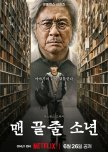
The drama follows Heo Mun-oh, a failed
novelist turned bitter literature professor who hasn't written anything meaningful in over twenty years. His stagnant life begins to crack when Lee Kang, a quiet engineering student who always sits in the last row, submits a piece of writing that's unnervingly good. What begins as mentorship slowly mutates into obsession, as Mun-oh becomes consumed by Kang's work and the boundaries between fiction and reality begin to dissolve.
Both male leads deliver razor sharp performances.
Mun-oh's psychological unraveling is portrayed with remarkable precision. You watch a man slowly lose his confidence, his identity, and eventually his grip on reality until he becomes almost unrecognizable. Kang serves as the perfect counterbalance quiet, unreadable, and seemingly always one move ahead. Every conversation between them feels like a chess match where only one player knows the rules, making even their quietest scenes incredibly tense.
What makes the drama exceptional is its refusal to rely on cheap twists or manufactured suspense. Instead, it explores the frightening lengths people will go in pursuit of literature and artistic greatness. Mun-oh doesn't simply admire Kang's writing he becomes possessed by it. He begins reshaping his own morals around it, allowing his imagination to consume him completely.
The questions the series keeps asking linger long after each episode ends:
What truly inspires great writers? Is it talent? Trauma? Jealousy? Or the irresistible desire to control someone else's narrative?
Without revealing spoilers, the final episodes completely reframe everything that came before. Every clue was there from the beginning, but like Mun-oh, you're too deeply caught inside Kang's narrative to recognize them. The twist doesn't exist to shock it exists to make you rethink everything you've been watching. The execution is meticulous, relying on subtle conversations, lingering silence, and the unsettling realization that you've been viewing the story from the wrong perspective all along.
Perhaps the drama's greatest strength is that it refuses to create heroes or villains. Mun-oh isn't merely a victim, and Kang isn't simply a genius. Their relationship constantly shifts between admiration, manipulation, dependence, rivalry, and mutual fascination. By the finale, you realize you've become just as trapped within Kang's narrative as Mun-oh himself. You're left questioning who deserves your sympathy and that's precisely the point.
Notes from the Last Row is less of a mystery than it is a mirror. It's a haunting exploration of obsession, authorship, artistic ambition, and the dangerous seduction of a truly compelling story. It's slow, bleak, intellectually demanding, and deliberately refuses the comfort of easy answers or tidy redemption.
The writing is exceptional. The performances are unforgettable.
Watch if: You enjoy psychological dramas that treat storytelling itself as a weapon.
Skip if: You're looking for a fast-paced thriller, a comforting watch, or a neatly wrapped ending.
Notes from the Last Row isn't concerned with shocking plot twists or constant suspense. Instead, it asks a far more unsettling question: Who owns a story?? The person who writes it, the one who tells it, or the one who controls how it's remembered?
The drama follows Heo Mun-oh, a failed
novelist turned bitter literature professor who hasn't written anything meaningful in over twenty years. His stagnant life begins to crack when Lee Kang, a quiet engineering student who always sits in the last row, submits a piece of writing that's unnervingly good. What begins as mentorship slowly mutates into obsession, as Mun-oh becomes consumed by Kang's work and the boundaries between fiction and reality begin to dissolve.
Both male leads deliver razor sharp performances.
Mun-oh's psychological unraveling is portrayed with remarkable precision. You watch a man slowly lose his confidence, his identity, and eventually his grip on reality until he becomes almost unrecognizable. Kang serves as the perfect counterbalance quiet, unreadable, and seemingly always one move ahead. Every conversation between them feels like a chess match where only one player knows the rules, making even their quietest scenes incredibly tense.
What makes the drama exceptional is its refusal to rely on cheap twists or manufactured suspense. Instead, it explores the frightening lengths people will go in pursuit of literature and artistic greatness. Mun-oh doesn't simply admire Kang's writing he becomes possessed by it. He begins reshaping his own morals around it, allowing his imagination to consume him completely.
The questions the series keeps asking linger long after each episode ends:
What truly inspires great writers? Is it talent? Trauma? Jealousy? Or the irresistible desire to control someone else's narrative?
Without revealing spoilers, the final episodes completely reframe everything that came before. Every clue was there from the beginning, but like Mun-oh, you're too deeply caught inside Kang's narrative to recognize them. The twist doesn't exist to shock it exists to make you rethink everything you've been watching. The execution is meticulous, relying on subtle conversations, lingering silence, and the unsettling realization that you've been viewing the story from the wrong perspective all along.
Perhaps the drama's greatest strength is that it refuses to create heroes or villains. Mun-oh isn't merely a victim, and Kang isn't simply a genius. Their relationship constantly shifts between admiration, manipulation, dependence, rivalry, and mutual fascination. By the finale, you realize you've become just as trapped within Kang's narrative as Mun-oh himself. You're left questioning who deserves your sympathy and that's precisely the point.
Notes from the Last Row is less of a mystery than it is a mirror. It's a haunting exploration of obsession, authorship, artistic ambition, and the dangerous seduction of a truly compelling story. It's slow, bleak, intellectually demanding, and deliberately refuses the comfort of easy answers or tidy redemption.
The writing is exceptional. The performances are unforgettable.
Watch if: You enjoy psychological dramas that treat storytelling itself as a weapon.
Skip if: You're looking for a fast-paced thriller, a comforting watch, or a neatly wrapped ending.
Was this review helpful to you?


