

 76
76 328
328 9
9 1
1 4
4 12
12 2
2 3
3 2
2 1
1 5
5 10
10 1
1 1
1 2
2 2
2 3
3 2
2 2
2 2
2 1
1 1
1 8
8


This review may contain spoilers
I will remember you, will you remember me?
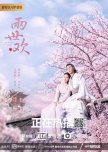
This is a heart warming, unabashedly tropey love story about how true love conquers all. The OTP face a daunting obstacle: Feng Mianwan's (Chen Yuqi) mother is blamed for Jing Ci's (Yu Menglong) mother's demise. Nonetheless Jing Ci shields her from his revenge driven aunt and raises her as his companion/maid. They are childhood sweethearts but when he can no longer protect her, he finds a doppelganger, arranges for them to swap identities and doses her with an amnesia drug to forget him and their past. In her new identity Mianwan/Ah Yuan evades her (doppleganger's) engagement to the noble Mu Beiyan, dresses as a man and goes to work as a fledgling constable. In her new life, she grows into her own person and finds meaning in her existence. Her guardian angel Jing Ci joins her in a new identity as a county official and together they investigate criminal cases. They eventually stumble upon a larger conspiracy with ties to both their identities and extends to the highest levels of the empire.While this is mostly a lighthearted and fun love story, there is a sad undertone as Jing Ci's health is failing and he struggles to conceal his feelings for Ah Yuan. She does not remember him but falls in love with him all over again. His intention is to selflessly see her happily settled with someone who can expect to live a normal lifespan and who can protect her but who is he kidding? Love is never ultimately that self-less! Both characters are strong and intelligent and have an enjoyable rapport with the other couples; confidantes and allies who help them unmask their enemies and reveal the secrets of their past. I particularly liked the princess who is a fantastic and loyal friend with her own rather charming love story.
There is broad consensus that Yu Menglong's Jing Ci deserves an award for best characterization ever of a plank. Although the character is supposed to be unwell, in pain and stoic, he impressively took being plank-like to a whole new level. He has this amazingly eerie ability to seem deathly still and expressionless while speaking or in motion. Given the excoriating feedback, I feel a bit bad for the actor who clearly over-intrepretred the character and was also probably camera shy the way his eyes avoided the lens the whole time. To be fair, there were the rare one or two scenes when Jing Ci's feelings for Ah Yuan overcame him that were well acted though far from squeal-worthy. The one saving grace is he and Chen Yuqi make for a very stunning and romantic looking couple. Am a big fan of Yuqi who has really honed her acting skills and was convincing as a smart and independent minded character who knows what she wants and is not fooled or daunted by Jing Ci's seeming indifference. I really appreciate this smart and strong female lead character who is not obnoxious or dislike-able, which is more than I can say for several similarly themed 2020 releases. She is a total delight from her remarkable ability to absolutely adore her plank to her subtly comical eye rolls at Mu Beiyan's ridiculous overtures. And no, I never shipped her with Mu Beiyan - her Ah Yuan is way too capable for a dilettante and (nice) dufus like that. While Mu Beiyan is a well written, likable and much better acted character, I still find it impossible to ship a love rival who is better made up and coiffed than the female lead!
The story overall is not terribly original but the cases are interesting enough. You will not win armchair detective of the year if you spot the bad guys early on or unravel the conspiracy on your own. Some of the plot twists are a bit lazy but the characters are quite colorful and stop short of being too archetypal. The ending was well done, wraps up most loose ends and delivers a final and very satisfying coup de grace. It won't rock your world but you won't have to retreat into the fetal position to get over a gigantic slump after it ends either. I would have rated this higher (7.5/8.0 ) if Yu Menglong's performance managed to improve towards the end.
Was this review helpful to you?
Fortune favors the bold.
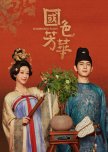
Flourished Peony 国色芳华 is the first part of a sweeping two part story about a woman's quest to restore her mother's legacy and control her own destiny. It is set during China's cultural golden age when peonies were sought after as the "Queen of Flowers", a symbol of beauty and prosperity. He Weifang or Mudan (Peony) is a merchant's daughter with a rare talent for cultivating exquisite peonies. She is exploited by her grasping in-laws who have designs on her dowry and disdained by her husband Liu Chang, who pines for a county princess. She intrigues corrupt Flower Envoy Jiang Changyang when he overhears her wickedly praying her husband be plagued with piles, baldness, unfaithful concubines and bomb out in the imperial exams. Amused and empathetic, he helps her end her loveless marriage and finances her business ventures. Cheering her on from the sidelines, he lends the rare helping hand when she is in over her head. She gets him out of a tight spot and an unspoken trust, friendship and romance flowers between them.Mudan’s journey—from a submissive daughter-in-law to an independent businesswoman—unfolds amidst feudal Tang society, where class divisions, filial piety, and arranged marriages were societal constraints on both men and women. While the narrative highlights the systematic nature of women's subjugation and their lack of legal rights and agency, it is framed in the context of a feudal society where no one truly has free will. Thus, a promising scholar from an official family cannot hope to marry a county princess, a county princess can no more choose her husband than a merchant's daughter, and even an insouciant Flower Envoy must entertain a union not of his choosing. I really appreciate this kind of social commentary that is sharp, yet balanced and contextual.
Mudan has fantastic business instincts and is a confident, persuasive, and a savvy risk-taker that dares to seize the moment.She is ahead of her time and champions modern values in terms of women's rights and roles. While the obstacles women faced are realistically depicted, fortune favors the bold and Mudan overcomes them confidently and resourcefully. This kind of too capable, superwoman character would be suffocating and alienating if Mudan's resourcefulness and confidence were not also flaws that drive the plot. Anyone else would keep a low profile upon learning that Liu Chang and his dreadful parents are in Chang'an. Not Mudan!. With a misplaced sense of invincibility, she glories in her success and growing reputation, inevitably bringing herself to the vengful Lius and the jealous Youzhen's attention. Fear not, her plot armor is so thick that some poor patsy inevitably pops up just in time run into the white truck of doom for her! Thus she never truly suffers the consequences of her miscalculations and over-confidence.
Even though Sheng Yi's arc could have been tighter, her story is moving, realistic and compellingly portrayed. She is the most miserable and oppressed character in this story as a result of both her low status, her gender and her upbringing. Even though her actions are controversial and frustrating, I empathised with and rooted for her the whole way. Unlike Mudan, Sheng Yi is a product of her times; it is natural for her goals to be aligned with prevailing social norms. Whereas Mudan's modern values and opinions don't quite fit with the ancient Tang society. Sheng Yi makes a passionate case that not every woman wants or needs to be Mudan. Sadly, Mudan cannot fathom how given a chance to be free, a woman would choose to cling to traditional roles. Her tone deaf conversation with Sheng Yi where they both talk past each other highlights how two people can care deeply for each other without understanding one another. This is one of Mudan's blind spots as learning nothing from Sheng Yi, she blithely steamrollers Lv Gengchun into turning her medical practice into a for profit business.
This storyline unfolds at a slow pace that is barely noticeable as the atmospheric set and costumes, the rich dialogue and the tension between the deep and complex characters is immersive. Even though many plot arcs are quite cliche, the characters are captivatingly written, with flaws that can lead to significant setbacks and/or their downfalls. Both Liu Chang and Youzhen are insufferably arrogant characters who go to extreme lengths to get what they want only to learn they don't want what they get. Wei Zheming is persuasive as Liu Chang, an erudite but weak character who genuinely believes himself to be a better man than her really is. While the antagonists are smart or powerful enough to pose a credible threat, they spiral downhill into cliched obsessive archetypes for the convenience of the plot or to elevate Mudan or Changyang. But their stories are not over and there could be a reversal in the second part of the story that delivers a more nuanced and complex antagonist than what we have seen so far.
As someone who is no fan of romance, I find the delightful slow-burn connection between Mudan and Changyang to be the highlight of the drama. Unlike too many other stories that rush into love, this relationship develops organically and leisurely. The chemistry between Yang Zi and Li Xian is palpable and their bond feels deep, mature and authentic. They are both consummate actors that skilfully convey how their characters are savoring that delicious, giddy moment where they know they will be lovers but they are in no hurry to take that next step. Instead they are just basking in the strong foundation of their mutual trust and friendship while anticipating the passion that lies ahead. I love how Yang Zi has disappeared into this role and is not just Yang Zi being Yang Zi. And it has been too long since I have seen Li Xian's crooked smile and how he effortlessly conveys that there a lot more to Jiang Changyang than what meets the eye with just a few subtle expressions. I can't wait for the second part, which should reveal more of our enigmatic Flower Envoys and take his relationship with Mudan from confidantes to lovers.
The first part of the story ends somewhat anti-climatically with Mudan almost too effortlessly accomplishing what she sets out to do and with many sub-plots left open. The profound social insight, engaging storytelling and fantastic acting papers over some of the more predictable sub-plots. Unlike most empowerment dramas, it avoids separating the male and female lead but still indulges in some contrived plot points just to prove that women can make it with minimal help from men. Even though Mudan and Changyang's story is unfinished, I like it well enough so far to rate it an 8.5/10.0. If everything ties up well, my final rating for this story can be a 9.0 or even better.
Was this review helpful to you?
Wild goose chase.
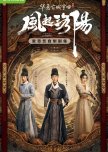
Ancient conspiracy thrillers are right up my alley so I looked forward to Luoyang with bated breath. This is set in Shendu (now Luoyang), capital of Wu Zetian's Wu Zhou Dynasty (690-705). As the only female emperor in over 5000 years of Chinese history, Wu Zetian remains a controversial figure - an ambitious, usurper whose exceptional intelligence and leadership is only matched by her ruthlessness against anyone in her way, including or especially her own children. She cultivated informers and multiple secret police and spy rings that gathered evidence against her detractors. and maintained a careful balance of power between the important political structures of her administration. This is reflected in the drama in the clear delineation of responsibilities between the Judiciary, Inner Guard and Secret Police (Lianfang). During this time, the Wu clan and Li clan were embroiled in a power struggle which persisted until Wu Zetian intervened and clarified her succession plans. Nonetheless it ended in messy plotting, betrayals and twists that are drama worthy in and of themselves. This is rich fodder for conspiracy plots such as this one.The drama starts thrillingly with a bold daylight assassination of an informer and his daughter and the ensuing dizzying high speed chase through the streets of Shendu. All three main protagonists mortician Gao Bingzhu, foodie Baili Hongyi and inner guard Wu Shiyue are at the scene and invisible threads from their past pull them together to uncover a much deeper conspiracy that could rock the very foundations of Wu Zetian's empire. Clues emerge that connect seemingly unrelated cases and force the three protagonists to work together, at first reluctantly and with selfish agendas and then with growing mutual respect and trust that blossoms into deep friendships. I most enjoyed the tripartite friendship in the drama and would have liked to see it better explored rather than unnecessary romantic arcs. Huang Xuan nailed it with his cynical yet paradoxically idealistic Gao Bingzhu; whose shrewdness and insight into dark hearts of man does not extend to those he cares for. I also did not see much chemistry between him and Song Qian who impresses with her fight scenes but falters somewhat in her line delivery. Wang Yibo's performance is strong in some aspects but uneven overall with too many scenes where he is clearly unsure what facial expression to wear. This role does not elevate him for me from an actor that I don't mind watching but wouldn't seek out. That said the trio has enough combined chemistry that I am happy to watch them together again. As for Song Yi, she has gotten enough flack and her character was so poorly written that all I will say is this is a role such a wonderful actress should have just passed on.
I did not enjoy the first two episodes of the drama - too much was happening at the same time and the cameraman swung the camera so wildly I thought he was possessed. The action scenes are exciting and well choreographed enough they did not need to artificially augmented by cheap camera tricks. After the psycho camera settles down, the plot unfolds at an intense and exciting pace against a gorgeous backdrop of dazzling sets and with a deluge of colorfully garbed denizens - they must have hijacked and costumed practically every Hengdian tourist as extras on set I have never seen so many people crammed into each scene. My personal favorite set is the Unwelcome Well which looks almost too inviting to be a ghetto. While the costumes and certain props are anachronistic, everything comes together is such a vibrant and captivating panorama that it scarcely matters. This is complemented by well designed side characters that are based on well known historical figures. Hints of their personalities, scandalous affairs and alliances are quite faithful to history and add a nice ambiance to the setting. It set up for intriguing Dumas like plot twists that didn't materialize.
This drama builds to a top-notch, shocking and heartbreaking climax prematurely at episode 20 where both actors delivered standing ovation worthy performances. It achieves that perfect sequence of shock followed immediately by stunned comprehension and acceptance as all the clues rushed to the fore to blindside the viewer to the next unfolding twist. In the second half, the plot visibly loses momentum and digresses into romantic arcs that don't belong in this genre and filler maudlin flashbacks. The writing of the mini-threads in the second half is insipid with excessive gratuitous character implants, many of whom delivered cringe worthy performances.
In hindsight it would have been difficult to top the fantastic mid-drama climax but it is still extremely disappointing for the final reveal to be so bland. The hollow villain that everyone was on to as a bad guy early on but dismissed as too obvious turns out indeed to be the final villain, one that is not worthy of being called a mastermind. Both their motive and end game plot is not well articulated or convincing. Multiple clues and more interesting suspicious characters that don't play out leave me feeling like I went on a wild goose chase. I don't know if they ran out of money or wasted it on too many bodies but there is no sense of peril or excitement in the final showdown. Forget explosions or collapsing buildings, we don't even get one good last fight scene. The final insult is how unfathomably a feather brain like Liu Feng manages to find himself in the right place at the right time to deliver an unnecessary and uncalled for outcome. This is just a misguided attempt to deliver an audience shocker to make up for the nothing burger of a final reveal.
Even though this remains a very entertaining and highly recommended watch, the ending is a big let down that knocks 0.5 off my final rating for the show. I feel that an 8.0 is the best I can give to this show, which is still one of the better c-dramas of the second half of 2021.
Was this review helpful to you?
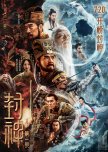
Creation of the Gods Ⅰ: Kingdom of Storms
26 people found this review helpful
Sons of a tyrant.
Wuershan's Creation of Gods trilogy is the culmination of an eight year labor of love that is the most ambitious and grand scale adaptation of Chinese classic Investiture of Gods ever. This Homeric, often chaotic tale of gods, demons and men that blends speculative history with myth and legend is probably the most widely adapted ancient Chinese vernacular novel. This grandiouse, exhilarating, action packed, and painstakingly crafted production is a visual triumph and an immersive adventure that is best experienced on an IMAX screen.Kingdom of Storms is the first instalment that focuses on the origin story of the King Zhou of Shang and how he incurred the wrath of the heavens to the extent the gods intervened. In a departure from canon, this adaptation does not lay the moral decay of King Zhou solely at the door of the hedonistic, fox jezebel Su Daji. This version holds King Zhou accountable, clearly asserting that his ambition and moral flexibility already put him on the dark path from the get go. This is a more layered and manipulative King Zhou, who adopts all of his noble hostages including Ji Fa as foster "sons". He ruthlessly indoctrinates his own son Yin Jiao as well as his hostage sons into choosing to be sons of a tyrant over their own fathers. All of the sons are pushed to decide whose son they really are and what kind of man they wish to become. This recurring theme of conflict between father and son and right and wrong adroitly weaves most of the sub-plots together.
Kris Phillips with his magnificent build and his imposing, quietly menacing , almost mesmeric screen aura is impeccably cast as King Zhou. He so much looks and breathes the part that it is easy to ignore his at times bizarre Mandarin and the occasionally stiff acting. Although the stunningly gorgeous Naran is bewitching as Daji, the role lacks complexity. She doesn't get to do much more than alternate between a sensuous seductress and a cunning and feral animal spirit when cornered. This debouched couple lights up the screen with their dark chemistry but I could have done with a bit less of their wanton cavorting that comes off as too unsubtle Hollywood. Beyond their honed physiques and stunning atheleticism, both Yu Shi's Ji Fa and Chen Muchi's Yin Jiao won my heart with their brotherhood and their portrayal of initially bewildered and disillusioned sons who grow up to become fearless and resolved men. They stand out among the dazzling number of up and coming young actors who managed to make an impression in this whirlwind production as does Ci Sha's not so hot headed Yang Jian. The deities don't feature as prominently in this first chapter but I much enjoyed this first glimpse of the diabolically mischevious Nezha.
For those unfamiliar with the chaotic original works, the storytelling may seem cluttered with vignettes at the cost of plot advancement as this largely sets the stage for what culminates in the battle of all battles between good and evil. Beyond an almost gratuitous amount of wildly, intense action scenes, the narrative pays homage to key features of the original works from Ji Chang's meat pies to Bi Gan's seven chamber heart. It culminates in Ji Fa's hair rising escape from the Shang capital Zhaoge. Keep watching after the credits roll as the following epilogue sets up the next instalment where hopefully we see a lot more plot movement. This is a very difficult and messy novel to adapt but so far, I am very impressed with how cogently and fittingly everything ties together. This promises to be the best adaptation by a long mile of this well loved novel, the first part of which warrants a highly enthusiastic 8.5/10.0 from me.
Was this review helpful to you?
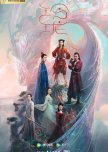
Man made goddess.
This fantasy drama is set in Sichuan, a world that is being torn apart by internal strife, corruption and disillusionment after the people are abandoned by their goddess. The young ruler Yuan Yi sets out to restore faith, peace and prosperity to his land by seeking the return of the goddess. This brings him to a remote village that is occupied by a tribe whose sacred duty is to contain the deadly earth fires from erupting and engulfing their world. There he encounters Linglong, a young girl with inexplicable powers and her father Huotu Xin. They are semi-outcasts in the village as Linglong's mother was an outsider who disappears as mysteriously as she appeared. Is Linglong the key to bringing back the goddess to Sichuan?I have to give top marks for how mythically gorgeous this fantasy world looks - especially the fabulous flying fish ships. This drama's premise around this magical fantasy land and its man made goddess is very interesting and I really enjoy how the world building takes place slowly as the mysteries of the past and the origins of the goddess are revealed. The problem is that the plot peaks at that point, meanders around before limping to an unimpressive and dissatisfying ending.
I really enjoyed Yuan Hong's performance as Linglong's father in this drama and find it to be the drama's most memorable and enjoyable relationship. His heart warming, comical rapport with Zhao Jinmai's Linglong regularly had me grinning away and made me continue even after the plot lost momentum. This is one of the best portrayed father-daughter relationships I have seen in c-drama. I am so glad I watched this because I really needed to wipe the (not good) images I had of Yuan Hong after Rebel Princess. He is an incredible and smoking hot actor and I wish the drama was written around his character Huotu Xin, who is much more interesting than the titular character Linglong. That is one of my main gripes - the titular character Linglong is not that interesting and her relationship with Yuan Yi is sweet but does not make a lasting impression. Sadly the China market is idol-focused and there is limited room for actors like Yuan Hong who are ageing out of lead roles.
I love realistically written, opaque and intriguing characters with conflicting agendas, which is how many of the other main characters are written. That makes them so much more interesting than the OTP that I care a lot more about them and am dismayed at how callously they are dealt with. Even Li Sha and Yin Xiao are much more interesting both in terms of their personalities and abilities than the OTP. Not only was I rooting for both Wu Yuan and Yin Zhuang at the same time, I was also rooting for Wei Shengyan and Huotu Xin at the same time! It is incredible that this drama manages to resolve such win-win triangles in a way that manages to disappoint someone who is rooting for both angles. Wei Shengyan is a smart and curiously likeable protagonist who suddenly does stupid, self destructive things to force the plot towards the ending the writers wanted. I don't want to spoil the end so I will just leave it at lots of stuff happens, there are many sacrifices but Sichuan is not necessarily a better place and I don't care that much about the winners.
I enjoyed many aspects of this fantasy drama and can recommend it as a decent filler drama to watch with low expectations. I rate it 7.0.
Was this review helpful to you?
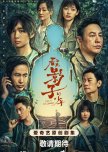
Lost and Found.
Set in the 1990s, this is a riveting suspense thriller about three teenage boys who go missing on a dark and stormy night. Three years later, Xiao Qi, a pick-pocket is caught and identified as one of the missing boys. He is reunited with his grateful family but he does not seem quite the same and claims to have little memory of what transpired three years ago. This revives the investigation of the old case, with Wang Shitu leading the investigation. His investigation shines a spotlight on human trafficking rings. His search is painful and personal as his son has been lost for more than a decade. As the investigation advances, he gets to know Xiao Qi and the Jin family and more questions emerge as to what really happened that fateful night.This drama does a terrific job building suspense, planting the seeds of many credible explanations with each frightening new reveal. Mystery buffs will enjoy trying sorting through all the lies to pull all the pieces together. The first villain's confession however was not convincingly obtained and that case is too hastily tied up to focus on the final villain. There are too many confessions obtained using this same threat of shaky evidence against a loved one. Even though a shadowy image of the main villain and what must have happened emerges early on, the cat and mouse of pinning them down is riveting. This is one of the most layered, selfish, manipulative and just plain evil sociopaths I have seen in a long time. What is truly scary is their motive is vile but understandable; that this is easily something someone, anyone is capable of doing simply because they want what they want badly enough. The final solution however is somewhat anti-climatic; there are many more interesting ways this could have played out. There are also a fair number of plot holes and loose ends.
The strongest and most moving aspect of this narrative is not the mystery but the relationships that evolve around it. The mother and the father who lost a child and the unimaginable and continuing pain that they endure. And the lonely boy that was lost and found, and how through all this mess they somehow manage to heal a small part of each other. With this kind of cast, I don't have to praise the acting. Zhang Songwen and Rong Zishan's chemistry is well established and as expected, they deliver in spades and make me root for them every step of the way. But the most surprising and distressing performance is Guo Keyu's portrayal of Bian Meizhen's confused longing for her lost child and her devastating moments of awareness.
Overall, the mystery plot is good but does not live up to its early promise and is not as tight as could be. But the character arcs are superbly done and the ending is perfect and brilliant in the most realistic of ways. This is a highly recommended 8.5/10.0.
ENDING SPOILER COMMENTS
Doudou was a red herring from the start and considering the theme of this story is lost children, it is no surprise that there is no fairytale ending. Nonetheless, Wang Shitu does not give up and continues to look. This kind of story is not easy to write or to end in a way that acknowledges and respects the suffering of victims of child trafficking. Jin Manfu is the manifestation of what must be every parent with a lost child's worst nightmare. But this story also reminds us that there are Wang Shitus and Bian Meizhens in this world who can still open a corner of their hearts. And that maybe they can also find some solace by opening a small part of their hearts. The only small bone the drama throws the audience is Doudou probably ended up in a family with a dog and where he is much loved and may one day still be found.
X
Was this review helpful to you?
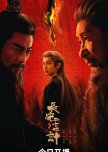
All Warfare Is Based on Deception
The Vendetta of An (or The Twenty-Four Strategies of Chang’an/长安二十四计) is an intense, fast-paced suspense thriller with an intricate plot full of twists and reversals. Set in a fictional dynasty, feudal lord Xiao Wuyang marches into Chang’an and deposes his brother, puppet emperor Xiao Wenjing. Yet his grip on the throne remains tenuous until the tyrannical General Yan Fengshan is captured and his elite shadow army, the Huben, is disbanded. If anyone is up to this perilous task, it must be the son of the Huben’s founder. Finally, the stage is set for Xie Huai’an to return to the capital to demand an accounting for his family’s massacre fifteen years earlier.Though Huai’an is driven by revenge, as the Chinese title suggests, the plot unfolds along the lines of art of war. It is an intriguing and sophisticated conspiracy where the devil is in the details, and the chessboard is not fully visible to all players. These schemes play out amid the daily lives of ordinary people in Chang’an—an innovative take on the classic “empty fort strategy” (空城計, kōng chéng jì). Ultimately, all warfare is based on deception, and Chang’an is the battlefield where hidden protagonists and antagonists attempt to outwit each other with complex, multi-layered stratagems. This drama demands full attention; its dialogue carries literary depth and is laden with clues that hint at complex character motivations.
This is without a doubt one of the most engaging and best-written dramas I’ve watched in 2025. However, across 28 episodes, the drama packs in too many ideas and themes. There is a profound sense of foreshadowing and symmetry, of cause and effect and “an eye for an eye,” that underlies the plot arcs and character outcomes. But it succumbs to the overdose of melodrama and excessive twists that have weighed down too many 2025 dramas—often at the cost of both character and logic. Vendetta takes “falling off a cliff” to new levels in how unbelievably incompetent every character seems at stabbing someone in the guts. The breakneck pace and multiple reversals successfully distract from how certain aspects of the plot and characters don’t fully hold together. It’s high entertainment, but it pushes the limits of suspension of disbelief and doesn’t withstand close scrutiny.
Although Huai’an is widely touted as a brilliant strategist several steps ahead of everyone else, his wins are few and far between. They come at a high cost, often by adopting the “self-injury stratagem” (苦肉計, kǔ ròu jì). This is fitting—the stakes are sky-high, and Huai’an is under-resourced and outmanoeuvred by hidden foes who, like him, play the long game. In this story, characters are allowed to fail, with real consequences. While Huai’an has loyal allies, they make mistakes and, worse, need rescuing at pivotal moments. Often, the antagonists seem smarter, more competent and more ruthless. Yet they, too, are grounded in reality; miscalculate and possess flaws that can be exploited to snatch victory from the jaws of defeat. With such well-matched players, the margin between victory and defeat is razor-thin, turning on a dime.
Plot-wise, the narrative builds through multiple exciting twists to a thrilling and satisfying climax about two-thirds of the way through. Lurking in the shadows are Tiemo sleeper cells, ready to “loot a burning house” (趁火打劫, chèn huǒ dǎ jié) by exploiting Chang’an’s internal strife. Huai’an is taken by surprise, routed, and trapped at a disadvantage as hidden enemies emerge from the woodwork and barbarians gather at the gates. This story arc contains so many double- and triple-crosses, schemes within schemes, and bombshells that the plot becomes slightly deformed. For me, the best subplot was Wang Pu’s short arc, a masterclass in psychological warfare. In contrast, Baiwan’s arc felt unnecessary, adding little beyond forced angst while artificially lowering the intelligence of Huai’an’s team. That time would have been better spent deepening more interesting characters and tying up loose ends.
Cheng Yi navigates Xie Huai’an’s introspective transitions well, particularly as he reins in his obsession with an unchangeable past and finds a higher cause in a changeable future. The main aspect of his portrayal that missed the mark for me was its overly maudlin tone. The frequent waterworks made it seem as though he was the only character who had ever suffered loss during chaotic times. It’s also difficult to root for a protagonist so world-weary and single-minded in purpose. Thus, for me, Li Lianhua remains Cheng Yi’s best role, even though Vendetta of An has the stronger plot.
The main characters are multifaceted, with interesting backstories anchored by an impressive roster of veterans and solid performances all around. I found Wenjing’s duality—the twists and turns of his journey and his struggle against his true nature—most compelling. Unfortunately, his character was eventually dumbed down and squandered for shock value and cheap angst. Among the younger cast, Liu Yitong's Han Ziling was memorable. While I can’t fault the acting, Wang Jinsong’s gentle aura felt mismatched to his role. Yan Fengshan emerges as a more intense and menacing villain than the primary antagonist.
The finale builds to another exciting, action-packed, high-stakes climax in which Huai’an deftly “lures the tiger down the mountain” (調虎離山, diào hǔ lí shān) with yet another self-injury stratagem, then “shuts the door to catch the thief” (關門捉賊, guān mén zhuō zéi) and “borrows a corpse to resurrect the soul” (借屍還魂, jiè shī huán hún). There’s much to unpack in the excellent finale, though it leaves several loose ends only partly tied up in the special episode. The ending was more clear on a second watch—more on that in the spoiler section below. Most importantly, Huai’an’s final epiphany brings his character journey to a fitting close.
Overall, this drama that is a feast for the eyes and a boot camp for the little gray cells would have benefited from fewer themes and narrative curveballs. A tighter plot with fewer logic holes could have earned a 9.0 from me, but as it stands, it’s a highly recommended 8.5/10.
ENDING SPOILERS & ADDITIONAL COMMENTS
(Do not scroll further if you have not finished the drama.)
On a second watch, I realized the final episode is far more definitive than I initially believed. To begin with, Huai’an’s hair did not magically turn white overnight; he dyed it again, just as he did before infiltrating Hidden Soldier Valley. According to Cen Weizong’s reading of his natal chart, Baitou's hair would not turn white again until the end of his lifespan (83 years). He was playing to the Tiemo King's superstition by suggesting he was at death’s door.
As Huai’an is stabbed and his life flashes before his eyes, he finally admits he still wants to live—if only to remember his family a little longer. He breaks free from his obsession with revenge and reclaims his identity as Liu Zhi, a Huben shadow guard sworn to protect Chang’an. When he triggers the explosion, he discards his identity as Xie Huai’an, who stays in the granary and dies in the blast. Liu Zhi, however emerges and takes a day or two to live as an ordinary person. One could argue Liu Zhi never walked out of the granary either, but what matters more is that the character’s journey comes full circle. It’s a good ending, even without the special.
The special episode ties up loose ends and is clearly a prelude to a second season. Wuyang ends up on the throne, while Wenjing remains officially dead, choosing to serve the court incognito as the former pageboy Zhang Mo. Ye Zheng leaves to court his love Zhaolu, and Xiaoqing becomes a doctor.
The mysterious figure in Yulong Ridge is quite obviously Liu Zhi. He lets his hair down and imprisons himself there among his Huben guard—much like the Tiemo King did—to manipulate events from the shadows. He owes Cen a favor (likely a quid pro quo for luring the Tiemo King to the granary), after which they are square. This sets up the next season involving a mysterious figure at Mt. Shiluoman in Tiemo. Liu Zhi's work is not done; 200,000 Tiemo troops can still be deployed at any time. Until that threat is neutralized and lasting peace is achieved, it’s convenient to let the world believe Huai’an/Liu Zhi is dead. The person at Mt. Shiluoman is likely a high priest—probably Cen’s superior. When Huai’an kidnapped the Tiemo envoy, he mentions an altar at Mt. Shiluoman where nobles undergo a ceremony to receive the token around his neck. A new king should soon be chosen in Tiemo. It is in Liu Zhi/Chang'an's interest to try to influence the process.
One of the larger open plot holes for me is what drove Liu Ziyan and Yan Fengshan to turn on Liu Zhiwei. The only explanation that makes some sense is that they blamed him for the disastrous mission to rescue a high-ranking Huben spy captured by the Tiemo King 25 years earlier. I don’t believe that spy was Liu Zhi’s mother, as the timeline doesn’t align: she couldn’t have given birth to Liu Li/Baiwan if she died 25 years ago, and it contradicts Huai’an’s statement that his mother died when he was ten. I also find it difficult to believe that two uneducated Tiemo slaves raised as wolf bait could rise to become two of the most erudite and high-ranking officials in Chang’an. I could go on but I will stop here because I did enjoy this drama quite a bit despite the logic holes.
WANG PU ARC SPOILERS
Wang Pu made a fatal mistake when he couldn't resist meeting with Huai'an. He lost the moment he went to that temple by himself. He wasn't alone of course but he didn't realize Huai'an's men would kill all of his men that were following him there.
When Wang Pu learned of that YFS murdered his parents, he didn't care at all. The problem is YFS would NEVER believe that and would never trust him the same way again. This is the brilliance of Huai'an's trap - he ruined their relationship simply by meeting alone with Wang Pu to tell him his origin story. It is his nature - YFS would never be able to trust Wang Pu again. This left poor Stockholm Syndrom Wang Pu no choice but to prove his loyalty by killing himself. But YFS is a sick son-of-a-bitch. He could have refused to confirm what Huai'an told Wang Pu. But instead he told him in bloody detail anyway and when he was finished Wang Pu started eating the poisoned dumplings.
Huai'an already said Checkmate to Wang Pu at the end, both knowing how this would play out. But Wang Pu thought he would be able to deliver YFS a final win by luring Huai'an to watch his downfall. But even in this, he was outplayed bc Huai'an never showed up. It was an eye for an eye for Bai Wan's death.
X
Was this review helpful to you?
Could have, would have, and should have been epic but just isn't.
This drama's thrilling opening had me on the edge of my seat with my heart in my throat. It is one helluva start that brilliantly sets the stage for the backstory. We are immediately transported to ancient Wei, a wicked, immoral, debauched kingdom where the dissipated nobility hunt slaves for sport. Our titular character Xing'er/Chu Qiao is no ordinary slave she is a superhero; assassin, gladiator, warrior and survivor. Her courage and fiery fighting spirit draws the interest of many suitors including her owner and spymaster Yuwen Yue, Yanbei hostage prince Yan Xun, Prince Yuan Song of Wei and Prince Xiao Ce of Liang. If not for the fact that she pulls her weight when it comes to the rescuing, this would sound absurdly Mary Sue. As it turns out, the most powerful men across three rival kingdoms simply have a death wish and are fatally attracted to dangerous, irascible and bad-ass women. Recognising her indomitable spirit and lethal fighting ability, Yuwen Yue trains her to be a top notch spy and assassin.I enjoyed every moment of the first half of this drama - despite some discontinuity in the editing, the plot is intriguing, the characters are flawed and complex, it moves at a fast pace and the fight scenes are powerful and exhilirating. The chemistry between Zhao Liying and Lin Gengxin is off the charts and their supercharged one on one fight scenes are hot, hot, hot. The way Yuwen Yue grooms her, her gratitude and resentment and the push and pull attraction between them and their strong personalities results in a highly combustible build-up in passion between them. I just love how his eyes reveal how vulnerable he is, his grumpy sullen glower conveys his displeasure at being enslaved by his slave while the tiniest wry smile suggests a sense of acceptance and humor about it. The fierce answering spark in Xing'er's fiery eyes and her combative, resentful stance is a dead giveaway as to who this spitfire also most unwillingly longs for. I believe she would never have left with Yan Xun if her pride had not been so wounded at the thought she was nothing more than a lean mean killing machine to Yuwen Yue.
I have always considered Zhao Liying a vastly overrated, creepy life sized LOL doll with her gigantic head and eyes. This drama has given me a newfound appreciation for her acting skills and commanding screen presence. Her fight scenes are phenomenal and it is obvious that she immersed herself in this fabulous, kick-ass role of a fearless heroine with a big heart and bold dreams. It is hard to pull off the typical cold male lead well but Lin Gengxin effortlessly depicts the iceberg that conceals a dormant volcano. It is such a waste that his masterful articulation of such a complex and interesting character does not get nearly enough screen time. With one glaring weak link, this boasts an all star cast with complex, interesting and funny supporting characters with Xiao Ce (Deng Lun), Yue Qi and Yang Song being my favourites.
After peaking near the middle with a barbarous, heart wrenching massacre that results in irreversible divisions, the plot digresses into a long winded, meandering, melodramatic and ultimately trite tale of revenge as the focus shifts to the second leads Yan Xun and Chun'er. They are parallel selfish and amoral characters who go off the rails albeit for good reason and become consumed by hate and revenge. Although Li Qin does a fantastic job making a delusional, entitled and spoilt princess somewhat empathetic, the character Chun'er is not smart or interesting enough to command the amount of screen time she got and in so many gratuitous sub-plots. Xing'er/Chu Qiao's character is thrown under the bus in these arcs where she is dumbed down, stagnates and even regresses on several fronts when she excuses Yan Xun's misdeeds and lies at the cost of many lives. Like Chun'er she closes both eyes to the fact that Yan Xun sold her an empty dream and is nothing but a selfish, heartless prick with no game plan, is of mediocre ability and has no vision.
Yan Xun is a well written, complex and interesting antagonist. It is hinted from the beginning that he is innately selfish and quite manipulative, traits that rule him after the loss he experiences. This has to be said - this role however was badly miscast and that is why the drama pretty much implodes in the second half, from the moment Yan Xun takes centerstage. Shawn Dou is a blank actor that never compelled me because underneath the surface of his toothy, million dollar smile, there is not much to him. He can only pull off easy going, laid back two dimensional good guy roles and from his blank placid gaze it is clear he never really gets deep into character, he is the epitome of still waters run shallow. They would have been way better off sticking a Darth Vader mask over him rather than to inflict the wooden, constipated expression he wore for over half the damn drama on us. And the annoying sibilant "dark" whisper that became his voice made him the first male character I have ever been tempted to mute in a c-drama. To me, there is no believable triangle in this drama because there is zero spark between him and Zhao Liying. Put against an intensely masculine actor like Lin Gengxin, Shawn Dou's utter lack of sex appeal (男人味) is painfully obvious. I don't mean to offend his fans but this is too important a role that got way too much screen time to have been so poorly cast. I struggled to complete this drama because I lost all interest in the Yanbei arcs and the last few episodes are simply incoherent.
I was well warned that this drama has the worst open ending ever. The problem is that unlike The Rise of Phoenixes, it is not just about one bad ending episode. This drama starts to sink from about the halfway point where my intriguing historical spy / assassin drama turns into yet another boring revenge drama and my strong female allows her dreams to be subsumed by someone else's agenda. The only reason I didn't drop this is the remarkable chemistry between Yuwen Yue and Xing'er. I am reading the book (which is long but riveting) so I know their story does go on and the portrayal of both characters are quite faithful to the novel. Many much more interesting sub-plots didn't play out because they wasted 15-20 episodes on the most boring Yan Xun and Chun'er. Sadly the odds of this ever being completed with the original cast are low.
This drama could have, would have, and should have been epic but it just isn't. All it is is unfinished. Thus I rate the first few arcs 9.0/9.5 but the second half is at best a 5.5/6.0. My overall score is 7.5 which I consider generous. This is one that must be watched with adjusted expectations.
Was this review helpful to you?
But I have promises to keep, and miles to go before I sleep.
Patience is required for this drama that is unlikely to enjoy broad appeal. It is a Beijing Academy student production so don't expect high production values; indeed there is a distinctly amateurish and unpolished feel to the entire effort.The shadowy and suspenseful plot is steeped in the supernatural and mythology and takes a long time to unfold. The synopsis, which already gives away much of the story adds to the impression that nothing is happening. Hidden forces conspire to release the demon Jiu Ying, that according to legend was sealed by five deities representing the five elements (metal, earth, water, fire and wood). This manifests itself in increasing hostilities between the You Kingdom and the Wolf Tribe that make war and chaos seem inevitable. These events bring the three siblings Hongxuan, Hongyi and Hongshou whose Baili family has long been the power behind the You throne; together with Ming Yefeng, the leader of the Wolf Tribe who also has a mysterious past with Hong Yi. They are linked by destiny and rediscover their powers so that together with other supernatural beings from a past lifetime, they can once again fulfill an ancient promise to keep the world safe. It is not a complicated or super original fantasy story that culminates in an epic clash between good and evil.
What is interesting about this drama is the characters and the acting. The actors are not given much to work with in terms of dialogue so they have to rely heavily on body language and subtle expressions to convey their characters. This makes the complex characters particularly difficult to get to know and nobody is as they originally appear. It is very difficult to tell who is friend and foe and what their motivations are. For most of the drama, Baili Hongxuan and Ming Yefeng were the most complex and interesting characters for me. While they are both quite grey, both turned out to be quite different from what I expected and almost opposite of each other. I really enjoy this kind of peeling of the onion approach in terms of how a layered character gradually becomes unveiled but many will find this kind of storytelling frustrating and boring.
I suspect many may be interested in this because of Wu Lei and Song Zuer. I admit I discovered this because of Wu Lei. While his character Baili Honsghou is quite one dimensional - the typical c-drama hero that goes through many common tropes; it is the best performance I have seen from Wu Lei since NIF. It is very nice to see how far he has come as an actor; that he is not just an incredibly athletic lean, mean, killing machine. As for Song Zuer, she is an actress that provokes strong reactions, especially when she plays the bratty young girl. I never minded her that much because I always noticed that she has screen presence that belies her small size and her performance in this also showed much progress and was actually quite nuanced towards the end. And it will be remiss of me to not mention how super hot Zheng Kai's Ming Yefeng is - I can't believe I have never seen this actor before!
The story advances much more quickly in the last 10-12 episodes although it appears a bit messy as many characters are introduced at once. But they are not interesting characters and all you need to really know is that they are either obstacles to be overcome or they are there to give some assistance along the way. All of the substantively relevant characters are introduced at the beginning. There are a few nice twists at the end with respect to the emperor as well as the mysterious man in the hood. The ultimate villain (to me was not Jiu Ying) was hiding in plain sight the whole time but their motive for unleashing evil on the world was pedestrian and lame. Most of the so-called heroes or deities in this show have feet of clay, do not have high morals and are not particularly enlightened beings. The story is very matter of factly callous in its treatment of spirits or demons. This is very typical of the genre so if you are familiar with Chinese mythology, you will not be surprised by any of this or how the story ends.
I enjoyed this drama but it is not for everyone. Watch at your own risk.
Was this review helpful to you?
Let life be beautiful like summer flowers...
This tantalizing and poignant love story captures the spirit of carpe diem. It opens with a young girl's chance encounter at the hair salon. She is aroused by a strong and silent stranger from the way he caresses her ears and washes her hair. For most girls, it would stop just there; a titillating fantasy not to be acted upon. But He Ran is not like most girls. She throws herself at Xiao Han shamelessly; not one whit bothered that he is well into his prime. Twist and all, this is a simple and very cliched romance plot that hinges on the chemistry between the leads and whether they can convince audiences to root for them.He Ran's relentless pursuit of Xiao Han can very easily come across as crude and thirsty but Xu Ruohan gets this tricky portrayal mostly right down to the small nuances. She is just an artless young, girl headily experiencing infatuation, desire, and possibly even love for the very first time. She can be incredibly petulant, unreasonable, and childish, like the protected and spoiled little rich girl she is. But she taunts and tempts him with the instinctive provocativeness and burgeoning sensuality of a child-woman. The way she looks at him with her heart in her eyes and the effervescent joy in her smile made me shake my head at the futility of Xiao Han's efforts to evade her charms.
As for Xiao Han, his genuine attempts to resist the ardent allure of this captivating young temptress is just the right touch. He rightly has misgivings - she is too young and they are from different worlds. Xiao Han is a man of few words; a gentle giant who is very still and seemingly unmoved by her attempts to seduce him. Only the smallest microexpressions give him away - the hint of a smile, a tensing of his incredible jawline, a barely perceptible slow sidelong glance, and a whisper of innuendo in his tone. While Xiao Han clearly looks and is more mature, the relationship doesn't come across as exploitative largely because He Ran is the instigator and calls most of the shots. Of course, it helps that Jerry Yan does not look a day over thirty and the only offensive thing about him is how well he wears those sleeveless wife-beater T-shirts.
Their love story unfolds against a lush, almost surreal romantic palette drenched with deep and lush saturated colors of the riotous blooms adorning Xiao Han's intimate seaside home. The couple's sultry chemistry permeates the screen, captured mesmerizingly by the director's avant-garde and sensual visual composition style. The superbly curated soundtrack supercharges the narrative with all the right emotions at every critical juncture. I was invested in their romance the moment I heard the first song, Cantopop hit (半點心 A Drop of Your Heart). At the time, they had barely even met! I am so busy being a Peeping Tom that it takes me a while to notice that the plot doesn't move much. He Ran is just escaping into Xiao Han's world and their relationship is built around "ask me no questions and I will tell you no lies". They are both secretive and repeatedly fail to communicate. Thus despite its addictive beauty, theirs does not bear the hallmarks of a lasting relationship.
He Ran and Xiao Han's relationship shortcomings are amplified by the too coincidental to be true gender reversed second age-gap romance. There the couple actually dares to call each other out and are open about themselves and their doubts and constraints. That said, their initial attraction is too tropey and not convincing and it is a major subplot that develops too late in the main plot line; right after He Ran and Xiao Han's relationship peaks. This long-winded and often boring digression annoyed me and disrupted the momentum of the main romance. Their sizzling chemistry also highlights a more adult passionate intensity that seems missing in He Ran and Xiao Han's encounters.
The Chinese title of this drama 夏花 / Xià Huā or Summer Flowers, comes from Rabindranath Tagore's poem "Let life be beautiful like summer flowers..." After Shakespeare, Tagore is the most widely read and well-loved foreign poet in China. Thus there is already a lot of foreshadowing in the Chinese title. But I think it is not that important how He Ran and Xiao Han's story ends. Because the story's real message is about living in the moment and daring to live and love with no conditions or expectations for the future. That they did and like summer flowers, their love bloomed with wild abandon drenching the earth with the radiant, ecstatic colors of beautiful life. With a little bit of help from Uncle Han, who is just the best fairy godfather ever.
As for the ending, I didn't like it. Not at all. It diminishes both main characters. It is why even though I love many parts of this drama, I can only rate it a 7.5. A better ending would have gotten an 8.0-8.5 from me. I will elaborate on why I am so disappointed in the ending below. It is of course a major spoiler so please don't scroll down if you have not finished watching the drama.
Warning - major ending spoiler way down below.
Major Ending Spoiler
To me killing off a character is a lot better than killing the character of the character. And that is what leaving the door open for some ambiguity does - both He Ran and Xiao Han's characterizations suffer as a consequence. The ending should have been clear and decisive. The drama consistently builds up to it. This loosey-goosey ending makes the timeline messy and creates unnecessary loose ends. Did Xiao Han not accompany He Ran to seek treatment? What about his promise to care for her? Surely he was not growing flowers at home while she was fighting for her life thousands of miles away. But what really takes the cake is He Ran's unreasonable demand that Xiao Han waits for her and loves no one else. It is utterly selfish and insensitive. What if his first love had demanded that of him and he never gave He Ran the time of the day? Dying is easy, it puts her beyond all further suffering and emotion. From then, the suffering begins for the survivors. She sets her mother free but poor Xiao Han is supposed to miss her for the rest of his life? Did she ever even truly love him? Wow! This cop-out ending made me intensely dislike He Ran instead of remembering her poignantly as the brave young girl she was at the beginning. A girl who chose to live life gloriously if briefly instead of wallowing in self-pity.
"Let life be beautiful like summer flowers and death like autumn leaves." - Stray Birds by Rabindranath Tagore
Was this review helpful to you?
Who's your daddy?
Destined is a story about how an unlikely couple discovers themselves and each other and survive turbulent times together. Liu Yuru has been auditioning all her life to be a worthy wife to the finest young gentlemen in Yangzhou. To her aghast, she finds herself engaged instead to Gu Jiusi, the scandalous scion of Yangzhou's wealthiest family. Gu Jiusi is no less dismayed to find himself shackled to such a paragon of virtue but he is chastened by his careless prank that got them in that situation. They hilariously find that they are actually well suited and the sum of their parts is greater than the whole. The first arc is by far the best; it is funny, romantic and underpinned by genuine chemistry and rapport between Song Yi and Bai Jingting.The couple's newfound bliss does not last as the country is swept into chaos as civil war breaks out. At their loss of influence in the capital, the Gu family is forced to flee Yangzhou for Youzhou far to the north. There they are still inevitably caught up in the war and ensuing political upheaval. Meanwhile, in the shadows, a hidden mastermind plots their downfall at every turn. There is a marked dark tone shift in the drama as it delves into the political arcs in the latter half. This drama explores the - "Who's your daddy?" question and whether it matters. All of the main characters have bad dads to different degrees; overly-indulgent, indifferent, overly-judgemental, negligent, wilfully blind and missing in action. Most of them are no worst for the wear but others allow their resentment to get the better of them.
This is a very entertaining drama despite that the second half is sloppily written and ridden with logic holes. The source material evidently had more substance and depth but the drama adaptation falls short on multiple fronts. The plot and character designs don’t make sense without novel readers to help connect the dots (see @CloudA’s discussion threads). The best written parts include most of Jiusi and Yuru’s arcs and humorous moments. The political arcs have too many logic gaps and farcical sub-plots that undermines the intelligence of allegedly smart characters. The writers have a very superficial understanding of history, politics and inner palace protocols. It is mystifying why the Dowager Empress does not secure the position of crown princess for her daughter in exchange for her support. Instead she uses up all her goodwill to try to foist her on a happily married man! The new emperor is so weak instead of banishing these harpies to the cold palace, he allows them free rein to bully his loyal court officials and interfere in official proceedings. He puts a known villain in charge of the crown prince's education when both Ye Sh'an and Gu Jiusi are obviously better choices. They forgot to tell us Luo Zishang has an invisibility cloak that gives him better access to the emperor's bedchamber than a favorite concubine! Game of thrones in this drama pretty means Pass the Throne (parcel). This kind of writing is why fluffy romance writers should stick to their knitting and not try to write about stuff they know nothing about.
What does make this drama work is phenomenal acting all around that papers over the lousy writing. All of the main actors are incredibly charismatic and blend into their roles so well that the portrayals surpass the character blueprints. This is especially true of Liu Xueyi's mesmerising ability to make the vicious, misguided and tragicomic Luo Zishang seem sympathetic even though his backstory and motives are not well explored and only fully revealed at the end. As a result, for most of the drama, this character comes across as a cardboard villain; a delusional sociopath that is just evil for the heck of it. Similarly Fan Yu's character evolution takes abrupt turns and his interest in succeeding his father is not well explained. Fortunately the good characters in this drama are far better written than the tired trope of villains who blame their bad behavior on their bad dads. Their motivators are not as forced and it is a lot of fun to watch the rapport, loyalty and friendships between them blossom so organically. After Jiusi and Yuru, Zhou Ye is my favorite character even though he can be a noble idiot. He just gets really hard things done and done right in the nick of time to save the day.
In the final arc, both Jiusi and Yuru are sidelined so that everyone else can do absurd things to let the villain easily get the upper hand. We are short changed of a satisfying final battle of wits between Jiusi and Zishang to make way for a very anti-climatic reveal of Zishang's backstory that devolves further into a maudlin moment of truth and reconciliation that somehow diminishes both characters.Along comes Zhou Gaolang to bravely re-take a city that was already in hand! There was a senseless, gratuitous death of a terrific character just to squeeze a few audience tears and to add insult to the injury, the perpetrator was unjustly sentenced to live the life of the idle rich. While many favourite characters got good outcomes, some of them deserve better and the final denouement fell flat and was anti-climatic This drama peaked too early at King Liang's epic siege and went downhill from there. The early arcs were an 8.5 for me but the back half was at best 7.0/7.5. Even though I can only rate this 8.0 overall, it is still a very enjoyable drama that is shored up by some fantastic acting. It is best watched tipsy or with your brain half switched off as the plot does not bear close scrutiny.
Was this review helpful to you?
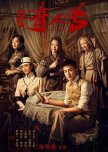
It is twice the pleasure to deceive the deceiver.
This Chen Kaige production more than lives up to its pedigree with a fresh and intriguing plot, unforgettable characters, eye popping visuals and costumes and movie quality production values overall. It is the rare Chinese drama that delivers a hefty and completely satisfying wow factor at the end that actually exceeds the exciting, high octane start. Unlike most Republican era dramas, this one is not at all just plain depressing and yuck.On his way home, fresh graduate Hua Minchu (Oh Hao) finds himself entangled in the affairs of the Eight, a vast and powerful jianghu alliance representing eight professions or guilds (spies, sages, mechanics, deceivers, thieves, assassins, poisoners and entertainers). The Eight guild masters have been long awaiting the emergence of a new leader (their Holder) to help them "go legitimate" by disbanding and exiting the grey underworld economy to become upstanding and productive members of society. But this is easier said than done as different factions emerge and other forces plot to seize power and unlock the secrets of a fabled magnificent treasure.
This drama bursts with colorful and multi-faceted characters from the most banal to the most divine; the most loyal to the most diabolical; the most compassionate to the most deadly and the most transparent to the most deceptive. While Oh Hao's Hua Minchu is clearly the lead and very well acted, this drama is about teamwork and the entire idiosyncratic cast steals my heart. All of the guild masters are legends unto themselves; each bringing an unmatched skill to the table that complements the skills of the other masters. Both good and bad are so dynamic, bad ass and so utterly awe inspiring it is literally a gangster's paradise. I love that this drama is about a team that works together, loves together, rejoices together and mourns together - the sum of the parts is greater than the whole. It is big fun to watch such impeccably well acted character dramas like this that doesn't just focus on one lead character. That said, I must admit that Oh Hau/Hua Minchu is delicious! He is a man's man - tall, tan, charismatic and ruggedly handsome - unlike the super androgynous, pasty white faced effeminate male leads we see too much of. He is not the best fighter nor does he always make the best decisions but he is clever and dang - he is way too sexy for whatever outfit they pour him into! I watched this through what I (mistakenly) thought were gaping plot holes just to savor his effortless charm and masculinity.
The villains in this show are very good villains - just as deadly, well resourced, smart and cool . Among others, our heroes are pitted against main villain Fang Yuanji, a viciously brutal, steroid enhanced lean mean killing machine and a shadowy mastermind with an opaque agenda. I had my heart in my mouth every time the Eight engages in hand to hand combat with Fang Yuanji and all their encounters are shockingly consequential. I don't think I need to elaborate on the visual virtuosity of action scenes produced by Chen Kaige - and in truth I don't have the words to do them justice.
From the start, I saw this as a character drama and did not have high expectations in terms of plot so I was wowed when it actually delivered. The story is tightly written and the plot unfolds at an exciting pace with enough conspiracies, twists, angst, betrayals, manipulations and manifold adventures within the well constructed and engaging arcs. However, it is not that easy to develop believable romance threads within such an action packed and heavily character laden story. As such, the romance between Minchu and Xishui (Tan Songyun) was not convincingly developed and it was quite obvious that many of their scenes were cut. That said, they still had good chemistry and Tan Songyun is always adorable, she just seemed to have been dealt a bit of a raw deal on her scenes. I don't enjoy triangles generally but in this case, it is handled very well and turns out to be actually relevant to the plot. In the middle, plot holes emerged with key actors making uncharacteristic decisions that had me rolling my eyes. And then in the final two episodes, I realized I was fooled - everything makes sense and every major loose thread comes together in an EPIC showdown and an exhilarating finale that will leave you thrilled, agonized, shocked and completely and utterly pleased by the way the deceiver is deceived. This is the one drama I have seen this year with a truly strong finish and it is the way dramas should end - shortly after a thoroughly satisfying climatic peak.
Make this the next drama you start. You can thank me later. My 8.0/10 rating would be higher were it not for the cut episodes and the somewhat weaker romance arcs.
Was this review helpful to you?
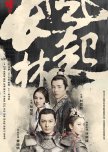
Nirvana in Fire Season 2: The Wind Blows in Chang Lin
29 people found this review helpful
Closure
While NIF2 works as a superb standalone story, it is best appreciated if watched after NIF. Also be aware some of my comments may be spoilers for NIF so best not to read this if you haven't watched it.NIF2 is the story of the changing fortunes of the Changlin family as together with the Liang empire, they navigate a changing of the guard. While the story skips a generation, the ghost of Lin Shu "haunts" the drama. After all, the powerful Changlin Army is the legacy Prince Jing created in Mei Changsu/Lin Shu's memory. Xiao Tingsheng, the now elderly Prince of Changlin instills in his family the same moral values, duty, honor and loyalty that were innate to Prince Jing and Lin Shu. His sons Xiao Pingzhang and Xiao Pingjing grow up with and share a deep bond beyond blood ties with their imperial peers, especially the Crown Prince and their cousin Xiao Yuanqi. Their proximity to the throne and unbalanced power in the court is feared and envied by many. This sets the stage for political plots and intrigue at the highest levels of the court that pose many challenges for the Changlin family. This brings the free spirited and fun loving Pingjing back from the famed Langya hall to aid his more responsible elder brother Pingzhang, the heir who already shares their father's duties.
In NIF, we can only imagine what young Lin Shu's life was like. NIF2 invites us to experience being in the bosom of a close and loving family at the epicenter of power in the empire. We laugh and we cry with them, their friends are our friends, their foes our enemies, their hopes our hopes and we feel the pain of their losses in an acute and very real way. The script-writing and plot in this drama is deep and masterful in a way that rivals that of NIF. While political plotting, revenge, justice, loyalty, morality, duty and envy are still strong themes, it dives more deeply into relationships between sovereign and subject, parent and child, husband and wife and siblings and cousins while exploring the fine line between good and evil and nature vs nurture. Unlike NIF, the story does not revolve around one core character but a number of key characters. Like NIF there are many grey characters and even the good characters are very realistically written with their own strengths and flaws. These lead characters evolve over time as the story-line spans a generation shift and explores how these characters deal with change. The second half of the drama focuses on the younger generation and this is where weakness in the acting emerged as these demanding transitions are played out by younger and less experienced actors. That said, overall the cast was very strong and well populated with many veteran actors.
Newcomer Liu Haoran's Xiao Pingjing was stellarly portrayed from start to finish. He managed to "grow up" from the immature, playful, outspoken, impetuous and slightly irresponsible younger son to be a skilled pugilist, brilliant general and military tactician, the rising star of the Changlin family. This actor immediately conveyed that Pingjing must be what a young Lin Shu (whom we never met in NIF) would have been like. He is the young actor to watch coming out of NIF2. Sadly his love interest Lin Xi was played by a limited and forgettable young actress. Lin Xi's father was killed before she was born so she is an aloof character, a talented and capable lady doctor. She had to make a terrible, controversial and life altering decision in this drama. This is an awesome part that a better actress could have killed. This one wore a perpetually tragic expression and when pressed to defend her decision she overacted, wailing in a completely out of character way. There was no chemistry between Pingjing and Lin Xi and as a couple, they were not convincing. Pingzhang and his wife Meng Qianxue on the other hand were touchingly in sync with each other. Fortunately this is not a love story although there is more romance than NIF. Both female leads were strong and well written characters but only Meng Qianxue's role was well acted.
In the second half of the drama, cousin Xiao Yuanqi also comes of age, clawing his way up despite the disgrace his father (the youngest son of Prince JIng) brought on to their branch of the family. Yuanqi is a chameleon and the most interesting, complex and empathetic character in the entire drama. To be fair it is a challenging role, one that actor Wu Haochen was not up to. While his performance was technically good, it was also pedestrian and boring. He simply lacks onscreen presence and charisma. I didn't want to watch him and would either tune out or tune into whoever he was sharing the screen with. This was too critical a role for them to have miscast so badly. The character itself was exceedingly well developed, it just didn't come to life in the right way. It is why for me this drama is not a perfect 10 even though the script, plot and story-line can hold its own against NIF.
NIF broke my heart because even though Lin Shu/Mei Changsu got his justice, it was his final act. What he lost could never be recovered. I was inconsolable for a long time. Watching NIF2 was cathartic because NIF2 shows us that his legacy and everything he stood for lives on in all the lives he touched. And despite its own tragic moments, in NIF2 we get to imagine that maybe Lin Shu came back to fulfill his final promise. That gave me the closure I badly needed.
Was this review helpful to you?
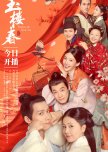
Women hold up half the sky.
Song of Youth is a historical Chinese soap opera that pays tribute to 红楼梦 Hongloumeng (Dream of the Red Chamber), widely regarded as China's greatest novel. Fans of the novel will immediately recognize that the backstory of an aristocratic family in decline and the multiple character blueprints that are based on this vernacular classic. Uniquely, this narrative plucks out the all-consuming, angsty, tragically epic love triangle that forms the core of the novel and focuses instead on broader, often less appreciated themes. The love triangle is still there but it is been muted to the extent that it is only peeks out towards the end.Lin Shaochun, a talented actress from a performing troupe marries Sun Yulou, the youngest scion of the noble Sun family. With her innate resourcefulness and the support of her husband, she becomes indispensable to his initially disapproving family by ably resolving all their internal and external conflicts and challenges. Bai Lu as always delivers a very enjoyable performance as the supportive and loving wife of Sun Yulou and the clever, thoughtful and femininely authoritative Sun family fixer. Even though I think Wang Yizhe has a lot of potential as an actor, he struggled to get into character and I didn't see much spark between him and Bai Lu. But it doesn't matter because albeit with some challenges, their arc is short and it is ultimately a rather pedestrian love match. After that the narrative explores more complicated and more poignant relationships where the couples have limited ability to make their own choices. Very much like Court Lady, Lin Shaochun is just a tour guide through the social structures, culture, relationships, vanities and daily life details of feudal 18th century China. Thankfully unlike Court Lady, Bai Lu's portrayal of the role as occasionally ruthless and not overly preachy and righteous makes Lin Shaochun very likeable if too infallible to be that interesting.
What stands out about this drama is that very much like Hongloumeng, it celebrates the contribution of women to society - Mao Zedong was far from the first to acknowledge that women hold up half the sky. True to the novel, the drama is very female centric - Lin Shaochun is the main protagonist and in a fitting role reversal the ML Sun Yulou is just a prop; an attractive, decorative vase. Even the best antagonists are formidable and devious women. In fact, most of the male characters in the drama are rather weak and not that intelligent - Sun Yulou only pulls himself together to be worthy of Lin Shaochun, his oldest brother is a foolish gold digger's wet dream, his second brother is the most capable of the lot and his third brother is a henpecked wastrel. All of them become better, more successful men thanks to their smart, determined and capable wives. I find both the eldest and (especially) the second brothers' stories to be far more interesting than that of the main CP. Unfortunately the second brother's story fizzles out in the middle and ends in a slightly disappointing way. Nonetheless, Yao Dizu is by far the most multi-faceted and refreshing character in the drama, more so than Lin Shaochun. She is also the only character that gets to be the author of her own story. If Lin Shaochun were written to be more of a bystander and less of the person who always saves the day, this would be a much better drama. She always wins by the same modus operandi so by the second or third arc, I was on to her and the "twists" become predictable.
The other problem with this drama is that it doesn't seem to be written in one voice or tone and thus gives the impression that it doesn't know what it wants to be. I think it is intended to be a satire or parody of bourgeois upper society during Ming Dynasty. Unfortunately in parts the humor is quite slapstick when it comes to Lamu Yangzi and some of Jin Chen's scenes because that matches the kind of humor they do best. Bai Lu and the rest of the cast however, are better suited towards more subtle, satirical humor and when the writing tries for something in between, it comes across as forced and half the time it misses the mark. That said, there are some really good laugh out loud moments but overall the wit and humor is hit or miss. The rhythm of the screenplay is particularly awkward at the beginning but more enjoyable from the middle episodes. After the four brothers' stories, the recycling of themes around the fallout from arranged marriages gets old and the final arcs flatline - I saw the final end twist a mile away so the end was predictable and anti-climatic.
This gorgeous production was clearly shot with meticulous attention to detail from the sets to the authenticity of the costumes, make up and the cultural details. The only lapse is perhaps the fact that the classic Cantonese opera Legend of the Purple Hairpin is sung in Mandarin and not in its original language (this was one of my grandma's favorite operas, she used to play the Liza Wang/Adam Cheng recording all the time). Overall a high quality production that is an enjoyable light watch even though it falls well short of Hongloumeng in terms of panoramic impression, breadth of social commentary and lasting impact. This is fun enough for me to rate this a 7.5.
Was this review helpful to you?
One that loved not wisely but too well.
Once upon a time in Beili, there lived a woman who was simply too beautiful 倾国倾城/qīng guó qīngchéng; she could fell a city with one look and fell a kingdom with a second look. This kind of woman is a menace to mankind that can only be locked out of sight in a gilded cage. This is the cautionary tale of a brave man, one that loved not wisely but too well who dared to set her free. And his one true friend who tried to help him do the right thing.Dashing Youth 少年白马醉春风 or Young White Horse Drunk in the Spring Breeze is the highly anticipated prequel to 2022's dark horse hit high fantasy martial arts drama The Blood of Youth 少年哥行. Like its predecessor, it is a youthful coming of age story about friendship, adventure and the spirited idealism of youth. Even though Baili Dongjun is the titular character, it is equally his best friend Ye Yun's villain origin story. They are parallel characters; both innate martial artists and scions of the Beili empire's founding families. As boys, they vowed to storm the martial world together when they grew up; Yun as the Sword Deity and Dongjun as the Liquor Deity. After the Ye family's downfall, they are destined to go down opposite paths. Dongjun lives a charmed life; making a name for himself as Li Changsheng's final disciple at the prestigious Jixia Academy; surrounded by new friends like Sikong Changfeng and Beili's Eight Talented Gentlemen. He reunites briefly with Ye Yun, who now calls himself Ye Dingzhi. In sharp contrast, Ye Dingzhi's path is a lonely one, full of obstacles, inequities, betrayals and brief snatches of happiness.
At its core, this is quite a straightforward story that is cluttered in the storytelling. There are too many digressions into the Who's Who of the martial world and and its pretentious rankings. While the fan service is terrific, such a dazzling array of too hot to handle swordsmen put my exploding ovaries in danger of apoplexy. The surfeit of hot filler characters with shallow side stories distract from the main arcs. For all their fancy swords and pompous rankings, all we see are a few showy poses and twirls before the CGI takes over and screen explodes in a gory orgy of light and digital creatures. While the CGI is well done, it is a big let-down not to see a few well choreographed live action fight sequences.
I was happy to see Hou Minghao dub himself as Baili Dongjun. It makes a big difference in how the character comes to life. While his acting is still a work in progress, he plays a character he can relate to and it shows. Ye Dingzhi is a more complex and intense role, one that He Yu pulls off charismatically. Even though he does questionable things, I empathized with him every step of the way. It would have been nice to see more of Xia Zhiguang's Sikong Changfeng. The humor and camaraderie between all the dashing youths is one of the drama's highlights. Even though the romances are not convincingly written or well developed, I liked all of the couples enough to root for them. The role of Yi Wenjun should have been more sympathetically portrayed instead of just as helpless, selfish and willful. The lovely Ye Yao is only Dongjun's muse, her character doesn't get to do much.
The irreverent Li Changsheng/Nangong Chunshui is the funniest, best acted and most engaging character in this story. Even though his arcs don't tie well with the main plot, the narrative visibly sags after his exit. His parting words to his disciples 凭心而动/píng xīn ér dòng or "act according to your heart" captures the spirit and idealism of youth that is Dongjun's lifelong mantra; one that years later, he passes on to his disciple Tang Lian. He helps Dingzhi steal the bride because Wenjun was not willing and therefor it is wrong to force her. It is the simple, absolute truth that trumps the cynical calculations driven by politics and expedience. He never wavers from this belief. It is true that Wenjun is a selfish, weak and dislikable character who makes terrible decisions with devastating consequences. But she was still wronged in the first place. Thus like Dongjun, I understood, even tried to empathize with her until she was too easily manipulated into returning to Tianqi. That was not only a stupid decision, it showed that she simply did not trust and love Dingzhi enough to wait for him. Poor Dingzhi, he never got any breaks. Even the love of his life failed him at the end. Through sick and sin, it was always and only Dongjun who remained his one true friend.
There is little new in the political plot that wasn't revealed in dialogue and flashbacks in TBOY. Which would be fine if they fleshed out the character stories and the succession struggle instead. But those are dealt with cursorily with Ruojin left as a blank cartoon character and the relationship between the brothers not explored. TBOY romanticizes Prince Langya as a tragic hero, the noble uncrowned king of Beili. In this prequel, he is the character that disappointed me most. He tore up his father's will out of misplaced loyalty and his own selfish desire to live an unrestrained life. He never made the case for why Ruojin was more worthy, supported him unconditionally and in the case of Wenjun, enabled him even though he knew it was wrong. There was never a so called greater good or do or die reason why Wenjun had to marry Ruojin, it was simply a matter of imperial privilege and entitlement. They could have escaped with his help and everything could have been so different. But I don't hold him solely responsible; there were so many malign forces at play and bad decisions that there is plenty of blame to go around.
The ending to this story leaves that bitter after taste that the bad guys won. It makes too convincing a case that a too beautiful woman who can topple kingdoms must be safely locked out of sight so she can do no harm. Both Wenjun and Dingzhi paid a high price for their mistakes but too many people who pushed Dingzhi down the dark path got off unscathed. In the novel, Dongjun has an epiphany about his own dào/道 or convictions in the middle of his fight with Dingzhi. He switches sides and punches the daylights out of the emperor instead. He scolds him: "She does not like you, why force her to marry you? She has escaped and is living a happy life, why lock her up again? You are the emperor with a harem of 3000. My brother only loves one person. Live and let live. Learn from your brother, he can even let you have the throne, why can't you let my brother have one wife?" Even though it changed nothing it was something that had to be said. Without this scene, Ruojin is never called out or held accountable for his role in starting a war over a woman. Instead it is Dingzhi who is destroyed and villainized for trying to hold on to a grass hut in a tiny corner of the world where he was happy. It is very hard to feel good about a story that ends like this.
This messy and disappointing prequel was in some ways limited by what was already canon in TBOY but still could have been better on multiple fronts, Nonetheless it is a chock full of eye candy and a fun watch if you don't look too hard at it and ignore the inconsistencies with TBOY. Even though this is a critical review I enjoyed the drama. I am just mad because it had the potential to be almost as good as TBOY. But it wasn't and so I can only rate this 8/10. I am still happy to recommend it , especially if you loved TBOY. If you liked Wuxin before, you will love him more after knowing his parent's story.
Was this review helpful to you?


