



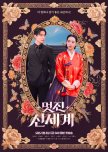
A World I Still Carry After the Story Ended
I took some time to reflect after finishing this drama. I cried a lot when it ended, and even now it still feels difficult to fully move on from it. It has become something very special to my heart in a way I don’t often experience with dramas, and I know it will stay with me for a long time.
What lingers most is not any single twist or resolution, but the atmosphere the story leaves behind. It feels like being held inside a world that knew exactly what it wanted to be, and trusted itself completely from beginning to end. The shifts in tone —from humor to deep melodrama, from fantasy to quiet intimacy — never felt abrupt or disjointed to me. Instead, they seemed to follow an emotional rhythm that gradually reveals itself.
I also appreciated how the drama often feels like a quiet tribute to earlier drama traditions and classical tropes. As someone who has been watching dramas since the 2010s, there was something familiar and intentional in the way it draws from older narrative patterns, yet reshapes them with a more modern emotional sensibility, something I miss a lot in recent dramas.
As the story unfolded, the familiar genre elements — reincarnation, time shifts, fragmented identities — stopped feeling like separate narrative devices. They began to merge into a single emotional logic, where identity is not fixed but layered across time, carrying traces of different lives within the same continuity. The characters felt less like separate versions of themselves and more like expressions of something trying to reconnect.
The romance is built in a similarly restrained way. There is no reliance on rivalry or external competition to generate tension. Instead, the focus stays on recognition — on how connection persists even when memory, time, and circumstance keep pulling the characters apart.
The writing itself feels unusually tight. The dialogue is sharp, perceptive, and often quietly very clever in a way that really stands out if you understand Korean. I found myself laughing more than once at how precisely some lines land. Certain phrases stay in the mind long after they are spoken, because they feel so intentional and carefully placed, almost inevitable in hindsight. Nothing feels ornamental — everything seems to serve the emotional direction of the story.
The performances match this precision. Much of the emotion is carried through subtle physical detail, especially in quite scenes. It creates a sense that what matters most is happening slightly beneath language, in spaces where feeling is not fully articulated but still clearly understood.
By the end, the story does not settle into a single interpretation of its world. Its timeline, its metaphysical structure, even the fate of its Joseon counterparts remain open to different readings. That openness feels intentional, as if closure would diminish something meant to remain partially ungraspable, echoing the way history itself resists being fully grasped.
What remains strongest is the coherence of it all — the way writing, performance, pacing, and emotional logic align so closely. It stays in memory as a continuous emotional experience that slowly deepens the longer you sit with it afterward, as if asking you to stay a little longer before you leave.
What lingers most is not any single twist or resolution, but the atmosphere the story leaves behind. It feels like being held inside a world that knew exactly what it wanted to be, and trusted itself completely from beginning to end. The shifts in tone —from humor to deep melodrama, from fantasy to quiet intimacy — never felt abrupt or disjointed to me. Instead, they seemed to follow an emotional rhythm that gradually reveals itself.
I also appreciated how the drama often feels like a quiet tribute to earlier drama traditions and classical tropes. As someone who has been watching dramas since the 2010s, there was something familiar and intentional in the way it draws from older narrative patterns, yet reshapes them with a more modern emotional sensibility, something I miss a lot in recent dramas.
As the story unfolded, the familiar genre elements — reincarnation, time shifts, fragmented identities — stopped feeling like separate narrative devices. They began to merge into a single emotional logic, where identity is not fixed but layered across time, carrying traces of different lives within the same continuity. The characters felt less like separate versions of themselves and more like expressions of something trying to reconnect.
The romance is built in a similarly restrained way. There is no reliance on rivalry or external competition to generate tension. Instead, the focus stays on recognition — on how connection persists even when memory, time, and circumstance keep pulling the characters apart.
The writing itself feels unusually tight. The dialogue is sharp, perceptive, and often quietly very clever in a way that really stands out if you understand Korean. I found myself laughing more than once at how precisely some lines land. Certain phrases stay in the mind long after they are spoken, because they feel so intentional and carefully placed, almost inevitable in hindsight. Nothing feels ornamental — everything seems to serve the emotional direction of the story.
The performances match this precision. Much of the emotion is carried through subtle physical detail, especially in quite scenes. It creates a sense that what matters most is happening slightly beneath language, in spaces where feeling is not fully articulated but still clearly understood.
By the end, the story does not settle into a single interpretation of its world. Its timeline, its metaphysical structure, even the fate of its Joseon counterparts remain open to different readings. That openness feels intentional, as if closure would diminish something meant to remain partially ungraspable, echoing the way history itself resists being fully grasped.
What remains strongest is the coherence of it all — the way writing, performance, pacing, and emotional logic align so closely. It stays in memory as a continuous emotional experience that slowly deepens the longer you sit with it afterward, as if asking you to stay a little longer before you leave.
Was this review helpful to you?


