



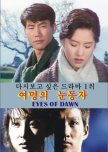
A tragic, life-affirming saga about a trio of young Koreans who are perpetually dispossessed.
A tragic, life-affirming saga about a trio of young Koreans who are perpetually dispossessed.
Over the course of 36 episodes, each of these three young Koreans is forced to fight for Japanese Imperial rule only to enter a fight for their own sovereignty against those same Japanese leaders. Though they win their sovereignty, their victory only dovetails into more bloodshed as the Korean War begins. The overall impression is a decades-long fight for the right to exist.
Each of these three leads is distinct and are all supported by high quality performances from the cast:
- Jang Ha-rim is thoughtful and compassionate, which makes him a remarkable intellectual and strategist. He begins the series as a medical student who is drafted into the Imperial Japanese military when his affair with a Japanese woman is discovered. Throughout the series, his thoughtfulness and compassion endear him to others even if these traits get him into trouble when the ideological beliefs of the people around him change. He's played by Park Sang-won in a solid, expressive performance.
- Choi Dae-chi is a fighter, which makes him an effective soldier and tactician. He starts the series as a student soldier for the Imperial Japanese Army and meets and falls in love with Yoon Yeo-ok. They have sex in a Japanese military base and Dae-chi fathers a child with her. Given the difficult circumstances surrounding their lives, though, they have a hard time coming together as a family. He's played by Choi Jae-sung in a series-best performance.
- Yoon Yeo-ok is resilient, brave, and perhaps a little lucky. She was 17 years old when she was abducted and forced into sex work at an Imperial Japanese military base. At first, she's overwhelmed with despair, torn from her agrarian roots and thrust into routine abuse on the base. It’s during this time that she meets Dae-chi. As the show continues, though, she grows into a brave woman, thanks in part to the support she receives from both of the male leads and the American military. She's played by Chae Shi-ra in a devastating, star-making turn.
The show thrives on its epic sweep, intimate character drama, and remarkable visuals. This is clearly an inspired project, which was ground-breaking when it was first broadcast at the end of 1991. The show was notably lavish for a South Korean production at that time. It was shot all over Asia, including extended shoots in Manchuria and Japan and there are reportedly as many as 100,000 extras involved in the production. Throughout the series, there's an embrace of elegant, sweeping camera movements which are redolent of classic Hollywood film-making. This is paired with dynamic staging of the actors as they play off each other. I prefer this style of staging and camera movement over the sporadic and choppy editing rhythms that dominate modern TV series.
With that said, I have some gripes. A nitpick I have is with the performances of the English-language actors who play the American soldiers. They're not a huge part of the story, but I wish some of the line readings were more polished. The Korean cast is quite strong, which makes the scenes of these actors stand out in a negative way. Another more substantial gripe I have has to do with the show's writing. There's a tendency, especially in later episodes of the series, to bail the characters out of situations. As such, there were a handful of situations in which the tension built up seemed to dissipate. The series often benefits from a more raw, realistic approach to events, which can make some of these conveniences seem out of character for the show. This type of writing may be present in the novel the series is based on, though. I would check the source, but it has not been translated into English yet.
Overall, an emotional, grand, and often sad experience.
Favorite Episodes:
1. Episode 32
2. Episode 9
3. Episode 30
4. Episode 36 (Final Episode)
Favorite Character: Choi Dae-chi
I started this series on January 30, 2024 and completed it today, May 18, 2025. This is the first Korean drama I've completed.
Over the course of 36 episodes, each of these three young Koreans is forced to fight for Japanese Imperial rule only to enter a fight for their own sovereignty against those same Japanese leaders. Though they win their sovereignty, their victory only dovetails into more bloodshed as the Korean War begins. The overall impression is a decades-long fight for the right to exist.
Each of these three leads is distinct and are all supported by high quality performances from the cast:
- Jang Ha-rim is thoughtful and compassionate, which makes him a remarkable intellectual and strategist. He begins the series as a medical student who is drafted into the Imperial Japanese military when his affair with a Japanese woman is discovered. Throughout the series, his thoughtfulness and compassion endear him to others even if these traits get him into trouble when the ideological beliefs of the people around him change. He's played by Park Sang-won in a solid, expressive performance.
- Choi Dae-chi is a fighter, which makes him an effective soldier and tactician. He starts the series as a student soldier for the Imperial Japanese Army and meets and falls in love with Yoon Yeo-ok. They have sex in a Japanese military base and Dae-chi fathers a child with her. Given the difficult circumstances surrounding their lives, though, they have a hard time coming together as a family. He's played by Choi Jae-sung in a series-best performance.
- Yoon Yeo-ok is resilient, brave, and perhaps a little lucky. She was 17 years old when she was abducted and forced into sex work at an Imperial Japanese military base. At first, she's overwhelmed with despair, torn from her agrarian roots and thrust into routine abuse on the base. It’s during this time that she meets Dae-chi. As the show continues, though, she grows into a brave woman, thanks in part to the support she receives from both of the male leads and the American military. She's played by Chae Shi-ra in a devastating, star-making turn.
The show thrives on its epic sweep, intimate character drama, and remarkable visuals. This is clearly an inspired project, which was ground-breaking when it was first broadcast at the end of 1991. The show was notably lavish for a South Korean production at that time. It was shot all over Asia, including extended shoots in Manchuria and Japan and there are reportedly as many as 100,000 extras involved in the production. Throughout the series, there's an embrace of elegant, sweeping camera movements which are redolent of classic Hollywood film-making. This is paired with dynamic staging of the actors as they play off each other. I prefer this style of staging and camera movement over the sporadic and choppy editing rhythms that dominate modern TV series.
With that said, I have some gripes. A nitpick I have is with the performances of the English-language actors who play the American soldiers. They're not a huge part of the story, but I wish some of the line readings were more polished. The Korean cast is quite strong, which makes the scenes of these actors stand out in a negative way. Another more substantial gripe I have has to do with the show's writing. There's a tendency, especially in later episodes of the series, to bail the characters out of situations. As such, there were a handful of situations in which the tension built up seemed to dissipate. The series often benefits from a more raw, realistic approach to events, which can make some of these conveniences seem out of character for the show. This type of writing may be present in the novel the series is based on, though. I would check the source, but it has not been translated into English yet.
Overall, an emotional, grand, and often sad experience.
Favorite Episodes:
1. Episode 32
2. Episode 9
3. Episode 30
4. Episode 36 (Final Episode)
Favorite Character: Choi Dae-chi
I started this series on January 30, 2024 and completed it today, May 18, 2025. This is the first Korean drama I've completed.
Was this review helpful to you?


