



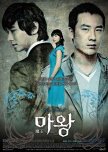
"Mawang" -- Police Procedural as Greek Tragedy
The show's conceit is perhaps the most inventive I've encountered in Korean TV so far: A police procedural re-imagined as a Greek tragedy about guilt, vengeance, and forgiveness.It tells the story of Gang Oh-soo, a passionate, hard-driving police detective tasked with investigating a series of murders that are orchestrated by a mastermind who sends tarot cards and pictures as warnings to his targets. As he gets deeper into the case, however, it's revealed that this killer is someone deeply damaged by a violent act Oh-soo committed as a teenager. The killings Oh-soo investigates activate his latent guilt, and the forgiveness he seeks by serving the law proves to be harder to come by than he imagined.
Oh-soo is set unknowingly on a collision course with defense lawyer Oh Seung-ha, an enigmatic figure who publicly serves the law but covertly orchestrates crime. Something precious was taken from him when he was young and he pursues vengeance, defending the numerous killers Oh-soo identifies as suspects. He harbors real feeling for the show's third lead Seo Hae-in, a woman with psychometric powers that allow her to view an object's history. (Oh-soo uses this extensively in his investigation). She witnesses the aftermath of Oh-soo's crime as a teen and grows up to become an unwitting pawn in Seung-ha's vengeful game.
While it functions well as a police procedural, "Mawang" is ultimately more interested in the interior worlds of its characters, especially Oh-soo and Seung-ha. As Oh-soo increasingly realizes that the mastermind of these crimes is seeking revenge, it breaks him. The show capitalizes on two main ways to present this breakdown: his aggressive tactics and his abandonment of his own well-being. There are numerous scenes in which he accuses stutterer Yeong-cheol of committing crimes he did not actually commit. While it's understood that Yeong-cheol is a co-conspirator with the mastermind, Oh-soo often assumes that Yeong-cheol is the mastermind and is unable to pinpoint his specific involvement for a long time. Oh-soo's pursuit borders on harassment on numerous ocassions, confronting him at his workplace, in a nearby park, and even at his apartment door. These are symptoms of a man unraveling under the specific horror of being both investigator and target.
On the other hand is Seung-ha, the mastermind Oh-soo is pursuing. While he wears a calm demeanor, he is haunted by the pain he felt when his brother was killed by Oh-soo. It's the seed of the destruction of his family, with his mother passing shortly after his brother's murder, leaving him to grow up in an orphanage. Oh-soo's crime, which was forgiven because his powerful father ensured that he was let off easy, is also the seed of Seung-ha's vengeful pursuit. As the show continues, however, it becomes clear that Seung-ha's revenge causes more damage than Oh-soo's murder did. Seung-ha effectively destroys Oh-soo's entire family as well as the network that let Oh-soo go free. It isn't until the bruising and heartbreaking final scene that Seung-ha seems capable of seeing past his pain enough to see the cost of the damage he's done.
While the show definitely shows its age, it was made for network Korean TV in the aughts with all the technical hangups that implies, the writing is imaginative enough that I found it absorbing viewing. It's a slow build to the final scene, which brings everything into sharp and painful focus. I imagine that I could watch 40-50 more Korean dramas without ever finding an episode as grimly cathartic and tragic as the final episode of this drama. The ending of "Sandglass" is the one ending in Korean TV that matches this in that both shows refuse to offer the audience relief when a major character is killed at the hands of a sympathetic instigator at the end of a slow accumulation.
Was this review helpful to you?

"Be Melodramatic" -- Meandering, But Moving At Times
The first half of Be Melodramatic can feel unhurried to a fault, which made the back half all the more satisfying. From episode 9 onward, the series gains emotional momentum while retaining its dry, self-aware sense of humor, allowing its characters to reach genuine turning points.Most of the show’s major relationships come to a boil, most notably Jin-joo and Beom-soo’s. Jin-joo spends much of the series hesitant to commit, weighed down by regrets from her previous relationship. I appreciated how the show frames her eventual decision to embrace Beom-soo not as a grand romantic revelation, but as a quiet moment of clarity. A dinner date with her ex at a fancy restaurant (one he can barely afford) is meant to win her back through spectacle. Instead, it backfires, making clear how little such gestures matter to her now and confirming that her feelings lie with Beom-soo.
While others move toward romance, Eun-jung continues to process the death of her fiancé. In the second half of the series, she becomes more committed to confronting her grief head-on. As the visions of her late partner grow more persistent, she begins therapy and slowly works through the pain she’s been avoiding. By the show’s end, she’s in a better place, though notably not “healed” in any tidy sense. Her storyline is easily the saddest and most affecting of the series’ latter half, and the show deserves credit for allowing grief to remain unresolved rather than conveniently overcome.
Although the back half leans more heavily into drama, episode 13 stands out as a deliberate tonal detour. While ongoing storylines continue in the background, the episode largely revolves around a fart-related misunderstanding. The writers commit fully to the bit, mining bodily humor for laughs. This includes a sequence where Jin-joo asks her mother to fart in front of her husband to test his reaction, followed by a montage of discreet, situationally inappropriate gas. Against all odds, the episode manages to be both juvenile and strangely heartwarming, capturing the show’s knack for finding intimacy in absurdity.
My main complaint with the second half lies in the show’s overall form. While the production of Jin-joo’s drama serves as a narrative thread connecting the characters, it remains secondary to their interpersonal dynamics. There’s nothing inherently wrong with this, but it occasionally leaves the series feeling directionless. This is most noticeable in the finale, which I found mildly disappointing. Some emotional payoffs land well, but I couldn’t help wishing the show leaned more heavily into depicting the drama’s production itself. Watching these distinct personalities collide on a working set — rather than circling around it — might have provided a stronger sense of narrative cohesion.
Still, these criticisms don’t outweigh the show’s strengths. Be Melodramatic is an enjoyable, thoughtful comedy-drama with memorable lead characters and a mature approach to love, loss, and creative ambition.
Was this review helpful to you?

"Goblin" -- Melancholy, Touching, Funny
"Goblin" is an often funny show, which is something of a miracle given the dramatic backstory that informs it. A centuries-old immortal cursed to wander the earth until his bride can pull a sword from his chest isn't exactly light fare, but the series finds humor in the everyday absurdities of its supernatural premise.What makes the show work are the charming character interactions. The bickering roommate dynamic between the Goblin and the Grim Reaper is delightful. The playful push and pull between the Goblin and his bride crackles with warmth. Even supporting characters like the restaurant owner add texture to the world. These relationships are the show's strongest asset, and the writers clearly know it.
The more relaxed approach to moving the plot forward, however, may be tough for some viewers. Extended episode runtimes only amplify this issue. There are stretches, particularly in the middle of the series, when it feels like little happens. The show lingers in moments of domestic calm or comedic banter when the narrative momentum could use a push forward.
A bigger issue I have with the show is the fuzziness of its magic system. The use of reincarnation can feel a little arbitrary at times. Characters return when the story needs them to, but the rules governing who gets reincarnated and why are unclear at times. This also flows into who retains their memories, as well as which memories they retain.
That said, I genuinely like the twists in the last five or six episodes. The revelations change the dynamic of the character relations in meaningful ways, adding weight to interactions that once felt purely comedic or romantic. The more dramatic second half often pays off the investment viewers made in the characters during the first half. Watching these relationships deepen and strain under the pressure of destiny is rewarding. I particularly enjoyed the darkness of the last episode, even if the ending is controversial for some viewers.
Despite its narrative unevenness, "Goblin" remains an emotionally impactful show, full of humor, heart, and pathos. If you can tolerate a slower pace and some hand-waving around the mythology, there's a lot to enjoy here. The show succeeds on the strength of its characters and their relationships, and that's ultimately what lingers after the credits roll.
Was this review helpful to you?
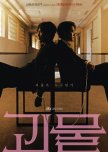
"Beyond Evil" -- A Methodical, Tense, Slow-Burn Cop Thriller
Beyond Evil starts by balancing broad, small-town comedy against genuinely unnerving horror. That mix feels uneven at first, but it does real character work. Dong-sik's played-for-laughs arrest of a group of gamblers still tells you what you need to know about him: relaxed and affable on the surface, something darker underneath. That comic register mostly evaporates as the show goes on. By episode 7 or so, the show has committed fully to its thriller identity, and it's better for it.What makes the early patience worth it is Dong-sik and Joo-won, in roughly equal measure. Dong-sik is a suspect in a twenty-year-old murder. He's visibly hiding something and secretly holding onto case files in his basement. Joo-won arrives as his opposite, a rigid rule-follower whose faith in the system starts cracking almost immediately once he's forced to work alongside him. Their uneasy dynamic becomes the show's real center of gravity long before the plot mechanics justify it. The slow burn works because both men are consistently interesting even when individual scenes don't yet explain themselves.
The show's larger idea is that a single murder investigation gradually exposes an entire town's complicity. The police station, the municipal government, and the local construction company are all implicated. This is the show's strongest structural choice. It reframes what looks like a whodunit into something closer to an indictment of institutional rot, and that reframing is handled with real control rather than being announced outright.
Episode 7 is a strong candidate for the show's emotional peak. It pairs a devastating flashback with a cathartic capture. But it's not an uncontested one. Episode 8 immediately complicates that catharsis by revealing the arrested man wasn't responsible for Dong-sik's sister's death. Episode 10's interrogation of Chief Nam, anchored by a genuinely mesmerizing performance from Shin Ha-kyeon, arguably hits harder emotionally, even if Nam's turn toward sympathetic figure is a smaller, more compressed transformation than the show sometimes plays it as. There isn't one clean high point so much as a sustained run of strong episodes across 7 through 10.
The back half is where the show's technique starts to work against it. The flashback-heavy structure, used sparingly and well earlier on, becomes a crutch. Exposition arrives almost exclusively through re-enactment rather than dialogue. By episodes 13 and 14, the rhythm turns genuinely repetitive: another manipulation from Joo-won, another flashback doing work a line of dialogue could handle more efficiently. It's a real flaw, not just a stylistic quirk, and it's the clearest sign of a show leaning on a device past the point where it's earning its keep. The episode 14 childhood flashback is the exception that proves the rule. It contextualizes Joo-won's relationship with his father in a way nothing else in the show manages.
The finale earns its ending anyway, and it earns it through both leads. Joo-won's transformation, from rigid rule-follower to someone willing to use a recorded conversation as a weapon against his own father, is just as significant as Dong-sik's long search for resolution. If anything, it's the more dramatic arc of the two, since it requires him to abandon the worldview he started the show with entirely. The decision to let everyone complicit face real consequences, then close on a calm, unhurried time jump, feels like a show that trusts its own patience rather than rushing to wrap things up.
Best Episodes:
1. Episode 7
2. Episode 16
3. Episode 8
Best Character: Lee Dong-sik
Was this review helpful to you?
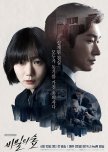
Brief Writeup on "Stranger Season 1"
A polished if conventional police procedural from South Korea, examining corruption, power, and justice through its central mystery.The great performances really anchor this one, especially the actor who plays Shi-mok Hwang. This is a demanding role: a man with limited emotional range. Even then, the actor shapes a hardboiled and cerebral presence with quiet power.
It’s slow to start, but it accumulates power with each episode until the tense and heartbreaking ending.
Favorite Episode: Episode 16 (The Finale)
Favorite Character: Yeo-jin
Was this review helpful to you?
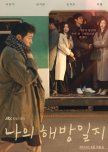
"My Liberation Notes" -- Love as Mutual Worship
"My Liberation Notes" (2022), in essence, is a story about the difficult and thankless task of finding purpose and warmth in a world that resists those things. This task forces one to confront the gap between the life one has and the life one wishes they had. While navigating that difficult mental gap, this person will come to terms with numerous disappointments and triumphs, acquainting themselves with their strengths and their weaknesses in turn. The way one reacts to these outcomes and revelations gives their endeavor distinctive texture. The hard work of living is invested as much in navigating these feelings as it does in navigating the chasm between themselves and their aspirations.Over the course of the show's 16 episodes, we see three siblings take on this task and change as individuals. These three are the Yeom siblings: Mi-jeong, Chang-hee, and Gi-jeong, all adults who live in their parent's home. They live lives that seem to meander as they travel from their home in fictional town Sanpo to Seoul to work jobs that are often taxing on their psyches. In the show, they liken their humble home to the "white" of the egg relative to the "yolk" that is Seoul, embodying through this metaphor how tangential their roots are to the locus of South Korean business and busyness that is Seoul. This show illustrates how these characters' lives are treated as peripheral to the larger ecosystem of Seoul, and thus the heart of Korean enterprise.
The show gets its title from the "Liberation Club" that Mi-jeong starts with two of her work colleagues, including Tae-hun, who will be important to Gi-jeong going forward. In establishing the club, the show also establishes the desire all these characters have to escape the monotony and aimlessness that seems to permeate their lives. It's always about the job, the commute, but never about themselves. The "Liberation Club" is as much an opportunity to reflect as it is a place to rebel against the emptiness of this culture. For the show, it serves as a recurring structural anchor that gives Mi-jeong a way to express her interiority without resorting to voiceover, and a communal forum through which the drama explores the idea of "liberation" itself, crucially without ever defining it.
The endeavor of these siblings is presented with realism and restraint, not unlike one of Ozu's later films like Tokyo Story (1953). As in Ozu, this series often depicts quieter moments in these characters' lives and deals just as much in what is said as in what is withheld. Where many Korean dramas tend toward overt expressiveness, the dialogue-heavy realism of this drama eschews that for something more akin to walking into an ordinary moment of these people's lives. This restraint allows the details of these people's lives to accumulate into a complete picture of the mundanity of their existence, and it is the drama's greatest ask of the viewer.
In the first six episodes this ask feels like a liability. The early episodes lack narrative inertia and feel more like a procession of conversations without a clear destination than any kind of story progression. Writer Park Hae-young takes her time showing each character's status quo: Mi-jeong's introversion and desire for liberation from her difficult contract work situation, Gi-jeong's dismissive attitude toward potential suitors, Chang-hee's contempt for his work at the supermarket, and Mr. Gu's crippling drinking habit. The drama is slowly accumulating details that will pay off in bigger narrative developments from episode 10 onward, though this only becomes legible in retrospect.
An illustrative example of the way the show builds context involves Tae-hun, a divorced dad scorned by Gi-jeong in the show's first episode. Gi-jeong, who is single and going on 40, talks disparagingly about divorced dads and regards them as damaged goods, in Tae-hun's presence, the man she will fall desperately in love with. Her desire for Tae-hun grows as the show continues, moving her past her former dismissiveness to something approaching genuine openness and even a growing desire to be accepted by Tae-hun's daughter and sister. This character development would not be as rich had the writer not taken her time to establish the depth of Gi-jeong's judgmental nature early.
If the early episodes establish the desperation of each character's situation, then the relationship between Mi-jeong and the man referred to as Gu is the key to the drama's architecture. Part of what makes this relationship so unique from what I've seen in Korean drama is the gentle way it unfurls and the way it resists the tropes of the romance genre. There's no meet-cute, he's an employee of her father. There's no declaration of love, just Mi-jeong begging him to "worship" her, something Gu appears to do reluctantly at first.
In fact, Ms. Park's greatest invention in this drama may be the framing of romantic love as an act of mutual worship. Worship requires devotion and attentiveness that the ambivalent and sometimes hostile world around them rarely allows. The grace Gu and Mi-jeong learn to show for each other as the series continues becomes a sanctuary and a source of liberation from the monotony and loneliness that surrounds them.
For someone as introverted as Mi-jeong in particular, this gives her the liberty to express sides of herself that wouldn't be accepted as readily in her work or family life. She becomes more talkative, which turns out to be a mixed blessing. At its worst, her newfound chattering grosses out Gu as she rambles at length about gruesome images of animal violence and dismemberment. At its best, she becomes a valuable contributor to the Liberation Club she founded. Her talkativeness also leads to a latent confidence and assertiveness that was absent before she began her "worship" of Gu.
For Gu, a gangster who hides in the country to avoid the recrimination of his former associates, the relationship provides a reservoir of warmth that complements the peaceful life he leads working for her father in Sanpo. His conversations with Mi-jeong bring out a warmer and more playful side to him not afforded elsewhere in his life, and their relationship provides something akin to liberation.
The three siblings are each navigating the same fundamental condition through different temperaments and circumstances.
Take Chang-hee, for instance. Much of the show is about his desire to obtain material wealth and the luxuries that come with it. However, as the series progresses, that desire dissipates as he comes to terms with his true gift: his empathy. This revelation is hard won. Before it comes, he struggles in vain to earn a promotion from his subordinate role at a grocery store chain to a more managerial role that would provide him the wealth he desires. He only seems to come to this realization in moments when he is required to care for others after their loved ones have passed.
Gi-jeong transforms from a dismissive, judgmental, and resentful person to accept that the man who would love her the most is the divorced dad Tae-hun, whom she scorned in the show's first episode. She walked through life with a strict set of requirements for her perfect "Prince Charming," but was routinely disappointed when no one met those lofty standards. Once she starts falling for Tae-hun, she becomes almost comically obsessed with courting him. In one of the show's most memorable scenes, she asks Tae-hun if he wants to pursue a relationship with her, only to get rejected and then get hit by a moped, which is revealed to be a tactic she concocted to gain his sympathy. She went from not wanting to even talk to a man like Tae-hun to becoming so desperate for his affection that she will take a moped injury for even a morsel of it. It's desperate, and a little off-putting, but it is a notable transformation.
The arc of the Yeom parents is present as well, though more static compared to the main cast. Before his wife's death, Je-ho would scold Chang-hee for wasting money and not being accomplished enough. After she dies and Chang-hee stays to care for him, Je-ho's perspective changes. I wished for a scene in which he would demonstrate more direct expression of his reverence for his deceased wife's support. Then again, the fact that it remains understated actually fits the show's architecture. It is, in the end, a drama that trusts implication over declaration.
This quality of implication over declaration is a consistent virtue of Park Hae-young's writing. This is the second drama I've seen from her, the first being My Mister (2018). Despite how universally beloved My Mister is, and how often it is preferred to My Liberation Notes, I felt that subplot bloat set in as its cast became increasingly massive and there was a need to fill considerably more air time per episode. The standard episode of My Mister ranged between 70 to 90 minutes, while My Liberation Notes tended toward 60 to 65 minutes (the 80-minute finale is the main exception). The climactic episodes of My Mister felt somewhat diffuse because the central plot with Park Dong-hoon and Lee Ji-an had to coexist with numerous subplots of varying quality. There is little such bloat in My Liberation Notes, which builds toward something poignant precisely because there is less to distract from the main storyline.
Seeing the way this show pulls together makes me wonder how I would feel returning to My Mister now. The major reframe would be in how I look at the subplots. Instead of experiencing them as an albatross around the neck of the central plot, I'd be more eager to assess them on their own merits, knowing that Park writes in ways that accumulate meaning rather than generate narrative momentum. For now, My Liberation Notes registers as the stronger work, and the tighter construction is the primary reason.
Despite the somewhat depressing reality of modern-day South Korea that this show presents, it is often quite warm. Dinner tables become stages for philosophical exchange rather than conflict, and there is a friendly rapport among the characters that allows for an honest flow of ideas. While some conversations drift toward confrontation, as in the arguments between Chang-hee and Je-ho or between Gi-jeong and Tae-hun's sister, they tend more often toward the philosophical than the argumentative.
The show earns its warmth through honestly presenting the realities of these lives without allowing them to tip into conflict or despair. A lot of the warmth in Korean dramas can feel manufactured because writers engineer it through proven likability mechanics designed to please an audience. Park is bold enough to believe that presenting characters as genuine human beings struggling with life's challenges can be warm without conceding to market pressure. It is understood that the Yeom family and the various people they allow into their lives wish well for each other, which makes even the most vicious arguments among them come from a place of love.
With that said, 16 episodes is a liability for a drama whose storytelling prizes concision. Some viewers will be alienated before the payoffs arrive, and there are stretches in the middle where the accumulation of reflective conversation outpaces what the drama has yet earned. Twelve to thirteen episodes would be ideal for a drama as restrained and realistic as this one, and the absence of a propulsive plot will test the patience of viewers accustomed to more conventional narrative momentum. For those willing to observe character behavior without that pressure, the final four episodes justify the commitment.
Overall, My Liberation Notes provides a warm, lived-in account of the struggle to live with purpose in modern-day South Korea. This is essentially what might have happened if Yasujiro Ozu could travel forward in time and make a television series about modern life. Episode 14, the highlight of the series for me, felt much like the ending of Tokyo Story (1953). The viewer who should avoid it is one who needs clear conflict and narrative momentum to stay engaged. This is notably light on both.
I would recommend it to viewers who appreciate character-focused, philosophically oriented television that rewards patience and dedication, the kinds of traits that seem to be part of the "worship" Mi-jeong talked about early in the series. Fittingly, the show is for those who can worship.
Favorite Episodes:
1. Episode 14
2. Episode 15
3. Episode 13
Favorite Character: Yeom Mi-jeong
Was this review helpful to you?
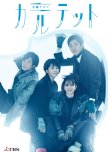
"Quartet" -- The Pain and Joy of Performing as a String Quartet
Quartet sneaks up on you. On paper, it is a gentle story of four strangers who share a villa in the mountains as they fumble toward a life as an amateur string quartet. Beneath that, however, runs a mystery that the series takes its time revealing. These two modes do not always feel as though they belong together, and yet the show slowly wins you over.Yuji Sakamoto's writing is key to the show's appeal. It is grounded, melancholy, and funny in a gentle way that feels earned rather than manufactured. The series is at its best when it simply lets its four leads exist in the same room, talking, bickering, eating, and being awkward around each other. The filmmakers find many dynamic ways to keep these scenes fresh, deploying creative staging ideas throughout the dialogue sequences that prevent them from ever feeling static. The show has a rare gift for finding profundity in the smallest of moments, as when the quiet scandal of squeezing lemon on a communal plate of chicken karaage without obtaining anyone's consent becomes, improbably, an occasion for genuine feeling.
The mountain locale lends the series a pleasing remove from ordinary life. There is a sense that these musicians are glad to be performing, regardless of whether any audience receives them warmly. That contentment is hard won: the characters navigate real difficulty in booking gigs and reckoning with the complicated histories they each carry. Their passion for performing together persists anyway, indifferent to external validation, and it gives the show an emotional core that rewards patience.
The heavy reliance on dialogue is both the show's greatest strength and, on occasion, its limitation. The dense, witty exchanges are a pleasure, but the approach can feel one-note in stretches. A little more variety in texture would have helped.
The cast is excellent across the board, with Takako Matsu a particular standout. She brings an understated gravity to her role that anchors the whole ensemble. The mystery element threads through the series with enough patience that it initially seems at odds with the looser, contemplative slice-of-life half. But the show earns the synthesis. By the end, the two strands feel less like competing tones than like two voices that were always, quietly, playing the same piece.
Was this review helpful to you?
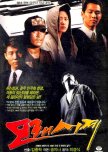
"Sandglass" -- A Tragic Bromance Set in '70s and '80s South Korea
A complex and moving dramatization of South Korean life under authoritarian rule."Sandglass" begins as a story of Park Tae-soo and Kang Woo-suk, two friends whose lives are shaped and transformed by the corrupt South Korean government in the 1970s and 80s. Tae-soo is an ambitious young gangster who fights his way through life, while Woo-suk is a precocious intellect who wishes to become a prosecutor. Both of these men have affection for Yoon Hye-rin, the daughter of a corrupt casino owner in Seoul.
As the series evolves, however, their lives transform in ways that they never would've anticipated. Hye-rin is rebellious in her youth, defying her father and striving for a Korea free of corrupt figures like him. As the series continues, however, she comes to work in his casino and works to maintain his empire as she grows up. This puts her into direct conflict with Tae-soo, a gangster and a former flame who also works in the casino business. What develops is an uneasy "lovers as rivals" dynamic between Tae-soo and Hye-rin. While their affection for each other is evident, they also must work against each other's interests at times to improve their standing. The person who operates from love in this arrangement sets themselves up for destruction.
Woo-suk also transforms somewhat. As a prosecutor, he does the seemingly improbable by using his position to challenge South Korea's corrupt power elites. In doing so, he brings about a necessary moment of transparency for the Korean people that helps reshape Korean politics for the better. This is remarkable given his belief that he lacked the moral character to bring about such transparency. He was once involved in the Kwangju Massacre as a soldier, in which he suppressed the voices of people who opposed the government. Not only does he fulfill his father's wish for him to become a prosecutor, but he creates a better South Korea for his wife and child.
While the filmmaking definitely shows its age (the soundtrack, sound effects, and some of the cinematography and editing), Song Ji Na's screenplay is timeless in the way it weaves a complex human drama during a troubling period in South Korea's history. It's by turns tragic, thrilling, and hopeful.
Favorite Episodes:
1. Episode 7 - Fueled by a gripping and horrifying depiction of the Kwangju Massacre.
2. Episode 23 - Perhaps the most cathartic episode of the series
3. Episode 24 - The tragic but necessary conclusion of the series
Favorite Characters:
1. Park Tae-soo
2. Baek Jae-hee (Hye-rin's memorably loyal bodyguard. He's played by Lee Jung-jae, who would go on to star as Seong Gi-hoon/Player 456 in "Squid Game" nearly three decades after this series)
3. Kang Woo-suk
4. Yoon Hye-rin
Was this review helpful to you?
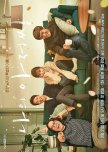
"My Mister" -- A dark ode to life's struggles
"My Mister" is a warm and melancholic story that centers around Dong-hoon Park, a structural engineer at Saman E&C, and Lee Ji-an, a temp worker Dong-hoon hires. What follows is a mix of vicious office politics and extended looks at the challenging life circumstances of its large cast. Most of the cast is well fleshed out, even minor characters that are not readily implicated in the corporate drama involving Dong-hoon that serves as the drama's anchor.Where this show thrives the most is in its atmosphere. Unlike many modern K-dramas, this is a more somber affair. Many of my favorite moments in the series are ones in which the cameraman decides to let the audience sit with these characters as they process their emotions. This stillness is expressive of the ways in which they reckon with their difficult circumstances. While these characters all face their own challenges, the writers are careful to include moments of warmth throughout through moments of kindness and joyous gatherings among friends. The show is dark, but it's not depressing.
With that said, I do have some gripes about the series. I have mixed feelings about the editing, which I think can be too busy for its own good. This was most problematic in dialogue scenes, in which there are several cuts placed in rapid succession and split screens are employed with little discernible purpose.
Perhaps my biggest complaints, however, are related to the writing. My first writing complaint likely has more to do with the structure the writers were asked to work within, but I found the episodes to be much too long. Each episode is between 70 to 90 minutes in runtime, which felt like a lot for the kind of story presented here. If the writing remained focused on the central dynamic, that of the office politics that implicate Dong-hoon and Ji-an, I might have appreciated it more. The series might've ended much earlier as well.
As is, I feel that the show includes too many subplots that don't strengthen the show and add bloat to the runtime. The subplot I enjoyed the least involved Dong-hoon's brother Gi-hoon as he reconnects with the actress the brother blames for ruining his film career. As the series reached its end and I was looking forward to the resolution of the Saman E&C office politics, a lot of the Gi-hoon scenes felt like a distractions from what I was really invested in. While that storyline comes to a satisfying conclusion in the final episode, the road there feels arduous. I tended to prefer the subplots that had a more direct impact on the office politics. While the loanshark, Jang Ki-young, who harasses Ji-an is sometimes too comically evil for my taste, the way he becomes entwined with the corporate politics toward the end of the series redeems that arc a little bit. Even then, I wished for better character development for him outside of his tragic backstory.
Even though I have a few gripes, I still am grateful for this show's unusual take on melodrama. It feels grounded even as the seemingly absurd happens (Ji-an listening to Dong-hoon through a wiretap at seemingly all times) and it finds moments of genuine pathos in all its storylines regardless of how much I feel they contribute to the show.
I started this show on March 27, 2024 and I completed it on June 30, 2025.
Top 3 Episodes:
1. Ji. An. (Episode 16)
2. The Envelope (Episode 9)
3. Out of All, Why? (Episode 11)
Favorite Characters:
1. Park Dong-hoon
2. Lee Ji-an
3. Director Park Dong-woon
4. Jeong-hee
5. Director Yoon Sang Tae (His mugging at literally every major revelation he's allowed to witness is deeply funny to me. He was always going to be a favorite.)
Was this review helpful to you?
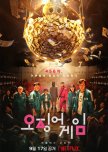
A solid first season of "Squid Game"
A solid first season overall, even if the last three episodes are a slight disappointment to me.The death games in "Squid Game" are a debtors' jail reimagined as a Battle Royale. Instead of a protracted battle to the death, each battle consists of a Korean children's game, which is intensified by the inclusion of life-and-death stakes. These games are perverse in the way they mix childhood memories (for the Korean contestants at least) with the spectacle of death. Death is often brutal, either through failing a particular obstacle or being tricked by someone who was believed to be a friend. For enduring all of these games, the prize is 45.6 billion won, about 100 million won per player (each human has a price here). The games are a cruel and unbecoming spectacle, yet games like these continue to be popular entertainment in fictional media all over the world. First in Japan with "Battle Royale", then with "The Hunger Games" in the USA, and now in South Korea with "Squid Game. (And perhaps others that are, at present, unknown to me).
The players of these depraved games are the focus of this story, but a compulsive gambling addict named Seong Gi-hun is the main focus. Gi-hun is the 456th and final player to enter the games. His reason for entering appears to be to ensure that his ex-wife and daughter don't become too estranged from him as they move away from him to America. While in the games he forms alliances with a small group of other players including Kang Sae-byeok (Player 067), Cho Sang-Woo (Player 218), Oh Il-nam (Player 001), Ali Abdul (Player 199), and Lee Yoo-Mi (Player 240) among others. It's understood early on that these alliances are tenuous at best, given that only one person will survive to the end. These constitute many of the most important supporting players as well as some of the strongest friendships in this season. They become a tight unit, using strategy to master the early games and outwit their opponents.
While the players provide a clear look at the horrific games they must endure, a subplot involving Detective Hwang Jun-ho serves as a window into the terrifying world of being on staff at these games. The detective disguises himself as one of the games' goons in order to find his brother, who he believes is somehow involved with these games.
From a writing perspective, the series is often a mixed bag. It starts strong by creating relatable characters and focusing on the games, which are depraved, yet compelling spectacles. The behind-the-scenes look provided through the detective is also interesting to start. For the most part, the first six episodes are engaging, especially the heartbreaking episode "Gganbu". I have mixed feelings about episodes 7 and 8, even if the games remain as compelling as ever. However, I must admit that I was disappointed by the finale. There's a twist in the finale involving a former contestant that seemed quite bizarre to me. It undermines one of the most emotional scenes of the series in my opinion and I'm not fond of it.
With respect to the filmmaking, I believe its often good. The set design in the games is colorful, at once playing up the child-like nature of the games while providing an off-putting contrast to the depravity unleashed on these sets. I also think the cinematography is solid, though some of the night time exteriors in the real world could benefit from some more lighting. Direction is perhaps the weakest production aspect, as some of the handheld camera scenes can get a little sloppy. Better planning may have yielded better results for those scenes.
I'm glad I checked this out, even if I'm fine with not watching more of the show. If someone wants me to watch the rest of it, then I'll consider it. For now, I'll be okay with what I've seen. It's a solid first season, if a little inconsistent.
Favorite Episode: "Gganbu"
Runner-up: "Stick to the Team"
Favorite Characters:
1. Seong Gi-hun / Player 456
2. Oh Il-nam / Player 001 (I'm considering the character before the twist, not after)
3. Cho Sang-woo / Player 218
4. Kang Sae-byeok / Player 067
5. Ali Abdul / Player 199
Was this review helpful to you?
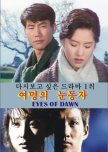
A tragic, life-affirming saga about a trio of young Koreans who are perpetually dispossessed.
A tragic, life-affirming saga about a trio of young Koreans who are perpetually dispossessed.Over the course of 36 episodes, each of these three young Koreans is forced to fight for Japanese Imperial rule only to enter a fight for their own sovereignty against those same Japanese leaders. Though they win their sovereignty, their victory only dovetails into more bloodshed as the Korean War begins. The overall impression is a decades-long fight for the right to exist.
Each of these three leads is distinct and are all supported by high quality performances from the cast:
- Jang Ha-rim is thoughtful and compassionate, which makes him a remarkable intellectual and strategist. He begins the series as a medical student who is drafted into the Imperial Japanese military when his affair with a Japanese woman is discovered. Throughout the series, his thoughtfulness and compassion endear him to others even if these traits get him into trouble when the ideological beliefs of the people around him change. He's played by Park Sang-won in a solid, expressive performance.
- Choi Dae-chi is a fighter, which makes him an effective soldier and tactician. He starts the series as a student soldier for the Imperial Japanese Army and meets and falls in love with Yoon Yeo-ok. They have sex in a Japanese military base and Dae-chi fathers a child with her. Given the difficult circumstances surrounding their lives, though, they have a hard time coming together as a family. He's played by Choi Jae-sung in a series-best performance.
- Yoon Yeo-ok is resilient, brave, and perhaps a little lucky. She was 17 years old when she was abducted and forced into sex work at an Imperial Japanese military base. At first, she's overwhelmed with despair, torn from her agrarian roots and thrust into routine abuse on the base. It’s during this time that she meets Dae-chi. As the show continues, though, she grows into a brave woman, thanks in part to the support she receives from both of the male leads and the American military. She's played by Chae Shi-ra in a devastating, star-making turn.
The show thrives on its epic sweep, intimate character drama, and remarkable visuals. This is clearly an inspired project, which was ground-breaking when it was first broadcast at the end of 1991. The show was notably lavish for a South Korean production at that time. It was shot all over Asia, including extended shoots in Manchuria and Japan and there are reportedly as many as 100,000 extras involved in the production. Throughout the series, there's an embrace of elegant, sweeping camera movements which are redolent of classic Hollywood film-making. This is paired with dynamic staging of the actors as they play off each other. I prefer this style of staging and camera movement over the sporadic and choppy editing rhythms that dominate modern TV series.
With that said, I have some gripes. A nitpick I have is with the performances of the English-language actors who play the American soldiers. They're not a huge part of the story, but I wish some of the line readings were more polished. The Korean cast is quite strong, which makes the scenes of these actors stand out in a negative way. Another more substantial gripe I have has to do with the show's writing. There's a tendency, especially in later episodes of the series, to bail the characters out of situations. As such, there were a handful of situations in which the tension built up seemed to dissipate. The series often benefits from a more raw, realistic approach to events, which can make some of these conveniences seem out of character for the show. This type of writing may be present in the novel the series is based on, though. I would check the source, but it has not been translated into English yet.
Overall, an emotional, grand, and often sad experience.
Favorite Episodes:
1. Episode 32
2. Episode 9
3. Episode 30
4. Episode 36 (Final Episode)
Favorite Character: Choi Dae-chi
I started this series on January 30, 2024 and completed it today, May 18, 2025. This is the first Korean drama I've completed.
Was this review helpful to you?


