



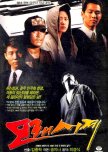
"Sandglass" -- A Tragic Bromance Set in '70s and '80s South Korea
A complex and moving dramatization of South Korean life under authoritarian rule.
"Sandglass" begins as a story of Park Tae-soo and Kang Woo-suk, two friends whose lives are shaped and transformed by the corrupt South Korean government in the 1970s and 80s. Tae-soo is an ambitious young gangster who fights his way through life, while Woo-suk is a precocious intellect who wishes to become a prosecutor. Both of these men have affection for Yoon Hye-rin, the daughter of a corrupt casino owner in Seoul.
As the series evolves, however, their lives transform in ways that they never would've anticipated. Hye-rin is rebellious in her youth, defying her father and striving for a Korea free of corrupt figures like him. As the series continues, however, she comes to work in his casino and works to maintain his empire as she grows up. This puts her into direct conflict with Tae-soo, a gangster and a former flame who also works in the casino business. What develops is an uneasy "lovers as rivals" dynamic between Tae-soo and Hye-rin. While their affection for each other is evident, they also must work against each other's interests at times to improve their standing. The person who operates from love in this arrangement sets themselves up for destruction.
Woo-suk also transforms somewhat. As a prosecutor, he does the seemingly improbable by using his position to challenge South Korea's corrupt power elites. In doing so, he brings about a necessary moment of transparency for the Korean people that helps reshape Korean politics for the better. This is remarkable given his belief that he lacked the moral character to bring about such transparency. He was once involved in the Kwangju Massacre as a soldier, in which he suppressed the voices of people who opposed the government. Not only does he fulfill his father's wish for him to become a prosecutor, but he creates a better South Korea for his wife and child.
While the filmmaking definitely shows its age (the soundtrack, sound effects, and some of the cinematography and editing), Song Ji Na's screenplay is timeless in the way it weaves a complex human drama during a troubling period in South Korea's history. It's by turns tragic, thrilling, and hopeful.
Favorite Episodes:
1. Episode 7 - Fueled by a gripping and horrifying depiction of the Kwangju Massacre.
2. Episode 23 - Perhaps the most cathartic episode of the series
3. Episode 24 - The tragic but necessary conclusion of the series
Favorite Characters:
1. Park Tae-soo
2. Baek Jae-hee (Hye-rin's memorably loyal bodyguard. He's played by Lee Jung-jae, who would go on to star as Seong Gi-hoon/Player 456 in "Squid Game" nearly three decades after this series)
3. Kang Woo-suk
4. Yoon Hye-rin
"Sandglass" begins as a story of Park Tae-soo and Kang Woo-suk, two friends whose lives are shaped and transformed by the corrupt South Korean government in the 1970s and 80s. Tae-soo is an ambitious young gangster who fights his way through life, while Woo-suk is a precocious intellect who wishes to become a prosecutor. Both of these men have affection for Yoon Hye-rin, the daughter of a corrupt casino owner in Seoul.
As the series evolves, however, their lives transform in ways that they never would've anticipated. Hye-rin is rebellious in her youth, defying her father and striving for a Korea free of corrupt figures like him. As the series continues, however, she comes to work in his casino and works to maintain his empire as she grows up. This puts her into direct conflict with Tae-soo, a gangster and a former flame who also works in the casino business. What develops is an uneasy "lovers as rivals" dynamic between Tae-soo and Hye-rin. While their affection for each other is evident, they also must work against each other's interests at times to improve their standing. The person who operates from love in this arrangement sets themselves up for destruction.
Woo-suk also transforms somewhat. As a prosecutor, he does the seemingly improbable by using his position to challenge South Korea's corrupt power elites. In doing so, he brings about a necessary moment of transparency for the Korean people that helps reshape Korean politics for the better. This is remarkable given his belief that he lacked the moral character to bring about such transparency. He was once involved in the Kwangju Massacre as a soldier, in which he suppressed the voices of people who opposed the government. Not only does he fulfill his father's wish for him to become a prosecutor, but he creates a better South Korea for his wife and child.
While the filmmaking definitely shows its age (the soundtrack, sound effects, and some of the cinematography and editing), Song Ji Na's screenplay is timeless in the way it weaves a complex human drama during a troubling period in South Korea's history. It's by turns tragic, thrilling, and hopeful.
Favorite Episodes:
1. Episode 7 - Fueled by a gripping and horrifying depiction of the Kwangju Massacre.
2. Episode 23 - Perhaps the most cathartic episode of the series
3. Episode 24 - The tragic but necessary conclusion of the series
Favorite Characters:
1. Park Tae-soo
2. Baek Jae-hee (Hye-rin's memorably loyal bodyguard. He's played by Lee Jung-jae, who would go on to star as Seong Gi-hoon/Player 456 in "Squid Game" nearly three decades after this series)
3. Kang Woo-suk
4. Yoon Hye-rin
Was this review helpful to you?


