



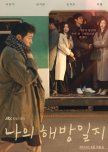
"My Liberation Notes" -- Love as Mutual Worship
"My Liberation Notes" (2022), in essence, is a story about the difficult and thankless task of finding purpose and warmth in a world that resists those things. This task forces one to confront the gap between the life one has and the life one wishes they had. While navigating that difficult mental gap, this person will come to terms with numerous disappointments and triumphs, acquainting themselves with their strengths and their weaknesses in turn. The way one reacts to these outcomes and revelations gives their endeavor distinctive texture. The hard work of living is invested as much in navigating these feelings as it does in navigating the chasm between themselves and their aspirations.
Over the course of the show's 16 episodes, we see three siblings take on this task and change as individuals. These three are the Yeom siblings: Mi-jeong, Chang-hee, and Gi-jeong, all adults who live in their parent's home. They live lives that seem to meander as they travel from their home in fictional town Sanpo to Seoul to work jobs that are often taxing on their psyches. In the show, they liken their humble home to the "white" of the egg relative to the "yolk" that is Seoul, embodying through this metaphor how tangential their roots are to the locus of South Korean business and busyness that is Seoul. This show illustrates how these characters' lives are treated as peripheral to the larger ecosystem of Seoul, and thus the heart of Korean enterprise.
The show gets its title from the "Liberation Club" that Mi-jeong starts with two of her work colleagues, including Tae-hun, who will be important to Gi-jeong going forward. In establishing the club, the show also establishes the desire all these characters have to escape the monotony and aimlessness that seems to permeate their lives. It's always about the job, the commute, but never about themselves. The "Liberation Club" is as much an opportunity to reflect as it is a place to rebel against the emptiness of this culture. For the show, it serves as a recurring structural anchor that gives Mi-jeong a way to express her interiority without resorting to voiceover, and a communal forum through which the drama explores the idea of "liberation" itself, crucially without ever defining it.
The endeavor of these siblings is presented with realism and restraint, not unlike one of Ozu's later films like Tokyo Story (1953). As in Ozu, this series often depicts quieter moments in these characters' lives and deals just as much in what is said as in what is withheld. Where many Korean dramas tend toward overt expressiveness, the dialogue-heavy realism of this drama eschews that for something more akin to walking into an ordinary moment of these people's lives. This restraint allows the details of these people's lives to accumulate into a complete picture of the mundanity of their existence, and it is the drama's greatest ask of the viewer.
In the first six episodes this ask feels like a liability. The early episodes lack narrative inertia and feel more like a procession of conversations without a clear destination than any kind of story progression. Writer Park Hae-young takes her time showing each character's status quo: Mi-jeong's introversion and desire for liberation from her difficult contract work situation, Gi-jeong's dismissive attitude toward potential suitors, Chang-hee's contempt for his work at the supermarket, and Mr. Gu's crippling drinking habit. The drama is slowly accumulating details that will pay off in bigger narrative developments from episode 10 onward, though this only becomes legible in retrospect.
An illustrative example of the way the show builds context involves Tae-hun, a divorced dad scorned by Gi-jeong in the show's first episode. Gi-jeong, who is single and going on 40, talks disparagingly about divorced dads and regards them as damaged goods, in Tae-hun's presence, the man she will fall desperately in love with. Her desire for Tae-hun grows as the show continues, moving her past her former dismissiveness to something approaching genuine openness and even a growing desire to be accepted by Tae-hun's daughter and sister. This character development would not be as rich had the writer not taken her time to establish the depth of Gi-jeong's judgmental nature early.
If the early episodes establish the desperation of each character's situation, then the relationship between Mi-jeong and the man referred to as Gu is the key to the drama's architecture. Part of what makes this relationship so unique from what I've seen in Korean drama is the gentle way it unfurls and the way it resists the tropes of the romance genre. There's no meet-cute, he's an employee of her father. There's no declaration of love, just Mi-jeong begging him to "worship" her, something Gu appears to do reluctantly at first.
In fact, Ms. Park's greatest invention in this drama may be the framing of romantic love as an act of mutual worship. Worship requires devotion and attentiveness that the ambivalent and sometimes hostile world around them rarely allows. The grace Gu and Mi-jeong learn to show for each other as the series continues becomes a sanctuary and a source of liberation from the monotony and loneliness that surrounds them.
For someone as introverted as Mi-jeong in particular, this gives her the liberty to express sides of herself that wouldn't be accepted as readily in her work or family life. She becomes more talkative, which turns out to be a mixed blessing. At its worst, her newfound chattering grosses out Gu as she rambles at length about gruesome images of animal violence and dismemberment. At its best, she becomes a valuable contributor to the Liberation Club she founded. Her talkativeness also leads to a latent confidence and assertiveness that was absent before she began her "worship" of Gu.
For Gu, a gangster who hides in the country to avoid the recrimination of his former associates, the relationship provides a reservoir of warmth that complements the peaceful life he leads working for her father in Sanpo. His conversations with Mi-jeong bring out a warmer and more playful side to him not afforded elsewhere in his life, and their relationship provides something akin to liberation.
The three siblings are each navigating the same fundamental condition through different temperaments and circumstances.
Take Chang-hee, for instance. Much of the show is about his desire to obtain material wealth and the luxuries that come with it. However, as the series progresses, that desire dissipates as he comes to terms with his true gift: his empathy. This revelation is hard won. Before it comes, he struggles in vain to earn a promotion from his subordinate role at a grocery store chain to a more managerial role that would provide him the wealth he desires. He only seems to come to this realization in moments when he is required to care for others after their loved ones have passed.
Gi-jeong transforms from a dismissive, judgmental, and resentful person to accept that the man who would love her the most is the divorced dad Tae-hun, whom she scorned in the show's first episode. She walked through life with a strict set of requirements for her perfect "Prince Charming," but was routinely disappointed when no one met those lofty standards. Once she starts falling for Tae-hun, she becomes almost comically obsessed with courting him. In one of the show's most memorable scenes, she asks Tae-hun if he wants to pursue a relationship with her, only to get rejected and then get hit by a moped, which is revealed to be a tactic she concocted to gain his sympathy. She went from not wanting to even talk to a man like Tae-hun to becoming so desperate for his affection that she will take a moped injury for even a morsel of it. It's desperate, and a little off-putting, but it is a notable transformation.
The arc of the Yeom parents is present as well, though more static compared to the main cast. Before his wife's death, Je-ho would scold Chang-hee for wasting money and not being accomplished enough. After she dies and Chang-hee stays to care for him, Je-ho's perspective changes. I wished for a scene in which he would demonstrate more direct expression of his reverence for his deceased wife's support. Then again, the fact that it remains understated actually fits the show's architecture. It is, in the end, a drama that trusts implication over declaration.
This quality of implication over declaration is a consistent virtue of Park Hae-young's writing. This is the second drama I've seen from her, the first being My Mister (2018). Despite how universally beloved My Mister is, and how often it is preferred to My Liberation Notes, I felt that subplot bloat set in as its cast became increasingly massive and there was a need to fill considerably more air time per episode. The standard episode of My Mister ranged between 70 to 90 minutes, while My Liberation Notes tended toward 60 to 65 minutes (the 80-minute finale is the main exception). The climactic episodes of My Mister felt somewhat diffuse because the central plot with Park Dong-hoon and Lee Ji-an had to coexist with numerous subplots of varying quality. There is little such bloat in My Liberation Notes, which builds toward something poignant precisely because there is less to distract from the main storyline.
Seeing the way this show pulls together makes me wonder how I would feel returning to My Mister now. The major reframe would be in how I look at the subplots. Instead of experiencing them as an albatross around the neck of the central plot, I'd be more eager to assess them on their own merits, knowing that Park writes in ways that accumulate meaning rather than generate narrative momentum. For now, My Liberation Notes registers as the stronger work, and the tighter construction is the primary reason.
Despite the somewhat depressing reality of modern-day South Korea that this show presents, it is often quite warm. Dinner tables become stages for philosophical exchange rather than conflict, and there is a friendly rapport among the characters that allows for an honest flow of ideas. While some conversations drift toward confrontation, as in the arguments between Chang-hee and Je-ho or between Gi-jeong and Tae-hun's sister, they tend more often toward the philosophical than the argumentative.
The show earns its warmth through honestly presenting the realities of these lives without allowing them to tip into conflict or despair. A lot of the warmth in Korean dramas can feel manufactured because writers engineer it through proven likability mechanics designed to please an audience. Park is bold enough to believe that presenting characters as genuine human beings struggling with life's challenges can be warm without conceding to market pressure. It is understood that the Yeom family and the various people they allow into their lives wish well for each other, which makes even the most vicious arguments among them come from a place of love.
With that said, 16 episodes is a liability for a drama whose storytelling prizes concision. Some viewers will be alienated before the payoffs arrive, and there are stretches in the middle where the accumulation of reflective conversation outpaces what the drama has yet earned. Twelve to thirteen episodes would be ideal for a drama as restrained and realistic as this one, and the absence of a propulsive plot will test the patience of viewers accustomed to more conventional narrative momentum. For those willing to observe character behavior without that pressure, the final four episodes justify the commitment.
Overall, My Liberation Notes provides a warm, lived-in account of the struggle to live with purpose in modern-day South Korea. This is essentially what might have happened if Yasujiro Ozu could travel forward in time and make a television series about modern life. Episode 14, the highlight of the series for me, felt much like the ending of Tokyo Story (1953). The viewer who should avoid it is one who needs clear conflict and narrative momentum to stay engaged. This is notably light on both.
I would recommend it to viewers who appreciate character-focused, philosophically oriented television that rewards patience and dedication, the kinds of traits that seem to be part of the "worship" Mi-jeong talked about early in the series. Fittingly, the show is for those who can worship.
Favorite Episodes:
1. Episode 14
2. Episode 15
3. Episode 13
Favorite Character: Yeom Mi-jeong
Over the course of the show's 16 episodes, we see three siblings take on this task and change as individuals. These three are the Yeom siblings: Mi-jeong, Chang-hee, and Gi-jeong, all adults who live in their parent's home. They live lives that seem to meander as they travel from their home in fictional town Sanpo to Seoul to work jobs that are often taxing on their psyches. In the show, they liken their humble home to the "white" of the egg relative to the "yolk" that is Seoul, embodying through this metaphor how tangential their roots are to the locus of South Korean business and busyness that is Seoul. This show illustrates how these characters' lives are treated as peripheral to the larger ecosystem of Seoul, and thus the heart of Korean enterprise.
The show gets its title from the "Liberation Club" that Mi-jeong starts with two of her work colleagues, including Tae-hun, who will be important to Gi-jeong going forward. In establishing the club, the show also establishes the desire all these characters have to escape the monotony and aimlessness that seems to permeate their lives. It's always about the job, the commute, but never about themselves. The "Liberation Club" is as much an opportunity to reflect as it is a place to rebel against the emptiness of this culture. For the show, it serves as a recurring structural anchor that gives Mi-jeong a way to express her interiority without resorting to voiceover, and a communal forum through which the drama explores the idea of "liberation" itself, crucially without ever defining it.
The endeavor of these siblings is presented with realism and restraint, not unlike one of Ozu's later films like Tokyo Story (1953). As in Ozu, this series often depicts quieter moments in these characters' lives and deals just as much in what is said as in what is withheld. Where many Korean dramas tend toward overt expressiveness, the dialogue-heavy realism of this drama eschews that for something more akin to walking into an ordinary moment of these people's lives. This restraint allows the details of these people's lives to accumulate into a complete picture of the mundanity of their existence, and it is the drama's greatest ask of the viewer.
In the first six episodes this ask feels like a liability. The early episodes lack narrative inertia and feel more like a procession of conversations without a clear destination than any kind of story progression. Writer Park Hae-young takes her time showing each character's status quo: Mi-jeong's introversion and desire for liberation from her difficult contract work situation, Gi-jeong's dismissive attitude toward potential suitors, Chang-hee's contempt for his work at the supermarket, and Mr. Gu's crippling drinking habit. The drama is slowly accumulating details that will pay off in bigger narrative developments from episode 10 onward, though this only becomes legible in retrospect.
An illustrative example of the way the show builds context involves Tae-hun, a divorced dad scorned by Gi-jeong in the show's first episode. Gi-jeong, who is single and going on 40, talks disparagingly about divorced dads and regards them as damaged goods, in Tae-hun's presence, the man she will fall desperately in love with. Her desire for Tae-hun grows as the show continues, moving her past her former dismissiveness to something approaching genuine openness and even a growing desire to be accepted by Tae-hun's daughter and sister. This character development would not be as rich had the writer not taken her time to establish the depth of Gi-jeong's judgmental nature early.
If the early episodes establish the desperation of each character's situation, then the relationship between Mi-jeong and the man referred to as Gu is the key to the drama's architecture. Part of what makes this relationship so unique from what I've seen in Korean drama is the gentle way it unfurls and the way it resists the tropes of the romance genre. There's no meet-cute, he's an employee of her father. There's no declaration of love, just Mi-jeong begging him to "worship" her, something Gu appears to do reluctantly at first.
In fact, Ms. Park's greatest invention in this drama may be the framing of romantic love as an act of mutual worship. Worship requires devotion and attentiveness that the ambivalent and sometimes hostile world around them rarely allows. The grace Gu and Mi-jeong learn to show for each other as the series continues becomes a sanctuary and a source of liberation from the monotony and loneliness that surrounds them.
For someone as introverted as Mi-jeong in particular, this gives her the liberty to express sides of herself that wouldn't be accepted as readily in her work or family life. She becomes more talkative, which turns out to be a mixed blessing. At its worst, her newfound chattering grosses out Gu as she rambles at length about gruesome images of animal violence and dismemberment. At its best, she becomes a valuable contributor to the Liberation Club she founded. Her talkativeness also leads to a latent confidence and assertiveness that was absent before she began her "worship" of Gu.
For Gu, a gangster who hides in the country to avoid the recrimination of his former associates, the relationship provides a reservoir of warmth that complements the peaceful life he leads working for her father in Sanpo. His conversations with Mi-jeong bring out a warmer and more playful side to him not afforded elsewhere in his life, and their relationship provides something akin to liberation.
The three siblings are each navigating the same fundamental condition through different temperaments and circumstances.
Take Chang-hee, for instance. Much of the show is about his desire to obtain material wealth and the luxuries that come with it. However, as the series progresses, that desire dissipates as he comes to terms with his true gift: his empathy. This revelation is hard won. Before it comes, he struggles in vain to earn a promotion from his subordinate role at a grocery store chain to a more managerial role that would provide him the wealth he desires. He only seems to come to this realization in moments when he is required to care for others after their loved ones have passed.
Gi-jeong transforms from a dismissive, judgmental, and resentful person to accept that the man who would love her the most is the divorced dad Tae-hun, whom she scorned in the show's first episode. She walked through life with a strict set of requirements for her perfect "Prince Charming," but was routinely disappointed when no one met those lofty standards. Once she starts falling for Tae-hun, she becomes almost comically obsessed with courting him. In one of the show's most memorable scenes, she asks Tae-hun if he wants to pursue a relationship with her, only to get rejected and then get hit by a moped, which is revealed to be a tactic she concocted to gain his sympathy. She went from not wanting to even talk to a man like Tae-hun to becoming so desperate for his affection that she will take a moped injury for even a morsel of it. It's desperate, and a little off-putting, but it is a notable transformation.
The arc of the Yeom parents is present as well, though more static compared to the main cast. Before his wife's death, Je-ho would scold Chang-hee for wasting money and not being accomplished enough. After she dies and Chang-hee stays to care for him, Je-ho's perspective changes. I wished for a scene in which he would demonstrate more direct expression of his reverence for his deceased wife's support. Then again, the fact that it remains understated actually fits the show's architecture. It is, in the end, a drama that trusts implication over declaration.
This quality of implication over declaration is a consistent virtue of Park Hae-young's writing. This is the second drama I've seen from her, the first being My Mister (2018). Despite how universally beloved My Mister is, and how often it is preferred to My Liberation Notes, I felt that subplot bloat set in as its cast became increasingly massive and there was a need to fill considerably more air time per episode. The standard episode of My Mister ranged between 70 to 90 minutes, while My Liberation Notes tended toward 60 to 65 minutes (the 80-minute finale is the main exception). The climactic episodes of My Mister felt somewhat diffuse because the central plot with Park Dong-hoon and Lee Ji-an had to coexist with numerous subplots of varying quality. There is little such bloat in My Liberation Notes, which builds toward something poignant precisely because there is less to distract from the main storyline.
Seeing the way this show pulls together makes me wonder how I would feel returning to My Mister now. The major reframe would be in how I look at the subplots. Instead of experiencing them as an albatross around the neck of the central plot, I'd be more eager to assess them on their own merits, knowing that Park writes in ways that accumulate meaning rather than generate narrative momentum. For now, My Liberation Notes registers as the stronger work, and the tighter construction is the primary reason.
Despite the somewhat depressing reality of modern-day South Korea that this show presents, it is often quite warm. Dinner tables become stages for philosophical exchange rather than conflict, and there is a friendly rapport among the characters that allows for an honest flow of ideas. While some conversations drift toward confrontation, as in the arguments between Chang-hee and Je-ho or between Gi-jeong and Tae-hun's sister, they tend more often toward the philosophical than the argumentative.
The show earns its warmth through honestly presenting the realities of these lives without allowing them to tip into conflict or despair. A lot of the warmth in Korean dramas can feel manufactured because writers engineer it through proven likability mechanics designed to please an audience. Park is bold enough to believe that presenting characters as genuine human beings struggling with life's challenges can be warm without conceding to market pressure. It is understood that the Yeom family and the various people they allow into their lives wish well for each other, which makes even the most vicious arguments among them come from a place of love.
With that said, 16 episodes is a liability for a drama whose storytelling prizes concision. Some viewers will be alienated before the payoffs arrive, and there are stretches in the middle where the accumulation of reflective conversation outpaces what the drama has yet earned. Twelve to thirteen episodes would be ideal for a drama as restrained and realistic as this one, and the absence of a propulsive plot will test the patience of viewers accustomed to more conventional narrative momentum. For those willing to observe character behavior without that pressure, the final four episodes justify the commitment.
Overall, My Liberation Notes provides a warm, lived-in account of the struggle to live with purpose in modern-day South Korea. This is essentially what might have happened if Yasujiro Ozu could travel forward in time and make a television series about modern life. Episode 14, the highlight of the series for me, felt much like the ending of Tokyo Story (1953). The viewer who should avoid it is one who needs clear conflict and narrative momentum to stay engaged. This is notably light on both.
I would recommend it to viewers who appreciate character-focused, philosophically oriented television that rewards patience and dedication, the kinds of traits that seem to be part of the "worship" Mi-jeong talked about early in the series. Fittingly, the show is for those who can worship.
Favorite Episodes:
1. Episode 14
2. Episode 15
3. Episode 13
Favorite Character: Yeom Mi-jeong
Was this review helpful to you?


