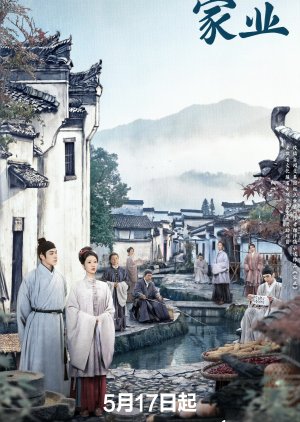
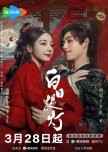
The story of a woman who makes ink.
It was a good series for me. Another success story about a woman. I watched many such stories in Chinese dramas in 2025 and 2026. Success stories attract my attention and I enjoy watching them. This was one of those stories. It's a story about ink. I especially found Yang Zi very successful. The story was built around her. I can say the male lead was just a supporting character. But they were still compatible. I liked both of them. Apart from that, the excessive talking and advice, and many details about ink making, made the series stagnant and boring. It wasn't a series that progressed at a consistent level. Sometimes it rose, sometimes it fell. The quality wasn't maintained. The occasional competitions and fights added color to the series, but otherwise, stagnation prevailed. There was no real romance. There was no real drama either. Everything was left open, as if only the focus was on ink making. I think this bored the viewers. In the rest of the series, especially the family relationships, their loyalty, respect, love, customs and traditions were beautifully portrayed. The spirit of unity and togetherness was beautifully portrayed. There was also revenge and intrigue. The series could have been even better if these elements had been distributed more carefully.I especially recommend it to those who enjoy stories about female success.
Was this review helpful to you?

50 Shades of Betrayal and One Pot of Ink
The HeirIf you ever wanted a masterclass on how many disasters can happen over a block of ink, The Heir has you covered. 😆 What starts as a fascinating journey into the history and craftsmanship of tribute ink quickly turns into a marathon of twists, betrayals, greed, murder, family secrets, revenge plots, and enough scheming to keep every villain employed for life.
The strongest part of the drama is easily its unique subject matter. I never expected to learn so much about the history and importance of ink production, and the writers deserve credit for making such a niche topic genuinely interesting. The acting is stellar across the board. The villains are properly evil, not the watered down kind, and every actor fully commits to their role.
The male lead is undeniably handsome, but for much of the drama he feels more like a boy trying to survive a storm than a man steering the ship. Meanwhile, the female lead absolutely carries herself with confidence. She has that no nonsense attitude, sharp intelligence, and quiet strength that makes you believe she could walk into a room full of schemers and send them all home for detention.
My biggest frustration was the pacing. Every plot twist seemed to arrive carrying three more twists behind it. Just when one misunderstanding was about to be resolved, another betrayal appeared from the shadows. The story often felt like it was making us wait in line for outcomes that could have arrived much sooner. If dramas can suddenly time skip years for an epilogue, surely they could have shortened some of the endless untangling along the way.
The romance is mature and grounded. The separation between the leads never felt like a silly breakup manufactured for drama. They are pulled apart by circumstances, family obligations, and the sins of the previous generation. In many ways, they are paying the price for battles they never started.
Overall, The Heir is a well acted historical drama with a fascinating cultural backdrop, strong leads, memorable villains, and a believable romance. Just be prepared for a plot that sometimes treats "one more twist" as a personal life philosophy. By the end, you'll know more about tribute ink than you ever expected, and you'll probably have survived enough betrayals to qualify for emotional compensation.
Rating: 8.5/10
Worth watching for the history, performances, and mature romance. Bring patience for the endless plotting.
Was this review helpful to you?

A Heartwarming Tale of Family, Legacy, and Perseverance
This drama may not be everyone's cup of tea, but it's definitely one for viewers with more refined tastes. I particularly appreciated its setting, which feels distinct from the usual Hengdian productions and adds a refreshing charm to the overall viewing experience. The story focuses on family dynamics, cultural heritage, and Li Zhen's journey amid the Li family's long-standing feud and the struggles of the Hui Ink industry. Romance is present, but it's very much in the background. Personally, I wouldn't have minded a little more romance, but the heartfelt family relationships and wholesome interactions filled that gap surprisingly well.If you're looking for heavy angst or a revenge-driven plot, you may be disappointed. The villains aren't taken down in a dramatic fashion, instead, their downfall unfolds gradually, leaving them with the bitterness of their own choices. Rest assured, justice is served. However, that's also what makes the drama feel realistic. Rather than focusing solely on revenge or retribution, it emphasizes resilience, growth, and the courage to move forward. It reminds us that sometimes the greatest victory is not getting even, but letting go and building a better life for yourself. It also serves as a gentle reminder that kindness may not always be rewarded immediately, but it often leaves behind a far greater legacy than resentment ever could.
Was this review helpful to you?

A tribute to ink
This is richly produced if deeply flawed drama set during the Ming dynasty, highlighting the Huizhou ink industry. While there are moments of stirring tribute to the painstaking craftsmanship involved in the making of ink and moments of genuine human drama, this is overall a pretty meandering and lackluster drama that is far too long with 42 episodes. Think of every family drama trope you have seen in a period Chinese drama of a similar genre, and you will find it in this show. Most critically, there is little chemistry between the lead characters, who are only thinly constructed in writing and even more poorly executed on screen, especially the character of Luo Wenqian.Some real emotional weight is brought through several veteran actors - notably Tian Xiaojie as Li Zhen's grandfather, Li Hongliang as her uncle, and Cao Lei as Luo Wenqian's brother. Unfortunately for Yang Zi, this is not her best feature - she is far more effective and engaging in the recent Flourished Peony.
I could not help thinking of The Story of Minglan while watching this. That drama was perhaps the first of this kind of idol period drama. Although a very long drama there as well involving various family and political drama arcs, it built to a nice climax as it went along. Moreover, the characters were dimensional and grew as the story grew. Unfortunately in The Heir, things build to an awkward ending arc (against the Japanese?), and the lead characters for the most part remained the same throughout the show. Unless you are very interesting in exploring ink-making or a devoted fan of the cast, you probably could skip out on this one.
Was this review helpful to you?

Beautiful show and learned about ink in a predictable feel-good story
The Heir follows a familiar story pattern that is not new, but is as feel-good as ever. A cheerful, hardworking, fearless, [insert more positive adjectives] young woman of prodigal genius overcomes various obstacles to bring happiness to herself and everyone around her. Her protagonist halo glows so brightly that there isn’t much suspense; the show is mostly about cheering her on and feeling good when she succeeds.I think this show’s high point is its production. You can tell a lot of effort was made to bring this time period (Ming Dynasty) and place (Huizhou) to life. Its portrayal is vivid and detailed, with beautiful settings and a lot of atmosphere. The streets teem with extras, the food looks delicious, the costumes get dirty, old people have freckles, the FL’s fingernails always have ink, etc. There are also so many little details surrounding the daily life, like all the little tasks they do, it creates a nice slice-of-life feel.
We also get to learn all about ink-making. Shows that focus on a single industry will really play it up and put it on a pedestal, which I never found that relatable (sorry, I just don’t share the passion for ink!). But we can still admire the devotion of the characters, and it’s a fun way to learn about a new topic and the culture embedded within it.
As for the story... Li Zhen, the FL, is both capable and likable, so it’s fun to watch her underdog successes. As she makes her way up the career ladder, she faces off against scheming competitors, mean-spirited family members, natural disasters, and the like. She sometimes gets discouraged and shows real emotions, which makes her relatable and adds some humanity to an otherwise overpowered character.
The ML is also likable and good support for her, but he definitely seems secondary. He is also just on his own mission separate from hers. The romance between them is a good level for people who want just a hint of romance but nothing too played up. The FL and ML don’t even interact that much for the first half of the show, which I didn’t mind and barely noticed. Their relationship grows naturally and subtly as they work together and develop a solid friendship. Later there is some noble idiocy on his part, but luckily she is the kind of brave FL who stays true to herself.
I was happy with the growing relationship, but it’s only one part of Li Zhen’s life. Of the scenes that really left an impression on me, most were Li Zhen with her mom or her grandfather, rather than anything with the ML. At one point when Li Zhen is struggling in the rain, I thought the ML would magically arrive like every other show, but instead it was her mom- made me tear up. (As a side note on the mother-daughter idea, the story arc with the Princess and her mother is also quite sweet).
Female empowerment is not an outright theme- except for occasionally throwing sexism at Li Zhen- but it’s still a show where the writers seem to like women. I especially like that the female side characters are generally well-written, having varying roles and degrees of power as well as different relationships with each other (often positive). Li Zhen herself also just overshadows the ML, often being the one to save him, and she handles without him what I think is the biggest conflict of the story.
Those are the things I liked. Unfortunately, I just also didn’t find the show that interesting.
The thing is, the plot is kind of repetitive and the conflicts do not feel meaningful. The FL has so much plot armor, there isn’t actually any REAL question about whether or not she will triumph. And the villains are rather one-dimensional and uninteresting, just cartoonishly bad people. Normally I like bad villains because it’s less emotional load, but these were just too excessive. Fourth Aunt, for example- poorly written but rather well acted- spews nonsense that makes no sense and nobody ever argues logic with her. And the most prominent villain simply gets more and more unhinged as the show goes on.
I just honestly did not find it that interesting to see over and over, villains acting super evil and Li Zhen coming up with ways to squash them, or win over hearts when she can. Even among the side characters, many are likable (“good people”), but there are only a few that I actually found interesting- and one is already gone within 6 episodes.
The entire foundation of the show is also weak, since the tragedy that anchors the show (the Tribute Ink scandal) is full of holes. Ink does not spontaneously combust; why did nobody look into who set the fire? Every time somebody directed more misplaced vitriol at Li Zhen, I could understand it as a plot device, but I still had to roll my eyes.
So in general, the show is not too stressful (not too many deaths either, beyond the first few episodes), but also not that interesting or meaningful. I watched most of it at 1.25X or 1.5X speed. I just don’t really need to spend THAT much time watching people curse the villain or praise Li Zhen.
For the acting, I think it’s really good. Both Yang Mi and Elvis Han had some great expressions and captured the right vibe. This show also has a lot of older characters, and I love watching older actors because they’re generally more experienced and quite good.
The production, as mentioned previously, is excellent, really bringing the show to life, as befitting a show that wants to educate its audience. The styling is nice and not over-done. I also really liked the music, especially the BGM which is used well for effect. I especially appreciate the playful BGM which let me know when I can take it easy, and the uplifting one that plays when good things are going to happen. The OST is also nice but is not over-used, probably because this show didn’t overdo it with the dramatic scenes.
Overall, although the show does many things well, it unfortunately suffers a fatal error of not having meaningful conflicts or just being that interesting overall. It seems mostly good for soaking in the setting and getting to know a time and place and industry. I’d give the story a 6 or so (somewhere between “not that into it” and “entertained but not masterpiece”), but +0.5 for great portrayal of female characters. And then the production is so good that I’ll rate the overall show higher than the story. ...I also happened to watch this when I was home sick, and discovered that it’s perfect for a dazed binge when you’re not feeling too good or thinking that clearly and just need something external to make you feel better.
ENDING – READ AHEAD ONLY IF YOU WANT TO KNOW, CONTAINS SPOILERS
The ending is... hm, I thought it was happy. How could it not be? Nobody who just spent 42 episodes watching an invincible protagonist win all her battles wants anything less than Happily Ever After... surely the scriptwriters know that.
The strange thing is, everything is working out and then with 5 minutes to go, the ML is suddenly sent off to battle. With one minute left he comes back, walking across a field towards the FL. Textover tells us that Li Zhen essentially retires after all this, no mention of the ML. It was so odd and unnecessary that I googled it, and it seems many people consider this an open ending a la The Double (ie the vision is implied to be an illusion because he died).
Well, I chose to take the ending literally, like he actually returned. But it is a strange bite-sized chunk of story that is easy to ignore if you prefer that method instead.
Was this review helpful to you?

This review may contain spoilers
One Big Family (on a Town Scale) Thwarted by a One-Man Villain
Most of the Heir is a beautiful inky tale about the people who can hurt us the most and legacies fighting tooth and nail to have a future. If you're interested in that, welcome to the show.FL's Family: Li
The Li family feuds may be frustrating at first, but it would be strange to watch a series like this and not expect and want to see characters suffer and grow. Thankfully our female lead gets some punches in and rises through her skills, dedication and love for the art of ink making as well as her love for the family that stands by her.
Despite being one of Zhen's biggest naysayers, her uncle is one of the best side-characters with a great arc throughout the drama. In historical dramaland, disabilities often are either faked, miraculously cured or characters with disabilities are evil without reason. The Heir redeems Zhen's explosive disabled uncle well. Cured of his hatred rather than his disability, he remains himself and shows that his old injuries do not hold him back.
Her eight grandfather is the typical old man, who has seen too much and understands too much to go easy on his granddaughter. Nevertheless, their bond only strengthens throughout the drama. As seventh grandmother's favorite, Zhen interacts a lot with her too. It's interesting to see how one matriarch builds up another. Even though there are a lot of strong grandmothers in historical dramas (like in the recently released A Splendid Match), I wouldn't say other FL's are so explicitly taught.
Zhen's mother has a bittersweet backstory and always has her daughter's back. Zhen's friendship Hua was also very pleasing to watch.
ML's Family: Luo
Wenqian, the ML, is a very human character instead of standing above the FL. They both have setbacks throughout the story. The male lead appears more toward the middle and last half of the drama. His story starts as the classic revenge story, except things don't go as planned. Overall, the characters in The Heir are not as good at scheming as the usual leads, which was refreshing to see. They also don't need to be because unlike in other dramas, the characters here never aim to play their game in the capital (except for the villains).
While I'm not particular fond of the met-as-children-once trope for the main couple, it worked here. Zhen and Wenqian are so cute and awkward, they are simply endearing.
Wensong, the ML's older brother, is one of the best characters the drama has to offer because he cares about ink to an unnatural extend, and it is one of the few crimes this drama commits that he is the only character of his unhinged type. Though, Li Zhen and her uncle come close, it would have been nice to get more mad geniuses.
The elders of their family are an interesting bunch. I would have enjoyed some more time with the aunt.
Villain's Family: Tian
Let's get to the, imo, weakest part of the drama. Two of the Tian family members are almost comically evil and if this were another drama, they wouldn't stand out so much. Alas, in a world filled with characters who have business sense and their own levels of integrity, if of their time, they are a bit too on-the-nose. The main bad guy, Tian Benchang, was exhausting to watch almost immediately. Most times he is on screen, I hope he disappears again. At least he gets what is coming for him.
The Heir is best when it is about the ink, its process, its competition and its consequences. Sadly, the villain overshadows those challenges by being vicious on the personal level only. Despite his non-stop-scheming taking up time, he also suddenly always has the best ink there is in Huizhou. He was simply badly balanced, so the part in which he appears most - the penultimate arc - drags the drama down.
The only light in the dark for the Tian family is Ronghua, who gets dealt a bad hand by being tied to a family which could not appreciate her less. Apart from Zhen's uncle, Ronghua has the best arc in this drama. In fact, I would have liked to see more of her struggles as a nobel lady.
From Family to City to Country
That the nationalism might become strong in this one was to be expected, sadly I don't think the drama balances the story expanding from the family business to the city industry to national craftsmanship as well as it could. Through Wensong's involvement in the army, there are mentions of the national situation from the start, but they are made too unimportant when his punishment after failing to secure military funding is inconsequential. Tian Benchang also overstays his welcome as the big bad, so that ink as the national treasure is squeezed into the last four to three episodes.
Was this review helpful to you?

This review may contain spoilers
An Engaging Storyline Turns into a Messy Disappointment!!
What started as an engaging female-centric drama ends in disappointment!!Set in the mid-Ming Dynasty, the show largely revolves around the budding ink industry. A royal tribute scandal causes the centuries old Li family to fall from grace, dooming the eighth branch as they are exiled. As the Li family declines, the Luo family rises and then follows into ruin, only for the Tian family to rise in power instead. While we walk through this revolving door of rise and downfall, the storyline focuses on Li Zhen, the heroic daughter of the Eighth Branch who vows revenge against everyone who caused her family to fall. The first half is quite engaging, as Li Zhen learns ink making. Her struggles chronicle the intricate makings of the once prominent ink industry. But the second half engages in repetitive plotting and scheming, thereby souring the overall experience. I really wanted to enjoy this show, but towards the end, I just wanted to get done with it!!
Read the complete article here-
https://kcdramamusings.wordpress.com/2026/06/08/the-heir-series-review/
Was this review helpful to you?
This review may contain spoilers
Interesting historical family saga
The story of ink in the Ming Dynasty was interesting. Learning about the process, artistry and prestige such a commodity was during those times is similar to stories of silk. China really guarded their secrets. interesting also to watch the Japanese/ Chinese conflict.coming from a western background and new to Chinese drama I enjoy the historical content. I don’t know if the story was historical accurate or not but each scene seem to convey a natural and multidimensional interaction between family and community over the years that was believable.
the only characters I didn’t like as I found them too one dimensional was fourth Aunt and the father Tian. all actors were complex and interesting and the supporting characters provided the depth for main characters to shine. Tian Bangchan should have been billed as the main character because (apart from Li Ying) he was the main character and villain ( driving the plot)
I also enjoyed the fact that this story focused on the determination and success of a woman (not sure if it would have been possible during the Ming Dynasty) and how her family worried and encouraged her.
maybe this drama should not have been billed a romance as on that front it was disappointing especially the ending. I fact I deducted a whole point due to the ending. I wanted clear closure and happy ever after ending after so much angst, hardship and sadness that went of for previous 40 hours of watching. I was drained.
at time the story drifted and some scenes were really drawn out. for me the chief complaint was the length of the drama. I often fast forward through many scenes eg the whinging by Aunt or father Tian and son colluding or seling off the daughter were repetitive.
flashback scenes were also overdone.
Was this review helpful to you?
Gems!!!
Diving to this drama with no expectation except that it will be heavily female centric, yes in a way, but it was so much much more.Chinese tittle 家业 embodies it perfectly, and it capture the essence of Chinese family value and done it so tastefully. Bittersweet and beautiful.
Acting is top notch, no words are needed, they compliment each other
Soundtrack is fitting (though none stood out)
It is a drama that you need to savor little by little not to be binged
The one lacking is only the plot for the male lead but it was minor
Was this review helpful to you?
Honor to Tian Xiaojie!
I enjoyed this not only because of the until-now obscure craft of ink production and use, and the very genuine portrayal of what was involved, but the strong family relationships. Maybe I missed it but I have seen no review that mentioned Tian Xiaojie, who stole the show in my opinion. He was the vehicle for family ties, for family honor, for deep love of his son and grandchildren, for love of his craft. This would be a much poorer production without the depth this actor brought to his role. He was a major mover of the action, Zhen's inspiration and mentor - and he played the role to perfection.Was this review helpful to you?

The Ink Was Richer Than the Story
Set against the turbulent backdrop of the mid Ming Dynasty, The Heir turns an ink-making empire into a battlefield of ambition, reputation, and survival. What begins with a tribute-ink scandal sends the once-revered Li family into decline and sets off a chain reaction that reshapes Huizhou's storied ink industry. From the ashes of a tarnished legacy rises Li Zhen, an underdog with talent to spare and grit to match, who rises from obscurity to become the industry's unexpected enfant terrible. Across the board stands Luo Wen Qian, a calculating heir determined to restore his family's fallen fortunes. As old rivalries simmer and new powers emerge, the two find themselves locked in a high-stakes game of strategy against the formidable Tian family. In a world where ink is power and reputation is currency, fortune favors not merely the bold, but the shrewd.One thing viewers should know before starting The Heir: do not come here expecting a romance-driven story. The real star of the show is the Ming Dynasty ink industry itself. The drama dives surprisingly deep into ink production, ink classifications, business practices, cultural traditions, and historical terminology. It even provides textual explanations throughout the episodes, making the viewing experience feel educational without becoming overly academic. In fact, learning about the ink industry became my favorite aspect of the drama. For a series centered on something as specific as ink-making, it manages to make the subject fascinating and accessible.
The opening episodes immediately pulled me in. The tribute ink competition serves as an effective introduction to both the industry and the Li family. During the event, young Li Zhen impresses everyone by helping determine the rightful winner, showcasing her natural talent and intelligence. The celebratory family banquet that follows cleverly establishes the family dynamics and personalities. It did not take long to realize that Aunt Tian Jiang Yue would eventually become a source of trouble, while Li Zhen's relationship with her seventh-branch grandmother Wang Ru Jun provided some genuinely heartwarming moments.
The child actors deserve special praise. The young actress portraying Li Zhen delivered one of the strongest child performances I have seen in a Chinese drama. She perfectly balanced intelligence, confidence, and youthful charm, giving the character an incredibly strong foundation. Young Luo Wen Qian also left a positive impression. While the character already showed hints of becoming someone who might frustrate me later, the young actor's affectionate gaze toward Li Zhen felt sincere and natural. The casting team truly struck gold with the younger versions of the leads.
The drama's first major tragedy arrives during the tribute ink delivery. Due to circumstances that appear connected to Li Zhen's father, the eighth branch becomes the scapegoat for the family's downfall. Watching Li Jin Shui punish his own son before the entire branch is expelled from the family was heartbreaking. The emotional weight lands particularly well because we have already seen how much the elderly patriarch values the family name. Not long afterward, Li Zhen loses her father, leaving her to grow up alongside her mother, grandfather, and older brother. The subsequent time skip marks the beginning of her journey into adulthood.
Adult Li Zhen remains hardworking, kind, and remarkably resourceful. She becomes well-liked throughout her community and frequently offers practical business advice to those around her. At this point, she is engaged to Tian Ben Chang, who initially appears to be a sincere and diligent young man. Unfortunately, that image quickly crumbles. Driven by greed and family pressure, Ben Chang manipulates Li Zhen's brother into handing over the Li family's secret ink recipe. The consequences are devastating, leading to Li Jin Shui being forced to swear that he will never touch ink again. Watching Li Zhen immediately break off the engagement after discovering the truth was immensely satisfying. It was one of the moments where her strength felt empowering rather than performative.
Another standout character is Luo Wen Song. Initially, I misunderstood him due to his involvement in acquiring the Li recipe, but he quickly redeemed himself through genuine remorse, thoughtful advice, and unwavering support for Li Zhen. His passion for developing new inks made him one of the most entertaining characters in the entire drama. Eccentric, knowledgeable, and endlessly curious, Wen Song injected life into every scene he appeared in. Ironically, he became my favorite adult character despite having relatively limited screen time. His eventual departure from the story felt abrupt and disappointing because he left such a strong impression.
The downfall of the Luo family should have marked the beginning of an incredible revenge arc. Political turmoil destroys everything Wen Qian once had. His father sacrifices himself, Wen Song is relentlessly hunted, and Ben Chang's resentment toward the Luo family escalates into outright madness. The sequence involving the burning house is one of the drama's most infuriating moments. Watching Wen Song perish while Wen Qian stood outside witnessing the tragedy generated exactly the kind of rage that fuels great character development. Unfortunately, this is where my problems with the writing began.
Prior to his family's downfall, Wen Qian was immature, carefree, and more interested in having fun than shouldering responsibility. The tragedy, combined with his years under Marshal Qi's army, seemed like the perfect recipe for transformation. I expected him to return as a sharper, more disciplined, and more formidable strategist. Instead, very little changed. Despite spending years training under Marshal Qi, Wen Qian rarely demonstrates meaningful growth. His plans are often underwhelming, his strategic thinking leaves much to be desired, and his pursuit of justice moves at a glacial pace.
What frustrated me most was how little impact he had on his own storyline. He repeatedly claims that he wants the Tian family to climb higher so their eventual fall will hurt more, yet he spends much of the narrative making minimal progress toward that goal. His screen presence is surprisingly limited for a male lead, and there were times when I genuinely forgot he existed. Even when opportunities arise for him to take control of the narrative, he stumbles through poorly executed decisions and impulsive mistakes. The story constantly tells us that he is important, but rarely shows us why. And then comes the biggest issue: Li Zhen ends up resolving almost everything.
I have no problem with female-centered dramas. Some of my favorite dramas feature strong women at the forefront. However, The Heir becomes so determined to portray Li Zhen as universally capable that it begins to undermine the story itself. The narrative repeatedly follows the same formula: someone underestimates Li Zhen because she is a young woman, she delivers an inspiring speech, proves everyone wrong, and saves the day. Once or twice, this works. After numerous repetitions, it becomes exhausting.
The problem extends beyond her personal victories. Li Zhen becomes the solution to nearly every conflict in the drama. Family disputes, business crises, industry challenges, and even Wen Qian's revenge arc eventually circle back to her. The Li family repeatedly mistreats her and her branch, yet she continually returns to help them whenever they ask. The cycle becomes predictable and frustrating.
This issue reaches its peak in the second half. What initially felt like a shared story between Li Zhen and Wen Qian gradually transforms into Li Zhen carrying the entire narrative while Wen Qian fades into the background. The decision to have her essentially resolve the conflict with the Tian family felt especially baffling because this was supposed to be the culmination of Wen Qian's journey. At one point, he barely even appears while Li Zhen bends over backwards to deliver justice on behalf of his family. I was genuinely flabbergasted.
The villains themselves are not particularly impressive either. Oddly enough, they are not infuriating because they are clever or terrifying. They are infuriating because they are pathetic. Aunt Tian's motivations stem largely from resentment. The Tian family embodies ingratitude at its finest. Ben Chang evolves into a deeply unstable man driven by jealousy and grudges. Yet despite their pathetic nature, the family drama and constant scheming still managed to raise my blood pressure more than a few times.
To the drama's credit, the production values are excellent. The cinematography is gorgeous, and the visual presentation immediately draws you into the world. The earthy browns and muted grays complement the ink-making theme beautifully while reinforcing the historical atmosphere. Every workshop, residence, and street feels carefully crafted. If aesthetics alone determined ratings, The Heir would score significantly higher.
The ending ultimately left me feeling indifferent. By that point, I had already grown numb to many of the writing decisions. The revelation surrounding the original sabotage felt unnecessary, the prolonged separation felt equally unnecessary, and the open-ended conclusion failed to provide the sense of closure I was hoping for. A simple wedding scene would have been far more satisfying than a series of interpretive text cards.
In the end, The Heir is a drama of two very different halves. The first half is engaging, educational, and rich with fascinating insights into the Ming Dynasty ink industry. The second half struggles under repetitive character writing, questionable narrative choices, and an overwhelming need to position Li Zhen as the answer to every problem. If you're a fan of Yang Zi, interested in learning about historical Chinese craftsmanship, or simply looking for beautiful cinematography, there is certainly value here. But if you're hoping for a tightly written story with balanced character development and a rewarding payoff, you may find yourself running out of ink long before the final episode.
Was this review helpful to you?
Superb all the way around
I am in love with this drama. It is top notch all the way around. The acting by everyone was brilliant.The storyline of the making of ink in historic China was fascinating. I have never seen how ink was made back then. Very interesting indeed.
The main characters really did an amazing job portraying their parts. Their acting was so natural that they made it very believable.
All in all, my advice is that you watch it.
Was this review helpful to you?