 News
News 

 1
1all in the dressing
The "salad bowl" concept is the idea that Tokyo is a messy collection of cultures rather than some perfect, seamless melting pot. I love how this show respects that metaphor. In a melting pot, everything is supposed to dissolve into one beautiful flavor, but the Japanese monolith does not actually allow it. It is that rigid wall of culture that forces the individual parts to stay distinct, keeping their own texture because they are never fully invited in. It highlights the friction in places like Shin-Okubo or the industrial pockets of Edogawa, where the "one Japan" image meets the reality of the people it refuses to absorb. This is the actual reality of the world they built, and it defines everything from the cases to the characters.Nao is just incredible as Mari. It is honestly hard to explain, but she just breathes this specific energy into every single line and every single scene. It is alive and refreshing. She makes the character so believable. She is a cop who actually bothers with the crumbs... the cases that the rest of the department treats as afterthoughts. I really liked that the show does not lean too hard into that tired "one cop against the world" trope. It is not that everyone else is a villain or too stupid to be believable. It is just that Mari cares about the community level cases with an intensity others do not have. She just wants to be good at her job and help the people actually trying to survive in that bowl.
I found the way the show handles Arikeeno’s and Oda's history has a level of gravity that caught me off guard. Professional survival in Japan demands a "dual life," a performance of normality that is mandatory within the police force and rigid corporate hierarchies. The 2023 Understanding Act failed by prioritizing majority "peace of mind" over actual protection, which basically sanctioned the harassment and sidelining of anyone who does not fit the mold. Because workplaces view anyone who is not a "family man or woman" as untrustworthy, a mask of conformity is required to navigate a culture of deep, persistent suspicion. Seeing how certain parts of a private life can be used as a threat makes Arikeeno’s stone-faced exterior feel like necessary armor. It is a heavy, honest look at the kind of trauma that comes from having your personal identity treated like a threat to society.
While I noticed the show occasionally uses strokes that are a bit too broad, it offers a necessary look at the real problems foreign residents face in Japan. It handles the labor market reality with actual depth. Many of these people are just looking for a better life and recognize they are helping a country that cannot keep its workforce full because of the birthrate issue and population decline. I know firsthand how wonderful and accepting most Japanese people are, so I appreciated that this isn't a blatant condemnation of the country. It is more about the friction in the system. It is a lens to give some focus.
The show gave me some truly heartbreaking tales of people trying their best to work within that system, like the elder care case. It is a sharp contrast to those who just abuse it. Even when the villain veers into a bit of a caricature or feels a little clownish, it was never enough to distract me from the weight of the story. It is the only part that feels a bit too drama-fied, but the rest of the show is grounded enough to balance it out.
The focus on language is the best part for me. It is rare to see a drama actually lean into the struggle of communication like this. The delivery was sometimes rough, but I expected that with a drama focused on language. It makes the world feel more grounded. Instead of everyone magically understanding each other, I saw the friction and the work it takes to get a point across. It makes the cases feel urgent because I could see how easily things get lost in translation.
In the end, it comes back to that salad bowl. It is a beautiful and messy collision of lives that do not always blend perfectly. Even with the rough edges and the occasional broad stroke, it is the most human look at Tokyo I have seen in a long time. It actually makes you care about the people trying to find their place in the mix.
Was this review helpful to you?

 1
1"You don't let go of anyone's hand now"
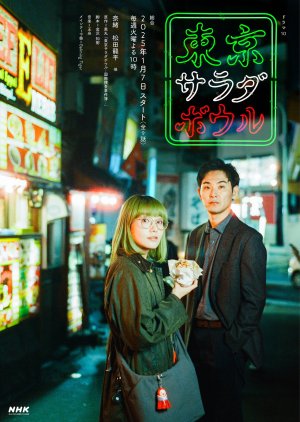
Tokyo Salad Bowl tackled immigration in Japan and the accompanying racism and discrimination that often arose from it. The heart of the drama was a green haired police officer who used food to connect with people and open doors, paving the way for healing and friendship.Koda Mari has recently transferred to the International Investigation Division where officers deal with crimes involving immigrants. There is a stable of interpreters including Arikino Ryo who can speak Chinese. Neither Ryo nor her new colleagues know what to make of her bright green hair, obsession with discovering new foods, and sunshine personality. They say she picks up the crumbs, small cases that they can’t be bothered with. But the crumbs she gathers often turn into discovering a bakery of wrongdoing. Mari takes a liking to quiet, pessimistic Ryo and cajoles him into helping her with cases, feeding him on a regular basis. As the two work together, Mari comes closer to discovering what drove Ryo from the police force and why he is so withdrawn.
I went into this drama hesitantly as it was based on a manga. Too often I’ve found manga heroines too effervescent with too little brain power. To my surprise, despite her garish green hair and terrible fashion sense, Mari had good cop instincts though she was in desperate need of a self-defense class. She believed that Tokyo was a salad bowl of ethnicities and that everyone deserved to be treated humanely. I was worried when she was chowing down on scorpions and ox penises in the first episode but the dishes became more palatable to me as the drama progressed. And like most female leads in Asian dramas that weigh 90 pounds/40 kg soaking weight she ate her body weight in food daily.
Japan’s dwindling population required a steady influx of foreign workers. Most ended up in low paying or manual labor jobs. Just as the country walked a fine line of wanting and not wanting immigrants, the drama sought to plea for better treatment of foreign workers and also subtly excused racism. It’s not racism---people just don’t trust foreigners, are quick to judge and blame, make snide comments about race, different cultures, customs, and are sometimes abusive towards them. Yeah, that’s racism. It was also telling that the Chinese often had scruffy wild hair and dowdy clothes. Baby steps. Most of the immigrants were shown as hard working and trying to make a better life for themselves and their families. As Mari worked in the police department they also dealt with foreigners who ran afoul of the law. (Important note-as in my country, immigrants commit fewer crimes than native citizens.)
The drama brought to attention the challenges of interpreting and how difficult it can be to translate specifically and for meaning. The language barrier when living in a different country can be daunting and absolutely terrifying if a person ends up in legal difficulty. Trafficking of vulnerable populations was explored though not in depth. Most of the cases were more about community building and understanding people’s needs rather than the actual crimes themselves. The main villain was weakly written and didn’t seem capable of running an international crime ring at such a young age.
Tokyo Salad Bowl was a good analogy for different cultures coming together in one dish. Different peoples bring their unique cuisines giving people strong reasons to bond over food. The drama tweaked the strong desire for conformity with foreign workers, a competent female police officer with shocking green hair, and a gay character. Aside from her ability to seek out the best sustenance in town, Mari’s super power was the ability to really listen and not let go of a hurting person’s hand. Anyone who knows how to care for a suffering person with an offer of Pajamas and tea knows the value of food and friendship. A gentle and entertaining drama about healing, treating people as valuable human beings, and finding the truth.
14 July 2026
Trigger warnings: Smoking. Drinking.
Continuity notes: Mari’s hair changed in intensity from scene to scene as well as her exposed roots. Girl could have used a good wig. I know it’s based on a manga, but when Mari was undercover, I just kept hearing a line from My Cousin Vinny, “Oh yeah, you blend.”
It could go from daylight to nighttime during the course of breakfast.
Was this review helpful to you?

A detective drama that I instantly fell in love with
The story takes place primarily in the International Investigation Unit of the Higashi-Shinjuku Police Department. Here, our female lead, Koda Mari, is a young police officer known for her many quirks, like her green hair or her penchant for investigating “small” cases. She’s often assisted by a former detective turned translator, Arikino Ryo (Matsuda Ryuhei). In every episode, they interact with immigrants from different places, shedding light on the challenges and experiences of those living in a foreign land.The plot is fairly straightforward, with an episodic format with one case each, that also slowly putts in some backstory for the leads. Not all cases were equally compelling, but each one was at least engaging to follow.
From this, it may seem like just another detective drama at first, but something about the about the leads kept me glued on this one. Their dynamic was delightful to watch. Truly, the highlight of the whole show.
Personally, I thought the way they lured us into Arikino’s past and case to be perfectly done. Each episode kept me wanting to know more about him. He’s rather mysterious and inexpressive as a character, but he never felt flat or stiff thanks to his actor. Honestly, Matsuda Ryuhei was a real discovery for me.
The female lead also held her own, but maybe I have a soft spot for the actress and for quirky, sunshine characters.
The show is not without its faults, there are many things that left me like hmmm, like threads that weren’t properly solved or were simply dropped after a few episodes (like the food aspect). But, all in all, it has a wonderful cast, a solid plot, and some great acting.
So, give this drama a chance! It definitely exceeded my expectations!
Was this review helpful to you?

This review may contain spoilers
Their Friendship was the Best Part
If this drama has taught me anything, it's that when my dream of living and working in a different country materialises, the 1st thing I'll do is enroll in a language school.What I Liked
🥙The highlight given to all the food. You can make me watch almost anything as long as you mention that they will be talking about food from different cultures. I liked how Mari was curious and willing to try different foods. If she were real, I know that we'd go on so many food adventures together.
🌸Mari & Arikino's Friendship - Sure, it starts with Mari basically bulldozing into Arikino's life and dragging him along her adventures - his opinion be damned - but Arikino needed it. He needed someone to pull him out of that solitude and loneliness that had become his life. Someone to add some colour, taste, love (albeit platonic) into his life, and show him that not all humans are all bad. I love how he, over time, came to not only respect our lovely lettuce head, but also go out of his way to protect her against even his superiors
🚔A cold look at (some) foreigner experience in Japan - The world, at least today, loves Japan. There is a reason why the term 'Japan glazers' exists. I love how this show highlights how not every foreigner's experience is all cherry blossoms, mochi, matcha, and roses. I appreciate how they highlighted matters like xenophobia, racism, disregard from police forces, how language barrier affects daily life, etc., all things you never hear about unless you do a rather deep (and possibly depressive) dive into Japan - or any other country for that matter
PS. I also recently learned about a thing called 'hostage justice,' and Lord, was I traumatized. The thought of being a foreigner, getting arrested over there, having no language to explain yourself, and being saddled with legal enforcement that doesn't give 2 shits about you gives me shivers
💕How much respect and care Mari gave to Arikino & Oda's r/ship - She didn't make a big deal out of it, just simply approached the matter with care, and when Arikino finally opened up to her, lent a listening and understanding ear. She is such a good friend. We all need such friends in our lives (we should also strive to be such friends too)
🎶I did enjoy the OST by Balming Tiger. It's a fun little tune. But no other songs stood out
What Could've Been Done Better
🚨The police cases (and volunteer) - I would've liked it if we dove deeper into them. I wanted the show to dig just a bit deeper into the accused persons and the cases. But I suppose that wasn't the intention
🚨Mari's hair - It was distracting. Not the colour, but the roots and the intensity of the colour. I know TV shows/dramas are rarely shot chronologically. That is likely why her hair colour and roots growth differed so much. But, seeing her hair be bright green in one shot and a faded green with roots showing in another scene, and these scenes are supposed to be in one day or wto consecutive days takes you out of the story. They shold've gotten her a good wig or something
🚨The Villains - Mr. Volunteer guy played a much smaller role than I expected. He shpwed up in all white looking pretty but menacing and I thought he had a much bigger role. He doesn't. It felt like a waste.
Agawa did not get what he deserved. Yeah he got his throat slashed and might never wake up. Boohoo🙄. The man sold people to human traffickers, let murders slide, got that one witness murdered, threatened to out Arikino & Oda (leading to Oda's death) jeered at Arikino that one time they met at the station, and if left alone, would've gotten Mari killed too.
Being in a coma was too good for him. IMO, he deserved a worse fate
Was this review helpful to you?