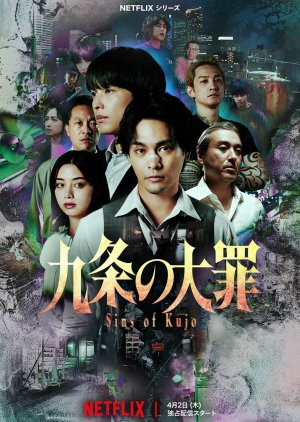
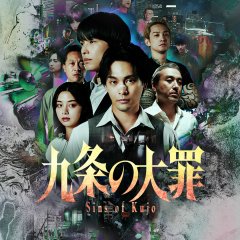
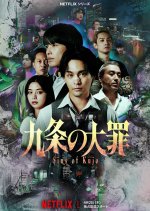
The story follows a lawyer who primarily handles difficult cases from clients such as gangsters, yakuza, and those with criminal records, as he separates law from morality and pursues the best possible solutions for his clients. (Source: MyDramaList) ~~ Adapted from the manga series "Kujo no Taizai" (九条の大罪) by Manabe Shohei (真鍋昌平). Edit Translation
- English
- Arabic
- Українська
- Русский
- Native Title: 九条の大罪
- Also Known As: Kujo no Taizai , Kujou no Taizai , Kujou's Deadly Sins , くじょうのたいざい
- Director: Doi Nobuhiro, Yamamoto Takeyoshi, Adachi Hiroshi
- Screenwriter: Nemoto Nonji
- Genres: Thriller, Psychological, Law, Crime
Where to Watch Sins of Kujo

Subscription (sub)
Cast & Credits
-
") Yagira YuyaKujo TaizaMain Role
Yagira YuyaKujo TaizaMain Role -
") Matsumura HokutoKarasuma ShinjiMain Role
Matsumura HokutoKarasuma ShinjiMain Role -
") Ikeda ElaizaYakushimae HitomiSupport Role
Ikeda ElaizaYakushimae HitomiSupport Role -
") Machida KeitaMibu KengoSupport Role
Machida KeitaMibu KengoSupport Role -
") Otoo TakumaArashiyama YoshinobuSupport Role
Otoo TakumaArashiyama YoshinobuSupport Role -
") Muro TsuyoshiKyogoku KiyoshiSupport Role
Muro TsuyoshiKyogoku KiyoshiSupport Role






Reviews

A Promising Mix of Law and Yakuza — But the Bromance Fell Flat; Stayed for Machida
I’d been looking forward to this series for three very specific reasons. First, Machida Keita — he’s become one of my go-to Japanese actors lately. Even in a supporting role, he tends to steal focus, so my expectations were quietly high. Second, the genre mix: yakuza undercurrents, legal drama, detective work, a bit of action and moral ambiguity. That blend is very much my thing. And third, I was hoping for a solid dose of bromance — ideally a mentor – trainee dynamic with some emotional weight and unspoken loyalty.On the first point, no complaints whatsoever. Machida delivers. His character, Mibu, is calm, restrained, slightly opaque, and written with enough moral ambiguity to keep things interesting. He’s not exactly squeaky-clean, but he’s compelling and, crucially, believable. That kind of stoic presence can easily fall flat, but here it lands.
The plot, though, sits somewhere around a 7/10. It’s watchable, occasionally gripping, but not something that completely pulls you under. One issue is emotional investment: I didn’t really care about the clients or victims in many of the cases. Some of them are morally dubious at best, which makes the whole “defence” angle feel a bit… unearned. You’re watching, you’re following, but you’re not exactly rooting for anyone. Still, it’s entertaining enough to keep going.
What really threw me off, however, is the structure. After ten episodes, the story feels oddly fragmented, almost as if it just… stops mid-thought. It’s unclear whether this is meant to lead into a second season or if something got lost in the editing. Either way, the lack of narrative closure is frustrating.
Now, the bromance — arguably one of the main selling points for me — was a mixed bag, leaning towards disappointment. I actually liked Kujo: composed, purposeful, clearly driven by something beneath the surface. There’s a sense that he’s playing a long game, and that works well.
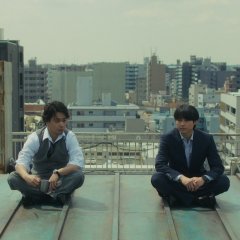
But the dynamic with Karasuma didn’t click at all. And this is very much a “type issue” for me. I struggle with the trope of the inexperienced junior who immediately starts questioning, lecturing, and emotionally demanding things from a seasoned mentor. Karasuma comes across as whiny, entitled, and oddly confrontational for someone with very little standing. The constant moralising and need for validation just grated on me. Instead of a loyal, perceptive partner trying to understand his superior, we get someone who feels more like a disruption than support.
Ironically, the secondary bromance (with Mibu) had far more potential. There’s a quieter, more understated connection there — shared history, mutual understanding, minimal words. You get the sense that something significant happened between them, something that shaped their relationship. I would have happily watched more of that, but it remains underexplored.
All in all, it’s a solid, fairly engaging watch with a few standout elements — mainly the performances and the genre blend — but also some noticeable shortcomings in character dynamics and narrative payoff. I enjoyed it, even if parts of it didn’t quite land for me. If you’re into legal dramas with a yakuza edge and don’t mind a slightly uneven character setup, it’s definitely worth a try. And if there’s a continuation, I’d be curious to see where it goes — this story feels like it still has something up its sleeve.
Was this review helpful to you?

This review may contain spoilers
Hoping for more...
Where does this leave us? If no one fights for the defenseless, who will?This was done in a way to put a face to the evil, the reasons behind it and the advocate for justice for all. The never ending cycle of crime for the sole purpose of making money. The lawyer who fought the system regardless of the client.
I liked it for the steady portrayal of strength in the face of danger, from which ever side it came. I liked that there was a personal line he drew and never crossed it. The full circle from the first to last was a nice catch as well as how interconnected they all were.
There was a lag between ep 3 to 5, but it picks up as the characters are no longer isolated but linked through various means.
The main leads gave me what I wanted: evolving questions. It wasn’t straightforward, not always legal and differing views that didn't feel shallow. It was nice to see Keita as a gangster but personally didn't overshadow Yuya and Hokuto. They held their own.
If there is going to be S2, I'll be watching.
Was this review helpful to you?