



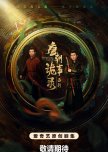
A Drama Where History, Mystery, and Humanity Converge
In an era when historical C-dramas often opt for romance, fantasy, or visual excess rather than substance, Strange Tales of Tang Dynasty: To The West stands as a quiet masterpiece of restraint, intelligence, and emotional honesty. Unlike most dramas where sequels are less impressive, Strange Tales is different: its second season actually refines the first. A deepening. A journey not only westward across the Tang frontier but inward, into the moral complexities of justice, memory, and human frailty.
A World Built on Respect for History
This drama clearly knows its world. Scriptwriter Wei Fenghua—a noted Tang historian weaves historical references into the fabric of the story. We see real artifacts: the Golden Bowl with Mandarin Ducks and Lotus Petals (a genuine Tang treasure now housed in museums), silver incense sachets (xiangnang) with intricate chainwork, Dunhuang cave murals, and even Dugu Xin's seal. Even the food is meticulously recreated: Shushan, one of the earliest forms of ice cream, served in lotus bowls; lamb-filled pancakes; Bo Tuo noodle soup—all documented in Tang texts.
But what truly stunned me were the forensic methods. The red oil-paper umbrella held over a corpse to reveal hidden bruises through light refraction. The sticky rice dough pressed onto skin to detect concealed injuries. The sealed rice ball test for poison. While China's first forensic manual (Xi Yuan Ji Lu) wasn't compiled until the Song Dynasty, these techniques reflect plausible proto-forensic practices that likely circulated orally long before. Their inclusion is a testament to the show's commitment to grounding even its strangest tales in tangible reality.
Mysteries That Honor the Audience's Intelligence
Season 2 follows Lu Lingfeng as he's appointed sheriff of Yunding, a frontier town on the western edge of the empire—hence the title "To The West". Accompanied by Su Wuming, Pei Xijun, Master Fei, and Ying Tao, their journey mirrors Journey to the West in structure but replaces celestial demons with human ones: grief, corruption, betrayal, and forgotten oaths.
Each case is a self-contained novella, and the drama cleverly shifts between mystery subgenres. Most episodes are classic whodunits, inviting us to discover the killer alongside the team. This is the demanding, high-cognitive-load style—the kind that keeps your brain spinning with suspect matrices, hidden clues, and unresolved patterns. For me, that meant binge-watching three to five episodes a day, because each resolution only made me hungry for the next puzzle. A few episodes are inverted detective stories, revealing the culprit early and letting us savor the tension of how justice will catch up. And the remaining are hybrids, playing with our expectations and shifting the hidden truth mid-stream. This variety keeps the storytelling fresh and respects the audience's intelligence at every turn. Unlike the calming, sleep-friendly inverted style of shows like Justice Bao, Strange Tales of Tang Dynasty To The West thrives on intrusive suspense—and I loved every demanding moment of it. If you like high dopamine with quick reward, this is the drama for you.
"The Death of the Coroner" left me breathless—not for its twist, but for its devastating emotional truth. "Letter from Shangxian Hall" channels Agatha Christie's elegance, with a solution so fair and inevitable it feels like poetry. "Snowstorm at Mojiadian" uses isolation and silence to build unbearable tension, while "Mara's Defeat" explores faith, manipulation, and redemption with remarkable nuance. And in the season's poignant finale, "The Provider" unravels a child's death tied to a cruel tradition—and reveals how greed, not love, can hide behind the mask of sacrifice.
Crucially, the drama never treats viewers as a passive audience. It invites us to observe, deduce, and question. There are no *deus ex machina* reveals. Every conclusion is earned through logic, empathy, and attention to detail.
Characters Who Grow Without Breaking
Yang Xuwen returns as Lu Lingfeng with even greater depth. The brash young general of Season 1 is gone. He's now more patient, measured without losing his resolution. Less arrogant and more humble. Yang Zhigang's Su Wuming remains the soulful anchor, the ultimate source of wisdom and deductive brilliance for their team.
The ensemble chemistry is flawless. Pei Xijun's intelligence, Master Fei's loyalty, Ying Tao's quiet strength—they all serve the story,. And refreshingly, the focus stays on their collective mission, not manufactured romantic tension.
One Small Imperfection
I give this 9.5/10—not 10—only because of the faint romantic threads in the drama: Lu Lingfeng with Pei Xijun, and Su Wuming with Yingtao. Neither pairing seems built to serve the plot. Rather, they feel like an additional topping on an ice cream that is already good on its own—pleasant enough, but ultimately unnecessary. Without the romance, the group dynamics would still work perfectly. It's hard not to suspect that the creators added these threads mainly to attract a certain demographic of viewers. The romance is minimal, tasteful, and far less intrusive than in most C-dramas, but I believe the story would have been even more powerful with purely platonic bonds. In a drama so committed to realism and intellectual partnership, even a whisper of romance feels slightly out of key. That said, it never overshadows the core narrative—and I understand its roots in Season 1.
Final Thoughts
Strange Tales of Tang Dynasty: To The West is a rare gift: a historical drama that respects its audience's mind and heart equally. It doesn't dazzle with spectacle. You can feel the creators' sincerity—they just wanted to tell a good story. Every frame, every line of dialogue, every action is placed with care and passion.
A World Built on Respect for History
This drama clearly knows its world. Scriptwriter Wei Fenghua—a noted Tang historian weaves historical references into the fabric of the story. We see real artifacts: the Golden Bowl with Mandarin Ducks and Lotus Petals (a genuine Tang treasure now housed in museums), silver incense sachets (xiangnang) with intricate chainwork, Dunhuang cave murals, and even Dugu Xin's seal. Even the food is meticulously recreated: Shushan, one of the earliest forms of ice cream, served in lotus bowls; lamb-filled pancakes; Bo Tuo noodle soup—all documented in Tang texts.
But what truly stunned me were the forensic methods. The red oil-paper umbrella held over a corpse to reveal hidden bruises through light refraction. The sticky rice dough pressed onto skin to detect concealed injuries. The sealed rice ball test for poison. While China's first forensic manual (Xi Yuan Ji Lu) wasn't compiled until the Song Dynasty, these techniques reflect plausible proto-forensic practices that likely circulated orally long before. Their inclusion is a testament to the show's commitment to grounding even its strangest tales in tangible reality.
Mysteries That Honor the Audience's Intelligence
Season 2 follows Lu Lingfeng as he's appointed sheriff of Yunding, a frontier town on the western edge of the empire—hence the title "To The West". Accompanied by Su Wuming, Pei Xijun, Master Fei, and Ying Tao, their journey mirrors Journey to the West in structure but replaces celestial demons with human ones: grief, corruption, betrayal, and forgotten oaths.
Each case is a self-contained novella, and the drama cleverly shifts between mystery subgenres. Most episodes are classic whodunits, inviting us to discover the killer alongside the team. This is the demanding, high-cognitive-load style—the kind that keeps your brain spinning with suspect matrices, hidden clues, and unresolved patterns. For me, that meant binge-watching three to five episodes a day, because each resolution only made me hungry for the next puzzle. A few episodes are inverted detective stories, revealing the culprit early and letting us savor the tension of how justice will catch up. And the remaining are hybrids, playing with our expectations and shifting the hidden truth mid-stream. This variety keeps the storytelling fresh and respects the audience's intelligence at every turn. Unlike the calming, sleep-friendly inverted style of shows like Justice Bao, Strange Tales of Tang Dynasty To The West thrives on intrusive suspense—and I loved every demanding moment of it. If you like high dopamine with quick reward, this is the drama for you.
"The Death of the Coroner" left me breathless—not for its twist, but for its devastating emotional truth. "Letter from Shangxian Hall" channels Agatha Christie's elegance, with a solution so fair and inevitable it feels like poetry. "Snowstorm at Mojiadian" uses isolation and silence to build unbearable tension, while "Mara's Defeat" explores faith, manipulation, and redemption with remarkable nuance. And in the season's poignant finale, "The Provider" unravels a child's death tied to a cruel tradition—and reveals how greed, not love, can hide behind the mask of sacrifice.
Crucially, the drama never treats viewers as a passive audience. It invites us to observe, deduce, and question. There are no *deus ex machina* reveals. Every conclusion is earned through logic, empathy, and attention to detail.
Characters Who Grow Without Breaking
Yang Xuwen returns as Lu Lingfeng with even greater depth. The brash young general of Season 1 is gone. He's now more patient, measured without losing his resolution. Less arrogant and more humble. Yang Zhigang's Su Wuming remains the soulful anchor, the ultimate source of wisdom and deductive brilliance for their team.
The ensemble chemistry is flawless. Pei Xijun's intelligence, Master Fei's loyalty, Ying Tao's quiet strength—they all serve the story,. And refreshingly, the focus stays on their collective mission, not manufactured romantic tension.
One Small Imperfection
I give this 9.5/10—not 10—only because of the faint romantic threads in the drama: Lu Lingfeng with Pei Xijun, and Su Wuming with Yingtao. Neither pairing seems built to serve the plot. Rather, they feel like an additional topping on an ice cream that is already good on its own—pleasant enough, but ultimately unnecessary. Without the romance, the group dynamics would still work perfectly. It's hard not to suspect that the creators added these threads mainly to attract a certain demographic of viewers. The romance is minimal, tasteful, and far less intrusive than in most C-dramas, but I believe the story would have been even more powerful with purely platonic bonds. In a drama so committed to realism and intellectual partnership, even a whisper of romance feels slightly out of key. That said, it never overshadows the core narrative—and I understand its roots in Season 1.
Final Thoughts
Strange Tales of Tang Dynasty: To The West is a rare gift: a historical drama that respects its audience's mind and heart equally. It doesn't dazzle with spectacle. You can feel the creators' sincerity—they just wanted to tell a good story. Every frame, every line of dialogue, every action is placed with care and passion.
Was this review helpful to you?


