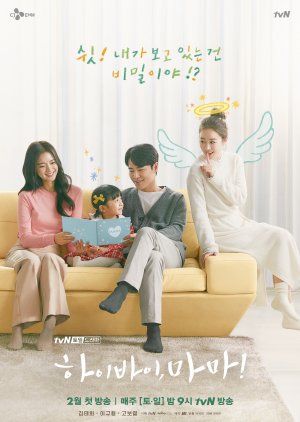
Hard-hitting! Emotional! Relatable!
Hi Bye, Mama! completely made me doubt human nature, from having regrets, greed to forgiveness. the annoying part of the story is that all the characters appear to be nice. they are all written nice that throughout the watch, I don't know who to side with. Which also made me doubt my beliefs and understanding. And also with the point taken, I realized a very good excellent thing on Hi Bye Mama, and it was being the main character of your own life. Love that the drama, characters, are well-written imposing that everyone's story is important.One point is that it tackles a lot of stereotypes... in a very nice and acceptable way. Not all stepmoms are bad and they are also one's mothers as they can also love their children unconditionally, and about underdeveloped kids discriminated, and many more.
Realization hits hard when the title is Hi Bye Mama, knowing throughout the watch that it was supposed to mean with her daughter but in the finale... it was a message for her mother. That is so exceptional and I did not expect that to come. To quote this remarkable dialogue from ms midong.
"A woman who lost her husband is called a widow. A man who lost his wife is called a widower. A kid who lost his parents is called an orphan. But there's no word for a parent who lost their kid. Know why? It's because no word can describe it. There is no word in this world that can describe the excruciating pain" that is so hard-hitting and I remember this dialogue after realizing the other deeper meaning of the title, Hi Bye, Mama!
Overall i would def recommend watching this! as I know everyone can realize, can learn, a thing or two from how thoughtful the script, dialogues, and plots it brings
Was this review helpful to you?

Sweet
It really deserves a higher rating,I love Cha Yu-ri personality in this drama. She want that her ex-husband is happy, even if she will be alone. Seo-woo is sugar-sweet too.
The story is really heartwarming. You really cry all the time in this drama. Right from the start, you are drawn into the world of Cha Yu-ri. There are numerous sad as well as funny incidents.
The quality of the drama is really good again, as you can see from the many locations that have been used.
In summary, a very good series, with a great cast and a great story.
Was this review helpful to you?

This review may contain spoilers
My Wife and My Dead Wife (Coffee for three?)
Even before it became part of Korean fantasy television, the forty-nine-day limit has its roots in Buddhist tradition, where it represents the transitional period between death and rebirth – a liminal time in which unfinished business can still be brought to a conclusion.Asian cinema and television have repeatedly reworked this imagery, interpreting it through different sensibilities: sometimes through a precise chronological framework, as in “Hi, Bye, Mama!”; at other times by aligning, it with the rhythm of the seasons, as in “Be with You”; or through an intangible presence that continues to accompany those left behind, as in “Windstruck”.
In some of these works, however, the return is never the story’s conclusion, but rather its premise. It is the narrative gesture from which questions take shape, questions that concern memory, grief, affection and the very way in which time changes people.
What happens when it is not just a person who returns, but a past that everyone, in different ways, had learnt to transform into a memory?
This question marks the beginning of “Hi, Bye, Mama!”. Having died suddenly five years earlier, just as she was about to give birth, Cha Yu-ri is given the inexplicable chance to return to the world of the living for forty-nine days. The miracle, however, does not return her to the past, but to a present that has already learnt to live with her absence. A husband who has rebuilt his life, a daughter who has grown up associating the word ‘mum’ with another woman, a family that has transformed grief into memory: it is within this microcosm that the series chooses to set its characters.
Such a premise almost inevitably leads the viewer to imagine a story of a second chance. It is an almost natural expectation, fuelled by the narrative premise itself. Yet, episode after episode, the series slowly begins to shift its focus in a very different direction...
Yu-ri’s journey progressively takes her through a series of psychological stages that ultimately redefine the very meaning of her return. Whilst she initially faces reality with the bewilderment of someone who finds herself in a world that has suddenly become alien to her, she soon realises that the true miracle lies not in having returned, but in coming to terms with a time that has never stopped to wait for her.
Although she had observed Gang-hwa and Seo-woo’s lives for years, as an invisible presence, direct contact with that present reality brings about a very different sense of disorientation: her husband has built a new family, her daughter has learnt to call another woman ‘Mum’, and she herself gradually realises she is merely a guest in a life that no longer belongs to her. The reunion thus gives way to an unexpected feeling: that of being a stranger in the place she once called home.
This state of paralysis is only broken when her maternal instinct once again takes precedence over every other emotion. Realising that her ghostly presence risks having a negative influence on Seo-woo, Yu-ri gradually abandons the idea of a simple reunion and chooses a far more painful path: entering her daughter’s life without being able to identify herself as her mother. She thus accepts a marginal, almost invisible role, working as an assistant at the nursery the little girl attends and observing her daily growth at close quarters.
It is within this microcosm that “Hi, Bye, Mama!” finds one of its most successful insights. The series, in fact, rejects one of the most overused tropes of family melodrama — the contrast between the ‘real’ mother and the antagonistic stepmother — opting instead for a far more complex and humanly credible approach.
Min-jung is not an obstacle to be removed, but a woman who has built, day by day, a genuine emotional bond with Seo-woo, taking on responsibilities that no one would have wished to inherit.
From this point on, the conflict ceases to be external and becomes entirely moral. The more Yu-ri comes to understand the sincerity of Min-jung’s love, the more the miracle of her return loses the appearance of a gift and takes on the form of a trial. To remain alive would mean reclaiming a place that time has inevitably entrusted to someone else, shattering a balance built through hard work and sacrifice.
The forty-nine-day countdown thus ceases to be a mere narrative deadline and becomes a slow realisation: the problem is no longer figuring out how to return to her own life, but accepting that, in the meantime, that life has continued to exist without her.
At this stage, however, one of the script’s main weaknesses becomes apparent. The series establishes from the outset that Yu-ri has spent five years alongside her family as an invisible presence, observing their daily lives. Because of this, it is difficult to reconcile this premise with the gradual ‘discovery’ of Min-jung’s character.
Many of Min-jung’s qualities – such as her dedication, patience and the bond she has built with Seo-woo – which Yu-ri seems to grasp only during her time at the nursery, should already have been part of her emotional makeup. Instead, the screenplay chooses to sacrifice this continuity of perspective in order to gradually guide the viewer towards the same realisation, achieving an effective emotional progression, but at the cost of internal consistency that is not always convincing.
Even the gradual revelation of Yu-ri’s return seems to obey the demands of the episodic structure rather than the natural consequences of such an extraordinary event. The news remains confined to ever-narrowing circles, as if the screenplay preferred to preserve the narrative balance rather than allow its inevitable repercussions to spread throughout the entire family and social microcosm.
At the same time, the series assigns the numerous ghosts in the columbarium an almost choral role, transforming each individual regret into a variation on the same theme. The intention is clear: to gradually prepare the viewer for Yu-ri’s fate through a series of small farewells. It is a choice that makes sense on a symbolic level, but one that often ends up diluting the narrative tension, taking away from the very human relationships that represent the series’ truest heart, and even verging on the redundant through the introduction of the – frankly unnecessary – figure of the exorcist.
Three different choices that ultimately produce the same effect: distancing the narrative from the human core that its very premise had made so powerful
When “Hi, Bye, Mama!” moves away from fantasy tropes and simply relies on its cast, it immediately regains its authenticity. It is particularly in the more contemplative scenes – even more so than in the dialogue – that the series reaches its finest moments: a mother who confesses to having forgotten the sound of her daughter’s voice; a father who continues to cherish every one of her belongings as if time had never passed; a sister who still enters her room; Gang-hwa realising he has never truly been alone; Yu-ri watching Seo-woo asleep beside Min-jung; the everyday conversations between Yu-ri and Eun-sook, built more on silences than on words.
And it is through these very fragments that Min-jung, too, completes her transformation, finally ceasing to be ‘the second wife’ and assuming, with full dignity, the role of mother.
Fantasy never disappears entirely; it simply becomes transparent. It remains the necessary condition for these characters to meet once more, but finally steps back from the centre of the narrative, making way for what the series does best: portraying the fragility of human bonds.
“Hi, Bye, Mama!” seems to suggest that the past survives not so much in moving images as in objects and small daily rituals. It is a memory that does not flow: it remains. Like a photograph.
It is significant that the theme of memory, too, is explored through a deeply material imagery. Photographs, letters, rooms left untouched, small everyday objects: memory almost always passes through what can be touched and cherished.
What is striking, however, is the almost total absence of audiovisual memories. In an age when home videos, voice recordings and short clips are perhaps the most immediate way to preserve the presence of a loved one, “Hi, Bye, Mama!” deliberately chooses not to go down this route. It is hard not to imagine that those fragments of voice and movement could have taken on enormous emotional significance within the narrative.
Whilst the drama retains its emotional power intact in the decisive moments, much of the credit goes to an impeccable cast that consistently avoids any melodramatic excesses. Kim Tae-hee crafts an extraordinarily restrained Yu-ri, conveying her pain through hesitations, uncertainties, silences and glances rather than words. It is a minimalist performance that naturally accompanies the character’s journey of self-discovery right through to her catharsis.
Particularly effective is the way the various emotional stages are handled. In the early episodes, Yu-ri rediscovers the world with a clumsy, almost childlike physicality, whilst learning once more to inhabit her body and navigate everyday life. This initial lightness makes the subsequent transformation all the more striking: as the forty-nine-day deadline approaches, Kim Tae-hee gradually strips the character of that vitality, making her movements slower and her body heavier, as if the inevitability of the separation were also reflected in her physical presence.
In the most intense scenes, the actress once again works with an almost understated skill: a restrained gesture, a held breath, a gaze that seeks to etch into her memory what she is about to lose, and tears held back. In this very composure—which eschews emphasis in favour of a silent and dignified grief—the actress conveys Yu-ri’s most authentic essence, transforming her into the portrait of a love capable of stepping aside.
Even more striking is the performance by Kim Mi-kyung, who brings the magnificent Eun-sook to life through a grief that is almost entirely internalised. Her journey only finds its full realisation in the finale, when the wish she expressed years earlier is revealed as the true reason behind Yu-ri’s return, gently overturning the narrative’s perspective: alongside the grief of a daughter deprived of motherhood, the pain of a mother forced to outlive her own daughter emerges with equal intensity.
For much of the series, Eun-sook suppresses her grief behind a façade of severity. She forbids anyone from mentioning Yu-ri, avoids her grave and imposes a sense of normality that is, above all, a survival mechanism. Kim Mi-kyung conveys this tension through understated acting, characterised by measured gestures, an ever-composed demeanour and glances that shy away from anything that might reopen the wound, transforming her steadfastness into a veritable emotional armour.
When Yu-ri returns, the actress allows that armour to crack without ever resorting to exaggeration. In the scenes shared between mother and daughter — a caress, a lullaby, a bowl of soup prepared just as it used to be — the pain emerges through small, everyday gestures, gaining even greater intensity through their very simplicity. It is then that we realise how Eun-sook’s harshness was never a sign of distance, but rather the fragile dam built up over the years to prevent grief from overwhelming what remained of the family.
Go Bo-gyeol carefully avoids any antagonistic portrayal. Her Min-jung constantly walks a fine line between gratitude, guilt and a sense of inadequacy, without ever turning her pain into a demand. Even in moments of greatest fragility — often brought on by confessions made over a glass too many — the actress maintains surprising control, allowing her emotions to emerge very gradually. Tears never represent a melodramatic climax, but rather the natural surfacing of pain that has been held back for far too long.
Lee Kyu-hyung portrays, with great restraint, a character constantly torn between two mirror-image feelings of guilt: that of having failed to protect Yu-ri, and that of having granted himself the right to start living again. His performance almost always eschews emphasis, save for the inevitably tragic moments, shaping Gang-hwa through hesitations, silences and sudden stiffening of the body, as if every gesture were the result of a precarious balance that is constantly at risk of breaking.
Without ever upstaging one another, the lead actors all seem to employ the same approach, almost achieving an ensemble performance, whilst remaining consistently true to the emotional core of the story, despite the script’s distractions, the excesses and redundancies of the fantasy elements, and the questionable nature of certain moments.
By the end of the series, “Hi, Bye, Mama!” leaves the viewer with a curiously ambivalent feeling. On the one hand, there is the realisation that this is a work capable of tackling universal themes with rare sensitivity and of relying on a cast of extraordinarily restrained performers; on the other, there remains the impression that the series has often faltered in the face of the power of its own concept.
The story of a mother who returns not to reclaim her life, but to learn how to truly let go, would probably have possessed, on its own, all the strength needed to sustain the narrative. Instead, the screenplay chooses, on several occasions, to dilute that tension within a broader narrative structure, alternating moments of genuine intensity with others that seem to pander to a more conventional fantasy aesthetic.
And yet, whenever the series finds the courage to push the supernatural into the background, something very simple happens: we stop questioning its rules and start taking an interest solely in the characters. These are the moments when “Hi, Bye, Mama!” reaches its highest level, reminding us that the real miracle lies not in Yu-ri’s return, but in the chance given to all the characters to finally say to one another what time had left unsaid.
This repeated oscillation between profound insights and a more cautious narrative structure makes “Hi, Bye, Mama!” a series that continues to challenge the viewer even after the credits have rolled. Not so much for what it tells, but for what, at times, it hints it might be. An almost unresolved state; a work that genuinely moves the viewer, whilst continuing to suggest, between one scene and the next, the outline of an even bolder drama.
“Hi, Bye, Mama!” seems to find its ultimate meaning not in the illusion that pain can be erased, but in the possibility of transforming a farewell that has remained unresolved into a farewell that is finally spoken. Rather than simply telling the story of a return, the series ultimately explores the way in which we learn to let go of those we have loved. At that point, to paraphrase Serge Gainsbourg, one of his famous lines seems to come almost naturally:
‘Je suis venu te dire que je m’en vais.’
7/10
Was this review helpful to you?
Every mom should watch and enjoy this drama. My most favourite character is Yuri's mom. Though the ending is realistic it would be even better Min jong met someone who loves her and Yuri staying alive. Anyways I felt worth watching this emotional roller coaster.
Was this review helpful to you?
Was this review helpful to you?
This review may contain spoilers
Stupid show with a good start
The biggest problem with this show is that they made a 16-episode show with only 3 episode worth of content. They resort to filling the episodes with meaningless side characters and their stories that don’t amount to anything substantial. They shamelessly try to distract you by showing endless flashbacks and repeating the same scenes over and over again from slightly different angle to fill the run time. I keep seeing this in other K-dramas, too. Why do they have to be 16 episodes? Is this from some K-drama constitution that everything has to be 16 episodes long no matter what?The other problem is that characters don’t act like normal human beings. I get that this is a show about a dead person coming back to life, etc. The dead wife can’t control herself every time her daughter’s around seemingly because she missed her daughter so much. She forgets everything that’s going on around her. The husband might as well be dead because he’s detached from everything including his daughter, the new wife and his job. I’m not sure how he’s still employed. The new wife has no personality whatsoever and doesn’t talk much. The mother-in-law pretends like she doesn’t miss her granddaughter. Characters keep making unrealistic decisions all across the board. I do like the actors in the show and I feel like they could’ve done better with better story and directions.
You also get to see the K-drama staples like needless misunderstandings, incredible coincidences (it’s incredibly amazing how the characters somehow run into each other no matter what/where/when all the time over and over again), long stares, multi-genre confusion and so on. In fact, everything is turned up to 150%. Man, I had such a high hopes for this show based on the first episode.
I’ll continue to watch to see what will come out of this. The show is pretty good when it’s good but when it’s bad, it’s really bad and frustrating. Sigh...
Was this review helpful to you?
That to love means the ability to sacrifice
First of all i'm glad that this drama has a good rating and seems to be quite popular because if i remember correctly at the time of it's airing, It didn't get a lot of heat. The story was beautifully written, even though it's fantastical it has tight logic and there are explanation for each events. The acting was good and believable. I can't remember the music in it but i'm the type of person who thinks that if the music fit the mood and not irritating then it was good enough for me. I have watched this drama 2 times in it's entirety so i think that was enough proof that it has a good rewatch value because i'm the kind of person who rarely rewatch. In conclusion it was a drama with clear intention who doesn't aspire to be modern or keep up with what's hot or popular. The team clearly knows what particular story they want to tell and execute it brilliantly. Maybe to others it was a rather usual drama that has many shortcomings. But Hi Bye, Mama! struck a chord with me and make me remember it fondly.P.S. This is a belated review and english is not my first language so sorry if the review is not coherent or understandable
Was this review helpful to you?

i love this
really so much good 🤍🤍🤍🤍🤍🤍🤍🤍🤍🤍🤍🤍🤍🤍🤍🤍🤍🤍🤍🤍❤🤍🤍🤍🤍🤍🤍🤍🤍🤍🤍🤍🤍🤍🤍🤍🤍🤍🤍🤍🤍🤍🤍🤍🤍🤍🤍🤍🤍🤍🤎🤍🤍🤍🤍🤍🤍🤍🤍💋💋🤍🤍🤍🤍🤍🤍🤍🤍🤍🤍🤍🤍🤍🤍🤍🤍🤍🤍🤍🤍❤🤍🤍🤍🤍🤍🤍🤍🤍🤍🤍🤍🤍🤍🤍🤍🤍🤍🤍🤍🤍🤍🤍🤍🤍🤍🤍🤍🤍🤍🤎🤍🤍🤍🤍🤍🤍🤍🤍💋💋Was this review helpful to you?

A heartfelt drama about loss and acceptance
Hi Bye, Mama was one of the first K-drama series I watched. It was such a shocker series for me, unlike anything I've seen in western tv series.The story is just perfect, about loss and reconciliation, acceptance, grief, regret, but also joy. The series has so much heart that I admit that this series made me sob the most, it really touches you.
It makes you truly think about the most painful things people go through, the loss of someone close.
The actors did an amazing job, all of them.
I did not know what I was going to watch when I started watching it, but I'm glad I decided to watch it "blindly".
It still sits in me to this day since I saw it earlier this year.
It's one of my top series to recommend to people, at least people who are open to drama series.
Was this review helpful to you?
About the content. I really loved the acting. To be honest, the emotions were perfectly conveyed and we felt each character's sincerity. I usually complain about some dramas for not showing clearly the reason why one character act a certain way but I think this drama shows otherwise because we got all the details we needed to understand each character's point of view. There were no real evil expect life's injustice, I would say? So that's a good reason to watch this drama, we can relate to it. Although I was a bit skeptical at first that the "supernatural" aspect would make it unpleasant and unrealistic, everything felt real, to me. It was neither slow nor quick, it was at a perfect pace.
So don't hesitate and watch this drama !!!
Was this review helpful to you?

This review may contain spoilers
Love That Refuses to Leave, Even When We Do
Grief has never hit me the way Hi Bye, Mama! did — not with screaming or spectacle, but with these quiet, exacting cuts. The kind that show up when you least expect them: folding clothes, hearing a laugh that sounds like someone you lost, watching someone smile through pain because they don’t know how to stop taking care of everyone else. That’s the kind of grief this show understood.I didn’t start it expecting to unravel. I thought I was walking into something gentle — a touching ghost story, maybe a second-chance fantasy. But Hi Bye, Mama! doesn’t play in wish fulfillment. It sits with the ache of unfinished goodbyes, of memories that cling too tightly, and of a love so fierce it can’t bear to be forgotten.
Kim Tae-hee gave Cha Yu-ri a kind of radiance I wasn’t prepared for. She wasn’t just a mother who died too soon — she was a woman still full of life, overflowing with it, trying desperately to stay present even when the world had already moved on without her. The way she loved her daughter wasn’t soft-focus idealism. It was raw. Unapologetic. Desperate and beautiful. And when she smiled — when she chose to smile for the sake of others — I broke a little more.
What floored me most was the way the show treated death. There’s no horror here, no fear-mongering. The afterlife wasn’t a threat. It was just... waiting. Patient. Soft-edged. A space where ghosts watched the living with both joy and unbearable longing. It wasn’t cruel. It was just real. Because grief isn’t cruel. It’s just what’s left when love has nowhere to go.
Sure, not every subplot landed. Some stories felt stretched, and the pacing wobbled under the weight of its emotional scope. But none of that dulled the core. The show never lost sight of what it was about: not death, but the aftershocks of love. The kind that keeps echoing, even when the world says it’s time to move on.
It reminded me that we’re all walking around with our own ghosts — not always seen, but always felt. And that sometimes, the bravest thing we can do isn’t to hold on tighter. It’s to let go with love.
Hi Bye, Mama! didn’t ask for my tears. It earned them. Quietly. Fully. And I’m still carrying it, in all the best and hardest ways.
Was this review helpful to you?
The acting was astounding, I felt the connection and chemistry between all the actors. Prepare for many, many tears. It really does push the message to live every day like it’s your last and life to the fullest. Tell friends and family you love them as much as possible. You just never know when death may happen.
I actually really loved the ending. It was realistic, as that is how life is- it's not always a fairy tale, but obviously with the supernatural aspect.
Overall, this is just so beautifully done.
Was this review helpful to you?