


WARNING: THE SCROLL IS STILL IN THE WORKS.... Still looking for data and links!
|
-- Table of contents --
(Click on links above to access the sections, you can link back to Table of contents after each "chapter" using the final link in blue) Note: Pictures link to their origin, Gifs by me, Information from Baidu, Wikipedia and various articles To view the list of my other drama companion pieces (with links to them), check : HERE. |
Text optimized for light or dark modes. Some column problems in the music sections may not allow all handheld devices readers to see the right hand column (where some bonuses are added). When I checked on the smartphone, the right hand column was hidden and could cause a long string of letters lengthening with apparent "empty space" before next info is shown. I will try to rework it later, but It is a quirk of MDL programming, so better use this Companion piece on a computer or on a tablet (where text and pictures appear OK as I checked) |
1. BASIC INFO
| ||||||||||||||||||||||||||||||||||||||||||||||||||||||||||||||||
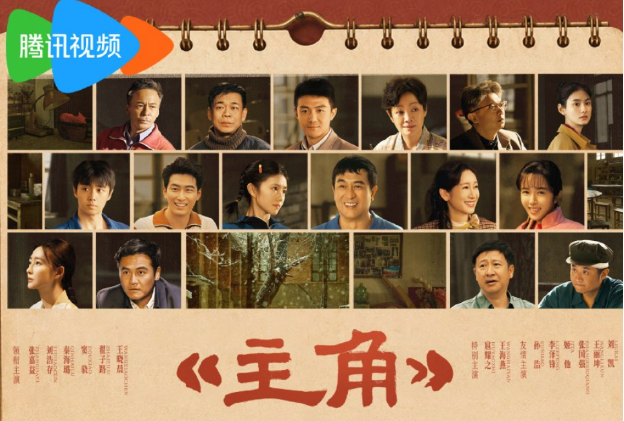
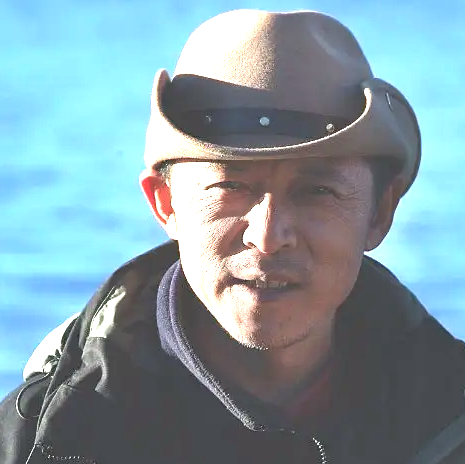
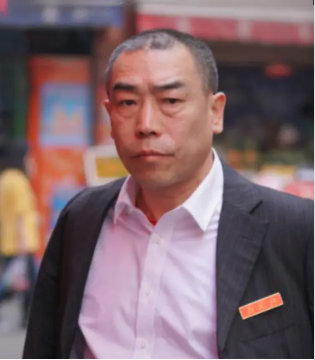
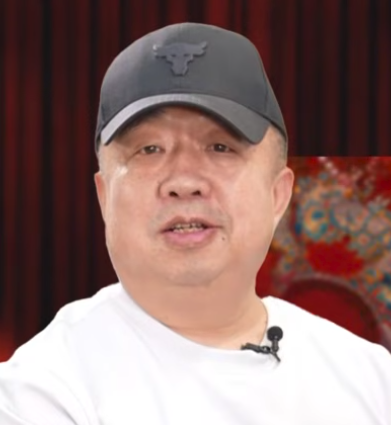
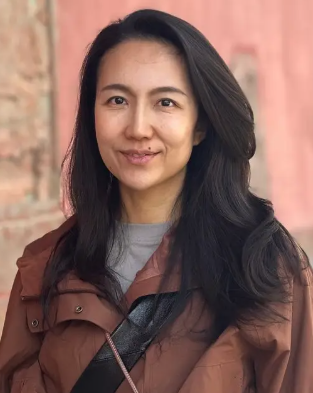
Note: Máo Dùn 茅盾 (1896-1981) was the pen name, meaning "contradiction" of Shěn Déhóng 沈德鸿, (born Shěn Yànchāng 沈燕昌, courtesy name Shěn Yànbīng 沈雁冰 in Wūzhèn 乌镇, Tóngxiāng of Zhèjiāng province). He was an influential writer and journalist, Minister of culture of the PRC 1949-1965, and Chairman of the China Writers Association 1949-1981. CAST: Note: no-one was mentioned as dubbed ; the leads perform with their real voices. The Qínqiāng opera songs and occasional dialogues are using Xī'ān, Shǎnxī (Shaanxi) dialect.
CREW :
| ||||||||||||||||||||||||||||||||||||||||||||||||||||||||||||||||
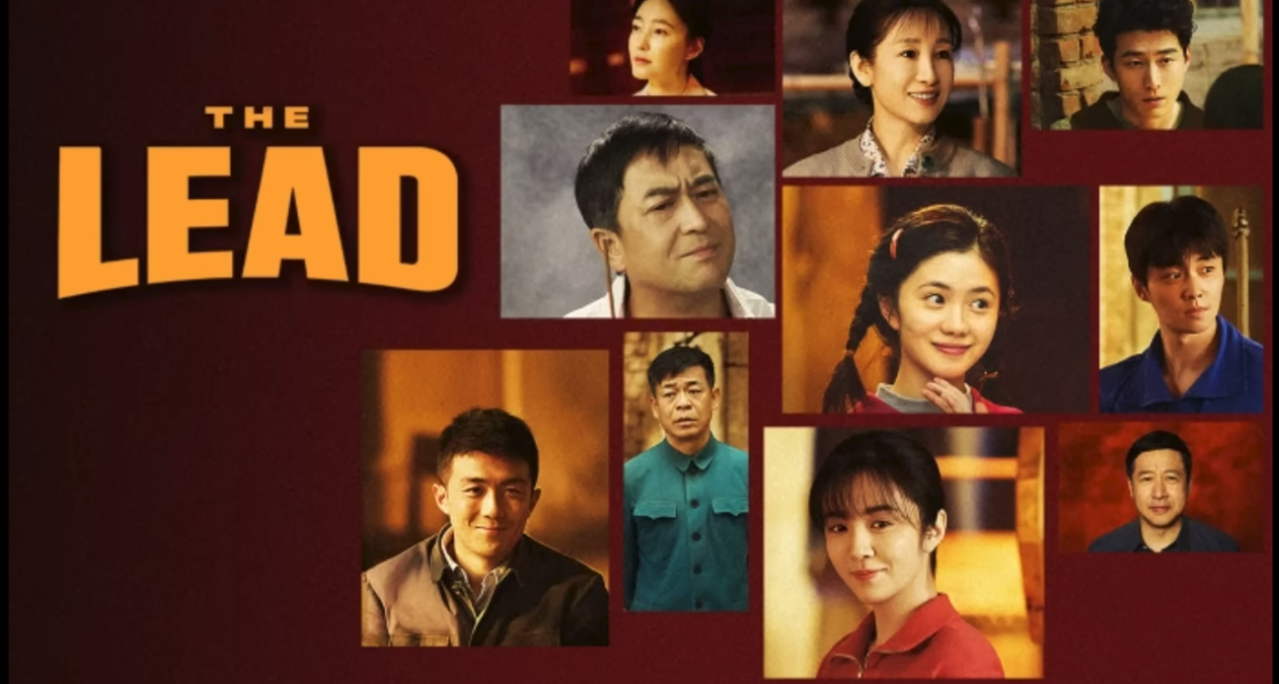
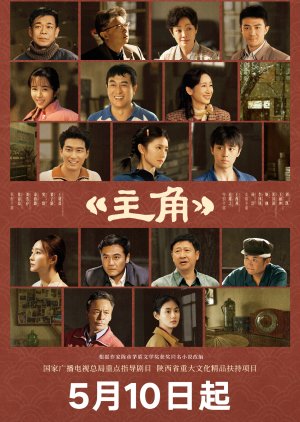
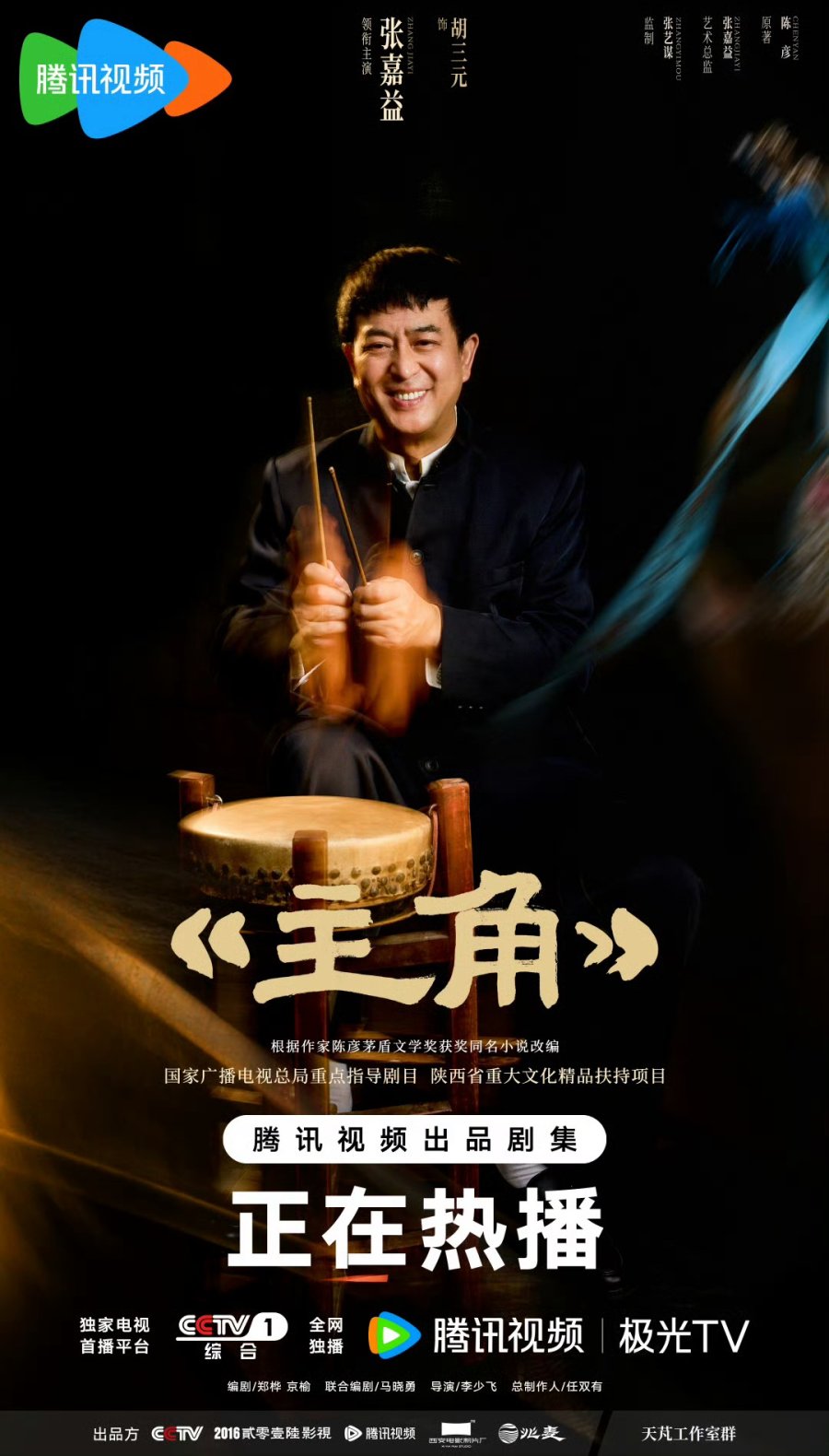
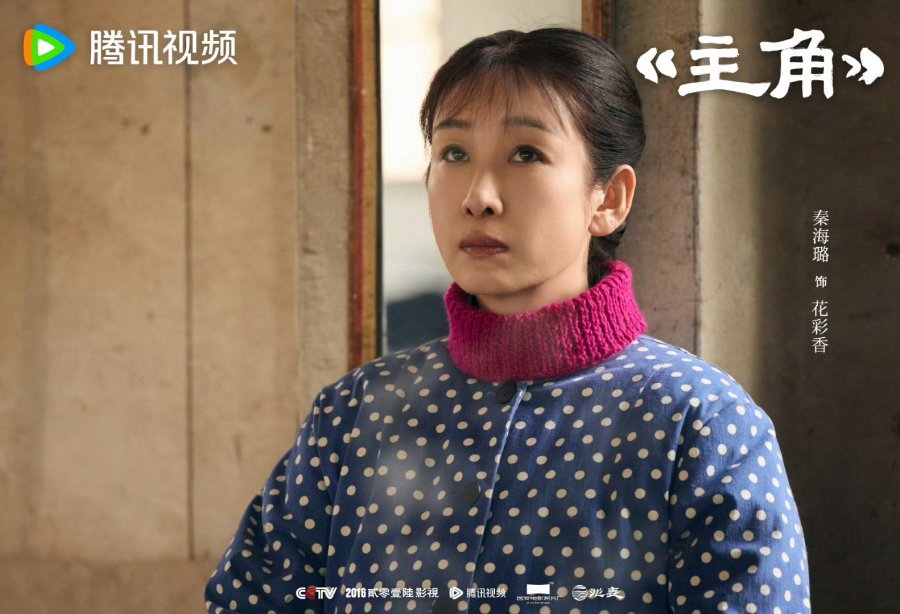
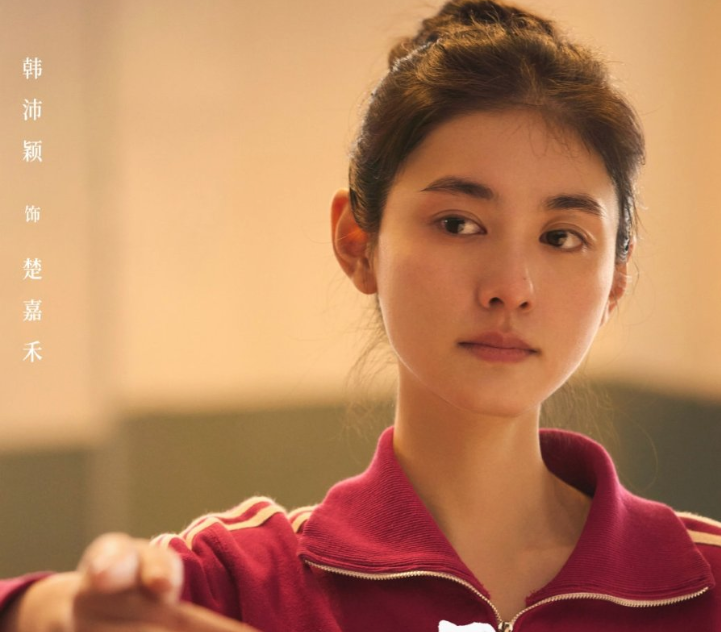
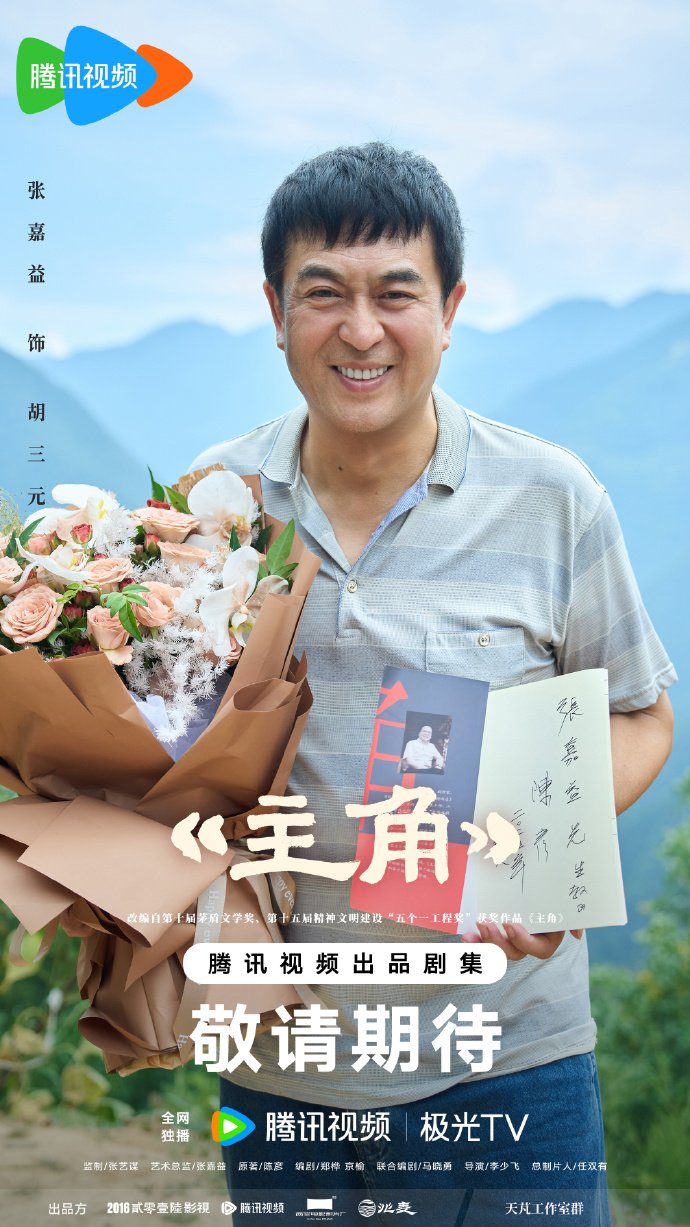
SYNOPSIS : . The story follows the half-century-long artistic journey of Yì Qín'é, a renowned Qínqiāng opera singer, as she grows from a young goat herder through various struggles in the theater troupe to eventually become a leading performer on stage through sheer hard work. Láidì had been the over quota daughter of poor peasants up in the mountains in Jiǔyángōu 九岩沟, Shǎnxī Province. The parents had one long awaited baby son and her sister was already engaged in her early teens to the son of the village chief. Her uncle Hú Sānyuán took her to the Qínqiāng 秦腔 opera troupe in town where he was a drummer, and persuaded his colleagues to accept her as a trainee, although she refused to sing or even to speak at first. She only wanted to get back to be a shepherdess. But, through the efforts of her uncle's colleagues, Huā Cǎixiāng and Mǐ Lán, playing lead role and understudy respectively until the older actress left, Laidi started to open up. After having been remembered only as the bizarre mute and immobile scarecrow for her first appearance on stage, she was recognized as a budding talent in her first role, and her uncle gave her her first stage name Yì Qīng'é . Noticed by Liú Hóngbīng , the heir of a wealthy family, she became his protégé while he fended off the childhood friend Fēng Xiāoxiāo, who also was growing as an artist. The characters Fēng Xiāoxiāo, Liú Hóngbīng , represent the emotional experiences of different stages in the life of Qín'é . Chǔ Jiāhé and them are peers in the troupe and compete with Yì Qín'é. | ||||||||||||||||||||||||||||||||||||||||||||||||||||||||||||||||
Cultural background : Author Chén Yàn said that the creation of "The Protagonist" aimed to reflect the changes in Chinese society through the transformation of traditional Qínqiāng 秦腔 opera in the last years of the Cultural Revolution and the Reform and opening up period. Rise and fall of internal migration and economy is in the background. The experience of Yì Qín'é covers growth and training, emotional twists and turns, career ups and downs, and ultimately she achieves artistic inheritance and spiritual sublimation.
Yì Qín'é 忆秦娥 is the name of a ci 词 lyric poetry form. It is a double-tone form with forty-six characters, available in both oblique and level rhyme schemes. The oblique rhyme scheme is the fixed form, often using entering tone rhymes. Each stanza has five lines, with three oblique rhymes and one repeated rhyme. It is traditionally attributed to the great Táng Dynasty poet Lǐ Bái, who first composed the ci poem 忆秦娥·箫声咽 Yì Qín'é·xiāo shēng yàn (Remembering Qín'é - The Sound of the Xiāo flute Fades), which contains the line "Qín'é''s dream is broken by the moon over Qín Tower," hence the name. It has many other names, including "QínTower Moon," "Deep Green Clouds," and "Double Lotus Leaves. |










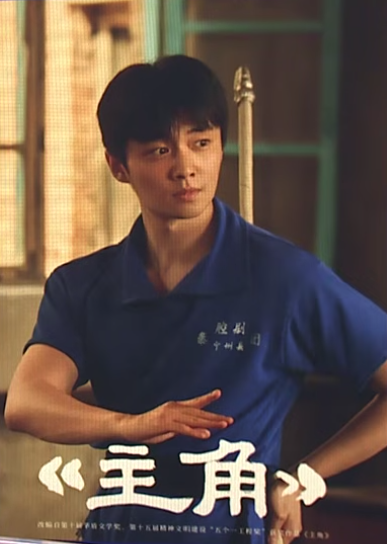
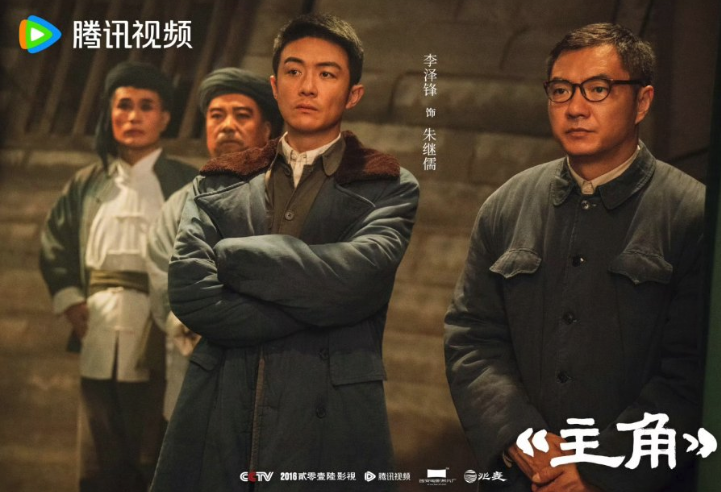

Trailer (3'32) :
Previous trailer (1'33) :
CLIP FROM THE DRAMA (with English and Chinese subtitles, 16') :
Promotional event recording of May 18, 2026 (50'19, with English subtitles) :
2. PRODUCTION, FILMING LOCATION AND DATES |
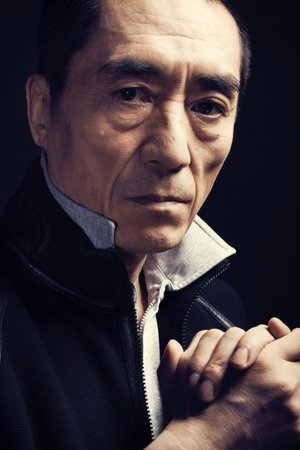
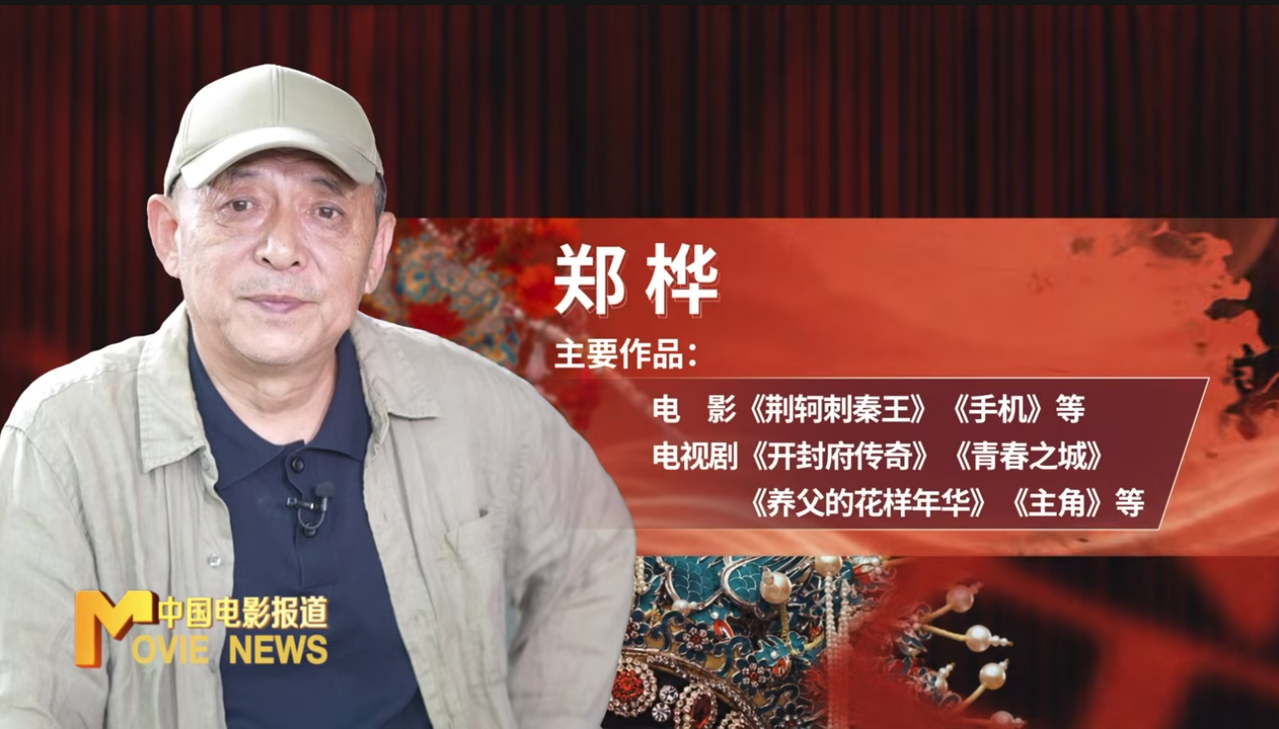
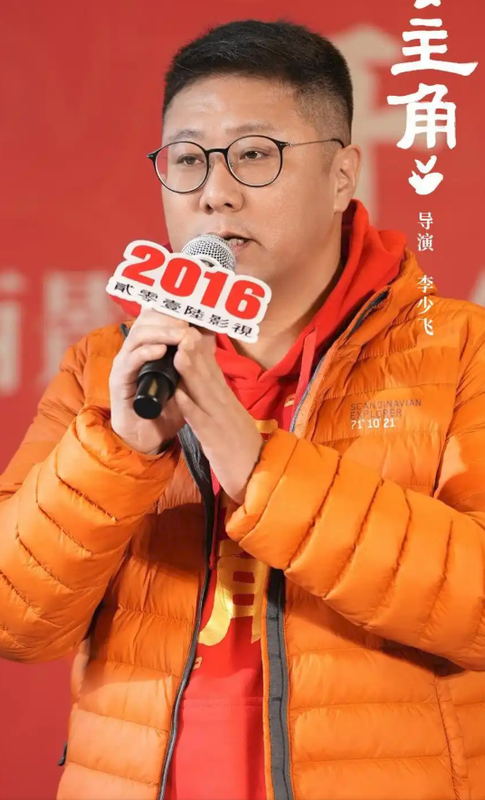
1/ PRODUCTION ROLESAbout the role of each, crew and cast, the above video uploaded May 28, 2026 (9'46, with optional machine translated subtitles) gives some insights. Zhāng Yìmóu was primarily in charge of quality of lighting and cinematography, helping with the buzz, but co-directors Lǐ Shǎofēi and Zhèng Huà co-directors skillfully led the cast to best performance. Liú Hàocún was also grateful to the elder cast, particularly Qín Hǎilù who had experience in Chinese opera, and to co-director and screenwriter Zhèng Huà, who has good experience in filming Chinese Opera. She recalled the long and arduous preparation work :
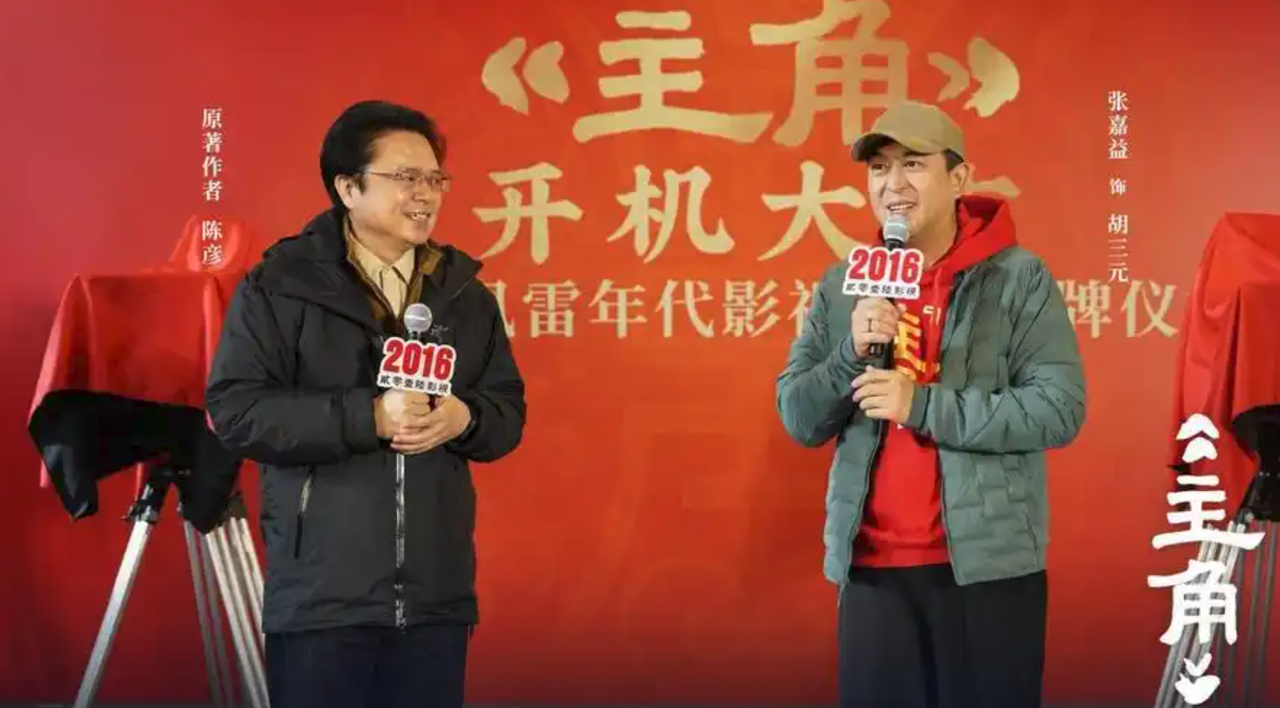
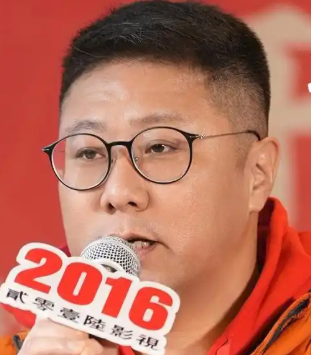
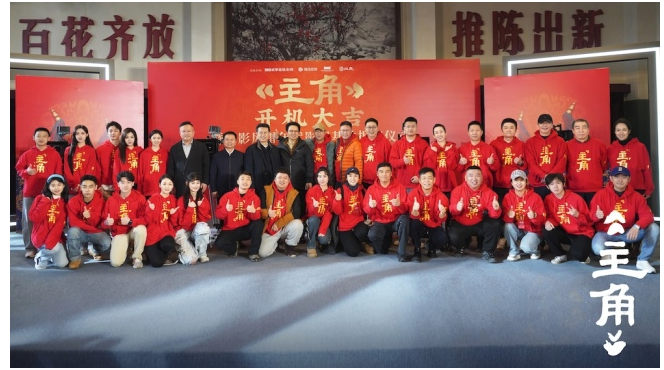
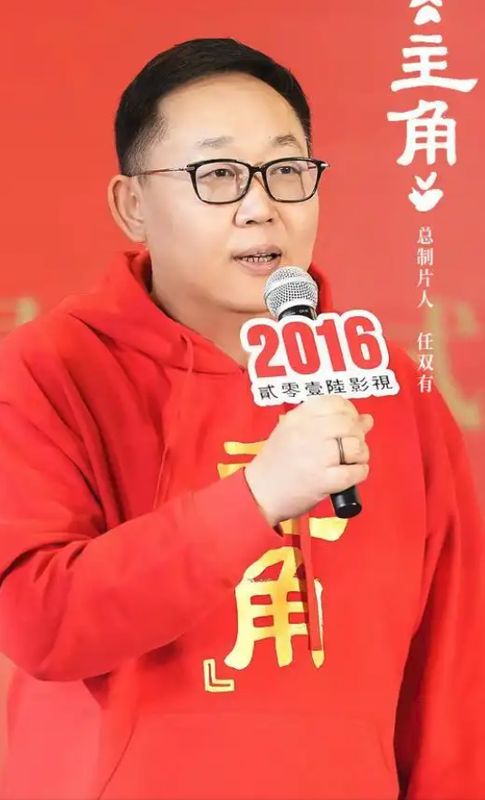
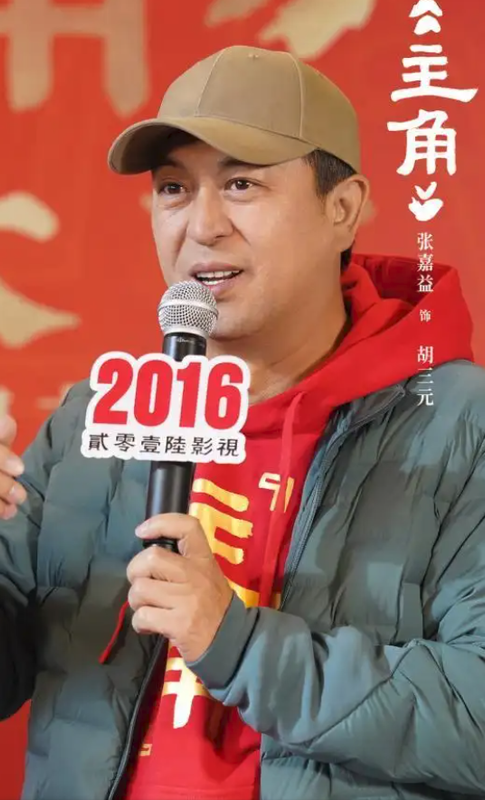
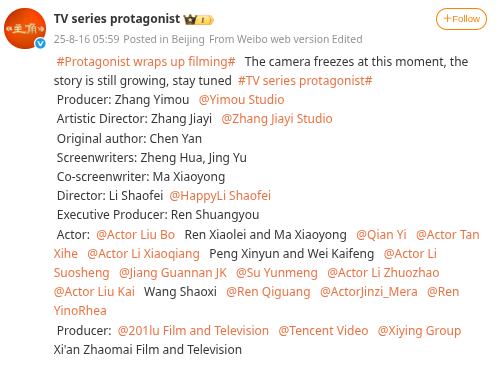
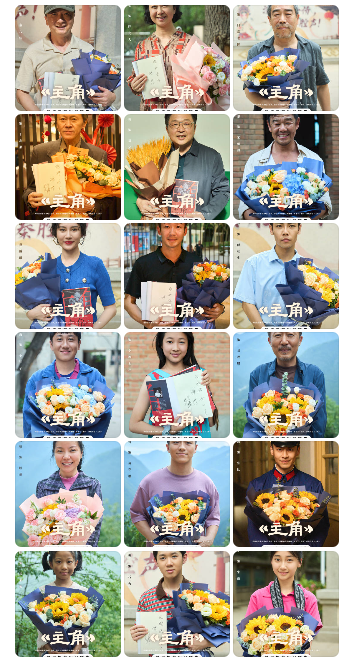
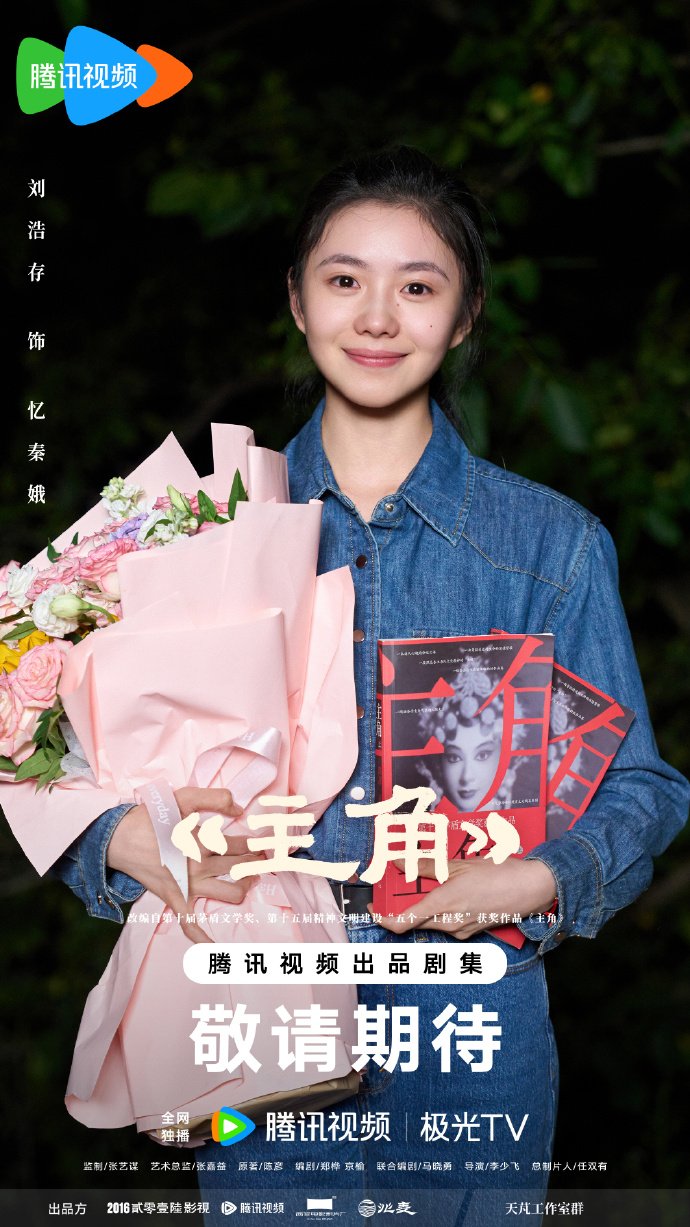
She did not go into the work that may have been needed in post production. In another interview, the cast recalled that the parts from the experienced star actors like Zhāng Jiāyì did not need many takes, but one in particular impressed the young actress by the emotional quality he demonstrated. Liú Hàocún even said that she only had six days really filming together with them in the drama: the process was kept fast and efficient. (Like every member of the cast she used her own voice; no voice actors are listed). DATESThe drama was filmed from March 3 to August 25, 2025 in Xī'ān and other places.BOOTING : "On March 3rd, 2025, the TV series The Protagonist, adapted from the Mao Dun Literature Prize-winning and Five-One Project Award-winning novel of the same name, officially began filming and announced its cast". Rèn Shuāngyǒu 任双有, President and Chief Producer of 2016 Film & Television (co-producer with Tencent Video, Xī'ān Film Studio, and Xī'ān Zhàomài Film & Television) expressed his sincerest gratitude to all the main creative guests for joining the project and also announced that, "Simultaneously, the official team released a "Dreamlike Life" poster, photos from the filming launch, and other materials, instantly generating widespread attention both within and outside the industry." The opening ceremony was held at the "Xī'ān Film Studio's Fēngléi Era Film and Television Base" 西影风雷年代影视基地 in the ancient capital of Xī'ān . Leaders and key creative guests present witnessed this important moment in the unveiling of the film and television base. The base is a joint venture between Xī'ān Film Group and Xī'ān Industrial Investment Group. Both parties leverage their respective strengths to revitalize existing industrial heritage, achieving an ideal synergy of "industry + culture," and aiming to create the largest era-themed film and television base in China, integrating film and television shooting, film and television tourism, film and television education, and comprehensive supporting facilities. Xī'ān Film Studio's Fēngléi Era Film and Television Base covers an area of 1,000 mu (approximately 67 hectares) and is located in Zǐwǔ Street, Cháng'ān District (长安区子午街道) , Xī'ān, at the foot of Sōngpíng Mountain (松坪山) on the northern slope of the Qínlǐng Mountains (秦岭山) and on the west bank of the Hào River (滈河). The base has well preserved the architectural style, factory space, and living scenes of the original Fēngléi Instrument Factory from the 1960s and 1970s, forming a unique time and space space with the ecological landscape of the Qínlǐng Mountains. (info from a Chinese online news feature) WRAP: Translation of the Weibo post tagged by @a cappuccino gal on Dec 19, 2025 in Photo section with the collection of wrap bouquets pictures (thanks to her) :
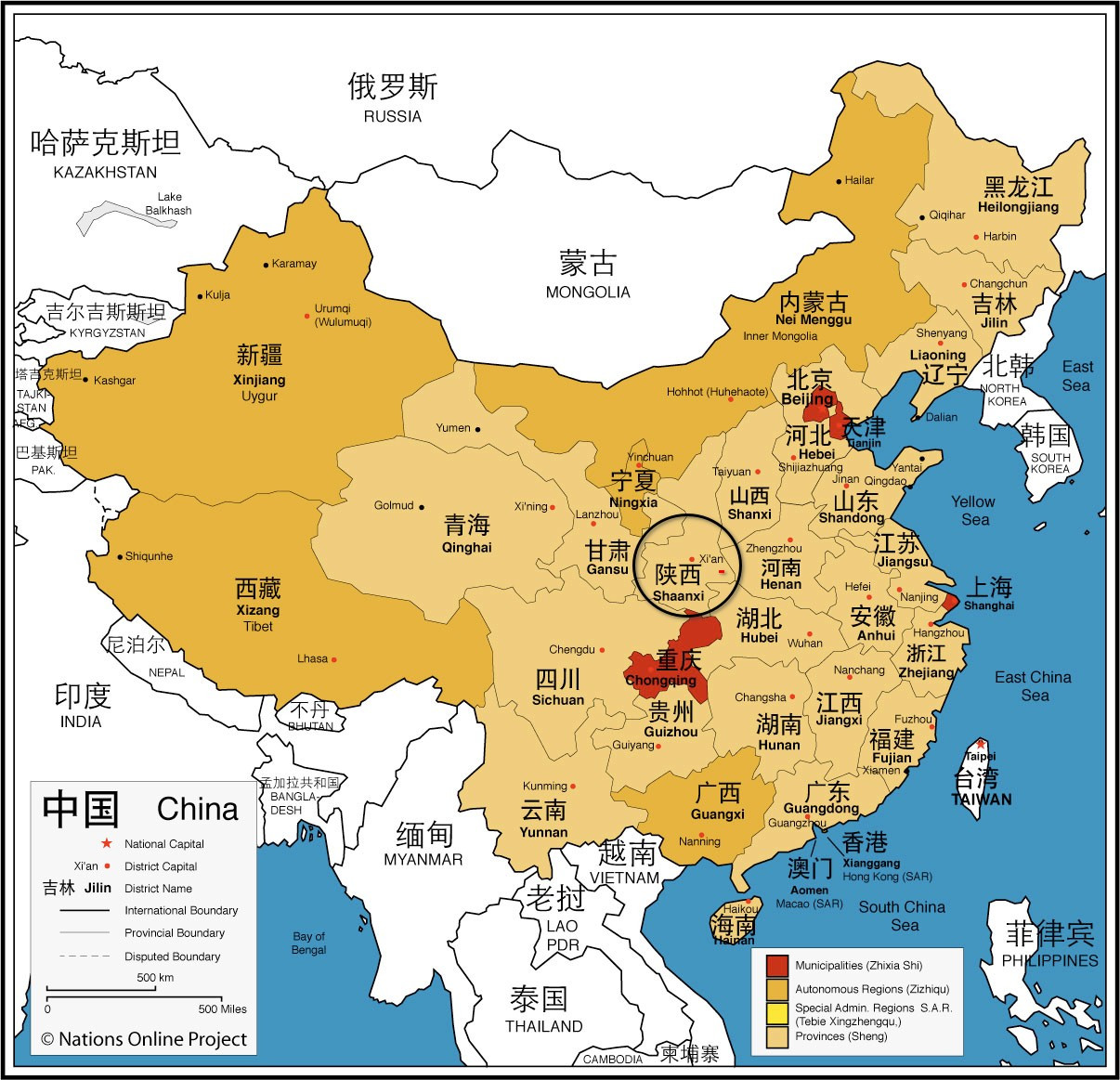
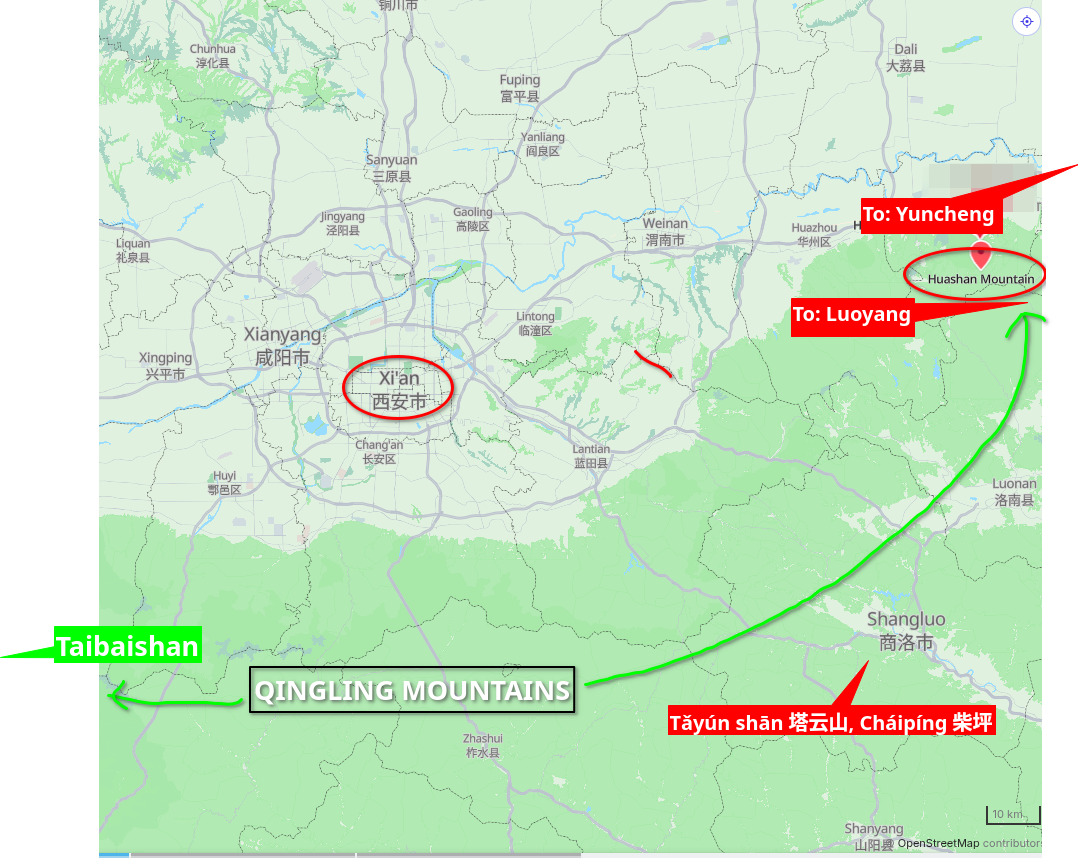
On August 15 and 16, 2025, two Weibo social media page showed the actors receiving their wrap bouquets and advised audiences to look out for the series which was "continuing to grow", as it awaited a release slot in the queue of dramas projected then for first semester of 2026. The production started slowly to build up momentum through the usual post-production work, pictures and posters releases, interviews and events preparation, seeking investments etc, until the release date finally was announced in May 2026. 3/ FILMING LOCATION AND PLACESProduction designer Zhào Hǎi 赵海 interview, in the above dubbed in English video (Video 7'13, uploaded to YouTube on May 29, 2026) The drama was filmed in Xī'ān 西安 and surrounding region in Shaanxi/Shǎnxī 陕西 province. "The' "Xī'ān Film Studio Fēngléi Era Film and Television Base" boasts a highly realistic recreation of the urban landscape of the last century, exuding a nostalgic and retro feel." As for the rural sets, production designer Zhào Hǎi 赵海 explained that he and his team searched for a suitable location for a long while before finding it within 2+ hours drive away, in the nearby mountains. The road was actually rather dangerous, but once found, the location was just what was wished for. Jiǔyángōu 九岩沟, mentioned in the drama seems to be an imaginary village, but there are plenty of such localities in the nearby high hills of Shǎnxī Province, which has three main regions:
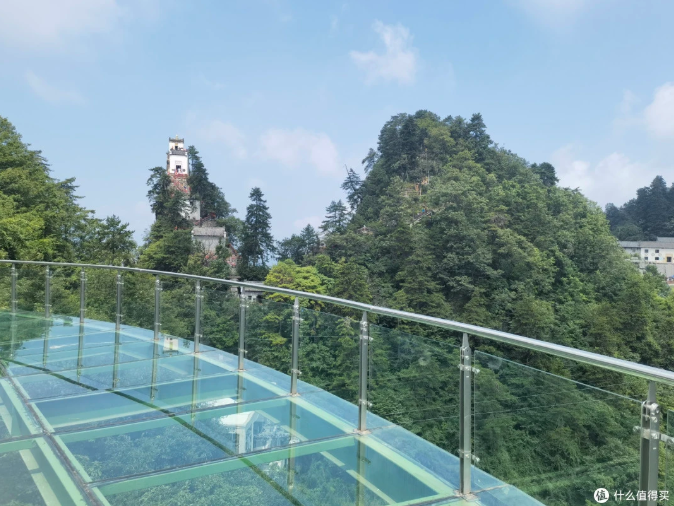
The highest peak in those Qínlíng 秦岭 mountains, Tàibáishān 太白山, stands snow covered all year at 3,771.2 meters /2,372 feet; the area is a national park with protected plant and animal species in the subtropical lower reaches. The distance between Xī'ān and Tàibáishān is approximately 116 km (83 miles), 2 and a half hours drive . But due to protected wildlife and plants, hiking is restricted to marked trails and may be off limits to foreign tourists. The rest of the province has a variety of climates, since the arid loess plateau borders Inner Mongolia to the north, but the central plain is temperate and fertile. The provincial capital Xī'ān, at the southern edge of the loess plateau, is only 120 km away from Mount Hua (Huàshān 华山), which is famous for its scenery, its five peaks and its Daoist temples such as the Bāxiāntái 八仙台 "eight immortals terrace". (Trail map link). Qin'é is an imaginary character, and the place she was born in was inspired from Cháipíng zhèn 柴坪镇 midway between Tàibáishān and Huàshān, a locality up a mountain road, under the administration of Shāngluò prefecture 商洛市 in Shǎnxī Province, which is located about 110 km (70 miles) southeast of the provincial capital, about 84 minutes drive by expressway. The city is integrated into the Xī'ān One-hour Economic Circle, making it a convenient day-trip destination, and is attracting tourists for its breath-taking Daoist temple perched atop nearby Tǎyún shān 塔云山, its karstic landscapes, canyons, panoramas. This area was where the mountain scenes were filmed.
Maps above : Shǎnxī 陕西 in China borders Inner Mongolia/Nèiménggǔ 内蒙古 to the north, Shānxī 山西, Hénán 河南 and Húběi 湖北 to the east, Níngxià 宁夏, Gānsù 甘肃, Sìchuān 四川 to the west and Chóngqìng 重庆重庆 to the south. The distance from Xī'ān to Luòyáng 洛阳 is about 375 km (ca. 233 miles) by road. ; the high-speed rail travel distance is about 380 km (236 miles), with a travel time of 70 to 100 minutes. (Luòyáng is about 60km from Shaolin /Shàolínsì 少林寺 temple) The distance from Xī'ān to Yùnchéng 云城 is about 241 km (150 miles) by road and 223km (60 to 90 minutes) by high-speed rail. Distance from Xī'ān to Huàshān华山 is about 241 km (150 miles).
Sānménxiá 三门峡 in Hénán province is famous for its dam and swan lake wetlands, its Shǎnzhōu 陕州 Underground Pit Courtyards, unique underground dwellings carved into the loess plateau ; Hangu Pass (Hángǔguān 函谷关in present day Lingbao City), a historic strategic point mentioned in the Tao Te Ching (Dào Dé Jīng 道德經, the founding text of Lǎozǐ 老子 and the Daoists) , and the Bǎolún Pagoda (Bǎolúnsì tǎ 宝轮寺塔), one of only four echo-producing structures in China.
|

#/media/File:EN-QIN260BCE.jpg)
EPISODES OVERVIEW (Project in the works if I have time, when I will re-watch the drama)
3. Episodes overview |
The story is about the development of a child into a Chinese Opera female martial arts artist. At first, she is bewildered at her sudden transplant from the countryside, torn away from her familiar environment and parents, and with few clues as to why people act as they do around her. Her only defense at first is silence, but she lacks education and models, so she is pushed and formed by the people around her, accepting the hopes pinned on her, without resentment. Her strength slowly grows from there, but her later sentimental journey will not be easy.
theematchabun figured out in comments Qín'é’s age by year & episodes :
1976 | 11 yrs old (ep 1-14)
1982- 86 | 17 yrs old - 21 - almost 22 (ep 14-24)
1987- 88 | 22 yrs old - almost 23 (ep 24-34)
1990 | 24 yrs old - almost 25 (ep 34-36)
The story starts in the year 1976, which is the last year of the Cultural Revolution.
#1 Hú Sānyuán went up the mountain to find a "poor student" to teach ;
Director Huáng Zhèngjīng told the troupe they had been assigned to play Xiǎng Yáng Hóng 向阳红" On the mountain, "Sing a folksong to the Party" was heard echoing. On the Opera base, Huā Cǎixiāng crooned "Azalea" softly to herself ; Mǐ Lán was rehearsing the lead role. On the mountain, voices sounded an ironic ditty about uncles. Hú Sānyuán took Láidì and the wrecked bike to Qín Bāwá's shop; Láidì choked on her first wheat bun. Huā Cǎixiāng complained about Hé Dàchui's inept drumming . On arrival in the city, Láidì witnessed a parade marching and singing "Socialism is good", on her way into the Opera base, they saw a stretcher carrying a woman out ; Huā Cǎixiāng explained it was Huáng's wife who had drunk pesticide in a fit of anger because of an anonymous letter slandering Huā Cǎixiāng and Huáng for having an alleged "illicit affair".
|
|
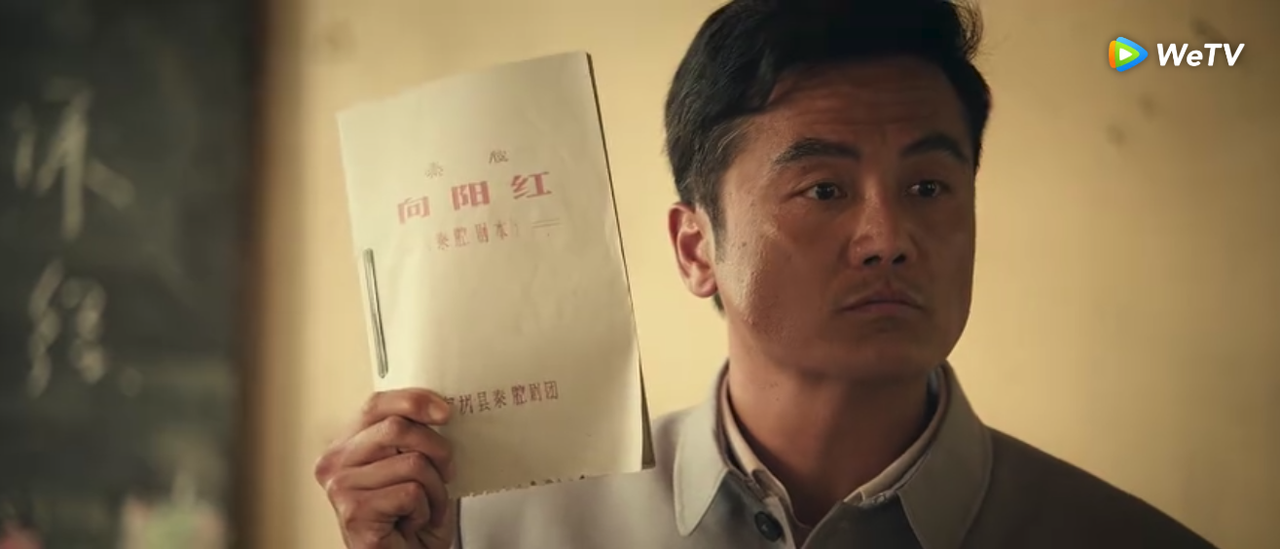
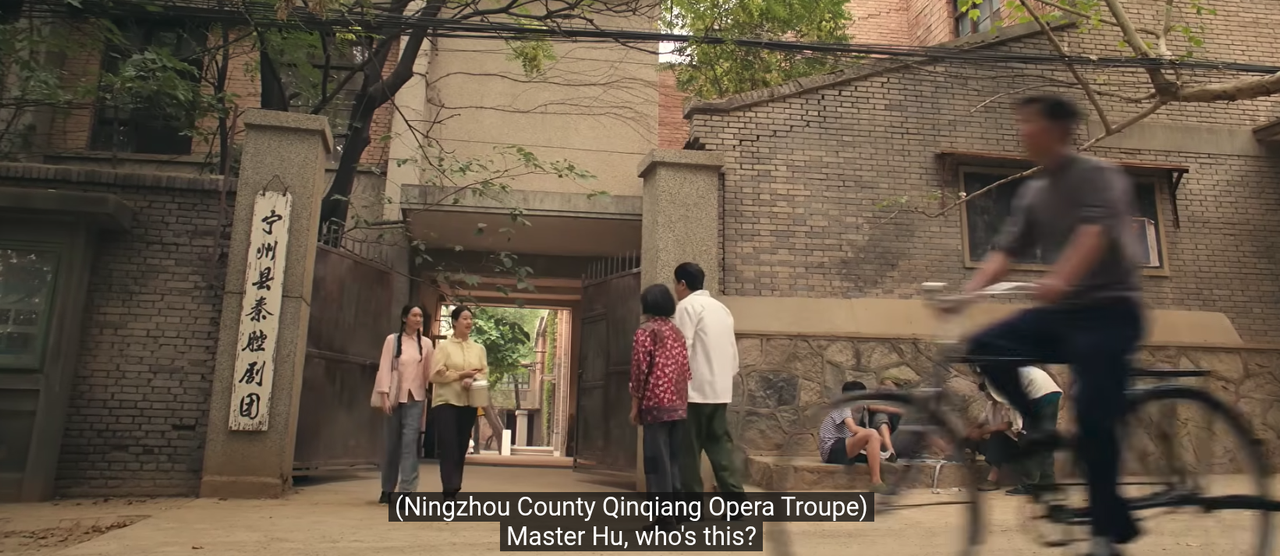
#2. Hú Sānyuán suggested Láidì be renamed Yì Qīng'é (but for the time being, she would still be called by her original name). The girl refused to speak or sing, only sniffed when she was spoken to. Hú Sānyuán found Mǐ Lán in the darkened meeting hall, practicing in secret the songs for the role. She helped him tend his wound.
Back in her room, Cǎixiāng had bathed Láidì and cut her hair. She suggested Láidì's stinking clothes be washed and altered as a costume by Bái Xié 白鞋 ("White Shoes, a nickname), who scared Láidì with her White Hair Girl opera wig, but kindly took Láidì's measures to make her new clothes.
Cǎixiāng took Láidì to sleep in her room, since it was inappropriate to let the 11 years old girl sleep in her uncle's room. Outside, members of the troupe were using the communal sink in the courtyard, singing the Xǐyī gē (Laundry Song). A tap on the windowpane got Láidì introduced to Bāyī 八一 but she only sniffed in answer to his questions. They were threatened by an arrogant big boy. In the courtyard, Mǐ Lán led the song "Azalea".
Next day, after a night of snoring, Láidì was still silent. Hú Sānyuán got worried when he heard he had been stricken from the examiners list because of the slander. Cǎixiāng took Láidì to train in the assembly room and they found Mǐ Lán training 12 years old Chǔ Jiāhé. Cǎixiāng brought Láidì to the costume room and gave her some advice.
Later, Láidì met Bāyī again. The son and kitchen hand of Master Sòng (宋师傅) , the cook, yearned to become an opera performer, but his father scolded him. At the morning meeting, Cǎixiāng was told that Mǐ Lán would replace her for the performance because of the rumors.
|
|


#3. The performance of Xiǎng Yáng Hóng drew a crowd ; the townspeople expected Cǎixiāng in the lead role but it was too late to switch so Mǐ Lán did her best. A plank prop was missing, with the political message thus truncated; Hú Sānyuán had an idea : he made Láidì stand in front of the missing part as a scarecrow, which both surprised and delighted the public. Her first, silent, role was a success !
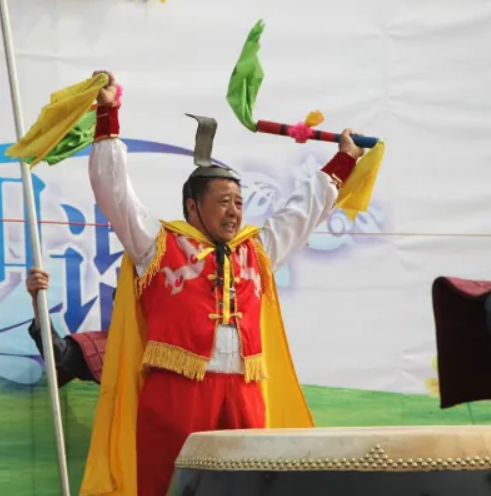
There was a scare when Hú Sānyuán was taken away by the police for questioning about the anonymous slander letter, but the matter ended up amicably with Hú Sānyuán demonstrating his art of drumming for the policemen, by beating with his sticks on tin plates and pans to explain the roles of the different drums : tánggǔ 堂鼓 ceremonial drum ; bǎngǔ 板鼓 frame drum with high pitched sound, Zhangǔ 战鼓 war drum...
Back in bed, Cǎixiāng told Láidì the sad story of the namesake colleague who had fallen to her death in an accident and who Hú Sānyuán and the senior members of the troupe still remembered.
Next day, to enlist supporters for his niece's application as trainee, Hú Sānyuán went to see Director Huáng (who was non-committal and did not even support his own kin), Qín Bāwá (who acknowledged that he had covered up for the scarecrow part), and Hé Dàchui (using blackmail to coerce him).
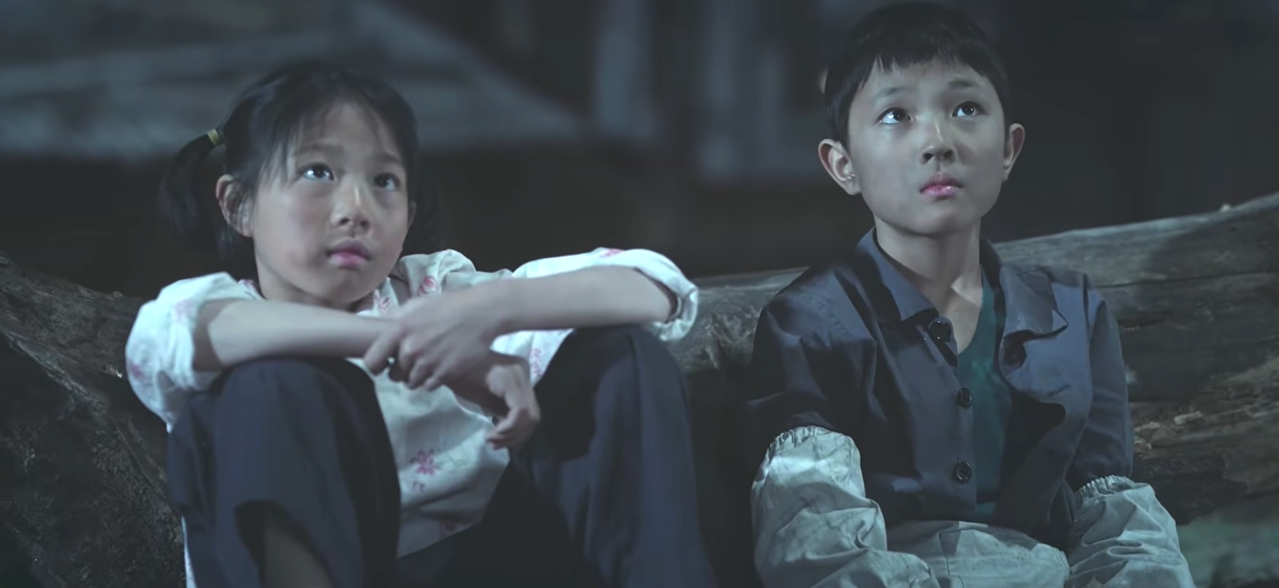
#4. Hú Sānyuán was ambushed and beaten when he stepped out from the cinema where he, Cǎixiāng and Láidì were watching a movie. The little girl got scared and would not obey Cǎixiāng who wanted to teach her the Pān Dōngzǐ 潘冬子 role singing "Twinkling Red Star"; she ran off but was caught by Hú Sānyuán who managed to coax her to sing for the first time. On their way back, Hú Sānyuán went to confront Hé Dàchui (who had staged the ambush) and rode him back to the base on his bicycle. Hé Dàchui revealed that Huáng 's weakness was Hēi Wá 黑娃, his nephew, even more clueless about opera than Láidì, but supported by Huáng 's wife.
In the evening, Bāyī shared some rock sugar with Láidì. Next day, at the audition, after being called in just after Fēng Xiāoxiāo who had brilliantly performed the Red Star song and even played the accordion, she suddenly broke into a loud and stinging complaint which stunned the examiners.
|
|

4 - MUSIC |
Date.of.release.........................................发行时间:2026年5月15日 Composer:.Zhang.Yilin..........................作曲:张镒麟 | 曲目: 1.主角开篇 (Main character's opening) 2.胡三元 (Hú Sānyuán) 3.钻烟囱变奏之欣欣向荣 (Variations: from the ashes) 4.久远里的秦腔 (Qínqiāng Opera from distant past) 5.小桃红 (Xiǎo Táohóng, Little Peach blossom) 6.小桃红的变奏之晨起训练 (Variation: Morning Training) 7.他舅 (His Uncle) 8.三滴血的动机时间变奏 (Three Drops of Blood Motive Time Variation) 9.赶坡之女主拓展主题 ("The Heroine from the Hills" theme expansion) 10.赶坡之中性上行 |
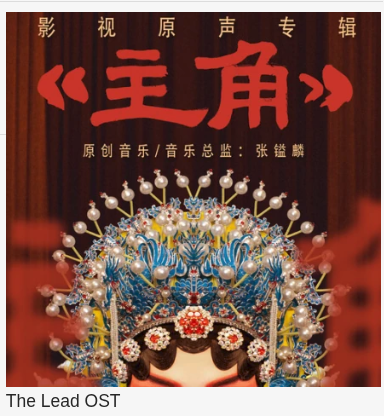
The OST list on the Baidu drama page is very long. I have organized below the titles in a table with links to quick access for the songs and/or to the post with further information further down in the Companion piece i.e. .........Music Part A (OST, popular songs, revolutionary songs), ........Music part B (Chinese Operas) which you can access also through the Table of contents. [key :click on link to section, which is next to tune title, check by number next]
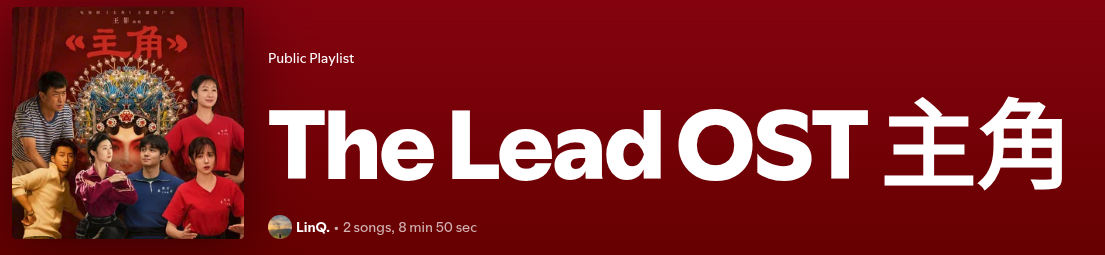
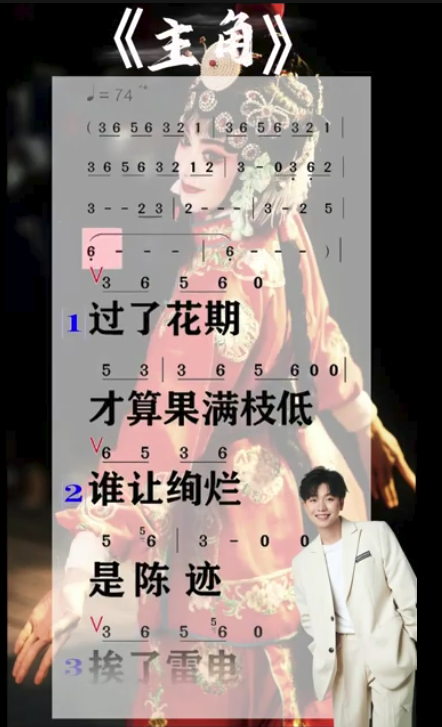
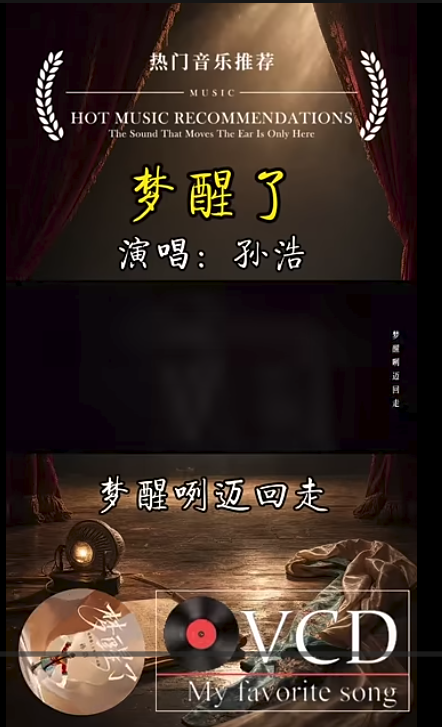
The OST songs [section A] 《主角》 / Zhǔjiǎo (Protagonist sung by Faye Wong WángFēi /王菲 《梦醒了》 / Mèng xǐngle (The Dream is Over sung by Sun Hao 孙浩 Baidu mentioned another song sung by Tán Mǐnmǐn 谭敏敏 but it seemed still unreleased as of June 8. |
The revolutionary songs [section A] #1 - 《社会主义好 / Shèhuì zhǔyì hǎo 》 (Socialism is Good) - 1958 #2 - 《祝酒歌》 / Zhù Jiǔ gē (Toast Song) - 1979 #7 - The Internationale, 《国际歌》/ Guójì gē, mandarin version - 1923 #8 - 《咱们工人有力量》/ Zánmen gōngrén yǒu lìliàng (We Workers Have Power) - 1947 #10 - 《映山红》/ Yìng Shān Hóng (Azalea) (Dāo Lǎng and Demiana Tadrous versions) -originally 1974 #11 -《洗衣歌》/ Xǐyī gē (Laundry Song)- 1964 #12 - 《 唱支山歌给党听》/ Chàng zhīshān gē gěi dǎng tīng (Sing a folk song to the Party-1963 #13- 《 在北 京的金山上》Zài Běijīng de jīnshān shàng (On the Golden Hill of Beijing) -1972 #14 - 《我爱北京天安门 》/ Wǒ ài Běijīng Tiān'ānmén (I Love Tiananmen Square in Beijing -1970 #15 - 《共产儿童团歌》/ Gòngchǎn értóngtuán gē (Communist Children's League Song) --1930 #21 - 红星歌》/ Hóngxīng gē (Red Star Song) -1974 #22 - 红莓花儿开》/ Hóng méi huā er kāi (Red Cranberry Flowers Bloom) - 1950 |
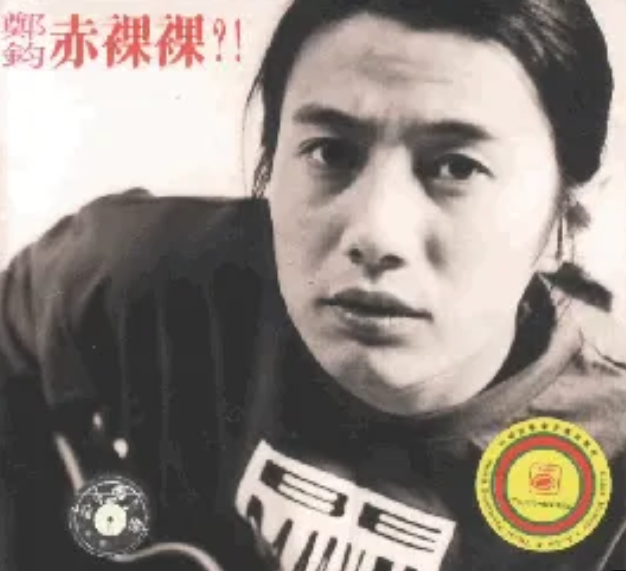
The popular songs and other songs [section A] #3 - 《无地自容》 / Wú Dì Zìróng (Too Ashamed To Exist), performed by Black Panther / Hēi bào 黑豹 rock band, with Dòu Wéi 窦唯 - 1987 #4 - 《灰姑娘》/ Huī gūniáng (Cinderella) sung by singer composer Zhèng Jūn 郑钧 - 1994 #5 - 兰花草》/ Lán huā cǎo (Orchid Grass) sung by Liú Wénzhèng 刘文正' - 1979 #6 - 《 童年》 / Tóngnián (Childhood) sung by Lo Ta-Yu - 1982 #9 - 《我只在乎你》/ Wǒ zhǐ zàihū nǐ (I Only Care About You) sung by Teresa Teng - 1987 #17 - 两只老虎 / Liǎng zhī lǎohǔ (Two Tigers) nursery rhyme #20 - 《粉红色的回忆》/ Fěnhóng sè de huíyì (Pink Memories) -1987 |
The instrumental tunes [section A]: #16 - The dying Swan / Le Cygne / 《天鹅》/ Tiān'é composed by Saint-Saens - 1886 #19 - A Maiden's Prayer composed by C: Tekla Badarzewska - 1956 |
The Chinese Opera repertoire and arias : #1 - [section B1] Beating Jiāo Zàn 《打焦赞》 Dǎ Jiāo Zàn #2 - [section B1] The Legend of the White Snake《白蛇传》Báishézhuàn #3 - [section B1] Fox Fairy Tribulation 《狐仙劫》Hú xiān jié #4- [section B1] Beheading Shān Tóng《斩单童》Zhǎn Shān Tóng #5 - [section B1] Zhá Měi àn 《铡美案》(The Case of Chén Shìměi') #6 - [section B2] The Big Truth 《大实话》Dà Shí Huà #7 - [section B2] Zhāng Lián Sells Cloth 《张连卖布》Zhāng lián mài bù #8 - [section B2] #9 - [section B2] #10 -[section B2] #11 -[section B2] #12 -[section B3] #13 -[section B3] #14 -[section B3] #15- [section B3] #16 -[section B3] #17 -[section B3] #18 -[section B4] #19 -[section B4] #20 - [section B4] The Female Generals of the Yang Family 《杨门女将》Yáng mén nǚjiāng #21 -[section B4] #22 -[section B4] #23 -[section B4] #24 [section B4] #25 -[section B5] #26 -[section B5] #27 [section B5] #28 -[section B5] Honghu Red Guards 《洪湖赤卫队》Hónghú chì wèiduì #29 -[section B5] #30 -[section B6] #31 -[section B6] #32 -[section B6] #33 -[section B6] #34 -[section B6] #35 -[section B6] The Prince Breaks the Formation 《亲王破阵乐》Qīnwáng pò zhèn yuè #36 -[section B6] Golden Beach 《金沙滩》Jīn Shā Tān |
5- CHINESE OPERA |
Appendix : the popularity of Qínqiāng opera |
Liú Hàocún commented that she went through 6 months of intensive training to master the poses, moves and expressions needed for the drama. Likewise, Zhái Zǐlù (playing the role of Fēng Xiāoxiāo) also trained for "over 6 months" for his own part as he explained in an interview (GIF excerpts below) |


1/ MOVES AND POSES : the "five methods"
Hand movements (gestures), eyes (expressions), body (postures), steps (footwork), and technique (performing methods) are all codified. Here are some that were used in the drama :
| The ‘lying down' pose ( 卧鱼/wò yú). is the hardest one to achieve. It is soft, slow and elegant, but requires extreme back flexibility, strong core, muscle endurance, balance, breath control and leg control are needed to move slowly without collapsing, the neck and shoulder must stay relaxed while supporting the arch. It usually requires years to be mastered. (Info + video turned into GIF : liliuliucun , X) | ||
| Trainig to juggle and catch the spear was a lengthy process; Liú Hàocún sometime joked that it was necessary for the performance of an opera involving a "fire stick" or "poker"!
| ||
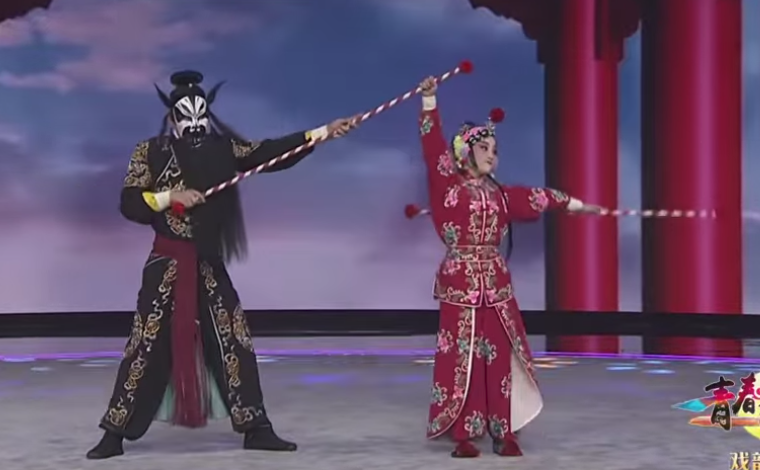
| Dàchūshǒu 打出手 "fighting" or kicking back spears from various directions without dropping them is a required skill for Wǔdàn actresses. | ||
| Traditional Opera coach Rèn Xiǎolěi 任小蕾 focused on hand movements and showed the Lánhuā hand (Orchid Finger), a fundamental stylized gesture. It is achieved by pinching the thumb and middle finger together while extending the other three fingers, creating a shape reminiscent of an orchid blossom. [5 minutes BTS video posted June8, 2026 to YouTube.] More hand poses can be found in this feature from the magazine "That's Beijing " of June 27, 2019, such as 逗花 dòu huā (cupping one’s hands in obeisance or greeting.) ; 挹翠 yì cuì ( ‘pouring jade,’ one of the many ways to hold a fan) ; 蒨蒨 qiàn qiàn ("flourishing,’ in the process of rolling up her sleeves), etc. Short video for other hand moves: here. | ||
| In the same video as above, Rèn Xiǎolěi discussed the importance of eye movements, known as yǎnshén 眼神 , noting that in traditional Chinese Opera, false eyelashes are not used. Fixed Gaze, Shifting Eyes, and rapid, constantly changing movements are essential for roles like the Huādàn (see roles, below ); for males, the exaggerated stares and rolling eyes are more common for Jìng roles (generals, gods, or bandits), with makeup that heavily emphasizes the eyes. The eyes techniques training historically involved following doves flying in the sky without moving the head or the body. | ||
| Footwork is also codified. The performer often walks fast, with small steps, in a circle that represents "traveling a long distance". If he waves a tasseled horsewhip, then he is riding. To get on the horse, or over a rocky path, he will do a high leg kick, and many more if the horse is galloping. Female Dàn 旦角 walk with very small steps, which make them look like floating, They may use special platform shoes evoking bound feet, in the Cǎi qiāo (踩跷), literally "walking on stilts" difficult "false foot" technique. | ||
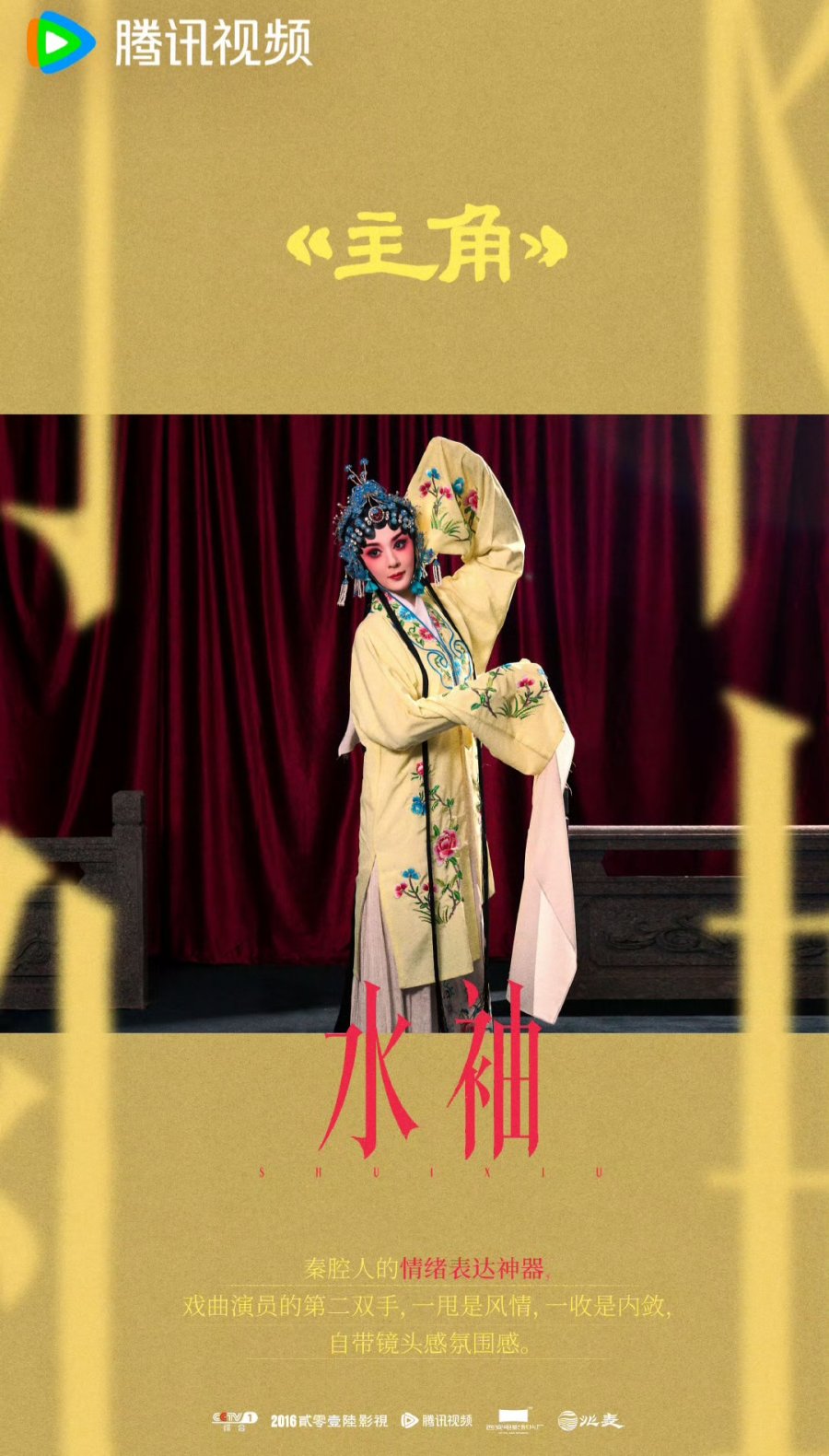
| Shuǐxiù 水袖 ("water sleeves). These are long, flowing silk extensions attached to the cuffs of costumes, widely used by male and female characters of higher social classes, these sleeves transform hand gestures into fluid, water-like movements that amplify the performer's inner states. Sometimes the water sleeves can extend like ribbons although that is more for dancing. | ||
| Among the spectacular techniques, some kept secret are the rapid mask and costume changes (biàn liǎn 变脸) in mere seconds in Sìchuān opera and, occasionally, in Wùjù (aka Jīnhuáxì 金華戲) opera. This is used for specific roles for supernatural entities, demons, and shape-shifting spirits to illustrate their magical ability to transform. An example is the White Bone Spirit (Báigǔjīng 白骨精) from the play Sūn Wùkōng 孫悟空Thrice Beats the White Bone Spirit (Sān dǎ báigǔjīng 三打白骨精). Chinese opera also mixes in juggling and acrobatic moves that are extremely skilled, with dangerous jumps and "zombie falls" backwards "to die" or faint, or jumping on spear points. |





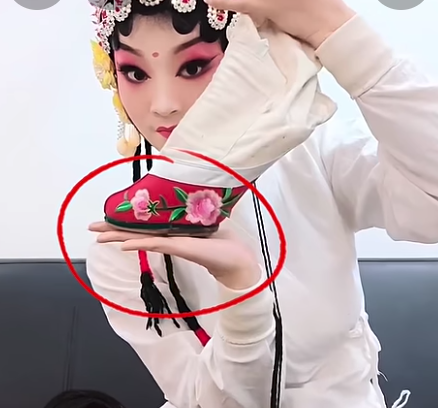


In this little non standard 京剧 play, "The war between the herons and the vultures.", several moves, poses and techniques are used including the ribbon (8'17, posted to YouTube July 2018, English subtitles)
2/FACIAL MAKE UP and MASKS
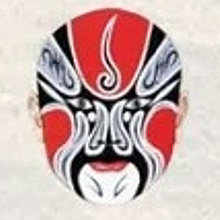
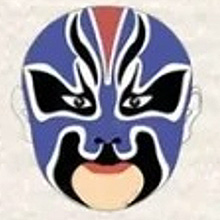
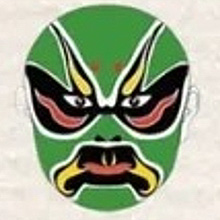
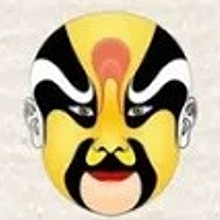
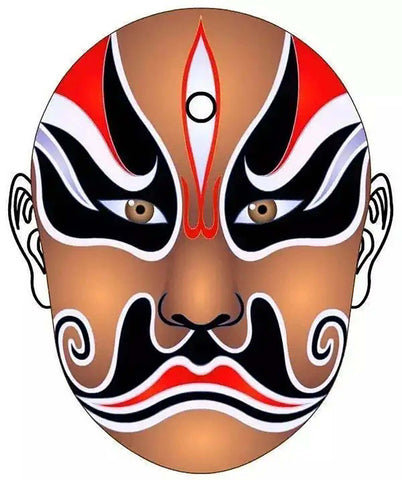
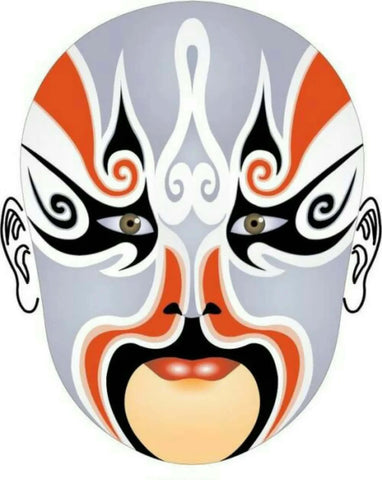
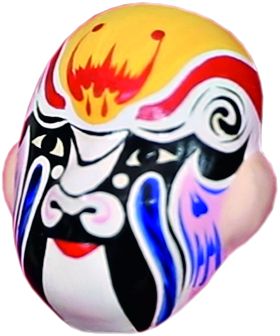
In Chinese Opera, especially In Běijīng opera (Jīngjù), facial makeup patterns, known as Liǎnpǔ (脸谱), function as a visual code to instantly reveal a character's personality, moral alignment, and fate. It is like a visual shorthand language and it is better to read up and learn about it in a book with close-up pictures and stage photos before attending an opera . The interpretation relies on a strict system of colors and pattern complexity. This system allows the audience to understand a character's role and moral standing immediately upon their entrance, serving as a "visual lexicon" for the opera's narrative. With masks, it is also possible to express changes, and Sìchuān opera is particularly spectacular in this respect, with its sleight-of-hand mask changes : the masked actor will change masks at lightning speed until the skin make-up underneath is revealed...
1/ Each COLOR corresponds to specific character traits:
| |
|
|
| |
|
|
|
|
|
|
|
|



2/ PATTERNS
|
|
|
|
|


 Makeup colors for female performers are different and more unified with a face looking pale and pink, red "bud" shaped lips : they generally do not wear the elaborate, patterned facial makeup (Liǎnpǔ 脸谱) associated with male warriors or villains. Instead, they follow a strict set of rules for "beautifying makeup" (jùnbàn 俊扮), designed to present an idealized, uniform standard of feminine beauty. (see next subsection: the Dàn roles)
3/ COSTUMES, HEADDRESS, AND ROLES
Introduction to the four main roles in Peking Opera (these roles are named same way in other Chinese operas):
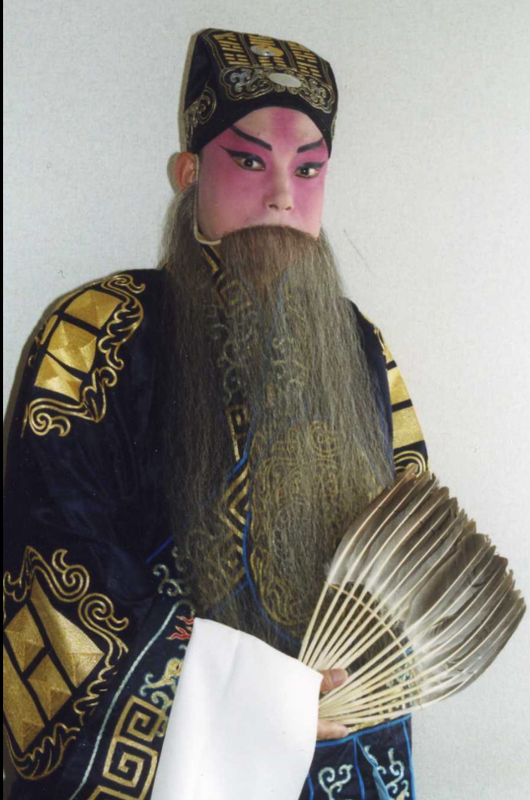
 Some costumes are immediately recognizable, such as the one of the Monkey King. Male roles may have costumes with inbuilt flag holders for warriors, or have simple robe designs and colors for young men and scholars like the blue and white clad characters above ; a more elaborate design may be reserved for a king or emperor like the black-gold character above or have pants like the guard to the right, above. The "shēng " 生 (male characters in general), "jìng" 净 (colorful face) or "chǒu" 丑 (clown) types of characters) are the three main roles for actors, with subtypes recognizable by make-up, dress or headdress, like explained below.
|
| ||
|
| ||
|
| ||
|

.jpg)

 Females characters (known as Dàn roles) generally do not wear the elaborate, patterned facial makeup (Liǎnpǔ 脸谱) associated with male warriors or villains. Instead, they follow a strict set of rules for "beautifying makeup" (jùnbàn 俊扮), designed to present an idealized, uniform standard of feminine beauty regardless of the actor's actual features. The application follows a specific sequence:
White Base: A thick layer of oil-based white paint is applied to the entire face, neck, and sometimes chest to create a smooth, porcelain-like canvas. This eliminates natural skin tones and shadows.
Red Rouge: Peach-red or crimson rouge is applied heavily around the eyes and temples, blending upward toward the hairline and downward to the cheeks. This creates a distinctive "flushed" look that emphasizes the eyes.
Black Accents: Sharp, thick black lines are drawn to extend and shape the eyebrows and eyelids. The eyes are often elongated upwards at the corners to create a stylized almond shape.
Lips: The lips are painted a small, bright red "cherry" shape, often smaller than the actor's natural lips, centered on the lower face
Slight variations exist based on the specific subtype of the female character:
Headdress is simple, such as a scarf , dress is also in darker (blck, blue, white) or simple color and design. Typical roles are Dù Lìniáng (杜丽娘) from "The Peony Pavilion" (Mǔdān tíng 牡丹亭) and Wáng Bǎochuàn (王宝钏) the woman who had trouble recognizing her husband who came back after an 18 year absence in the "Wǔjiāpō" (武家坡) opera . |
|
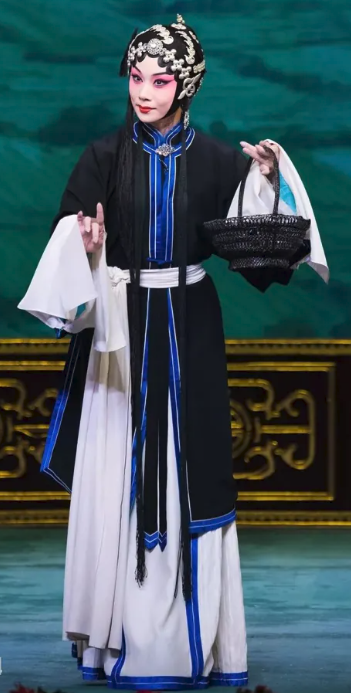
Huādàn 花旦, "flowery role" (Playful/Flirtatious Women): May feature slightly brighter or more extensive rouge to suggest liveliness and coquettish, though the fundamental pattern remains the same. They represent young women, about 12 to 16 years old ; they may be accompanying a Qīngyī lady as the maid. Or they may be queens and princesses with more elaborate pattern costumes called "mang" for the royalty and "guan' for the princesses. The headdress sports pearls/beads and/or flowers. Typical roles : Hóngniáng (红娘) of the "Romance of the West Chamber" (Xīxiāngjì 西厢记) and Yán Xījiāo (阎惜姣) of "Wūlóngyuàn" (乌龙院)
|

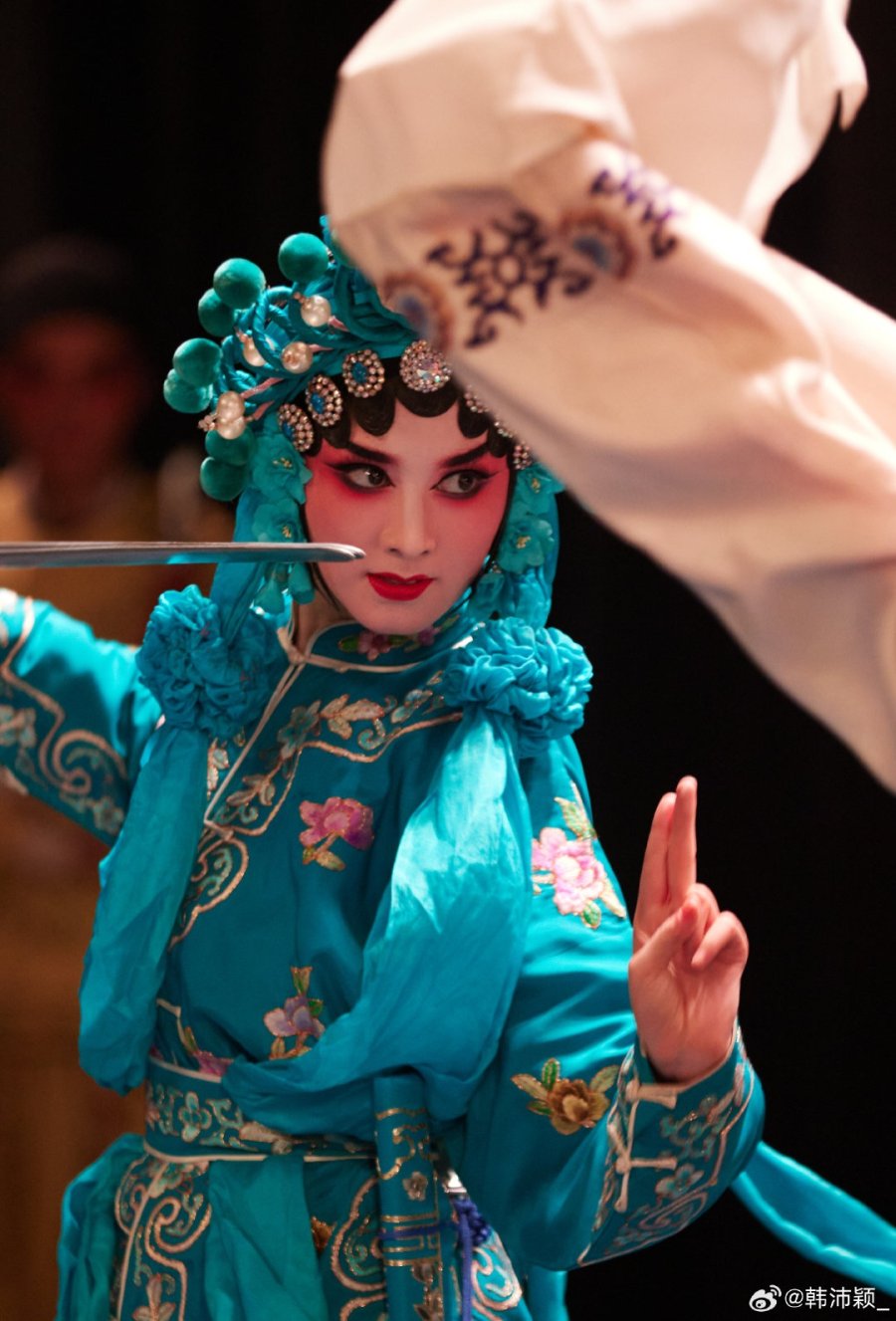
Wǔdàn 武旦 (Warrior Women): While primarily using the standard Dàn face, some fierce female generals might incorporate very subtle martial elements (like slightly sharper eyebrow angles), but they rarely use the full-face painted patterns of male jìng roles. If a female character is supernatural (a demon or spirit), she may occasionally wear more elaborate makeup, but this is distinct from the standard human Dàn roles. They specialize only in fighting hence they seldom sing or speak, but they may use the Cǎi qiāo (踩跷) false foot, performing on tip toe on special platform shoes ; they were required to do so, in the past. They wear an armor called "kao 靠". It is is characterized by its red or pink color and intricate flower and phoenix embroidery. This armor typically features multicolored streamers hanging from the waist and is often equipped with four flags on the back, which signifies the character's military rank and battlefield presence
Typical roles are : Huā Mùlán 花木兰 ; Zhīzhū jīng (蜘蛛精) 'spider demon' of "Pánsī dòng" 盘丝洞 (Spider cave, a story from "The Journey To The West") and Hù Sānniáng 扈三娘 a prominent female character in Chinese opera, primarily known as a warrior from the classical novel "Water Margin" aka "Outlaws of the Marsh") : nicknamed "Ten Feet of Green"; she is characterized by her superb martial arts skills, particularly in using Sun and Moon Double Blades and a red lasso.
Among the Wǔdàn are the Dāomǎdàn 刀马旦 (literally "sword and horse females") who are specifically associated with cavalry combat and armor. Typical roles are Liáng Hóngyù 梁红玉 (wife and warrior in the army of her husband Hán Shìzhōng who was fighting the Jurchen invaders in the 12th century) and Mù Guìyīng 穆桂英, a prominent figure in the Generals of the Yáng Family legends.
The headdresses of Wǔdàn or Dāomǎdàn warrior women also sport róngqiú ("velvet balls") or Língzǐ翎子 or zhìlíng 雉翎, pheasant feathers: "if they bite them, they express shyness but if they shake them, they are furious". |
4/ STAGE PROPS
In Sìchuān opera, Qièmò 切末 is the name for all stage props and some simple decorations. They have the characteristics of "one thing with multiple uses" and "a combination of practicality and substitution". They include articles of everyday life such as candlesticks, lanterns, fans, handkerchiefs, brushes, paper, ink and ink slabs, tea sets and wine sets; sedan chairs, vehicle flags, oars and horse whips; weapons (Waving a whip means riding a horse, and waving an oar means rowing a boat); and various articles to demonstrate environments, such as cloth backdrops to represent cities, curtains, flags, table curtains and chair covers. Traditional Qièmò are not just imitations of real articles, but artistic articles in their own right.
Tables and chairs are usually made of wood and painted in red. They may be used to represent generic furnishings or an imperial desk, a judge's desk, or a banquet table. The table can also be used as a rock or other objects. When a person goes up a hill, he stands on a table. One table on top of another means a particularly high mountain. The table can also represent a wall for jumping over. Slumping over a table with the head resting on one hand means to have a sleep. Climbing from a low hill to a higher one is represented by stepping from a chair onto a table. Chairs can be used to represent the doors of caves or jails.
| Flags are also frequently used. A square flag with the Chinese character for "marshal" on it, a rectangular flag with the Chinese character for "commander" on it and a flag with the name of a certain army on it represent the location of army camps and commanders-in-chief. In addition, there are water 水, fire 火, wind 风 , and vehicle flags (the latter show a stylized wheel). Actors shake these flags to represent waves, fire, wind or moving vehicles. |
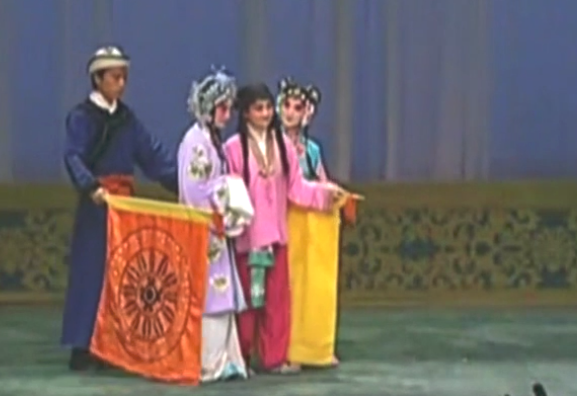
Flags are also frequently used. A square flag with the Chinese character for "marshal" on it, a rectangular flag with the Chinese character for "commander" on it and a flag with the name of a certain army on it represent the location of army camps and commanders-in-chief. In addition, there are water 水, fire 火, wind 风 , and vehicle flags (the latter show a stylized wheel).
5/ MUSIC INSTRUMENTS - THE OPERA ORCHESTRA
Many Chinese Operas rely a lot on the rhythm and tunes played by the ancient or folk instruments :
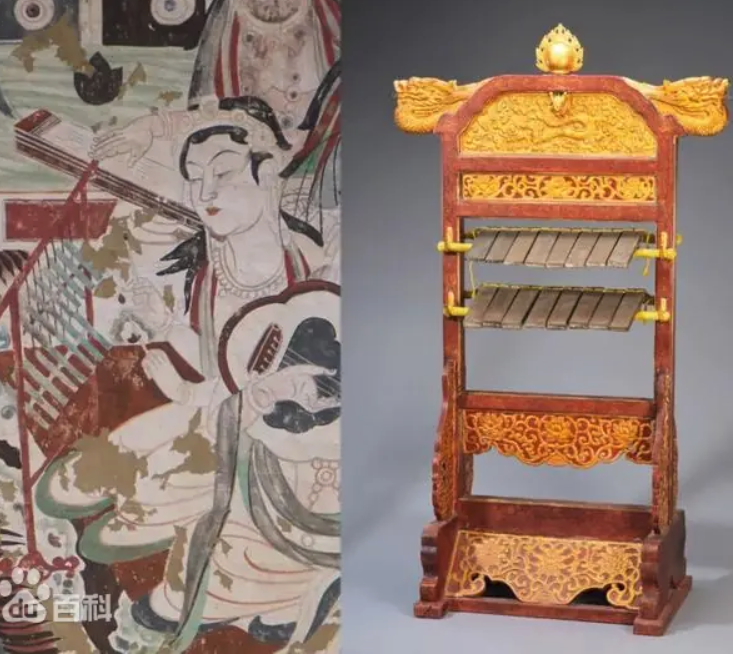
percussion gives the rhythm and time such as for battle parts, and signal beginning or end of expressive parts: the music instruments include gongs, Fāngxiǎng metallophone, drums like the big war drum Zhàngǔ or smaller ones, clappers etc,
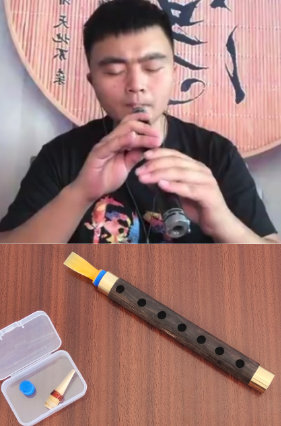
loud and persistent notes underline the solemn or joyous feelings, from the Suǒnà trumpet or the Guǎnzǐ reed clarinet,
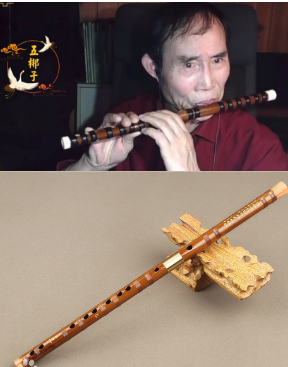
more melodic tunes are played by the flutes like the horizontal Dízǐ, or the Shēng reed pipe mouth organ (for pictures and description of some of these, see Section 12 B6 #35- The Prince Breaks the Formation 《亲王破阵乐》Qīnwáng pò zhèn yuè) or by string instruments such as the Chinese violin "èrhú", the big lute "pípá",and/or zithers such as the "gǔzhēng".
6/ VOICE AND PITCH - TYPES OF OPERAS and Qínqiāng
Liú Hàocún training and rehearsal for voice and poses (video without subtitles, 1'46; posted May 10, 2026 on Liú Hàocún official channel of YouTube)
There are more than 360 different types of Chinese Operas. They have been performed for over 900 years in China, with evolution and traditions. The more widely known are :
Běijīng Opera, Jīngjù 京剧
Sìchuān Opera Chuānjù 川 剧 (typically with sleight-of-hand face mask changes);
Yuè Opera Yuèjù 越剧 from Guangdong
Kūnqǔ opera 崑曲 (adaptations of romantic novels and stories with emphasis on voice, from the Jiangnan);
Huángméi opera Huángméidiào 黃梅調 (with large parts in spoken dialogue) ;
Qínqiāng opera Qín qiāng 秦腔 (with specific rhymes in Shǎnxī dialect, and use of wooden clappers, from which it is also called Bangzi opera and Luàntán (亂彈, literally "hit in chaos"),
etc.
The Yisu Art Troupe, the oldest opera group still performing in China, has staged Qínqiāng Opera since it was established in 1912. It illustrates the history of this art (video posted to YouTube on Dec.29, 2021, 23'58, English narrated) |
The Thirteen Rhyme Categories of Qínqiāng Opera are a vocal technique term in Qínqiāng 秦腔 singing. Their core focus is the vowels within syllables, consisting of three parts: the initial consonant, the main vowel, and the final consonant. The main vowel is generally formed by the vowels a, o, and e; if these are absent, vowels such as i, u, and ü can also be used. The initial consonant is limited to i, u, and ü. The final consonant is divided into two categories: diphthong finals and nasal consonant finals. This system classifies rhyme categories into thirteen categories based on the principle of identical or similar main vowels (consistent final consonants), including the rhyme categories with variegated vowels (a...).
APPENDIX : THE POPULARITY OF QINQIANG OPERA
Meeting masters. "Ivica Radojkovic studies at Northwest University in China's Shǎnxī Province. He spends his spare time immersing himself in Qínqiāng opera, studying its martial arts-inspired movements, practicing its singing styles and exploring its ornate costumes. " (May 26, 2026, CGTN clip on YouTube, 2'47, with English subtitles) | |
The Huāliǎn 花臉" (or Painted Face, another name for the Jìng 净 male role) brought together Qínqiāng Opera and modern Rock music in a "battle song."for the December 2024 Counter-Strike game exhibition, offering music and esports enthusiasts worldwide a unique audiovisual experience. (Dec.2024, CGTN clip on YouTube, 3'40, with English subtitles) | |
A full 2hrs 25 celebration of Qínqiāng with Qín mountains and folk culture for the 2023 Chinese New Year TV show (posted to YouTube on Jan 0, 2023, 2hrs25, no subtitles) |
5 - RECEPTION |
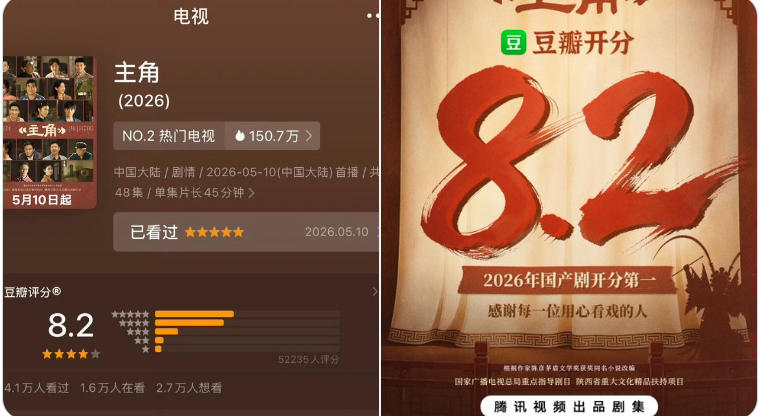 Douban score on June 1, 2026 from 52,000 ratings in China (the highest in 2026 to date, for a drama)
 Since beginning to air, The Lead had captured the attention of a large audience in China and ranked n°1 in views for two consecutive weeks, as reported by the Marcus drama news vlog.
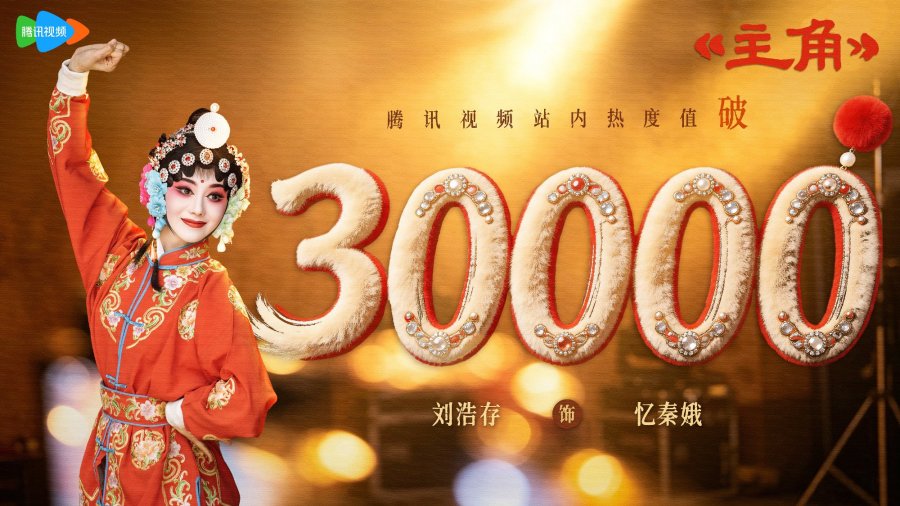
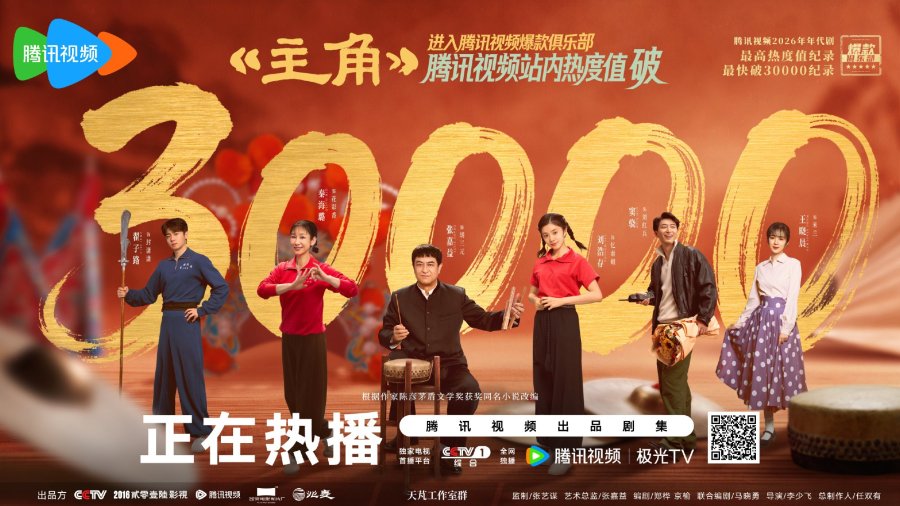
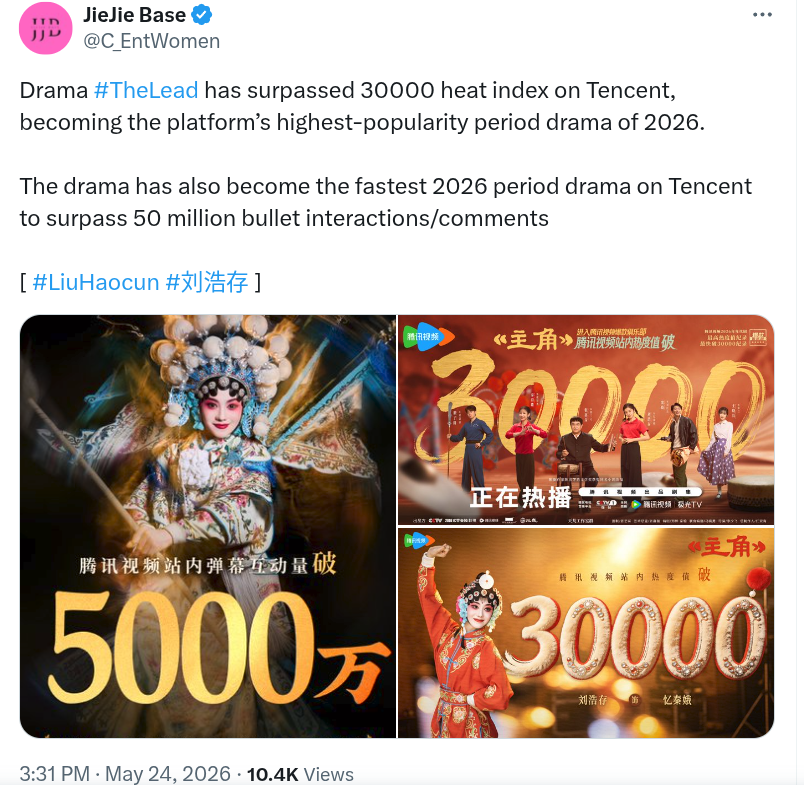
On May 24, it broke 30,000 on Tencent's heat index. (30,000 is considered a big "hit") ; it became the second drama aired by May 2026 to hit this yearly record.
"The drama also became the fastest 2026 period drama on Tencent to surpass 50 million bullet interactions/comments".
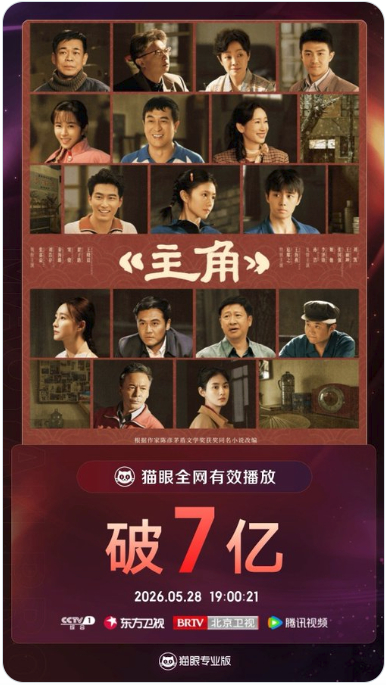
On May 28, 2025,according to Maoyan data, it was reported to have reached 700 million effective views since airing.
|
It has in effect, despite the allure of popular idol actors, overshadowed the competing dramas, even one like "The Heir" about the precious ink making heritage, which has a lot of merits, but was more expected as a conventional costume period romance with a vengeance trope. These two TV series were running almost neck to neck in favor from the public for three weeks, with "The Lead" as champion for two weeks in audience metrics, and only conceding on June7, 2026, with "a gap of 0.3 points, the closest ever seen to date" according to c-drama news YouTube reporter Marcus. On June 15, it was back as "champion" of the week in TV series category.
| The Lead, views rank (weeks ending date):
|
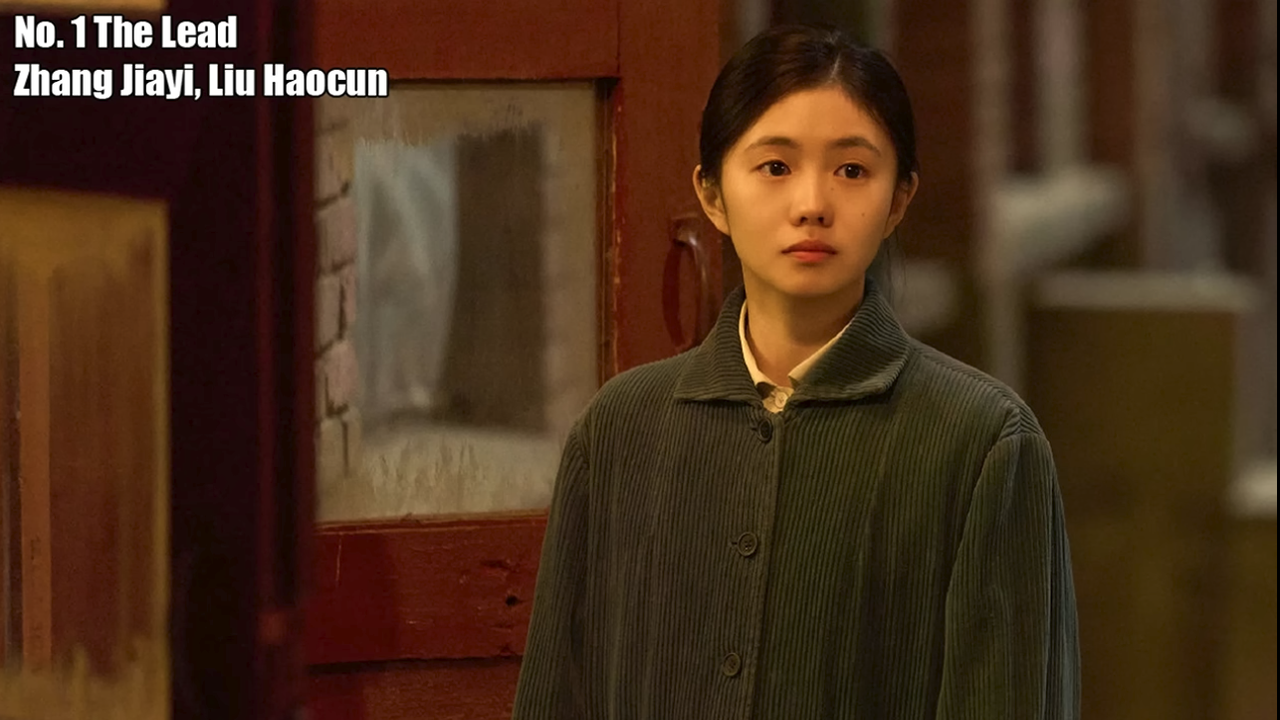
Although less expected than the"ink business drama", "The Lead" did not cater to the usual romance loving audience, but portrayed a more realistic resilient and strong woman in another heritage drama, that despite its less appealing theme (young audiences are not primarily interested in Chinese opera, usually preferring mandopop, hip hop, rap or rhythm and blues, or e-pop derived from game music) sparked a renewed interest for the ancient and demanding art with its special way of using the voice.
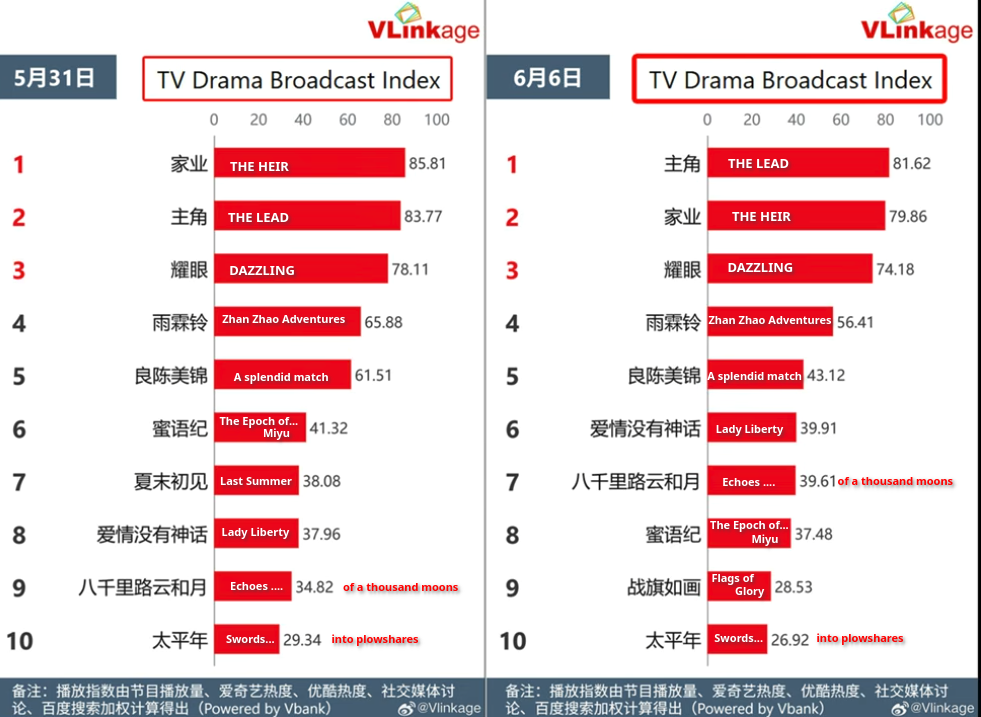 VLinkage metrics of audience for TV dramas during week leading up to June 7, 2026: collected data are added for each series and divided by number of days to get comparable numbers. These specialized audience metrics based on daily clicks and other indicators are useful for studios to evaluate popularity and marketability of the shows. The Lead and The Heir kept alternating for top spot.
Since the drama aired, every week has been bringing batches of BTS compilations and interviews in the medias. The cast may have wrapped filming last year, but this year 2026 is just as busy for them with the promotional duties although this is not a "romance" drama. The praise has been growing and many have been drawn to it from outside the usual target audience for TV series. Even though some, less kindly, have tried unsuccessfully to tie the news about the young actress to an unfortunate incident that happened long ago in her parents' dance studio, or to being only a "well-connected" "Mou" girl because the famous director had her debut as FL in his filmed in 2018 movie One Second (一秒钟). But her dedication and talent is now clear to all and the critics are mostly laudatory.
For part of the audience who were raised in resolutely modern views, the special Chinese genre of "gǔfēng" pop songs, tunes that blend in Chinese opera like singing (such as Red Performer (Chì Líng 赤伶) by HITA), certainly has eased the understanding of classic or modern Chinese opera rhythms , nasal tones and vibrato. All the while, Huángméi style which mixes Chinese Opera style singing with dialogues, has always had much popularity (Zhōu Shēn even sang a special song to celebrate it!. The costumes and movements have also long influenced wǔxiá and "historical" costume dramas from China. The country of Méi Lánfāng 梅兰芳 has not forgotten the "Jīngjù" and other hallowed opera styles cultural roots, and The Lead drama may spark a revival in studies of Chinese opera (which can be an elective subject in Chinese universities, which may offer workshops in view of cultural events. Thus, students can learn about the art and practice for "intellectual leisure" since Chinese opera is both based on physical training and other arts, with the costumes, make-up, and use of voice projecting. Avoiding the more strenuous physical stunts, the singing and some moves are also "taught" in continuing education classes or "retiree colleges" in many cities, so the knowledge is far from lost although some young people saw it as outdated).
The songs listed for The Lead drama by Baidu made me nostalgic, since several were hits that we knew then. I am sure the appeal and nostalgia, the memories or stories passed down, sparked by the soundtrack have also touched very personally many others and much contributed to this drama's being launched on its successful orbit in China. Of course, it may be more difficult to understand for people abroad with no prior knowledge about Chinese classical and pop culture or how the country evolved in the past 70 years or century, or simply these audience may be more drawn to idol dramas with pretty faces and young men showing nice abs !
6 - THE LEAD : MUSIC - PART APart A - Original songs, popular and revolutionary songs, instrumental tunes |
I have organized in section 4 a shorter list of the OST songs, the 22 other popular or revolutionary songs, and instrumental tunes, and the 36 Qínqiāng opera arias or repertoire pieces, which I have all numbered, listed and detailed below.
|
TITLE of Song or tune ( C: composer ; L: lyrics) | SINGER or performers | |
|---|---|---|
OST songs | ||
link to MV with pinyin and English translation
| 王菲 WángFēi /
| |
| 孙浩 He plays the part of Gǒu Cúnzhōng (the gate keeper) in the drama. | |
《胡三元呀么胡三元》(Hú Sānyuán, oh Hú Sānyuán)
| 谭敏敏 Tán Mǐnmǐn No video release mentioned as of June 8 | |
22 Popular and Revolutionary songs | ||
The song belongs to the genre of political music known as Patriotic Music (爱国歌曲) and Revolutionary Music (革命歌曲) that were spread by the CPC from 1921. The latter, also known as red songs (红色歌曲) were presented differently from the usual national anthems, since the government made a genuine effort to upgrade the music for a political cause. | Xī'ān Youth Music Teachers Choir 西安青年音乐教师合唱团 in drama. (Sung bya marching band in ep.1, as BGM in the cqnteen scene, ep.2) This recording: China Central Orchestra Choir,The PLA Frontline/Qiánxiàn Chorus | Socialism is good sung by PLA choir (subtitled) |
[ In 1976 the order to arrest the "Gang of Four" was followed by a mass rally of 1.5 million Chinese citizens on Tiān'ānmén plaza; Hán Wěi was inspired by a glass of báijiǔ (rice wine/alcohol) there; his original song mentioned Chairman Huà Guófēng but was modified to the versions sung presently]
The song became widely famous after being performed by tenor Lǐ Guāngxī 李光羲 (1929-2022) on the 1979 CCTV New Year's Gala. | Dù Jiànsēn 杜建森 in the drama This recording by Chinese Armed Police Male Choir in 2008 added by uploader to footage from 1976. | Although it was first sung in 1976 by soprano Sū Fèngjuān 苏凤娟 (1929-2020) it was not recorded by her before1978. |
This rock band from the early 1990s, gained fame after Cuī Jiàn 崔健 became the icon of Chinese rock (1989 "A Piece of red Cloth" ; 1986 "Nothing To My Name" etc) Since then, Chinese rock has seen new bands appear, like 二手玫瑰 (Secondhand Rose),回春丹 (Rejuvenation Pill), 逃跑计划 (Escape Plan) with their 2004 hit "The Brightest Star in the Sky") , but rock music stayed relatively "underground". They did perform in park pop-rock festivals like MIDI in Hǎidiàn, Chāoyáng, Tōngzhōu... (preserved footage of Dòu Wéi and band in 1993) | sung by Yè Zǐléi 叶子雷 (no furher info) in the drama Recording from Black panther / Hēi bào 黑豹 rock band, with Dòu Wéi 窦唯 as lead singer.
| Rock bands often performed in in live houses such as Yúgōng Yíshān, which hosted Mongolian rockers Hánggài 杭盖) or other bands like Carsick Cars whose "Zhōngnánhǎi Beijing underground rock scene anthem" (video from 2008) was even used by artist Ài Wèiwèi. |
| sung in the drama by Dòu Xiāo 窦骁 ( Shawn Dou, who plays the part of Liú Hóngbīng)
The recording in left column is by the original singer composer Zhèng Jūn 郑钧 | |
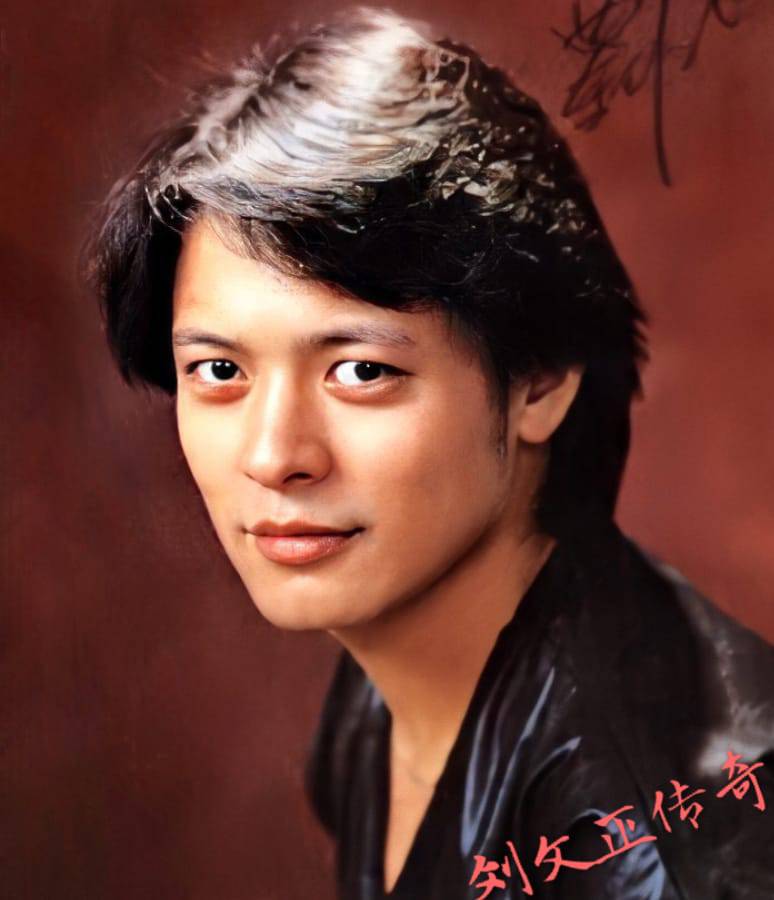
[In the summer of 1921, Hú Shì 胡适 was given a pot of orchid grass, but it didn't bloom until autumn. Inspired by this, he wrote a short poem. Set to music and originally sung by Yín Xiá 银霞 , the song was released on September 1, 1979, in the album "Answer." ( 回答 huídá). In 1979, Liú Wénzhèng's rendition of "Orchid Grass" topped the Hong Kong Dragon and Tiger Chart.]
|
The reclusive former singer b;1952 in Taiwan rose to fame in the '70s and ‘80s, and was once hailed as the ‘First Ancestor of Idols’ for the impact he left on the music industry. He retired in 1983, moved to New York and faked his death in 2022 ! | The fake announcement of the death of Liu Wen Cheng ( links to full article)
|
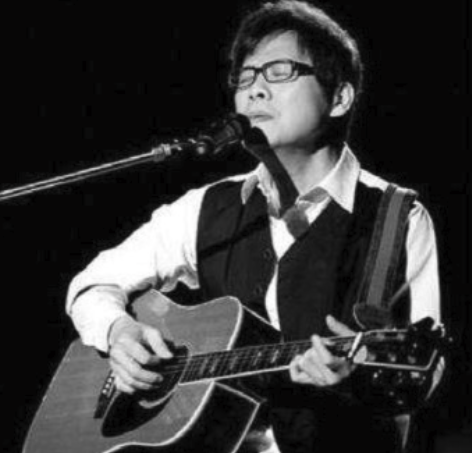
The author-composer is also famous for 明天就会更好 (Tomorrow will be better) from 1985 used in performances by singers who sing together or each sing one line, such as this December 2023 all-stars version with Liú Hàocún singing a line. | Lo Ta-yu's other well-known song (original 1985 recording) + lyrics and translation | |
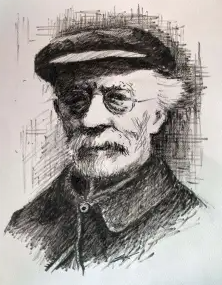
The Internationale is a socialist and communist anthem originally written in French by Eugène Pottier in June 1871, shortly after the suppression of the Paris Commune. The poem was set to music by Pierre Degeyter in 1888. It became the official anthem of the Soviet Union from 1917 to 1944 and remains an international symbol of the labor movement. | Chorus Recorded here in 1997 by Central Symphony Orchestra & Chorus Of China (中国中央管弦乐团及合唱团) | Text of the original French version :
|
| Chorus |
|
[On new Chinese lyrics, different from those written by Araki Toyohisa 荒木丰久 of the original Japanese song "時の流れに身をまかせ" (Toki no Nagare ni Mi o Makase/Give Yourself to the Flow of Time"), which was originally released in 1986]
| Pān Yōuyàn 潘幽燕 in the drama. Originally sung by Teresa Teng / Dèng Lìjūn 邓丽君 | Everybody in China knows the songs of Teresa Teng. |
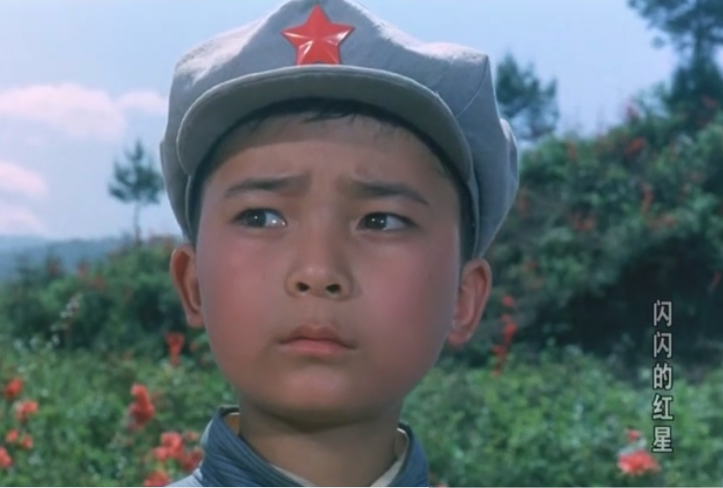
The song was part of the Chinese opera film Sparkling Red Star (闪闪的红星 Shǎnshǎn de hóngxī ; it became a famous Chinese revolutionary song, symbolizing hope and resistance. The movie has been remade into a drama in 2007, starring young Chén Xīngxù 陈星旭. | Qín Hǎilù 秦海璐 (playing as Huā Cǎixiāng) croons it softly in ep.1 The versions chosen are sung by Dāo Lǎng 刀朗 and Demiana Tadrous (rec. in Cairo, 2022, with English translation). The original was sung by Dèng Yùhuá 邓玉华 in the movie. | |
| The version chosen is sung by Péng Lìyuán 彭丽媛; (wife of XJP) in 2007 for a special gala to mark August 1, the memorial day for the foundation of PLA. | |
The lyrics are excerpted from a poem Léi Fēng 雷锋 copied from a newspaper into his "Léi Fēng's Diary," which composer Zhū Jiàn'ěr set to music as a solo folk song. The author of the 1958 poem was Jiāo Píng 蕉萍 (the pen name of an employee of the Jiāopíng Coal Mine of the Tóngchuān Mining Bureau in Shǎnxī Province) It was used as an interlude in the feature film "Léi Fēng ," and was first sung by Hú Sōnghuá 胡松华. [Léi Fēng was the "model worker" celebrated in 1963.] --> link to the song with pinyin and translations | The version found is sung by Yù Kěwéi 郁可唯 + Ā Lán 阿兰 | Baidu listed it n sloppily with the wrong "gē" since 哥 "older brother" and 歌 "song" are pronounced same way! But no, there is no "Brother Zhi Shan in the drama! |
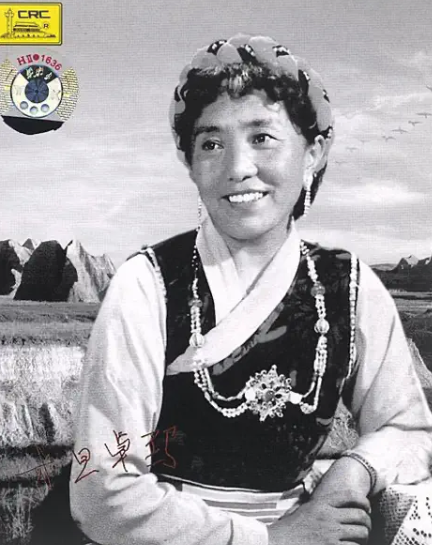
This was originally a religious toasting song from the Shān Nán region of Tibet which solo singer Cháng Liúzhù 常留柱 had learned in Tibet in 1961, . --- Mǎ Zhuō added a prelude, wrote Chinese lyrics to "On the Golden Mountain of Běijīng,". In 1964, the adapted version performed by Tibetan singer Yōng Xī 雍西 received praise from leaders such as Máo Zédōng 毛泽东. Premier Zhōu Ēnlái 周恩来 suggested to change the religiously charged word "heaven" in the lyrics to "on the great road,".)The song became widely popular in the version sung by Tsetan Dolma on broadcast in 1972. Note: Jīnshān (literally: Golden Mountain) refers in fact to the hill called Jǐngshān (景山), literally meaning "Prospect Hill" or "View Mountain." It stands behind the Forbidden City in Běijīng, overlooking the golden rooftops and palaces, a prime place to have a bird's eye view on the capital. |
|
|
[The song was penned by then 12-year-old student Jīn Guólín, who was in 5th grade in 1970, and the music was composed by the 19-year-old apprentice from Shànghǎi Sixth Glass Factory Jīn Yuèlíng ] | This song was part of the daily routine for many primary schools during the Cultural Revolution. | |
[“This song dates back to the early phases of the Chinese Civil War. The melody uses a the tune of a Young Pioneer song "Взвейтесь кострами, синие ночи" from the Soviet Union. The Chinese Communists, many returning from studying in the Soviet Union, refitted it with Chinese lyrics in the 1930s.] | ||
(part of "Le Carnaval des Animaux")
| This recording : Grand gala opening of the new Mariinsky II Theatre in Saint Petersburg, broadcasted live on May 2, 2013 danced by Ekaterina Kondaurova | |
Nursery rhyme This popular nursery rhyme has versions in many languages using the original French tune 'Frère Jacques'; the simple tune made it also a prime vehicle to convey political messages through adapted lyrics such as "Down with the local tyrants" in the 1974 Sparkling Red Star movie. | ||
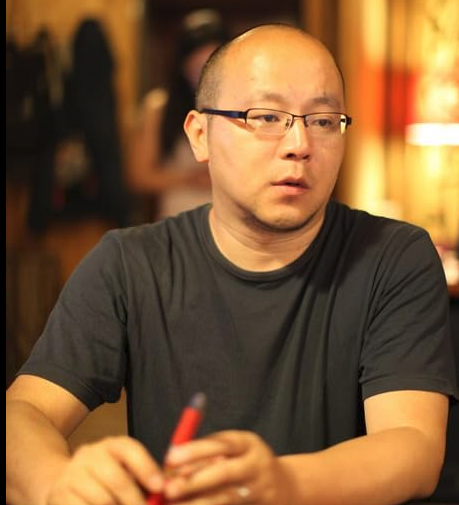
The writer of the lyrics of this song, also a novelist and playwright, wrote the 2019 novel from which this drama is adapted ; he is also a screenwriter. | not found in songs uploads |
|
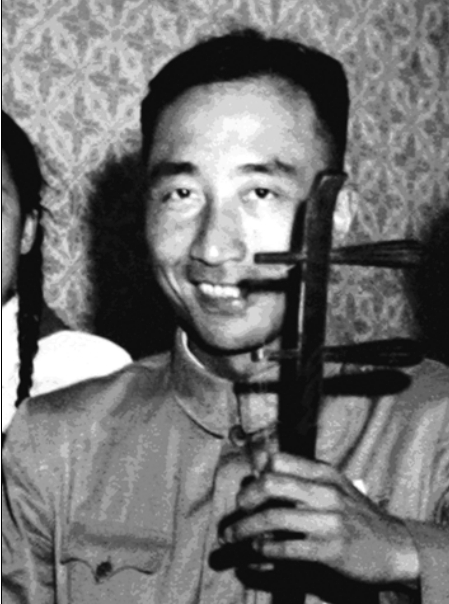
C: Tekla Bądarzewska-Baranowska(b. 1829 or 1834 – died 1861) She was a talented composer from Poland. She is famous in Asia for this piano piece, but she's almost unknown in her home country! |
| |
[Originally sung by Hán Bǎoyí 韩宝仪, and prereleased in Singapore in 1986, this song has been translated into English by British singer Shaun Gibson who posted his bilingual version on the Internet, in China, where he has been living and works for many years] | MV of the bilingual version sung by Shaun Gibson | |
The Red Star Song was an assignment by Shěnyáng Military command, as theme song for the 1974 movie 閃閃的紅星Shănshăn de hóngxīng (Sparkling Red Star). The children's march, powerful and resonant, should "capture the spirit of the protagonist, Pān Dōngzǐ 潘冬子, a young revolutionary and his growth under the care of the Party." The movie is a musical. Among the first songs heard after theme song is a "revolutionary slogan" song to the tune of 'Brother Martin'/'Frère Jacques", better known in Chinese version as "Two Tigers" children's song (see #17) | 百合花开童声合唱团 (Lily Bloom Children's Choir, in the drama) The MV to the left has several historical versions sung, from timestamp 0:24 In ep.4 of the drama, Láidì is asked to sing the song at her first audition, but it is Fēng Xiāoxiāo who ends up stealing the show. |
|
The first Chinese singer to perform the song was mezzo soprano Dǒng'Ailín 董爱琳 who rose to prominence with her 1950 rendition; among other notable covers were those of Luó Tiānchán 罗天婵. A modern Mandarin cover version was performed by Máo Bùyì 毛不易 for the 2020 film Lost in Mome The Chinese translation of the Russian song Ой, цветёт калина (Oh, the Kalina Flowers Are in Bloom) was created by an anonymous translator from the late 1940s or early 1950s. He based his Chinese version of the lyrics on a Japanese-Russian dictionary that mistranslated the Russian word kalina (viburnum/bush honeysuckle), because no Russian-Chinese dictionary was available at the time. | Lǐ Sīyuán 李思源 in the drama
|
-> original version in Russian sung by Péng Lìyuán 彭丽媛; |






7. MUSIC - PART B1#1 to #5 of the 36 Opera repertoire and arias |
Héběi bāngzǐ 河北梆子 (aka Hebei Clapper Opera or Wooden Clapper Opera) is derived from Qínqiāng 秦腔 and Shānxī bāngzǐ 山西梆子 operas, which were introduced to Héběi during the middle of the Qing Dynasty. It is sung in Beijing dialect. There are more than 500 stories used in Héběi bāngzǐ. This one is about Yáng Páifēng 杨排风, a fierce girl, kitchen maid in the noble Yáng house and personal maid of the matriarch Shé Tàijūn佘太君, who was sent to help rescue the son of Sòng general Yáng Yánzhāo. Yáng Zōngbǎo had been captured by the enemy general Hán Chāng who remained undefeated. Jiāo Zàn who was in charge of the rescue operation, initially looked down on the lowly female, and tried her skills through sparring with her ; he was defeated, her strengths in martial arts were recognized, they joined forces and defeated the enemy, completing the mission and rescue. From then on, Yáng Páifēng and her secret weapon, the "fire stick" became famous. The opera is also known as Bōhuǒgùn《拨火棍》(The Fire Stick or the Fire Poker) or《杨排风》. Note: In novels and operas, Mèng Liáng and Jiāo Zàn are two generals under Yáng Yánzhāo. They were originally mountain bandits, known for their bravery and ruthlessness, but later they both joined Yáng Yánzhāo's forces to fight against the Liáo Dynasty, becoming famous in Lǔ (Shāndōng) and Jì Héběi). In "The Protagonist", the story was given a new meaning. Qin'E becomes the heroine, transforming from an excluded girl to a stage protagonist and the realization of a spiritual coming-of-age ceremony. |
|

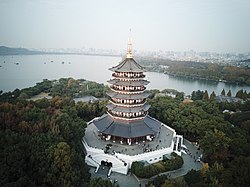
This is one of the most famous Chinese opera stories, which has been performed in many countries as a showcase of Chinese Opera (For example : the stylized boatsman with his row "takes the couple on board" with movements that mime the boat gently rocking...) The story has evolved over the centuries to fit the public's wish for romance and benevolence, veering away from the initial notion of a demon seducing men for evil. Story: The opera tells the love story between Bái Sùzhēn 白素贞 (White Lady), and Xǔ Xiān, a scholar. White Lady, a white snake spirit who had cultivated for a thousand years to achieve human form, was assisted by her sworn sister Xiǎoqīng 小青 (whom White Lady often nicknamed "Sister Green" Qīngmèi 青妹 or "Little Blue" Qīng'ér 青儿 (*) who also had cultivated 700 years to transform into a human . Bái Sùzhēn encountered Xǔ Xiān at the famous West Lake in Hángzhōu. They fell in love and got married. Fǎhǎi, a monk, believed that a human being should not marry a spirit. Therefore, he sowed discord between the couple and brought obstacles and misunderstandings to them. He pushed Bái Sùzhēn down under the Léifēng Pagoda, where she was imprisoned for twelve years. Xiǎoqīng retreated to Mount Éméi. Twelve years later, she had finally mastered the power of True Fire, The Monk he hid inside a crab shell (**) but was defeated. Léifēng Pagoda collapsed, and Bái Sùzhēnwas saved. White Lady told the truth to Xǔ Xiān. Both expressed their love and made up with each other. From then on, Green Snake and Bái Sùzhēn, Xǔ Xiān and their child all lived a blessed and happy life together. ___ (*) 青 Qīng is a color which for the Chinese, evokes the pale iridescent blue and green of water and lush rolling hills in the breeze, "verdant like in the word 青翠 Qīngcuì, sometimes also the "fresh blue and clear" skies 青天 Qīngtiān, with evoke "youth" 青年 Qīngnián. Green of plants is 绿 Lü and blue of flowers is 蓝 Lán. Colors are usually specified with a word that adds meaning. 白天 Báitiān means daytime; 兰花 lánhuā means orchid, but those are not necessarily blue flowers 蓝花 :) (*) There is a saying that a crab's internal fat is orange because it resembles the color of Fahai monk's robe! |
| ||||||
#3- Fox Fairy Tribulation 《狐仙劫》Hú xiān jié A fantasy Běijīng Opera adaptation of the "Fox Fairy" story, combining various new technologies to depict a three-lifetime love story between a human and a fox spirit, where sacrifice leads to "gain." Floating projection, 4D view, interactive technology—these digital art terms are all combined with the National Guǎngdong Opera troupe's new version of "FoxFairy. A love story between a human and a fox, even after reincarnation, gender reversal, and even the sealing of memories, their souls, once reunited, are still drawn to each other until the test of time. The fox remains young, but the human's hair turns white. How can they stay together forever? | |||||||
#4- Beheading Shān Tóng《斩单童》Zhǎn Shān Tóng This is a traditional short Qínqiāng opera, also known as :
It is based on the scene in Romance of Suí and Táng Dynasties 《隋唐演义》Suítáng Yǎnyì , where Shān Xióngxìn 单雄信 refused to surrender and Lǐ Shìmín 李世民 beheaded him. The play is mainly sung by painted-face actors, and lasts about 30 minutes (The scene in the recording above is performed by Hú Línhuàn 胡林焕) Below is a full version without English subtitles : In 2026, that version, starring Zhāng Xiǎoliàng 张晓亮 attracted attention , and was mentioned in the TV series "The Protagonist" . | |||||||
#5- Zhá Měi àn 《铡美案》(The Case of Chén Shìměi') The Case of Qín Xiānglián (also known as "The Judgement of the Míng Dynasty", shown in the above 53'17 recording ) is a highly influential classic play in Chinese opera, commonly found in Běijīng Opera, Qínqiāng Opera 秦腔, Hénán Opera (aka Yùjù 豫剧 orHénán Bāngzi 河南梆子) , Cháozhōu Opera (Cháo jù or Cháozhōu xì ), Sìzhōu Opera 泗州, Píngjù Opera 評劇, and Sìchuān Opera (aka Chuānjù 川劇) and it has been adapted into a Qínqiāng film (2009) and a TV series "The New Case of Chén Shìměi"《新铡美案》 (2004). It is adapted from novels such as "Bāo Gōng's Cases" 《包公案百家公案》 from the Míng Dynasty and "The Three Heroes and Five Gallants" 《三侠五义》 from the Qīng Dynasty. The play shows the concern for ethics and morality in ancient society through Qín Xiānglián 's psychological transformation from forbearance to resistance. STORY : In the Northern Sòng Dynasty, scholar Chén Shìměi 陈世美 scored champion in the exam, concealed his marital status and was selected as emperor's son-in-law. In his hometown stricken by several years of drought, his parents had died. His wife Qín Xiānglián 秦香莲 and her children son Dōng Gē 冬哥 and small daughter Chūn Mèi 春妹 went to the Biànliáng 汴梁 capital to find him but were expelled from the palace. Prime Minister Wáng Yánlíng 王延龄 sympathized with her and deised a plan to have Qín Xiānglián perform a song at the banquet for Chén Shìměi's birthday, so as to help them reconcile, but it failed. Wáng Yánlíng advised Qín Xiānglián to submit her case to Judge Bāo Zhěng 包拯 (a famous, powerful and upright official in ancient China) and sue her husband. Meanwhile, Chén Shìměi'sent a military officer, Hán Qí 韩琪 , to hunt his first wife down and kill her. But Hán Qí sympathized with the mother and son, and preferred to commit suicide out of righteous indignation, instead of completing the task ("sacrificing his life for righteousness" but also sharply contrasting with Chen Shimei's hypocrisy). Qín Xiānglián fled and went to Bāo Zhěng 's official office to accuse Chén Shìměi of "assassinating his wife and child." Bāo Zhěng summoned Chén Shìměi 'to accept a reconciliation, but the man did not cooperate. Judge Bāo Zhěng had the couple confront each other. Chén Shìměi' relied on his noble status to act arrogantly and spout abuse; Bāo Zhěng angrily sentenced him to death. The princess and queen mother rushed to stop the execution. But in order to uphold justice and the law, Bāo Zhěng still it carried out.. | Chinese New Year Gala CCTV 1994. Excerpt: Wáng Hǎibō 王海波 (TW) as Qín Xiānglián singing her complaint. English subtitled movie full opera version, 125 minutes, posted to YouTube in April 2022.
|

.png)
8. MUSIC - PART B2#6 to # 11 of the 36 Opera repertoire and arias |
#6- The Big Truth 《大实话》Dà Shí Huà "Dà shíhuà" (大实话) is not a specific genre of Chinese opera but rather a comedy sketch or cross-talk (xiàngsheng 相声 ) performance that often incorporates elements of local opera styles (such as Píngjù 评剧, Qín qiāng 秦腔 , or Huángméi 黃梅) for comedic effect, such as the above clown monologue starting with:
Note, the 岭 lǐng is the same as in the name of the Qínlǐng mountains 秦岭山.
| |
#7- Zhāng Lián Sells Cloth 《张连卖布》Zhāng lián mài bù Above: 1997 recording of the complete short opera (62 mins) without English subtitles It is part of the 眉户 (Méi Hù) opera repertoire, which is mainly performed in the Guānzhōng region of Shǎnxī, where it is most prevalent and considered the second-largest local opera genre in the province. STORY : Zhāng Lián , a once well-off farmer, became addicted to gambling, repeatedly losing until he sold all his land and belongings, relying on his wife, Sì Jiě 四姐 (Fourth Sister), to make a living through weaving. One day, his wife ordered Zhāng to go to the market to sell cloth, but he couldn't resist the persuasive words of his gambling friend, Wáng Lǎobā 王老八, and gambled away all the money he could have earned. When he returned home and his wife questioned him, Zhāng, with his glib tongue, offered all sorts of excuses. Sì jiě was utterly helpless. | 5 mins excerpt of the couple bickering (no English subs) |
#8- Teaching 《教学》 | |
#9- Black Dingben 《黑叮本》Hēi Dīngběn STORY: "Black Dīngběn" tells the story of after the death of Emperor Muzong of the Ming Dynasty, Concubine Li Yan was tricked by her father Li Liang into temporarily abdicating government. Duke Dingguo Xu Yanzhao and Vice Minister of War Yang Bo saw through the conspiracy to usurp the throne and launched a fierce remonstration with "Black Dīngběn" and "Two Visits to the Palace" as the core. In the end, they joined forces with loyal ministers to crush the rebellion and preserve the royal bloodline . The drama uses the roles of Bronze Hammer Flower Face (Xu Yanzhao), Xusheng (Yang Bo), and White-faced Traitor (Li Liang) to strengthen the dramatic tension of the conflict between loyalty and treachery . | |
#10- Poor Optimism 《穷乐观》 | |
#11- Fighting the Golden Luan 《打金銮》 |
10. MUSIC - PART B4#18 to #23 of the 36 Opera repertoire and arias |
#18- Fifteen Strings of Chinese coins 《十五贯》 | |
#19- Three Opposite 《三对面》 | |
#20- The Female Generals of the Yang Family 《杨门女将》Yáng mén nǚjiāng A full version with Hanzi and English subtitles (2h20) This Chinese opera is also an audiences favorite, often performed or excerpted for showcase. | |
#21- Visiting West Lake 《游西湖》 | |
#22- Peach Blossom with Human Face 《人面桃花》 | |
#23- Zhou Ren Returns to His Mansion 《周仁回府》 |
| ||||||||||
| ||||||||||
| ||||||||||
| ||||||||||
| ||||||||||
#28- Honghu Red Guards 《洪湖赤卫队》Hónghú chì wèiduì
| ||||||||||
#29- Three Drops of Blood 《三滴血》 | ||||||||||
#30- Forced to Liángshān 《逼上梁山》 |
12. MUSIC - PART B6#31 to #36 of the 36 Opera repertoire and arias |
#31- Twelve Scythe 《十二把镰刀》 | ||||||||||
#32- The Injustice of Dou E 《窦娥冤》 | ||||||||||
#33- Yutangchun 《玉堂春》 | ||||||||||
#34- Meeting at the Flower Pavilion 《花亭相会》 | ||||||||||
#35- The Prince Breaks the Formation 《亲王破阵乐》Qīnwáng pò zhèn yuè "The Music of Qin King Breaking the Enemy's Formation" (4'36) by "Tang Dynasty Ritual Music Restoration Group" Millennium Tang Music Concert, May 5, 2021, Changsha Concert Hall. This performance selects a portion of the melody from the interpretation of the famous song, based on the "Five-String Pipa Score," using a mix of modern music adapted for keyboards. clapperboard and traditional instruments:
"The Song of Breaking the Enemy's Formation" aka "Prince of Qīn Smashing the Battle-line" originated as a military song from the late Suí Dynasty [Suí cháo 隋朝]. In 620 AD, to praise Emperor Tàizōng 唐太宗 of Táng (Lǐ Shìmín 李世民) for his victory over a rebellious general and the subsequent stability of the Táng Dynasty [Táng cháo 唐朝], the soldiers and civilians wrote lyrics for the military song and sang it during victory celebrations. The song later developed into a grand song and dance piece, giving rise to various performance styles. Musically, it is played with large drums, and historically it is described as "its sound could be heard for a hundred miles, shaking the valleys; its vigorous and inspiring rhythm showcased the heroic spirit of ancient soldiers." In 633 AD, Lǐ Shìmín personally designed the "Qin King Breaking the Enemy's Formation Music and Dance Diagram", and ordered Lü Cai to teach the 128 musicians according to that diagram. According to it, the dance troupe's left side is circular, and its right side is square : the front imitates a chariot, and the rear is filled with troops ; the formation unfolds, assuming a battle stance. They practiced frequently while wearing armor and wielding halberds. This music became the theme song for the dance performance. | Audio recording posted to YouTube in June 2013 [The theme has inspired many composers for modern pieces such as this pipa and orchestra composition by Qīng yáo 青瑶 (with video) even if it is only vaguely reminding of the preserved tune. In same "universe", I like the lesser-known gǔfēng song 威风吟 about Lǐ Shìmín which uses almost Operatic notes sung by Zhōu Shēn .] "It is said that the Qin-Han War Drum has been preserved in Chinese folk culture, specifically as the drum tune that the villagers of Zhangqi Village, Zhengyang Town, Weicheng District , Xianyang City, Shaanxi Province, at the foot of the Han Yangling Mausoleum, have been playing during festive occasions" (Baidu) | |||||||||
#36- Golden Beach 《金沙滩》Jīn Shā Tān Golden Beach is a Qínqiāng Traditional play, also known as "Double Dragons" [Shuānglóng 双龙] and "Eight Tigers Entering Yōuzhōu". The play is based on the fictional "Shuānglóng Alliance" between the Sòng and Liáo dynasties, and its creative background is related to the period of the (907-979 AD) Five Dynasties and Ten Kingdoms [Wǔ dài shí guó 五代十国] --> Lǐ Kèyòng 李克用 with "northern king"/khagan Yélǜ Ābǎo jī 耶律阿保机 (872- 926 AD) founder of Khitan/Liáo dynasty. The plot revolves around the king of Sòng 宋 Zhào Guāngyì 赵光义 . He had vowed to fulfill his brother's (king Zhao Kuangyin) promised during his lifetime to visit Mount Wǔtái The treacherous minister Pān Rénměi 潘仁美 instigated him to go to Yōuzhōu 幽州 to enjoy the scenery. General Yáng Jìyè 杨继业 tried to dissuade him but failed ; Yáng Jìyè was trapped, imprisoned on Mount Wǔtái 五台山. King Zhào Guāngyì accepted an invitation to a banquet at Jīn shātān Beach. Yáng Jìyè warned him against going, and ordered his eldest son to pretend to be the King of Sòng to attend the banquet on his behalf. The banquet turned out to be an ambush, escalating into battle and bloodbath. In the end, five of the eight sons of the Yáng family were killed. Distraught, Yáng Jìyè decided to retire although the King tried to compensate with titles and erected the Lǐ Líng stele 李陵碑 for the Yáng martyrs. Yáng Yánzhāo 杨延昭, the fifth son of áng Jìyè, saw through King Zhào Guāngyì 's cruelty and ruthlessness. He refused to accept the titles bestowed by the king, and left to become a monk on Mount Wǔtái. In despair, Yáng Jìyè crashed into the Lǐ Líng stele and died. This drama has all the elements and a passionate plot. It is the play that best expresses the generosity and sadness of Qínqiāng, which is known for its sorrowful tales and poignant tones. The opera features poignant-tone stanza-style arias such as "Wǔtái Mountain Trapped Veteran Yáng" , showing the patriotism and tragic characteristics of Qínqiāng with scenery |


Details
- Title: The Lead
- Type: Drama
- Format: Standard Series
- Country: China
- Episodes: 48
- Aired: May 10, 2026 - Jun 3, 2026
- Aired On: Monday, Tuesday, Wednesday, Thursday, Friday, Saturday, Sunday
- Original Network: CCTV, Tencent Video
- Duration: 45 min.
- Genres: Life, Drama
- Tags: Emotionally Strong Female Lead, Passionate Female Lead, Master-Apprentice Relationship, Adapted From A Web Novel, Opera Singer Female Lead, Mentor Supporting Character, Artist Female Lead, Musician Female Lead, Talented Female Lead, Ambitious Female Lead
- Content Rating: Not Yet Rated
Statistics
- Score: 8.0 (scored by 305 users)
- Ranked: #2640
- Popularity: #8220
- Watchers: 1,711
- Favorites: 0


Popular Lists
Related lists from users

Recently Watched By


