1
1 1
1 1
1 1
1 1
1 1
1This review may contain spoilers
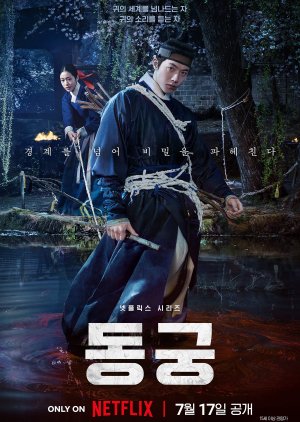
The East Palace is built on an irresistibly wicked, sinister premise and the actual experience of watching it fully delivers on that promise.. The teaser made it feel like a series perfectly tailored to my tastes and it turned out to be exactly that.. It's rare for anticipation to survive reality, it's even rarer for reality to surpass it..This drama seems to have taken some obvious inspiration from Stranger Things.. It has its own version of the Upside Down, The Realm of Gwi.. And honestly, I don't think that's a bad thing.. It's basically their version of the Upside Down, just set in the Joseon era with hanboks instead of 80s aesthetics... The core idea is similar, a parallel dark dimension bleeding into the real world.. Thankfully they didn't just copy paste the aesthetic.. Instead they made it feel like it genuinely belongs to Korean folklore..
Storywise it's pretty much classic, nothing wildly original.. The whole idea that he has to die to enter the other realm?? That was intense.. The transitions between both the worlds are executed perfectly every time without losing its impact.. The story sort of gives us an idea on who the villains are early on itself but it never reveals all its cards.. As it progresses, it keeps peeling back one layer after another and with each reveal there is another story hiding underneath.. There were quite a few surprises, and a couple of them I genuinely didn't see coming..
Spoilers ahead.. I never expected the King's mother to be the one behind the deaths of the previous King's children and also the FL's mother.. She never felt like someone capable of something that horrific.. And then the Crown Prince being the actual spirit behind all the chaos?? He wasn't even on my suspect list because the story presents his death as a suicide.. I really liked how every reveal led to another instead of wrapping everything up at once..
Honestly, the visuals of this drama are utterly gorgeous.. The cinematography is just crazy good.. The atmosphere almost feels like a character of its own.. The aesthetics are absolutely stunning with some marvelous color grading.. And thanks to that the action and fight scenes in the other realm were absolutely brilliant to watch.. And I believe that to make a story like this come to life it needs a strong soundtrack and they absolutely nailed it here..
Now, the characters.. Nam Joo Hyuk was so good as Gu Cheon.. It's honestly sad that it took him three years to return to the screen but he definitely didn't disappoint.. Roh Yoon Seo also did a really good job as Saeng Gang.. There were a few scenes where she was just outstanding.. I was probably the most curious about Cho Seung Woo's character before I started the drama.. I kept wondering what made him choose this role.. But yeah, the man did what he does best and gave us a fantastic portrayal of King Ju Sang.. Was he the bad guy?? Or was he just a man who was pushed too far and ended up doing cruel things to protect what he believed mattered most??
Before this review turns into a novel of its own, I will just say this.. The East Palace is a captivating watch till the end.. It has some of the best visuals I have seen in a KDrama in a while.. I loved the chemistry between the two leads and their performances.. I just wished that they had pushed it a little further and made it a 10–12 episode season.. There's still more to explore and I would love to see more of this couple.. So, are the chances of another season high?? I honestly hope so..
P.S. Ggeomeoksali was a cute little scene stealer..
Note:
Just to clarify what I meant above.. I felt that the drama seemed to take some inspiration from Stranger Things in its visual representation of the Realm of Gwi.. That's simply my personal interpretation.. The comparison was only the closest visual reference that came to mind while I was watching.. I wasn't trying to say that the script or its concepts were influenced by Stranger Things or any other work..
Was this review helpful to you?

 1
1 1
1A KINGDOM BUILT ON BURIED SINS
You know a fantasy K-drama is serious when the crown princes start dropping dead one after another before you've even learned anybody's name. The East Palace opens with the royal family being terrorized by what everyone believes is the vengeful spirit of a pond, and honestly, if I were the king, I'd stop pretending this was a coincidence after prince number two. But no. Like every politician in fiction, he spends way too long convincing himself everything is fine until the very last heir falls ill. Suddenly ghosts become everybody's problem, and that's when Gu-cheon, a man capable of crossing into the spirit world, is summoned to uncover what's really happening. Working alongside him is court lady Saeng-gang, whose ability to communicate with spirits makes her just as essential to the investigation.I'll admit my expectations were ridiculously high going into this. Nam Joo-hyuk was finally back after military service, Netflix was throwing money at a historical fantasy, and the trailers promised ghosts running around a Joseon palace. I was fully prepared for elegant people getting possessed every twenty minutes. Instead, the series did something much better. Yes, there are terrifying spirits and creepy folklore creatures, but they're really just the gateway drug. The real addiction is the mystery.
Every time Gu-cheon and Saeng-gang think they've figured something out, the show basically laughs in their faces and says, "Cute theory. Here's another century-old secret." The investigation keeps peeling back layers of palace history until you realize the ghosts aren't even the biggest problem anymore. The supernatural gets your attention, but it's the people who keep you awake afterward. The series understands one of horror's oldest truths: monsters are scary, but humans with power and something to hide are absolutely terrifying.
For much of its runtime, the mystery unfolds with remarkable confidence, but as the series progresses, it becomes increasingly determined to explain every supernatural rule governing its world. New layers of mythology, spiritual mechanics, and centuries-old lore are introduced so frequently that the investigation occasionally loses the elegant simplicity that made its opening episodes so compelling. Rather than deepening the mystery, some of these explanations feel like unnecessary detours that slow the pacing and briefly interrupt the tension.
Gu-cheon ended up being one of my favorite fantasy protagonists in years because the show never tries to make him effortlessly cool. He's sarcastic, emotionally unavailable, and gives off the energy of someone who desperately wants everybody to leave him alone. At first he almost seems indifferent to the supernatural despite having the ability to enter the spirit realm, but every trip comes with a physical and emotional cost, and the more you learn about his past, the more his detached personality starts to feel less like a character quirk and more like survival. Nam Joo-hyuk plays him with remarkable restraint, communicating exhaustion, guilt, and grief without needing lengthy speeches every five minutes.
Then there's Saeng-gang, who thankfully avoids becoming the obligatory female sidekick whose only purpose is looking impressed while the hero saves the day. If anything, she's the one holding the investigation together. While Gu-cheon wrestles with ghosts and vengeful spirits, Saeng-gang untangles palace politics, hidden motives, and decades of buried secrets. I loved that the series never treats intelligence as less valuable than supernatural abilities.
They solve different pieces of the same puzzle, and because of that, they actually feel like partners instead of two characters taking turns carrying the plot. Their chemistry isn't built on endless misunderstandings or forced romantic tension either. It grows through trust, mutual respect, and the realization that they're probably the only two people who truly understand what the other is carrying.
The palace itself deserves credit because it never feels like a pretty historical backdrop. It feels alive, and not in the comforting Disney-castle way. Every hallway, courtyard, and abandoned chamber seems to be hiding another crime someone desperately wants forgotten. The series relies far more on atmosphere than cheap jump scares, creating a constant sense that someone, or something, is watching from just outside the frame. Whenever Gu-cheon crosses into the spirit world, the visual shift immediately reminds you why he dreads using his abilities. Those sequences are eerie without becoming overindulgent, making the supernatural feel genuinely dangerous instead of simply cool to look at.
Cho Seung-woo and Jang Young-nam elevate the political side of the story far beyond the usual palace scheming. Neither the King nor the Queen Dowager sees themselves as villains, and that's exactly what makes them compelling. They're consumed by protecting the royal bloodline and preserving secrets that should probably never have existed in the first place, and somewhere along the way they sacrifice every shred of humanity they had left. Watching them eliminate anyone who gets too close to the truth becomes just as suspenseful as Gu-cheon's encounters with the spirits. Eventually, the show makes it painfully clear that the greatest evil haunting the palace was never the ghosts lurking in the pond. It was the people sitting on the throne.
One of the series' biggest strengths is how confidently it keeps reinventing its own mystery. Nearly every episode ends with what feels like a major breakthrough, only for the next revelation to completely reshape everything you thought you understood. Those twists rarely feel like cheap cliffhangers because each one uncovers another piece of the palace's forgotten history, making the investigation feel richer instead of more convoluted.
That said, the writers occasionally become so eager to outdo the previous reveal that later twists rely on increasingly elaborate mythology rather than emotional payoff. The surprises remain entertaining, but not every revelation carries the same weight as the earlier ones.
Visually, The East Palace is gorgeous. The palace sets are stunning, the costumes are rich without feeling theatrical, the creature designs draw heavily from Korean folklore, and the sword fights are choreographed with impressive precision. The CGI occasionally gets a little too ambitious, particularly during some of the larger supernatural set pieces, where spectacle sometimes takes priority over clarity. There were moments when I understood that something impressive was happening without being entirely sure what had actually happened.
What impressed me most is that The East Palace never forgets what kind of story it wants to tell. Beneath the ghosts, folklore, political conspiracies, and elaborate mythology lies a mystery about grief, ambition, guilt, and the terrible things people justify in the name of family and legacy. I just wish the series had trusted that emotional core as much as it trusted its ever-expanding lore. Whenever it focuses on its characters and the palace conspiracy, it's genuinely gripping. Whenever it disappears into lengthy supernatural explanations, some of that momentum slips away.
Even so, The East Palace remains an atmospheric, beautifully produced supernatural thriller elevated by strong performances, memorable horror imagery, and an engaging central mystery. It doesn't always balance its mythology with the same confidence it brings to its characters, but when everything clicks, it's exactly the kind of haunting historical fantasy I was hoping for.
Was this review helpful to you?
There Is Hardly Anything "Horror" About It
This drama felt more like a monster-chasing series than a haunted one. There was honestly nothing scary about it. The ghosts here were some monster-like wooden creatures than actual spirits. Instead of creating an eerie, haunting atmosphere, they mostly served as creatures for the characters to fight and run from, so I never really got that chilling, unsettling feeling throughout the drama.I mean... the ghosts just weren't ghosting, and that's my biggest issue with a drama that marketed horror as its one of the main theme.
I also saw a lot of netizens praising the CGI and action scenes, so I went in expecting something top-notch. But honestly, they didn't feel anything special to me. It was the same Netflix-style K-drama action and CGI we've seen plenty of times before.
That said, the actors' performances were good and were probably what kept me watching. The story itself was pretty standard—greed and selfishness leading to all the evil, which is basically the same theme we've seen in countless dramas. I also wish they had given more clarity on how Gu Cheon even survived in the end.
So overall, it's just an okay drama. If you're looking for a proper horror experience with genuinely creepy ghosts, this probably isn't it.
Was this review helpful to you?

This review may contain spoilers
A Royal Curse, a Cursed Story
When I started The Palace of the East, I knew exactly what I was getting into: a fantasy horror thriller set during the Joseon era, but also a drama written by the co-writers of The Guest (a good one) and Bulgasal (not a good one), and directed by Choi Jung Gyu, the man who gave us, among other things, the magnificent The Devil Judge in 2021. Aesthetically speaking, it is truly beautiful, putting forward an oppressive atmosphere reminiscent of the movie Silent Hill, or even the series Stranger Things in some visual aspects, through its lighting choices and its blockbuster fantasy feel. The series starts off at full speed during the first three episodes, which establish the setting. Unfortunately, the short format imposed by Netflix and the storytelling shift that occurs in the second half left me with a bitter aftertaste. I felt that the narrative was losing some of its ambition. Do not expect a revolutionary story, as this is something we have seen many times before. But it is everything else that makes the difference, and given the budget allocated to it, it really could not afford to fail. Let’s take a closer look.At the heart of the royal palace, a mysterious curse seems to have fallen upon the King’s family. After several unexplained deaths and the sudden collapse of the last Crown Prince, the King (Cho Seung Woo) calls upon Gu-cheon (Nam Joo Hyuk), a man capable of crossing the boundary between the world of the living and the world of spirits in order to hunt supernatural creatures and ghosts. He acquired this cursed ability as a child during a tragic event and has carried it as a burden ever since. To accompany and watch over him, he orders Saeng-gang (Roh Yoon Seo), a court lady who is actually his only daughter, to join him. He exiled her as a child because she possesses the ability to hear the dead. Together, they must uncover the secrets of the Eastern Palace, the residence of the heirs to the throne, a place consumed as much by political conspiracies as by supernatural forces, where every discovery brings them closer to a truth that some people are willing to kill to preserve. The Dowager Queen (Jang Young Nam) and the King’s brother, Prince Ik-Sang (Tae In Ho), are also lurking in the shadows, each serving their own interests.
From the very first minutes, The Palace of the East makes a strong impression. The cinematography is exceptional, the production design is incredibly rich, the music is magnificent, and the visual effects reach a level rarely seen in a Korean drama. The result is genuinely cinematic. The CGI is perfectly integrated, and the whole production has a very strong visual identity. On these aspects, I even find the drama superior to Alchemy of Souls or Kingdom, for example, which are fairly recent. The direction is remarkably elegant, fluid, and impressively effective. The universe sometimes evokes FromSoftware games, especially Demon’s Souls, with its majestic palaces, atmosphere of decay, and disturbing creatures. Let’s be very clear about this: it looks incredible. The story, without being innovative, uses its unsettling atmosphere to take us on an adventure close to a fantasy horror thriller. I really enjoyed the first three episodes because the protagonists are quickly identified, there are not too many of them, and our main duo is likeable. In short, from the beginning, you can feel that we are dealing with people who know their craft and know how to put their expertise into practice. The story, which seems simple at first glance, will gradually multiply false leads, encouraging us to question the true intentions of certain characters.
Unfortunately, this excellent first impression gradually fades away. I found the second half more intense and certainly more fast-paced, but while the action side takes over, the storytelling gradually falls apart as we get closer to the ending. The story seemed promising, but ultimately lacks development. Aside from Saeng-gang, Gu-cheon, and the King, most of the other characters are without depth, especially the Dowager Queen, Prince Ik-Sang, and the shaman. They mainly exist to lead us toward false leads. As for the antagonist, he is introduced in a clumsy way, used as a tool, and poorly exploited. The viewer discovers his importance very late, even though he could have become a much more memorable antagonist.
The true threat hidden from the beginning turns out to be the Crown Prince (Kwak Dong Yeon), who was poisoned by his father at the time, when the latter discovered that he was practicing occult sciences.
In reality, it is the entire cast of characters, despite being quite small, that suffers from a lack of writing and, for some of them, a lack of substance. The conclusion easily falls into over-the-top territory. Some scenes lack coherence, such as the notable absence of the royal guards (they must have had a swimming pool day). We are still inside the King’s palace. The lack of extras is also quite puzzling for a place that is supposed to be alive. The thriller aspect is gradually abandoned in favor of action, leading to a finale worthy of Mortal Kombat but without a Fatality... Although, maybe. In the end, we leave the drama with more questions than answers:
Why did the King decide to kill his own son, knowing that this act would trigger a terrible curse? Why are the Prince and the Shaman presented as threats to the Crown if their roles are ultimately so limited? What is the role of the Dowager Queen and what are her true intentions? Why make the prince played by Kwak Dong Yeon such a central character in the revelations when he is barely developed?
For me, the real missed opportunity of the script lies there: the drama never truly settles the Crown Prince’s guilt. And that is a shame, because it would have given much more depth to both the King and the Crown Prince.
The writers know how to create an atmosphere, establish mystery, and bring fantasy to life. However, they struggle to give their characters enough depth and to transform their many plot threads into a fully satisfying conclusion. To end on a positive note, I would say that the duo formed by Nam Joo Hyuk and Roh Yoon Seo works extremely well, and that we thankfully avoided the easy and unnecessary mistake of adding a fake romance that would have served no purpose.
In the end, The Palace of the East impresses more with what it shows than with what it tells. The writers know how to create an atmosphere, build mystery, and stage fantasy with real mastery. Visually and musically, it is a true success, with stunning cinematography, ambitious production design, and direction that sometimes gives it the feel of a cinematic production. I also really liked the presence of Ggeomeoksali, this small creature with an almost innocent appearance that brings a lighter touch to an otherwise very dark universe. Like a Mogwai from Gremlins, it could easily have become just a cute element designed to appeal to viewers, but it ultimately finds its place within the drama’s fantasy mythology. Unfortunately, this visual ambition is not always matched by the writing. The many threads introduced throughout the episodes do not all receive satisfying conclusions. It is a shame, because the whole story is missing a tragic depth that could have elevated it. Nevertheless, The Palace of the East remains a largely positive experience thanks to its unique atmosphere, carefully crafted fantasy universe, and above all, a duo that works remarkably well. This drama is not revolutionary, but it remains entertaining and enjoyable. It nevertheless leaves me with a feeling of incompleteness, with a script that ultimately failed to live up to its ambitions.
Was this review helpful to you?

8 Episodes of Tortured Gorgeousness (and One Over-Actor)
Okay, Netflix, I see you. You gave us Nam Joo Hyuk back from the military and immediately said, "Here, watch him suffer beautifully in silk robes for 8 hours." And honestly? Thank you for your service (both his AND yours).Let’s get the elephant in the palace out of the way: Nam Joo Hyuk as Gu Cheon is the reason my screenshots folder is now 10GB. This man didn't just play a tormented soul—he became a walking, brooding, rain-soaked tragedy. Every glance he gave Saeng Gang felt like it cost him a year off his life, and I was here for it. The way he clutches his chest, stares longingly into the distance, and still manages to look like a high-fashion magazine cover while bleeding out? Pure talent. Welcome back, sir. We missed you.
Now... Roh Yoon Seo as Saeng Gang. Sigh. I wanted to love her, I really did. But girl, chill. It felt like she was acting for the nosebleed seats in a stadium when the camera was two inches from her face. The wide-eyed shock every five minutes, the quivering lip that wouldn't quit—it gave "high school play" energy in a "prestige drama" world. She tried so hard I could practically see the effort sweating through the hanbok. Just… breathe, babe.
Meanwhile, Cho Seung Woo as King Ju Sang ate every single scene and left no crumbs. That man has a voice that could command armies and a glare that could curdle milk, yet he made the king so wonderfully layered. Every time he shared the screen with Gu Cheon, the tension was chef's kiss.
My only real complaint? We needed more Gu Cheon backstory! You can't dangle a tragic past like a carrot and only give us nibbles. I wanted a full flashback feast! But honestly? With only 8 episodes, the pacing was tighter than Gu Cheon's belt. No filler, no drag—just compact, angsty perfection.
So would I recommend it? Absolutely—if only to stare at Nam Joo Hyuk's cheekbones and watch Cho Seung Woo act circles around everyone. Just mentally prepare to fast-forward through Saeng Gang's overly dramatic gasps.
And Nam Joo Hyuk? Whatever you do next, I'll be there. Romantic lead? Action hero? Literally just reading a phone book in a turtleneck? Sign me up. That face is a national treasure, and I'm so glad it's back on my screen. 😍
Was this review helpful to you?
Barely watchable
My main gripe with this story isA They keep trying to protect people who deserve jack shit. I know they were forced to but still as a viewer it’s hard to care about the assholes these leads are risking their lives to protect.
and B the finale episode was a mess. I can’t really explain where but something went wrong. Nothing made sense. N nobody paid for their sins. All they achieved was stopping some evil spirits from murdering characters who are worse than the most evil tyrants in history.
Overall it definitely is nowhere on the level of Revenant n Exhuma in terms of occult theme execution or story
Also writing this review only to express my appreciation for the actor who played the shaman (Lee Hong Nae) and also the eternally underrated Kwak Dong Yeon. Just FYI if you feel I’m being harsh, this review is coming from a person who has been obsessively tracking the show for the past one year. N no I did not expect any romance.
Was this review helpful to you?

This review may contain spoilers
The Worst Kdrama I've ever watched
East Palace only have 8 episodes, but I still want to travel back in time and tell myself to avoid watching the film and count the tiles on the toilet instead.The choices of music is bad, it doesn't fit the situation of the scenes nor the setting of the entire film.
The characters are bad, the only character I find great is the tiny gwi-mae who follows them around.
"Justice" doesn't exist in the drama. The evil actions of the characters don't have consequences especially the ultimate villain A.K.A the KING. Everyone in the drama seems to feel the resolution is great even the director, but the ending is the worst conclusion I've ever seen in Kdrama land. The main character died for 3 days while Primordial Gwi-mae gets ahold of him, and he became an evil spirit after destroying another spirit, and despite all those chains tying him down in the afterlife, he still miraculously woke up AFTER DYING FOR 3 DAYS. Yes, he resurrected like the Messiah Jesus Christ.
Death isn't taken seriously in the film because no matter how many times they die, they will still live because they are IMMORTAL.
Dire situations without consequences are boring and predictable.
The East Palace Kdrama is full of plot armor and plot holes.
Don't even bother watching it.
A complete waste of time.
Was this review helpful to you?

This review may contain spoilers
I'm not a big fan of shows with spirits and possessed people ; VFX are often embarrassing to watch. That's invariably the case here. Stranger Things has done a lot of damage to the "otherworldly". I hope that one day we'll move beyond this blurry and unoriginal digital aesthetic.Apart from that, the real-world production is quite beautiful, in the snow and all in shades of grey mixed with a deep blue.
They chase away the spirits, but the real monster is the king. It makes you think. The monarchy surrounded by death and decay. I like the direction the story is taking. Let's hope for a more direct and less repetitive sequel.
Was this review helpful to you?

Sin, Retribution, and the Greed for Power
It’s been a while since I’ve watched a well-scripted horror drama. Thematically, it isn't strictly horror—it also weaves in court politics, power struggles, fantasy, and redemption.It is going to be brief.
Cinematography: The visual work is impressive. The drama portrays two distinct realms: the human world and the ghost realm. The ghost world features an ominous red tint that creates a distinctly eerie atmosphere. Combined with dynamic camerawork, the VFX and production design are top-notch. The unsettling ambiance, the grand palace setting, and the overall visual texture are deeply satisfying to watch.
Sound Design: The soundscape pairs seamlessly with the setting and atmosphere, elevating the overall tension.
Cast & Characterization: While the cast is relatively small, the performances are really good. None of the characters are strictly good or bad; instead, they feel like real people shaped by ambition, fear, loyalty, and survival instincts.
Pace: What really attracts me is its pace and tone. This drama is not draggy, rather has a fast pace that kept me engaged. To tell the truth, I was never bored throughout the drama. Another interesting thing is the amalgamation of horror, greed, power struggle and court politics. It's really rare for a horror drama to have such a convincing plot.
Plot: Tense, politically driven drama that’s less interested in courtroom dialogues and more focused on how power behaves when it’s trapped inside personal relationships. What makes the plot especially compelling is its momentum. Instead of treating court politics as distant background, the series folds it directly into character decisions—who gets access, who gets information, who can afford to be seen making mistakes. The narrative repeatedly forces characters to weigh survival against integrity, and it’s in those constant recalculations that the drama finds its emotional punch.
If you enjoy stories where strategy, betrayal, and longing collide, “The East Palace” delivers a consistently absorbing ride. The plot escalates with purpose, building an atmosphere where hope and fear coexist—and where every victory feels temporary, not because the story is cruel, but because the world it portrays is unforgiving by design.
Was this review helpful to you?

THE HAUNTED PALACE PART 2
This is what happens when production and cinematography get prioritized over storytelling. The plot was underwhelming and lacked impact. Sure, the visuals were stunning, but beyond that the story fell flat, basically a summarized version of Haunted Palace.Honestly, the story isn’t gripping or exciting at all. It feels like a copy of Haunted Palace at least that one prioritized storytelling over flashy cinematography. I don’t get why some Kdrama fans drool over this just because of the pretty visuals. Sure, the CGI is solid and the actors are great, but overall it’s underwhelming. I kept zoning in and out, dragging myself just to finish it.
Was this review helpful to you?

Don't be fooled: ML is not the main character, ML is barely in the show.
The ML had not but almost 10 minutes of screentime episode 5. Every episode has been the exact same amount of screentime for him as well. I'm so done with this show favoring the fl who's being an absolute b word to him, complaining, being a snob and having 0 facial expressions getting ALL the screentime and plot revolving around her, over the ml actually doing anything at all. This is getting a 6 from me, I should know better than to trust mdl comments in hopes the show will get better... lol but it isn't at all.Don't advertise Nam Joo Hyuk on the poster and trailer if he isn't even the main character. Every plot point has been about her but she's insufferable, and I'm not exaggerating that. I've never seen him in anything before and wanted to besides 25-21 because I know how it ends, but the guy isn't even here besides getting grilled by the fl. It's getting irritating and tiring, fast.
The Guest is great, but I feel the writers are horrible at writing tolerable female characters that don't b*tch and moan at the ML for absolutely no reason when they're trying their best, as shown with this show (I'm no curser, but that's how strongly this fl is annoying me).
All style, no substance. Nothing is explained when events occur and it's an absolute mess. Cgi nothing burger fest. Poor poor development and 2D characters to boot. I waited a long time for this in gleeful anticipation, but am deeply disappointed. I think this was written as a full length series but got cut short to 8 episodes, I'm not kidding you NOTHING makes any sense and you're not sure what you're watching.
Waste of a show. Roh Yoon Seo should be on the cover solely by herself, because that's all this show is, and she can't act to save her life. I bet my life on it that she has over 80% of the scenes, which would've suited it if you actually had originally advertised her as the lead so we'd know what we were signing up for, but this was misrepresented badly to draw viewers in with the lead Actor.
ML is here to be the FL's punching bag for everything and nothing more. This feels more like watching a so called "girl boss", but instead let's make her be rude to everyone around her and excuse it for being a "strong female lead."
The acting in it is quite bad too from most parties from leading roles to side characters, there's a couple actors here and there who did well, but it feels like B acting 90% of the time. It's very second-hand embarrasment to watch if I'm being completely honest. I'm wincing at the performances.
Skip on this if you don't want to waste your time. It's an incoherent mess and misleading in it's advertisement of what we originally saw of the show and how they marketed it, which is completely wrong and cheap to do.
Was this review helpful to you?

Great first half but disappearing second half of the drama
I was genuinely excited for this drama—it gave off major Constantinevibes, and I was ready for a thrilling ride. And for the first half, it mostly delivered.The cinematography is stunning. I loved how they brought the realm and all its creatures to life—the visual world-building was immersive and beautifully crafted. The contrast between the two worlds of the palace was especially well done. You could clearly see the real palace, where countless souls were sacrificed to human greed, standing in stark opposition to the other realm. That tension was palpable and added real weight to the story.
The duo at the heart of the drama was another highlight. Gu-cheon (Nam Joo-hyuk), the spirit slayer who can cross into the Realm of Gwi, and Saeng-gang (Roh Yoon-seo), the court lady who can hear the voices of the dead, made a compelling team . Watching them grow into a great partnership was genuinely satisfying, and their journey kept me invested early on. Cho Seung-woo as the king and Jang Young-nam as the queen dowager, added depth to the palace intrigue . But the absolute star of the show for me was the evil creature, Mengramile. I absolutely loved every scene he was in.
Unfortunately, the second half lost all the momentum the first half had built. It became quite boring, and the story started to feel unfocused and less engaging. It's a real shame because the potential was clearly there. The foundation was solid—great visuals, a compelling duo, and a memorable villain—but the execution in the later episodes just couldn't sustain it.
Overall, The East Palace had so much going for it, but it couldn't quite stick the landing. Worth watching for the first half and Mengramile alone, but I wish the rest had lived up to the promise.
Was this review helpful to you?