


 2
2 1
1 1
1


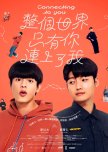
Connecting to You — When a Familiar Thread Still Leads Somewhere New
Are visible threads becoming the new supernatural shortcut for romance? Perhaps. The idea itself certainly isn't new. East Asian stories have been playing with the red thread of fate for generations, and recent dramas have increasingly found ways to make invisible emotional connections physically visible. So when "Connecting to You" introduced Chia-Kai, a young man who can see coloured threads connecting people according to love, friendship, family or hostility, I was not exactly amazed by the concept itself. They could probably have replaced the threads with colours around people's souls and created something equally workable. What made the series interesting was what it did after introducing the gimmick. Chia-Kai can see everybody else's connections but has none of his own, until police officer Da-Wei appears and an unfamiliar silver thread suddenly connects them. From there, the supernatural ability becomes part romance, part comedy and part investigative tool, giving the series an identity beyond simply waiting for the silver line to become romantic red. The source is a BL web novel by Beck, and the television project had actually been in development for years before reaching the screen, appearing in both the Busan Story Market and the Golden Horse project market. That preparation shows because the fantasy rules, police material and romance feel like parts of the same drama rather than three ideas accidentally pushed together.
Bruce Chiu Yi-Tai and Liu Yu Ren are probably what made me enjoy it as much as I did. They are absolutely adorable without looking as though somebody selected them from a catalogue labelled "BL top" and "BL bottom". That is something I repeatedly appreciate about Taiwanese BL. Of course different characters have different personalities, bodies and sexual dynamics, but I rarely feel that Taiwanese productions are desperately instructing me to categorise the couple according to who is supposed to dominate whom. Chia-Kai and Da-Wei could simply be two men who become important to one another. Their attraction grows through personality, curiosity, irritation, trust and the strange connection between them rather than through one actor being coded as overwhelmingly masculine while the other is deliberately made fragile. It allows me to focus on why these particular people connect instead of wondering which familiar BL archetype each actor has been assigned. Bruce gives Chia-Kai the right combination of loneliness and eccentricity because someone who has spent his entire life literally seeing everybody else's relationships while remaining "threadless" could easily become either unbearably tragic or ridiculously quirky. He finds a balance between the two. Liu Yu Ren gives Da-Wei enough scepticism to make their early interactions funny without turning him into the predictable emotionally constipated policeman who spends half the series pretending he feels nothing. Their chemistry is soft, easy and very Taiwanese in the best way.
The coloured-thread system also becomes more effective than I initially expected because it gives the story a way to talk about relationships without reducing connection to romance. Red is not the only colour that matters. Family, friendship and even hostility create bonds, while the thickness and appearance of those connections can reveal something people themselves may not want to admit. Chia-Kai therefore possesses an extraordinary advantage and an emotional curse at the same time. Everyone around him is visibly attached to somebody, while he has grown up believing there is apparently nothing connecting him to anyone. The silver thread with Da-Wei matters not simply because it might eventually mean "boyfriend", but because for the first time Chia-Kai has visible proof that another human being is connected to him at all. That makes the romance sweeter because love is not arriving to replace an empty colour with red; it grows through friendship, companionship and the gradual discovery that a bond can change. Using Chia-Kai's ability during investigations was also a smart choice because otherwise the supernatural premise could have become nothing more than a romantic detector. The police setting gives the ability practical consequences and keeps the episodes moving whenever the romantic storyline needs time to develop.
This is also why I continue to enjoy Taiwanese BL so much. Some of my favourites in the genre are Taiwanese, including "We Best Love", "HIStory3: Trapped" and "Secret Lover", and although "Connecting to You" does not enter that top group for me, it shares something I value in many of them. Taiwanese BL frequently feels comfortable being a drama first and a BL at the same time. A police story can remain a police story, a workplace drama can care about work, family members can have lives beyond opposing the romance, and the central couple is allowed to exist without every scene being designed around shipping. Even when the premise is supernatural, the emotions remain surprisingly ordinary. That gives many of these dramas a timeless quality for me. I can return years later without feeling that I am watching something built entirely around whatever BL trend happened to be fashionable during its release. "Connecting to You" is not revolutionary, but it understands that an original story does not require an original ingredient in every single place. A familiar red-thread concept can still produce something distinctive when the characters, rules and surrounding world have enough personality.
The production itself deserves credit for that cohesion. Director Yu Jhi-han had worked in film and queer storytelling before this, but "Connecting to You" was his first television series, and the project had already passed through serious industry-development spaces before production. Force Films does not have a large enough BL catalogue for me to declare that it has some proven formula for the genre, although it had previously worked with Yu on the queer short "Gentleman Spa". What I can judge is what ended up on screen: the series looks controlled, the supernatural visual language is clear without becoming childish, the investigative material never overwhelms the romance, and the relatively compact episodes rarely feel padded simply to reach a broadcast length. The supporting characters also make the world feel inhabited instead of existing solely to push Chia-Kai and Da-Wei together. That balance matters because the easiest version of this story would have been twelve episodes of "What colour is our thread now?" Fortunately, the drama has more curiosity than that.
Final Thoughts
"Connecting to You" did not give me one of my all-time favourite Taiwanese BLs, but it gave me exactly the kind of series I can imagine happily watching again. The central idea was familiar, yet the colour system, investigative element and emotional meaning of Chia-Kai finally developing a connection of his own gave it enough originality to stand apart. Bruce Chiu and Liu Yu Ren were charming together, their relationship never needed exaggerated dominant/submissive coding to make the attraction understandable, and the drama trusted the connection itself to carry the romance. Taiwan continues to remind me that a BL does not have to reinvent love to feel fresh; sometimes it simply has to understand why these two people, in this particular story, belong together.
Fate may draw the first line between two people, but what makes it worth following is everything they choose to build along it.
Bruce Chiu Yi-Tai and Liu Yu Ren are probably what made me enjoy it as much as I did. They are absolutely adorable without looking as though somebody selected them from a catalogue labelled "BL top" and "BL bottom". That is something I repeatedly appreciate about Taiwanese BL. Of course different characters have different personalities, bodies and sexual dynamics, but I rarely feel that Taiwanese productions are desperately instructing me to categorise the couple according to who is supposed to dominate whom. Chia-Kai and Da-Wei could simply be two men who become important to one another. Their attraction grows through personality, curiosity, irritation, trust and the strange connection between them rather than through one actor being coded as overwhelmingly masculine while the other is deliberately made fragile. It allows me to focus on why these particular people connect instead of wondering which familiar BL archetype each actor has been assigned. Bruce gives Chia-Kai the right combination of loneliness and eccentricity because someone who has spent his entire life literally seeing everybody else's relationships while remaining "threadless" could easily become either unbearably tragic or ridiculously quirky. He finds a balance between the two. Liu Yu Ren gives Da-Wei enough scepticism to make their early interactions funny without turning him into the predictable emotionally constipated policeman who spends half the series pretending he feels nothing. Their chemistry is soft, easy and very Taiwanese in the best way.
The coloured-thread system also becomes more effective than I initially expected because it gives the story a way to talk about relationships without reducing connection to romance. Red is not the only colour that matters. Family, friendship and even hostility create bonds, while the thickness and appearance of those connections can reveal something people themselves may not want to admit. Chia-Kai therefore possesses an extraordinary advantage and an emotional curse at the same time. Everyone around him is visibly attached to somebody, while he has grown up believing there is apparently nothing connecting him to anyone. The silver thread with Da-Wei matters not simply because it might eventually mean "boyfriend", but because for the first time Chia-Kai has visible proof that another human being is connected to him at all. That makes the romance sweeter because love is not arriving to replace an empty colour with red; it grows through friendship, companionship and the gradual discovery that a bond can change. Using Chia-Kai's ability during investigations was also a smart choice because otherwise the supernatural premise could have become nothing more than a romantic detector. The police setting gives the ability practical consequences and keeps the episodes moving whenever the romantic storyline needs time to develop.
This is also why I continue to enjoy Taiwanese BL so much. Some of my favourites in the genre are Taiwanese, including "We Best Love", "HIStory3: Trapped" and "Secret Lover", and although "Connecting to You" does not enter that top group for me, it shares something I value in many of them. Taiwanese BL frequently feels comfortable being a drama first and a BL at the same time. A police story can remain a police story, a workplace drama can care about work, family members can have lives beyond opposing the romance, and the central couple is allowed to exist without every scene being designed around shipping. Even when the premise is supernatural, the emotions remain surprisingly ordinary. That gives many of these dramas a timeless quality for me. I can return years later without feeling that I am watching something built entirely around whatever BL trend happened to be fashionable during its release. "Connecting to You" is not revolutionary, but it understands that an original story does not require an original ingredient in every single place. A familiar red-thread concept can still produce something distinctive when the characters, rules and surrounding world have enough personality.
The production itself deserves credit for that cohesion. Director Yu Jhi-han had worked in film and queer storytelling before this, but "Connecting to You" was his first television series, and the project had already passed through serious industry-development spaces before production. Force Films does not have a large enough BL catalogue for me to declare that it has some proven formula for the genre, although it had previously worked with Yu on the queer short "Gentleman Spa". What I can judge is what ended up on screen: the series looks controlled, the supernatural visual language is clear without becoming childish, the investigative material never overwhelms the romance, and the relatively compact episodes rarely feel padded simply to reach a broadcast length. The supporting characters also make the world feel inhabited instead of existing solely to push Chia-Kai and Da-Wei together. That balance matters because the easiest version of this story would have been twelve episodes of "What colour is our thread now?" Fortunately, the drama has more curiosity than that.
Final Thoughts
"Connecting to You" did not give me one of my all-time favourite Taiwanese BLs, but it gave me exactly the kind of series I can imagine happily watching again. The central idea was familiar, yet the colour system, investigative element and emotional meaning of Chia-Kai finally developing a connection of his own gave it enough originality to stand apart. Bruce Chiu and Liu Yu Ren were charming together, their relationship never needed exaggerated dominant/submissive coding to make the attraction understandable, and the drama trusted the connection itself to carry the romance. Taiwan continues to remind me that a BL does not have to reinvent love to feel fresh; sometimes it simply has to understand why these two people, in this particular story, belong together.
Fate may draw the first line between two people, but what makes it worth following is everything they choose to build along it.
Was this review helpful to you?


