


 2
2 1
1 1
1



My Strawberry Film — When Love Exists Only in the Eyes
Many viewers claim My Strawberry Film is “not really BL or GL.”But this reaction says more about what we expect from the genre than about what this drama truly is. This is not a story about labels, kisses, or confessions shouted into the rain. It is a story about people who don’t yet have the words to name what they feel. And because of that, it is one of the most emotionally honest dramas I have watched in years.
A Story Built on Echoes, Not Declarations:
At its heart, My Strawberry Film is about how love is inherited, not biologically, but emotionally. Minami discovers that her mother, Mizuki, was once in love with her best friend Kaoru, now married to a man. When an old video of Mizuki is exposed online, Minami is forced to face the truth: her mother’s first love was a woman. This revelation doesn’t feel like a plot twist. It feels like a quiet earthquake. Minami begins to recognize herself in her mother. The same sensitivity. The same emotional intensity. The same instinct to care too deeply, too quickly. Her feelings toward Chika are not random; they are a reflection, a continuation of a story that was never allowed to finish. The series does not frame this as tragedy, but as inheritance: love passing through time, reshaped by a society that has only recently begun to allow it to exist.
Ryo and Hikaru: Love Without a Vocabulary
The emotional core of the drama belongs to Ryo. Ryo is an introvert who has been in love with Hikaru for a long time. But instead of confessing, he does what many queer people learn to do early: he supports from a distance. He hides. He waits.
For six episodes, he encourages Hikaru’s attraction to Minami, even though it quietly breaks him. The camera often places Ryo on the edges of the frame, watching from doorways, corners, behind glass. His emotional isolation becomes visual language.
Hikaru, meanwhile, does not understand himself. He is drawn to Minami because he projects onto her the look he once saw in Mizuki’s eyes in that old video—the look of someone deeply in love. But Minami never looks at him that way. The person who does is Ryo. The playground scene, where Hikaru finally asks Ryo if he has feelings for him, is one of the most painful moments of the series. Ryo hesitates. Hikaru’s eyes fill with fear. So Ryo lies. Not because he doesn’t love him—but because he does.
The Past as a Mirror
Episode 7 recontextualizes everything. Hikaru realizes that Mizuki’s gaze in the video was the gaze of a woman in love with another woman. He understands, perhaps for the first time, that love like this had no safe place to exist 25 years ago. And suddenly, he understands Ryo. When Hikaru finally says that Ryo looks at him the same way Mizuki looked at Kaoru, the series completes its emotional circle. Love has traveled through time, waiting for a moment where it can finally be named.
The final scene is not a spectacle. No kiss. No music swelling. Only two hands holding each other. And that is more than enough.
Why Some Viewers “Didn’t See It”
Many online reactions describe the series as “one-sided” or “not really BL.” But My Strawberry Film is not about resolution. It is about recognition. This drama belongs to the same cinematic family as His (2019), Taiikukan Baby (2008), and Asymmetry (2008)—stories where desire is expressed through silence, through gaze, through what is never said. It trusts the audience to feel. And if you were waiting for visible confirmation, you missed the emotional language the show is written in.
Final Thought
My Strawberry Film is not about who ends up together. It is about the moment someone finally understands why their heart has always been restless. If you thought nothing happened, then maybe you weren’t watching the faces. Because in this series, every silence is a confession.

Wedding Impossible — When Love Is Trapped Inside a Lie
Wedding Impossible is a drama that only reveals its true emotional weight when watched in one sitting. Seen weekly, the characters can feel inconsistent or frustrating. Seen as a whole, their contradictions begin to make sense. This is not a perfect drama, but it is far more honest than many people give it credit for. Beneath the rom-com structure lies a story about fear, legacy, and the damage created when survival depends on deception.A Marriage Built on Fear
At the center of the story is Lee Do-han, a chaebol heir living in fear of his grandfather. After his former boyfriend is violently attacked, Do-han flees to the U.S. But he is pulled back by family duty: his grandfather wants him to take over the company and, more importantly, to get married. What makes this storyline truly disturbing is the implication that the grandfather already knows the truth. He fears the “scandal” and, as later revealed, is even responsible for the attack that forced Do-han into exile. His love is conditional, shaped by legacy rather than compassion. To protect himself, Do-han chooses a fake marriage with his best friend, Na Ah-jung. At first, she refuses, believing honesty is the only moral path. But reality is rarely that simple. Economic need, emotional pressure, and loyalty push her to accept. This is not romance. This is survival.
The Brother Who Loved Too Much
Lee Ji-han, Do-han’s younger brother, is the emotional anchor of the series. He has lived in his brother’s shadow, rejected by his grandfather, blamed for his sister’s death, and treated as disposable. Yet he remains fiercely loyal. When he meets Na Ah-jung, he falls for her without knowing who she is. Once he learns she is to become Do-han’s wife, he sees her as a threat and tries to sabotage the wedding, believing it to be a lie—without knowing how deep that lie truly goes. When the truth is finally revealed, Ji-han’s anger is often misunderstood as homophobia. But the drama makes something much more painful clear: his rage is about betrayal, not sexuality. He is hurt because his brother never trusted him. Because everyone knew except him. Because love built on silence still wounds those closest to you.
As he says, in essence: “You can hide from the world. But you cannot hide from the people who love you without hurting them.”
This is where the series becomes emotionally real.
A Reflection of Reality
This drama speaks to a truth many people recognize: living in the closet is not just about protecting yourself—it is also about the invisible damage left behind. Women married to men who cannot love them. Families kept at a distance. Brothers who lose the chance to truly know each other. In chaebol culture, where reputation equals power, the stakes are even higher. A scandal can erase a legacy. And fear becomes a prison.
Why the Drama Divides Viewers
Online reactions often criticize Wedding Impossible for being messy, slow, or emotionally inconsistent. But much of that comes from watching it weekly. The story is built on long emotional arcs that only make sense when seen continuously. It is not a drama you return to often. But it is not the failure some claim it to be. It is a quiet tragedy hiding inside a rom-com costume.
Final Thought
Wedding Impossible is not about who ends up together. It is about the cost of living as someone you are not. And that cost is never invisible.

Jazz for Two — When an Adaptation Forgets Its Own Heart
Some adaptations change details. Jazz for Two changes its soul. As a reader of the original webtoon, I was already worried when the series was announced with only eight episodes. The story needed space, silence, and emotional build-up. What we received instead feels compressed, hesitant, and emotionally restrained, as if the drama itself were afraid of its own intimacy.This is not a complete disaster. It is watchable. But it is also a reminder that not every story can survive being rushed.
A Love That Feels Performed, Not Lived
The webtoon is bold, emotionally raw, and explicit when it needs to be. The drama, however, feels uncomfortable with BL from the very first episode. The kisses often feel hidden rather than shared, obscured by lighting, camera angles, or objects in the frame. They look staged, not intimate. Only the final kiss in episode eight feels genuine. The rest suggest a production that is emotionally distant from the genre it is adapting. It gives the impression that neither the director nor the production fully trusted the story.
Casting Against the Characters
Ji Ho-geun, a newcomer, is the only actor who truly embodies his webtoon counterpart. His vulnerability feels sincere. His partner, Kim Jin-kwon, however, never quite escapes his idol image. He does not feel like a jazz musician, nor does he reflect the strength and emotional confidence of the original character. Instead, he appears fragile, almost hesitant, as if the role were wearing him rather than the other way around. The second couple suffers even more. Song Joo-ha is transformed from a rebellious but warm-hearted character into a simple bully. His entire backstory is rewritten, making his relationship feel sudden and unearned. The kiss between him and Seo Do-yoon arrives without emotional groundwork, as if the script itself were searching for justification. It would have been stronger to focus on one central couple rather than dividing already limited screen time.
A Story Stripped of Its Roots
The drama rewrites essential emotional foundations. Yoon Se-heon’s father, gentle and supportive in the webtoon, becomes pushy and then disappears. Han Tae-yi’s brother’s suicide, a defining emotional anchor, is rushed through without weight.
Even jazz, once the emotional language of the story, loses its authenticity. Tae-yi, who should understand jazz deeply, barely plays. The musical elements feel symbolic rather than lived. What was once a story about grief, connection, and healing becomes fragmented and shallow.
A Symptom of a Larger Industry Problem
In 2024, audiences expect better. When a well-loved BL webtoon is reduced to eight short episodes, stripped of intimacy, depth, and narrative coherence, it sends a clear message: popularity matters more than storytelling. This adaptation feels less like a tribute and more like a product.
Final Thought
If you have never read the webtoon, you may still enjoy Jazz for Two. But if you loved the original, this version feels like watching a memory fade. Not wrong. Just incomplete.

Love of Silom — A Great Premise Undermined by an Ending That Tried Too Hard to Please Everyone
Love of Silom had everything I usually look for in a mature BL. A darker setting, morally complicated characters, and a romance developing in a world where nothing comes easily. For most of the series, I was genuinely invested. Then the final episodes arrived, and instead of feeling satisfied, I felt betrayed by the writing.The story itself is solid. Setting the romance against the backdrop of Bangkok's nightlife and the escort world immediately creates higher stakes than the average university romance. The characters constantly have difficult choices to make, and for a long time the series isn't afraid to show that every decision has consequences. That's exactly why I expected the ending to remain consistent with everything that came before it.
Instead, the script suddenly becomes far too generous.
The father changes his mind much too easily. The villains are caught with surprising convenience. The inevitable betrayal unfolds exactly as expected, and before I knew it, almost every important problem had been neatly resolved. After spending the entire series building a harsh and realistic world, the drama suddenly delivers an ending where almost everyone receives exactly what they wanted. It felt less like the natural conclusion of the story and more like fan service designed to avoid upsetting the audience.
That's what frustrated me the most.
I actually respect dramas that stay true to their own story, even if the ending hurts. Jack & Joker is a perfect example. Whether viewers agreed with its conclusion or not, it remained faithful to the world it had created. Love of Silom, on the other hand, seems afraid to accept the consequences of its own narrative. Personally, I think the series would have been much stronger with a bittersweet ending—or even a tragic one—rather than trying to satisfy everyone.
My other major issue remains Up Poompat.
I know many viewers enjoy his performances, but I've never been able to connect with his acting style. I already felt this while watching My Stand-In, and unfortunately nothing changed here. To me, his movements often feel stiff, his emotions restrained to the point of seeming uncomfortable, and I constantly have the impression that he's thinking about acting rather than simply living the character. That's entirely my personal impression, but it prevents me from fully believing his performances.
The contrast with Poom Phuripan is enormous.
Poom throws himself into every scene with incredible commitment. Whether he's angry, vulnerable, or deeply in love, I always know exactly what his character is feeling. Watching him beside Up only made the imbalance more noticeable. One actor seems to give everything, while the other often feels emotionally distant. Because a romance depends on both leads convincing me equally, I struggled to fully invest in the relationship.
The production itself deserves praise. The atmosphere is convincing, the cinematography suits the darker tone perfectly, and the series looks consistently polished from beginning to end. Technically, there's very little to criticise. My disappointment comes almost entirely from the storytelling and the imbalance I personally felt between the two leads.
Final Thought
Love of Silom could have been a very good mature BL if it had trusted its own story until the end. The setting, the premise, and much of the story were exactly what I was hoping for. Unfortunately, the ending chose fan service over narrative consistency, and that decision weakened everything the series had built beforehand. Combined with an acting performance I still couldn't connect with, I finished the drama feeling more frustrated than satisfied. I know many viewers gave it a perfect score, but for me, this is one of those rare cases where I simply couldn't follow the majority.

Although I Love You, and You? — When “Cute” Is Not Enough
This is one of those dramas people describe as “soft” and “cute.” But while watching Although I Love You, and You?, I felt strangely disconnected—like I was looking at a romance through glass instead of living inside it. I didn’t hate this drama. But I didn’t believe it either. And that is the real disappointment.A Couple Without Gravity
The story asks us to fall in love with a pairing that, on paper, should be emotionally compelling. In the manga, Soga Hisashi is described as someone with striking eyes, quiet charm, and emotional weight—a man shaped by divorce and loneliness. On screen, Nishiyama Jun never truly carries that inner life. His performance feels flat, his presence too light for a character meant to hold emotional scars. Matsumoto Sakae, nearly 26 in the story, is portrayed by Kan Hideyoshi, who was only 21 at the time and visually reads much younger. Of the two, he is closer to the original character, but the age and emotional imbalance between them weakens the realism of their connection. Instead of tension, the relationship feels weightless. Scenes meant to feel intimate pass by without impact. I was watching a romance, but I never felt it in my chest.
A Story That Feels Edited Rather Than Told
It is impossible not to feel the compression. The series rushes through emotional turning points, trimming entire layers of complexity to fit the episode count. The side stories—especially the exes—should have added emotional depth and contrast. Instead, they feel unfinished, like sketches without color. There is no time to understand the emotional damage left behind, no space for the characters’ contradictions to breathe. Rather than exploring the moral grey areas of love, the drama simplifies them. You are told who is “wrong,” but never fully shown why. And without that emotional context, the story loses its emotional truth.
Why “Cute” Wasn’t Enough for Me
Online, many viewers describe this series as comforting and adorable. I understand why—it is visually gentle, tonally soft, and emotionally safe. But for me, that safety became a wall. Romance should feel like a risk. Like exposure. Like something that could hurt. Here, it never does.
Final Thought
Although I Love You, and You? is not bad. It is simply too careful. It chooses sweetness over sincerity, and in doing so, it forgets that love (real love) is rarely painless. That is why, when the final episode ended, I felt nothing pulling me back. And that is why I won’t return to it.

Peach Lover — A Bold Idea Buried Under Empty Shock Value
When I first heard about Peach Lover, I thought the premise was incredibly refreshing. A young man who secretly admires an anonymous adult-content creator ends up becoming his new partner after discovering that his idol is actually a famous actor hiding behind a mask. It's a concept that could have explored sexuality, public image, parasocial relationships, shame, intimacy, and the difference between performing desire and actually falling in love. The original 18+ novel by HAMSTER already contained all the ingredients for something far more psychological than purely erotic.Instead, the adaptation becomes obsessed with the one thing that should have been secondary: sex.
Let me be clear. I have absolutely no problem with explicit scenes. If a story is built around pornography and adult performers, then of course intimacy should be part of it. In fact, I expected it. The problem is that the series mistakes explicit content for storytelling. Instead of using intimacy to develop the relationship, it constantly interrupts the narrative with scenes that eventually become repetitive. After a few episodes, they stop feeling provocative and simply become filler.
Ironically, many early viewers praised the concept while expressing concerns that the series relied too heavily on style over substance. I completely understand why. The premise is fascinating. The execution isn't.
The writing is where everything falls apart.
The story involving Po's family never receives the emotional attention it deserves. Sasom's complicated life as both a mainstream celebrity and an adult performer could have created fascinating moral conflicts, but those ideas are barely explored. The return of the original Peach should have been one of the strongest dramatic moments of the series, yet it arrives without enough emotional preparation and disappears just as quickly. The intersecting relationships between the supporting couples also feel underdeveloped, as if entire chapters of the script were missing.
Nothing feels properly connected.
Every storyline begins with promise and ends before reaching its full potential.
After watching several of Cheewin Thanamin Wongskulphat's recent productions, I'm starting to notice a pattern. Earlier in his career, with series like Make It Right, he helped shape the modern Thai BL industry. More recently, however, his work increasingly prioritizes aesthetics, provocative scenes, and visual concepts over coherent storytelling. Peach Lover feels like the culmination of that evolution. Every episode looks attractive, but very few scenes leave a lasting emotional impression.
Then there's the acting.
Poom Nuttapart disappointed me the most.
I've seen him in previous productions, and I know he's capable of much better than this. Here, his performance constantly feels exaggerated. Instead of portraying Po as a young man discovering both his sexuality and the reality behind his fantasy, he often behaves like an overexcited fan living out a pornographic dream. The emotional vulnerability quickly becomes caricature, making it difficult to take many scenes seriously.
Ki Niwat, on the other hand, was the pleasant surprise.
Considering this was one of his first major leading roles, he shows much more restraint than I expected. Sasom could easily have become a one-dimensional fantasy figure, but Ki gives him enough humanity to make you understand the loneliness behind the mask. He handles the explicit scenes professionally, never making them feel embarrassing despite how exposed the role is. And let's be honest... with a physique like his, the camera certainly isn't struggling to make him look convincing.
Ironically, the chemistry between them isn't the issue.
I actually think they work reasonably well together.
The problem is that the relationship never grows emotionally because the script refuses to slow down long enough to let it happen. The series constantly tells us they're falling in love without ever allowing us to truly experience that evolution.
Even the soundtrack reflects the series' priorities. Instead of enhancing emotions, it often feels like it's trying to make scenes look cooler or sexier than they actually are. Combined with some questionable artistic choices—especially the unnecessary AI-generated imagery used throughout the series—it creates an atmosphere that sometimes feels more artificial than intimate.
Final Thought
Peach Lover had one of the most original premises I've seen in a Thai BL for a long time. It could have been an intelligent exploration of fantasy, identity, shame, and genuine intimacy. Instead, it chooses shock value over substance and aesthetics over emotional storytelling. Ki Niwat proves he has real potential as a leading actor, and Poom Nuttapart deserved a script that allowed him to show more nuance. Unfortunately, neither of them can save a series that spends so much time trying to look sexy that it forgets to tell a compelling love story.

7 Days Before Valentine — When Love Becomes a Curse You Must Survive
This is not a drama you watch in pieces. 7 Days Before Valentine must be experienced in one breath, like a single emotional descent. Because this is not a love story. It is a reckoning. What begins as a supernatural fantasy slowly reveals itself as a meditation on grief, selfishness, regret, and the unbearable weight of love when it turns into obsession.Q: The Demon Who Was Once Human
Q calls himself the “Cupid Reaper.” Seven wishes. Seven erasures. Seven chances to make someone disappear as if they had never existed. But he is not a demon. He is a man who once made an impossible choice to save his father, and in doing so, destroyed his own life. His backstory arrives in fragments, like memory shards, until episode 11 finally reveals the full truth. Q represents something painfully human: the moment we realize too late that love can trap us as much as it can save us. His tragedy is universal: we often only understand the value of a life when we are about to lose it.
Sunshine: A Mirror of Selfish Love
Sunshine is difficult to love. And that is precisely why he is unforgettable. At first, he blames everyone but himself for Rain leaving him. When Q offers him a contract, he accepts it without hesitation. Each day, he chooses someone to erase. But every wish reshapes the world in unpredictable ways. Rain’s new lover disappears, yet Rain still leaves. A politician vanishes, and policies change. An ex disappears, and Rain forgets Sunshine. Rain’s best friend disappears… and Rain kills himself.
The universe does not bend to Sunshine’s will. It reflects his denial. Only when he chooses to erase himself does the world reset and when he returns, Rain is still gone. Worse: Sunshine begins to forget he ever loved him. The truth finally emerges. His wishes were never about love. They were about control. And the only person who truly saw him was Q. So he makes the final choice. He erases the man who understood him.
A Story About Responsibility, Not Romance
Rain exists mostly through memory. Yet his presence defines everything. Through him, we see the truth Sunshine refused to face: they had nothing in common, and their love could not survive. Even the man Rain chose after Sunshine is treated with empathy. This drama refuses easy villains. Everyone is human. Everyone is flawed. The final encounter: Sunshine meeting Q again on the plane suggests something beyond time. Parallel universes. Reincarnation. Two souls eternally bound. It is not a happy ending. It is a hopeful one.
Why Some Viewers Missed It
There is little physical intimacy. No sensational romance. Only long conversations, quiet suffering, and unbearable tension.
For those who understand acting, this is where the miracle lies. Atom and Jet carry the entire series through dialogue alone. Their emotional endurance recalls the intensity of 180 Degree Longitude Passes Through Us (2022). This drama is not meant to comfort. It is meant to transform.
Final Thought
7 Days Before Valentine asks one question: When love hurts, do you destroy the world—or do you change yourself?
Those who gave it low scores did not lack taste. They lacked surrender. This story must be felt with the heart, not judged with the eyes.
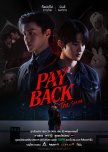
Payback — When Sex, Power and Revenge Share the Same Currency
I have watched many BLs advertise themselves as revenge dramas, only to forget about the revenge as soon as the romance begins. Payback never makes that mistake. It is one of the strongest revenge BLs I have seen in a long time because the love story does not interrupt the darker plot. Sex, ambition, corruption and revenge are all part of the same system. The Thai drama adapts the Korean Payback manhwa by samk and Fujoking, with Lee Yoohan becoming Sun while Yoon Jay retains his name. Sun enters the entertainment industry after learning the truth about the betrayal and death that destroyed his family, while Jay secretly holds considerable influence inside the company and offers the access Sun needs to complete his revenge. The official uncut version is rated for adults, and that tone is evident throughout the production.What interested me most was the way the series presents sex as another form of currency. Powerful people can exchange roles, protection and professional opportunities for access to someone’s body, while young performers are left trying to decide whether they are consenting or simply accepting what appears to be their only route forward. The explicit scenes are therefore not unnecessary additions created only to attract BL viewers. They are part of the corruption the story wants to expose. At times, the series is almost soft pornography, and with Min Thanakorn I honestly did not mind. The production is clearly aimed at a young-adult-to-adult audience, and pretending these characters exist inside an innocent romantic world would have weakened the story. The sex scenes are physical and erotic, but they also reveal who holds power, who is trying to regain control and who sees every relationship as another transaction.
The entertainment industry depicted here may appear exaggerated, but its basic mechanisms are not difficult to believe. The Harvey Weinstein cases and the wider #MeToo movement showed how powerful people could connect professional advancement with sexual access, silence and fear of retaliation. Even years after the movement became internationally visible, industry research continued to show that many workers doubted powerful offenders would actually face consequences. What makes Payback particularly interesting is that it places male performers inside that system. It is already extremely difficult for women to admit that someone exploited their ambitions or professional vulnerability. For men, expectations surrounding masculinity, strength and supposedly constant sexual willingness can create additional shame and make disclosure even more difficult. Research into male sexual victimisation repeatedly identifies stigma, fear of disbelief and masculine stereotypes as barriers to reporting.
The series places that discomfort directly in front of the viewer. These men are not only selling performances, faces and carefully constructed public identities. They are surrounded by people who believe their bodies can also become part of the business agreement. This is not a romance filled with hearts and flowers; it is a revenge story set in a world where intimacy, ambition and exploitation have become almost impossible to separate. Comparing the live-action adaptation with the manhwa makes the strengths and weaknesses of the casting much clearer. Min is remarkably close to how I imagine Lee Yoohan in reality. Fujoking’s Yoohan is lean, sharp-featured and emotionally guarded, carrying guilt and anger without constantly displaying them. Min has that same controlled coldness, making Sun appear as though every movement has been considered before anyone else enters the room.
Min Thanakorn is also incredibly beautiful, but his appearance is honestly the least important part of what he achieves here. His performance reminded me of the cold, brilliant investigators often found in Chinese police dramas: men who rarely show emotion but always seem to understand the situation before everyone else. Sun’s revenge never feels impulsive because Min makes it look like something he has carried, studied and refined for years. He understands how to act through stillness. He rarely needs to raise his voice or create exaggerated expressions because his eyes, posture and breathing already tell us what Sun is thinking. The same control makes the explicit scenes work. Min does not simply rely on nudity or choreography to make them erotic; the desire begins in his face and body before anything physical happens. At 26, Min already has extensive performance experience through idol training and televised competition programmes, and that familiarity with cameras is visible in the precision of his close-ups. Payback proves he is not simply a performer trying acting as another career extension. I can easily imagine him succeeding in crime dramas, psychological mysteries and films where a character’s intelligence or danger must be communicated without constant dialogue.
Toptap’s casting becomes more complicated when compared directly with Yoon Jay from the manhwa. In Fujoking’s artwork, Jay is broader, more physically imposing and visibly more mature than Yoohan. He carries himself with the relaxed arrogance of someone who knows he owns the room, while his smiles can feel playful, possessive or vaguely threatening depending on what he wants. The original Jay is not merely a rich sponsor who helps Yoohan. He is unpredictable, shameless and slightly frightening, with enough power that the reader can never be completely certain whether he will protect Yoohan or become another danger Yoohan must survive. The licensed novel even introduces him as an eccentric man whose apparently ridiculous behaviour hides much more dangerous secrets. Toptap is 22, while Min is 26, and the difference matters because the younger actor was asked to embody the older, more experienced and powerful character. Toptap is handsome and performs the emotional and intimate scenes well, but his naturally softer presence rarely communicates the physical or psychological authority associated with the original Jay. His age and youthful screen image are documented even though DramaBL’s profile had not yet incorporated that biographical information.
This concern was already visible among readers when the casting was announced. Several fans questioned the missing height difference, Jay’s younger appearance and the absence of the intimidating, imposing aura established by the manhwa. After watching the completed series, I understand exactly what they meant. The adaptation effectively reverses part of the original visual power dynamic. Min looks like the more mature, dangerous and controlled man, while Toptap often appears like the softer partner standing beside him. That does not destroy their chemistry, but it changes Jay’s position in the story. Instead of feeling like an unpredictable force capable of overpowering Sun, he sometimes feels more like Sun’s lover and financial supporter. Someone such as Ngern Anupart or Net Siraphop might have created the mature, physically dominant presence associated with the webtoon character more immediately. Even Boss Chaikamon appeared more threatening during several scenes than the man supposedly controlling the entire entertainment company. Toptap was not bad, but Min’s authority was so strong that Jay struggled to feel like his equal. That imbalance gradually transformed the whole series into Sun’s story. Everyone else felt like a supporting character attached to his revenge, while Jay mainly became the man closest to him and the person sharing his bed. This is quite different from the manhwa, where Yoohan and Jay generate tension because both men are dangerous in completely different ways.
Shogun Paramee provided some necessary softness and remained as naturally charming as usual. His presence prevented the production from becoming emotionally exhausting without undermining its adult tone. I am now even more curious to see him in Not Yours, whose international uncut premiere is scheduled for September 26, 2026.
The adaptation may not reproduce every part of the original character balance, but it understands why the revenge story works. It keeps Sun’s guilt, determination and complicated relationship with punishment at the centre rather than reducing the webtoon to sexual scenes. The explicit content receives considerable attention, yet the production never completely loses the corruption, betrayals and professional power games surrounding it.
Final Thought
Payback understands that a successful revenge drama cannot become afraid of its own darkness. It uses the BL relationship as part of the corruption rather than an escape from it, asking whether desire can ever be completely free when careers, money and influence control every decision. The comparison with the manhwa also explains why the casting produces such an uneven result. Min captures Lee Yoohan’s appearance, coldness and internal control remarkably well, while Toptap softens Yoon Jay into a younger and less intimidating figure. Their physical chemistry works, but the dangerous balance between the original characters becomes far less convincing. Fortunately, Min is powerful enough to carry the entire adaptation. He makes Sun’s revenge feel more important than every other relationship surrounding him, while his beauty, restraint and extraordinary command of the camera turn an already strong character into the centre of the production. Payback is unapologetically sexual, morally uncomfortable and far more interested in power than conventional romance. Most importantly, it never forgets why its main character entered the entertainment industry in the first place.

Our Sticky Love — Do We Only Believe in Second Chances When They Are Fictional?
I saw quite a few harsh reviews of Our Sticky Love, particularly people saying that twelve episodes were too much, and I honestly don't agree with everything I read. I understand some of the criticism because the drama occasionally takes its time when a few scenes could have been shorter, but I think reducing it to an overlong romantic comedy misses what the story was actually trying to do. For me, this wasn't simply about an amnesiac prosecutor falling in love with the man pretending to be her boyfriend. It was about second chances, and almost every important character was given one. That is probably why the slower pace didn't bother me nearly as much as it bothered some viewers. One review even argued that the story had a natural stopping point around episode ten and that the final two episodes stretched things out, which I can understand. But binge-watching twelve hours in a weekend also changes how pacing feels. Something designed to let characters settle, reflect and slowly reconnect can feel repetitive when consumed without much distance between episodes.Not every romance needs to move like an American thriller. Sometimes watching a drama is supposed to be relaxing. French and other European television and cinema have long been comfortable allowing silence, ordinary conversations and apparently insignificant moments to remain on screen, and I don't automatically consider that bad pacing. I do think Our Sticky Love could have been tightened in places, but "slow" and "badly written" are not synonyms. The creators are interesting in that regard. Writer Mo Ji-hye still has a relatively short credited television portfolio, with You Raise Me Up being her other major drama credit, so I can understand why some transitions and secondary plots feel less polished. Director Kim Jang-han, however, is not really inexperienced: he previously directed Do You Like Brahms?, You Raise Me Up and My Demon. His preference for emotional atmosphere over constant momentum therefore feels more like a directing style than simply someone not knowing how to pace a series.
At the centre of everything are Jung Hae-in and Ha Young, and I thought they were fantastic together. Jung Hae-in has reached a point in his career where he can make a character appealing without constantly reminding us that he is acting. Tae-ha is funny, protective and sometimes painfully awkward, but underneath all of that is someone who has spent years believing certain parts of his life cannot be repaired. His relationship with Eun-sae gradually becomes another chance to imagine a future instead of simply surviving his past. I also laughed when I saw people comparing Jung Hae-in physically with Cha Eun-woo, because what exactly are we supposed to prove with that comparison? They are attractive in completely different ways and belong to different generations of actors. Anyone who has followed Jung Hae-in's career—and, yes, remembers some of those shirtless scenes—already knows the man has absolutely nothing to be envious of. More importantly, he is not here simply to look beautiful; Tae-ha needed warmth, physical credibility as a former boxer and enough vulnerability to make his devotion believable, and Jung Hae-in gave him all three.
Ha Young surprised me even more because this is her first major romantic-comedy leading role after years spent largely in supporting parts. Eun-sae could easily have become unbearable: she is intelligent, privileged, suspicious and literally living inside a lie created by the man she will eventually love. Instead, Ha Young makes her funny without making her stupid and vulnerable without making her helpless. Critics who did enjoy the drama also singled out her comic timing, and I really hope this leads to more substantial leading roles because she proved she can carry one.
But the performance that affected me the most belonged to Heo Sung-tae. Gosh, he was scary. Baek Sang-gil initially appears to be exactly the kind of character Heo Sung-tae can play almost effortlessly: powerful, controlled and capable of horrifying violence without needing to scream every five minutes. Yet the final episodes ask much more from him. The monster slowly discovers that the young man he has manipulated, threatened and eventually prepared to destroy is actually his own son, the child he abandoned when he chose ambition and crime over the woman he loved. That revelation changes everything without magically making him a good person. His final moments were beautifully acted because several emotions existed at once. There was fear, regret, love and the horrifying realisation of what he had become. He finally understood that the cycle he created had reached his own child, but by then his chance to actually become Tae-ha's father had already disappeared. Watching an actor communicate that much while crying without turning the scene into exaggerated melodrama genuinely made me cry with him. And yes, Heo Sung-tae has received recognition for this kind of work. He won Best Supporting Actor at the 2022 APAN Star Awards for Squid Game and Insider, won a KBS supporting-actor award for Bloody Heart, and received major nominations including Baeksang recognition for Squid Game. His career is full of difficult, often unpleasant men, which makes the emotional vulnerability of Baek Sang-gil's ending even more impressive.
That ending is also where the entire drama finally came together for me, because second chances had been hiding everywhere from the beginning. Tae-ha gets another chance at love and at building a family after wasting part of his life inside a criminal organisation. Eun-sae gets another chance at life itself, but also an opportunity to discover who she is without her career, money and social position defining every decision. Other characters receive second chances in relationships, friendship, health and work. Even Jo Maeng-suk, the village shaman, fits the same idea. Her greed damages the gift she depended upon and disconnects her from the spiritual identity around which she built her life, yet the ending gives her another route back through tarot and the return of her intuition. It is funny, but it isn't meaningless. Even the comic side character is being told that losing something through your own mistakes does not necessarily mean you are condemned forever. What matters is what you do when the second chance appears. Some characters recognise it. Some almost miss it because of pride, fear or jealousy. Baek Sang-gil understands his too late, which is why his ending is so much sadder than a conventional villain simply receiving punishment. He could have had love, a son and another life, but every earlier decision gradually closed those doors until the only thing he could still do as a father was stop himself from destroying his child. That is why I think people concentrating only on the romance can miss quite a lot of what Our Sticky Love is doing. The love story is important, but family is everywhere too: biological family, chosen family, friendships that become family, and the possibility of creating something healthier than what you inherited. A second chance does not erase what happened before. It simply gives you one opportunity to decide whether the past will determine what happens next.
Unfortunately, discussion around Ha Young became complicated by something completely outside the drama. Shortly after release, historical records concerning her great-grandfather, physician Ahn Sang-ho, became the subject of controversy. Her agency initially called the allegations groundless, then apologised after confirming a 1916 record listing him as a council member of the Daejeong Chinmokhoe, and Ha Young subsequently apologised for having spoken proudly about family history without knowing the complete historical context. Planned promotional interviews involving both Ha Young and Jung Hae-in were cancelled as the controversy grew. I am not going to turn a drama review into a debate about Japanese colonial history, because it deserves a much more serious discussion than a paragraph attached to a Netflix romance. I also cannot prove that every negative review of Our Sticky Love was influenced by that controversy, and it would be unfair to dismiss legitimate criticism that way. The mixed reception existed for genuine reasons too, particularly around pacing and how the different plots were balanced.
But I do have a problem when criticism of an actor's work becomes criticism of something an ancestor did generations before that actor was born. Ha Young can be judged for what Ha Young says and does, including how responsibly she discusses her own family history once new information becomes available. She cannot travel backwards in time and make decisions for her great-grandfather. That distinction actually connects strangely well with the drama itself. Our Sticky Love repeatedly asks whether people must remain trapped by the mistakes of the people who came before them. Tae-ha certainly does not become responsible for Baek Sang-gil's crimes because they share blood. Why should that principle suddenly disappear when we stop watching fiction and start looking at an actress? Being descended from somebody who made morally compromised choices does not create inherited guilt. Nor should Ha Young have to prove that she is "Korean enough" because of a man who lived generations earlier. If anything matters now, it is what she does with her own life and what she chooses after learning more about that history.
Final Thought
Our Sticky Love is not a perfect drama, and I don't need to pretend it is simply because I enjoyed it. Some scenes could have been shorter, the balance between romance, comedy and crime occasionally becomes uneven, and a more experienced scriptwriter might have given certain secondary stories greater momentum. But twelve episodes did not feel pointless to me because the story wasn't only waiting for Jung Hae-in and Ha Young to kiss. It was giving people chances. A chance to love someone again. A chance to become a family. A chance to rebuild a career. A chance to survive illness. A chance to repair a friendship. A chance to admit that you were wrong. Even a chance to become the father you should have been years earlier, although Baek Sang-gil discovers with devastating cruelty that some chances do eventually expire.
That is what stayed with me after the romance ended. Life occasionally gives us another opportunity to correct something we damaged, but there is absolutely no guarantee that it will offer a third. Maybe that is also why I find some of the reaction surrounding Ha Young so uncomfortable. If a drama spends twelve episodes reminding us that people should be judged by what they choose to do with the life they have been given, perhaps we should be capable of extending the same reasoning to the actors once the credits stop rolling.

Sin and Love — A Good Story Filmed Like an Amateur Production
I don't think Sin and Love is bad because its story is bad. In fact, I gave the story a good score because the idea behind it is exactly the kind of Korean BL I want to see more often: police corruption, drug trafficking, undercover identities, kidnapping, power, sex, betrayal and an old relationship buried underneath everything. On paper, this could have been an excellent adult crime BL. Unfortunately, watching it sometimes felt less like watching a drama and more like watching an amateur video made by people who had never directed or edited one before.And no, I don't think a small budget automatically excuses that. I couldn't find any publicly disclosed budget for the series, so I don't actually know how little SEEKMedia spent. But some things do not require enormous amounts of money. Knowing where to place a camera, maintaining continuity between two shots, allowing an actor's reaction to finish before cutting away, using sound properly, or directing two actors so that an intimate interaction has motivation are questions of filmmaking before they are questions of money. DramaBL even had a viewer pointing out continuity mistakes where the actors physically change position between consecutive shots of the same scene. That is not something an expensive set would have fixed. The strangest thing is that Sin and Love clearly wanted to look adult. Even the promotional material sells darkness, danger and sexuality. SEEKMedia described a world where “love and sex” have become instruments of control and exchange, and the official premise involves criminals, corrupt police, undercover agents and people using one another for survival. It therefore creates an expectation of something dangerous and sensual, not necessarily explicit, but at least emotionally and physically convincing.
Instead, the series is surprisingly prudish. I kept thinking that it looked like gay porn with the sex removed. I know that sounds harsh, but it is genuinely the closest comparison I can find. The poster and staging suggest something erotic, the actors are positioned like something is about to happen, and then we get what feels like fake preliminaries without the desire that should explain why these men are touching each other in the first place. Intimacy does not need nudity or explicit sex to work. A look can be more erotic than an entire NC scene when the characters actually appear to want each other. Here, too many interactions seem to happen because the script says they should, not because the direction has built enough attraction, fear or obsession to make them inevitable. That is particularly frustrating because the story itself provides plenty of motivation. Se Hyun and Seong Ho have ten years of history behind them. Hyeok Jae is supposed to be a respectable senior police officer hiding ambition and corruption underneath, while Min Ho exists inside the same compromised system. These are not innocent university students wondering whether holding hands means they are dating. They are adults surrounded by violence, secrets and compromised loyalties. The emotional and sexual tension should have been suffocating.
Instead, the production repeatedly removes that tension just when it needs to become stronger. It also makes me wonder what SEEKMedia actually wants from these dramas. The company describes itself as a cross-cultural studio with an integrated production system and years of experience, but its recent BL catalogue has been built heavily around compact, digitally distributed productions. Tide of Love, followed quickly by a second season, already received criticism for abrupt editing, weak storytelling and scenes that seemed disconnected from one another. Its IMDb score currently sits around 3.9/10 from more than 140 ratings, which is not an enormous sample but is large enough to show that the negative response was not limited to one person. Even before Sin and Love premiered, viewers familiar with SEEKMedia were openly hoping that the company had learned from the criticism of its previous dramas.
That worries me because there is a difference between creating inexpensive BL and creating BL that looks inexpensive. Some excellent queer films have been made with almost nothing. A limited budget can even force directors to become more inventive because they cannot hide behind huge sets, expensive equipment or elaborate action scenes. If you only have four important characters and a handful of locations, then those limitations should become an advantage: concentrate on performances, framing, dialogue, atmosphere and tension. Sin and Love has ten episodes of around twenty-five minutes, meaning there was enough screen time to make four characters compelling. Instead, limiting the cast actually makes the mystery easier to predict. When so few people can realistically be responsible for what is happening, the ending gradually becomes less of a revelation and more of a confirmation. A crime thriller needs suspects, uncertainty and enough competing motivations to keep us questioning what we know. Here, I reached the ending with the feeling that there simply weren't enough pieces on the board for it to surprise me.
The actors are the reason I refuse to judge this series as harshly as the finished product probably deserves. Jung Myeong Cheol and Kim Hyeon Seo had already worked together as the leads of Tide of Love and its second season, so SEEKMedia clearly sees value in keeping them together. Kim Seong Hyuk, however, was the actor I particularly wanted to see because I loved him as Milk in Choco Milk Shake. That series showed how expressive he could be with very little dialogue. Milk's personality came through his movements, expressions and comic timing, and Seong Hyuk managed to make an intentionally strange fantasy character feel completely natural.
That is why I don't suddenly believe he forgot how to act. Hyeok Jae is much harder to play. He is officially described as a wolf in sheep's clothing: respectable and dignified on the outside while cunning, ambitious and dangerous underneath. Playing that type of villain requires restraint because the audience has to believe both versions of the man. If the performance becomes too obviously sinister too early, the disguise disappears. If it becomes too restrained, the danger disappears instead. There are moments where Seong Hyuk overplays it, and I noticed them. But I also saw flashes of the actor I remembered from Choco Milk Shake. Certain expressions, pauses and changes in his eyes show that he understands what Hyeok Jae is supposed to be. The problem is that those moments are surrounded by direction that often seems to ask for something larger and more obvious. When an actor is still developing, that guidance matters enormously.
That is why I gave the cast a high score despite criticizing several performances. Young or relatively unknown actors do not have the power of established stars. When someone finally gives them a main role, they cannot casually tell the director that the staging looks ridiculous, the scene lacks motivation or the edit is making their performance worse. They do what they are asked to do because refusing work when nobody knows your name can mean losing the opportunity entirely. The responsibility therefore cannot stop with the faces we see on screen. The director is Kim Im Jin according to current production listings, but regardless of one name, a drama is made by an entire team. Direction, cinematography, sound recording, editing and production supervision collectively decide what finally reaches our screens. An actor can give several versions of a scene; the production chooses which take remains. An actor can perform an emotional transition; the editor can destroy it by cutting at the wrong moment. An actor can try to create chemistry; poor blocking can make the interaction look forced.
That distinction matters even more in Korean BL right now. There are increasingly many small Korean BL productions competing for the same international audience, and attractive actors are often enough to generate the first click. Sin and Love had an especially marketable cast: the returning Tide of Love pairing, Kim Seong Hyuk from Choco Milk Shake, and a dark promotional concept filled with handsome men, crime and sexuality. It is difficult not to wonder whether some of these productions are becoming showcases for actors rather than dramas created because somebody genuinely has the resources and vision to tell the story properly. If the objective is simply to create footage so agencies and casting directors can see an actor's face and basic abilities, there is nothing inherently wrong with that. Make a short film, a pilot, a workshop scene or an acting reel. But once something is packaged internationally, sold through platforms such as iQIYI and Heavenly, promoted as a ten-episode drama and offered to paying viewers, I think it deserves to be judged as a professional production. SEEKMedia itself presents its work as internationally distributed content rather than student filmmaking. That is the part that frustrates me most because Sin and Love had a genuinely good story underneath all of this. The problem wasn't that there was nothing worth filming. The problem was that the production never transformed those ideas into something that felt dangerous, sensual or cinematic. A corrupt police system, drug organisations, an undercover operation and men whose past relationships interfere with their loyalties should create tension almost automatically. Yet so many scenes feel strangely empty that the story appears cheaper than it actually is.
Final Thought
Sin and Love is exactly why I don't automatically excuse a BL because it was probably made with limited resources. Budget determines how much you can build, how many locations you can use and how spectacular your action can become. It does not determine whether you understand your own actors, whether consecutive shots match or whether two people touching each other look as though they actually have a reason to do so. For me, this occasionally felt like watching gay porn without the sex: attractive men, suggestive staging and a poster promising something far more provocative, followed by intimacy that feels like awkward preliminary acting for a scene that never arrives. That would almost be funny if the underlying crime story were not good enough to deserve much better.
I also refuse to place most of that disappointment on the cast. Kim Seong Hyuk has already shown what he can do in Choco Milk Shake, and even here I could still see pieces of that ability beneath a villainous performance that sometimes became too exaggerated. The other actors were working inside the same limitations. When performers are still trying to establish themselves, they take the opportunities available and depend on experienced people behind the camera to make those performances work. SEEKMedia now has enough BL productions behind it that these problems are becoming harder to dismiss as simple growing pains. Tide of Love received many of the same complaints about editing and storytelling, and viewers were already nervous about Sin and Love before it premiered. That is a small body of evidence, but it is becoming a pattern worth paying attention to.
I would much rather see fewer Korean BLs made with enough preparation to make them memorable than an endless supply of attractive actors placed inside productions that look unfinished. Sin and Love had the story, the cast and even the right provocative concept. What it needed was someone behind the camera capable of making all three look as good as they sounded on paper.

Knot — It Knew the Omegaverse, but Not What to Do With It !
Few BLs disappointed me in 2026 as much as "Knot", mostly because the premise promised so much. This was not a production timidly borrowing one or two Alpha/Omega ideas. It gave us pheromones, Alpha-Beta-Omega hierarchy, claiming bites, biological bonds, nesting, knotting, male pregnancy and a rare Pure Omega whose reproductive value becomes important to a powerful family. On paper, that should have been enough to build a fascinating story about power, biology, freedom, reproductive control and social hierarchy. Instead, after twelve episodes, the strongest thing I remember is an Alpha father searching for the ultimate Omega for his bloodline. The writers clearly knew the vocabulary of Omegaverse, and sometimes the series seemed almost too eager to prove it through explanations of bonding, pregnancy, knotting and Omega biology, but knowing the rules of a fictional universe is not the same as knowing how to use them dramatically. Omegaverse becomes interesting when biology changes society and forces characters to confront what that society expects from them. "Knot" created the Alpha supremacy, the valuable Omega body and the bloodline obsession, then barely explored what any of it meant.Phatsa should have been the character capable of turning all that worldbuilding into a real story. He begins stubborn, independent and strong, almost more like the kind of personality this universe associates with an Alpha than the stereotypical submissive Omega. Discovering that he is actually an extremely rare Pure Omega could therefore have created a fantastic conflict between biological classification and personal identity. Why should discovering what his body is suddenly determine the kind of man he is allowed to be? Instead, once Nakhun bites and bonds with him, too much of that original strength disappears. Phatsa becomes increasingly needy, physically dependent and emotionally attached to his Alpha because the bond requires it, yet the story rarely allows him to seriously fight against what that dependency means. I wanted him to remain the man we met at the beginning while learning how to live as an Omega, not become defined by Nakhun because of biology. His relationship could have been about two men challenging what Alpha and Omega are supposed to mean, with Nakhun learning that loving Phatsa means treating him as an equal rather than simply protecting him. Most importantly, Phatsa should have confronted Nakhun's father and the entire bloodline system directly. The rarest Omega in their society could have become the person who destroys the assumption that Omegas exist for Alpha families to use. That would have made the title "Knot" much more meaningful too: not simply a biological mechanism, but a question about whether love can remain a choice once a physical bond makes separation painful. Can Phatsa genuinely choose Nakhun after his body has been altered by the bite? Can instinct become partnership rather than control? Those are the questions the series had everything necessary to ask and rarely did.
The rest of the writing suffers from the same problem: ideas appear without enough consequence. Phatsa can be frightened and dependent in one episode, then suddenly fight dangerous people and kill in another, without enough psychological development connecting those versions of him. Being brave in one situation and vulnerable in another is perfectly believable, but here his behaviour often changes according to what the current scene needs rather than according to a consistent character arc. The pregnancy material is equally confusing. One moment it feels intimate, another moment it becomes biological exposition, then it becomes a threat because powerful people value his reproductive ability, and later the story almost moves past it. The Alpha father's obsession with securing a Pure Omega should have been the centre of everything because it exposes what Alpha supremacy actually means: control of reproduction, inheritance and bloodline. Omegas can therefore be considered precious while simultaneously losing autonomy over their own bodies. That is dark, powerful material, yet "Knot" continually wanders away from it into corporate schemes, family discussions, villains and side conflicts that never become equally interesting.
The staging makes the story feel even smaller. For a drama supposedly taking place in a world dominated by biological hierarchy, powerful families and people willing to hunt someone because of his reproductive value, an extraordinary amount of "Knot" consists of people sitting inside rooms explaining things to each other. The series becomes claustrophobic without making that claustrophobia meaningful. It could have used enclosed spaces deliberately, trapping Phatsa inside Nakhun's world before gradually expanding the visual environment as he gained independence and control over his identity. Instead, the locations mostly make a supposedly large Omegaverse society feel like it exists inside a few houses and offices. The actors then have to compensate for dialogue that keeps explaining a world the drama rarely shows. Boat Yongyut and Oat Pasakorn still have chemistry, and that helps enormously, but chemistry cannot repair inconsistent character development. The intimate scenes are not the problem either. This is Omegaverse, so physical instinct, desire and sexuality naturally belong to the genre. What disappointed me was that the production seemed much more interested in reproducing the mechanics associated with Omegaverse than in examining their consequences. Showing pheromones, bites, knotting and male pregnancy is the easy part. Asking what a society built around those things does to the people living inside it is where the real story should have started.
That is why "Knot" feels so hollow despite containing so much. It has the ingredients of a much larger drama but the emotional and political weight of a much smaller one. We are told about an entire biological hierarchy while mostly watching domestic conversations. We meet a protagonist who could overturn expectations about Omegas, then watch his independence diminish once he bonds. We are given a father whose obsession with bloodline could expose everything wrong with Alpha supremacy, yet the story never allows that conflict to become the revolution it could have been. The writers understood the terminology, the production was willing to show aspects of Omegaverse that live-action Asian BL rarely touches, and Boat and Oat had enough chemistry to carry a relationship through difficult material. That is exactly why the result is so frustrating: the foundations were already there. What was missing was the decision to make those foundations matter.
Final Thoughts
"Knot" did not fail because it misunderstood the basic mechanics of Omegaverse. It failed because it knew the mechanics and never developed them into a strong enough story. Phatsa could have become one of the most interesting Omega protagonists in live-action BL: a man whose personality contradicted the hierarchy assigned to his body, who could love an Alpha without surrendering his independence, and who could eventually challenge the family trying to reduce him to reproductive value. Instead, too much of his strength disappeared, the pregnancy and danger plots remained inconsistent, and a huge fictional society somehow felt trapped inside a few rooms.
The series built the biology, explained the rules and created the hierarchy, but never gave any of them enough consequence. For something called "Knot", the strangest thing is how little of the story ever truly came together.
A world can be built on bonds, but without a story strong enough to hold them together, even the tightest knot eventually comes undone.

Memoir of Rati — Everything I Love About Historical BL
Historical BLs have always had something special for me. When they're done well, they offer much more than a romance. They transport you to another era, immerse you in another culture, and make every glance and every touch feel more meaningful because society itself stands against the characters. Memoir of Rati does exactly that, and it's one of the reasons I fell in love with it from the very beginning.I had already told you how much I love Great Sapol and Inn Sarin as a pairing, and this drama only confirmed it. They have the kind of chemistry that doesn't need exaggerated dialogue or constant physical intimacy. A simple look between them often says more than an entire conversation. Their relationship grows naturally, making every emotional moment feel completely earned.
The story is beautiful because it isn't just about two men falling in love. It's about duty, family, social expectations, and choosing happiness when the entire world tells you not to. Setting the story in early twentieth-century Siam gives the romance an additional layer of tension, making every decision the characters make feel important. Rather than using history as decoration, the series makes it an essential part of the narrative.
The production is simply stunning. Every location, every costume, and every carefully framed shot feels like it belongs in a period film rather than a television drama. The cinematography constantly enhances the emotion of each scene, while the music perfectly complements the atmosphere without ever overwhelming it. It's one of those rare productions where you can see the care that went into every visual detail.
The supporting cast is equally impressive. Nobody feels like they're only there to fill the screen. Every important character contributes something meaningful to the story, creating a world that feels alive beyond the central romance. That richness makes the drama even more immersive and gives greater emotional weight to the choices the protagonists have to make.
Final Thought
Memoir of Rati is everything I hope for when I start a historical BL. It tells a beautiful love story without forgetting the world surrounding its characters, it looks absolutely gorgeous from beginning to end, and Great Sapol and Inn Sarin once again prove why they're one of my favourite pairings. This is the kind of series that reminds me historical romances can be just as powerful as modern ones—sometimes even more so.:::

HIStory: Obsessed — A Dangerous Love That Changed the Rules
HIStory: Obsessed is rarely mentioned among the strongest entries of the franchise. And yet, for me, it remains one of the most haunting. Not because it is perfect—but because it is brave. This was not meant to be a soft romance. It was meant to disturb, confuse, and linger. And even with only four short episodes, it manages to leave an emotional imprint that many longer dramas never achieve.Obsession as a Language of Love
The series is built around intensity, not comfort. Love here is not gentle. It is consuming, unbalanced, and dangerous. With so little screen time, the story moves fast, but the emotional core is surprisingly rich. Every scene feels like a fragment of something larger, a story that wanted to breathe but was never given enough space. It deserved a full-length format. It deserved room to become the dark romance it was trying to be. And yet, even in its unfinished state, the obsession feels real.
A Product of Its Time and a Catalyst for Change
This drama exists at a turning point in Taiwanese BL history. Before marriage equality became law in Taiwan in 2019, stories like this helped shift public perception. They were imperfect, sometimes clumsy, but necessary.
HIStory: Obsessed walked so later entries could run.
Without it, there would be no HIStory 3, no HIStory 4, and no HIStory 5: Love in the Future, now a hit with a full twenty-episode run. The evolution of the franchise reflects the evolution of society itself. This drama is part of that foundation.
A Mystery Hidden in the Frame
There is a detail that still haunts me. Look closely at the blanket in the opening scene. Then look at the same blanket in the final episode, when they wake from a nightmare. It raises a question the series never answers: Did he go back in time? Or did he dream everything? That ambiguity is not a flaw, it is the soul of the story.
Final Thought
HIStory: Obsessed is not comfortable. It is not clean. It is not complete. But it is honest in its darkness. And sometimes, the stories that change us the most are the ones that leave us unsettled.

Love Hurts — When the Chemistry Is Bigger Than the Format
I rarely write reviews for Korean BLs with ten-minute episodes. There are simply too many of them now, and unless something really distinguishes itself, eight episodes of six to ten minutes can feel less like a drama than a collection of scenes surrounding one romantic idea. Love Hurts surprised me. The story itself certainly did not. Kim Dojin and Lee Jaewon were classmates who became close, developed feelings, separated without properly resolving what happened between them, and eventually have to confront a first love that neither has completely left behind. We have seen variations of first love, missed timing, ghosting, misunderstandings and reunion countless times across BL, films and heterosexual romance.The Korean title, 첫사랑니, is actually more interesting than the English one because it plays with first love and wisdom tooth: something buried underneath, painful when it begins to emerge and difficult to ignore once it starts hurting. That metaphor fits the story rather well. But even then, nothing about the premise made me think I was about to discover something revolutionary. (dramabl.com) What made me keep watching was the actors. And more specifically, their chemistry. There are BL couples where the script continuously tells us that two characters want each other while I sit there waiting for the actors to convince me. Love Hurts had almost the opposite problem. The screenplay had barely enough time to develop anything, yet every time Kim Changyu and Kang Seon-ho were together, my brain was basically shouting: get a room. The sexual tension is ridiculous. It isn't created through explicit scenes either. It is in proximity, eye contact, hesitation and the slightly uncomfortable awareness of another person's body. They often look like two people who remember exactly what being close to each other felt like and are trying to behave as if they don't. That is much harder to manufacture than a technically competent kiss. At some point I genuinely wondered whether they were a couple outside the drama, not because I have any interest in deciding actors' private relationships for them, but because their physical ease together was that convincing. Chemistry is not evidence of a real relationship; excellent acting can create exactly the same impression. In fact, making the audience briefly wonder where acting ends is probably one of the greatest compliments I can give two romantic actors. And that is especially noticeable because Love Hurts gives them almost nothing to hide behind.
There is no expensive fantasy world, no elaborate crime plot, no enormous supporting cast and no spectacular cinematography distracting us from whether the couple works. Eight episodes run roughly six to eleven minutes each, so the entire series is only around the length of a feature film. It was released through Lovememory's YouTube channel, with episodes initially available early to channel members before public release. (dramabl.com) When a production is this small, chemistry becomes incredibly important. Thankfully, Kim Changyu has plenty of it. I have had a crush on him since His Man in 2022, so I admit I wasn't approaching this with complete neutrality. He was adorable there, and four years later I still find him ridiculously cute. For anyone discovering him through Love Hurts, his Instagram is @gyu_11.12. But liking him personally isn't why I think he works here. His Man also makes Changyu interesting within Korean BL because he did not become visible by playing a fictional gay character. He first became widely known through Korea's first major gay male dating reality show, where eight men openly participated in a program about finding another man. He has since moved further into scripted queer productions, including Fan Service earlier in 2026. That transition matters. Changyu does not perform Dojin as a collection of mannerisms designed to signal "gay character." There is nothing exaggerated about the performance. He could easily fit into a heterosexual romance, thriller, workplace drama or comedy without needing to change some supposedly essential part of himself. And to be clear, that is not because masculine gay actors are somehow more versatile than effeminate gay actors. Effeminate men can play an enormous range of characters too. The point is that sexuality is not an acting type. A gay actor is an actor. That sounds absurdly obvious, yet Korean entertainment still has very few openly gay performers working visibly in mainstream scripted roles. Hong Seok-cheon famously lost television work after publicly coming out in 2000 and spent years rebuilding his career. More recently, Squid Game creator Hwang Dong-hyuk explained that when he considered authentic casting for a transgender character, the industry had so few openly trans or gay actors available that finding one was extremely difficult. That makes people such as Changyu important even when the BL itself is tiny.
There is also an interesting double standard around queer roles. Straight actors can play gay characters, gain a BL fandom and then return to heterosexual romances, thrillers or mainstream television without anybody deciding that their fictional sexuality defines their career. For an openly gay actor, however, there is always a risk that audiences and casting directors start thinking, "gay actor = BL." That would be an enormous waste. I don't want Kim Changyu to receive more BL roles simply because he is gay. I want him to receive more acting roles because he can act. If the character happens to be gay, wonderful. If his next character falls in love with a woman, murders somebody in a thriller, investigates crimes, becomes somebody's annoying brother or spends sixteen episodes doing absolutely nothing romantic, that should be equally normal. Representation becomes much more meaningful when LGBTQ actors are allowed to exist across an industry rather than being confined to stories about their sexuality.
Kang Seon-ho also deserves credit because this chemistry obviously requires two people. He already had experience in several short queer productions before Love Hurts, including projects such as Kiss Kiss Sxx, Love Reset, Connect and Sweet Blood. His professional profile also lists extensive short-film work and formal acting studies, which helps explain why the incredibly compressed format doesn't seem to overwhelm him. (starlet-studio.co.kr) Jaewon could easily have become frustrating because so much of the relationship depends on what he does not explain. In a longer drama, silence can slowly reveal itself. In a ten-minute episode, withholding information can simply make a character look irritating. Seon-ho manages to communicate enough underneath that distance that Jaewon doesn't become completely inaccessible. Together, they do something that many much more expensive BLs fail to accomplish: they make me anticipate physical contact before it happens. That is why I eventually started wanting something I normally don't even ask for. A sex scene. Not because Love Hurts needed explicit content to qualify as BL, and certainly not because every romantic story should end in bed. I frequently complain when productions use sex as a substitute for emotional development. Here it was almost the opposite. The tension had accumulated so consistently that by the finale I wanted some kind of physical release simply for narrative satisfaction. It could have remained tasteful and mostly implied. I just wanted the drama to finally say, "Yes, these two have spent eight episodes looking at each other like that, and now they are finally going to do something about it." At that point the imaginary voice in my head could finally say: AT LAST. That reaction tells me much more about their chemistry than any explicit scene actually could. What frustrates me is how clearly Love Hurts demonstrates the limitations of its format. This could have been a proper Korean BL. Not necessarily sixteen one-hour episodes—that would be ridiculous for this story—but perhaps eight episodes of thirty minutes, with a few additional characters and enough time to develop the original relationship, the separation, the reason behind Jaewon's behaviour and the difficulty of rebuilding trust after somebody disappears from your life. Instead, we receive approximately eighty minutes in total. That forces everything to become shorthand. The characters look at each other and we understand history. A few lines imply emotional damage. Flashbacks have to replace whole stages of a relationship. Conflict appears and disappears quickly because there literally isn't time for it to breathe. The actors compensate for an enormous amount of missing writing. And that is where I think Lovememory deserves both praise and criticism. The company has developed a very specific niche in Korean BL: extremely short YouTube productions such as Two Some Boys, With Me, Boysmate, Never Ending Story, Opposites Attract, Sweet Blood and now Love Hurts. It has also repeatedly provided opportunities to performers connected to queer reality television; With Me, for example, featured Kim Hanmin from His Man 3, while Fan Service brought together Changyu and fellow His Man participant Kim Changmin. I appreciate that enormously. But the company's catalogue also illustrates the problem with Korean micro-BLs. Audience samples for several of its productions are so small that ratings are not particularly meaningful—Two Some Boys, for example, has only a handful of IMDb ratings—so it would be unfair to declare a clear quality trend from scores. What is much easier to see is the production model itself: six-to-ten-minute episodes, small casts, limited locations and stories designed around what can realistically be achieved with those resources. Love Hurts is one of the cases where I think that model undersells the talent involved.
Technically, I was impressed. The cinematography, framing and especially editing feel considerably more professional than I expect from this level of Korean web BL. Nothing screamed "amateur production" at me. The camera understands faces, cuts generally arrive when they should, and scenes have visual continuity. The limited budget is visible through scale, not through incompetence. That distinction is important. A small budget doesn't bother me. Poor filmmaking does. If you can only afford two actors, three locations and ten minutes, then make those two actors and three locations look intentional. Love Hurts largely succeeds at that. Which is why I wanted more. This is exactly the opposite reaction I have to some Korean micro-BLs where I reach episode three and already feel they have stretched fifteen minutes of material into an hour. Here, I reached the ending thinking the production had found two actors capable of carrying substantially more drama and then gave them barely enough time to prove it.
Final Thought
There is nothing exceptional about the story of Love Hurts. First love. Separation. Misunderstanding. Feelings that never completely disappear. Reunion. We have seen all of it before, and we will see it again. But chemistry can make an old story feel surprisingly new. Kim Changyu and Kang Seon-ho made me believe these characters wanted each other before the screenplay had enough time to fully explain why. Every look seemed slightly too long, every bit of physical proximity felt loaded, and by the end even I—the person constantly saying BL does not need sex scenes—was sitting there thinking: please, just get a room already. That alone made this little drama memorable to me.
It also reminded me why I wish Korean BL would stop treating ten-minute web episodes as the natural home for so many queer stories. Love Hurts did not need a larger budget to become louder or more explicit. It needed a larger canvas for two actors who had already created something the production could not buy: believable attraction. And I especially hope this opens more doors for Kim Changyu. Being openly gay should not sentence an actor to playing gay characters forever, just as being straight has never prevented countless actors from building careers through BL. He has the screen presence and acting ability to do much more than one genre. For once, my complaint about a tiny Korean BL isn't that ten minutes per episode was already too much. It's that these two made ten minutes feel nowhere near enough.

Bittersweet Love — China Has Better Danmei Than This
Sometimes I genuinely don't understand the choices being made with Chinese BL adaptations. China has produced some of the most imaginative BL novels I have ever read. Case File Compendium combines romance with psychological obsession, medical mystery and science-fiction elements, while Guardian builds its relationship around supernatural investigations, gods, ghosts and an entire mythology. These are stories where the romance exists inside something much larger than simply watching two attractive men fall in love. And then we get Bittersweet Love. Once again, a poor young man is brought into an influential family, treated as inferior because of his background and expected to endure humiliation until one of the rich men eventually becomes emotionally attached to him. I have watched versions of this story in Chinese heterosexual dramas for years. Seeing essentially the same structure transferred into BL does not suddenly make it feel new.To be fair, Bittersweet Love is not pretending to have invented this story in 2026. It adapts Cheye Liuxiang's older danmei novel The Man Who Married into a Wealthy Family, which is explicitly set in 1990s China. Lu Xiaofan is a poor rural school dropout who enters the powerful Bei family through a sham marriage to their daughter and gradually becomes emotionally entangled with her brother, Bei Luqing. The original novel was already built around class, humiliation, family obligation and the enormous social distance between these two men. So perhaps my frustration is really with the decision to adapt this particular kind of danmei now. Chinese BL is finally finding new ways to reach international audiences, and Bai Xiao Studio is developing an entire slate of danmei adaptations specifically for overseas distribution. Bittersweet Love is one of the studio's first major releases, with other adaptations already announced behind it. When you have such an enormous library of Chinese BL literature available, beginning with another rich-family melodrama feels strangely conservative. I can understand the practical reason. This is an inference rather than something the studio has stated, but a family melodrama set mostly in homes, offices and social spaces is considerably easier to produce than something on the scale of Guardian or Case File Compendium. Supernatural worlds, investigations, action, elaborate sets and science-fiction concepts require much more money and production experience. A class-difference romance is a much safer first project.
Safe does not automatically mean interesting. My biggest difficulty was Lu Xiaofan himself. While watching the drama, I kept asking why an adult man who has already spent his childhood being treated badly would continue accepting humiliation so quietly. My instinct is almost the opposite: when people have spent years being pushed around, eventually they learn to defend themselves, become angry or start pushing back. I found myself thinking that no man would remain this submissive for so long, and frankly that even many women placed in his situation would eventually rebel. Psychology made me reconsider that slightly. There is no universal reaction to childhood mistreatment. Some people become confrontational, but others learn that resistance only creates more punishment. Repeated experiences of having little control can contribute to helplessness, avoidance and difficulty asserting oneself later. Family environments also influence how assertive young adults become and how they handle relationships. Trauma therefore does not necessarily create someone who fights back; sometimes it creates someone exceptionally skilled at surviving by becoming small. And strangely enough, that is much clearer in the novel. Cheye Liuxiang describes Xiaofan almost like a weed that survives wherever there is a tiny crack available. He continuously changes his expectations according to whatever position other people permit him to occupy. Even early in the novel, his family openly treats his educated older brother as more valuable, and Xiaofan has already internalised the idea that sacrificing himself for that brother is reasonable. He lowers his head not because he possesses no personality, but because he has been taught where he believes his place is. That distinction matters enormously.
A novel can keep us inside someone's thoughts. We understand humiliation because we hear the calculations behind it. We understand why Xiaofan says nothing because we know what he thinks he will lose by speaking. Passivity can therefore become characterisation. Television cannot simply remove that internal voice and expect the same behaviour to communicate itself. In the drama, Xiaofan too often just looks weak. Instead of thinking, "He has learned that accommodation is how he survives," I found myself thinking, "Why are you letting these people do this to you again?" Those are completely different reactions. If the adaptation wanted to retain such an unusually submissive protagonist, it needed to make his psychology visible through stronger dialogue, private moments, anger he suppresses, or small decisions showing that remaining quiet is itself a choice. Without that, the character begins to feel less like a complicated product of his environment and more like another BL protagonist designed to suffer until a powerful man decides he is worth protecting. That is particularly disappointing because the original Xiaofan is not actually completely powerless. The novel's description emphasises his adaptability, and older readers have specifically commented on the pleasure of watching someone initially perceived as weak eventually demonstrate considerably more awareness than people assume. The screen version preserves much of the suffering but, for me, loses some of the intelligence behind it.
Bei Luqing creates another familiar problem. He is handsome, educated, wealthy and socially untouchable, exactly the kind of emotionally restrained upper-class character Chinese romance has produced countless times. His attraction to Xiaofan is supposed to become interesting precisely because Xiaofan represents everything his social environment teaches him to look down upon. Yet even that dynamic feels oddly familiar now. Rich, cold man slowly discovers feelings for poor, warm, socially inferior person. Class difference. Family disapproval. Sacrifice. Misunderstanding. Separation. Reunion. Changing the poorer character from a woman to a man does not automatically make the structure innovative. That is why I kept thinking about Chinese danmei itself while watching. The literary genre has already moved far beyond this. Chinese authors have written political thrillers, historical epics, supernatural mysteries, science fiction, crime stories, psychological horror and some extraordinarily complicated morally grey romances. The international success of books such as Guardian and Case File Compendium demonstrates exactly how broad danmei can be.
So why does live-action BL so often retreat toward familiar melodrama? Part of the answer is probably economics. Another part is risk. Complex danmei requires complex production, and Chinese BL projects aimed overseas are still developing a sustainable model. Bai Xiao Studio currently has an ambitious list of adaptations in development, but Bittersweet Love does not yet give us a production catalogue large enough to judge whether the company can successfully handle something much more demanding. I could not find a substantial previous completed BL catalogue from the studio that would allow me to compare its writing, directing or production quality across several works. That makes this feel almost like a test case. Unfortunately, it is not a test case that makes me particularly excited about the future. The series itself looks competent enough, and Guan Yue and Yan Ruihao have moments where the relationship becomes genuinely touching. But competence is not what frustrates me. It is the lack of ambition. The material repeatedly circles the same humiliation, class inequality and emotional dependence rather than making those themes feel new.
Even the 1990s setting should have created something much more complicated. Being gay in that environment is not simply another obstacle equivalent to having disapproving parents. The social and legal reality surrounding two Chinese men openly forming a life together would have been enormous. Same-sex marriage is not legally recognised in mainland China even today; Chinese government guidance still defines legal marriage as between a man and a woman. That makes the ending especially strange. If their "marriage" is intended as a symbolic private commitment, I can accept it as romantic fantasy. People do not need state permission to promise themselves to one another. But if the drama expects the audience to read it as anything resembling an ordinary recognised marriage in 1990s mainland China, it becomes historically impossible. Interestingly, even the original novel eventually reduces the resolution to something close to a romantic declaration rather than pretending Chinese law suddenly changed. One older description of the ending has Bei Luqing finally finding Xiaofan after two years and simply telling him they should marry. It works as emotional language: "I choose you permanently." It does not need to mean that the government issued them a marriage certificate. The drama could have used that contradiction beautifully. Imagine ending with two men deciding that they consider themselves married even though their country does not. That would immediately say something about love, society and the limits of official recognition. Instead, when the surrounding story has already simplified so much of their emotional development, the marriage risks feeling like another convenient happy-ending image.
Final Thought
I started Bittersweet Love wondering why Xiaofan was written as such an unrealistically weak man. After looking more closely at the novel and the psychology behind his behaviour, I no longer think "unrealistic" is quite the right criticism. Someone raised to believe that his needs matter less than everyone else's can absolutely become an adult who survives through appeasement rather than confrontation. A person can spend years adapting instead of rebelling. The original novel seems to understand this much better than the television adaptation because we are allowed to see the thought process behind Xiaofan's submission. The drama gives us the behaviour without enough of the psychology. And that is ultimately my problem with Bittersweet Love. It takes ideas that could be psychologically and socially fascinating—poverty, class shame, childhood neglect, family obligation, homosexuality in 1990s China and loving someone from a world that considers you inferior—and turns them into another familiar rich-family romance. I don't dislike this kind of story because it is Chinese, or because it is melodramatic. I am frustrated because I know what Chinese BL literature is capable of.
I've read Guardian. I've read Case File Compendium. I know how strange, intelligent, dark and ambitious danmei can become. So when Chinese BL finally has another opportunity to exist openly on screen for an international audience, I want more than another poor boy entering a rich household and waiting for someone powerful to decide that he deserves love. The literature has already shown us how much further they can go.


