


 4
4 17
17 1
1 5
5 1
1 1
1 1
1


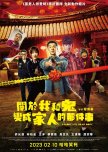
1980s action movie cop meets progressive millenial
Mao Bang Yu and Wu Ming Han couldn't be more different -- while the latter is a walking 80s action movie cop cliché, complete with casual sexism, homophobia and fast car chases, the former is an enviromentally aware, gay and family oriented millenial.What could go wrong, when those two are tied in a ghost marriage and Wu Ming Han has to help his "husband" move on to the next life?
Don't let yourself be fooled by the macismo in the beginning, this movie will show its depth later on.
This movie combines the best of old-fashioned action movies with a healthy dose of humour, criticism of sexism and homophobia, and a story about personal growth.
The bickering between the two main characters made me laugh, the grandma and her circle of aunties giggle, and the father's story cry.
Only one aspect is rather unfortunate, that with all the good messages about tolerance and equality, the fat, gay cop remained an object of "comedy", and did not get his own moment to shine.
The acting is great overall, the pacing fast, but lets the quieter moments breathe. I never would have thought that an action film could move me to tears, but this on did.
Was this review helpful to you?
This becomes very obvious in this film. The question of what Mu Ran will find when he arrives -- thee meaning of "Su Chen", who he is and where he is -- this is not the point of the film (also very obvious after a while).
The people he will meet on his journey, who live very different lives but are all part of the queer community, who will tell their stories about love and loss, about family and partnership, these people and their stories are at the heart of the film.
Mu Ran, and with him the viewers, will learn what it can mean to love. Will we regret having taken or not taken the opportunity to find happiness?
Was this review helpful to you?
This review may contain spoilers
Honestly, I have never been so bored with a show before. I don't know how I managed to finish it.* The storyline was dragging on and on, and I had the feeling that nothing much happened at all. I even drifted off during later episodes. The thing is, I do not mind slower paced series, if -- IF -- it fits the storyline. Also, twelve episodes of basically the same over and over again gets boring whatever the content might be. The plot could have been tightened to maybe four episodes or so.
* The writer seems to have only a passing idea of how the music industry, cafés or workplaces in general work. Examples that annoyed me most: Sentences like "Now that you are debuting, you are a real artist!" (or something like that), an employee mopping the floor during opening hours without reason, taking breaks just ecause you want to, "trainees" that practice unsupervised and are something like eleven years old(?), a freelance composer who then has to got to Shanghai (?). Overall, it feels as if the writer was one of those "trainee" children.
* The camera work was uninspired and kind of static.
* The acting was stiff, which was most apparent in group scenes, where those actors who did not have something to say just stood around like mannequins.
* The sets showed the tight budget, and putting a rainbow flag doesn't improve things. Although I did like the colour scheme they chose.
* Other people have already commented on the band's musical abilities, which I cannot remark upon, since I myself have no abilities in this field whatsoever. I don't think the pink-haired guy's singing was very good though.
* If the story is about tasty coffee, then I want to see tasty coffee! We haven't even seen how Plengrak brews it -- show us how the grounds look like when the water is poured into the filter, at least. The director responsible should maybe look at some Japanese shows who excel in showing food and drinks and make the audience crave them.
All in all, I'd say to give this series a miss.
Was this review helpful to you?
Neither funny nor thrilling
45 minutes in, and I noticed that I did not care about the serial killer. I did not care if he even existed or if it was [spoiler]. I did not care about the company's new marketing, I did not care about the three main characters.Ten minutes later, and I noticed that I did not care how the movie would end. So I stopped watching.
I admit, in the beginning, I did laugh a few times -- and then the jokes either were of the same category or I did not even notice them.
There was no tension, the "scary" scenes never were exciting, let alone thrilling.
Scenes were often too slow, or not contributing to the story -- why should I be interested in how they market their shirts(? I think they make shirts.)? And I say this as someone who has a high tolerance for slow pacing, if it's done with purpose.
Come on, there are excellent Thai comedies, and great Thai thrillers! You know how to do it!
Two good aspects:
* Three woman in main roles.
* Very good acting, especially of the Boss.
Was this review helpful to you?
This review may contain spoilers
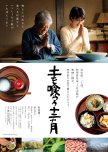
I should have liked the film, I wanted to love it -- but there was one major thing that annoyed me so much I even dreamed about it the following night. I tried to keep this review spoiler-free anyway, but I don't think I managed.For the most part, the film just shows an old man (Tsutomu) gathering vegetables from the hill and from his field, cooking and eating them; and writing a book. Alongside this, we hear his thoughts about food, and about life -- his own life and how it shaped him specifically. In the film, what we hear is what Tsutomu is writing -- it's probably the essay the film is based on.
It's an interesting choice, to take an essay with Zen thoughts about life and try to turn it into a film -- and until the one hour mark, it works.
We see the season change, the landscapes and the vegetables change with them. Occasionally, the man's quiet life connects to the outside world -- a visit by his editor, by a carpenter, or when Tsutomu visits his mother-in-law.
I liked that part, I was looking forward to see the rest of the seasons. Even the motive of death, which was introduced at the end of the first hour, was fitting -- life and death are interconnected, which is why we like to eat together after a burial or a wake. I even liked the change of pace then, that death made Tsutomo's life more hectic -- that is a beautiful juxtaposition.
But after the scare he gets, his voice-over thoughts start to sound like those motivational quotes on greeting cards / calendars / facebook posts -- every single sentence has this feeling to it. This is no longer like the flow of thoughts of an old man, with some deep thoughts and some more personal observations, it's more like a compilation of "The Best of Zen" you could buy in the gift section of a book store.
I would have liked it much better if there had been more silence in this part of the film, only occasionally enhanced by a single sentence or thought.
Since this film is based on an essay, I suppose that everything we hear in the voice-over is from the essay, and that everything from the essay is in the film -- so unless either the film is longer or parts of the essay had been cut, there wasn't much else to do.
I'm also not too impressed with the relationship between the man and his editor -- is it friendship? Something romantic? It's implied that it's the latter, but the apparent age gap and some other smaller things make it strange.
Let's go back to the good things:
I loved the acting and the looks of the main character. Tsutomu is just an older man who is living his life. I like that he looks just like an ordinary man. With just a few changes in his movements, the actor shows us the change from the sprightly man who ambles through the woods and chases after pigeons to the elederly man who feels as if he's at death's door.
I also loved watching nature change from month to month -- and whenever I met the little frog again, I thought "Hello friend, there you are!" -- and also how the ingredients and the food preparation was filmed, which is something Japanese dramas or movies excel in.
And then, the last few minutes had everything I loved about the film, we also went full circle; but not quite -- as the year is complete, and things go back to the start, we'll have changed and the new year will be the same, and different.
Was this review helpful to you?

A drama about contemporary societal problems not only in South Korea
Topics in this court drama are sexism, corruption, greed, power imbalance and the question of how to make a just and lawful decision.I think as a European person, I probably was not able to understand the intricacies fully. South Korea is still young as a liberal democracy, but within an old, patriarchial and strictly hierarchical society. So, some themes, like how the old order between younger people (and people in lower status) and people with more seniority (higher status) clashes with a new system of ethics, where everyone is equal in front of the law, are things I will probably never really understand.
What I liked:
* I loved the team dynamics, and that every one of the recurring characters had their own personalities.
* The romance between the judge of court 43 and the secretary was cute. I liked that they both changed for the better during their courtship, and neither of them -- especially not the female character -- lost their core personality traits.
* The cases were, for the most part, interesting.
* It was also fascinating to see how the judicial system in S.Korea works. According to Wikipedia, the script (and the book it was based on) was written by a senior judge himself, so I don't expect there to be any glaring inaccuracies.
What I did not like:
* The last episodes were too cheesy for my taste. That happy ending felt too forced for me. Two main points:
* Especially the relationship between Ba Reun and Oh Reum could have remained platonic -- until the second to last episode, I loved their dynamic, and how they were learning to listen to the other. Sometimes love remains unrequited, and men and women can work together as nothing more than colleagues.
* They could also have left the story arc about NJ group more ambiguous. In real life, you don't have this kind of closure.
All in all, I don't regret watching it, although the last episodes made me change my rating of a solid 9 to a disappointed seven.
Was this review helpful to you?

This review may contain spoilers
I have not seen the Korean drama or read the original webtoon, so I cannot compare them to this Japanese version. Nevertheless, this version has a distinctly "Korean feel" to it. Especially the love triangle (quadrangle?) and the fight against a power-hungry chairman of a huge conglomerate are plot points I've seen in several Korean dramas.(But I trust that the story was Japanese enough for the Japanese producers to make an adaptation.)
I liked the basic idea of a young man seeking revenge for a wrong done to him and his father -- with the help of friends he makes along the way.
(I wonder; if this had been an original idea, what would a Japanese writer have done with it? More friendship and group action, less love triangle, I hope.)
Also, the pacing and story managed to keep my interest until the four-year time skip. After that, I found a lot of the plot points superfluous and the rest dragged on.)
--spoilers start here--
I also did not like most of the characters:
* Aoi who was introduced as a high school brat, is suddenly a more than capable manager? At twenty? I find that not believable, especially as her main motivation is her "love" for Arata -- which feels more like a childish crush to me.
* Arata who is supposed to have strong morals, and put people before profit in the first episodes, becomes more and more ruthless and lives only for his revenge -- he even has no answer to the question "What are you going to do after?" for most of the series. That character devolpment could have been interseting but then they should have addressed it more.
* Riku, who was fine as a character, but until her surgery looked more like a FTM transgender person than a MTF transgender person. Also, why did they choose a biologically female actress? Were there no adequate male actors willing to play her? (I have no idea whether there are actual transgender actors in Japan who could have taken the role, which would have been the best choice.)
* Yuka was interesting for a lot of the episodes, because her actions were rather ambiguous. She was a character with shades of grey -- but unfortunately she was also too passive, waiting for Arata to "save her", whatever that meant.
* Ryota, the ex-criminal, had not enough screen time to develop his character. He's an example why I am not fond of time jumps -- what happened to him in the time when RC grew and he had to change his position? He started a an uneducated ruffian -- how did he manage to change to managing director?
* The one I felt the most sympathy for was Ryuji, who was the most likeable among the bunch. But why does his only reason for doing what he does have to be his "One True Love"(TM)? There are so many other motivations than that!
The Nagayas (father and elder son) were fantastic enemies though! No complaints here!
All in all, I do not regret watching it, but I wouldn't necessarily recommend it to others -- there are better dramas out there.
Was this review helpful to you?
A light-hearted, cute simple little love story about two marathon runners in college
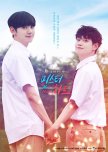
While this is not my favourite BL of all time, it is one of the go-to BLs whenever I need a short pick-me-up.The series and the drama are identical, there are just a few scenes swapped around where the episodes end / start, probably for narrative reasons.
What I liked:
* They chose a story line that is adequate for the length of the series. Anything more complicated, and it might have become frustrating (again).
* The series is focused on the two main leads, which are supported by only a few other characters, which also fits the drama's length. I loved all of them, the coach was like an exasperated but loving uncle, the friend insightful, the two loan sharks hilariously cute.
* They did almost everything to keep the story light-hearted, from the sometimes cheesy dialogue to the upbeat music.
* The story, though straightforward, shows quite a bit of character development for BOTH main characters.
What I did not like:
* To keep it consistently light-hearted, I would have liked if the scene with the loan sharks' boss could have been less violent -- I'm sure there was another way to put pressure on SangHa than to beat him up.
Overall, a sweet and short drama.
Was this review helpful to you?
This review may contain spoilers
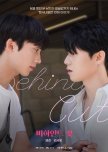
This is one of the worse short K-BLs I've seen. The premise is fine, but how they told the story in the second half made it fall apart completely. Did the people who were responsible not get feedback from someone else?What I liked:
* I loved the relationship between Yeong Woo and his father. Even if there are only a few scenes with them both, I have a distinct impression on how growing up must have been for Yeong Woo with this father, and for the father, raising is son to be an independent, and kind person. You see, it IS possible to establish how people feel about each other in just a few minutes of screentime!
* Stories not set in college or high school are always a plus for me. I liked that Yeong Woo was of a lower or middle class background. I also found it very relatable that he did not know what to do with his life.
What I did not like:
* The two main leads got too close, too fast for my liking. I've never talked to people I've only met three or four times about my most initmate dreams and hopes for the future.
* The show seems to follow the precept of "show, don't tell". The thing is, if you show only fragments, and we, as the audience have to guess what is going on, we won't be very satisfied. This becomes especially clear just before and after the time skip, where we only get to see disjointed scenes, sometimes without context. If we don't even get clues to guess, then it only becomes an exercise in frustration.
Some examples: Why the crying at the traffic lights? Where was Ki Jin during the time skip? When did Yeong Woo become a model, and how does he balance this with his delivery job? Where is his mother? Why is the friend also back? Did they ever talk about their breakup? What happened between Yeon Woo and the friend in the past? (Were they lovers? Friends? Rivals? Just classmates?)
I don't get why "follow your dreams" and "be with the one you love" have to be an either-or-decision. Long-distance-relationships? Talking about things and then compromising? That's apparently nothing that exists in this world.
All in alll, the drama feels more like an outline for the first few episodes of a longer story, not something you would consider complete and fit for release.
You can watch it, if you like, since the show is rather short, but I'd recommend to give it a miss.
Was this review helpful to you?

This review may contain spoilers
I watched this and the series version side-by-side. Apart from a few scenes that were switched around, both versions are identical; the movie feels more like a cohesive whole since it isn't interrupted every few minutes. If you want to watch this, you should choose the movie if you can.What I liked:
* the beautiful scenery at the ocean
* the simplicity of the story
* Han Gi Chan's acting
* Also, stories that are not set in highschool or college are always welcome.
* The Ex-boyfriend. It was a nice touch, not to know at the beginnning what to expect from him, and to discover in his third scene what he is actually like.
* The story didn't make use of the typical BL tropes, only standard romance tropes. The gender of the two protagonists actually did not matter much, which is always nice, if you want a light romance.
The story though has some qusetionable parts:
* I have so many questions: Where does Tommy come from? What is his motivation in staying with Ba Da? -- Why is Tommy there, right behind the car, at the beginning? Was it an accident, did he get in the way intentionally, did he just lie down there? -- Why does a chef buy at the grocery store?
* The gap year -- Why should two adults not know to try a long-distance relationship? What did Ba Da do while he was not at his small establishment and why did he decide to come back? What was the motivation for Tommy to return, and why at this point of time?
Holland's acting is, unfortunately, not suited for his role. I'm sure he did his best, but it seemed stiff to me, and even after rewatching I'm not always sure how his character feels. Especially since we only get Ba Da's POV, and Tommy doesn't really talk about his life, we have to rely on body language. I didn't, for example, notice that Tommy actually comes on to Ba Da until I watched the story for the third time.
Overall impression:
This is a nice and simple story, that focuses on few characters, sets and a single storyline. It didn't waste time on too many flashbacks or scenic shots, just enough to set the mood. The makers obviously used what they had wisely and tried to make a good story within the short time of an average movie.
I still would have wanted more info, be it explicitely stated or implicitely shown, to understand the motives of both main leads. Things are often too subtle to see them during a casual watching, or did you notice that Ba Da says in minute 33 of the movie "I didn't come here to do this?" and probably means that he notices a certain kind of attraction to Tommy? I didn't, and there are some other points where I'm really not sure if we get the intended message.
That subtlety doesn't mix particulary well with Holland's acting style.
Still, it's a nice movie to spend a lazy afternoon or evening on, even worth a rewatch or two, if yu need to shut off your brain. It's not an outstanding masterpiece but certainly better or at least not worse than some het romances.
Was this review helpful to you?

This review may contain spoilers
It feels like the writer had four or more different ideas for a story, couldn't develop any of them enough to fill all the episodes, and then decided to just throw them all together like Dr Frankenstein when he created his "human being".The four stories are:
* A silly time travel story with supernatural elements
* A story of corporate intrigue
* An office romance
* A story about finding yourself and your place in life.
I loved the first episodes (Time-travel story with lots of silliness and over-the-top acting) -- loved many of the elements, such as the deities using modern communication, the inclusion of Covid, Ho Bo Wei's attempts to return to his time and the developing relationship between Ho Bo Wei and Hai Yi. I wish they had shown more scenes of Ho Bo Wei marvelling at the development of his hometown, of him using his ability to find anything and everything, and more of the supernatural elements (I would have liked the god's backstory and how the Jade Emperor reacted to his mistake).
But then this plot is (almost) completely dropped and the second story about the corporate intrigue starts. Both main characters seem to change their whole personality -- Hai Yi turns into a closed-off, workaholic person (which, at least, is explained later) and Ho Bo Wei is suddenly a whining guy, whose only goal in life is to get together with Hai Yi. The sexual tension that had been building up completely disappears in favour of one person lying and not telling important things and the other (of course) completely misunderstanding. These episodes made me dislike both of them, and I almost gave up.
This story, too, could have been something good -- but on its own, not in conjunction with the time travel part, and without so much one-sided lying.
It is only in the last two episodes that the first story is taken up again, and underwhelmingly "resolved".
Some other minor plot points that are dropped, and sometimes picked up again -- the god, who is responsible for this whole thing, shows up and disappears again; the girl disappears for several episodes, shows up briefly because they needed a female person who can play pregnant, and disappears again; Covid plays an important role in the beginning but then everyone just walks around without masks or anything -- except when it is needed for the story.
The parallel story of the second couple does not have this problem of trying to tell two stories in one, but I hate how the managing director lies to his future partner from the very beginning. He does explain his decisions at the end, but it still doesn't sit right with me, and I don't think it's a good basis for a balanced and trusting relationship, especially as there is somewhat of an age difference.
I think this could have been much better if someone else had a look at the script and made a more cohesive story. Or, alternatively, go back to the roots of the HIStory shows, and tell one story in just a few episodes, like in HIStory 1 and 2.
Since others seem to like it, go and try for yourself, but I won't be coming back to this show.
Was this review helpful to you?

This review may contain spoilers
Cute cat-boy story about a lonely man finding his family
If you're famiiar with "cat boys" and all the tropes that come with it, you'll already know how Meow will be portrayed: as a naive and innocent, sometimes childish, always playful, very young-looking boy with a slight build and a smooth and soft face.If these stories about cat boys (whether in fan fiction or in manga/manhwa/manhua) do not devolve into straight-up porn, they usually stay light-hearted, soft and very, very cute. This one stays consequently on a PG level of intimacy, there's some toe holding, hand holding and one cheek kiss (where the kisser has no romantic intentions).
Content warning for some animal abuse, although we don't see any bodily harm.
First: The acting is okay. We are used to the newbies in Thai productions. and this is a bit above average. The main characters' actors, James and Gap, are more than above average, Gap did well in portraying his change from lonely artist to overwhelmed room-mate to a guy who is very much in love. James is a perfectly innocent cat-boy, showing every bit of his emotions very clearly, but without more exaggeration than the genre needs.
Second: The intro song is annoying, but bearable, the rest of the background music non-remarkable.
Third: I liked the sets, the locations and the editing. Not outstanding, but never empty and always realistic, fitting to the genre.
Fourth: I would have liked the ears to look a bit more realistic, and there were some instances when the actor's earlobes were visible.
Regarding the story, the series shows its manhua roots -- I did not find much about the original material; it seems that the manhua is at least 68 chapter (or books?) long; the few episodes of the anime version that I found were only a few minutes long. I suppose (and I just extrapolate from other manga and manhwa) that the oringinal material is one of those episodic endless manhua that never go anywhere, have little to no character development, and have no "ending", because if the couples would become official, the seres would be over. I guess that this is the main reason that this live action series's ending is more open. (Also, would anyone call someone their lover if their relationship is still unclear? Of course they don't.)
I would have loved to see more backstory for Meow, and I'm unsure if it's because of time constraints of the series or if the original did not provide more info? I do wonder why Meow is more childish than other members of the Ear People -- he's obviously slower to learn, but it also seems as if he's been sheltered from the wider world by his adoptive family? There's been some allusion to mistreatment as a little kitten but that doesn't explain everything.
Considering all the couples have the potential for power imbalance (adult / child-like cat boy, student / teacher, boss / intern) -- there's no need for concern here. The partners with more power never misuse this to push anything. The female couple is the most balanced -- while one is the bss, the other's compliments and clear adoration always melts the boss's heart. The second male couple also has its balance -- it's the student who would like to have more intimacy and tries to get closer. /Also, I think that Evan is more of an assistant than a full professor?)
Considering the main pairing: Even though Dermden (the adult artist) feels some kind of attraction in the first episode already, which evolves into love, and even though he would very much like to have a romantic relationship with Meow, he never acts on it. He even avoids situations where he could potentially cross boundaries, to Meow's great confusion. In the end, Dermdem is just happy that he has Meow in his life, and he'll take anything he'll get.
Overall, a nice and light watch, if you can accept all the tropes that come with cat boys and if you like some innocent romance.
Was this review helpful to you?
This review may contain spoilers
I should learn that the first episode in Korean dramas is never helpful in deciding which plot and tone the other episodes will have.What I liked:
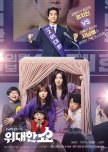
* I liked Wie Dae Han's character and its development throughout the series. He's a man who once had a very clear reason for going into politics but has lost it -- and is struggling to find it again through much of the series. That makes him a very flawed character, who are the best in dramas.
* My favourite character by far was Kang Joon Ho though, who had struggles all of his own -- who has to decide if he'll put his personal integrity above his familial ties.
* I also loved the supporting characters, foremost the aide, the Jung family, the kids, and the young ex-trainee. All of them were not only there for comic relief but also for the plot.
* I liked that on the politics side of the plot, the elements fit together and made a whole.
The whole drama is very much about personal values, and what it means to be a family and a good family member to the others, I think -- not only Wie Dae Han and Kang Hoon Jo have to learn but also the kids' father (I forgot his name), Kang Kyung Hoon, Han Tak...
What I did not like:
* They could have done away with the romance. Love triangles are overdone anyway, and in my opinion the romance did not add anything to the plot or the character development. Jung Hyun Soo could easily have remained a friend and colleague (she had enough reason for engaging with Wie Dae Han's daughter all of her own). Kang Joon Ho had more chemistry with Wie Dae Han than with her -- why not play up the rivals-since-school-days-angle instead of a lacklustre romance? Regardless who she ended up with, I really was not interested. I hate that writers think they have to force (het) romances into their stories.
* I would have loved to see more of the kids' stories instead. Han Tak was a really interesting character, and also Song Yi and her anxieties ould have been interesting to learn more about. Or what about the boy's need for eating and jumping around? There's more story there.
* I think this would have made the drama more interesting -- it was rather lengthy from episodes nine to eleven, which is where the romance subplot was most apparent. It was decent before, when it was about Wie Dae Han and the kids, and after, when the race for the election picked up.
* All in all, I was again disappointed by the female characters. The girl had spunk in the beginning but the got reduced to her role as impending mother, Jung Hyon Soo was overly emotional, the female journalist was a strange mix of ambitious and passively accepting the men's plans.
Overall, it's okay to watch. The ending was rather predictable -- but still I liked the character development we got to see.
Was this review helpful to you?
This review may contain spoilers
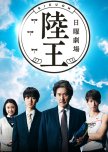
The drama's main theme is a small, declining business with a tradition of 100 years that fights against financial pressures, the bank, a behemoth of a business rival etc. etc. There are some earnest speeches with a lot of pathos and "ganbarimasu" -- I feel as if every main character has a similar story of failure (a patent that has not been picked up, a declining business, failed interviews, sports injuries) and it's a story about being the underdog who takes second chances they don't actually have.
It's very David ("heart and soul", the people are what's important, hard work and tenacity makes you successful) versus Goliath (money won't make you happy and shouldn't be your goal in business life), and the general outcome is quite predictable.
The acting was top-notch, and the overall quality great; even after just a few minutes of the first episode I started to care about the little tabi factory and its people, which made me watch the entire thing. Nevertheless, I found that the episodes were structured too similarly, so they got a bit repetetive, with one or two main obstacles, that are solved during the episode, and at the end there's a joyful "We made it", at times with an added a glimpse of the next problem. There were about three musical pieces that were mostly uplifting in nature, which also got a bit boring.
Something I liked is that there were more people in their fifties than younger characters.
I was annoyed by the implicit misogyny -- none of the female characters had any role but to say supporting things to the men; anything that pushed the plot forward was done by men. And, when the older son doesn't want to inherit the business, nobody even asks if maybe the daughter might want to?
One thing that I found rather unrealistic:
A person, who invents a whole new material and builds the machine to produce it with his own hands, and then holds a patent -- wouldn't he rigorously test his invention early on, to understand which influence all of the variables of production have? It seems that after Iiyama had invented one working verson procedure, he called it a day?
(Also, a mechanical engineering, material engineering and electrical engineering are different fields of expertise! Does Daichi have three degrees?)
I was also some other plot points I found a bit strange. For example: There's a fire, and a machine is destroyed -- and there's no insurance? Not even a small one? Also, why do neither Iiyama nor Miyazawa ever try to negotiate when they get offers they don't want to take -- only in the second to last episode Miyazawa gives a counter offer.
All in all, it was entertaining, and I'm glad to have watched an example of the dramas based on the successful Japanese "business novel" genre. If I do watch another one, then maybe a story by another author though.
Was this review helpful to you?

Not even Pond could save this
I will admit it, if not for Pond Ponlawit, I wouldn't have even considered starting this, and I could have spared myself hours of bored suffering.I do like the occasional Thai college BL; and didn't even expect much in the way of originality. But this one has several points I don't like, and in combination these are deadly for a series: stereotypical "top" and "bottom" characters, nonsense story, bad directing.
This will be somewhat of a rant although I tried to write it like I would for any other drama, so if you loved "Fourever You" and/or North and Johan's story, go back and stop reading *now*.
The four (potential) couples very obviously follow every stereotype there is: Each of the "tops" is older, richer, more popular, more into sports, taller, more masculine in looks than their "bottom" counterpart. The "tops" are also stereoptypically cold on the outside, while the "bottoms", at least the two we saw most of in the first episodes, are childishly over-the-top emotional.
That alone is a warning sign for me -- I do know that a lot of people like these dynamics.
The first couple -- Ter and Hill -- is at least mostly balance in their power dynamics, but that gets offset by Ter's 13-year-old mentality, which creates drama where there shouldn't be none. And where Ter is over-the-top, Hill is exceptionally bland; after six episodes with them at the center, I know *nothing* about him, except that he seemed to be in love with Ter since forever, and that he's quite well-off and does well in his studies. Their story is quite nonsensical -- we get told their backstory in short flashbacks; those are not shown chronologically, which would be fine on itself, but if we put the information together, it doesn't make sense! It seems that Ter thought Hill was dating a school mate at the same time as he had a crush on Ter's sister. Up to epiosde 8, we also saw two short scenes that don't fit into anything else. Maybe those wil be picked up again later, and I would love to know how this is explained, but it's not worth it to suffer through North's and Johan's story.
Because the second couple (North and Johan), which I have heard is beloved by fans, has the same kind of power dynamics that made me drop "Perfect 10 Liners" earlier: The "top" has some kind of power of his love interest, and abuses it to make him do things he would never do, like spending time with him, doing errands, making life decisions. Here, the power imbalance is a (fictional) debt of several 100 000 Baht North has to pay back to Johan, and it's made worse by the fact that North makes it very clear that his livelihood depends on the money he gets from his part-time jobs. Of course, super-rich Johan doesn't care, and keeps North away during working hours, which could have cost North his job. And no, Johan, buying your love interest an iPhone does *not* make up for your abusing your power.
So, I can deal with boredom, I can deal with nonsense stories, but I cannot nor will I ever be able to see how a mutually respectful relationship can ever come from a starting point like this.
And as a last point, the directing.
As I said, I started this drama for Pond Ponlawit. I noticed him first in "The Death of Khun Phra", and in "Century of Love" -- and after that I saw him in "180 Degree Longitude" and "Reset", as well as the short edutainment series "Criminal People 5G". In each and every one of these, I was blown away by how *different* the characters are. If not for the same face, I would never have guessed that this is the same actor. I wanted to see what he would do with a standard Thai BL "top" character.
So, I *know* he has talent. I *know* he has the ability to pull it off. But it seems that not even he could make a bland character without personality into something interesting.
And, watching him, it felt like Pond was directed to forcibly stop himself from acting -- sometimes there are slight movements of arms or the whole body that he stops, and then he goes back to an awkward stance with his arms hanging down at his side. This can only be because the director wanted it to be like that, I cannot think of another explanation. Maybe the director had a vision of the character that unfortunately the script didn't support (as I said, Hill has no personality at all)? I wonder what Pond would have made of Hill, if he could have acted the way he wanted under another director.
The same goes for Earth Katsamonnat, who also has shown his abilities in previous productions, although his character is already written as if Ter is a 13 year old girl, so he didn't have much leeway. And it's also very obvious that Bas Hatsanat as North did his best to give his character a well-rounded personality.
Which brings me to my last point of contention: This is one of those BLs that are very obviously aimed at very young teenaged girls, who can identify with the "bottom" roles and crush on the "top" roles -- which might make money and might also honour the heritage from Japanese BL manga -- but makes for such unrealistic behaviours that it's really hard to watch, especially if the rest is already making me want to drop it.
Was it good?
The only saving grace of the first five and a half episodes was Pond Ponlawit trying to make the best out of a character without personality.
Did I like it?
No. The drama uses stereotypes I hate, and doesn't even try to give them a bit of a twist. Once Hill became a background character, my interest droppped sharply, so I dropped the drama.
Who would I recommend it to?
I don't want to recommend this at all.
Okay, maybe to hard-core Pond fans.
And maybe to people who also liked "Perfect 10 Liners".
Was this review helpful to you?


