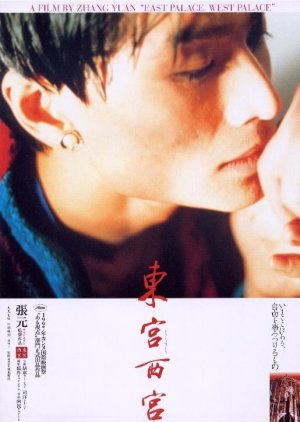
I watched this because China banned its release. I was curious and the movie proved worthy of that curiosity. It wasn't great, but it was one undeniably beautiful movie. I love the dialogues. Sometimes the lines are rather poetic. The actors could even tell more of the story even with no words at all. The film seemed to glorify the simplicity of its plot with good writing and actors.
Have an open mind upon watching this film, but don't get too attached. It's just a film after all.
Was this review helpful to you?

Love
not an easy watch but an illuminating aesthetic and feeling experience〜 not as I expected really a depiction of social attitudes in a homophobic society but an exploration of one man working out his psychological, emotional survival in that society, the fine line between love and hurt 、self-realization and self-disgust、 acceptance and rejection :who was it who said ”beauty can come out of a dunghill” ? beautiful imagery of nature and the eponymous palace in cinematography and sound ( Chinese opera ) 〜Si Han acted sensitively and convincinglyit is interesting to note that gay love was an accepted part of civilization in China (as in Japan) for hundreds of years ironically persecuted in current supposedly humanitarian times is it really a decaying palace or a decaying society where love is driven into the night and memorials of a past cultured civilization ?
Was this review helpful to you?
This is Queer ART!!
This Director, writers and actors responsible for East Palace, West Palace (1996) perfectly dramatise what it means to be queer, what it means to not just confront but to understand masculinity as a gay man, and its also a treatise on exactly how much joy, authenticity and humanity masculinity strips from men.Beautiful, artistic, violent, poignant and hopeful all describe this pathbreaking film, said to be the first mainstream Chinese production that is explicit about same-sex struggles - both within and against society and family, but also the most painful and bitter struggle that takes place within oneself.
One of the most striking scenes is A’Lan’s recounting to Officer Xiao Shi of his first time with another man, when he discovered masculinity and what it was like to be ‘the girl having sex with the boy’. This cognitive distortion that is gender performance of masculinity, far more than his sexuality, is what defines and distorts his relationship with sexual desire and his desperate pursuit of love with other men on these blighted terms.
One thing East Palace, West Palace is *not* about is “authoritarian Chinese” state repression or some kind of uniquely Chinese way of doing down the gays or any of the knee jerk McCarthyist insufferable western review points that infest this space 🙄. We know this, because we can picture the same exact scenes of cruising, police harassment and entrapment, as well as the internalisation of harmful, high risk community practices in every single country on the planet even today - including in countries with legal provision for same-sex marriage and other formal rights-based policies.
I also highly recommend this LetterBox review that delves into the film’s main gender politics of how being sexually desired but having to access sexual pleasure through that gendered prism corrupts our understanding of intimacy and ‘love’: https://letterboxd.com/kariso/film/east-palace-west-palace/
The tenderness, the brutality, the honesty with which he confesses to how much he wants - no, needs to give himself to masculine power has shaped A’Lan’s whole life, frustrated his happiness and cemented his constant loneliness. His collision with Police Officer Xiao Shi is therefore no chance meeting for *either man* and that coming together of one closeted and in-denial, and the other fatalistic but resigned in acceptance of a future of thrilling self-abnegation, is ultimately a potentially life changing event for both men.
Bravo to this queer team of artists!
Was this review helpful to you?

one of the most tender, sincere, genuine explorations of trauma in queer men
this was absolutely brilliant. incredibly profound and poignant. one of the most tender, sincere, genuine explorations of trauma in queer men.the film perfectly encapsulates how, as mackinnon once put, in sex, “the acted upon is feminized, is the ‘girl’ regardless of sex, the actor correspondingly masculinized.” then, it follows that feminized queer men experience and compartmentalize male violence in similar ways to women, while also facing different challenges in a world where their existence is often only allowed through degradation and criminalization.
this film understands something its modern counterparts that try to tackle similar themes of gay hookup culture and “toxic” relationships very rarely get right: romanticizing violence is a trauma response. desires produced under patriarchy (and capitalism) interact with one’s positionality and relevant social capital and may manifest as desire to own, desire to harm, or desire to be owned and harmed.
ah lan repeats how the convict loves her executioner and he says, “we love you. we have no other choice.” a lot of queer men, like a lot of women, have not known love but have experienced being sexually desired. in fact, it is often the only kind of attention they receive from the people they expect to be loved and cherished by. being sexually desired and then experiencing sexual pleasure through that interaction corrupts their understanding of intimacy and “love.” like ah lan, who has been traumatized with many such interactions, one, then, starts seeking attention through danger, violence, domination. when recounting an experience of rape, ah lan says he resisted but later yielded and then he was filled with pleasure: “is it not what making love is all about?” similar to the workings of the gay conversion therapy he was exposed to at the hospital, the euphoric feeling of sexual pleasure becomes associated with violence and domination, which he cross checks with societal narratives about love, and it doesn’t seem to get challenged at all.
what i find particularly poignant about the aforementioned quote from ah lan is that he acknowledges “we have no other choice.” similar to a lot of women, a lot of gay men strive for male recognition, the legitimizers of the world and all worldly things. “we have no other choice” because it is men who have the power to define things and violence is usually the only form “love” ever arrives in from them.
i also loved the scene where ah lan is once again recounting an experience where he was abused and it goes like this: are you crazy? i love him. you’re sick. no, i’m gay. i love him. i thought this simple dialogue had quite a lot of depth as it showed ah lan’s understanding of homosexuality, at least the position he occupied in his sexual (or any) relations with men, as submissive, engaged in self-erasure, and barely human. it’s almost as if he said when you’re gay, It’s Just What Happens. this is just what “love” looks like when you’re gay.
moreso, the film is not interested in making the policeman’s repression easy to sympathize with because, at the end of the day, isn’t it that they’re suffering from the same thing? yet, their proximity to power completely changes their positionality and he gets to resort to violence whenever he cannot manage his feelings and channel it all onto ah lan’s body.
i loved how they used hands as a narrative motif that carried touch in relation to desire and longing and belonging. i also thought ah lan’s characterization was utterly interesting. incredibly imaginative yet so restrained. the self-performance was melancholic but self-assured and strong at the same time; it felt like he was deeply aware of his suffering and it felt like he was sustained by the self-performance.
i think the sad part about it all was ah lan’s desire to be loved without having any idea of what it is or what it might feel like. he spoke of love without possessing a healthy emotional language for it, without ever being allowed any room for it. true intimacy and love become impossible in the existence of such hierarchy yet the yearning to be touched emotionally remains.
women and queer people often struggle with this but if domination is the only language through which you can receive attention, and desire, and pleasure, it naturally becomes hard to distinguish love from violence, especially when you haven’t been afforded the power of defining.
Was this review helpful to you?

An essential Chinese political-erotic drama
The images run before my eyes once again. I resist filling the blank page with my ideas. I fear that on this occasion, as on so many others, I will not be able to say everything about this political-erotic drama full of nuances and trust, that something will get stuck in my throat and I will not be able to express what I feel correctly.Next to me lies, open to its last page, a volume of the story by writer Wang Xiao Bo, who became co-writer, which tells a story of oppression and torment set in a time and place where people were criminals if they were part of the community LGBT+. To understand what happens before my eyes, I need to drink from its most intimate and pure essences. That's why I go to the book as well as the movie.
I think I see A Lan before me touring the two parks, the East Palace, the West Palace, with its public bathrooms, more than in search of sex with other homosexuals, trying to bump into the policeman he has fallen in love with. . It all happens there, behind the Forbidden City, behind the doors of the Palace, in Beijing.
It's 1996 and Zhang Yuan, the Sixth Generation filmmaker, comes to my aid to tell me the story about a repressed and latent homoerotic relationship between a "master and a slave". I enjoy the intense and dark author's chamber piece that leads me to learn about the relationship between an openly gay writer and a police officer who refuses to accept himself because he is overcome by a strong internalized homophobia.
I glimpse Xiao Shi, the handsome man with big hands, those hands that A Lan loves so much, how he fulfills the young gay writer's dreams of being arrested and interrogated by a police officer, it doesn't matter to him if it's for "vandalism".
I witness Xiao Shi go from initial repulsion to fascination and finally attraction. I judge that the accusation of intolerance is not intended to be limited to the Chinese government, but rather to that which is manifested in all parts of the world regardless of the political regime of a given country.
I distinguish before me eros, death and sensuality walking the avenues towards sadomasochism. I sense a possible reconciliation and even the beginning of a romantic relationship between the gay writer and his captor.
I discover in Jian Zhang's beautiful photography how two worlds collide. I notice the back and forth, the initial imbalance of power between victim and executioner. I notice how the power dynamic changes between these two people over the course of a single night, in the middle of an interrogation.
I experience that the writer, from his playful kiss that left the policeman perplexed, to the confrontation between the two moments before the final credits roll, never gives up or shows signs of self-pity.
The images run before my eyes once again, and allow me to appreciate that the effeminate and masochistic, who may seem submissive, transforms, towards the middle of a film that equally transforms into both a power game and a gender performance, upon receiving the freedom granted by Xiao Shi to tell the story of his life.
I enjoy how he manages to turn the interrogation room into his own stage, where he is not only able to spread his wings and fly, but also to shout his love to the police officer.
I evaluate the analysis of gender and sexuality, the replay between pain and pleasure. I recognize myself, like so many others, in the feelings expressed in this film. I appreciate how A Lan can express that she could be a man or a woman, a goddess or a prostitute, the thief in love with her jailer.
I watch as the prisoner assumes the position of power and completely dominates (and even hypnotizes) his captor and all the spectators. And if there is one complaint, it is the script, for not giving a writer, like A Lan, more power over his words to counterattack the uniformed man, and only repeatedly using a single reason: "It's not disgusting. It's love. You can find me despicable, but my love is not".
I appreciate in the film the use of Piaget's genetic psychology and his atmospheric Fassbinder.
I allow myself another regret, the last one, I assure you, but one that affects the film not being much better than it already is: unfortunately, Hu Jun does not always seem to know what to do, how to function in front of the cameras, while his interest in the life story of the homosexual man he interrogates is not given the necessary nuance.
However, I vibrate as I listen to A Lan reply to the policeman, "You've been asking me this whole time. Why don't you ask yourself?" In this way, 'East Palace, West Palace' returns to itself the institutional inquisition that pursues queerness, asking about its own queer nature.
I open my eyes as the film plays with the limits and rules of attraction and seduction as one man's story becomes another's gateway.
I compare the film with that experience that we have all had of risking everything for the opportunity to be ourselves, whether in the search for love, sex, happiness, or simply those moments of connection with other people who can feel like oneself.
I sharpen my senses about how the film also explores the complicated relationship between gay men and the desire to feel loved by those in power, both in the figure of a law enforcement official and in that of the rich daddy that the writer once followed to his house, to receive the burning of the lit cigarette butt in his chest.
I believe that by turning the police interrogation process into seduction, Zhang Yuan's film subverts expectations as expected, and crosses the borders between pain and pleasure, between hate and love.
I distinguish that the emotional structure of the story and the enthusiasm that Si Han and Hu Jun put into expressing their lines make this film moving, beautiful, and shocking. It is a triumph for those who were handcuffed and imprisoned for their sexual identity.
I estimate that it is in that moment, as well as during the 90 minutes of footage, that we can appreciate queer cinema at its maximum expression of gay liberation, a political cinema at its most subversive and resistant, while analyzing how malleable the presentation of the human being to the world. Because the film also fulfills its objective of functioning as an intriguing experiment on the clash between the State and personal space, between the public dimension and private life.
The images run before my eyes once again, and I notice how the cut scenes, in magnificent and precise flashbacks, fill in the missing story of the mysterious writer's past of suffering.
I thus learn about A Lan's hidden desires at school, her relationship with her mother, the sad existence of "Omnibus" (Vicki Zhao), her classmate that anyone can ride; the public shame that the homosexual suffers, his first sexual experience, his furtive encounters in abandoned places with other gay men; how pain has led him to be the person he is, how he has preferred pain rather than being ignored...
In this way I understand the dreamlike epiphanies of the androgynously stylized Chinese theater, whose images also roll before my eyes.
I do not lose sight of the fact that through questions and answers the tumultuous life of the person questioned since his childhood is narrated, the difficulties that come with being homosexual in China, and how the brief intimate scenes of A Lan's life blur the feelings of the man who wear uniform.
I resist the idea that this gay film was written and directed by a straight filmmaker, especially since the portrayal of the queer character is riddled with stereotypes.
However, I applaud that 'East Palace, West Palace' escapes the stereotypical view of narcissistic heterosexual directors, and doesn't tell us one more tearjerking trope about the story of a sad, lonely queer man who has been oppressed all his life and accidentally falls for himself. falls in love with the apparently "straight" police officer who tortures him, because one of the strengths of the film is to present as the protagonist a homosexual character who has almost disappeared in conventional cinema on a global scale due to the horrific process of assimilation of the community and gay culture.
In this sense, Zhang Yuan uses all the queer expressions and traits that are most irritating to heterosexuals. He never sugarcoats the young writer's life and experience of sexuality, to interrogate the very core of homophobia and internalized homophobia, that self-hatred that the character played by Hu Jun feels towards himself.
I see the loud cry for help, both political and sexual, which in this case go hand in hand.
I see the amazing and moving performance of the real-life gay man. I was amazed to learn that Si Han was there as part of the technical team and was only chosen because the supposed protagonist dropped out at the last minute.
The images run before my eyes once again. Contrary to the way Western critics try to frame the film, I don't think the film criticizes the "authoritarian government". Firstly, there are no major differences between how an American LGBT+ film from the 90s criticizes the way society and the state approach homosexuality and what Zhang Yuan's film examines.
That's not to say it's all the same, but simply that certain sections of the public would like to use what was shown in 'East Palace, West Palace' as evidence of some specifically unique and more terrible oppression in China.
The truth is that just by watching the film, I do not feel or see the supposed repression that Western propaganda seeks to impose, ignoring, in the process, the realities of nearby countries. Clear example of political motivation.
I resist the idea that the topics presented are intended to explicitly attack China. However, obviously the film does talk about what is accepted and what is not accepted within any society, in this case the Chinese one.
But A Lan himself raises his voice at this, and expresses (paraphrasing): "we are all different and we walk at our different paces, but we are identical." That is, the repression suffered by the main character throughout his life can be similar to that suffered by any homosexual in any heteronormative and patriarchal society.
Even in societies that are supposedly more liberated with respect to homosexuality, such as the United States, from the beginning of 2023 until today there has been an unparalleled process of legislative violence and regression in the human rights of LGTB+ people.
I am referring to the approval of anti-LGBT+ laws by different states that openly limit different facets of the rights of said community, which aim to put the members of this group back in the closet, and which will begin in 2022 when Ron DeSantis, the governor of Florida, approved the Don't Say Gay Bill, whose text prohibits teaching any educational content related to sexual orientation or gender identity to students between 3 and 17 years old, and requires that the educational curriculum necessarily define he sex as "determined by biology and reproductive functions" and gender as "binary, stable and fixed".
I believe it is necessary to make these distinctions because too often legitimate criticism is used by opponents as incendiary ammunition. It would be an injustice to this film if it were used like this.
The images flash before my eyes once again, and I hear Min Xiang's music, while the audience gives a standing ovation to 'East Palace, West Palace' at its premiere at the Mar del Plata Film Festival in Argentina, in November 1996, and at the 1997 Cannes Film Festival.
Was this review helpful to you?