This review may contain spoilers
a saga of delayed justice and shattered innocence
There are crime dramas that want to uncover who the killer is.And then there are dramas that understand that was never the most important part of the story.
This one belongs entirely to the second group.
Inspired by the real Hwaseong murders, the series uses a criminal investigation to talk about guilt, abuse of power, and the lives destroyed when a system chooses to protect itself before protecting innocent people.
The result is a dark, emotionally exhausting thriller that’s impossible to forget.
At first, it seems to follow a familiar structure:
a veteran detective, an ambitious prosecutor, and a serial murder case that comes back to haunt everyone decades later.
But it quickly becomes clear that the focus was never just about finding the culprit.
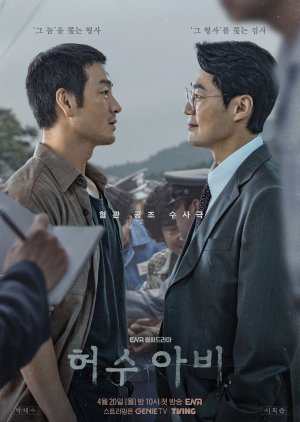
The story follows Tae joo, an investigator still trapped by the mistakes of the past as he revisits a case that ruined countless lives. Alongside him is Si young, a prosecutor willing to sacrifice anything to achieve results.What makes it interesting is that neither of them becomes a hero or a villain. Both carry guilt, frustration, and an almost desperate need to justify their own choices.
And that makes everything even heavier.
Much like Memories of Murder, the series is inspired by the Hwaseong murders that took place between 1986 and 1991.
For decades, the case became a symbol of police failure in South Korea. The real criminal was only identified in 2019, and before that, an innocent man spent years in prison after being tortured into confessing to a crime he never committed.
That tragedy becomes the emotional foundation of the entire story.
Because the drama has no interest in turning the killer into a fascinating figure. The focus is on the victims, the families, and the people destroyed by the investigation itself.Comparisons to Memories of Murder are inevitable, but the two works follow very different paths.
Bong Joon ho’s film was created while the case was still unsolved. There’s a constant feeling of helplessness and emptiness throughout it.
This story, however, takes place after the real killer has already been identified.
So the mystery stops being “who did this?” and becomes:
“How many lives were destroyed before the truth finally came out?”
The narrative trades suspense for guilt. Curiosity for pain. And it works incredibly well because of that.
⏩ Park Hae soo delivers an outstanding performance as Tae joo.
The character feels emotionally broken at all times, like someone carrying decades of regret without ever being able to move forward. It’s a quiet performance, but incredibly intense in its smallest details.
⏩ Lee Hee joon is also excellent as Cha Si young. The character could have easily become just “the corrupt politician,” but the actor portrays something far more disturbing: a man who genuinely believes the ends justify any means.
⏩ Kwak Sun young serves as the moral conscience of the story, constantly pushing the characters toward questions no one wants to answer.
The most terrifying aspect is realizing that the injustice is never treated as a simple accident.
The police wanted quick answers. The higher ups wanted stability. The media wanted someone to blame. And someone had to pay the price.
The innocent man who was imprisoned doesn’t feel like an isolated mistake. He feels like the inevitable consequence of an entire system functioning exactly the way it was designed to.
The structure jumping between 1988 and 2019 reinforces this idea constantly: the past never truly disappears. It survives through guilt, trauma, and silence.
Park Joon woo’s direction contributes enormously to the atmosphere.
Everything feels cold, exhausted, and uncomfortable. Even simple scenes carry a constant tension.
There’s also an interesting contrast between the two timelines:
1988 feels chaotic and suffocating. 2019 feels quiet, but haunted.
As if no one ever truly managed to move on.
This is not an easy drama to watch.
It’s slow at times, emotionally heavy, and completely uninterested in offering comfort to the audience.
But that’s exactly why it works so well.More than a crime thriller, the series is about collective guilt, institutional violence, and the human cost of turning justice into spectacle.
And when it ends, the feeling it leaves behind isn’t satisfaction.
It’s emptiness.
Fun fact: during the real investigation, the police placed scarecrows at the crime scenes with notes threatening the killer if he didn’t turn himself in. He never did. The scarecrows rotted away. The case remained unsolved for thirty years.
Was this review helpful to you?
The Scarecrow - More than a Thriller
The Scarecrow has come to an end and I have to say , it is one of the best dramas that I have watched. Like Memories of Murder, the series is inspired by the real life Hwaseong murders. Even though both works are based on the same case, they follow different paths. The film was created while the case was still unsolved.This drama, however, takes place after the real killer has already been caught. Even though I was already familiar with the case, the makers were still able to fully immerse me in the story through good writing(even though the last two eps felt a bit rushed to me but I am ready to overlook that) and incredible acting. They also bring a refreshing perspective to a case that has been adapted multiple times before. The OSTs were good , they elevated certain scenes.The ensemble cast of this drama has done an incredible job of bringing such complex characters to life and maintaining a tense atmosphere throughout the series. Especially the veterans Park Hae-soo and Lee Hee-jun, whose chemistry has been amazing. They made the drama so gripping and engaging by portraying such layered roles.
Coming to this drama being more than just a crime thriller and what I love the most about this drama especially compared to many other dramas inspired by the Hwaseong serial murder case, is that it doesn’t focus only on the killer himself. Instead, it focuses deeply on the people whose lives were destroyed because of those crimes : the victims, their families, the investigators, and everyone else involved in this case. How no one was able to truly escape from this case emotionally even though time had passed.
The drama shows not only the crimes, but also the devastating consequences of corruption within institutions like the police, prosecution, and courts.The irony being that institutions which are supposed to protect people end up becoming their worst enemy. It shows how greed, selfishness, and people refusing to admit their mistakes can ruin countless lives.
To end ,this drama is not an easy watch. It is frustrating, stressful, uncomfortable and heart wrenching. To sum it up it is emotionally exhausting ,more so when you realize this is based on real life. But that's exactly why it is good and why I love it.
Even after it ends, it leaves you with a hollow feeling, because there is no truly happy ending when you consider the number of lives destroyed by the actions of a vile human being and a deeply corrupt system meant to protect the innocent.This drama shows that Justice delayed indeed is justice denied.
I highly recommend The Scarecrow if you’re looking for a thriller that is more than just a crime mystery and instead focuses on the human cost of injustice and corruption. It’s a difficult but unforgettable watch.
Was this review helpful to you?

Who is the real scarecrow?
It had been some time since I immersed myself in a thriller. From the very first episodes, The Scarecrow got my full attention and to say I could barely miss the episodes' release would be an understatement.Based on real events, The Scarecrow tells the infamous case of the Hwaseong Murders which shook the public in the '80s. Many viewers are already familiar with the setup, since this is not the first time this case was presented through fictional lenses. Memories of Murder, the classic movie, was also based on the serial murders, while being released before the killer's arrest.
Despite being inspired by the same case, The Scarecrow diverted from Memories of Murder's storytelling. Instead of focusing on the investigation itself, The Scarecrow's writers prioritized the characters and their complex dynamics, which were built around the murders. Following two timelines (1988 and 2019), we got to see their involvement in the case, their bonds and how this tragic event shaped them for the rest of their lives.
The directing and cinematography were captivating. The camera work was so intense in many scenes, especially when it came to interactions between the characters (particularly Tae Ju and Si Young). One of the most memorable moments was Tae Ju and Si Young's reunion, where the camera did a 360° turn and it switched to the younger Si Young, the one who bullied Tae Ju at school. Scenes like this one added more emotions to the story and it's clear that the director put great emphasis on their framing.
While the first episodes had me guessing the identity of the culprit, The Scarecrow wasn't your typical mystery thriller, which keeps the viewers on their toes until the killer will be revealed. On the contrary, the reveal of the culprit happened pretty early - a bold choice, if one could say. However, that didn't affect my engagement with the drama, for its purpose was not to create a mystery thriller. The drama's goal was to present a real case that shattered the lives of many people, so by unveiling the killer earlier, it allowed the viewers to watch the story from a different perceptive (especially when the culprit was shown).
What I deeply appreciated in this drama is how it didn't hesitate to highlight the depths of corruption in the justice and political system. Having done a little bit of research regarding the events of the Hwaseong murders, I am astonished by the police's incompetence and all the wrongdoings that took place. In the drama, we constantly see the police officers running around in circles, not being able to work together to catch the culprit and acting on their own instead.
A great aspect that is constantly put on the center was the abuse of power, both by Si Young and the detectives. These people didn't hesitate to use their authority if it meant they would be able to achieve their goal. The torture scenes of the suspects were so disturbing and to think that they got to such great lengths instead of trying harder to catch the culprit made me so angry. Especially since he was right under their nose!
Where the drama shined the most was the way it depicted the different characters. A variety of people who found themselves entangled in such a cruel case. If you're going into this drama expecting to root hard for anyone, I'm afraid you might get disappointed, for these characters were flawed but oh so very complex. They would be straight up wicked or they'd either make mistakes for the sake of catching the culprit. By exploring all characters and by giving the viewers a chance to get to know them and understand their pain, we were allowed to emphasize with them and maybe understand them a little bit more. Maybe that wouldn't be enough to justify their actions, but at least it offered some explanation.
It was inevitable not to feel drawn to the main duo, Kang Tae Ju and Cha Si Young. Their relationship was a highlight on its own and it is one of the most complex depictions of a relationship between two people I've watched. They shared a painful past which accompanied them through their adult lives and with every encounter, I was really trying to guess where this would all end.
While this is a work of fiction, the writers didn't neglect an important aspect that many thrillers forget to tackle; the victims and their families. The drama treated the victims with respect, it never used their deaths as a shock factor and it made sure to humanize them and highlight the horror of their murder. The depiction of Hye Jin's family, who tried so hard to find her in 1988 and who finally confirmed her death years later, broke my heart. Seok Man's wrongful conviction was another devastating event, one that not only showcased the crimes committed by the police but it reminded us of the innocent lives that were destroyed because of the actions of a twisted monster.
Both Tae Ju and Si Young were so beautifully written, as bizarre as it sounds. I understand if many people aren't able to support their actions, especially Si Young's but I couldn't pain them merely as black and white, for they carried so much trauma and insecurities, each one their own. Their fallout was painful to watch after we got more more context regarding their background and every time they would act normal and friendly, a big "what if" would form inside my brain.
The actors did a marvelous job portraying their characters. Park Hae Soo and Lee Hee Jun stole the spotlight with their chemistry as Tae Ju and Si Young respectively. They brought the characters' emotions to life, I could feel them through my screen as if they were my own. Park Hae See in particular did a fantastic job portraying the different stages of Tae Ju - the police officer in the '80s, who was desperate to catch the culprit and the 2019 profiler who sought atonement for his guilt and who wanted to bring justice to those who were wronged. If his performance will go unnoticed, I will be very upset.
Kwak Sun Young did a great job as Ji Won, her character was the only one who made me feel warm and safe and she expressed Ji Won's fierce yet gentle character perfectly. Song Geon Hee in his dual role was very good and Seo Ji Hye definitely captured my attention by her portrayal of Sun Young. Her shift from a carefree Young woman to a grieving and hopeless person moved me a lot and she made me emphasize a lot for Sun Young.
The soundtrack was yet another aspect that made the drama more memorable. It was powerful and full of melancholy, a sad addition to the bleak atmosphere. I have many songs stuck in my head and every time I bring them in my mind, I can picture the characters and the sceneries.
Great as it might have been, The Scarecrow could have been even more polished in some areas. I believe that it would have benefited even more from a longer run-time (say, 14-16 episodes) since some aspects of the story would have been more fleshed out or they would have developed more smoothly. During the last episodes, I had the impression that some events felt disjointed.
The Scarecrow is one of the most haunting series I've watched. The ending made me shed so many tears, for the characters who had to live with their guilt and for the victims who had been wronged. So many things could have been different, if only the people behind the case had acted differently. Just like Tae Ju said, in the search of the scarecrow killer, he became a scarecrow himself. Just how easy it is to lose our moral compass? And how can the consequences of our actions follow us and the people affected by them? Thought provoking as it is, The Scarecrow questions our views of ethics, justice and power and while it remains a psychological thriller, it never strived from its purpose: to bring awareness to the people who are still waiting for justice.
Mayhaps we won't be able to solve all the problems in the world. But that doesn't mean we should stop aiming for a better future. Who knows. Perhaps we will come to see a society where there will be no place for "scarecrows".
Was this review helpful to you?

A Drama About Silence, Not Murder
The Scarecrow crept up on me. I didn’t even know it had been released until I browsed MyDramaList one day and came across it, and, of course, I was immediately intrigued. I mean, who wouldn’t be with a cast that includes Park Hae Soo and Lee Hee Joon in a drama that initially feels like a story about a serial killer but is, in reality, about the quiet things that ruin people long before a killer ever touches them: silence, shame, institutional pride, and the kind of guilt that doesn’t fade but ferments. What makes this drama different is that while most thrillers chase the killer, The Scarecrow chases the moment a society decides to stop looking. The show’s most interesting choice is to treat the murders as background noise. The real story is the ecosystem around the case, the police who needed a quick win, the prosecutors who needed a headline, and the townspeople who needed someone to blame so they could sleep at night. The killer and the victims are almost incidental. The system is the antagonist. This is why the drama feels heavier than most crime thrillers. It is not about catching a monster. It is about realizing the monster was never the point.Aside from the storyline, the character who cut the deepest is Kang Tae Ju, played by Park Hae Soo. Most dramas give you a tortured detective. This one gives you a man who isn’t tortured; he is rotting from the inside. Park Hae Soo has proved himself time and time again, whether in Karma, The Price of Confession, Squid Game, Money Heist, Chimera, or even Racket Boys. But the way he plays Tae Ju is like someone who has spent decades rehearsing how to appear functional. His performance is full of micro expressions: the half-second delay before answering, the way he avoids eye contact when someone mentions the old case, the stiffness in his shoulders when he enters the town again. It is not melodrama. It is erosion. It is brilliance. Lee Hee Joon, as Cha Si Young, on the other hand, is unsettling because he is not corrupt. On the contrary, he is reasonable, which makes him so very real. He is the kind of man who can justify anything if it keeps the machine running. He is not evil; he is efficient. And that is what makes him frightening. Again, the talent in this drama is unmatched.
Most crime dramas use darkness as a visual cue. The Scarecrow uses emptiness. Empty fields. Empty hallways. Empty chairs in interrogation rooms. The cinematography is remarkable. It is clear that the director understood the script and translated it with precision, especially in the way he showcased that emptiness is more frightening than darkness, because emptiness implies abandonment, which is the emotional core of the show. The camera lingers on spaces long after characters leave them, as if the room itself is remembering what happened there. I think the most original thing about The Scarecrow is its thesis: the worst injustices are not committed out of malice; they are committed out of convenience. The original investigation was not a conspiracy. It was a shortcut. And the drama forces every character to confront the fact that shortcuts have victims.
I have read plenty of reviews where others complained about the slow pacing, but I saw it differently. For me, the slowness was intentional. The show wanted us to feel the weight of time, the years lost, the evidence ignored, the lives paused. It was not slow because nothing was happening. It was slow because everything that mattered had already happened, and the characters were only at that moment brave enough to look at it. What The Scarecrow got right, in my opinion, is that it refuses to glamorize the killer. He is a narrative tool, not a spectacle. It shows how institutions create villains because they need them. It treats trauma as something that does not explode; it seeps. And it understands that justice delayed is not just justice denied; it is justice distorted.
The genius of this show is that it never gives you the emotional release you expect. There is no big confession scene, no cleansing breakdown, no triumphant moment of closure. Because the point is not solving it. The point is owning it. And this is what makes The Scarecrow linger with me long after the final episode. It is not a mystery you solve; it is a wound you sit with. As far as I am concerned, The Scarecrow is one of the rare Korean thrillers that understands the difference between crime and damage. Crime is an event. Damage is a legacy. And this is exactly what this drama is about: legacy. So if you want a thriller that entertains, this is not it. If you want a thriller that haunts, this is one of the best of the decade.
Was this review helpful to you?
This review may contain spoilers
This is the first drama made from this case after the real serial killer of hwaseong seril murders was identified using DNA in 2019.Killer was already in jail for murder and rape of his 18 years old sister in law.I had high hope for this drama. As a long time fan of crime thrillers of korean dramas i was excited to watch this. after watching several masterpiece of korean thrillers.
the drama witj gritty 1980s film grain, the muted village color grading, the haunting music reminds the memories of murder movie 2003 was amazing, and the stacked cast of Park Hae-soo, Lee Hee-joon, and Jung Moon-sung .
So we hoped well written crime thriller ." But if you peel back that beautiful wrapping paper, the script is a total mess.
The real-life Hwaseong investigation was a tragedy of corruption , systemic error, poice and government coverups, and massive technical limitations. but The police deployed over 2 million total officers across the years, walked thousands of miles, and did endless, exhausting double-work because they lacked modern databases.
The Scarecrow completely misrepresents this to make the plot convenient. Instead of showing an overworked, overwhelmed system drowned in bad data, the script narrows the scope so much that the detectives just look incompetent and lazy, "doing nothing but going around." By reducing a massive historical tragedy into a few uninspired characters pacing around a small set, the writer stripped away the true weight of the real-world frustration.
The show sets up Kang Tae-ju as an upright, brilliant, justice-driven ace detective. Yet, the writing immediately contradicts this by making him incredibly arrogant., acts completely conceited about his own correctness, and then—when it blows up in his face—the script desperately tries to gaslight the audience into thinking "but he tried his best! Specialy the wrongfully accused ones.
Even if the detective act arrogant in some dramas like beyond evil and signal , but the narrative punishes him for it, forcing him to grow. In The Scarecrow, Tae-ju’s glaring flaws are brushed under the rug by a script that wants him to be a tragic hero without earning it.When his reckless intuition results in wrongful arrest or interrogation torture (like what tragically happens to Lee Ki-beom), the script refuses to hold him accountable.
Instead of forcing him through a brutal arc of self-reckoning—the way Han Joo-won was completely shattered and rebuilt in Beyond Evil—the writer uses cheap emotional manipulation. We are shown slow-motion shots of him crying while the music swells, forcing us to pity him. It turns a detective story into an unearned melodrama. As you perfectly stated, he became a victim of his own narrative, not a protector of justice.
When he aggressively locks down a suspect and acts like he has infallible detective instincts, he isn’t being a "genius"—he is acting exactly like the corrupt, shortcut-taking cops he is supposed to be better than.The script then tries to force the audience to pity him by screaming, "But look how hard he’s trying!" It doesn't work.
The prison cell scenes between the older Tae-ju and the serial killer (Lee Gi-hwan) are completely flat.
Tae-ju’s dialogue lacks tactical intention; he isn't peeling back the layers of a psychopath's mind. It's just two actors sitting in a room delivering slow, melodramatic lines to make the show look intellectual, without any actual substance behind the words
As a example In Through the Darkness, the dialogue in the interrogation rooms is razor-sharp—based on real psychological profiling tactics used by Kwon Il-yong. Every question has a purpose, testing the killer's ego, looking for micro-expressions. Every line of dialogue was a psychological probe into behavioral patterns, cognitive distortions, and signature motivations. In The Scarecrow, the dialogue has no strategic intention. The writer didn't know how to write a real profiler, Tae-ju doesn't sound like a trained criminologist or profiler at all; he just sounds like a standard, generic drama character having a dramatic, slow-paced conversation to fill screen time.
gritty, true-crime-inspired story about institutional failure, the writer threw in cheap K-drama soap opera tropes
The Birth Secret: Making Cha Soon-young’s identity and family background a convoluted "birth secret" in the final episodes completely cheapened the show's gritty realism.
The Sudden Accident: Throwing in a sudden, unexplained car accident for his sister with zero narrative justification or logical buildup is just lazy writing to force an emotional climax.
Lee Choon-jae was actually caught and imprisoned in 1994 for the horrific rape and murder of his own sister-in-law (his wife's younger sister). He was serving a life sentence for that specific crime when his DNA finally matched the Hwaseong cases decades later.
By straying away from the cold, chilling logic of how these crimes and people actually functioned, and replacing them with secret children, sudden car crashes, and inconsistent character behavior, The Scarecrow stopped being a high-tier crime thriller. It became a melodrama dressed up in a dark Crime thriller drama coat.
Throwing in a sudden car accident for his sister with zero proper buildup or explanation, and then dropping a convoluted "birth secret" involving Soon-young in the final episodes
Was this review helpful to you?

More Than a Thriller: The Tragedy of a Town That Lost Innocence to Delayed Justice
I binged the first half of Scarecrow, drawn in by its gripping blend of thriller and suspense. The narrative moves seamlessly between 1988 and 2019, unraveling the Kangseong Serial Murders. The pacing is taut and nerve-wracking, as we witness the lives of Kangseong’s residents, the chilling murders, and the relentless pursuit of the killer. Although the identity is hinted at early on, the drama masterfully sustains tension, refusing to confirm until the very end.Through the eyes of the male lead—a principled police officer—we see not only the hunt for justice but also the weight of his past. His personal and professional ties are tangled in ways he never imagined, forcing him to sacrifice more than he thought possible.
The second half shifts tone. With the killer revealed, the suspense gives way to tragedy. Justice comes late, after countless innocent lives are lost and families shattered. The slower pacing reflects this grim reality: the chase is over, but the scars remain. No one in Kangseong escapes unscathed. The drama refuses to offer a neat resolution, reminding us that in life, victories are often incomplete, and justice delayed is justice denied.
What elevates Scarecrow beyond its thriller framework is its philosophical depth. The revelation of the killer almost feels secondary—the true devastation lies in the irreversible damage done. The performances are exceptional: Park Hae Soo and Lee Hee Jun embody characters whose fates are intertwined in complex, almost mirror-like ways. Neither friends nor enemies, they represent diverging paths of morality, and the writing captures this duality with nuance and power.
The final scenes (a dream of ML's) reminded me of Reply 1988 (maybe cause the events took place in that year + dream/wishful thinking of the ML), contrasting what Kangseong could have been with the tragedy it endured. This bittersweet ending lingers, reminding us that beneath the suspense lies a heartbreaking meditation on lost innocence.
Overall: Scarecrow may not be flawless, but it is a deeply emotional, well-written, and superbly acted drama. A one-time watch that leaves a lasting impression.
Was this review helpful to you?

The Masks of the Scarecrow
The Scarecrow is a crime thriller that takes place primarily in 1988 during its first ten episodes, with the final two shifting to 2019. Why 1988? For one, it is a year frequently used in K-dramas (most notably Reply 1988), partly because South Korea hosted the Olympic Games that year. More importantly, it marks the final years of military dictatorship before the country's democratic transition. This historical context is crucial and should never be forgotten while watching the story unfold. It was an era when brutal police methods were commonplace. If investigators failed to catch the real culprit, they often settled for extracting confessions from innocent suspects through violence. The title The Scarecrow refers not only to the serial killer himself but also serves as a metaphor: a scarecrow is, above all, a decoy. Its purpose is to deceive, manipulate perception, and create an illusion. Throughout the drama, the line between truth, accusation, and manipulation becomes increasingly blurred, constantly confronting viewers with morally questionable decisions and difficult dilemmas. Emotionally, this is not a drama one walks away from unscathed.Kang Tae-joo (Park Hae-soo) is a seasoned and fearless detective with little respect for authority. After being demoted and disciplined, he is transferred from Seoul back to the small town where he grew up. There, he soon finds himself investigating a serial killer targeting women at night along a rural road lined with rice fields and scarecrows—the murderer disguises himself as one to lure and deceive his victims. Tae-joo's path crosses once again with prosecutor Cha Si-young (Lee Hee-jun), a man who left deep psychological scars on him during their high school years through relentless bullying. Though Tae-joo still harbors a strong resentment toward him, the two bitter enemies are forced to work together to stop the monster terrorizing the region. However, Si-young comes from a powerful family, and his position as a prosecutor during the dictatorship grants him influence that often extends beyond his official authority. While the serial killer embodies calculated cruelty, the drama also exposes another form of monstrosity: the brutality of police officers serving a ruthless and corrupt system that shows little mercy toward the vulnerable. What follows is a manhunt spanning more than thirty years, leaving irreversible damage in its wake and destroying countless innocent lives.
The drama's structure relies on brief time jumps scattered throughout the narrative. The director carefully plants flash-forwards that either open or close chapters with prison encounters between Tae-joo and the real killer. Their exchanges become psychological duels, made all the more frustrating by the fact that the murderer's crimes are now beyond the statute of limitations, while he is incarcerated for entirely different offenses. This narrative device creates a fascinating dual timeline. As we follow the 1988 investigation—with all its flaws and systemic violence—these glimpses into the future act as a tragic countdown. We already know the hunt will last thirty years and that irreversible mistakes will be made. Yet the mystery remains compelling, as the killer's identity is not officially revealed until the end of Episode 7 (although attentive viewers may figure it out sooner). Knowing the culprit relatively early is not a problem because the story's real strength lies elsewhere. The suspense remains intact until the very end because the audience never truly knows what to expect, even when they think they do. The Scarecrow is, above all, a psychological drama that deliberately presses on painful wounds. It is raw, violent, often disturbing, but firmly rooted in reality.
Beneath its crime-thriller surface lies a much broader reflection on wrongful convictions, coerced confessions, and the institutional abuses that plagued South Korea during decades marked by authoritarian rule and anti-communist paranoia. The brief but remarkably filmed confrontation between students and police perfectly captures this atmosphere. Through characters who are falsely accused, imprisoned, or destroyed by suspicion, the series shines a light on the forgotten victims of rushed investigations, police pressure, and a justice system sometimes more concerned with closing cases than uncovering the truth. In this sense, the investigation itself ceases to be the heart of the story and instead becomes a symbol of a flawed system whose mistakes continue to haunt survivors decades later. That said, some writing choices raise questions. Why are certain characters never seriously considered as suspects? Why does the investigation cling so stubbornly to fragile assumptions, particularly regarding blood types? Viewed strictly as a detective story, the investigation can occasionally feel like a complete disaster. One ultimately accepts these shortcomings by reminding oneself of the historical context and investigative limitations of the period.
There are no simplistic heroes or villains here. Apart from the serial killer, every major character carries deep emotional wounds that cloud their judgment and threaten their mental stability. The line between good and evil is often razor-thin, and some will pay a terrible price for crossing it. What truly elevates the series is the confrontation between Park Hae-soo and Lee Hee-jun. Quite simply, both actors are exceptional in their respective roles. Having reportedly dreamed of acting together for over a decade, they bring remarkable authenticity and emotional intensity to their performances. Park Hae-soo delivers a nuanced portrayal of a man worn down by time, haunted by failure, and consumed by guilt. Opposite him, Lee Hee-jun is equally impressive. His constantly ambiguous performance maintains an atmosphere of tension throughout the entire series, making his character fascinating, unsettling, and profoundly human all at once. In a thriller, credibility is everything, and these two actors make every moment believable. Their conflict, rooted in a dark shared past, follows them throughout their lives. Eventually, one of them must step aside to protect the people he loves, displaying extraordinary resilience and self-sacrifice.
The production itself deserves praise as well. The opening sequence is magnificent, the direction often feels cinematic, and the rural late-1980s atmosphere is recreated with remarkable authenticity. At times, the show even evokes the feeling of an old American crime film, with acoustic guitar melodies adding an extra layer of charm. The supporting cast also deserves recognition for delivering strong performances across the board. As a fun piece of trivia, Lee Min-ki makes a brief appearance toward the end. The reason is simple: the director is also behind the K-drama Crash (Seasons 1 and 2), in which Lee Min-ki stars My only real reservation concerns the conclusion presented in the final episode. Personally, frustration outweighs satisfaction, even though I understand the creative choice the director made. Without revealing spoilers, the reactions of certain characters—particularly Sun-young, Tae-joo's younger sister, and her son—left me puzzled.
Some individuals are eventually exonerated, and the justice system acknowledges its mistakes, but not all cases can be corrected due to statutes of limitation. Curiously, some investigative avenues also appear to have been ignored in 2019, despite South Korea abolishing the statute of limitations for murder in 2015. At times, the suspense can feel predictable, and a few inconsistencies emerge to move the investigation forward. Morally and legally, however, do not expect a neat or universally satisfying ending. What remains is a masterclass in acting, a chilling story, a dark and melancholic atmosphere, and thought-provoking questions about ethics, justice, and morality. The Scarecrow is not a puzzle-box mystery designed to challenge viewers to identify the killer. Instead, it is a story about the suffering of innocent people and the devastating consequences when justice fails—or refuses—to do its job properly. Despite its imperfections, it is both heartbreaking and shocking. In the end, The Scarecrow is a powerful drama with real substance and weight, all the more compelling because it is deeply rooted in history.
Was this review helpful to you?

old files, new fire
Honestly thought it’d be mid but got served with a twist. Though the Hwaseong case files is a story we all know, this drama refreshes it with a gripping narrative, solid screenwriting, and a killer cast. It’s been a hot minute since a mystery-thriller hit and this one absolutely delivers. Will keep it brief, as it's best experienced going in completely blind. With sharp creative direction and a fresh spin on a case we knew, a familiar ground burns with new fire.Was this review helpful to you?

Everyone Needed Someone to Be Guilty
The Scarecrow feels like the kind of crime thriller that understands the most terrifying thing about violence is not the blood itself, but the memory of it. The way it lingers long after the crime scene is cleaned up. The way it quietly reshapes everyone who came too close. Inspired by true events, the drama moves with the cold patience of an old wound reopening itself. It is less interested in cheap shock value and far more obsessed with guilt, obsession, fear, and the unreliable nature of truth itself.At the center of the story is Kang Tae Ju, a retired criminal profiler dragged back into a case he thought time had already buried. There is something deeply unsettling about a serial killer demanding the presence of the very man who once hunted him, insisting he will only confess after Tae Ju recounts his story of what happened in 1988 Kangseong City. Then there’s Cha Shi Yeong, an ambitious prosecutor tied to Tae Ju through a fractured relationship that clearly never healed properly. Their dynamic gives the drama its emotional voltage. Every conversation between them feels less like dialogue and more like a courtroom cross examination layered with resentment, guilt, and unresolved history. Nobody fully trusts each other, yet everyone is forced into proximity to catch the scarecrow, even if their reasons for doing so are completely different.
What makes this drama compelling is that it is not really structured like a traditional whodunnit. The mystery matters, but the story is more interested in exposing how flawed, outdated, and deeply frustrating investigations were in late 1980s Korea. The pressure placed on investigators is constant, and you can see how desperation leads to rushed conclusions, violence, and irreversible damage. The parallels to the Hwaseong murder cases are impossible to miss. Countless suspects investigated, innocent people destroyed, reputations buried alongside the truth. The Scarecrow painfully illustrates how institutions meant to protect people can become the very thing that ruins them instead.
Ironically, Kang Tae Ju is a good person but not necessarily a good detective. His tunnel vision becomes one of the most frustrating parts of the series because his desire for justice repeatedly blinds him to other possibilities. Park Hae Soo portrays him brilliantly as a man whose outdated methods and rigid instincts slowly sabotage the very justice he wants to uphold. At the same time, Tae Ju keeps giving Cha Shi Yeong chance after chance, almost relying on old friendship and personal morality to correct itself somehow. That trust becomes increasingly difficult to watch.
Cha Shi Yeong, meanwhile, is probably the most fascinatingly hypocritical character in the drama. Lee Hee Joon captures his instability with frightening precision. Shi Yeong is torn between finding the correct suspect and living up to expectations placed upon him, both professionally and personally. The more pressure mounts, the more he resorts to violence, intimidation, and forced confessions. What makes it worse is how normalized all of it feels within the system around him. Innocent until proven guilty barely exists here. Instead of proper profiling, deduction, or evidence, people are beaten until a confession appears. The realism of it becomes genuinely maddening.
The first half of the drama keeps its grip through uncertainty. The question of who the real killer is hangs over every episode like cigarette smoke trapped inside an interrogation room. Earlier episodes focus heavily on character dynamics, especially the uncomfortable victim bully relationship between Tae Ju and Shi Yeong. At times, it was difficult to watch and I kept wondering whether certain aspects were truly necessary or simply there for additional dramatic weight. Still, their frenemy relationship becomes important to understanding the emotional collapse surrounding the 1988 case. Misunderstandings, fear, regret, and traces of genuine friendship all bleed together until it becomes impossible to separate sincerity from manipulation.
The title itself is clever. A scarecrow is designed to resemble a person without actually being one. Human, but not humane. A decoy pretending to be alive. That symbolism quietly infects the entire narrative because almost everyone in this drama hides behind constructed identities, selective memories, or false certainty. The deeper the investigation goes, the more the line between hunter, witness, and suspect begins dissolving into something morally indistinguishable. Persona non grata everywhere.
The second half expands the story in a way that makes everything feel heavier and far more tragic. Seeing events unfold from different perspectives adds tension while exposing how cruelty exists on both sides of the investigation. Surprisingly, the killer’s evil becomes less terrifying than the hypocrisy of the people chasing him. Different motives, same madness. Watching how far people are willing to go while disregarding the collateral damage left behind becomes one of the drama’s strongest points. Once the killer is revealed, it becomes obvious that the drama intentionally spent episodes misleading viewers through carefully planted clues and assumptions. Looking back, many scenes feel entirely different in retrospect. The timeline jumps between past and present already hint at wrongful prosecutions, so the real mystery becomes less about who committed the murders and more about why the truth was allowed to remain buried for so long.
Seo Ji Hye also delivers one of the most emotionally memorable performances in the series as Kang Sun Yeong. One particular scene in a dimly lit setting stayed with me long after the episode ended because the emotions felt painfully raw and restrained at the same time. Kwak Sun Yeong was equally enjoyable as Seo Ji Won, Tae Ju’s journalist friend, who honestly would have made a far better investigative partner than the endless parade of yes men surrounding him. Tae Ju desperately needed someone willing to challenge his thinking instead of simply following it. Unfortunately, he keeps brushing her off. The unnecessary family drama, however, was one element I could have done without entirely.
What makes The Scarecrow linger is that the narrative is not simply about revisiting an old case. Tae Ju is excavating his own memories along with it. Thirty three years may have passed, but the past here never truly stays buried. It festers. Nietzsche once wrote, “He who fights with monsters should be careful lest he thereby become a monster,” and this drama feels completely fascinated by that slow moral corrosion. Not through exaggerated theatrics, but through the quiet erosion caused by staring into violence for too long while convincing yourself you remain untouched by it.
By the end, The Scarecrow creates this suffocating late night atmosphere where everyone looks exhausted and every truth arrives carrying collateral damage behind it. The mystery itself matters, but what lingers afterward is the heavier question underneath everything: how much of our identity is built upon the stories we choose to believe about ourselves? The drama understands that truth, especially in old cases, is rarely clean. Trauma distorts memory. Institutions protect themselves. People rewrite history to survive it. Sometimes the scariest possibility is not that the monster escaped justice, but that everyone involved needed the wrong person to be guilty.
The ending itself leans into a kind of realism that is hard to ignore. There is a quiet acceptance that not everything can be fully resolved, especially when time has already done its work. Statutes of limitation, buried truths, and cases that slowly fade out of reach all come into play, leaving behind a sense of justice that feels partial rather than complete. It reflects a reality where justice is often only possible for what can still be fought for, not for what has already been lost to time. In that sense, it feels painfully aligned with real life cases as well, where answers do not always lead to closure, and accountability sometimes arrives too late to matter in the way we expect.
Bleak, intelligent, and deeply atmospheric, The Scarecrow feels less like a conventional thriller and more like being trapped inside a long winter with people who have spent decades lying to themselves. Veritas filia temporis. Truth is the daughter of time. But this drama also suggests that time can make the truth almost impossible to survive.
Was this review helpful to you?

Old story and yet!
I will try to keep it short because I do not think too much words are needed for this one.- There is great writing
It's an old story, one i am very familiar with and yet the writers managed to surprise me and catch my attention from the first episode and that until the end. The ending felt extremely realistic and actually matches quite well the real life events and yet it carries a certain optimism & emphasises that there still are ppl fighting for the truth, ppl ready to take accountability.
- There is great acting.
A very competent ensemble of actors that make you believe every single lines and breathes. The chemistry is alive, the talent and line delivery is impeccable.
- There is a story.
A heartwrenching and quite dumbfouding case of serial killer that will make you think how could this have happenned? It shows you all the human's mistakes, it enlights the darkest creases of humanity.
It is a very well creafted drama in his globality, one that seriously stood out by how complete it felt. Highly recommend.
Was this review helpful to you?

When Justice Expires , Only Truth Remains
The series is highly praised for prioritizing the devastating emotional trauma of the victims' families over the shock value of the murders.Viewers heavily compare the atmosphere to the classic thriller Memories of Murder, capturing a gritty, nostalgic era across a 33-year timeline.
Park Hae-soo delivers a powerhouse performance as detective Tae-joo, perfectly portraying a broken man consumed by decades of guilt.
The pacing is consistently tight, building immense tension by exposing corrupt police cover-ups and flawed forensic blunders step-by-step.
The plot takes a dark turn when it is revealed that Tae-joo’s own sister and his partner Cha Si-young hid critical case details.
Audiences were deeply riled up by prosecutor Cha Si-young's extreme, borderline-monstrous depravity to save his own political career.
The ultimate mystery shifts from identifying the killer to unmasking how many lives were ruined by systemic failures.
The finale left many fans frustrated yet deeply moved, as the actual perpetrators escape legal punishment due to the statute of limitations.
Despite the lack of legal justice, the ending brings a bittersweet sense of closure as a weary Tae-joo finally finds personal peace.
Overall, it is a masterclass in slow-burn suspense that trades basic jump-scares for a profound, haunting look at human guilt.
Was this review helpful to you?

This review may contain spoilers
"The past is never dead. It's not even past."
Heartbreaking and evocative from its magnificent opening credits, “The Scarecrow” fully achieves every narrative goal it sets for itself, gradually transforming its crime framework into something far broader and more painful. What initially appears to be a conventional serial killer investigation slowly evolves into a collective tragedy, an irreversible accumulation of consequences where guilt, compromise, denied truths, grief and memory settle layer upon layer, forming a sorrowful elegy for lives trapped within the failures of an entire system.Drawing inspiration from the infamous Hwaseong murders, the drama uses real-life events as the starting point for a far broader and more disturbing reflection. The killer ultimately comes to represent only one part of the horror, while the true heart of the narrative gradually emerges through the distortions of a system incapable of distinguishing between justice and convenience, where power, prestige, fear and opportunism contribute, directly or indirectly, to the making of the tragedy.
The killer is merely the catalyst. The real tragedy begins when Evil finds fertile ground in the distortions of power, the indifference of institutions and the fragility of individuals. From that moment onward, every mistake generates a new consequence, every omission creates another victim, and truth becomes increasingly difficult to separate from its manipulations.
Making this descent into the grey areas of collective conscience even more compelling is a remarkably sophisticated approach to characterization, one that consistently avoids the reassuring dichotomy of "good" and "evil." With the exception of the victims of the injustices perpetrated by the police and the prosecution, almost no one is ever reduced to a single narrative function.
More than mere individuals, many of the protagonists become mirrors through which the drama reflects the tensions and ambiguities of Korean society at the time, carrying on their shoulders not only their own personal destinies, but also the wounds, compromises and contradictions of an entire system, while never losing their fragile and painfully human dimension.
Particularly emblematic is the figure of prosecutor Shi-young, a character who quickly transcends the role of a simple antagonist to become the embodiment of a system built upon privilege, prestige and the exercise of power. Corrupt, manipulative and often morally repulsive, he nevertheless remains far too complex to be dismissed as a conventional villain, contributing to the constant ethical destabilization that stands among the drama's most fascinating achievements.
Serving as his counterpart is Tae-joo, a detective driven by a genuine search for truth, yet gradually consumed by the very obsession that should guide him. Far from being an irreproachable hero, he too ultimately contributes, directly or indirectly, to the chain of mistakes and tragedies that runs throughout the story.
Their relationship, built upon a constant oscillation between attraction and repulsion, trust and betrayal, almost recalls the parable of the scorpion and the frog. Shi-young seems to seek confrontation with Tae-joo relentlessly, as though he needs him as a moral reflection of the man, he himself might have become, while Tae-joo spends much of his life desperately trying to prove that a fundamental difference exists between them.
And yet, proximity to Evil deforms even those who stubbornly attempt to fight it, making their relationship one of the most tragic and complex pillars of the entire drama.
Equally compelling is the portrayal of serial killer Ki-hwan, a character the drama consistently refuses to turn into either an exceptional monster or a near-mythological figure. Far removed from the image of the omnipotent criminal mastermind, Ki-hwan emerges instead as an ordinary man, socially invisible, consumed by envy, resentment and a profound sense of inadequacy.
What makes him even more unsettling is precisely this apparent ordinariness. The moment he chooses to let his brother Ki-beom take the blame and be sacrificed in his place marks the true point of no return for the story, not only on a criminal level, but on a deeply human one as well. In that decision lies more than a simple instinct for self-preservation; it becomes the ultimate rejection of any emotional, familial or moral bond.
As the narrative shifts between past and present, the conversations between Ki-hwan and Tae-joo in 2019 gradually take on the shape of a long and painful psychological examination, one in which the killer continues to exert a subtle form of control over the detective. What emerges from these encounters is not the portrait of a man haunted by his crimes or consumed by remorse. Instead, Ki-hwan seems to observe events with an almost playful detachment, as though the suffering he caused were little more than a secondary element in a game that began decades earlier.
For this reason, their final confrontation never feels like a liberating reckoning. What unfolds instead is the continuation of a wound that has remained open for more than thirty years, a suspended dialogue between two men who have spent their lives imprisoned, albeit in profoundly different ways, by the consequences of the same tragedy.
Standing before that prison door as it closes for the last time, Ki-hwan makes one final attempt to preserve the toxic bond that, for three decades, allowed him to remain at the centre of someone else's life.
While the investigation provides the narrative's driving force, some of the drama's most powerful and emotionally resonant moments emerge through its intricate family dynamics. Revelations involving hidden identities, blood ties, children unaware of their origins and long-buried truths gradually take on the contours of a modern Greek tragedy, where fate cruelly intertwines victims, perpetrators and survivors alike.
The revelation that Tae-joo, Shi-young and Sun-young share the same family origins is far more than a melodramatic twist. As the story unfolds, it becomes yet another reminder of the extent to which the past continues to shape the lives of its characters, making the boundary between individual responsibility and inherited burdens all the more painful.
Paradoxically, it is precisely when the institutions reveal their inability to deliver genuine justice that the drama discovers its most sincere form of redemption. Not in courtrooms, nor in investigations reopened decades later, but in human relationships. Truths are finally revealed, identities acknowledged, sacrifices made for the sake of others, and difficult paths towards forgiveness begin to achieve what the justice system never could.
Young-beom stands as perhaps the clearest example of this. Forced to reconstruct the memory of a father he never knew, and initially convinced that Tae-joo bore primary responsibility for his death, his gradual understanding of the truth emerges not through a verdict or a decisive piece of evidence, but through encounters with those who lived through the tragedy and continue to carry its scars.
Even more significant is the way the drama approaches its innocents. Characters such as Ki-beom, Seok-man, Young-beom, the grieving family of little Hye-jin, whose tragic fate continues to echo throughout the narrative, and, ultimately, Tae-joo himself, endure irreparable losses, stolen years and a pain that no verdict could ever erase, yet they are never defined by resentment.
In a story shaped by compromises, omissions and shared responsibility, they become the guardians of its most profoundly human quality: the ability to keep living without allowing the injustice they suffered to become a form of poison in its own right.
As the moving epilogue suggests, some wounds can never truly heal, and certain absences can never be filled. They may, however, be understood, shared and, perhaps, accepted. It is within this fragile possibility of reconciliation with the past that “The Scarecrow” finds its deepest and most affecting form of hope.
In a television landscape that too often relies on narrative shortcuts, easy absolutions and simplified moral frameworks, “The Scarecrow” stands as a rare example of writing capable of engaging with complex material without betraying its contradictions. While deeply rooted in a story tied to modern South Korean history, the drama ultimately speaks a universal language, transforming its criminal narrative into a reflection on power, responsibility, memory and the consequences of our choices.
A result made possible not only by the quality of the writing, but also by an extraordinary ensemble cast whose commitment and emotional authenticity elevate every stage of the narrative. While Park Hae-soo, Lee Hee-joon and Jung Moon-sung deliver performances of remarkable depth and intensity, one of the drama's greatest strengths lies in the collective work of its entire cast. From leading roles to supporting characters, each performer contributes to creating a world that feels lived-in, believable and profoundly human, allowing even the smallest emotional nuances of the story to resonate with remarkable force.
The series offers neither complete consolation nor fully restorative justice. Some wounds remain open, some wrongs go unpunished, and many lives continue to bear the marks of what happened. Yet, without ever abandoning its bitterness, “The Scarecrow” suggests that understanding the past may be the first step towards no longer being imprisoned by it.
More than a story about the guilty and the innocent, “The Scarecrow” is a story about people trying to live alongside what has been, slowly learning that moving forward does not mean forgetting, but finding the courage to continue living with their scars
9/10
Was this review helpful to you?