

 122
122 415
415 15
15 2
2 6
6 2
2 7
7 9
9 3
3 12
12 1
1 1
1 1
1 1
1 2
2 4
4 7
7 4
4 9
9


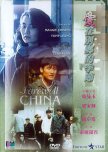
"Don't come home"
Farewell China was a 1990 film directed by Clara Law and filmed primarily in New York. The film showed the difficulty many illegal immigrants without a safety net of family or community suffer, especially when emigrating to one of the most expensive cities in the world.After years of trying, Li Hong receives her visa and travels to New York City ostensibly in order to study. Her husband, Nan Sheng stays in China with their baby son, Sansan. At first, Nan Sheng receives seven letters from Hong a month. The letters stop coming after she begs him to come home and he tells her tough it out and stay. Eventually Nan Sheng takes the dangerous illegal route to the states to find Hong. It doesn’t take long for him to discover the squalor and danger she lived in and the despair that riddled her life. With the help of Jane, a teenage Chinese American prostitute, Hong begins the arduous search for his wife.
The story of cultural identity and the dangers illegal immigrants faced, especially in 1990s New York City and the boroughs, was compelling. Arriving in a foreign land, with limited English skills, no money, and no connections was a recipe for disaster. However, Law lost me in the implementation of the elements. The over-the-top 15-year-old prostitute with a heart of gold who helped Nan Sheng did not hit as authentic. It was also disturbing when he worked as her pimp, “Chinese little girl. 15-years-old. Beautiful, clean, and sexy.” Nan Sheng stumbling across live sex shows and utter filth and overwhelming crime felt like a bad stereotype of the city. Although admittedly, 1990 was a peak year for crime. And people illegally in the country don’t go to the police for fear of deportation. The ending also let me down as it felt contrived and out of left field.
Aside from reservations I had about the storytelling, the acting was quite good. Tony Leung Ka Fai conveyed Nan Sheng’s longing, perseverance, and breaking points. The story of Maggie Cheung’s Li Hong was told primarily through flashbacks. Her character went from hopeful for a better life to the threshold of utter despair taking its toll on her sanity. Nan Sheng would come to understand how traumatic the words, “Don’t come home,” could be.
As much as I enjoyed Autumn Moon by Clara Law, I was unable to connect to Farewell China the same way. The very real horrors and sense of isolation and loss immigrants can feel was diminished by the melodramatic approach.
9 May 2025
Trigger warnings: Insects. Sexual content and full nudity, especially at a live sex show. Sex with an underage girl.
Was this review helpful to you?
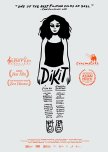
A young woman watches as a couple move in next door. The new neighbors have no idea what her evenings consist of, if they did, they would turn around and speed away. Yet they, too, are hiding a gruesome secret. One night the attached horrors will collide.
“Female creature who flew into the night hunting for pregnant women…and their wombs…craving the one thing her own body could never produce. For her body feared by many was split in two.”
I had to do a little research to figure out what the intro was talking about and the hints in the film. This was an updated folktale about the manananggal, a usually female creature that fed on pregnant women and/or their fetuses. It could split in half at the waist, leaving its lower extremities behind while it hunted. In some stories it could sprout bat wings and this character did indeed have scars on her back and waist. The screen was split, with the manananggal on the left and the pregnant neighbor on the right. No words were spoken aloud, the music and the action telling their stories. Serrano did a great job of pacing the story so that the viewer could follow both halves as they played out. The music, while simple, also created the perfect mood as both halves’ horrors were revealed.
I found the theme for Dikit hard to follow at first. In fact, I went back and watched it again. As I watched I remembered that a woman is most susceptible to partner violence when she is pregnant. In real life pregnant women’s injuries and deaths are not caused by demons. Unlike some humans who are evil, there are monsters who can transform into heroes.
7 May 2025
Was this review helpful to you?

"If you're not good, we need mutual understanding"
I went into The Great Buddha+ blind thinking it might be about a spiritual journey. Uh, no. This film had numerous lewd jokes and comments and pretty much audio porn. It looked like a low budget art house movie filmed mostly in black and white. The title was not false advertising as there was a big brass Buddha at the center of unsavory events.Belly Button lives hand to mouth, eking out a living by collecting and selling recyclable materials and junk. Too poor to drink, he eats one meal a day consisting of food thrown out in the evenings by convenience stores. He is pretty much at the bottom rung of the social ladder if he’s on the ladder at all. Fortunately for him, he meets with Pickle every day at his friend’s night job guarding a factory that makes among other things Buddha statues. Belly Button orders the passive Pickle around, the only person he can tell what to do. Pickle’s boss, Kevin, isn’t nice but is also the object of their envy with his wealth, Mercedes, women, and powerful friends. When the tv breaks down in the office, a bored Belly Button suggests they watch the dashcam from the boss’ car. Turns out Kevin has a car sex fetish which provides hours of amusement for the down on their luck friends…until they see something they shouldn’t or at least wish they hadn’t.
The film hammered home that Belly Button and Pickle were poor and powerless, out of the reach of justice. When they died, if they were lucky, their chalk line would look like a man and not a circle. No one truly knew the other. Men like Kevin weren’t held accountable for their actions as the courts were run by and for the wealthy. The other oft used image was the dashcam. The only color in the film was through the eyes of the dashcam lens. The witness of even heavily edited dashcam recordings was the reality of the nightly news and life. The director provided narration sporadically through the film, sometimes for the better and sometimes as a spoiler of coming events. My biggest problem with the film was that many scenes dragged on for far too long and side characters who added little were often introduced.
The Great Buddha+ had interesting concepts and even inspired a few laughs. The messages overall were bleak. Pickle and Belly Button had come to the conclusion that the only way their lots in life could change would be for the worse. Fate had not been kind with the families they’d been born into. The titular brass Buddha observed all the dirty and sad goings on with a placid face. Sometimes a flower can bloom on a pile of trash, sometimes the flower just gets stepped on before it can bloom. The Buddha may have been hollow, but did karma get the last laugh?
1 May 2025
Trigger warnings: Partial nudity, sexual content, lewd comments
Was this review helpful to you?

"Dumbass"
Like a Dragon was based on a video game. I’m guessing the video game was written better than this drama. It had potential but couldn’t get out of its own clichéd way.Four teens being brought up by Kazama at his orphanage decide to break ties with him and rob a gambling den. Turns out it’s run by the yakuza. Kazuma and Nishika are allowed to work for the yakuza to pay off their debt while Miho and Yumi are sent to the hostess bar to work their debt off. Kazuma ends up in prison for 10 years. Upon his release he discovers that his made family is caught up in a mess that could lead to an all out gang war.
This drama bounced back and forth between 1995 and 2005 in every episode. When a drama overly relies on this technique, it usually means there’s not enough story and the writers are trying to build some sort of suspense. People familiar with the game may be able to fill in the gaping narrative holes. The characters were poorly written which did not help the actors. The acting ranged from good to painfully bad. Majima Goro is currently listed as a main character, if you are watching for him, you’ll be disappointed as his appearances were fleeting.
I’d hoped the drama would strengthen as the characters headed for the big showdown. Instead, the story felt more convoluted and the performances more forced. I suppose I should mention what I liked about the drama. Takeuchi Ryoma was very pretty to look at and had obviously worked out for the role of the Dragon. This drama could also win a world’s record for longest princess carry. If you are familiar with the game you’ll probably get more out of this drama than I did.
30 April 2025
Was this review helpful to you?
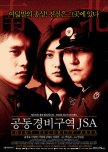
"Here the peace is preserved by hiding the truth"
Joint Security Area showcased how people are still people even when their ideologies clash. They enjoy talking, drawing, playing games, and can be both heroic and cowardly. Set along the DMZ it related how four men tried “to open the dam to reunification.”Swiss officer Sophie Jean arrives in South Korea to conduct a neutral investigation on an incident involving one South Korean soldier and three North Korean soldiers, two of which were killed. Warned that “a spark in a dry forest could burn the whole forest down,” she was told that the what wasn’t as important as the why. Sgt Lee is in custody stating that he was kidnapped and confessed to killing the soldiers during an escape. North Korean Sgt Oh gave a different story stating that the SK soldier attacked them. Sophie faced a network of conflicting eye witness accounts not seen since Rashomon.
The investigation scaffolding of the movie was the least interesting part of it, exasperated by heavily accented and stilted English speaking skills. It would not have been as big of a problem for me, except that the version I watched had no subtitles for the English, meaning I missed about half of what they said. It felt like the investigators purpose was to fill the viewer in on Korean history and the complications of working on the border.
What made this movie fascinating to watch was the slowly evolving illicit friendship between the two South Korean guards (Lee and Nam) and the North Korean guards (Oh and Jung). They shared gifts, gossip, and laughter. Ever present though was the tension between the two countries reminding them of how dangerous their shared time was. Song Kang Ho as Sgt. Oh gave a beautifully complex performance as the more experienced soldier who still possessed empathy. Lee Byung Hun’s Sgt. Lee was less mature and quicker to draw. With an overabundance of foreshadowing the writing was on the wall regarding the fate of the friends which made their time together all the more poignant.
The military scenes showed the lack of training some of the soldiers had. When Lee went off to relieve himself he either didn’t tell his squad or they didn’t do a head count as they retreated. There was also an awful lot of “battle rattle” where equipment wasn’t taped down properly to allow the troops to move more silently.
Joint Security Area highlighted how all men are brothers but also often enemies. The central part of the film sharing the men’s bromance was wonderfully comforting, which unfortunately made the fall all the more painful in the end.
27 April 2025
Trigger warning: Full frontal nudity of a male body in the morgue.
Was this review helpful to you?
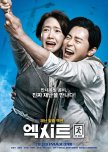
"Our lives are the very definition of disaster"
Often the only way out is through, but in Exit, the only way out is---up! Two underachievers help save a birthday party from a toxic death by using their extracurricular skills. (Warning! a few climbing puns tumbled out while writing this)Yong Nam spends every morning hanging out on the monkey bars at the park strengthening his climbing skills. Unable to find a job, he’s a disappointment to himself and his family. He schedules his mother’s 70th birthday party nearly 2 hours away because the girl he had a crush on in college works there. Eui Joo may have a job but she carries most of the weight while also fending off her boss’ advances. The two ex-friends meet at the party during a rocky moment. Soon they will both put their climbing skills to the test when toxic gas is released in the city and they have to find a route to lead the people in the building to the roof.
Exit was entertaining if you didn’t look at the science of it too closely. There were crevasses in the narrative logic that hurt the story’s balance. I was afraid it would fall into a slapstick comedy but fortunately, most of the “comedy” took place in the early part of the movie. Jo Jung Suk and Im Yoon Ah worked well together, elevating the material. The climbing element gave a different twist to the urban disaster genre. At one point Yong Nam said he was going to be boulder and only interview in the tall buildings because they were rescued first, yet it was when he and Eui Joo harnessed their skills that they helped save many lives, including their own. Suffering from a harsh economic job landscape, the two proved that their lives were hardly useless and their rock-solid abilities came in handy. They also inspired a community of basement dwelling underachievers to use their unconventional hobby to light the way as the duo raced along the rooftops. Exit may not have scaled new heights, but there are moments when it will keep you on edge.
20 April 2025
Was this review helpful to you?
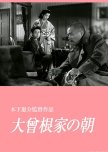
"Just as he wishes, I'll return as ashes"
Morning for the Osone Family was director Kinoshita Keisuke’s first film after the end of WWII. He had a lot to say about the disastrous and destructive Japanese war machine and the people crushed under its weight. The film rarely left the Osone’s home as the war played out in the household of the Osone family.The Osone deceased patriarch had been a professor and pacifist. The mother raised her three sons and daughter to be educated as the father had wished. Eldest son, Ichiro, writes articles for the paper, one of which lands him in jail. Taiji, an artist, is drafted. He would rather die for his art than the ambitions of the military. Daughter Yuko’s engagement to Minari Akira is called off by her military uncle who comes to live with them. The gung ho and corrupt colonel turns the household upside down forcing everyone to accept his patriotic criticisms as the war rages around them.
Sugimura Haruko gave a phenomenal performance as a mother powerless to stop the war and stop her sons from dying. I’d seen her in numerous Ozo films, but here she really shone as a loving mother who cared for her children and mourned them as the war machine took its toll on her little family. Director Kinoshita held nothing back in his criticisms of the war and most of his vile spewed forth via Sugimura. Ozawa Eitaro played the militant uncle who represented the worst abuses of the military. His plate was never empty, always enjoying the best of everything while the enlisted soldiers went hungry. He bragged how Taiji would be beaten into submission in order to become a soldier. He felt no remorse and no responsibility for the atrocities committed abroad and at home. If there is a rule to war it’s that young men die. It makes it more bearable when they know that they are dying for a greater cause and not for the unbridled ambitions of the elite. Fury over the unimaginable loss of life and the needless suffering so many endured erupted often quietly onto the screen.
Clocking in at under 90 minutes with nearly all of the scenes set in the Osone house, the atmosphere became claustrophobic with air raid sirens blaring and the colonel filling the rooms with his hot air. Mother and daughter contributed to the war effort and to keeping the family going even as the war took so much from them. From Christmas 1943 until Christmas 1945, it was a long dark night before morning would break on the Osone family returning their hope for a better day.
14 April 2025
Was this review helpful to you?
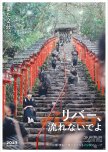
River of time
River was a quirky time loop film centered at an inn on the scenic Kibune River. The guests and workers are forced to face their own emotional loops and discover how to resolve an actual time loop that occurs every two minutes.Waitress Mikoto and clerk Kohachi realize they are having a conversation for the second time. Within two minutes Mikoto is transported back to the river’s edge. The situation is repeated for all of the guests and workers wherever they might be. Together they seek to find the cause and breadth of the time loop. As the affected people begin to despair, tempers fray and secrets come to light.
I enjoyed this revved up Groundhog’s Day where everyone was in on the situation. I did pity the actors as many of the repetitious scenes involved the characters running upstairs, not an easy task for the women in kimonos. There was a continuity issue of the changing weather. One moment it was green and sunny, the next there were several inches/cm of snow and ice on all of the surfaces and then back to greenery. The camera work and acting weren’t very advanced, but not overly distracting. Thankfully, the story moved forward even if time did not. Many of the characters were stuck in their lives and afraid to make decisions or share feelings. The repeated two minutes gave them time to think about their obstacles and relationships, helping them to resolve their problems. And for one chef, the chance to act out his revenge fantasy. That might come back to bite him when the clocks started up again.
10 April 2025
Was this review helpful to you?
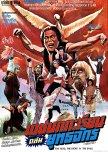
Meh
The Fists, the Kicks, and the Evils starred Bruce Leung in a Jackie Chan style film about a fighter whose fists were bigger than his brain. And probably smarter.A gang of martial artists is terrorizing a town by demanding extortion money and shutting down martial arts schools by killing the masters. Ah Lang is a hot head who just wants to fight never thinking of the consequences. Because of his hubris three people dear to him are murdered. He asks a local farmer to teach him better techniques so that he can have his revenge.
Bruce Leung played the young fighter who acted and spoke before he thought. I find this type of character highly annoying and never did warm up to Ah Lang. When the lead character’s gross incompetence led to the deaths of those around him and then he self-righteously sought to avenge them, the first person to have been punished should have been him. Two of the villains played by Chan Lau and Lam Hak Ming were overexaggerated caricatures. Bolo played a third villain wearing a matching hairstyle with the Big Bad, Phillip Ko Fei. Chiang Cheng played Ah Lang’s third martial arts teacher and the only one to survive. There was the requisite training montage after the baddies handed Ah Lang his butt. The fights were all of the rhythmic dance kung fu style but faster than most from this time period. The final fight between Leung and Ko was the best. The imagery and dialogue centered on Ah Lang’s Crane style.
The only version I could find was badly cropped and dubbed. I could have used English subtitles for the English dubbing. Between the degraded sound issues and one dubber’s weird New York gangster accent I had trouble understanding them.
The Fists, the Kicks, and the Evils was more the Incompetent, the Boring, and the Needs to Keep His Trap Shut so that his friends and family wouldn’t have died. Not horrible, but not worth recommending either. Graded on a curve as always.
27 March 2025
Was this review helpful to you?
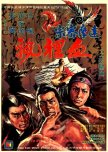
"Seems we're in for a fight" It's a kung fu movie, of course you are!
Shaolin Kung Fu Mystagogue at least lived up to its name, there was a Shaolin temple and the teacher played an important role. There were also the oft used Ming rebels, Ming prince/king and Qing bad guys with frightening weapons. No secret list this time but there was a secret scroll of Buddha’s Final Form, the ultimate technique.The rebels are trying to covertly maneuver the Ming prince/king out of Qing territory and safely into the south. They are thwarted by the diabolical Lu Ping (few character names in this dubbed version) and Chang Yi with his “Bloody Birds.” Carter Wong and his sister Hsu Feng work to save the king and take him to safety. Much of the action takes place in the Shaolin temple where a blind teacher helps to protect both the king and the secret scroll. Deadly traps are used in the Qing prison and the Shaolin temple.
This was Chang Peng I’s first directorial effort. Time has not been kind to his movie. The film was faded with salt and pepper pocking as well as the occasional yellow and blue streaks. Unfortunately, I could only find it with English dubbing. The cast was strong which helped gloss over the weak storyline. Chang Yi with his wild gray sideburns and swirling boomerang blades that could cut down trees and cause explosions made for a sinister bad guy. How he didn’t crack up with those wild weapons is beyond me. Hsu Feng had a spear with a retractable chain and blade. Carter relied on his Shaolin kung fu techniques only lacking the 18th form. Lu Ping as "His Highness" had an impenetrable body save for his Achilles heel. Phillip Ko Fei, a competent martial artist in real life, played the traitorous monk who aided the Qings.
The action came fast and furious from beginning to end with flaming traps, daggers, poisonous gas, and spiked walls all of which challenged the fighters both angels and devils. Oh, and Lung Fei had a golden manicure to die for. If you enjoy old kung fu movies with ridiculously funny and deadly weapons, this might be one to try. As always, its graded on a curve.
25 March 2025
Was this review helpful to you?
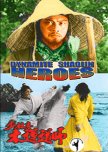
"I'm wearing a mask because I may have to kill you"
Dynamite Shaolin Heroes was a strange title for this Korean kung fu flick. There was no dynamite (darn!) and nothing related to Shaolin. I tend to steer clear of Korean martial arts movies from this era as much as I can because the quality was commonly low and that’s saying something for this genre. Usually, only Lo Lieh or Hwang Jang Lee can lure me in. To my surprise, DSH was watchable.The Ming rebels are hiding the two surviving princes hoping their government can be re-established. There is a list of Ming rebels, not just any list, but a list written in blood. The evil strawberry blonde Viceroy is determined to get his hands on that list. Kang is helping the rebels and arranging a marriage for his daughter to an “idiot,” who is not only incapable of protecting her, but also annoying. Another man desires to marry the daughter but she turns him down flat because he used to be a killer. Fortunately, whenever a lone rebel or the fiancée is attacked a basket-headed fighter comes to the rescue! He never kills anyone meaning the bad guys keep attacking and killing the supporting good guys. But suddenly, he begins to kill the attacking bad guys led by the Viceroy. Holy doppelgänger Batman! Now there are two heroic basketheads. One who kills and one who doesn’t. Who could they possibly be?
Lo Lieh played the Killer and a man hopelessly in love with the female lead. Kwon Yeong Moon was the incapable fiancé and Not Killer. In real life, Kwon would go on to train Sylvester Stallone and Muhammed Ali in taekwondo. The moves were fast with lots of flipping and rolling around on the ground, often with characters doing the gymnastics in synch. While the moves may have been faster than other kung fu flicks from this time period the kicks and hits often missed by a mile (km).
Godfrey Ho directed this film, he of the cut and splice movies with ninjas added to random existing films. Here he had two heroes who were both in love with the girl. Oh, and there was a prince and the rebel list to protect. I was generous with my score because the basic concept of the competing basketheaded heroes was at least a stab at originality. The acting was acceptable even though Kwon did not strike me as leading man material. The version I saw was badly cropped, faded and dubbed with British accents. With films in this shape, it’s usually better for them to be dubbed because the white subs often run off the screen and are rarely legible on the light background.
While Dynamite Shaolin Heroes wasn’t a great film, for a 1978 Korean kung fu film it was above average. As always, I grade these on a curve, and for this Lo Lieh film I was extra generous.
24 March 2025
Was this review helpful to you?

"Let others do the dirty work while you sit here and reap the rewards"
Last Hurrah for Chivalry was one of John Woo’s early directorial efforts. He used a traditional kung fu theme of revenge and turned it into a film about friendship and loyalty. The cast was strong and for a 1979 film in this genre was quite engaging.Kao Pang’s wedding reception is interrupted by Pak Chung Tong, his father’s arch nemesis. In short order nearly everyone is killed except for Kao and his two trusted servants who all escape out the backdoor. Kao’s sifu takes care of him and gives him the name of the famous swordsman, The Divine Blade aka Chang San. Chang has given up the sword but Kao deviously manipulates him into picking it up again. Coincidentally, Tsing Yi, a great swordsman but failed assassin keeps running into Chang and develops his own grudge against Pak. The two swordsmen form a bond and attack Pak for different reasons, neither of which may be legitimate.
John Woo was an assistant director to Chang Cheh in several films. Much like Chang’s films, the blood ran freely and the body count was high. Wai Pak (Snake Venom) played the congenial, if hot-tempered Chang San, who was willing to risk his life to help a new friend. Damian Lau as Tsing Yi used his sword for money and had no attachments to people even though the local courtesan was deeply in love with him. Lau Kong's duplicitous Kao Pang came across as a smooth snake in the grass before he became unhinged. Lee Hoi Sang was thoroughly believable as the fierce baddie who struck fear into men’s hearts. At 38 Lee was tight. Most of his scenes were without a shirt and his workout routine was definitely effective.
Fung Hak On’s fight choreography was quite creative with limited use of wires until the final fights. He also played the assassin Pray. “Pray and accept your fate!” His fight with Wai Pak was intense but dragged on for too long. Most of the bloody skirmishes were with swords with kung fu thrown in for good measure. While many of the fights had the traditional 1970s rhythm, they moved quicker than the Five Venoms’ kung fu posing. Chin Yuet Sang’s Sleeping Buddha style required skill to implement even if it was done for a brief moment of lethal levity. One battle to the death took place by candlelight!
I liked how John Woo began the film with the traditional revenge trope and then quickly turned it on its head. Damian Lau and Wai Pak brought their characters’ bromance to life. Woo’s writing also made me care about Chang San and Tsing Yi. The betrayals and double crosses hurt and I cared about the characters’ outcome, especially in a film where the bodies were stacking up. It was a long and bloody road to discover who was truly chivalrous and who deserved no mercy.
Though I enjoyed The Last Hurrah for Chivalry it would still only be for fans of this style of film as the acting and fights are now dated. If you do watch old kung fu flicks, this Golden Harvest film has either been restored or well cared for, unusual for a non-Shaw Brothers film.
23 March 2025
Trigger warning: Bag of snakes! And hacking of said snakes.
Was this review helpful to you?
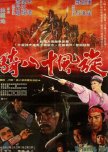
Just keeping riding, not worth a stop over
I started 18 Swirling Riders aka 18 Shaolin Riders because Lo Lieh was in it and I am on a mission to watch all of his films that are available. Otherwise, I would have dropped this film somewhere between the 20-40 minute mark.There were numerous characters and no coherent story. A great deal of the fights took place in the dark meaning there was no way to tell who was doing what to whom. Because of the large cast and terrible storytelling, it was next to impossible to care about any of the characters or the characters never introduced who died off screen. Or the characters who died on screen of which there were many.
Chia Ling was criminally underused as was Lo Lieh. Wen Chiang Long dominated the screen as the stiff upper lip hero who had a habit of laughing maniacally at inappropriate moments. He was also a master of disguise and used old school Mission Impossible face masks and wigs to fool people. Don Wong Tao played “Paper Knife”, a mysterious fighter who always wore a black weimao to conceal his superhero identity. Chen Sing finally showed up an hour into the movie as the Big Bad or one of the Big Bads, Lo Lieh’s character just seemed to be in a bad mood that was only alleviated by robbing and killing people.
As near as I can tell, the Riders stole from the corrupt rich and gave to the poor. Chen Sing was mad at the Riders for stealing a knife he cared about years ago and vowed to kill all of them, including 1000 children in their care. Lo Lieh, yeah, I don’t know, he seemed to be upset that the riders foiled his robbery. But even then, it wasn’t them and the contraband wasn’t gold, it was a woman. I could see why everyone might have been confused as there were no air holes punched in the small chest she was transported in. She wanted the Riders to help her avenge her master because a knife or “the” knife or a paper knife had been used to kill him. The synopsis says that there was a mole in the riders, but I never did see one. Oh, and there was a carp painting that people were dying for because it revealed secret kung fu weapons shaped like fish.
The fights that I could see involved wire-fu, trampolines, and reverse filming. The sword fights were okay. Because it was filmed in Taiwan, they had to fight in the woods, at least they avoided the quarry. In this instance with less than spectacular flying through the trees scenes.
To sum up, unless you are in a ride or die contract like I am with Lo Lieh, I highly advise skipping this mess. I gave it a generous 5 because it was dubbed and maybe some of the story was lost in translation.
22 March 2025
Was this review helpful to you?
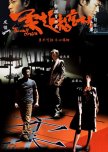
"I'll be Sanshiro Sugata, you be Higaki"
Throw Down was director Johnnie To’s homage to Kurosawa Akira’s Sanshiro Sugata. Gotta say, other than the judo connection, I didn’t see anything to tie the two films together. Sanshiro Sugata showed how the study of judo turned a young man’s life around as he learned discipline and honor. Throw Down was about hustlers’ and even gangsters’ love of judo.Szeto To is a washed up judo champ who manages a night club. He is an inveterate gambler and alcoholic. In his spare time he attempts to steal money from a local gangster in order to pay back his debts. Mona is from Taiwan and is trying to make it big as a singer and/or actress. Completely broke and without much talent, she bulldozes Szeto into giving her a job at the club and eagerly helps him in his heist attempts. Tony arrives in town and challenges Szeto to a match, sticking around as a saxophone player for the club. Szeto’s old teacher wants him to take over his dojo and an old rival shows up desiring a rematch.
Everyone except for Mona was a judo expert in this film. With the exception of a barroom brawl, most of the fights were over quickly with a throw down. Lack of character development made it almost impossible to become emotionally invested in any of the characters. They also weren’t very likeable. Szeto was a loser with a capital “L”, someone who was set on self-destruct mode for a reason that only became apparent at the end of the film. Mona was desperate enough to debase herself and steal in order to make her dream become reality. And Tony only cared about trying out new techniques and fighting anyone around. None of the characters had much depth and there weren’t any emotional stakes. Even the bad guys weren’t very bad when it came to judo. There was no real conflict except within Szeto and because the audience was largely kept in the dark, he just came across as pathetic. The characters were only happy when they were competing in dojos, alleyways, the street, wherever they could talk someone into battling. Tony put up a sign for a judo tournament but only one minor character went to it off screen.
Where the film succeeded was in the cinematography. It looked good and the music was pleasant. The short fights also came across as realistic with the judo throwing and the grappling on the ground. At the end of Sanshiro Sugata, the final fight took place in the tall grass. Apparently, Johnnie To decided to have his final fight in even taller grass but with a less climactic ending. Sanshiro Sugata had an uplifting message about the discipline of judo leading to personal growth and respect for others. I suppose if you squint really hard, Throw Down had a message about getting up regardless of how many times you’re knocked down and to have something in your life you are passionate about. I just wish the characters had been more fleshed out so that I would have cared about whether they got up 1001 times.
15 March 2025
Was this review helpful to you?
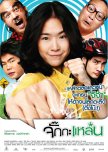
Jeeja deserved better
Jeeja Chanthathanisa Tang was the only redeeming quality to This Girl Is Bad-Ass! If you love Thai slapstick comedies, you will probably like this film far more than me. It looked super low budget and the story made little sense. Watching Jeeja in action couldn’t make up for what this film lacked.Jakkalan works for a specialty bike messenger company. She and her crew run afoul of two rival gang bosses they deliver packages for which culminates in a warehouse fight involving guns, martial arts, and an angry cobra.
The acting was terrible, the story a mess, and the comedy painfully cringe-worthy or just downright offensive. Jeeja was indeed a badass, but this movie was just bad.
14 March 2025
Trigger warning: Snake
Was this review helpful to you?


