

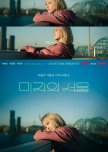
Nuestro Seúl por Descubrir
A 1 usuarios les ha parecido útil esta reseña
This review may contain spoilers
Everyone keeps hiding, What they long to find...
Drawing inspiration from one of storytelling's most enduring motifs—the double and the exchange of identities—Our Unwritten Seoul transforms a potentially familiar premise into a profound reflection on invisible pain and the weight of expectations. The series explores alienation, the search for belonging and purpose, and the painful reckoning with dreams that can no longer be pursued.Through the lives of twin sisters Yoo Mi-ji and Yoo Mi-rae, seemingly opposites in both temperament and circumstance, the drama gradually reveals a cast of characters united by hidden wounds, lingering guilt, unspoken regrets, and fragile inner lives concealed behind reassuring façades.
The writers deserve considerable credit for embracing such an ambitious narrative structure. Expanding through a remarkable number of interconnected backstories, the series touches the lives of nearly every major character without ever losing sight of its emotional core. As its world grows, Our Unwritten Seoul maintains a striking thematic unity, weaving together love, solidarity, quiet melancholy, and a rare emotional restraint that becomes one of its defining qualities.
One of the drama's greatest strengths lies in its constant reversal of perspectives. Those who appear to have everything under control often stand closest to breaking point, while the individuals most readily dismissed as unsuccessful or directionless prove to be the ones most capable of understanding and supporting others. Through this tension between perception and reality, the series encourages viewers to look beyond first impressions and question assumptions that seem firmly established.
Seen in this light, the theme of identity exchange serves a far deeper purpose than a simple narrative device. The twins do not merely step into each other's lives; they experience the weight of the judgments, misunderstandings, and expectations that shape those around them. In doing so, the drama challenges the notion that identity can be easily recognized or defined from the outside, revealing how little we often know about the struggles hidden beneath the surface.
Mi-rae appears to be the successful daughter while carrying a loneliness few people ever notice; Mi-ji is viewed as the sister who never quite found her place despite her remarkable ability to connect with others; Ho-su seems to have built the life everyone admires, yet remains deeply marked by physical and emotional wounds. Even Ro-sa ultimately proves very different from the figure the neighborhood—and the audience—had come to know.
The title itself carries a meaning that extends far beyond its geographical reference. This "unwritten Seoul" evokes lives still waiting to be told, stories struggling to break free from the definitions imposed by others—or by the characters themselves. The twins' journey becomes an attempt to reimagine their identities through a new perspective and a different understanding of their past.
The places themselves contribute to this reflection. The Seoul portrayed by the series bears little resemblance to the city of postcards and tourist guides. Alongside the modern metropolis survive seemingly modest spaces such as Ro-sa's restaurant and Se-jin's strawberry farm, which become places of memory, healing, and renewal. By preserving stories, relationships, and identities threatened by time and modernity, they offer the characters refuge from external pressures and the opportunity to reconnect with parts of themselves they believed lost.
These reflections on identity, belonging, and self-discovery find their clearest expression in the journeys of the main characters. Though their paths differ greatly, Mi-rae, Mi-ji, and Ho-su share the same challenge: learning to separate who they truly are from who others believe them to be, while coming to terms with wounds and guilt that have shaped their lives for far too long.
Mi-rae is not alone because she lives alone. She is alone because she has learned to carry everything on her own. Family responsibilities, professional expectations, successes, and failures have gradually built an invisible prison around her, one in which vulnerability feels like weakness and asking for help like a personal defeat.
Nothing illustrates this condition more effectively than her desk at the office. Isolated from her colleagues, exposed to everyone's gaze yet excluded from any genuine sense of belonging, it functions as a modern-day scarlet letter—a tool of exclusion that turns Mi-rae into a warning for anyone who dares challenge the company's hierarchy.
Her breaking point does not stem from weakness, but from the gradual disappearance of every space in which she can simply exist as herself. Her family sees a dependable daughter, her workplace a problem to manage, and society a measure of success. Eventually, Mi-rae begins to see herself through the same lens.
By contrast, Se-jin's strawberry farm becomes a place of healing. Where the office demands performance and conformity, the farm offers acceptance, the freedom to fail, and the chance to reconnect with a more human version of herself.
The exchange with Mi-ji does not transform Mi-rae into someone else; it allows her to reconcile with who she already is. Thoughtful and cautious until the very end, she gradually learns to separate her worth from achievement and expectation. When she leaves the company and chooses a different future, she is not abandoning herself—she is choosing herself for the first time. Her journey ultimately reflects one of the series' central ideas: one's place in the world does not necessarily coincide with the role the world has assigned.
If Mi-rae embodies the weight of expectations, Mi-ji represents the ability to keep moving forward despite disappointment and loss. Her apparent lightness does not come from an absence of pain, but from a refusal to let pain define her. Having lost her dream of becoming an athlete and spent years struggling with isolation and self-doubt, she nevertheless retains a rare ability to look beyond immediate obstacles.
Her optimism never feels naïve. It emerges instead from a genuine resilience that allows her to recognize the suffering of others without judgment and offer support without trying to solve every problem. This quality makes her Ho-su's anchor during the most difficult period of his life.
Mi-ji's own healing begins when she stops seeing herself as someone who needs to be saved and discovers that she can be a source of strength for others. In a drama filled with characters searching for their place in the world, she comes to embody perhaps its simplest and most meaningful idea: the ability to move forward, one day at a time, without losing faith that each new page may still hold something beautiful.
Ho-su is perhaps the most idealistic character in the series. Guided by a strong sense of justice and unwavering loyalty to his principles, he struggles to accept compromises he considers morally wrong, even when they might make his life easier. This integrity often places him at odds with his professional environment and leads him to stand beside those he believes have been treated unfairly.
To the drama's credit, however, Ho-su is never portrayed as a figure of heroic perfection. His convictions often turn into self-imposed isolation, convincing him that every burden must be carried alone.
Like Mi-ji, he lives under the weight of a past he has never fully forgiven himself for. The accident that took his father's life and damaged his hearing continues to shape both his sense of self and his relationships. Despite Bun-hong's unconditional love, Ho-su still sees himself as a burden to those around him. When his condition worsens, this fear resurfaces with renewed force, leading him to push Mi-ji away precisely when he needs her most.
Their bond acquires a particular depth because both are defined by wounds and guilt that have kept them tied to the past. It is no coincidence that Ho-su is one of the few people capable of recognizing Mi-ji regardless of appearances or circumstances. His confession carries an additional significance: the person Mi-ji has always considered less accomplished and less worthy of love is exactly the person he falls in love with. Ho-su loves her not for who she might become, but for who she has always been. At a time when he had stopped believing in himself, she was the one person who continued to believe in him.
His journey reaches its conclusion when he realizes that accepting help does not mean surrendering his dignity. Coming to terms with his worsening hearing loss is not an act of resignation, but an acknowledgment that vulnerability does not diminish a person's worth. In this sense, Ho-su embodies one of the series' most delicate reflections: courage does not lie in facing every battle alone, but in allowing those who love us to walk beside us.
Ro-sa and Sang-wol's beautiful backstory feels almost like a drama within the drama itself. Through the lives of two women raised on the margins of society and forced to confront poverty, exclusion, and violence, it retraces part of the long and difficult path of women's emancipation in modern Korea. Despite their different backgrounds and personalities, they come to embody many of the values at the heart of the series: solidarity, sacrifice, belonging, and mutual devotion.
It is no coincidence that Ro-sa refers to Sang-wol as her "twin", creating a striking parallel with Mi-ji and Mi-rae. Like the sisters, their bond transcends conventional definitions, becoming a relationship built on profound emotional intimacy and unwavering support. The result is one of the series' most moving relationships, granting these secondary characters a depth rarely afforded to figures outside the central storyline.
Their story also offers one of the drama's most poignant reflections on identity. For decades, Sang-wol lives under Ro-sa's name, not to erase herself, but to preserve the memory of the only person who ever offered her love, dignity, and belonging. In a narrative deeply concerned with how identity is shaped and perceived, their bond suggests that identity itself can become an act of care—an emotional legacy carried forward through time.
Equally important are the maternal figures, portrayed with remarkable nuance. Far from idealized, Bun-hong and Ok-hui reveal how love can be expressed through both devotion and imperfection. In different ways, they pass on not only affection and protection, but also fears, guilt, and expectations that echo across generations. Some of the drama's most moving moments emerge when these inheritances are finally acknowledged, allowing old cycles of pain and misunderstanding to be broken.
Ultimately, the series suggests that rewriting one's life does not mean becoming someone else. It means learning to revisit one's story with greater understanding, making peace with mistakes, regrets, and missed opportunities without allowing them to define the present. Every blank page becomes an opportunity to continue the story with a deeper awareness of who we are.
Perhaps the authors' most insightful choice lies in their refusal of artificial complementarity. The exchange does not turn the sisters into improved versions of one another, nor does it merge their personalities. Instead, it allows them to understand themselves and the world around them more deeply while remaining true to their nature. Mi-rae stays thoughtful and cautious, Mi-ji impulsive and radiant; what changes is not who they are, but the way they learn to inhabit their own identities.
Much of this delicate balance rests on Park Bo-young's extraordinary performance, which serves as the emotional core of the series. Tasked with portraying two profoundly different characters without relying on exaggerated distinctions, she delivers a performance of remarkable sensitivity, capturing the full emotional range of the narrative—from vulnerability and strength to melancholy, hope, and the desire to begin again. More than a display of technical skill, her portrayal makes both sisters feel authentic and deeply moving throughout their journeys.
Alongside her, an excellent ensemble cast brings depth and credibility to a richly layered narrative world where even secondary characters leave a lasting impression. From Ho-su, Ro-sa,/Sang-wol to the maternal figures whose influence resonates throughout the story, each character is given meaningful space without ever feeling superfluous.
This may be Our Unwritten Seoul's greatest achievement: its ability to embrace a remarkable number of themes, characters, and narrative threads without sacrificing cohesion or emotional depth. Where many stories would lose focus, the drama remains firmly anchored to its human core, guiding every character toward a resolution that feels both earned and sincere.
Ultimately, Our Unwritten Seoul is not a story about becoming someone else, but about learning to accept who we are. It is a story about identity, memory, belonging, and second chances, reminding us that no life can be rewritten by erasing the pages that came before. What we can do is learn to see those pages differently and find the courage to keep writing the ones still ahead. As the finale gently suggests, every blank page is not a reminder of what has been lost, but a testament to what we may still become.
9/10
¿Te ha parecido útil esta reseña?
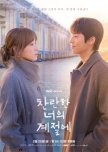
In Your Brilliant Season
A 1 usuarios les ha parecido útil esta reseña
Love,love,love..
Just finished In Your Radiant Season, and what an amazing drama it was. Not a single second felt boring, it kept me completely hooked from start to finish. Every episode had something meaningful, emotional, or exciting that made me want to keep watching.I know some viewers felt that the ending was rushed, but personally, I didn't feel that way at all. The drama gave us a happy ending and beautifully wrapped up the stories of all the characters. It was satisfying to see everyone get the closure they deserved. And the youngest sister and her boyfriend's story was captivating enough.
Overall, In Your Radiant Season is a heartfelt and engaging drama that kept me invested throughout. Definitely one of those shows that stays with you even after it ends. And i already miss them.
¿Te ha parecido útil esta reseña?
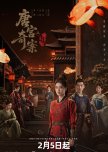
El misterioso caso del palacio Tang
A 3 usuarios les ha parecido útil esta reseña
This review may contain spoilers
Infuriating, rage bait nonsense not suitable for any audience let alone western sensibilities
If you are looking for a logical, tightly-plotted Tang Dynasty detective thriller, keep walking. Unveil: Jadewind manages to completely insult the viewer’s intelligence within the first eighty minutes of its runtime, relying on artificial frustration rather than competent storytelling.The production budget is clearly on screen. The cinematography is moody, the costumes look expensive and the lighting effectively channels that "Tang Dynasty Gothic" aesthetic. If you mute the television and just look at the pretty pictures of Bai Lu and Wang Xingyue, it is a visually polished show.
However, the writing is absolute garbage, driven entirely by a double-standard logic that breaks the universe immediately. Episode 1 introduces a Female Lead who is supposed to be a martial-arts-elite palace investigator. Yet, when a government official tries to openly assassinate her, she refuses to take a kill shot, leaving her looking utterly passive and weak. Apparently, the script wants us to believe she is bound by rigid legal bureaucracy, while the villain is allowed to commit open treason in broad daylight with zero consequences. Episode 2 doubles down on the nonsense during the princess's murder investigation. We are introduced to the Right Chancellor's daughter—a toxic, unhinged bully who treats everyone around her like a human trampoline. Instead of being punished by the literal Royal Family, the Princess gives her a "gentle dressing down" because the writers want us to accept the absurd trope that a Chancellor holds more power than the Emperor himself.
This drama doesn't build tension; it just builds rage. The script is structurally engineered to keep you infuriated at the constant, unpunished injustice handed to decent people, expecting you to stick around for dozens of episodes for a payoff that isn't worth the psychological torture. Netflix have packaged this up based purely on star power metrics, but no amount of high-budget cinematography can save a show built on such a deeply flawed foundation. Save your sanity and drop it now.
¿Te ha parecido útil esta reseña?

Warm and authentic
This one reminded me of Given — not in plot but in feeling. Music as emotional language, a pairing that feels genuine rather than performed, and a warmth that doesn't need to manufacture drama to hold your attention. If you know Given, you'll understand why that's a compliment.The couple feels authentic in a way that's harder to achieve than it looks. Baram's quiet, consistent support of Han Tae never tips into something saccharine — it just feels like someone who actually sees another person and chooses to stay. And Han Tae's journey of learning to believe in himself and let someone in is handled without overplaying it. The music running through all of it earns its place rather than just being backdrop.
A genuine comfort series — the kind you put on when you want to feel something warm without being put through the wringer. Those are rarer than they should be, and this one does it well.
¿Te ha parecido útil esta reseña?
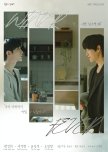
This review may contain spoilers
The series was too short to do anything with it
I actually appreciate being dropped into a relationship that already exists but that only works when the series gives you enough in the first few minutes to feel why these two people belong together. The current between them has to be strong enough to pull you in immediately. Here it wasn't, and that's the root of almost every problem that follows.The emotional logic of Yu Jun's position is genuinely interesting. Fifteen years of friendship turned love, a partner who is attentive and seemingly perfect, who anticipates every need without asking for anything in return — and slowly that devotion starts to feel less like love and more like pity. The fear of being someone's charity case rather than their equal is a painful and completely understandable place to arrive at after that long. I could follow that thread.
The problem is that the series barely had time to lay it out before it needed to move on. The breakup arrived before I was emotionally invested enough for it to land, which made it feel less like an inevitable tragedy and more like an overreaction to a situation the series hadn't fully built. Baek Hyeon Seo stepping into that gap didn't help — his presence read more as convenient plot mechanism than genuine threat, and I spent most of his screentime wondering what exactly he thought he was doing and why he had so much energy for someone else's relationship.
The resolution follows a pattern I find frustrating: misunderstanding arises, partner apologises without fully understanding what went wrong, they reunite, nothing has actually changed. The underlying dynamic that created the problem in the first place is still there.
¿Te ha parecido útil esta reseña?
More flirt than substance — but the flirt was pretty good
The setup has charm: a former idol starting over as a corporate intern, unexpectedly reunited with his childhood friend who is now his boss and apparently has had feelings for him this entire time. Choi Jun wasting absolutely no time making his interest known is the kind of confident energy that carries a series — and Ki Hyun Woo has the kind of screen presence that makes you forgive a lot.The heart-fluttering moments deliver. The flirting and innuendo-laced conversations between the two Juns are genuinely fun, and the kissing and intimacy in the final episode are among the better executed scenes in the series. When the show commits to what it actually is — a charming, slightly forward workplace romance — it works.
The problems are structural and persistent. The plot is paper thin, stretched across too many business meetings I had zero investment in and too many side characters who don't earn their screentime. The childhood connection, which should be the emotional core of the whole series, is never properly explained — why they lost touch, what it meant to each of them, why Choi Jun waited until now. A single text message could have resolved the episode five misunderstanding, which tells you everything about the communication logic at work here. The flashbacks are confusingly edited and add little.
Episodes one through three, seven, and eight. The rest is filler with occasional highlights. There's a better version of this series somewhere in the premise — it just didn't quite make it to the screen.
¿Te ha parecido útil esta reseña?
This is terrible
I cannot believe I wasted hours on this dreadful costume disaster. The plot is mind-numbingly repetitive, filled with absurd plot holes that even casual viewers can spot instantly. Writers treat history like disposable fanfiction, rewriting eras and customs randomly to cater to cheesy romantic tropes.Acting is embarrassingly stiff; leads show no chemistry, mumble half their lines and prioritize pretty camera angles over convincing acting. Action scenes are laughably amateurish, and background music blares nonstop to mask how dull each scene truly is.
The whole project prioritizes star hype and viral marketing over coherent storytelling and historical respect. If you crave a compelling ancient drama, skip this cash-grab farce entirely. It is hollow, uninspired and utterly forgettable.
¿Te ha parecido útil esta reseña?
I love everything about the FL ❣️❣️ you will never regret watching her dramas
This drama is all I've been waiting for this year. The first episodes are already giving you the bad ass and smart female lead. While her husband is planning how to execute the vallains she is already 10 steps ahead of them. Although the drama is slow burn romance but still you will see their chemistry.¿Te ha parecido útil esta reseña?

This review may contain spoilers
I Need Season 2
I am absolutely obsessed with this adaptation! As a massive fan of the webtoon and anime, I had super high expectations, and Japan completely delivered. Ōji Suzuka is perfect as Shimura- he nails that pathetic-but-determined underdog energy so well, and his chemistry with Kanegon is hilarious. It’s a quick 6 episodes, so some training arcs are compressed, but the pacing is fantastic and that finale cliffhanger left me desperate for Season 2! If you love a good zero-to-hero comedy, definitely check this out. I just posted my full, detailed thoughts and ending breakdown over: https://myasianbinge.com/viral-hit-review/ if you want to read a deeper review!¿Te ha parecido útil esta reseña?
This review may contain spoilers
No proper ending , unhealthy dynamics
The ost is nice tho theres only a few to repeat...The story starts of cute where the main lead cant underatand his feelings and misunderstand the love for wanting to control...
1 main thing i dont like is how both couples didnt officialise their feelings or relationship n just kinda went to it.
2. Theres a lot of unresolved drama like the 2nd male lead family issue. Youen seem to have some trauma that they didnt communicate. The sudden return of qiuyu master in the opponent team. There was no match after to show youen's massage n treatment help qiuyu win.. would have been nice to have a proper closure. In the end the brother still dont know their relationship... both relationships seems like a underground relationship..
3. The dynamic of qiuyu n youen is like a switch from 1 being "above" and instructing the other as a contract obligation and then switch to feeling bad and desperate trying to win him back and power switch over... there was no trust but alot of triggers and that caused more obstacles...
4. The whole show was either unnecessary fights or toxic relationships control...
5. The 2nd couple is healthyish with possessiveness but there was no officially asking out n then a whole ton of misunderstanding that the other dont want them..
Tbh i watched it cause of moments clips here and there but watching the whole show , i wont rewatch it...
¿Te ha parecido útil esta reseña?
El Amor Comienza en el Mundo de "Si"
A 0 usuarios les ha parecido útil esta reseña
A parallel world that pulls you in — but doesn't quite make you feel the weight of leaving it
The concept genuinely works for me. A man who wanders into a shrine under a full moon, makes a wish, and wakes up in a version of his life where things came easier — warmer colleagues, a closer dynamic with the person he's been measuring himself against. It reminded me a little of Fringe in the best way: not science fiction exactly, but that particular uncanny feeling of a world that looks like yours and isn't quite. I found that premise more compelling than I expected.The tension between the two leads translated for me too. I believed the pull between Akihito and Ookami, the admiration layered over something more complicated, the way proximity in the parallel world shifts what can't be said in the original one. Akihito's reluctance to return made complete sense to me — I think I would have struggled to leave too.
Where the series loses me a little is in the clarity of what exactly Akihito loves about Ookami specifically. I didn't get enough of that — the particular reason this person, this dynamic. What I would have wanted is exactly what you're describing: small but meaningful differences between the two worlds, things that exist in one and not the other, that quietly reveal what the real world actually cost him and what the parallel world quietly took away. That kind of detail would have made the eventual choice — to go back, to rebuild something real rather than inhabit something already finished — land with much more weight.
The idea was there. The execution just didn't go quite far enough with it.
¿Te ha parecido útil esta reseña?
El Caso del Espantapájaros
A 2 usuarios les ha parecido útil esta reseña
A realistic and heartbreaking- masterpiece
I finished this drama last night and I'm still thinking about it. Still feeling it. Still angry.I went in expecting nothing. I came out with my blood boiling and tears on my face.
A fast-paced, emotionally devastating drama inspired by true events that exposes police corruption in 1980s Korea. It will make you angry, heartbroken, and deeply uncomfortable – and that is precisely why it works.
The story: Captivating doesn't even cover it. I was on the edge of my seat from episode one. I told myself "just one more episode" about seven times. Ended up binge-watching the whole thing. No regrets.
The acting is amazing. Every single person brought their A-game. Tae Ju broke my heart over and over again.
The 80s cinematography was beautiful. They made me feel like I was there.
This drama is inspired by a true case. It is heartbreaking to realize that so many lives were destroyed simply because some police officers wanted promotions. Your blood will boil watching the so-called "good guys" – the people meant to protect citizens – reveal themselves as complete scumbags.
I loved Tae Ju and his strong sense of justice. It is heartbreaking to watch him fight this battle alone. I was crying toward the end because the emotional weight was immense. Seeing people suffer for 30 years – and continue to suffer because the law and justice are not on their side – is devastating.
Tae Ju and Si Yeong: Their relationship was complicated. Difficult. In some sense, it was good to watch them – two people constantly outsmarting each other. But at some point, you realize the truth: people do not change. No matter how much you hope. No matter how much you want them to. When you see how the police cover up the entire case and realize this actually happened, your blood boils again. And it makes you wonder: how many more people like them are still out there?
I love that the ending was realistic and not sugar-coated. It made the entire experience feel truly authentic. This drama will stay with me for a long time.
Verdict: Watch it. But prepare yourself. You'll cry. You'll get angry. You'll feel helpless. And you won't forget it.
¿Te ha parecido útil esta reseña?

Who doesn't like hot guys in expensive suits and uniforms?
My initial reason to watch “The Next Prince” was because I needed more Net after “Love Upon a Time”. As my newest Thai crush, I wanted to see him in other dramas and “The Next Prince” came to mind. I was also interested in the setting of the drama, and the expensive-looking production quality. Because my friends all warned me that this drama is not worth the time and is boring, I really had no expectation coming into this. I might even expect it to be really bad. You know, maybe that’s the reason why I ended up liking it ok.I was disappointed because Net has a very small supporting role in “The Next Prince”. Oh, he’s still cute and handsome as the quiet and a little nerdy Prince Calvin. But his story with Jay/JJ could have been so much better. The drama could have spent more time on them (and also the other pair) and give us a more satisfying and interesting side romance. Instead, they felt like an afterthought.
The other side romance between Prince Ramil and Paytai is another unique one. Their relationship really should have gotten a lot more screen time. The effect of domestic abuse could have been more than just slapping and beating up someone. It could have a deeper dive into the S&M dynamics due to domestic abuse, or personal sexual preference. This supposedly sad romance could have had more emotional depth aside from a scene here and there. What wasted potential!
What about the main romance? I quite like it, so no big complaints. I just wish there are fewer slow motion and everything moves faster. I was pleasantly surprised at NuNew’s acting. Aside from a few really sad emotional scenes, he did pretty good and looked the part. Zee is probably the main reason I continue to be invested. He is just so darn handsome in this uniform. He looks dashing! His acting could have been better, but it might also be due to his role requiring him to act ‘cool’ and ‘stern’. He has such big eyes but I barely see enough emotions from them. But I do like the pacing of the romance itself. I enjoy seeing Khanin flirt and chase after Charan, and Charan acting all flustered yet secretly loving all the attention. Because it’s Zee and NuNew, you know they are going to give you amazing kisses. I think they are a real couple but if they aren’t, they are really good actors who really love kissing! Those tongue actions cannot be missed!
What about the actual plot? It’s really nothing you have never seen before. We have court politics, fighting for power using dirty tactics and a hunger games-like competition to win the crown. It’s funny they need their kids to fight on behalf of the fathers.
This drama has a lot of product placement. In a way, I understand the need for them. This is an expensive drama. But it also takes me out of the drama when I see these products.
I guess my biggest complaint is the pacing of the drama. For most of the drama, I had to watch it at 1.25x speed, and even 1.5x a couple times. I am not a drama watcher that usually speeds up. If I need to do that, this drama will automatically not get a rating higher than 8.5. There are too many slow motion scenes, camera staying on a face for way too long, slow talking and slow moving. It’s no wonder some of these episodes are over an hour long.
But I can’t deny I binge this drama rather quickly. The hot guys and hot kisses and NC scenes keep me entertained. The plot is fine. The acting of the veteran cast is really good though. Props to all the dads in the drama. The younger cast are fine, some better than others with no one really stands out and is excellent. The OST is pretty good as well. NuNew has a beautiful voice and sang a few of the songs in the soundtrack. I would recommend this drama if you want to check out a BL with a unique setting, and enjoy seeing hot guys in suits and uniforms.
Drama Completed: 6/13/2026 Review #694
¿Te ha parecido útil esta reseña?

This review may contain spoilers
Aquele clichê que eu tanto amo kkkkk
Okay, a história pode ser aquele clichê dentro da premissa ML gangster/ chefe de gangue que fica obcecado pela FL, que tem um noivo canalha, e no fim se apaixonam? Com uma pitada de conspiração familiar? Sim, pode ser, mas eu AMO hahahahahahaha!Me surpreendi muito em ver o Ki Hyun Woo neste papel, o conheci no BL Jun & Jun, de 2023, apesar de ter assistido o BL Semantic Error (não me recordo dele aqui) e o revi em mais um BL, o Ball Boy Tactics, de 2025. Acho que sua atuação aqui foi muito boa, gostei de que o foco não tenha sido ele ser o chefe de tudo ou até mesmo a conspiração, mas sim o relacionamento dele com a FL, interpretada pela atriz Lee Ha Eum. Confesso que a atuação dela foi um pouco mais fraca, mas acho que até que se encaixou na personalidade da FL, que infelizmente sofria com as humilhações da madrasta e seu irmão, enquanto seu pai estava acamado e o seu noivo a traía a rodo... Mas os dois juntos eram até que fofos, e é a segunda colaboração deles.
A atuação da madrasta e do irmão eram um pouco mais exageradas, se tornando até cômica e de revirar os olhos, mas pelo menos apareceram pouco. Assim como o 2ML e a 2FL.
A cena da primeira vez deles foi bonita, mas a cena mais engraçada foi dela bêbada, mas não quando fala sobre o ex e sim no flashback do peixinho dourado hahah
O final teve aquela pitada clichê sobre a revelação sobre quando ele se apaixonou por ela, mas o drama foi bem gostoso de assistir e eu ri bastante, então tudo bem ser clichê, faz parte hahah a Coreia do Sul está aprendendo com os dramas verticais chineses...
¿Te ha parecido útil esta reseña?

This review may contain spoilers
ENCORE
to dando 8 no geral pq• protas bonitos
• química boa
• história legalzinha mesmo com as falhas + baixo orçamento
• direção fez eles parecerem um casal mesmo
• gostei de todo finalzin de ep ter uma mini visual novel de escolha sobre eles no passado
enfim achei a série gostosinha veria de novo até pq é curtinha também
únicas coisas assim q eu tenho a reclamar é
qual o sentido do wan ter surtado tanto a nivel de sumir da vida do tae sem nem esperar pela resposta dele?
juro era só ter esperado 1 segundo q tava resolvido o problema
e qual é das histórias coreanas sempre terem plot de um deles se deparar com a escolha de precisar sair do país a trabalho???????
fico a pensar
mas gostei q a decisão do wan não foi algo q limitou os horizontes dele e também foi uma daquelas séries q eu penso q gostaria de ver os atores trabalhando juntos de novo pq gostei da química (encore👏 encore👏 encore👏)
ultimamente to considerando isso um ponto positivo pq nao vejo mais sentido em reclamar sempre q as séries são curtas e poderiam ser maiores
em época de série vertical essas nem são tão curtas né + bl ainda na vdd é um nicho indie né ainda mais essas séries de uns anos atrás acho q fica até injusto pq provavelmente foi por limitação mesmo e não falta de vontade👎
é isso série boazinha pra mata o tempo atoa🙏
¿Te ha parecido útil esta reseña?


