


This review may contain spoilers
A beautiful work of cinematic art
Like many of us today, I have the attention span of a goldfish with ADHD. However, this drama had me gripped me from start to finish, without skipping or fast-forwarding. The cast and crew did a phenomenal job, especially for a drama with almost 40 episodes. I’m sure it took a lot of hard work because the result was a beautiful work of cinematic art.I have a list. A very short list of dramas that keep me thinking about them for a long time. Road to Splendor is now on this list.
THE DIALOGUE AND CHARACTER ARCS
There are two elements of the writing I think were executed really well. The first is the layered dialogues. I loved how warnings, advice, and instructions were often hidden so you had to read between the lines to get the real messages the characters trying to communicate to one another. The second element I loved were the character arcs. Three characters in particular stood out to me: Fan Ya Ke, Zhao Ling, and Madam Yu.
***SPOILERS AHEAD****
Let’s start with Zhao Ling. Shoutout to DYX for his portrayal of this character. Absolutely incredible. Zhao Ling is first introduced to us as a man whose circumstances pushed him to live outside the law to survive, yet he remained principled and morally-upright. As we follow Zhao Ling’s (relatively) quick journey from the bottom, we see him rise in rank, but fall in spirit. By the time he’s the emperor’s official right-hand man, Zhao Ling is a shell of his former self. As time went on, he realized that the things he was losing or was at risk of losing, were actually the important things. And that the things he’d gained weren’t what truly mattered.
The second character arc is Fan Ya Ke’s. This character made my blood boil like lava. The actor portraying her was fantastic. Fan Ya Ke’s desperation for external validation made me think about how this is it is in real life. When we want a certain car, or want to travel to a certain place, do we really want those things or do we just like the feeling of knowing other people know we have them, or have had done them? Anyway, in the context of this drama, the lesson we learn about reputation is a nuanced one. On one hand, especially in historical times, gossip can literally ruin lives, like we saw in Ting Yun’s case. On the other hand, shackling oneself for the sake of reputation, is not worth one’s happiness or freedom, as we see at Yan Ke’s.
Last, but most definitely not the least, Madam Yu’s arc. Shoutout the amazing actor that portrayed her. She captured the cold, calculating, and cruel nature of this character perfectly. Madam Yu is a monster in fine robes and she knows it. She wants to keep her influence and wealth, and she will not let anyone or anything stand in her way. At the end of the drama, not only had she lost all the power she schemed and killed to keep, she had also lost her sanity. It was easier for her to lose her mind, than to accept the fact that she was now a commoner, a fallen noble, with the road back to splendor closed to her and her family for generations to come.
HEARTBREAKING SCENES THAT MADE ME CRY
It takes a lot to bring me to tears but these two scenes had me weeping on my couch.
The first scene was when Yan Yu Cheng died. All his life he’d wanted to crawl out of the mud. He’d worked hard. He’d done his best. Yet, it wasn’t enough. The moment he gave up, you could see it in his eyes. He was done. I burst into ugly tears when he said, “The road ahead, I can no longer walk it with you. I am too tired.”
The second time I cried was when Zuo Shi died. You know an actor is good when she makes you cry for the villainess. When she put her neck in the noose, my eyes started to water. Then, I broke completely when she said, “I spent my whole life merely existing. Now it is time to truly live.”
SATISFYING SCENES I WISH WE GOT
These are the three scenes I wish we saw at some point in the story:
1. Fu Ting Yu properly confronting her paternal grandmother.
2. The four written confessions actually being revealed in court or publicly.
3. Fan Ya Ke getting a taste of her own medicine publicly.
THE ENDING
I read some earlier comments by people who felt the ending was unsatisfying. I personally think it was ideal for the moral of the story. The journey of the MCs wasn’t supposed to be a clean straight line with them starting at the bottom at the start of the drama and then ending their story when they’ve reached the top.
Instead, their journey was supposed to be a circle. Where the characters ended up in the same position (externally) they’d began. In the end, it seemed like nothing had changed but internally, they were completed different people from whom they were at the start of the story. They'd traveled the road to splendor and realized it wasn’t what truly mattered. Instead, they’d gained wisdom, experience, inner peace and true happiness.
Was this review helpful to you?

 2
2 1
1 1
1The First Ever Zombie Apocalypse BL Has Arrived, and It Was Worth the Wait
I have watched over 500 BLs across more than 10 years, and there has always been one genre I desperately wanted to see combined with BL: a zombie apocalypse. So when the trailer for The Last Oath randomly appeared on my Facebook, I immediately knew I had to watch it. There was absolutely no way I was missing the first ever zombie apocalypse BL.After eight episodes, I AM OBSESSED.
The atmosphere of The Last Oath is exactly what I want from a zombie apocalypse series. I love that abandoned feeling of a world where humanity has collapsed and nature has slowly started taking over again. Trees and greenery surround abandoned buildings, technology is almost completely absent, and the characters have to depend on basic survival skills to stay alive. The forest locations are absolutely stunning, but there is also something eerie and unsettling about how beautiful the world looks while danger could be hiding anywhere and zombies could appear at any moment.
This is exactly what I want from an apocalypse story because the characters actually have to SURVIVE. They search for canned food and supplies, use maps instead of phones, carry flashlights, live together for protection and leave their shelter to hunt for resources. They fight zombies using axes, knives, bows and arrows rather than conveniently having unlimited guns and ammunition. These little details make the world feel much more believable and immersive.
And the zombies are actually SCARY.
They are fast, aggressive and brutal. Once someone gets bitten, the infection takes over incredibly quickly, so there is constantly a sense of danger. The violence is not watered down either. We are getting blood, gore, brutal deaths and proper zombie action. That death in the opening episodes was absolutely brutal and immediately showed me that this series is not afraid to kill characters.
The story follows college student Lin Zai, who discovers that he appears to have a mysterious immunity to the infection. He becomes caught up with Special Agent A Leh, who was originally sent after him, but circumstances force them to depend on each other for survival. It is such a perfect setup for enemies to lovers because they might not completely trust each other, but in this world they NEED each other.
A Leh also had one of the coolest character introductions. He is fast, dangerous, brutal and an incredible fighter. Watching him take on zombies with his dual knives and slash his way through them was epic. He immediately has that mysterious badass energy that makes you want to know more about him.
Both Chen Liang as Lin Zai and Chen Ming Han as A Leh are absolutely gorgeous, but thankfully their chemistry is just as strong as their visuals. That scene where Lin Zai slowly cleaned the dirt and blood from A Leh's face and revealed his handsome face underneath honestly felt like love at first sight. Then Lin Zai ripping open A Leh's shirt to treat his wound gave us even more tension. Somehow, in the middle of a zombie apocalypse, we have already managed to get our first CPR kiss too. I am definitely not complaining.
Their dynamic is already one of my favourite parts of the series. One is dangerous and mysterious while the other possesses an immunity that could potentially change everything. Now they are stuck together in a world full of zombies where trusting the wrong person could get them killed. Give me enemies to lovers, forced proximity, survival and romantic tension and I am SOLD.
Most importantly, THIS IS ACTUALLY BL!
That was probably my biggest concern going into the series. I did not want to wait more than 10 years for a zombie apocalypse BL only to get another bromance disguised as one. Thankfully, we are getting genuine romantic chemistry, attraction and actual kissing scenes. The romance is clearly part of the story rather than something viewers have to imagine for themselves.
The series also has 24 episodes at around 22 to 23 minutes each, which I am really happy about. The episodes might sound short individually, but with 24 episodes, that is roughly equivalent to a standard 12 episode series with longer episodes. For me, this absolutely feels like a proper full length BL rather than a short series.
The pacing has also been excellent so far. There is barely any wasted time. Within the first two episodes we already have zombie attacks, survival, brutal deaths, action, mystery, character development and romantic tension. With four episodes releasing each week and 24 episodes in total, we actually have a proper story to look forward to.
The Last Oath brings together everything I wanted from a zombie apocalypse BL. Zombies, survival, brutal action, gorgeous leads, realistic zombie makeup, beautiful post apocalyptic scenery, enemies to lovers and actual romance all in one series. It has the danger and intensity of a proper survival story while still giving us the chemistry and BL elements we came here for. What more could I ask for?
The first eight episodes have already delivered almost everything I wanted. The story is thrilling and intense, the production looks great, the scenery is beautiful, the action is exciting, the music works well, the leads can act and their chemistry is already there. Most importantly, the zombie scenes actually make my heart race because I care about whether these characters survive.
My only very minor criticism so far is that I noticed a little CGI and what appears to be AI in a few scenes. However, these moments are very brief, blend smoothly into the story and never distracted me from the overall experience. The strong acting, intense fight scenes, exciting plot, beautiful locations and everything else the series does well easily outweigh those few seconds for me. Personally, I would much rather have a few moments of CGI or AI if it helps bring an ambitious zombie apocalypse BL like this to life than not have a series like this at all.
Of course, we are only eight episodes in, so there is still a long way to go. But if the quality, pacing, action and chemistry continue at this level, I can genuinely see The Last Oath becoming one of my favourite BL series of the year.
10/10 so far.
If you love Zombie Apocalypse, BL, Action, Survival, Enemies to Lovers, Romance, Gore and Post Apocalyptic stories, this is an absolute MUST WATCH.
Was this review helpful to you?

This review may contain spoilers
Nice start, terrible ending
Worth watching until episode 8, but it only goes downhill from there.Lower your expectations drastically if you plan to watch this series, it is bizarrely overrated.
You have been warned.
(SPOILERS!)
Why why why must there always be an assassin in a ROMANCE DRAMA??? Please k-drama writers, stop relying on this overused plot device to justify dragging on the show for too many episodes! This storyline isn’t even the main story of the show! The main premise was “fan with disabilities travels back in time to save her utt from depression, then discovers he was her neighbour all along and must deal with heartbreak while doing her best to save him from his bleak destiny”. This had so much potential! So many important, deep themes that could have contributed to these characters’ development and depth, but they’re all discarded to put a generic serial killer as the main excuse for all their problems! Aaaah that made me so angry!!
Seon Jae had 2 personality traits: he liked to swim and he liked Im Sol, and around episode 4 he gives up swimming. So we are left with this one-dimensional personality of his, where his sole purpose in life is to be with Sol. Not even the music bit had a significant impact on the story! I wanted to see him fall in love with music so bad after having his dreams of being a professional swimmer shattered, but it seems music is just like any other job to him. He might as well have chosen to be a janitor in Im Sol’s office building. The only purpose of him still being in music is so we can have the plot device of him being famous, but that’s it.
The show should have ended around episode 8 when they get together again in the future after she successfully avoided her accident in the past. It was completely wholesome the way they spent the entire night together just talking, enjoying funny moments and finally opening up about their true feelings for each other! It was almost like Before Sunset, but actually enjoyable. And what’s more, she didn’t have to return to the past that last time—he wasn’t dead, he was hospitalized! There was a real chance that he would wake up, and she didn’t even wait to see if it was possible! If he had woken up in that timeline, all would end up just fine seeing as the assassin was already imprisoned again. They could be together without any fear, but the writers just had to keep stalling us through another 8ish more episodes.
Between episodes 9 and 13 I was just bored, but after episode 14 is when we really start to have key lore and writing mistakes. If she went back all the way to before he first met her and stopped him from ever getting to know her at that time, in the future she SHOULD still be a wheelchair-user OR dead, because Seon Jae would have never been there to save her from her first abduction! The writers just gave up at this point, there is no more logic. No more attempts at making this story the least bit sensical. And, AND, how is she still friends with Tae Seong?? Did she make the effort to befriend him in the new timeline? Wasn’t she only able to stay in the past for one or two months? At that point teenager Sol would’ve come back and found out she was friends with Tae Seong and tried to date him again, and he would have been bored with her AGAIN, then they would end up NOT being friends after all, so IT DOESN’T MAKE SENSE! The third time she went back in time we see a scene where in the future Seon Jae disappears from an Eclipse promotion billboard, but in the future after Sol went back again and never met him, he is still famous, but he doesn’t seem to be a part of Eclipse, why is that? He should be a part of the band if Sol was never there to stop him from going to auditions with them! MAKE IT MAKE SENSE!!!
And oh my god, the protagonists have nothing to do with THE MAIN VILLAIN’S defeat?!?! What even is this show?? How the hell have I watched 16 mf episodes of Sol trying to save Seon Jae from this guy only for him to be killed by A RANDOM WHITE TRUCK??
Obs: I don’t think I have seen a FL cry as much as Sol. For real, she’s crying every 10 mins in each episode.
Conclusion: Can we just be honest? The only reason this k-drama is so highly overrated is Byeon Woo-seok, and that’s fine, I too will be watching every show he does. Hell, I came here after watching Perfect Crown just to see him a little more, he really is very charming! But let’s not act like this series is a work of art, please. Off the top of my head I can think of at least 5 other k-dramas that deserved the ratings Lovely Runner got with way better plot and character development.
The soundtrack is great though.
Was this review helpful to you?

Cinematic chaos
This drama is so cinematic—it feels more like watching a movie than a drama. It’s messy, chaotic, dark, and completely unhinged, but somehow that’s what made it such a fun watch. The story keeps spiraling in the most unexpected ways, and the title really says it all—the affair was literally just the beginning. 😂Not a perfect drama, but definitely an entertaining one. And Kim Hye-soo, Cho Yeo-jeong, and Kim Ji-hoon? What a cast. They really carried this messy story in such a fun way
Was this review helpful to you?

A Light & Casual Watch
I’ve been catching up on Ding Yuxi’s older series lately, so I decided to check this one out. The female lead is Esther. I’ve already seen them together in Love Game in Eastern Fantasy, and I personally didn’t like that story much, so I didn’t have high expectations going in. But this one was actually pretty good.The plot feels quite fresh. The theme of working in the publishing industry, with writers and editors, is interesting and inspiring. The early episodes move along in a fun and engaging way. The female lead’s character is hardworking, determined, and capable at her job—she’s not just a cute character. She has clear development. The male lead is a bit spoiled/self-centered but takes good care of the person he loves, and there are plenty of funny scenes. From the middle to the later parts, the pacing gets rather slow, with a lot of filler and unnecessary dragging. The secondary couple’s relationship develops slowly, and some of their scenes feel unnecessary. The chemistry between Esther and Ding Yuxi is good, and the secondary couple is okay too. Another plus is that I believe they used the actors’ real voices without dubbing.
Overall, strong start, but the middle to end feels stretched and a bit boring. If you’re looking for a cute series without heavy drama or much toxicity—just a light, fluffy, easy-to-watch show that you can casually follow without any major peaks—then this one is worth checking out.
Was this review helpful to you?
The Edge of Horizon — Thai Drama at Its Finest
Sometimes calling something a BL almost feels too restrictive. The Edge of Horizon is absolutely a BL. Its central love story is between two men, and that relationship is never hidden behind bromance or ambiguity. But after finishing it, I didn't think, “That was an excellent BL.” I thought, “That was an excellent Thai drama.” For me, this was a perfect 10/10.The story begins in Siam in 1932, with Phob, the son of a palace nursemaid, growing up beside Prince Thinnakon. They love each other before they are old enough to fully understand why the world considers that love impossible. One is born into service; the other is born into royalty. Years later, they meet again as adults at the same moment their country itself is moving toward enormous political and social change. That setting is not simply decoration. The series takes place around the 1932 Siamese Revolution, when Thailand was moving away from absolute monarchy toward constitutional government. The changing country therefore reflects the changing relationship perfectly. Phob and Thinnakon are asking whether the social order that decided their places at birth should also have the right to decide whom they are allowed to love. What impressed me immediately was the respect given to that world. Period dramas are easy to make beautiful and much harder to make believable. Putting actors in old clothes and finding an antique house is not enough. Here, status exists in almost everything: the way characters speak, stand, enter rooms, address one another, dress and even look at somebody above or below them socially. The palace does not merely look old. It feels governed by rules.
The actors actually trained for those differences. Inn Jakkrasin explained that the younger Phob required workshops focused on the submissive physical behaviour expected of a servant, while the adult military Phob required completely different preparation. He consulted military contacts about details such as saluting and the positioning of his feet. Ongsa similarly changed his normal fast speech into something slower and more deliberate for Thinnakon, including a different vocal tone appropriate to his character's upbringing. Those details matter because class is the real third person in their relationship. Phob and Thinnakon never seem to believe they are unequal as human beings. The world keeps reminding them that they are. That is considerably more interesting than simply giving us an evil father who says, “You cannot date another man.”
Vasin's opposition is tied to sexuality, certainly, but also bloodline, title, duty, reputation and hierarchy. Thinnakon is not simply his son. He represents a royal family and everything that family believes must survive through him. From Vasin's perspective, his son's life is not entirely private property. And Chai Chatayodom is terrifying in the role. He doesn't need to become some ridiculous screaming villain because his authority already fills the room. This is a veteran actor with decades of experience and multiple acting awards, including major Best Actor and supporting-actor honours, and you can see exactly why. Vasin can frighten me with restraint. His anger feels dangerous because it comes from someone absolutely convinced that his position gives him the right to control everybody beneath him. The best villains rarely think they are villains. Vasin believes he is protecting his family, his status and the order that gave meaning to his own life. That does not excuse what he does, but it makes him much more interesting than a one-dimensional homophobic father. Chai gives him enough humanity that I could understand where the character's fear came from while still wanting somebody to push him into the nearest pond.
Then there is Pond Ponlawit. Yes, my dreamy "I wish he was my boyfriend" gorgeous boy was there, so obviously I was going to notice him. But Prince Chattrathorn is genuinely one of the most interesting supporting characters because Pond refuses to play him as simply unpleasant. Even Inn and Ongsa said they were surprised by what Pond created with the role. Inn specifically praised how much reasoning and detail Pond put behind Chattrathorn's arrogance, while Ongsa said the performance made a morally grey character feel much more dimensional than he expected. That is exactly what I saw. Chattrathorn can be arrogant, cruel and infuriating, but Pond makes you feel that there is an entire internal logic underneath every ugly decision. He doesn't simply walk into a scene carrying “antagonist energy.” He walks in believing he has reasons. And Pond has become very good at that. The real revelation for me, however, was Inn Jakkrasin and Ongsa Tthuchh.
Phob needed strength without becoming the stereotypical masculine protector who solves everything for the softer royal character. He has anger, pride and political convictions, but he also understands that loving Thinnakon means loving somebody whose entire identity was built inside the system Phob increasingly questions. Inn makes that contradiction believable. Phob wants change, but he loves somebody connected to what is changing. He can resent privilege without resenting Thinnakon. He can fight against hierarchy without pretending that history disappears because two men kiss. That is a much harder character to play than a simple revolutionary hero. Ongsa's Thinnakon is almost the opposite, and I loved him. He is gentle, adorable and sometimes painfully easy to want to protect, but the writing never confuses gentleness with stupidity. Thinnakon has been raised inside enormous privilege while simultaneously having very little freedom over his own life. He can command other people and yet cannot simply command the right to love Phob. Ongsa's eyes do so much of the work. Sometimes Thinnakon looks at Phob with the happiness of the child who grew up beside him. Sometimes he looks at him as the adult who already knows exactly how much their relationship could cost. The transition happens without needing constant dialogue. And together, Inn and Ongsa have chemistry. Not manufactured “BL couple chemistry.” Not two actors repeatedly placed close enough together until fandom decides they look cute. They feel attached. There is history in the way they look at each other. Their intimacy makes sense because the relationship began before sexuality even entered the equation. They know each other as children, friends, first loves, people separated by adults, and eventually men who have independently grown into very different positions. So when physical intimacy finally enters the relationship, it feels like an extension of everything already there.
The production treated those scenes with the same care as the rest of the drama. Inn and Ongsa have spoken about establishing trust and boundaries beforehand, while director Kathadeb built the scenes through carefully planned individual shots. The result is sensual without suddenly making the drama feel as though somebody changed channels and put on a different series. That visual control exists everywhere. The cinematography understands how gorgeous period drama can be without turning every frame into an advertisement for expensive costumes. Interiors feel inhabited. Natural light, darker rooms, formal spaces and open landscapes all have different emotional functions. The characters can look tiny inside architecture that represents generations of social hierarchy, then much freer when the world around them physically opens. And the costumes deserve their own praise. Viriya Pongkajorn's work doesn't simply make everybody attractive. Clothing immediately helps separate royalty, servants, military personnel and people occupying different social positions. As characters age and their places in society change, their appearance changes with them. The clothes become part of the storytelling rather than an expensive wardrobe department showing us what it bought. That is what I mean by respect. Respect for Thai clothing. Respect for forms of address. Respect for class differences. Respect for military behaviour. Respect for the political period. Respect for architecture and domestic hierarchy. The production does not treat 1932 Thailand as an exotic background created for international BL viewers. It treats it as Thailand. That distinction may be why The Edge of Horizon feels much closer to a traditional high-quality Thai lakorn than to the familiar BL production model. And one31 knows how to do this. This is the same broadcaster behind To Sir, With Love and, more recently, the large-scale period BL Love in the Moonlight. GagaOOLala even promoted The Edge of Horizon as another grand One31 period production following Love in the Moonlight. This is therefore not a tiny BL company suddenly experimenting with historical costumes. One31 is bringing the production traditions of mainstream Thai television into queer romance.
That may be one of the most important developments in Thai BL. For years, BL often operated like its own smaller industry: younger actors, smaller budgets, university settings, limited casts and productions primarily targeting BL audiences. There is nothing inherently wrong with that model, but The Edge of Horizon shows what happens when a male-male romance receives the same treatment as a major historical television drama. You get Chai Chatayodom. You get Kathaleeya McIntosh and Duangjai Hathaikarn. You get experienced supporting performers standing beside younger BL actors rather than a cast composed almost entirely of newcomers. You get proper historical drama. And suddenly the BL is no longer expected to carry everything alone. The family stories matter. Political divisions matter. Generational conflict matters. The women matter. The older characters matter. Social class matters. Even characters who oppose Phob and Thinnakon have lives beyond simply creating obstacles for the main couple. That ensemble is one of the reasons the eleven episodes feel justified. I never felt that I was waiting through “non-BL scenes” for the romance to come back. Those scenes are the drama. The relationship exists within a family and a country, so understanding those people is part of understanding why loving each other is so difficult.
Even the political conflict avoids becoming a simplistic lesson where monarchy equals evil and revolution automatically equals good. Phob wants social change for understandable reasons, but political movements are still made of human beings, and human beings bring ambition, self-interest and contradictions with them. Thinnakon's privilege does not make him cruel, while Phob's ideals do not make every decision around him automatically correct. History is rarely that clean. The music understands the same idea of hope. Ongsa's “Saeng Raek” (“First Light”) was created around the image behind the title Arun Rung—dawn, the point where light finally appears after darkness. Songwriter-producer Achariya Dulyapaiboon described the imagery through the apparently impossible meeting of sun and earth, mirroring two people whose worlds tell them they should never meet. That symbolism could have been painfully obvious. Instead, it works because the whole drama is about change that initially seems impossible. A servant can become an officer. A prince can question what his title demands of him. A country can transform its political structure. A family can discover that tradition is not automatically the same thing as morality. And two men born on opposite sides of a hierarchy can decide that the line separating them does not deserve more respect than their love. The ending therefore felt earned rather than simply satisfying. I didn't need another tragedy proving that gay historical romances must end in punishment. Nor did I need a ridiculous modern fantasy where everyone suddenly adopts 2026 values in 1932. The drama finds something much better: hope.
Change comes slowly. People resist it. Some traditions survive, others evolve, and the characters themselves have to learn which parts of the world they inherited deserve preservation and which deserve to be challenged. That is what a historical drama should do. It should not simply reproduce the past beautifully. It should make us understand why people lived as they did while still allowing us to question what that world demanded from them.
Final Thought
I went into The Edge of Horizon knowing Pond was there, so that was already one excellent reason for me to watch it. I finished it thinking about everybody. Inn's strength. Ongsa's gentleness. Pond turning an arrogant royal into a genuinely layered man. Chai Chatayodom being absolutely terrifying. The mothers, grandmother, women and servants around them. The costumes. The military detail. The language. The palace. The music. The politics. The intimacy. The history. That is why giving it 10/10 feels easy for me.
The Edge of Horizon never seems embarrassed to be a BL, but it also never behaves as though being a BL means it should accept lower ambitions. The romance receives the same visual care, dramatic weight and experienced supporting cast that a major heterosexual period lakorn would expect. And that is exactly how it should be. I don't want queer historical dramas to feel like modern BL actors playing dress-up in borrowed costumes. I want them to feel rooted in the country, culture and period they are portraying. I want traditions to matter because challenging a tradition means nothing if the audience never understands what that tradition represented. I want older actors capable of terrifying me, mothers whose choices hurt, political change with consequences, beautiful language, carefully designed clothing and romance that belongs organically inside all of it. The Edge of Horizon gave me that. Audience reception also suggests I was hardly alone. Shortly after the finale, IMDb had it at roughly 8.5/10 from around 180 ratings, with individual episodes repeatedly scoring around 9 or higher. That is still a modest international sample, but the consistency is notable, and contemporary reviews repeatedly praised the acting, cinematography, historical setting and the way romance was integrated with class and political change. For me, however, numbers are secondary. I have watched enough BL to know when I am forgiving something because I love the actors, when I am enjoying something despite its flaws, and when a production simply gives me almost nothing I want to change. This was the latter.
The Edge of Horizon is not just one of my favourite Thai BLs of 2026. It is Thai drama at its finest.
Was this review helpful to you?
This was great!
I watched this in one go, i couldn't turn it off. The story and actors just made me keep watching. Though i really dislike the vertical format i could overlook that this time because it was so good.Though i have seen many stories like this one i still liked it. The visuals were great and the background music was good.
All the actors did a good job.
The acting of the mains was so good and their chemistry and kisses were amazing!
I really hope to see a normal format series with both of them in the future.
Was this review helpful to you?
AI Flashbacks are ruining an otherwise good series.
Reasons why AI flashbacks are distracting1. They ruin the suspension of disbelief.
2. They ruin the vibe.
3. They look so childish.
4. They look cartoonish and comical, yet they are very violent scenes.
4. They break the immersion in the show.
5. They are jarring, causing my brain to do a reality check, which ruins the show,
6. Shows that use AI should have disclaimers, so viewers can decide to watch and be prepared if they choose to watch.
7. Using AI assumes that viewers like or don't mind animation, but that is a mistake; some viewers like me don't like animation and don't watch animated shows,
I like shows with real humans, which is what I am expecting to see, which is why I chose to watch this show, so seeing animated characters is very disappointing and not what I signed up for.
Was this review helpful to you?

This review may contain spoilers
Started Fun, But I Lost Interest
I ended up dropping The Starry Love at episode 17.I actually enjoyed the first arc and thought the drama had a pretty good start, but once his spirit split into three, I started getting really bored. It felt like that arc was going to take forever to finish, and I just didn’t have the motivation to keep watching.
The chemistry between the leads is definitely there, but the drama leans heavily into parody and comedy, which isn’t really my thing. I know it probably gets more serious later on, but I didn’t want to force myself through so many episodes just waiting for that shift to happen.
Overall, it had some things I liked, especially in the beginning, but by episode 17 I had completely lost interest, so it was time to drop it.
Was this review helpful to you?

This review may contain spoilers
Just finished Blossom of Power and honestly… what a drama! 😭❤️ I went in without expecting too much, but this drama had me completely hooked. The storyline, the emotions, the chemistry, the twists… everything just kept pulling me in.I love how the story kept me curious about what would happen next. Some scenes had me smiling, some had me stressed, and some had me literally shouting at my screen 😂😭. The characters were also so interesting that it was hard to stop watching.
Definitely one of those dramas that makes you say “just one more episode” until you realize you’ve finished the whole thing. 😂❤️
Blossom of Power, you did your thing! 100/10 for me. 👏🔥
Was this review helpful to you?

This review may contain spoilers
watched 3/4th but dropped it cause I couldn't connect with the fl and their university life
I liked Zhai Xiaowen and Zhou Keyu but not the fl. I just couldn't connect with her. She was also portrayed as really stupid that she doesn't understand basic things between people her age even when she was 16. The high school part with the family dynamics and other friends were wholesome but the university life just kept on dragging and became boring. fl and ml were really close when in high school but suddenly in uni they're extremely shy to touch each other and blah blah. I understand why jing xichi did not want to confess as soon as he realized he liked her because he was afraid their friendship will be destroyed because of how fl treated song cong after he confessed. She just easily chose to forgo 3 years close friendship when it was not even just friends, they were close neighbours and family friends. Of course rejection was needed since there's no reason to give the other person hope but idk she was kinda just being ignorant and a little mean. Like I said, if this was a random guy or just a classmate makes sense why you would avoid him but that kinda reaction after a long friendship even making him feel like he owed her a sorry for saying that was just giving red flags. I still tried to continue and reached ep 22 but I can't go any further so I'm dropping it.Was this review helpful to you?
## A Game Within a Game—And I Loved Every Move!
OVERALL IMPRESSION🌟Wow, this was psychological revenge done brilliantly! A dark, gripping thriller that stood well above the usual C-short. The twists kept twisting, and the suspense constantly had me wondering who was really in control. What impressed me most was that beneath all the plotting were complex characters whose grief, guilt, and longing gave the story genuine emotional depth.
WHAT I LIKED💖
• The FL was intelligent, calculating, and incredibly capable. I loved how she used her understanding of people to turn apparent vulnerability into a weapon.
• This was a fascinating game of cat and mouse, where tenderness could be just as dangerous as an open threat!
• Her strength didn’t erase her trauma. The contrast between her ability to help others and her struggle to show herself compassion was heartbreaking.
• I loved the understanding between the FL and the assistant. Their connection had emotional substance alongside that intense chemistry.
• His intelligence, steadfast support, and protectiveness were wonderful—and he certainly wasn’t difficult to look at!
• The villain’s arrogance made the psychological battle particularly compelling. Imagine being so impressed with yourself that you stop listening to anyone else!
WHAT I DISLIKED⚠️
• The antagonists’ cruelty, entitlement, and disregard for human life were genuinely disturbing.
• Watching the FL turn her pain against herself was particularly difficult. This is emotionally heavy material, not a lighthearted revenge romp.
PRODUCTION AND PERFORMANCES🎭
• Gou Yuxi was superb. Her expressions could shift from tender to chilling in an instant, making the FL fascinating to watch.
• Huang Bo went far beyond the usual scumbag role with a frighteningly dark, unhinged performance.
• Hu Wenle also delivered an outstanding performance, bringing warmth and conviction to the assistant.
• The writing, direction, filming, and handling of suspense made me forget I was watching a vertical drama. This deserves more praise than the average short!
FINAL THOUGHTS💭
I loved that the emotional relationships mattered just as much as the revenge. The conclusion felt satisfying and consistent with the weight of the story. Highly recommended for psychological revenge-thriller fans. Keep your eyes on the apparently innocent ones—this drama knows how to make you question everything!
Was this review helpful to you?

Love Hurts — When the Chemistry Is Bigger Than the Format
I rarely write reviews for Korean BLs with ten-minute episodes. There are simply too many of them now, and unless something really distinguishes itself, eight episodes of six to ten minutes can feel less like a drama than a collection of scenes surrounding one romantic idea. Love Hurts surprised me. The story itself certainly did not. Kim Dojin and Lee Jaewon were classmates who became close, developed feelings, separated without properly resolving what happened between them, and eventually have to confront a first love that neither has completely left behind. We have seen variations of first love, missed timing, ghosting, misunderstandings and reunion countless times across BL, films and heterosexual romance.The Korean title, 첫사랑니, is actually more interesting than the English one because it plays with first love and wisdom tooth: something buried underneath, painful when it begins to emerge and difficult to ignore once it starts hurting. That metaphor fits the story rather well. But even then, nothing about the premise made me think I was about to discover something revolutionary. (dramabl.com) What made me keep watching was the actors. And more specifically, their chemistry. There are BL couples where the script continuously tells us that two characters want each other while I sit there waiting for the actors to convince me. Love Hurts had almost the opposite problem. The screenplay had barely enough time to develop anything, yet every time Kim Changyu and Kang Seon-ho were together, my brain was basically shouting: get a room. The sexual tension is ridiculous. It isn't created through explicit scenes either. It is in proximity, eye contact, hesitation and the slightly uncomfortable awareness of another person's body. They often look like two people who remember exactly what being close to each other felt like and are trying to behave as if they don't. That is much harder to manufacture than a technically competent kiss. At some point I genuinely wondered whether they were a couple outside the drama, not because I have any interest in deciding actors' private relationships for them, but because their physical ease together was that convincing. Chemistry is not evidence of a real relationship; excellent acting can create exactly the same impression. In fact, making the audience briefly wonder where acting ends is probably one of the greatest compliments I can give two romantic actors. And that is especially noticeable because Love Hurts gives them almost nothing to hide behind.
There is no expensive fantasy world, no elaborate crime plot, no enormous supporting cast and no spectacular cinematography distracting us from whether the couple works. Eight episodes run roughly six to eleven minutes each, so the entire series is only around the length of a feature film. It was released through Lovememory's YouTube channel, with episodes initially available early to channel members before public release. (dramabl.com) When a production is this small, chemistry becomes incredibly important. Thankfully, Kim Changyu has plenty of it. I have had a crush on him since His Man in 2022, so I admit I wasn't approaching this with complete neutrality. He was adorable there, and four years later I still find him ridiculously cute. For anyone discovering him through Love Hurts, his Instagram is @gyu_11.12. But liking him personally isn't why I think he works here. His Man also makes Changyu interesting within Korean BL because he did not become visible by playing a fictional gay character. He first became widely known through Korea's first major gay male dating reality show, where eight men openly participated in a program about finding another man. He has since moved further into scripted queer productions, including Fan Service earlier in 2026. That transition matters. Changyu does not perform Dojin as a collection of mannerisms designed to signal "gay character." There is nothing exaggerated about the performance. He could easily fit into a heterosexual romance, thriller, workplace drama or comedy without needing to change some supposedly essential part of himself. And to be clear, that is not because masculine gay actors are somehow more versatile than effeminate gay actors. Effeminate men can play an enormous range of characters too. The point is that sexuality is not an acting type. A gay actor is an actor. That sounds absurdly obvious, yet Korean entertainment still has very few openly gay performers working visibly in mainstream scripted roles. Hong Seok-cheon famously lost television work after publicly coming out in 2000 and spent years rebuilding his career. More recently, Squid Game creator Hwang Dong-hyuk explained that when he considered authentic casting for a transgender character, the industry had so few openly trans or gay actors available that finding one was extremely difficult. That makes people such as Changyu important even when the BL itself is tiny.
There is also an interesting double standard around queer roles. Straight actors can play gay characters, gain a BL fandom and then return to heterosexual romances, thrillers or mainstream television without anybody deciding that their fictional sexuality defines their career. For an openly gay actor, however, there is always a risk that audiences and casting directors start thinking, "gay actor = BL." That would be an enormous waste. I don't want Kim Changyu to receive more BL roles simply because he is gay. I want him to receive more acting roles because he can act. If the character happens to be gay, wonderful. If his next character falls in love with a woman, murders somebody in a thriller, investigates crimes, becomes somebody's annoying brother or spends sixteen episodes doing absolutely nothing romantic, that should be equally normal. Representation becomes much more meaningful when LGBTQ actors are allowed to exist across an industry rather than being confined to stories about their sexuality.
Kang Seon-ho also deserves credit because this chemistry obviously requires two people. He already had experience in several short queer productions before Love Hurts, including projects such as Kiss Kiss Sxx, Love Reset, Connect and Sweet Blood. His professional profile also lists extensive short-film work and formal acting studies, which helps explain why the incredibly compressed format doesn't seem to overwhelm him. (starlet-studio.co.kr) Jaewon could easily have become frustrating because so much of the relationship depends on what he does not explain. In a longer drama, silence can slowly reveal itself. In a ten-minute episode, withholding information can simply make a character look irritating. Seon-ho manages to communicate enough underneath that distance that Jaewon doesn't become completely inaccessible. Together, they do something that many much more expensive BLs fail to accomplish: they make me anticipate physical contact before it happens. That is why I eventually started wanting something I normally don't even ask for. A sex scene. Not because Love Hurts needed explicit content to qualify as BL, and certainly not because every romantic story should end in bed. I frequently complain when productions use sex as a substitute for emotional development. Here it was almost the opposite. The tension had accumulated so consistently that by the finale I wanted some kind of physical release simply for narrative satisfaction. It could have remained tasteful and mostly implied. I just wanted the drama to finally say, "Yes, these two have spent eight episodes looking at each other like that, and now they are finally going to do something about it." At that point the imaginary voice in my head could finally say: AT LAST. That reaction tells me much more about their chemistry than any explicit scene actually could. What frustrates me is how clearly Love Hurts demonstrates the limitations of its format. This could have been a proper Korean BL. Not necessarily sixteen one-hour episodes—that would be ridiculous for this story—but perhaps eight episodes of thirty minutes, with a few additional characters and enough time to develop the original relationship, the separation, the reason behind Jaewon's behaviour and the difficulty of rebuilding trust after somebody disappears from your life. Instead, we receive approximately eighty minutes in total. That forces everything to become shorthand. The characters look at each other and we understand history. A few lines imply emotional damage. Flashbacks have to replace whole stages of a relationship. Conflict appears and disappears quickly because there literally isn't time for it to breathe. The actors compensate for an enormous amount of missing writing. And that is where I think Lovememory deserves both praise and criticism. The company has developed a very specific niche in Korean BL: extremely short YouTube productions such as Two Some Boys, With Me, Boysmate, Never Ending Story, Opposites Attract, Sweet Blood and now Love Hurts. It has also repeatedly provided opportunities to performers connected to queer reality television; With Me, for example, featured Kim Hanmin from His Man 3, while Fan Service brought together Changyu and fellow His Man participant Kim Changmin. I appreciate that enormously. But the company's catalogue also illustrates the problem with Korean micro-BLs. Audience samples for several of its productions are so small that ratings are not particularly meaningful—Two Some Boys, for example, has only a handful of IMDb ratings—so it would be unfair to declare a clear quality trend from scores. What is much easier to see is the production model itself: six-to-ten-minute episodes, small casts, limited locations and stories designed around what can realistically be achieved with those resources. Love Hurts is one of the cases where I think that model undersells the talent involved.
Technically, I was impressed. The cinematography, framing and especially editing feel considerably more professional than I expect from this level of Korean web BL. Nothing screamed "amateur production" at me. The camera understands faces, cuts generally arrive when they should, and scenes have visual continuity. The limited budget is visible through scale, not through incompetence. That distinction is important. A small budget doesn't bother me. Poor filmmaking does. If you can only afford two actors, three locations and ten minutes, then make those two actors and three locations look intentional. Love Hurts largely succeeds at that. Which is why I wanted more. This is exactly the opposite reaction I have to some Korean micro-BLs where I reach episode three and already feel they have stretched fifteen minutes of material into an hour. Here, I reached the ending thinking the production had found two actors capable of carrying substantially more drama and then gave them barely enough time to prove it.
Final Thought
There is nothing exceptional about the story of Love Hurts. First love. Separation. Misunderstanding. Feelings that never completely disappear. Reunion. We have seen all of it before, and we will see it again. But chemistry can make an old story feel surprisingly new. Kim Changyu and Kang Seon-ho made me believe these characters wanted each other before the screenplay had enough time to fully explain why. Every look seemed slightly too long, every bit of physical proximity felt loaded, and by the end even I—the person constantly saying BL does not need sex scenes—was sitting there thinking: please, just get a room already. That alone made this little drama memorable to me.
It also reminded me why I wish Korean BL would stop treating ten-minute web episodes as the natural home for so many queer stories. Love Hurts did not need a larger budget to become louder or more explicit. It needed a larger canvas for two actors who had already created something the production could not buy: believable attraction. And I especially hope this opens more doors for Kim Changyu. Being openly gay should not sentence an actor to playing gay characters forever, just as being straight has never prevented countless actors from building careers through BL. He has the screen presence and acting ability to do much more than one genre. For once, my complaint about a tiny Korean BL isn't that ten minutes per episode was already too much. It's that these two made ten minutes feel nowhere near enough.
Was this review helpful to you?

This review may contain spoilers
I went into this drama with the best faith possible, thinking Hee-ae could do no wrong, and I'm correct that she can do no wrong. She and Han So-hee are the glue that hold the entire thing together, because without them, this would be a terrible terrible mess. And not in a good way.I know the tradition of makjang is to simply take the most dramatic path possible, but I think this also proves how hard it really is as a genre to get right writing-wise. If there's just one element to rub you the wrong way, it can all go horribly horribly wrong. This would've been an amazing series had it only been six or so episodes long, even at twelve I could see some of the fat being trimmed, but my goodness they really undo some of the good will I came in with at the end.
I don't think this is a controversial opinion, I fucking hate Joon-young. I don't even know if I need to explain why. We get the fun makjang bullshit over with, time skip, and then boom straight into teenage boy family issues. This sounds cruel, because it is, but I straight up to not care about this little shit's issues a few episodes into having to constantly fucking deal with them. We get it, your parents divorced, your mom is a little bit insane, your dad is a lot more insane, feelings or whatever. Do we really have to constantly focus on him like he's the main character now? Wouldn't this have all been more effective if we weren't constantly beaten over the head with it? Could he have possibly, at any point, seen where his mother might be coming from?
I know Sun-woo is a manipulative person, but at the end of the day, she's dealing with an ex who's constantly stalking her and demanding she leave her own community and pitting her entire social circle against her, if anything she's restrained in how she deals with things. Far too restrained, I'd say. I'm aware that teenage boys are stupid, but those two must have really raised him wrong if he thinks his parents at all share equal responsibility for this situation.
Don't even get me started on the last 15 minutes of the series. I'm glad every character got their sweet little wrapup. Don't mind the woman who's son decided to punish her for daring to tend to someone who just attempted suicide. Would he have chosen differently if she just ignored him ? With how he acted throughout the show, probably fucking not! Nothing good can ever come out of a drama that involves a box truck running someone over or almost running someone over. Ever.
Sky Castle veers into bullshit territory at times too, I think all makjang is destined to at some point or another, but at least it knew how and when to wrap things up and let the characters all take natural paths into their closing stages. I don't think it's entirely fair to say K-dramas always have really good beginnings and really bad endings... but this is definitely an argument in that trope's favour.
Frankly, we have a lot of characters, and not a lot of point to many of them. Nothing ever really coalesces like you think it would. You can't just show me Seo Yi-sook and Kim Hee-ae in the same room five years before Queenmaker and not have that relationship be more of a factor. Like many she just fucks off from the plot after scene after scene of teasing something bigger that never happens (remember that politician that gets thrown into the plot like five episodes before the end?) I'm at least more of a fan of that Queenmaker pre-reunion than the other one. I'm beginning to think Lee Kyung-young might have exactly one character in his tank and it's only taken like five movies and two dramas for me to notice. He's been around for a while, you'd think he'd change it up a little.
Not a totally worthless watch, despite the terrible plot decisions in the second half, Hee-ae's performance never falters once. She even made me feel a little bit of emotion at the end that wasn't white hot rage. And I'm even beginning to understand why Korean lesbians rated So-hee higher than Kim Tae-ri in their actress crush ranking they all got together and decided on a couple weeks ago or whatever. Park Hae-joon also makes a real good villain, I really fucking hate his guts, and I'm going to have a difficult time watching Love, Take Two when I get around to that one because of it. I definitely don't want this to come across as too negative, there are moments where this is a really fun show to watch and follow along with, but it is infuriating at times in ways that really make me wonder if it's actually worth recommending to anyone. This show is like cigarettes, it feels real damn good at times, but it will also shorten your lifespan by a third, and the enjoyment fades away quick into something more like having to see things out to the end.
I think I just need to watch Moonlit Winter again or something soon to calm the fuck down. This is what happens when you're heterosexual. Just say no.
Was this review helpful to you?
This review may contain spoilers
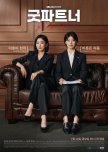
Overall, I enjoyed Good Partner quite a bit, though I found most of the courtroom cases pretty tedious. The show was at its best when focusing on the relationship between Cha Eun-Kyung and Han Yu-Ri, along with Cha Eun-Kyung's divorce storyline, but that arc wrapped up by episode 10. I'm not sure what a second season would even accomplish. Was this review helpful to you?


